You are currently viewing a new version of our website. To view the old version click .
Buildings
  • Article
  • Open Access

3 December 2025

Dynamic Splitting Tensile Behavior of Hybrid Fibers-Reinforced Cementitious Composites: SHPB Tests and Mesoscale Industrial CT Analysis

,
,
,
and
PLA Joint Logistics Support Force University of Engineering, Chongqing 401331, China
*
Author to whom correspondence should be addressed.
This article belongs to the Section Building Materials, and Repair & Renovation

Abstract

Building structures are inherently susceptible to damage from extreme dynamic loads, while conventional concrete exhibits inadequate tensile resistance. While hybrid fibers systems can surpass the limitations of single-fiber reinforcement through their synergistic action, their internal damage mechanisms under impact loading remain inadequately understood. This study investigates the dynamic splitting behavior of hybrid fibers-reinforced cementitious composites combining polyvinyl alcohol (PVA) with either steel (SF) or polyethylene (PE) fibers, using Split Hopkinson Pressure Bar (SHPB) tests at strain rates of 5–31 s−1, along with industrial CT scanning for meso-scale damage analysis. Results indicate that the SF–PVA hybrid improved strength by up to 15.6% compared to mono-PVA, while the PE–PVA hybrid achieved an 11.1% increase. All hybrid systems exhibited improved energy dissipation (which rose 25–45% with strain rate) and displayed secondary stress peaks. Quantitative CT analysis revealed distinct damage patterns: the mono-PVA specimen developed extensive damage networks (porosity: 7.20%; crack ratio: 4.48%), the SF-PVA hybrid system displayed the lowest damage indices (porosity: 3.29%; crack ratio: 1.76%), whereas the PE-PVA hybrid system exhibited the most significant dispersed damage pattern (crack-to-pore ratio: 39.32%). The hybrid systems function via distinct mechanisms: SF–PVA offers multi-scale reinforcement and superior damage suppression, whereas PE–PVA enables sequential energy dissipation, effectively dispersing concentrated damage. These insights support tailored fiber hybridization for impact-resistant structural design.

1. Introduction

Building structures are susceptible to extreme dynamic loads (e.g., explosions and impacts), which generate high-energy stress waves. The reflection of these waves can induce tensile stresses, leading to material cracking, localized damage (e.g., spalling), and compromised structural integrity. Therefore, the dynamic tensile properties of construction materials are critical for ensuring impact resistance. Conventional concrete, despite its widespread use, exhibits low tensile strength, poor deformability, and insufficient energy dissipation, limiting its protective capacity. Consequently, developing new materials with enhanced dynamic performance is of significant research and practical importance.
Incorporating fibers into concrete is an effective strategy to overcome its tensile deficiencies. Through mechanisms such as fiber bridging, pull-out energy dissipation, and multi-stage crack refinement, fibers significantly improve tensile behavior [1,2,3]. Early studies primarily focused on single-type fibers, which are subject to inherent limitations: micro-fibers (e.g., PVA, PP) suppress micro-crack initiation but contribute little to peak strength and macro-crack control, whereas steel fibers enhance macro-crack resistance but are less effective against micro-cracks and often impair workability at high volumes [4,5,6,7]. These drawbacks have motivated the study of hybrid fibers systems.
Building upon these limitations, recent research has further demonstrated that hybrid fiber-reinforced cementitious composites (HFRCC) provide superior crack control and toughness enhancement through multi-scale reinforcement mechanisms. Advances in hybrid fiber design indicate that the coordinated activation of micro- and macro-fibers produces complementary effects that refine early microcracks, delay crack localization, and stabilize post-cracking behavior—benefits that cannot be achieved by single-fiber systems [8]. At the same time, microstructure-guided reinforcement strategies have shown that optimizing fiber–matrix interfaces and tailoring meso-scale crack-bridging processes can significantly enhance tensile performance and improve the damage tolerance of cementitious materials [9]. More recently, hierarchical reinforcement and fiber synergy concepts have emerged as an important development trend, providing new pathways for improving crack resistance, toughness, and long-term durability in engineered cementitious composites [10]. These advances highlight the importance of evaluating hybrid fiber systems from both mechanical and meso-structural perspectives.
The dynamic tensile properties of HFRCC are commonly studied via direct tension tests using universal testing machines (strain rates ~10−5–10−1 s−1) and impact-based methods such as splitting, spalling, or direct tension tests with Split Hopkinson Pressure Bar (SHPB) systems (strain rates ~10−1–103 s−1). These approaches have facilitated extensive research on the dynamic behavior of HFRCC. Under direct tension, Maalej et al. [11] observed that HFRCC with 0.5% SF + 1.5% PE exhibited increased tensile strength with strain rate and a significantly higher Dynamic Increase Factor (DIF) than plain concrete and steel, attributing this to the bridging effect of PE fibers on micro-cracks at high rates. Complementing this, Tran et al. [12] found that hybridizing long and short steel fibers (total 1.5%) synergistically enhanced strain capacity and peak toughness, with hooked-end fibers being most effective. Furthermore, Son et al. [13] demonstrated that a 1.5% SF + 0.5% PVA mix achieved optimal overall dynamic performance, where PVA fibers improved energy dissipation by promoting steel fiber straightening and pull-out. In the context of splitting tests, Shi et al. [14] reported that BF + PP HFRCC showed superior impact resistance and ductile failure. Studies on SF + PP systems by L.Yang et al. [15] and G.Yang et al. [16] indicated that dynamic splitting strength and energy absorption first increased and then decreased with fiber content and aspect ratio, highlighting the importance of optimal dosage. Similarly, Guo et al. [17] noted significant enhancements in coral concrete with SF + CF fibers, while Sheng et al. [18] found a 1% PVA + 1% PE hybrid most effectively increased dynamic splitting strength and controlled crack propagation. In the realm of spalling tests, Millon et al. [19] revealed a strong synergistic effect in SF + PVA HFRCC under dynamic loading (150 s−1), with notable increases in spalling strength and fracture energy. This is consistent with findings by Li et al. [20], where HFRCC exhibited slow crack growth, high energy absorption, and a 10 MPa higher spalling strength than ordinary concrete. Finally, Jiao et al. [21] confirmed that hybrid fibers in C80-grade HFRCC significantly improved spalling strength—with steel fibers outperforming PP—and resulted in progressively more ductile failure patterns with increasing strain rate.
Under external loads, material failure is essentially a process where internal damage initiates at the micron scale, progressively accumulates, and ultimately leads to macroscopic failure. The reinforcement mechanism of hybrid fibers in cement-based materials operates through mechanisms such as fiber bridging and pull-out, which synergistically act throughout this entire damage evolution process. Therefore, delving into the meso-scale to directly observe and quantify the internal damage state of materials after impact, and establishing the intrinsic relationship between meso-scale damage patterns and macro-scale mechanical properties, is crucial for understanding the synergistic enhancement mechanism of hybrid fibers. At the meso-scale, numerical models have also been developed to simulate cracking processes in heterogeneous concrete. For example, Zhu et al. [22] employed a discrete-element-based meso-scale model incorporating aggregates, mortar, interfacial transition zones (ITZ) and pores to simulate tensile cracking in concrete, and demonstrated that variations in aggregate and pore contents significantly and non-monotonically affect tensile strength and crack evolution.
In addition to such meso-scale numerical models, Industrial Computed Tomography (Industrial CT), as an advanced non-destructive testing technique, enables high-resolution observation and three-dimensional visualization of internal structures. It provides a reliable technical approach for quantitatively analyzing the geometric morphology, spatial distribution, and statistical characteristics of internal damage such as cracks and pores in cement-based materials after impact. Existing studies have utilized Industrial CT for the inspection and analysis of concrete. For example, Du et al. [23] established a meso-scale model of concrete considering defects based on Industrial CT technology, quantitatively analyzing stress distribution during the tensile process of porous concrete. You et al. [24] proposed a parametric modeling method for constructing concrete meso-models from CT images, resolving the conflict between “reconstruction accuracy” and “computational efficiency” in concrete meso-modeling. Du et al. [25] applied Industrial CT technology to study the meso-structural damage of C60 high-performance concrete after exposure to high temperatures, elucidating the mechanism by which polypropylene fibers improve concrete spalling resistance under high temperatures. Rong et al. [26] used Industrial CT to scan ultra-high performance cement-based composites after multiple impacts, revealing the propagation patterns of internal cracks. Recent CT-based dynamic damage studies have further demonstrated that CT reconstruction can quantitatively capture crack propagation paths, pore connectivity evolution, and internal defect growth under high-rate loading, providing a reliable link between dynamic stress input and meso-scale damage development [27].
In summary, existing research on the dynamic tensile performance of HFRCC has primarily focused on combinations of inorganic metallic fibers (steel fibers) with organic synthetic polymer fibers (such as PVA and PE) or other inorganic fibers, with limited studies addressing hybrid systems involving different polymer fibers. Moreover, analyses of experimental results have largely relied on macroscopic mechanical data and phenomenological observations, while investigations into meso-scale internal damage features such as pores and cracks remain scarce. Recent multi-scale characterization studies also indicate that hybrid fiber performance is strongly governed by the interaction between damage processes occurring at different length scales, and that integrating meso-scale damage metrics can significantly improve the interpretation of hybrid fiber synergy, especially when considering interactions between macro- and meso-scale damage processes [28]. Recent macro–meso studies have shown that materials subjected to high strain-rate loading can undergo transient microstructural transitions—such as accelerated crack coalescence, localized pore expansion, and strain-rate–activated interfacial degradation—that are not observable under quasi-static conditions [29]. These rate-dependent meso-scale transformations indicate that dynamic tensile behavior cannot be interpreted solely from macroscopic responses, but must be linked to the evolution of internal microstructural damage.
Consequently, the internal mechanisms governing hybrid fibers reinforcement are not yet fully understood. This aligns with recent advances in cementitious composite design, where multi-scale reinforcement concepts and fiber synergy strategies have been identified as key directions for improving crack resistance and durability in next-generation engineered materials [10]. While the combined application of SHPB and industrial CT techniques offers a powerful approach for post-impact material characterization, studies employing this integrated methodology to investigate hybrid fibers-reinforced cementitious composites remain scarce. Systematic analyses correlating hybrid fibers systems with the evolution of internal meso-damage are still lacking.
To address these research gaps, specifically: (1) the limited understanding of hybrid systems involving different polymer fibers (e.g., PVA and PE), and (2) the scarcity of quantitative, meso-scale analyses linking internal damage evolution (pores and cracks) to the macroscopic dynamic tensile properties, this study is designed to systematically investigate the dynamic splitting behavior of two novel hybrid fibers systems: SF-PVA and PE-PVA. A split Hopkinson pressure bar (SHPB) was used to conduct tests at multiple strain rates, and post-impact industrial CT scanning was systematically employed on these systems to quantitatively characterize the internal meso-damage. This integrated approach allows us to directly link the macro-mechanical response to the meso-scale damage mechanisms, thereby providing crucial insights into the synergistic reinforcement mechanisms of hybrid Fibers under dynamic tensile loading.

2. The Experimental Design

2.1. Materials, Mix Proportions, and Specimen Preparation

The matrix composition, detailed in Table 1, was designed based on a typical Engineered Cementitious Composites (ECC) mix proposed by Yang et al. [30]. The raw materials included P.O 42.5 ordinary Portland cement (Blaine fineness: 350 m2/kg), Grade I fly ash (90% of particles < 45 μm), and extra-fine river sand (fineness modulus: 1.8, maximum size: 1.3 mm), ensuring a dense and homogeneous matrix conducive to effective fiber dispersion [31].
Table 1. The matrix material mix ratio (kg/m3).
Polyvinyl alcohol (PVA), steel (SF), and polyethylene (PE) fibers were employed, and their physical properties are summarized in Table 2. The two hybrid fibers ratios (0.5% + 1.5% and 1.5% + 0.5% by volume) were selected in accordance with an established fiber blending strategy. This approach maintains a constant total fiber volume fraction of 2.0% while interchanging the proportions of the two fiber types, thereby allowing the investigation of synergy and potential role reversal between a primary and a secondary fiber; this combinatorial design has been widely used in previous HFRCC studies, including dynamic tests under different strain rates [13,32,33]. In this study, all reinforced mixtures therefore contained 2.0% total fibers by volume, with the specific hybrid combinations listed in Table 3.
Table 2. Physical parameters of various fibers.
Table 3. Fiber dosage in mixture proportions (kg/m3).
To minimize fiber balling, a standardized mixing procedure was strictly adopted [34]. Cement, fly ash, and sand were first dry-mixed for 1–2 min. Subsequently, water and superplasticizer were added and wet mixing continued for 3–4 min to obtain a homogeneous, highly flowable matrix. PVA fibers were subsequently introduced and mixed for 5–6 min, taking advantage of the initial fluidity for uniform dispersion. Finally, SF or PE fibers were gradually added and mixed for another 5–6 min. By this stage, the increased matrix viscosity effectively inhibited balling of the later-added fibers.

2.2. SHPB Splitting Tensile Test

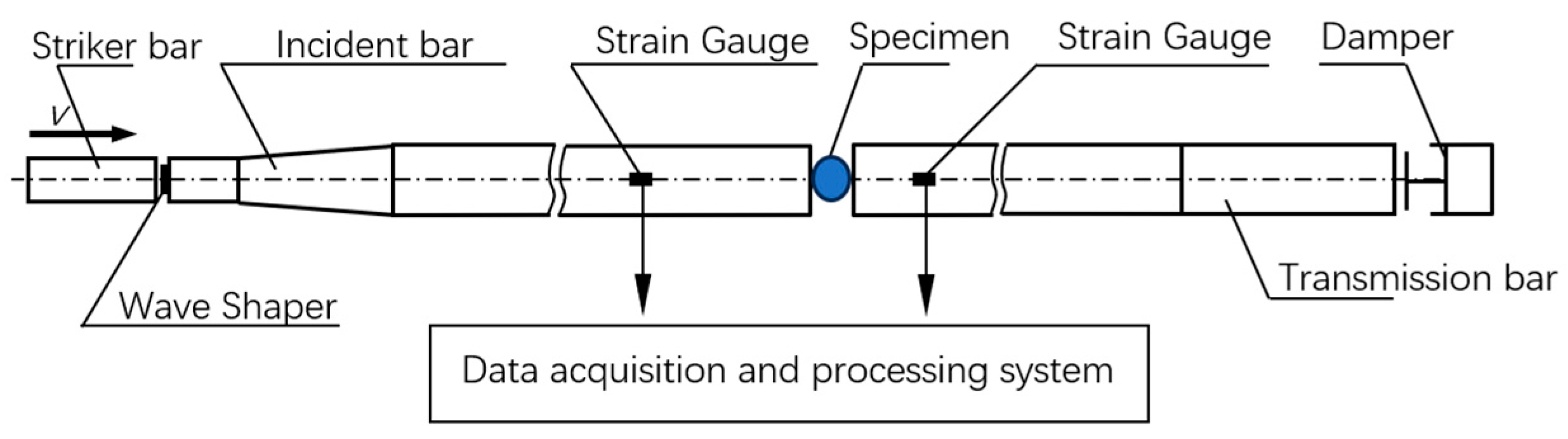
The dynamic splitting tests were performed on a 50 mm diameter direct conical variable-cross-section SHPB apparatus developed at the Impact Dynamics Laboratory, School of Civil and Hydraulic Engineering, Hefei University of Technology, Hefei, China. To ensure a constant strain rate and dynamic stress equilibrium during loading, a wave shaper was employed. A circular rubber sheet with a diameter of 15 mm and a thickness of 2 mm was used as the wave shaper and was affixed to the center of the impact surface of the incident bar. Cylindrical specimens with dimensions of 50 mm in diameter and 25 mm in height (i.e., a thickness-to-diameter ratio of 0.5) were fabricated using PVC pipe molds.
The thickness-to-diameter ratio of the Brazilian disc specimens was thus fixed at 0.5 (i.e., a 2:1 diameter-to-thickness ratio). This specific geometry was selected for the dynamic Brazilian disc test based on established methodologies [35]. A thickness-to-diameter ratio of 0.5 is widely recognized to facilitate dynamic stress equilibrium along the loaded diameter prior to failure and, more importantly, effectively suppresses the lateral inertial confinement effect that can otherwise lead to an overestimation of the tensile strength. Furthermore, the use of the aforementioned wave shaper generates a gradually rising incident pulse, which promotes one-dimensional stress equilibrium and approximate stress uniformity within the disc prior to cracking. Therefore, the adopted specimen dimensions are considered adequate to mitigate inertial effects and to satisfy the fundamental assumptions of the dynamic Brazilian disc test analysis.
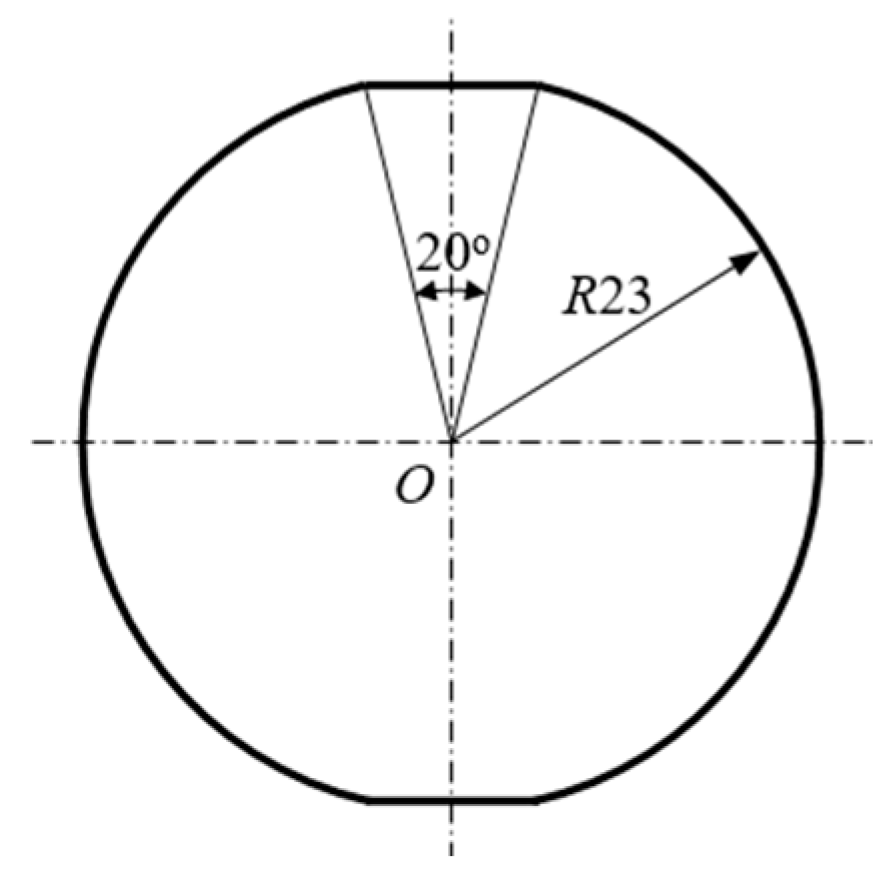
A total of 18 specimens were prepared for each mix proportion. Of these, 3 specimens were tested under static splitting loads using a universal testing machine for reference, 12 specimens were subjected to dynamic splitting tests at four different strain rates, and 3 were reserved as backups. The test conditions are summarized in Table 4. After standard curing, the specimen ends were machined using a surface grinder to create parallel loading platforms, following the specifications illustrated in Figure 1.
Table 4. Loading conditions and strain—rate ranges in SHPB splitting tests.
Figure 1. Schematic diagram of splitting specimen.
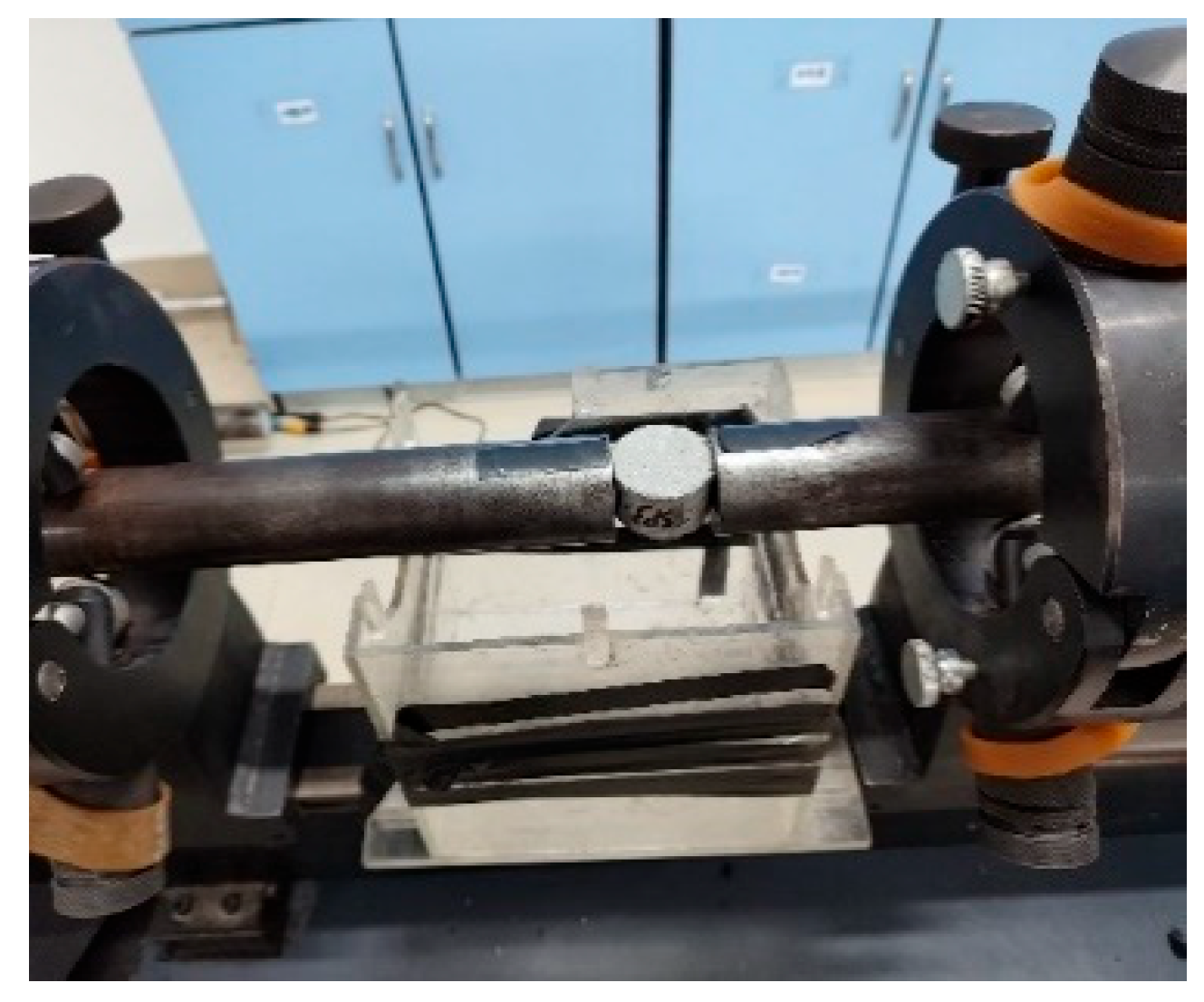
During testing, data were acquired using a DH5960 multi-channel ultra-dynamic signal parallel synchronous testing system (DHTEST, Jingjiang, China). Strain gauges were attached at two cross-sections on both the incident and transmission bars. At each cross-section, two axial strain gauges were mounted 180° apart to compensate for any bending effects in the pressure bars. The schematic diagram of the test setup is shown in Figure 2. The actual test setup and on-site conditions are shown in Figure 3.
Figure 2. Schematic of the SHPB splitting test setup.
Figure 3. The SHPB splitting test setup.
For a Brazilian disc under diametral compression, the stress state at any point within the disc, based on the elastic analytical solution for a plane-stress problem, is given by the following equations [36]:
σ x = 2 F π L s i n 2 θ 1 c o s θ 1 r 1 + s i n 2 θ 2 c o s θ 2 r 2 2 F π D L
σ y = 2 F π L c o s 3 θ 1 r 1 + c o s 3 θ 2 r 2 2 F π D L
τ x y = 2 F π L c o s 2 θ 1 s i n θ 1 r 1 + c o s 2 θ 2 s i n θ 2 r 2
At the center of the disc, where r 1 = r 2 = 0.5 D and θ 1 = θ 2 = 0 , the equations simplify to:
σ x = 2 F π D L
σ y = 6 F π D L
τ x y = 0
Numerically, the tensile stress at the center is one-third of the compressive stress. Considering that the tensile strength of concrete-like materials is approximately one-tenth of their compressive strength, the specimen fails in tension, with its tensile strength taken as σ t = σ x .
Based on this principle, the dynamic splitting tensile strength in the Brazilian disc test using the SHPB apparatus is calculated using the following formula:
f td = k 2 F π h d = k 2 σ t , max A 0 π h d
where h is the specimen height, d is the specimen diameter, σ t , max is the maximum stress of the transmitted wave, A 0 is the cross-sectional area of the pressure bar, and k is the loading platform correction factor. For the loading angle used in this test, k is taken as 0.95, based on the average value reported in most literature [37].
In this test, the tangent slope of the nominal strain–time curve was determined from the average strain rate. The nominal strain is given by the following equation:
ε t = k 2 σ t , max A 0 π h d E 0

2.3. Industrial CT Scanning

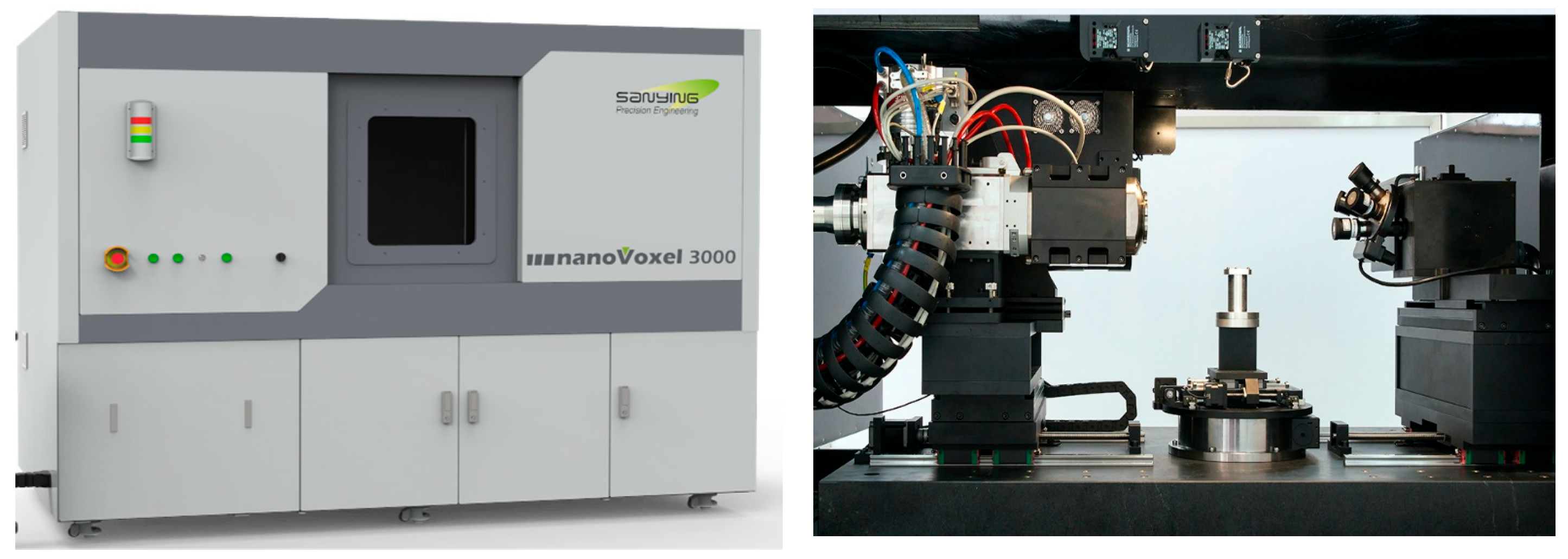
This study was performed using a NanoVoxel-3000 industrial X-ray computed tomography (CT) system (Sanying Precision Instruments, Tianjin, China), as shown in Figure 4. In this system, a high-energy X-ray beam generated by the source penetrates the specimen and is recorded by a detector array on the opposite side. The internal structure is visualized through differences in X-ray attenuation: high-density materials (e.g., steel fibers and the matrix), which attenuate X-rays more strongly, appear brighter, whereas low-density regions (e.g., pores and cracks), which are more transparent to X-rays, appear darker. During scanning, the tube voltage and current were set to 200 kV and 180 μA, respectively. The specimen was rotated between the X-ray source and the detector in small angular steps, and thousands of projection images were acquired. These projections were then reconstructed into cross-sectional slices with an isotropic voxel size of 9.5 μm.
Figure 4. NanoVoxel-3000 industrial CT system.
The reconstructed CT slices were imported into the Avizo software (version 2023.1) for 3D visualization, processing and quantitative analysis. Pores and cracks were collectively defined as a low-density “void phase” and segmented using a global grayscale threshold, which was predetermined based on the specimen’s grayscale histogram and verified by visual inspection of representative slices to ensure accurate delineation of the solid matrix and defects. The resulting binary volumes were used to extract statistical data, including total porosity, crack ratio, and pore size distribution. A standard noise-suppression routine of the scanning system was applied prior to data delivery to remove isolated artifacts. Given the reconstructed voxel size of 9.5 μm and the influence of partial-volume effects, features smaller than approximately 30 μm (corresponding to about three voxels) could not be reliably resolved. Therefore, the effective resolution for pore and crack characterization in this study was taken as approximately 30 μm.

3. Results and Analysis

For each mix proportion, quasi-static splitting tests were first conducted using a universal testing machine. Dynamic splitting tests were subsequently performed at four impact velocities using the SHPB apparatus, with each test condition repeated three times to ensure statistical reliability. All test data and observed phenomena were systematically recorded. Following the impact tests, selected P, SP2, and EP2 specimens from the TS2 impact condition were scanned using industrial CT to non-destructively characterize the internal meso-scale damage morphology.

3.1. Results and Analysis of the SHPB Splitting Tensile Test

3.1.1. Dynamic Splitting Tensile Strength and Strain Rate Effects

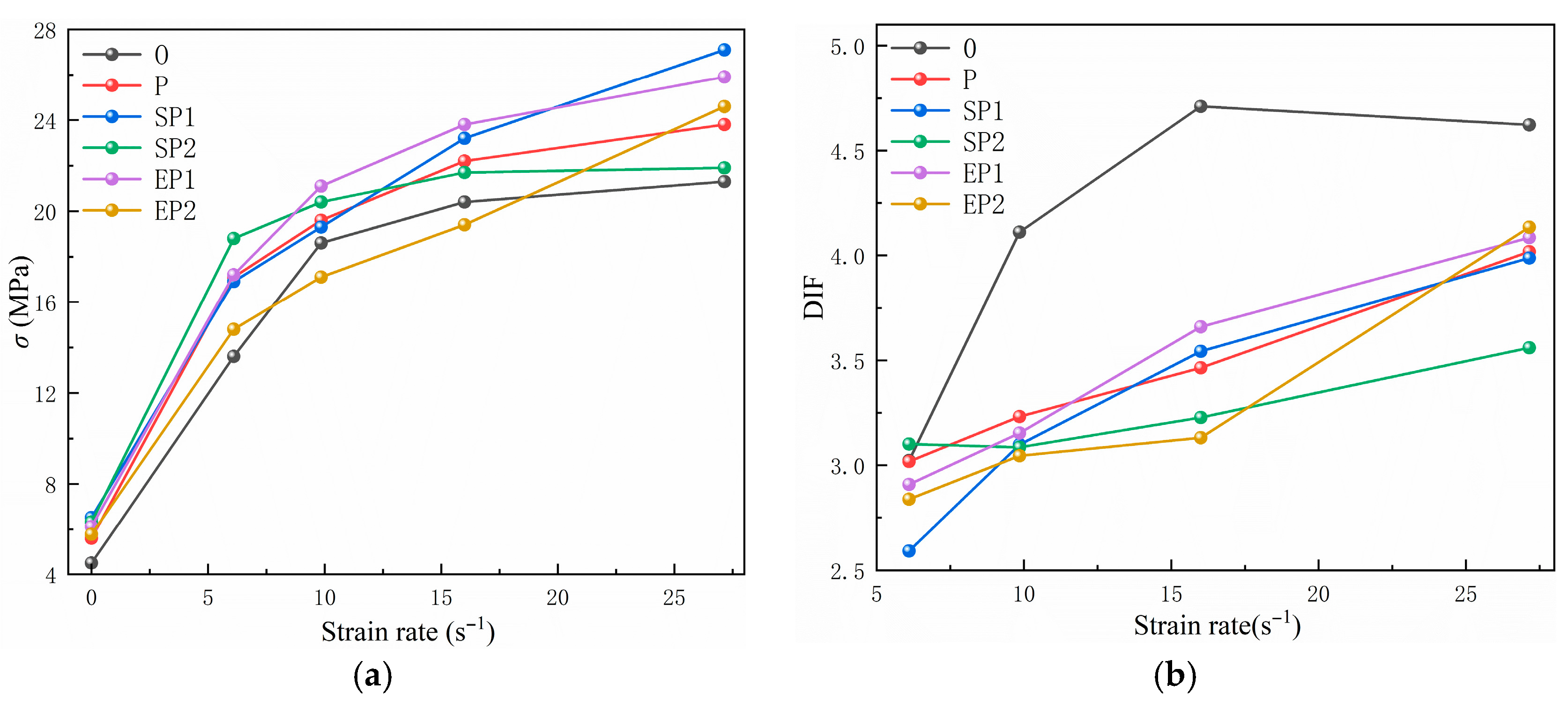
The SHPB splitting test results (Table 5 and Figure 5) demonstrate that as the strain rate increases from TS1 to TS4, both the dynamic splitting strength and DIF of all mixes exhibit a consistent increasing trend, demonstrating a significant strain-rate strengthening effect.
Table 5. Dynamic splitting strength and corresponding DIF.
Figure 5. Effects of strain rate on dynamic splitting tensile strength and its DIF. (a) Dynamic stress–strain rate curves; (b) DIF–strain rate curves.
In terms of static strength, the performance ranking was SP1 > SP2 > EP1 > EP2 > P > O, and all hybrid fibers specimens demonstrated higher strength than the mono-fiber specimen (P). Compared to the splitting strength of mix P, at the high strain rate TS4, mixes SP1, EP1, and EP2 showed improvements of 15.6%, 11.1%, and 6.2%, respectively, while SP2 performed similarly to P. At the low strain rate TS1, SP2 improved by 16% and EP1 by 5.3%, whereas SP1 was comparable to P, and EP2 was slightly lower than P. Overall, hybrid fibers specimens consistently outperformed the mono-PVA specimen (P), indicating that hybrid fibers provide superior splitting strength enhancement compared to mono-PVA fibers, with the effect being more pronounced at higher strain rate.
Regarding Dynamic Increase Factor DIF, the DIF versus strain rate curves of all fiber-reinforced specimens lay below that of the plain matrix specimen (O). Furthermore, the curves of both SP and EP hybrid mixes were positioned below that of the mono-PVA mix (P) at strain rates TS1 to TS3. This indicates that incorporating hybrid fibers reduces the DIF increase, thereby reducing the material’s sensitivity to strain rate.

3.1.2. Stress-Time History Curves

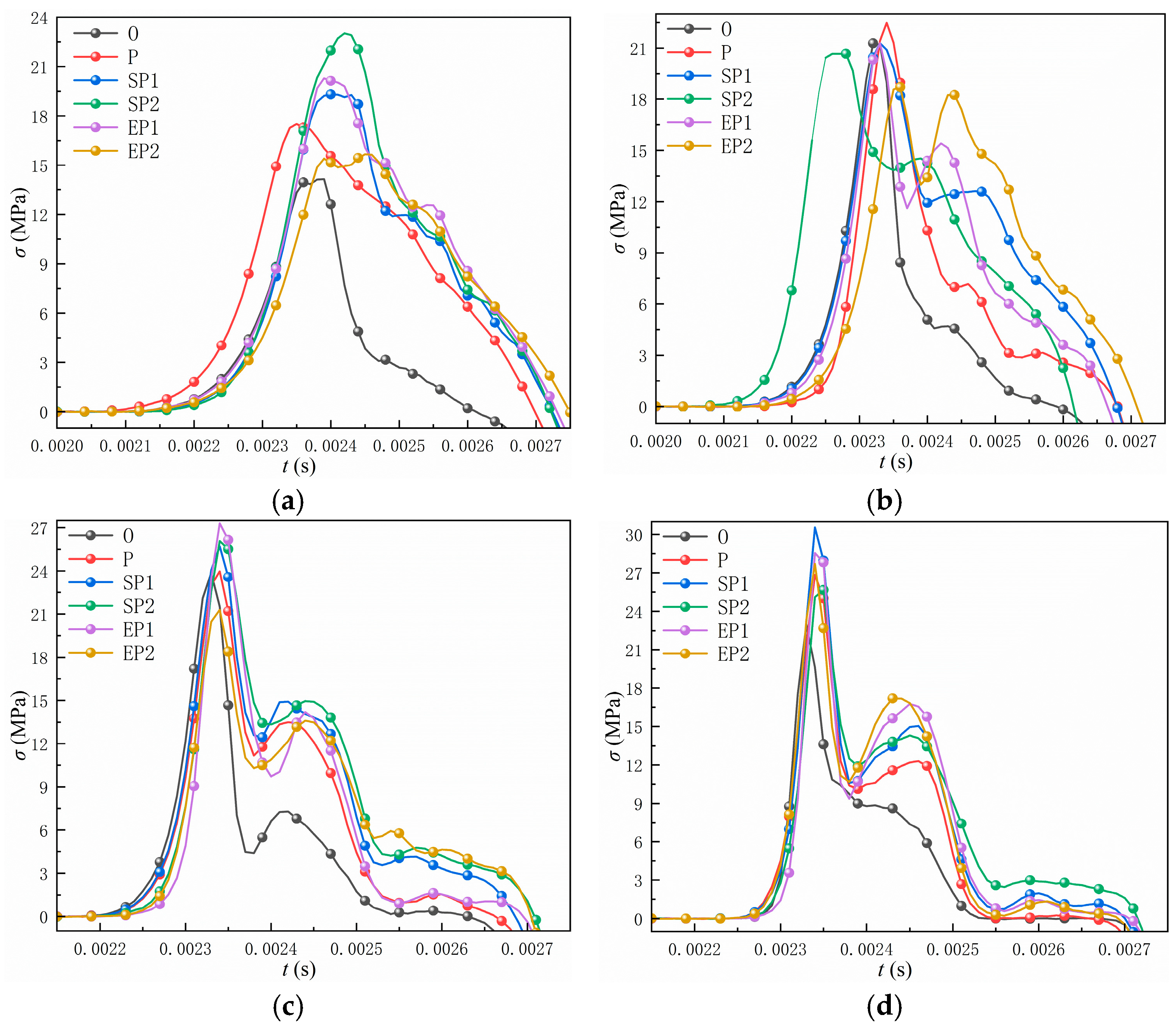
Figure 6 presents the stress-time history curves of each specimen at strain rates TS1 to TS4. These curves can be divided into two distinct stages based on the peak stress: the ascending branch and the descending branch.
Figure 6. Stress–time history curves under different strain rates. (a) TS1; (b) TS2; (c) TS3; (d) TS4.
In the ascending branch, the curves for different mix ratios are highly consistent and show minimal variation at comparable strain rates. This consistency becomes increasingly evident with increasing strain rate, with curves exhibiting substantial overlap at TS3 and TS4. This behavior occurs because the pre-peak ascending stage is extremely short, during which crack initiation and development are delayed, damage remains minimal, and fibers cannot activate effectively. Since the matrix material constitutes approximately 98% of the specimen volume, it dominates the mechanical response during this stage. Consequently, differences in the ascending branches are minimal, and the curves often overlap completely.
In contrast, pronounced differences are observed in the descending branches among the specimens. At similar strain rates, the stress-time curves of hybrid fibers specimens display a fuller profile compared to those of mono-PVA specimens, reflecting a more gradual stress decay and slower softening rate. This demonstrates the activation of fibers during the softening stage, wherein hybrid fibers effectively retard the softening process and prolong the failure duration.
Furthermore, during the stress softening stage, the curves exhibit a brief period of secondary stress growth, manifesting as a distinct second stress peak. The magnitude of this secondary peak is consistently greater in hybrid fibers specimens than in mono-PVA specimens. This phenomenon is linked to the sequential activation of fiber-bridging mechanisms following the formation of the main matrix crack. The initial stress peak corresponds to the maximum load-bearing capacity of the intact fiber-matrix composite. After matrix cracking, a complex interplay ensues: fibers with stronger interfacial bonds (e.g., PVA) may rupture, leading to a rapid stress drop, while fibers with weaker bonds (e.g., PE) undergo progressive pull-out. The secondary peak marks the point at which the pull-out resistance of these extensively debonded fibers is fully mobilized, or where load is dynamically redistributed to bridging fibers that were initially unaligned or located in less-stressed regions. The “twin-peak” phenomenon is more pronounced in PE-based hybrids than in steel-based hybrids because the low interfacial bond strength of PE fibers promotes progressive, extensive pull-out instead of brittle rupture, resulting in a more sustained and pronounced secondary load-bearing stage. This characteristic becomes more accentuated with increasing strain rates, as the enhanced interfacial friction for all fibers and the potential for fiber fracture further intensify this dynamic load redistribution process.

3.1.3. Failure Modes and Energy Dissipation

In SHPB dynamic splitting tests, the failure morphology of the specimens is closely related to energy transfer and conversion. According to the law of energy conservation, the energy dissipated during testing can be calculated from the incident, reflected, and transmitted energies measured in the pressure bars. The corresponding calculation formulas are given in Equations (9)–(12) [38].
W i t = C 0 E A 0 0 t ε i 2 t d t
W r t = C 0 E A 0 0 t ε r 2 t d t
W t t = C 0 E A 0 0 t ε t 2 t d t
W s t = W i t W r t W t t
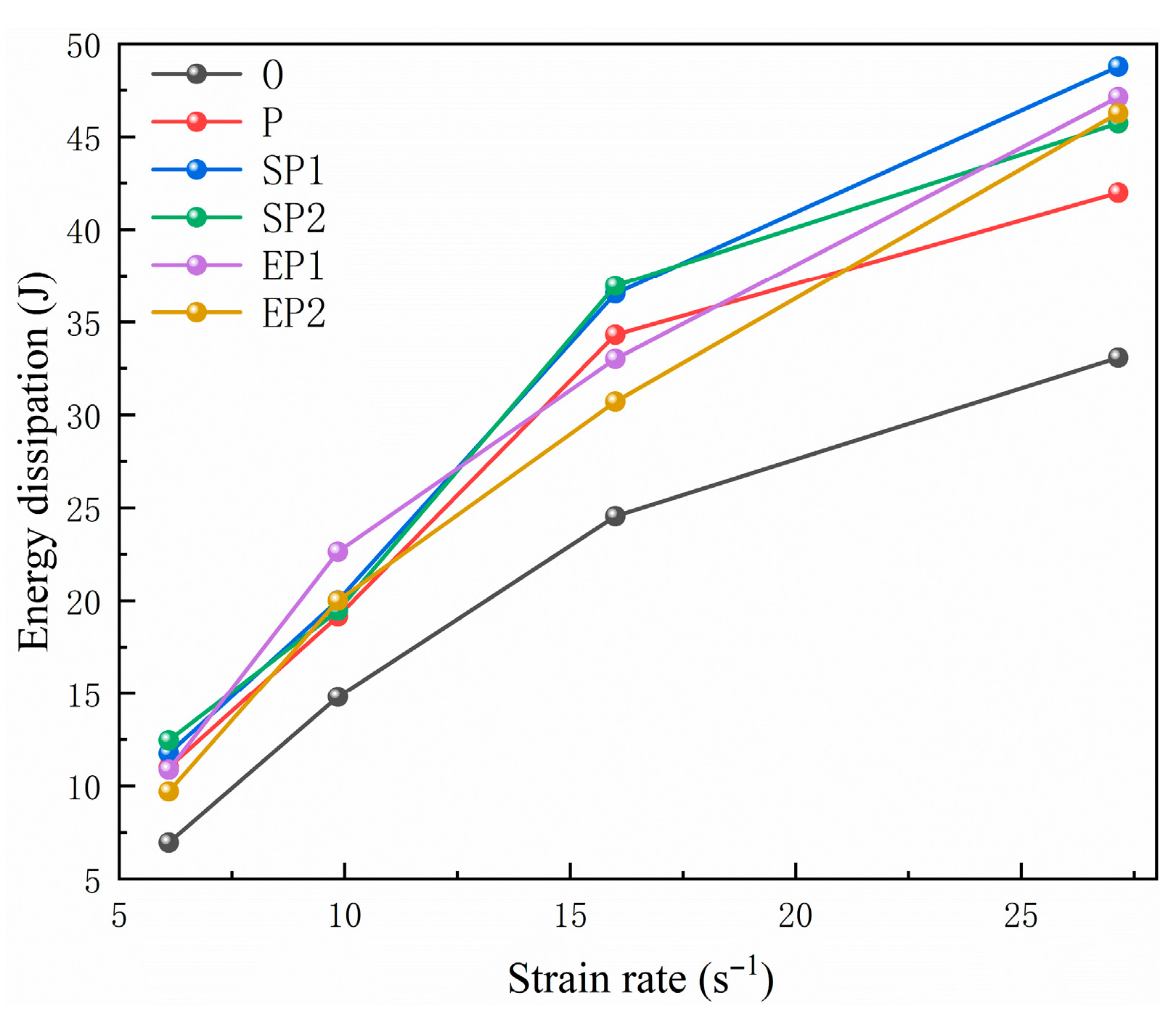
The calculated energy dissipation for each specimen is presented in Figure 7. As shown, the energy dissipation of all specimens increases with the strain rate, demonstrating a significant strain-rate effect. Compared to the plain matrix, fiber incorporation significantly improves the energy dissipation capacity. At the lower strain rates (TS1 and TS2), the energy dissipation of fiber-reinforced specimens exhibits minimal variation. However, based on the relative positions of the curves, most hybrid fibers specimens still achieve higher energy dissipation than the mono-fiber specimen. At the TS3 strain rate, the differences are more pronounced: SF + PVA hybrid specimens dissipate more energy than the mono-PVA specimen, while PE + PVA hybrids dissipate less. Notably, at the TS4 strain rate, all hybrid fibers specimens exhibit superior energy dissipation than the mono-PVA specimen. These phenomena demonstrate that hybrid fibers generally enhance the energy dissipation capacity, with this enhancement being particularly effective at higher strain rates.
Figure 7. Energy dissipation relationship diagram of specimens under different strain rates.
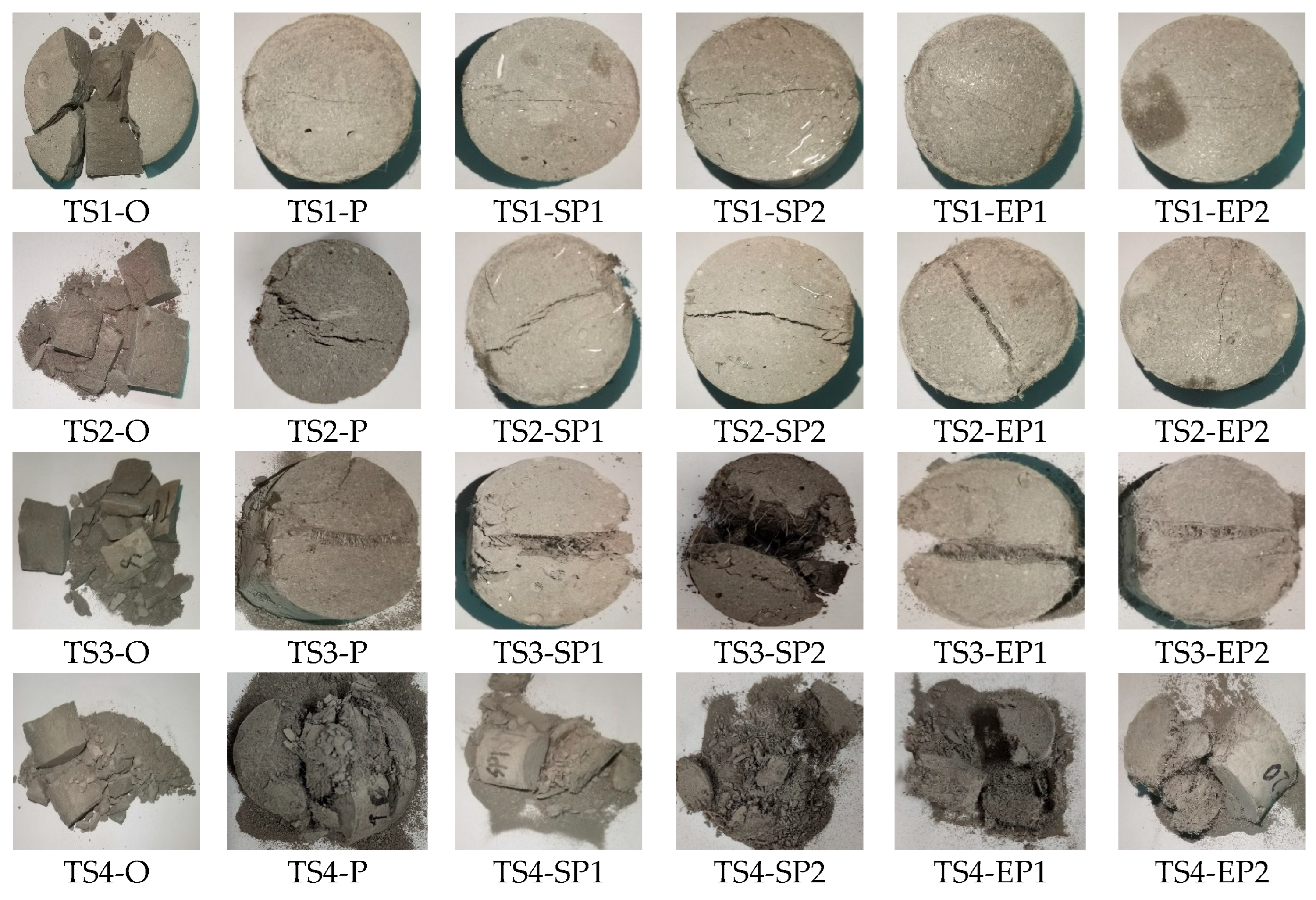
Figure 8 illustrates the characteristic splitting failure modes of the different specimens. The typical failure progression under dynamic splitting begins with crack formation at central flaws, followed by coalescence along the loading direction, ultimately resulting in a through-center macro-crack that divides the specimen. Higher impact loads intensify fragmentation, transitioning from clean splitting to complete disintegration. Notably, plain matrix specimens exhibited the most severe splitting failure at all strain rates. For fiber-reinforced specimens at TS1, incomplete crack penetration was observed, with hybrid fibers specimens (SP1, EP1, EP2) demonstrating enhanced ductility through parallel multi-cracking—particularly pronounced in EP mixes. At TS2, complete crack penetration occurred while fibers maintained overall specimen integrity; crack widths varied significantly (EP1 > SP2 > SP1 > P > EP2), with minor crushing at the loading interfaces. Under TS3 loading, SP2 specimens fractured completely with visible steel fiber pull-out, whereas polymer fiber hybrids (SP1, EP1, EP2) and the mono-fiber P specimen retained structural continuity, highlighting the superior crack-bridging capacity of polymer fibers at high strain rates. At the ultimate TS4 level, fragmentation severity followed the order SP2 > SP1 > P > EP1 > EP2, clearly demonstrating the effectiveness of PE fibers in mitigating damage under extreme loading conditions, whereas steel fiber hybrids exhibited compromised impact resistance.
Figure 8. Failure modes of each specimen at different strain rates.

3.2. Results and Analysis of the Industrial CT Scanning

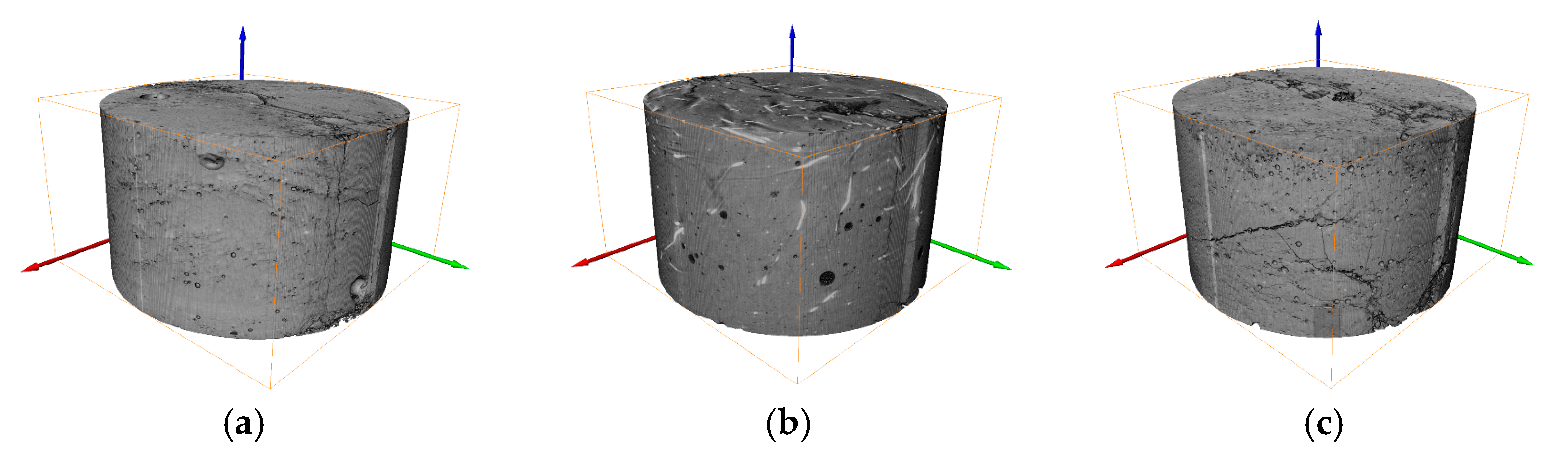
Based on the CT scans, three-dimensional models of specimens P, SP2, and EP2 under the TS2 strain rate condition were reconstructed, as presented in Figure 9.
Figure 9. Three-dimensional model of the impact-split specimen. (a) P; (b) SP2; (c) EP2.

3.2.1. Internal Crack Characterization

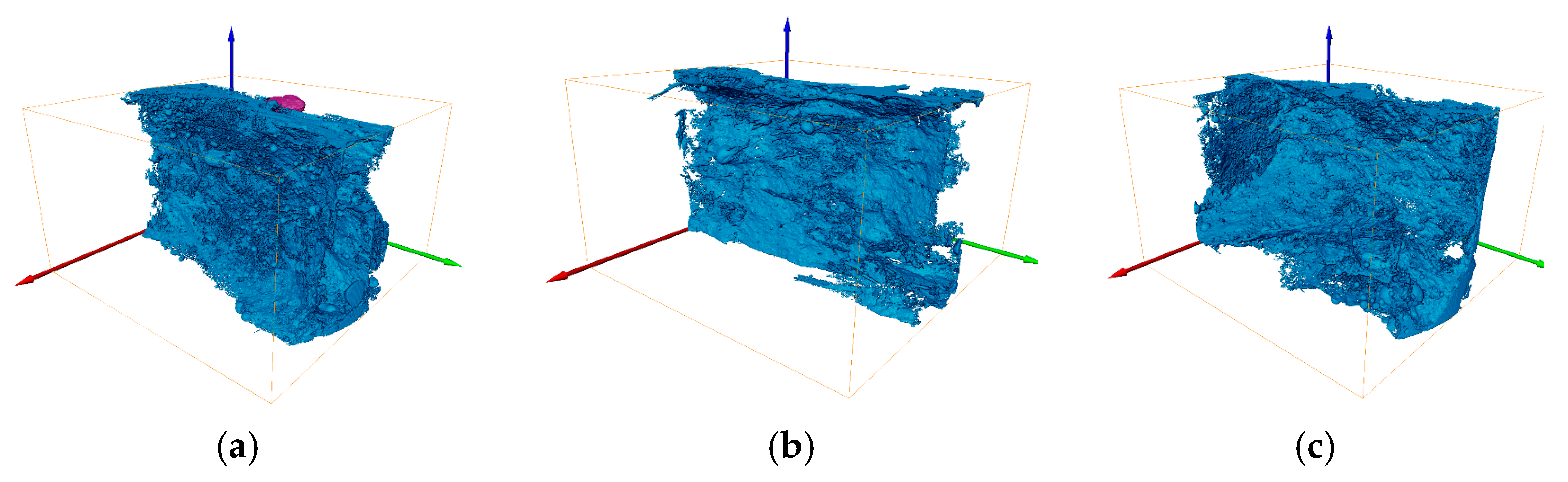
Figure 10 presents the 3D renderings of internal cracks within the specimens. The main crack zones are primarily concentrated in the central radial tensile-splitting region after impact. These zones are characterized by penetrating main cracks with secondary branches, displaying morphological and distribution features characteristic of impact-induced splitting fractures.
Figure 10. Three-dimensional rendering of cracks in the impact-split specimen. (a) P; (b) SP2; (c) EP2.
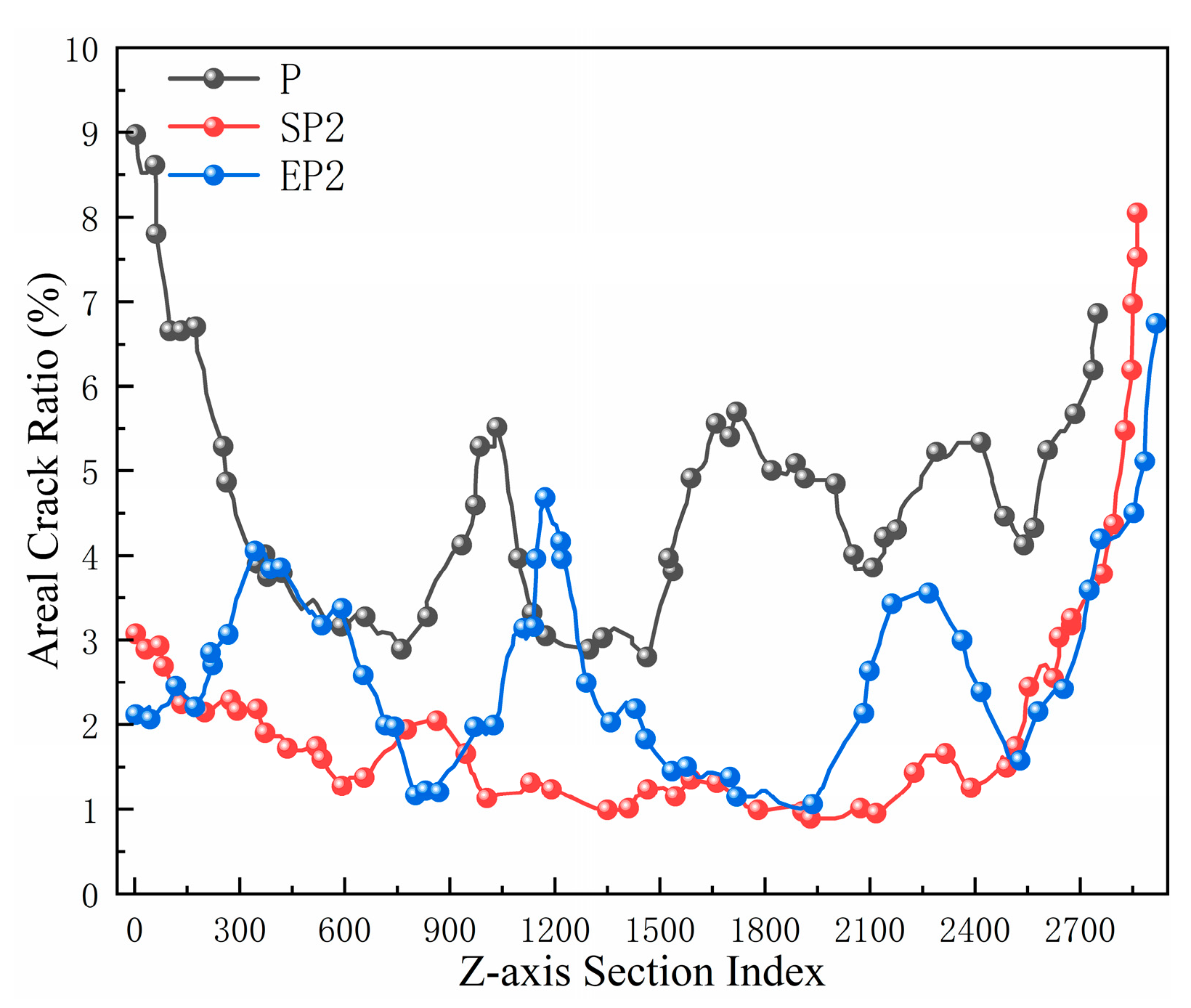
Figure 11 shows the through-thickness variation in areal crack ratio for the three specimens after impact splitting. The damage distribution differs considerably among them. Specimen P exhibits the most pronounced fluctuation, with the highest damage (7–9%) near the surfaces and the lowest (∼3%) in the center. This pattern reflects stress concentration and localized crushing at the loading points, indicating strong impact-induced damage penetration. In Specimen SP2, although a peak (∼8%) occurs at one end, the mid-section maintains consistently low damage levels (1–2%). Moreover, the fluctuation in crack ratio across the thickness is significantly suppressed compared to Specimens P and EP2. These features suggest that while cracks initiate at both ends, they are effectively arrested by steel fibers before extensive propagation, thereby preserving central integrity and yielding a more uniform damage profile. Specimen EP2 displays a distinct asymmetric pattern, with a prominent peak (6–7%) in the upper-middle region and reduced cracking at the opposite end. This unilateral penetration mode, involving oblique crack propagation from one side, contrasts clearly with the symmetric cracking in Specimen P and the uniformly suppressed damage in Specimen SP2. In summary, the three specimens show fundamentally different damage modes: conventional symmetric cracking in P, uniformly distributed fiber-arrested cracking in SP2, and unilateral oblique penetration in EP2. The hybrid steel fibers are particularly effective in mitigating crack penetration and promoting a more homogeneous damage distribution with minimal internal fluctuation.
Figure 11. The through-thickness variation in areal crack ratio.
Table 6 summarizes the quantitative characteristics of the internal cracks. Specimen P developed two concentrated crack zones, while only one was observed in each of the EP2 and SP2 specimens. The overall crack ratio also differed significantly among the specimens: specimen P exhibited the highest value of 4.48%, considerably greater than those of SP2 (1.76%) and EP2 (2.55%). In terms of crack size, specimen P also contained the largest flaw, with the main crack zone having an equivalent diameter of 14.8 mm, compared to 11.2 mm in SP2 and 12.7 mm in EP2. The average crack width in P was also slightly larger than in the hybrid fibers specimens. Spatially, the two main crack zones in specimen P formed angles greater than 80° with the Z-axis, whereas those in the hybrid specimens SP2 and EP2 were both below 80°. These results demonstrate that hybrid fibers are more effective than mono-fiber in restraining crack development, with steel hybrids providing superior crack inhibition compared to PE hybrids. Furthermore, hybrid fibers induced noticeable crack path deflection.
Table 6. Statistical table of quantitative crack analysis data.

3.2.2. Internal Pore Characterization

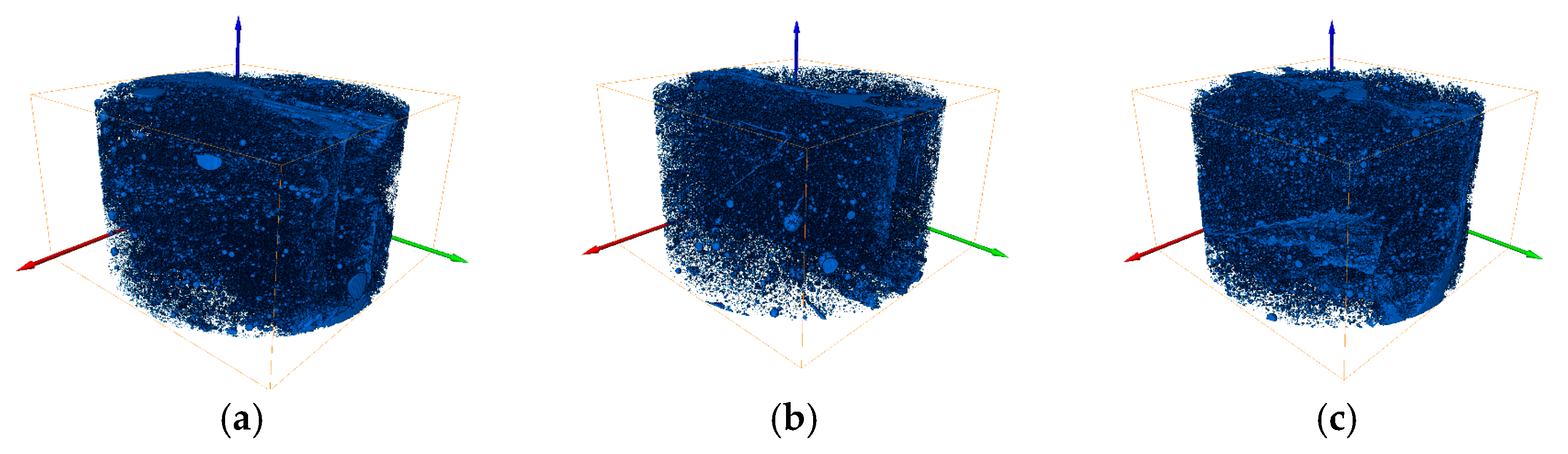
Figure 12 presents the 3D renderings of internal Pores within the specimens.
Figure 12. Three-dimensional rendering of pores in the impact-split specimen. (a) P; (b) SP2; (c) EP2.
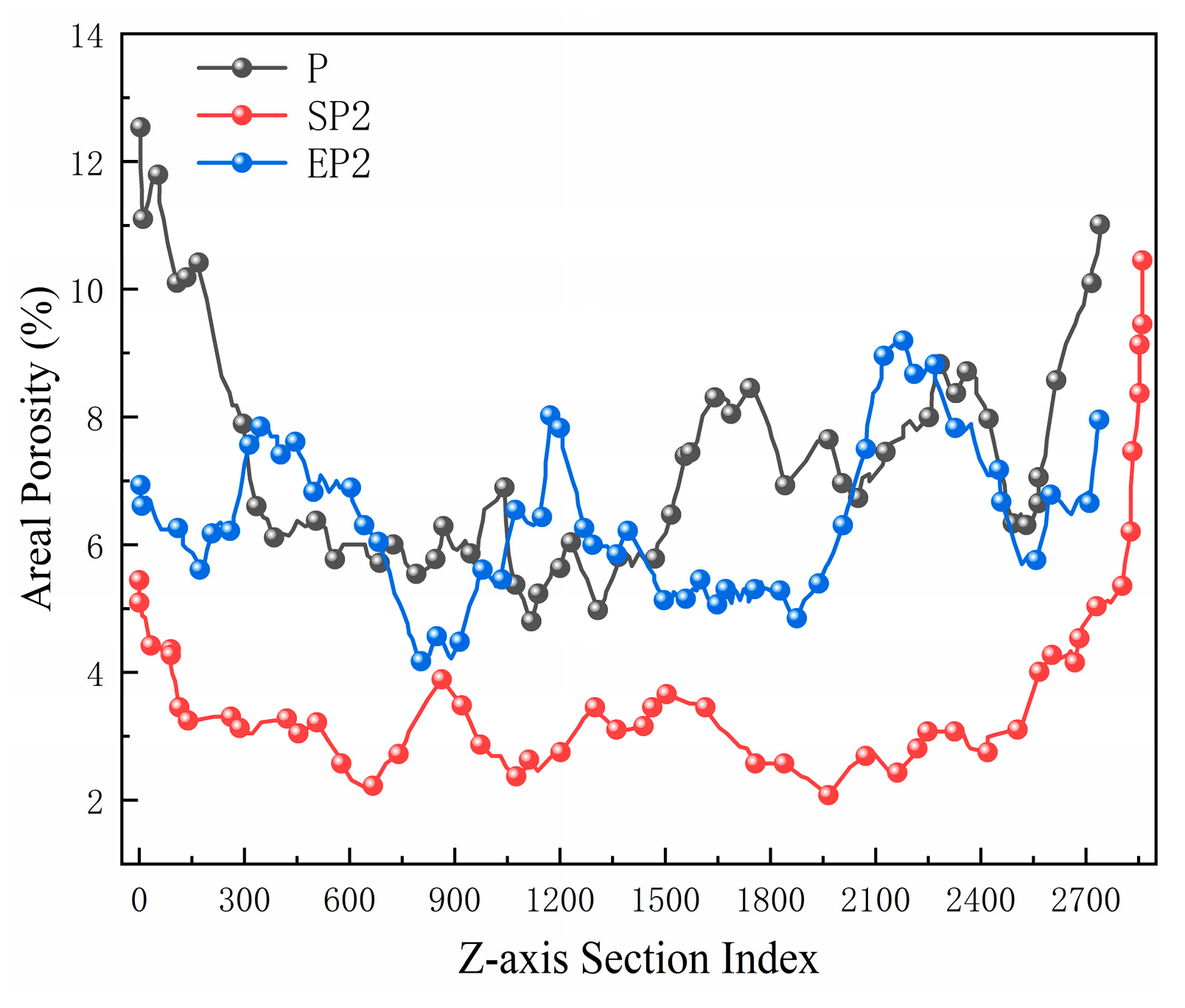
Figure 13 shows the through-thickness variation in areal porosity in the three specimens after impact splitting, revealing non-uniform distributions in all cases. While the central sections generally exhibit lower porosity, areas near the surfaces show significantly higher values. Specifically, specimen P displays a bimodal distribution with peaks of approximately 12% at both top and bottom surfaces and a trough of around 5% in the central, indicating that pore damage decreases from the surfaces toward the core. Specimen EP2 also shows higher areal porosity near the surface (peak ~9%) with the minimum (~4%) in the middle. However, unlike specimen P, its distribution curve shows multiple fluctuations along the height, including secondary peaks at certain mid-level sections. This pattern suggests that PE fibers promote a more dispersed pore distribution, forming multiple localized damage zones within the specimen, which leads to frequent fluctuations in porosity but with relatively limited peak values. Specimen SP2 demonstrates a different pattern, characterized by a high peak at one end (~10%) but generally low values overall, with the opposite end showing much lower porosity (~2%) and most central sections maintaining 3–5% porosity. This distribution indicates that steel fibers effectively restrict damage penetration through the full specimen height, confining severe damage mainly to the initiation end while preserving the integrity of the opposite end. In contrast, both specimen P and EP2, which lack sufficient rigid fiber bridging, develop through-thickness damage with concentrated failure at both surfaces, resulting in symmetrically elevated porosity at both ends.
Figure 13. The through-thickness variation in areal porosity.
The quantitative pore characteristics are summarized in Table 7. The analysis reveals that specimen P exhibits the highest overall porosity at 7.20%, which is significantly higher than EP2 (6.48%) and substantially greater than SP2 (3.29%). This indicates that the mono-PVA reinforced specimen sustained the most severe internal damage, while the hybrid steel fiber specimen (SP2) demonstrated the lowest porosity—approximately half that of P—highlighting the remarkable effectiveness of steel fibers in inhibiting damage formation. In terms of pore size and volume, specimen P contains exceptionally large pores. Its maximum pore equivalent diameter reaches approximately 0.97 mm, with a maximum pore volume of about 26.3 mm3, far exceeding the values for SP2 (0.67 mm, 5.99 mm3) and EP2 (0.53 mm, 1.49 mm3). Notably, the maximum pore volume in P is nearly an order of magnitude larger than those in SP2 and EP2, reflecting the formation of highly continuous large-pore damage in the mono-PVA specimen under impact splitting—a phenomenon absent in hybrid fibers specimens. Regarding pore size distribution, specimen P contains approximately 2.18 × 10⁶ micropores (<100 μm), EP2 about 1.91 × 10⁶ (of similar magnitude to P), while SP2 has only about 8.06 × 10⁵—one order of magnitude fewer than P and EP2. This demonstrates that hybrid PE fibers partially suppress micropore formation, while hybrid steel fibers are significantly more effective. For medium-sized pores (100–500 μm), EP2 has the highest count (1.86 × 10⁵), exceeding P (1.06 × 10⁵) and SP2 (4.09 × 10⁴), indicating that PE fiber hybridization leads to more dispersed damage characterized by numerous medium-sized pores. Specimen P also exhibits the highest pore connectivity, with a maximum coordination number of 94, far surpassing EP2 (24) and SP2 (13). This suggests that in the pure PVA fiber specimen, extensive pore interconnection forms a global damage network, whereas hybrid fibers—particularly steel fibers—significantly reduce pore connectivity, isolating the damage into localized voids. In summary, steel fiber incorporation markedly reduces both the quantity and size of pores across all scales, while PE fibers promote more dispersed pore distribution without forming concentrated damage pathways.
Table 7. Statistical table of quantitative pore analysis data.

3.2.3. Pore-Crack Evolution

Industrial CT scanning enables the quantification of internal voids and cracks through grayscale threshold segmentation. In this study, all low-density regions are collectively defined as the pore phase. Since both cracks and pores appear as low grayscale values in CT images, threshold segmentation cannot fully separate them. Thus, the reported “porosity” represents the total void volume fraction, including isolated pores, connected pores, and macroscopic cracks. To specifically identify cracks, additional criteria—such as geometric morphology, topological structure, and local grayscale gradient—were applied to the pore data. Accordingly, “porosity” here describes the distribution of all damage features, while “crack ratio” specifically denotes the volume proportion of voids identified as elongated, connected macroscopic fracture surfaces. The difference between porosity and crack ratio represents the proportion of independent, non-connected pores.
The relationships between porosity and crack ratio for each specimen are presented in Table 8. The three specimens show clearly distinct damage evolution patterns. In specimen P, cracks account for 62.16% of the porosity, indicating that post-impact damage is predominantly in the form of localized, concentrated connections. Among the hybrid fiber specimens, although SP2 has the lowest overall crack ratio and porosity, its crack-to-pore ratio is 53.5%—lower than specimen P but significantly higher than EP2 (39.32%). This demonstrates that hybrid fibers reduce damage concentration, with steel hybrids being more effective in overall damage control while still exhibiting mainly concentrated connections. In contrast, PE hybrids, while less effective in reducing total damage, promote damage morphology consisting primarily of independent, scattered pores rather than connected cracks, indicating a shift toward more dispersed damage distribution.
Table 8. Internal crack–pore evolution relationship.

4. Discussion

The performance enhancement of fiber-reinforced cementitious composites originates from four fundamental fiber–matrix interaction mechanisms: crack bridging, interfacial bonding, fiber pull-out, and crack deflection. The distinct macro-mechanical responses and meso-scale damage patterns revealed by SHPB tests and industrial CT for different mix proportions are fundamentally governed by the physical and chemical interactions at the fiber–matrix interface under dynamic loading. The properties of different fibers dictate their failure modes, which in turn quantitatively shape the internal damage state of the composite and give rise to synergistic effects that cannot be predicted by a simple superposition model.

4.1. CT-Informed Meso-Scale Fiber–Matrix Damage Mechanisms

Before examining the fiber-matrix interaction mechanisms, it is essential to establish the dynamic stress-damage-performance relationship governing the material response. Recent CT-based mesoscale investigations have demonstrated that dynamic stress inputs can be quantitatively correlated with the evolution of internal defects, where the morphology and connectivity of pores and cracks serve as critical predictors for macroscopic mechanical degradation [39]. According to this theoretical framework, the dynamic tensile response of hybrid fiber-reinforced cementitious composites is fundamentally governed by how stress waves reorganize the internal void-crack network, rather than being solely determined by fiber reinforcement. Consequently, the quantitative damage metrics obtained through CT analysis in this study (Table 6, Table 7 and Table 8) can be directly correlated with the interfacial characteristics and failure mechanisms of different fiber types, thereby providing crucial evidence for interpreting the enhancement mechanisms of hybrid fibers.

4.1.1. Steel Fibers: Multi-Scale Damage Suppression

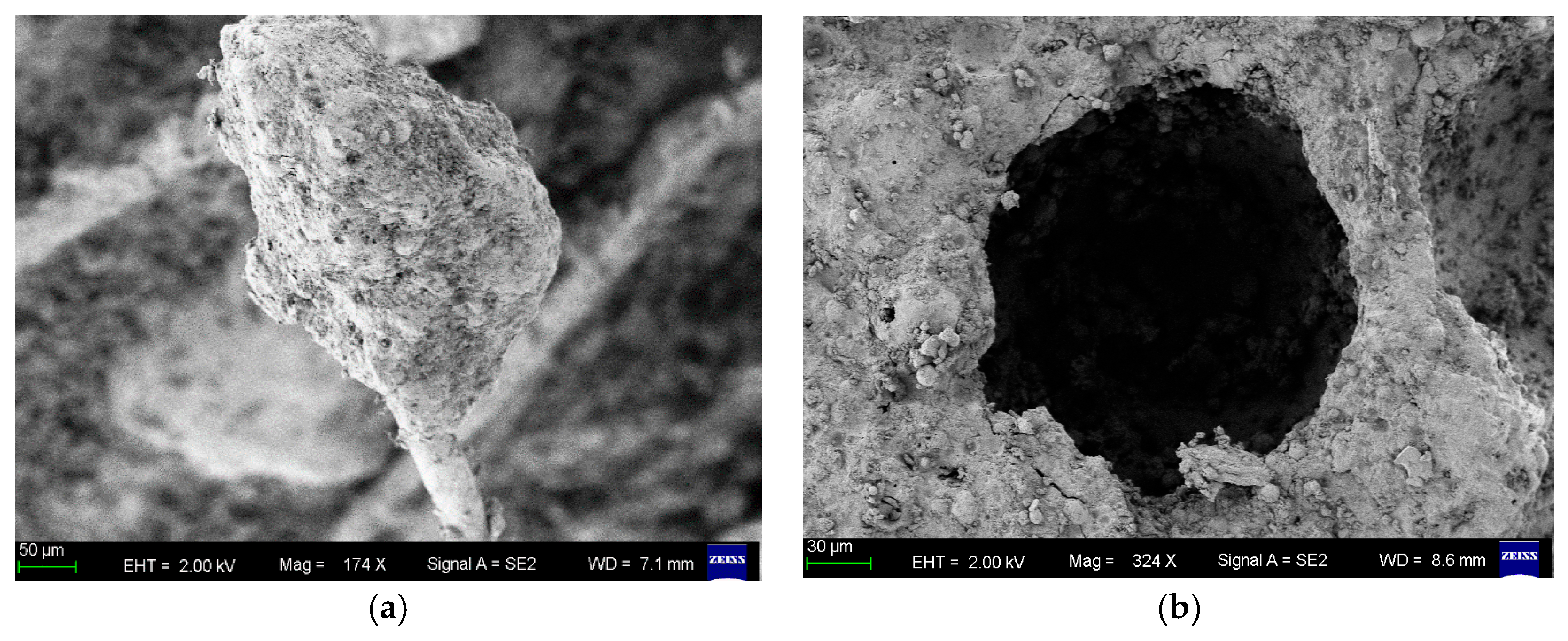
Steel fibers achieve robust interfacial bonding through multiple mechanisms: their hooked ends create mechanical interlocking with the cement matrix; Fe2+ ions can react with Ca2+ in C–S–H gels to form Fe–O–Ca chemical bonds; and the surface oxide layer on the fibers promotes additional C–S–H formation, further enhancing chemical adhesion. This strong bonding renders complete debonding and pull-out of steel fibers difficult, resulting in significant crack suppression. SEM observations (Figure 14) reveal large voids following fiber pull-out, with fiber surfaces extensively coated with matrix material, indicating that anchorage failure is dominated by localized matrix crushing rather than interfacial debonding. The inherent stiffness of steel fibers enables them to directly resist tensile, compressive, and shear stresses, functioning similarly to discrete longitudinal reinforcement in concrete. This allows them to share applied loads and dissipate energy through their own deformation.
Figure 14. Anchorage failure of SF due to localized matrix crushing. (a) SF pull-out end coated with matrix; (b) Large voids after SF pull-out.
Consequently, steel fibers provide multi-scale reinforcement: chemical bonding at the micro-scale, mechanical anchorage at the meso-scale, and structural reinforcement at the macro-scale. This explains the optimal damage suppression performance of the SF–PVA hybrid specimen (SP2) in CT scans, which exhibits the lowest porosity (3.29%) and crack ratio (1.76%).

4.1.2. PVA Fibers: Bond-Dependent Failure and Localized Damage

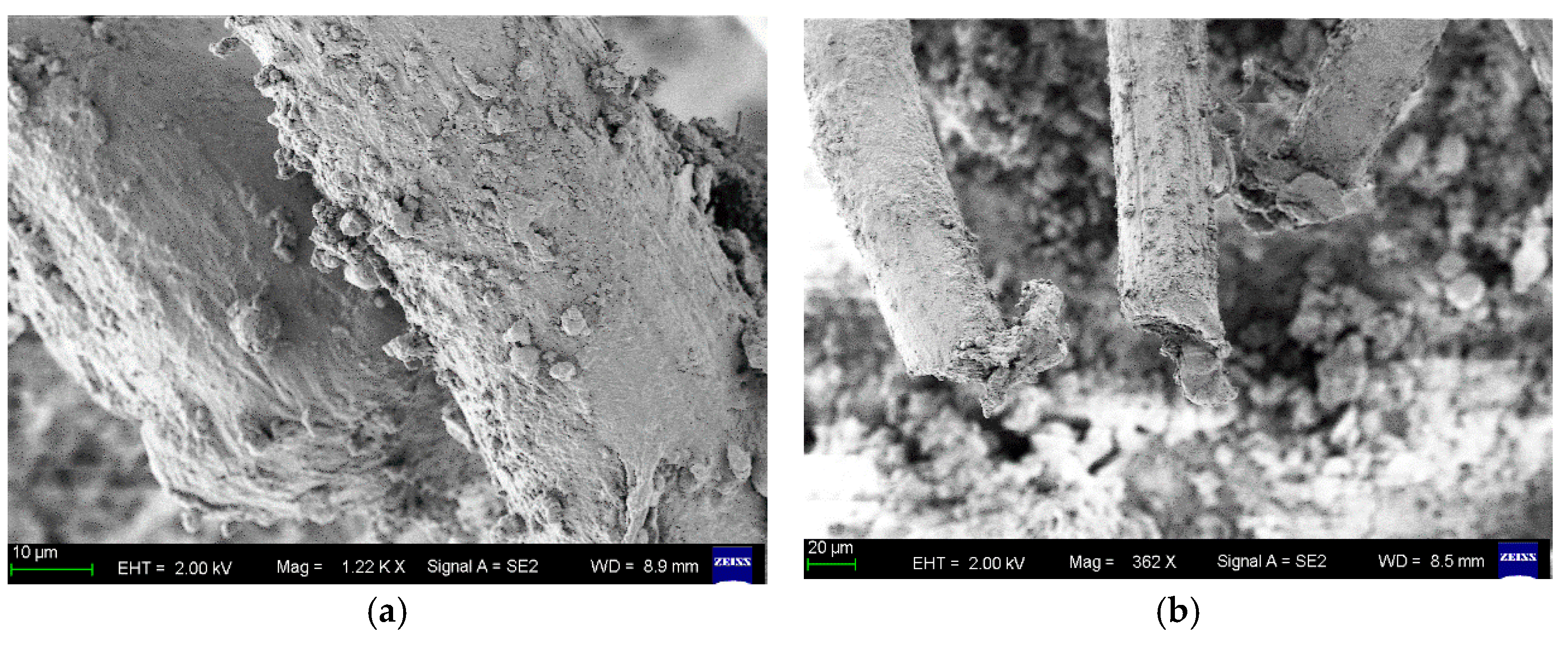
PVA fibers are hydrophilic and bond with the cement matrix primarily through chemical adhesion between surface hydroxyl groups (–OH) and silanol groups (Si–OH) in C–S–H gels. This chemical bond is strain-rate sensitive and strengthens under high strain rates, potentially exceeding the tensile capacity of the fibers and promoting brittle fracture rather than pull-out. SEM observations (Figure 15) confirm this failure mode, showing PVA fiber surfaces with adhered hydration products and fractured ends.
Figure 15. SEM images of failed PVA fibers. (a) Thin Layer of Hydration Products Adhered to PVA; (b) Fractured Surface of PVA Fiber.
Once fiber fracture occurs, the post-crack bridging capacity is rapidly lost. This leads to the most severe and highly connected damage observed via CT in the mono-PVA specimen (P), characterized by a porosity of 7.20% and a crack ratio of 4.48%. Damage tends to localize because a large number of PVA fibers undergo tensile rupture instead of debonding and continuing to bridge cracks in a more distributed manner.

4.1.3. PE Fibers: Frictional Pull-Out and Dispersed Damage

PE fibers are hydrophobic and interact with the matrix mainly through physical adsorption and frictional forces. This frictional bond is largely strain-rate insensitive, showing no significant enhancement under high loading rates. Consequently, the interfacial bond strength of PE fibers is lower than that of both steel and PVA fibers. Their high intrinsic tensile strength, combined with this weak interfacial bonding, typically prevents fiber fracture; instead, PE fibers tend to be completely pulled out under impact.
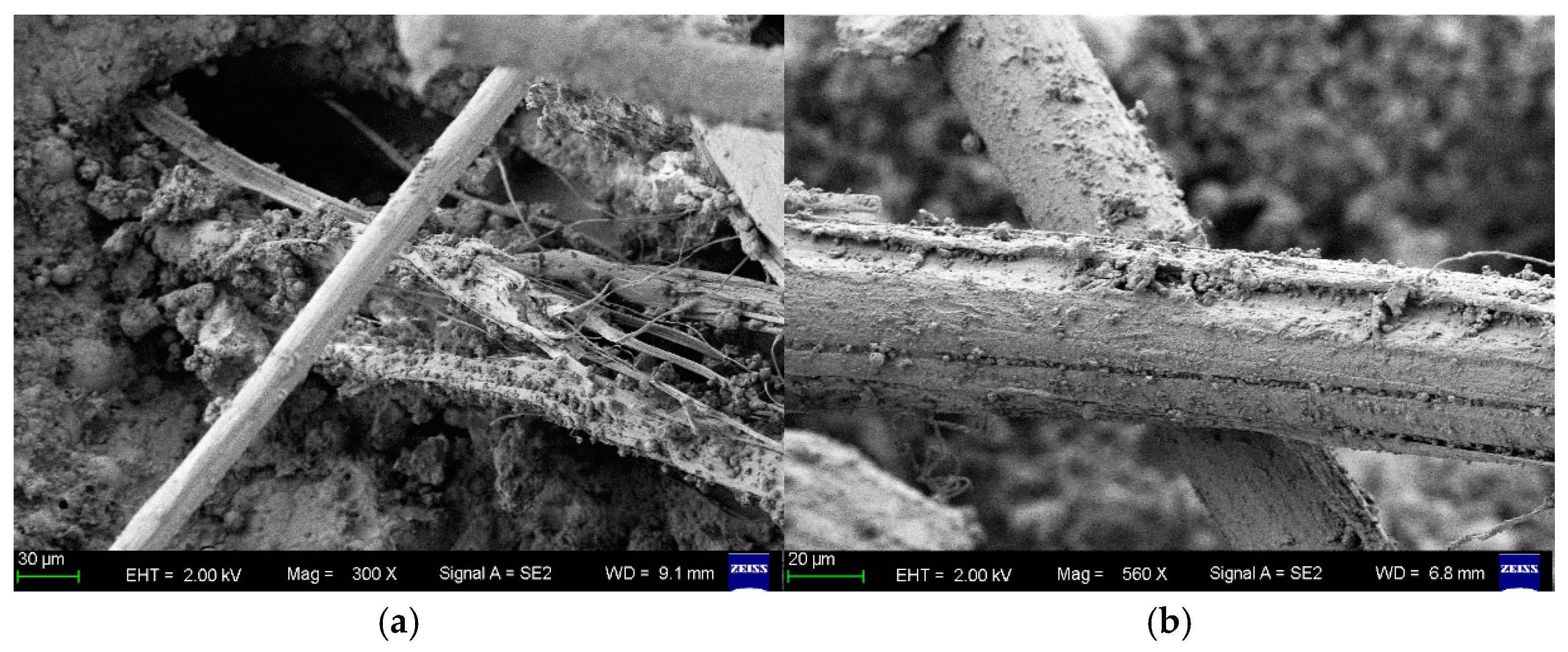
SEM images (Figure 16a) reveal clean, debris-free PE fiber surfaces after pull-out, accompanied by longitudinal splitting or “fibrillation” (Figure 16b), where individual fibrils separate from the main fiber. The smooth surface of PE fibers facilitates easy debonding, while fibrillation during pull-out generates a gradual and sustained frictional resistance. This mechanism, although less effective than steel fibers in preventing crack initiation, promotes the activation of numerous microcracks and isolated pores around pulling fibers, thereby dispersing the damage.
Figure 16. SEM images of failed PE fibers. (a) Clean interface of PE after pull-out; (b) Longitudinal fibrillation of PE fiber.
This explains the unique damage pattern of the PE–PVA hybrid system (EP2) in CT analysis: a moderate crack ratio (2.55%) coupled with a high proportion of isolated pores, as evidenced by the lowest crack-to-pore ratio (39.32%) and a large number of medium-sized pores. The CT-derived pore size distribution thus quantitatively confirms the dispersed micro-damage activation associated with PE fibers.

4.2. Analysis of Fiber Synergy and Failure of Simple Superposition

Vairagade et al. [40] have reported that the advantages of hybrid fibers do not arise from a simple linear superposition of the functions of different fibers. The performance of hybrid systems cannot be explained by directly summing the contributions of individual fibers. The test results in this study, which clearly reflect the synergistic effects of the fibers, further substantiate this viewpoint.
In the SF–PVA hybrid system, synergy originates from temporal and functional complementarity. PVA fibers are activated first at the micro-crack stage, refining cracks and enhancing matrix integrity. This preserved integrity provides a more stable anchorage environment for the subsequently mobilized steel fibers, enabling them to fully develop their macro crack-bridging potential without premature anchorage failure. This staged interaction results in a performance (higher strength and lower meso-damage) that surpasses expectations based on a simple linear combination of the responses of PVA and SF alone. CT scans clearly capture this effect: specimen SP2 exhibits lower crack ratio, reduced porosity, and substantially decreased crack connectivity compared with specimen P, all indicating a nonlinear enhancement of internal damage resistance.
In the PE–PVA hybrid system, synergy is dominated by mechanistic complementarity within a multi-stage defense process. The strongly bonded but lower-strength PVA fibers act as the first line of defense, activated at small crack openings and dissipating energy through debonding and fracture. As their load-bearing capacity diminishes, the weakly bonded but high-strength PE fibers become fully mobilized. Their progressive pull-out and fibrillation provide a prolonged second stage of energy dissipation and stress redistribution. Although secondary stress peaks may also appear in PVA-only composites, the hybrid systems exhibit distinct evolution patterns—including delayed peak timing and altered post-peak response—which coincide with CT-observed delayed activation of additional fiber groups. This indicates that the secondary peak behavior in hybrid systems arises from inter-fiber interactions, rather than from additive effects of single fibers.
These hybrid-specific meso-damage characteristics deviate noticeably from volume-fraction-weighted predictions. For both hybrid systems, porosity, crack ratio, and crack connectivity are significantly lower than those obtained from a simple mixture of the constituent single-fiber responses. The fundamental nature of this reinforcement mechanism—where different fibers synergistically perform distinct functions at different stages of damage evolution—is inherently nonlinear. It cannot be captured by a simple superposition model that assumes independent and additive contributions. Instead, the combined SHPB and CT results demonstrate that tailored hybridization enables damage-control strategies that go beyond the sum of individual fiber effects.

5. Conclusions

(1)
SHPB dynamic splitting tests demonstrated that all specimens exhibited significant strain rate strengthening effects in terms of dynamic splitting strength, DIF, and energy dissipation capacity. Hybrid fibers specimens consistently outperformed single-fiber specimens, with SP1 showing the highest strength improvement (15.6% at the TS4 strain rate) among all mixes. The stress-time curves of hybrid fibers specimens, particularly those containing PE fibers, displayed fuller post-peak descending branches and more pronounced secondary stress peaks, indicating enhanced post-crack resistance. While failure modes transitioned from partial cracking at low strain rates to complete fragmentation at high strain rates, hybrid fibers specimens—especially those with polymer fibers—were able to maintain superior structural integrity.
(2)
Based on quantitative meso-scale damage analysis using industrial CT, it is demonstrated that the mono-PVA specimen exhibited the most severe internal damage, with the highest porosity (7.20%) and crack ratio (4.48%), along with the formation of penetrating large pores (maximum pore volume: 26.3 mm3) and a highly interconnected crack network (coordination number: 94). The hybrid steel fiber specimen showed optimal damage suppression, achieving the lowest porosity (3.29%) and crack ratio (1.76%), with the least severe internal damage distribution. In contrast, the hybrid PE fiber specimen, by inducing multi-scale pore distribution, not only provided certain inhibition of cracks and pores (with both porosity and crack ratio reduced compared to the P specimen) but, more importantly, led to a more dispersed and homogeneous damage distribution (crack-to-pore ratio: 39.32%, the lowest among all mixes).
(3)
The combined SHPB and CT results show that the dynamic performance of HFRCC is controlled by fiber–matrix interactions rather than by fiber volume alone. Hooked steel fibers with strong mechanical/chemical bonding effectively suppress internal damage, leading to the lowest porosity and crack ratios, whereas hydrophilic PVA fibers tend to rupture at high strain rates, producing more severe and connected cracking. Hydrophobic PE fibers, dominated by frictional pull-out and fibrillation, induce more dispersed microcracks and isolated pores. In SF–PVA and PE–PVA hybrids, these distinct interfacial behaviors act in a complementary, time-dependent manner, generating damage patterns and toughness levels that clearly deviate from a simple linear superposition of the mono-fiber responses.

6. Limitations and Future Work

Although the dynamic tensile properties and meso-damage mechanisms of HFRCC have been well characterized by integrated experimental and CT-based analysis, several pivotal questions remain to be addressed for a holistic mechanistic interpretation and successful translation to engineering practice:
(1)
Numerical Modeling
While the current methodology is effective in identifying key damage patterns and synergistic mechanisms, it has not yet incorporated meso-scale numerical simulation. The primary challenge lies in the accurate modeling of the complex, random distribution of hybrid fibers and their interfacial interactions. Developing such models would be instrumental in quantitatively deconvoluting the contribution of individual fiber systems to the overall composite response under dynamic loading.
(2)
Assessment of Practical Engineering Viability
Future work must undertake comprehensive cost–benefit and risk assessments. This includes evaluating the incremental cost per cubic meter, directly comparing the practical trade-offs (e.g., workability, density, and long-term durability) between SF-PVA and PE-PVA systems, and assessing potential safety hazards during construction (such as injury risks from exposed steel fibers or chemical stability concerns of polymer fibers) to establish safe-handling protocols. These analyses are essential to guide rational material selection and ensure responsible field deployment.
(3)
Regulatory Compliance and Sustainability
It is imperative to validate the compliance of these materials with international performance standards for dynamic loading (e.g., blast, impact, seismic), supported by validation through full-scale component testing to facilitate their future inclusion in design codes. Concurrently, a systematic life-cycle assessment (LCA) is required to quantify the balance between the embodied energy of fiber production and the potential service life extension, enabling an accurate evaluation of the net environmental footprint of hybrid fiber systems.
(4)
Integration with Emerging Construction Technologies:
The compatibility of hybrid fiber composites with novel construction methodologies—such as extrusion-based 3D printing, digitally fabricated hybrid elements, and functionally graded material deposition—remains an unexplored yet critical area. Investigating this integration is a promising research direction, as these advanced techniques offer the potential for tailored fiber orientation and enhanced structural performance.
Addressing these issues is crucial for advancing these high-performance composites from laboratory research to widespread and optimized engineering practice.

Author Contributions

Conceptualization, T.C.; methodology, T.C.; software, T.C. and W.Y.; validation, X.L.; formal analysis, T.C., W.Y. and H.W.; investigation, T.C. and X.S.; resources, W.Y. and H.W.; data curation, T.C.; writing—original draft preparation, T.C.; writing—review and editing, X.L.; visualization, T.C.; supervision, T.C. and X.S.; project administration, T.C.; funding acquisition, T.C. All authors have read and agreed to the published version of the manuscript.

Funding

This research was funded by the Chongqing Natural Science Foundation, grant number CSTB2022NSCQ-MSX0194 and Science and Technology Research Program of Chongqing Municipal Education Commission, grant number KJZD-M202412902.

Data Availability Statement

Data are contained within the article.

Conflicts of Interest

The authors declare no conflicts of interest.

References

  1. Noh, H.W.; Truong, V.D.; Cho, J.Y.; Kim, D.J. Dynamic increase factors for fiber-reinforced cement composites: A review. J. Build. Eng. 2022, 56, 104769. [Google Scholar] [CrossRef]
  2. Wang, Y.; Liu, S.; Yan, C. Long-Term Performance of PVA Fiber-Reinforced Cementitious Composites; China Building Materials Industry Press: Beijing, China, 2020. [Google Scholar]
  3. Xu, S.; Li, Q. Ultra-High-Toughness Cementitious Composites in High-Performance Building Structures; Science Press: Beijing, China, 2010. [Google Scholar]
  4. Liu, L.; Xiao, J.; Wu, Z. Experimental study on compressive behavior of PE-ECC under impact load. Front. Mater. 2023, 10, 1204083. [Google Scholar] [CrossRef]
  5. Zhao, S.; Liu, R.; Liu, J.; Yang, L. Comparative study on the effect of steel and plastic synthetic fibers on dynamic compression of UHPC. Compos. Struct. 2023, 324, 117570. [Google Scholar] [CrossRef]
  6. Yang, J.; Kang, S.; Yoo, D.-Y. Effects of fibers on the mechanical properties of UHPC: A review. J. Traffic Transp. Eng. 2022, 9, 363–387. [Google Scholar] [CrossRef]
  7. Ahmad, J.; Zhou, Z.; Deifalla, A.F. Steel fiber-reinforced self-compacting concrete: Fresh properties review. Int. J. Concr. Struct. Mater. 2023, 17, 51. [Google Scholar] [CrossRef]
  8. Zhao, Y.; Li, W.; Xu, F.; Lu, Z.; Jiang, Z.; Zhang, J.; Chen, Y.; Wang, K.; Liu, S.; Huang, H.; et al. Hybrid Fiber Design Strategies for Improving Crack Resistance and Tensile Performance of Cementitious Composites: A Comprehensive Review. Cem. Concr. Compos. 2024, 150, 105234. [Google Scholar]
  9. He, S.; Chen, H.; Yu, J. Microstructure-Guided Toughness Enhancement in Fiber-Reinforced Cementitious Materials. Constr. Build. Mater. 2023, 398, 132645. [Google Scholar]
  10. Liu, Z.; Guo, X.; Huang, B. Advances in Cementitious Composite Design: Multi-Scale Reinforcement, Fiber Synergy, and Durability Improvement. Materials 2024, 17, 1123. [Google Scholar]
  11. Maalej, M.; Quek, S.T.; Zhang, J.; Lee, B.Y.; Hsu, L.S.; Tan, D. Behavior of hybrid-fiber engineered cementitious composites subjected to dynamic tensile loading and projectile impact. J. Mater. Civ. Eng. 2006, 17, 143–152. [Google Scholar] [CrossRef]
  12. Tran, N.T.; Kim, D.J. Synergistic response of blending fibers in ultra-high-performance concrete under high-rate tensile loads. Cem. Concr. Compos. 2017, 78, 132–145. [Google Scholar] [CrossRef]
  13. Son, M.; Kim, G.; Kim, H.; Lee, S.; Nam, J.; Kobayashi, K. Effects of the strain rate and fiber blending ratio on the tensile behavior of hybrid steel–PVA fiber cementitious composites. Cem. Concr. Compos. 2020, 106, 103482. [Google Scholar] [CrossRef]
  14. Shi, F.; Pham, T.M.; Hao, H. Mechanical properties of high-strength concrete reinforced with hybrid basalt–polypropylene fibers under dynamic compression and split tension. J. Mater. Civ. Eng. 2024, 36, 04024136. [Google Scholar] [CrossRef]
  15. Yang, L.; Zhang, W. Energy dissipation and fractal fragmentation of hybrid-fiber concrete under impact loading. Eng. Blasting 2023, 29, 25–32, 41. [Google Scholar]
  16. Yang, G.; Bi, J.; Dong, Z.; Zhang, Y. Dynamic tensile properties of hybrid-fiber concrete based on digital image correlation. Mater. Rep. 2023, 37, 22030038. [Google Scholar]
  17. Guo, R.; Li, J.; Ma, L.; Ou, C.; Xu, X. Microstructure analysis and dynamic splitting tensile tests of CF/SSF-reinforced coral-sand cement mortar. Explos. Shock Waves 2024, 44, 113101. [Google Scholar]
  18. Sheng, M.; Wang, X.; Huang, Y.; Song, Q.; Zhou, X.; Yang, L.; Xing, F. Dynamic splitting behavior of microcapsule-based self-healing cementitious composites under SHPB loading. J. Build. Eng. 2024, 91, 109638. [Google Scholar] [CrossRef]
  19. Millon, O.; Kleemann, A.; Stolz, A. Influence of the fiber reinforcement on the dynamic behavior of UHPC. In Proceedings of the 1st International Interactive Symposium on UHPC, Des Moines, IA, USA, 18–20 July 2016; pp. 1–9. [Google Scholar]
  20. Li, Q.; Shu, C.; Xu, S. Layered spalling tests on ultra-high-toughness cementitious composites. Eng. Mech. 2020, 37, 51–59. [Google Scholar]
  21. Jiao, C.; Quan, C.; Li, X. Spalling behaviour of hybrid-fiber high-strength concrete. J. Vib. Shock 2017, 36, 91–96. [Google Scholar]
  22. Zhu, Z.; Mediamartha, B.; Yu, S. Simulation of the Mesoscale Cracking Processes in Concrete Under Tensile Stress by Discrete Element Method. Materials 2025, 18, 2981. [Google Scholar] [CrossRef]
  23. Du, X.; Zhang, Z.; Lou, Z.; Liu, X. Study on meso-scale pore defects of concrete based on CT images. J. Build. Mater. 2020, 23, 603–610. [Google Scholar]
  24. You, Q.; Wang, W.; Nan, C.; Liu, Y. Construction of meso-scale concrete model based on CT images. J. Railw. Sci. Eng. 2023, 20, 3385–3395. [Google Scholar]
  25. Du, H.; Fan, Y. Meso-structural damage of C60 high-performance concrete at high temperature based on X-CT. J. Build. Mater. 2020, 23, 210–215. [Google Scholar]
  26. Rong, Z.; Wang, Y.; Meng, Y. Resistance of ultra-high-performance cementitious composites to repeated impacts. J. Southeast Univ. (Nat. Sci. Ed.) 2020, 50, 320–326. [Google Scholar]
  27. Wang, S.; Huang, Y.; Liu, P. CT-Based Quantitative Analysis of Crack Propagation and Internal Damage Evolution in Cement-Based Materials under Dynamic Loading. Materials 2023, 16, 3104. [Google Scholar]
  28. Zhang, Y.; Zheng, Y. Macro–Mesoscale Mechanical Properties of Basalt–Polyvinyl Alcohol Hybrid Fiber-Reinforced Low-Heat Portland Cement Concrete. Polymers 2023, 15, 621. [Google Scholar] [CrossRef]
  29. Wang, K.; Qiu, Z.; Hu, H.; Sun, M.; Wang, J. Macro-Meso Mechanical Behavior and Degradation Mechanisms of Silty Clay Subgrade Subjected to Coupled Traffic Load-ing and Dry-Wet Cycles. Transp. Geotech. 2025, 55, 101725. [Google Scholar] [CrossRef]
  30. Yang, E.-H.; Li, V.C. Strain-rate effects on the tensile behavior of strain-hardening cementitious composites. Constr. Build. Mater. 2014, 52, 96–104. [Google Scholar] [CrossRef]
  31. Yang, E.-H.; Sahmaran, M.; Yang, Y.; Li, V.C. Rheological Control in Production of Engineered Cementitious Composites. ACI Mater. J. 2009, 106, 357–366. [Google Scholar] [CrossRef]
  32. Li, L.; Li, B.; Wang, Z. Effects of Hybrid PVA–Steel Fibers on the Mechanical Performance of High-Ductility Cementitious Composites. Buildings 2022, 12, 1934. [Google Scholar] [CrossRef]
  33. Meng, W.; Khayat, K.H. Effect of Hybrid fibers on Fresh Properties, Mechanical Properties, and Autogenous Shrinkage of Cost-Effective UHPC. J. Mater. Civ. Eng. 2018, 30, 04018030. [Google Scholar] [CrossRef]
  34. ACI 544.1R-96; State-of-the-Art Report on Fiber Reinforced Concrete. American Concrete Institute: Farmington Hills, MI, USA, 1996.
  35. Xie, Q.; Shi, D.; Chen, X.; Peng, L.; Sun, R. Investigation on Dynamic Splitting Mechanical Properties of Weakly Cemented Siltstone Based on Digital Image Correlation Method and FracPaQ Algorithm. Geoenergy Sci. Eng. 2024, 243, 213310. [Google Scholar] [CrossRef]
  36. Hondros, G. The Evaluation of Poisson’s Ratio and the Modulus of Materials of a Low Tensile Resistance by the Brazilian (Indirect Tensile) Test with Particular Reference to Concrete. Aust. J. Appl. Sci. 1959, 10, 243–268. [Google Scholar]
  37. Wu, S.-C.; Ma, J.; Cheng, Y.; Cheng, Z.; Li, J. Review of the Flattened Brazilian Test and Research on the Three-Dimensional Crack Initiation Point. Yantu Lixue 2019, 40, 1239–1247. [Google Scholar]
  38. Wang, H.; Lv, N.; Lu, Z.; Wang, H.; Zong, Q. Experimental Study on Mechanical Properties and Breakage of High-Temperature Carbon Fiber-Bar Reinforced Concrete under Impact Load. Sci. Rep. 2024, 14, 20566. [Google Scholar] [CrossRef]
  39. Wang, K.; Chen, Z.; Wang, Z.; Chen, Q.; Ma, D. Critical Dynamic Stress and Cumulative Plastic Deformation of Calcareous Sand Filler Based on Shakedown Theory. J. Mar. Sci. Eng. 2023, 11, 195. [Google Scholar] [CrossRef]
  40. Vairagade, V.S.; Dhale, S.A. Hybrid fibre reinforced concrete—A state of the art review. Hybrid Adv. 2023, 3, 100035. [Google Scholar] [CrossRef]
Disclaimer/Publisher’s Note: The statements, opinions and data contained in all publications are solely those of the individual author(s) and contributor(s) and not of MDPI and/or the editor(s). MDPI and/or the editor(s) disclaim responsibility for any injury to people or property resulting from any ideas, methods, instructions or products referred to in the content.

Article Metrics

Citations

Article Access Statistics

Article metric data becomes available approximately 24 hours after publication online.