Article

Analysis of the Effect of Reinforced Insulation Design Standards on Energy Performance to Establish ZEB Strategies for Non-Residential Buildings

Department of Building Energy Research, Korea Institute of Civil Engineering and Buidling Technology, 283 Goyang-Daero, Ilsanseo-Gu, Goyang-Si 10223, Gyeonggi-Do, Republic of Korea
*
Author to whom correspondence should be addressed.
Buildings 2025, 15(23), 4366; https://doi.org/10.3390/buildings15234366 (registering DOI)
Submission received: 29 September 2025 / Revised: 18 November 2025 / Accepted: 19 November 2025 / Published: 2 December 2025

Abstract

To support national carbon neutrality goals, enhancing the thermal insulation of building envelopes has emerged as a crucial strategy in reducing building energy consumption. This study conducted a detailed quantitative analysis of energy performance improvements achieved through enhanced insulation levels in four representative non-residential building types: office, accommodation, educational, and sales facilities. Based on four scenarios—Baseline (2019), Insulation Reinforced, Passive House, and Zero Energy Building (ZEB)—EnergyPlus simulations were performed to calculate end-use energy demand and consumption. The results revealed that office buildings achieved the highest improvement, with up to 34.7% energy reduction, while educational and sales facilities showed moderate and limited improvements, respectively. These findings provide quantitative evidence for prioritizing insulation-based policies and differentiated ZEB strategies tailored to each building type. The proposed RB models and scenario-based methodology offer a robust foundation for establishing future ZEB regulations and performance-based energy policies in South Korea. To ensure clarity, the study explicitly referenced verified data sources and field measurements. The IdealLoadsAirSystem used in the simulation assumes 100% system efficiency; thus, the reported outcomes represent building system loads rather than final energy consumption. The ZEB-level scenario analyzed in this study focuses on envelope and lighting improvements only, not on HVAC system optimization.

1. Introduction

Globally, buildings account for approximately 30% of total energy consumption, including 55% of electricity use, and contribute around 37% of greenhouse gas (GHG) emissions. A significant portion of this energy is used for heating and cooling. In response, countries have developed various technologies and strengthened policy frameworks to enhance building energy efficiency. These policies have been a major driving force behind efficiency improvements. For example, appliances and equipment regulated under minimum energy performance standards (MEPS) represented one-third of the energy consumed in the building sector in 2019. Since 2000, these standards have been increasingly reinforced through mandatory policies in many countries. Strong policy interventions remain essential to drive the technological innovations needed to meet energy and climate goals [1]. In line with this global movement, South Korea has actively promoted the adoption of Zero Energy Buildings (ZEBs) as a core component of its “2050 Carbon Neutrality Scenario” [2]. Specifically, the Third Green Building Master Plan (2021–2025) identifies the expansion of ZEBs and reinforcement of building envelope performance as key policy tasks, laying the technical and regulatory groundwork to enhance energy-saving outcomes [3].
Against this backdrop, research that systematically analyzes building energy consumption characteristics and quantitatively evaluates the impact of insulation policy improvements has become increasingly important. In recent years, many countries have developed reference buildings (RBs) based on national standards and statistics. Simulation analyses using these RBs have proven effective for policy development and for guiding high-performance building design [4,5,6,7,8,9]. In addition to the above, several recent studies have assessed the impact of envelope insulation improvement under ZEB transition scenarios (e.g., [10,11,12]), demonstrating diverse regional responses. Building energy consumption is influenced by a range of complex factors, including building type, HVAC (Heating, Ventilation, and Air Conditioning) operation methods, occupancy density, operating hours, and envelope insulation performance. Notably, energy consumption characteristics vary significantly across different building types, making type-specific analysis essential.
However, most existing domestic and international studies have focused on a single building type or employed simplified models. Comprehensive comparative analyses across multiple building types and insulation levels remain limited. To address this gap, the present study investigates the effects of improved insulation levels on energy consumption across four non-residential building types—office, accommodation, educational, and sales facilities. These types were selected because they represent a substantial share of energy use in the non-residential sector and exhibit heating and cooling loads that are highly sensitive to changes in envelope performance [13]. The selection thus supports both effective analysis and policy applicability.
The reference year (2019) from Korea’s carbon neutrality roadmap [2] was adopted as the baseline for insulation levels. Four policy reinforcement scenarios were developed: (1) baseline (2019) level, (2) insulation reinforced level, (3) passive house level, and (4) ZEB level. For each scenario, key input parameters were systematically defined, including the thermal transmittance (U-values) of exterior walls, roofs, lowest floors, and windows; window solar heat gain coefficient (SHGC); internal heat gains; ventilation and infiltration rates; and heating and cooling set-point temperatures.
To strengthen the credibility of the model inputs, Section 2.2 now clarifies the sources of key input data, which were derived from verified national standards and measurement-based studies. It is also clarified that the IdealLoadAirSystem outputs represent building system loads rather than final energy consumption, reflecting the model’s assumption of 100% efficiency. Section 4.1 further defines the scope of the ZEB scenario as a ZEB-level building envelope scenario to avoid conceptual confusion between envelope and system efficiency effects.
The highlights of this study include (1) establishing reference building models for four major non-residential types, (2) defining four policy-based insulation scenarios, and (3) quantitatively evaluating energy performance improvements to inform ZEB strategy formulation.

2. Methods

2.1. Object of Research

In this study, simulation-based quantitative analysis was conducted to evaluate the potential for improving energy performance through changes in the insulation levels of non-residential buildings in Korea. Office, accommodation, educational, and sales facilities were selected as target building types. The term “accommodation” refers to lodging facilities such as hotels and dormitories, which differ from residential buildings in that they are commercially operated, with variable occupancy and higher service energy use. Accommodation buildings generally show balanced heating and cooling loads due to year-round operation and internal gains from occupants and equipment.
These categories were chosen based on both empirical data and policy considerations. They represent a significant proportion of energy consumption among non-residential buildings in Korea [14]. These building types have relatively high demands for heating, cooling, and lighting, making them well-suited to demonstrate measurable energy savings from improved envelope insulation performance.
For example, office buildings typically have high occupancy, educational facilities operate HVAC systems over extended hours, and sales facilities experience high energy loss due to their open structure [5].
Second, these building types are designated as key evaluation categories in building energy performance assessment systems, such as the Building Energy Efficiency Rating Certification System and the Green Building Certification System. Thus, the study’s findings have high potential for policy application.
Third, while previous research has developed reference building (RB) models primarily focused on residential buildings such as apartments [6], non-residential buildings differ in their operational methods, occupancy patterns, and internal heat conditions. Therefore, a scenario-based analysis tailored to each building type offers a more effective and targeted approach.

2.2. Building Energy Analysis Simulation

Dynamic energy simulations were conducted for the four selected building types using EnergyPlus (National Renewable Energy Laboratory (NREL), Golden, CO, USA). The simulations used TMY2 weather data representative of Seoul’s climate. EnergyPlus is a dynamic simulation engine that can accurately model hourly energy flows in a building, including thermal conditions, HVAC systems, lighting, domestic hot water, and ventilation [13].
The simulation setup followed the reference building model (RBM) methodology and analysis procedure presented in ref. [4]. Simulation models were constructed using input variables and design parameters specific to each non-residential building type. Actual building design documents and statistical data—explicitly cited from national standards and measurement-based studies—were referenced to reflect physical and operational characteristics, including total floor area, number of floors, window-to-wall ratio, internal heat gains, occupancy density, and heating/cooling schedules.
Figure 1 presents the overall research flow, indicating the data collection, input parameter configuration, and EnergyPlus simulation process. For clarity, a summary of the input variables described in Section 4.2 has been partially included in this section, and the detailed numerical values are organized into a separate table.
The simulation used the IealLoadAirSystem to calculate thermal loads under ideal system operation. To avoid misinterpretation, the outputs were treated as building system loads rather than final energy consumption, since the IdealLoadsAirSystem assumes 100% equipment efficiency.

3. Literature Review

Many countries have developed RBs and utilized them as foundational data for national policy development and institutional planning. For example, the U.S. Department of Energy (DOE) constructed RBs for 16 building types across 16 climate regions [15]. The European TABULA project selected representative housing types for each participating country and evaluated energy retrofit scenarios [16]. India developed RBs for both high-rise and low-rise office buildings, while Brazil and Portugal focused on single-family and multi-family housing [8,10,17].
Corgnati et al. [18] classified RB development methodologies into three categories: the sample building-based method, the actual building-based method, and the theoretical/statistical method. They reported that a bottom-up approach—combining statistical modeling with dynamic simulation—has been most widely adopted in practice.
Kim et al. (2014) [6] developed RB energy models for 11 building types across the residential, commercial, and public sectors based on national statistical data. These models reflected the average physical characteristics and operating conditions of each building type. Simulations were conducted using EnergyPlus, with various input parameters, including envelope U-values, window-to-wall ratios, air changes per hour (ACH), and internal heat gains. The simulation results were validated against national energy consumption statistics, demonstrating that the RB models represented real buildings within a deviation of 10–20%. Kwak et al. (2019) [5] created eight design scenarios for office buildings based on elements such as building form, window systems, and insulation performance. Using EnergyPlus, they simulated heating and cooling loads for two groups—an existing group (Group A) and a newly designed group (Group B). The results showed that insulation improvements alone reduced energy use by approximately 10%, and improvements in the window system yielded a total reduction of up to 13.1%. This aligns closely with the Korean government’s average reduction target of 12.8%, thereby verifying the policy’s effectiveness.
Among studies that focused specifically on insulation performance, Lee et al. (2017) [11] analyzed energy savings from envelope retrofits in two public office buildings. Their study showed energy reductions of up to 31% through reinforcement of the exterior wall, roof, and floor. Similarly, Krarti et al. [12] assessed the energy-saving potential of a large-scale retrofit program in Kuwait for residential, commercial, and public buildings. They provided a quantitative analysis of annual energy use, peak demand, and carbon emissions for three levels of retrofitting, based on simulation for each building type. Kwak et al. (2019) [5] also found that strengthening building approval standards led to significant improvements in insulation performance, with U-values decreasing by an average of 37%. However, they noted a recent slowdown in insulation performance gains and emphasized the need to adopt additional technologies beyond passive measures—such as advanced window systems and highly airtight designs.
Most previous studies have focused on residential or office buildings, with limited comparative analysis across various non-residential building types and policy scenarios (see Table 1). In particular, few studies have structured insulation performance scenarios aligned with a national reference year (e.g., 2019) and long-term policy goals (e.g., ZEB implementation).
Accordingly, this study focuses on four non-residential building types in Korea—office, accommodation, educational, and sales facilities—to provide a differentiated approach from prior research.

4. Policy Scenarios for Insulation Standards

4.1. Insulation Performance Scenarios

In this study, four policy scenarios were developed to strengthen insulation standards for building envelopes. Each scenario is defined as follows:
  • Reference Level: Based on the 2019 building energy code (used as the baseline year) [22]
  • Insulation reinforced level: Improved envelope U-values compared to the reference level [20]
  • Passive house level: High insulation and airtightness to meet U-values ≤ 0.15 W/m2·K for the envelope and ≤1.2 W/m2·K for windows, as per Passive House Institute guidelines [23]
  • ZEB level: Design standards including enhanced load reduction measures (e.g., SHGC reduction) in addition to improved envelope U-values for ZEB implementation
These scenarios span the performance range from conventional energy-saving standards [22] to high-efficiency and ZEB-level policy targets. The ZEB-level scenario primarily reflects envelope and lighting improvements, without HVAC optimizations.
(1)
Reference level
This baseline scenario reflects the insulation performance defined in the 2019 building energy-saving design standards. It corresponds to the legal minimum insulation requirements in 2019 and includes parameters such as envelope and window U-values, window-to-wall ratio, and airtightness levels generally applicable at that time. This scenario also aligns with the emission reference year used in South Korea’s national carbon neutrality roadmap.
(2)
Insulation reinforced level
This level represents practical design improvements beyond the minimum legal requirements. It is based on high-insulation recommendations included in the 2018 revision of the building energy-saving design standards. U-values for key envelope components (roof, walls, and floor) are enhanced by approximately 30–40% compared to the baseline, reflecting typical values used in high-performance buildings aiming for energy efficiency certification.
(3)
Passive house level
This level is based on the standards defined by the Passive House Institute Korea and Passive House International. U-values are set to 0.15 W/m2·K or lower for exterior walls, 0.1 W/m2·K or lower for roofs, and 0.8 W/m2·K or lower for windows. The scenario also incorporates reinforced airtightness and solar heat control. Its primary aim is to minimize heating and cooling demands using envelope-focused design strategies, significantly reducing reliance on mechanical systems.
(4)
ZEB level
This level reflects the first-grade certification requirements under the Zero Energy Building Certification System administered by the Ministry of Land, Infrastructure and Transport (MOLIT) [24].. The envelope U-values are comparable to, or in some cases better than, those of the passive house level. Airtightness and window solar control are further enhanced. Additionally, this scenario assumes optimized system efficiency and operational control to minimize the energy required to maintain indoor comfort.

4.2. Data Configuration by Scenario

For energy simulation under the above scenarios, key input variables—such as internal heat gain (lighting and equipment density), ventilation, infiltration, heating and cooling set-point temperatures, and envelope properties (U-value, SHGC)—were defined based on building type and scenario level.
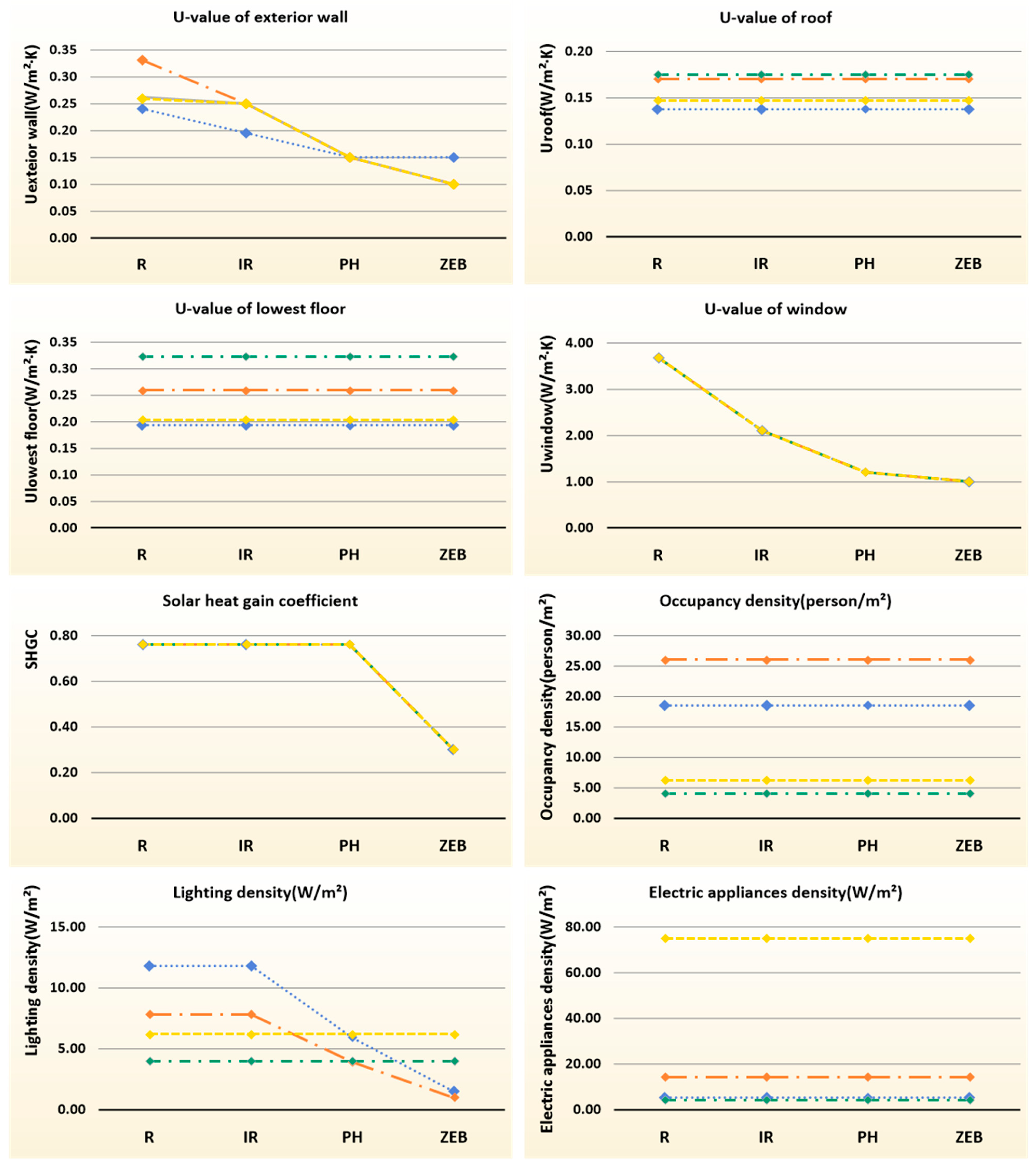
RB modeling inputs were primarily derived from previous studies and supplemented with data from sources including energy-saving design standards, building energy efficiency certification guidelines, and the academic literature [22,23,25,26,27]. Each value was refined to match the technological intent and design objectives of the corresponding scenario, ensuring internal consistency among variables (see Figure 2 and Appendix A).
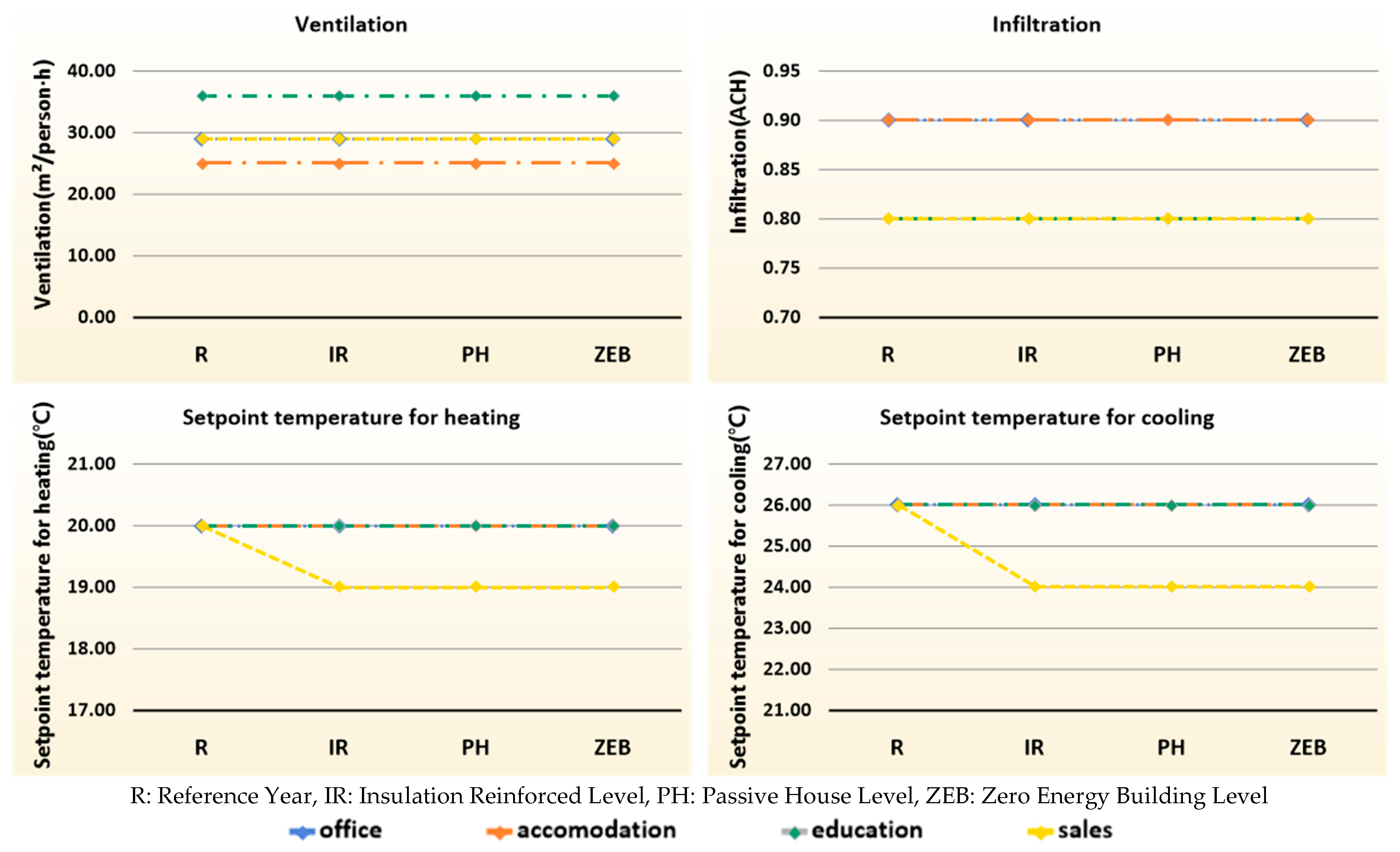
Figure 2 illustrates the changes in key input variables by building type under each of the four insulation scenarios. The goal is to provide a comparative view of the parameters influencing simulation outcomes—such as U-values of exterior walls, roofs, floors, and windows; window SHGC; internal heat gain (occupancy, lighting, and equipment density); infiltration and ventilation rates; and heating and cooling set-point temperatures.
  • Envelope U-values: These decreased with higher scenario levels for all building types, indicating improved insulation performance. For instance, the office building’s exterior wall U-value dropped from 0.240 W/m2·K under the baseline to 0.150 W/m2·K at the ZEB level—an improvement of about 37.5%. Similar improvements were observed in the other building types. Notably, window U-values at the ZEB level were set to 1.000 W/m2·K or lower, assuming the use of high-performance glazing.
  • SHGC: Window SHGC remained constant (0.760) from the reference level through the passive house level but dropped sharply to 0.300 under the ZEB scenario. This reflects the assumed use of solar-control glazing or external shading to mitigate cooling loads, especially relevant in sales facilities with high internal gains.
  • Occupancy Density: These values were held constant across scenarios and based on typical usage patterns. Office buildings had the lowest occupancy (0.10 persons/m2), while educational and accommodation facilities were set at 0.20 and 0.40 persons/m2, respectively. Sales facilities were set at 0.15 persons/m2, reflecting average foot traffic and staff presence.
  • Lighting Density: Lighting loads decreased significantly at higher scenario levels. For example, office buildings dropped from 11.83 W/m2 under the baseline to 1.48 W/m2 at the ZEB level—an 87.5% reduction. Similar reductions (to ~1.2–1.6 W/m2) were seen in accommodation and sales buildings, reflecting the use of LED lighting and sensor-based controls.
  • Electric Equipment Density: This varied by building type and remained constant across scenarios. Offices and educational buildings maintained 13.6–14.0 W/m2, while sales facilities were significantly higher at 75.0 W/m2, reflecting continuous operation of display and POS equipment. Though unchanged across scenarios, this parameter is a key indicator of internal load intensity.
  • Infiltration and Ventilation: These were fixed by building type, not scenario. Infiltration was held at 0.90 ACH for all types. Ventilation was higher in office and educational buildings and lower in sales and accommodation facilities, reflecting operational norms rather than insulation standards.
  • Set-Point Temperatures: Most building types maintained 20 °C for heating and 26 °C for cooling. However, in sales facilities, the cooling set-point was reduced to 24 °C under the ZEB scenario, reflecting the comfort requirements of cooling-dominant spaces and adjusted operational strategies.
Table 2 summarizes the key input parameters applied in the EnergyPlus simulations for each insulation scenario. U-values and SHGCs were modified according to policy-based performance levels, while occupancy, ventilation, and equipment parameters were held constant to ensure comparability across scenarios.

5. Results

This chapter presents a quantitative analysis of the energy simulation results under the four insulation reinforcement policy scenarios defined in Section 4. The analysis targets four non-residential building types—office, accommodation, educational, and sales facilities—and compares changes in energy load and energy consumption for heating, cooling, domestic hot water, lighting, and ventilation across the scenarios. In addition to comparing scenarios, the relative energy-saving effects and trends by insulation level were analyzed for each building type. Table 3 provides a detailed summary of the simulation results for energy load and energy consumption.

5.1. Energy Load

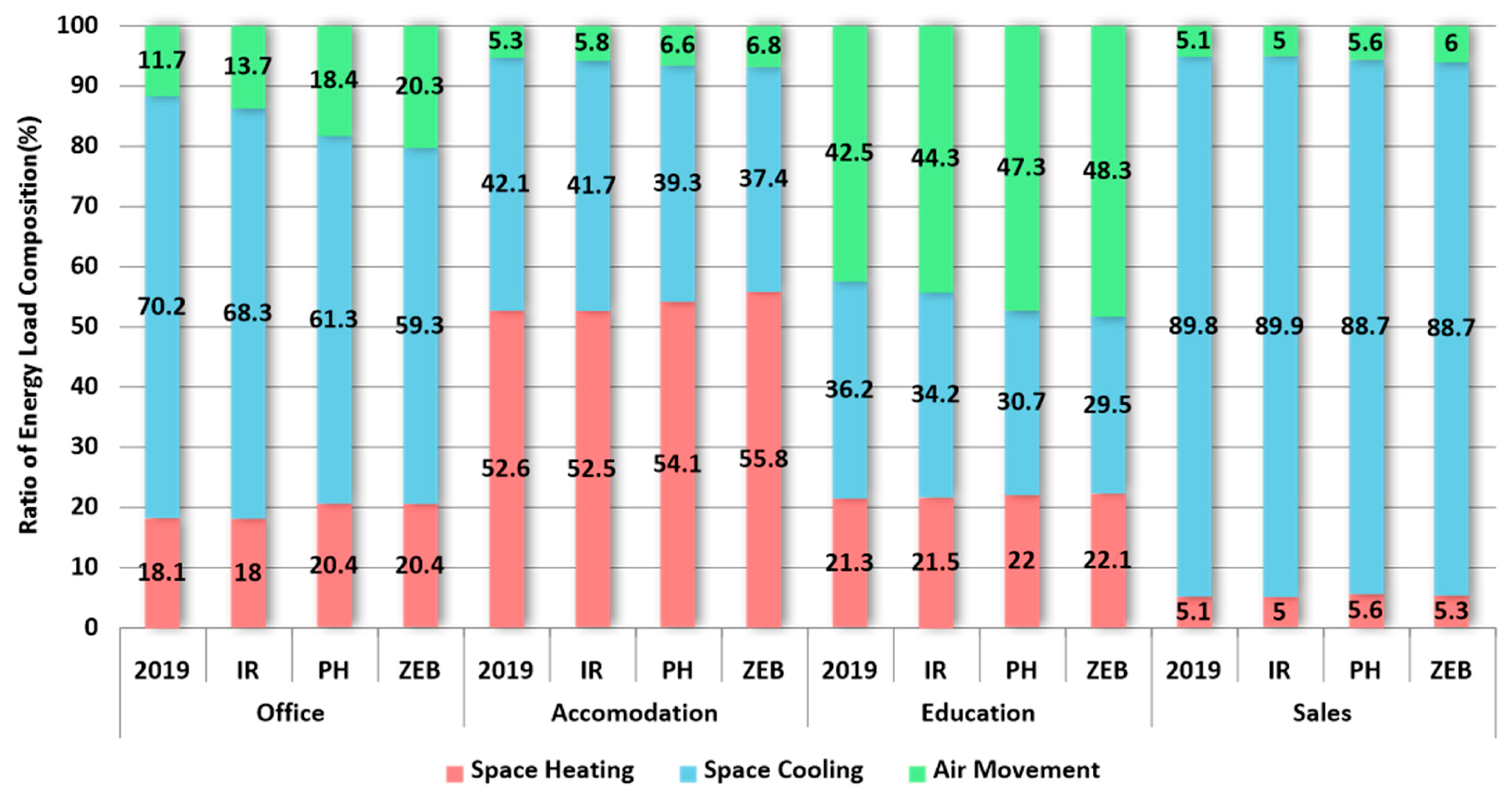
Heating, cooling, and ventilation loads were calculated using EnergyPlus for each insulation scenario, showing consistent reduction patterns with improved insulation levels (Figure 3). The indicator used is energy load per unit area (kWh/m2), and the results are presented with a focus on the change rate between scenarios and the share of each component.
(1)
Office buildings
The total energy load for office buildings decreased by 24.6%, from 100.48 kWh/m2 at the reference level to 75.75 kWh/m2 at the ZEB level. Among the components, cooling load accounted for the largest portion. This reflects the heavy summer cooling demand due to long occupancy hours and equipment usage. Notably, the cooling load was reduced by more than half—from 47.29 to 23.46 kWh/m2—at the passive house level, significantly contributing to the overall reduction. This is largely attributed to the lowered SHGC of the windows and enhanced solar radiation blocking.
(2)
Accommodation facilities
In accommodation facilities, heating and cooling loads were found to be similar in scale. The total load decreased by 19.3%, from 131.26 kWh/m2 in 2019 to 105.86 kWh/m2 at the ZEB level. Cooling load showed a marked reduction, primarily due to improvements in the window-to-wall ratio, solar heat gain coefficient (SHGC), and overall insulation performance. Conversely, the heating load increased slightly under the ZEB scenario. This is likely due to reduced internal heat gains, altered heat loss dynamics, and increased heating demand as a result of indoor temperature settings.
(3)
Educational facilities
For educational facilities, the total energy load decreased by 13.0%, from 87.46 kWh/m2 in 2019 to 76.08 kWh/m2 at the ZEB level. Ventilation load accounted for over 40% of the total, reflecting the high occupancy and constant air exchange requirements. The cooling load decreased significantly, from 44.13 to 30.58 kWh/m2, contributing substantially to the total reduction. However, ventilation load remained unchanged across all insulation levels.
(4)
Sales facilities
Sales facilities exhibited the highest total load at 373.57 kWh/m2 in 2019, with the cooling load accounting for over 88% of the total. Under the insulation reinforced scenario, the load increased to 402.37 kWh/m2, likely due to higher thermal mass and cooling rebound effects from improved insulation. At the ZEB level, the total load dropped slightly to 354.22 kWh/m2, yielding only a 5.2% reduction. These results indicate that an insulation-focused approach alone has limited effectiveness for energy savings in cooling-dominant buildings like sales facilities.

5.2. Energy Consumption

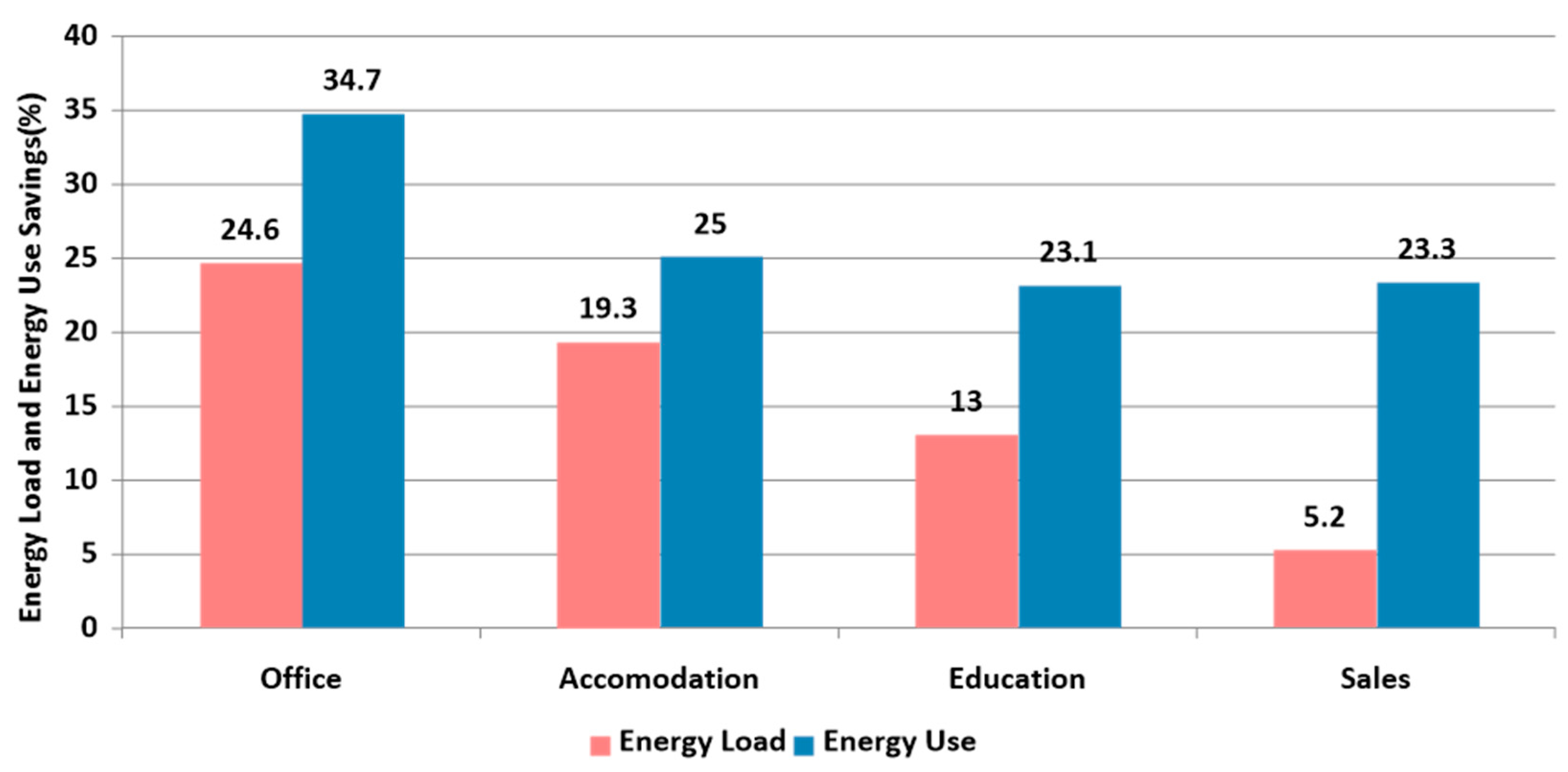
This section presents a quantitative analysis of changes in energy consumption based on the insulation performance levels (Figure 4). The focus is on the energy required for various operational needs: heating, cooling, domestic hot water, lighting, and ventilation. Based on the simulation results, the analysis highlights total energy consumption changes and each building type’s contribution to energy savings across the scenarios. Overall, energy consumption reductions ranged between 23–35% depending on building type, highlighting that insulation reinforcement alone yields varying benefits across load-dominant types.
In sales buildings, an increase in cooling energy was observed under the “insulation reinforced” scenario. This phenomenon is explained by the suppression of nighttime heat dissipation, which raises the indoor baseline temperature and increases the initial cooling demand when systems start operating. The discussion now includes this mechanism as a plausible cause of the cooling-load rebound effect.
(1)
Office buildings
The total energy consumption of office buildings decreased by approximately 34.7%, from 202.39 kWh/m2 in 2019 to 132.12 kWh/m2 at the ZEB level. Significant reductions were observed in lighting and cooling energy. These reductions became more pronounced under the Passive House and ZEB scenarios, reflecting the application of high-efficiency lighting (LED) and solar radiation control through a reduction in SHGC. Heating and ventilation energy showed no notable changes across scenarios, which is attributed to the consistent set-point temperatures and ventilation conditions.
(2)
Accommodation facilities
The total energy consumption for accommodation facilities decreased by approximately 25.0%, from 262.31 kWh/m2 in 2019 to 196.96 kWh/m2 under the ZEB scenario. Cooling and lighting energy saw relatively large reductions due to improvements in window performance and reduced lighting density. Domestic hot water and ventilation energy showed minimal change across scenarios, as these conditions were held constant. However, their proportional share in total energy consumption increased under the ZEB scenario, primarily because other energy components decreased, while hot water and ventilation demands remained stable.
(3)
Educational facilities
Energy consumption in educational facilities decreased by approximately 23.1%, from 229.59 kWh/m2 in 2019 to 176.51 kWh/m2 under the ZEB scenario. The most substantial reductions were observed in cooling and lighting energy, while ventilation and domestic hot water consumption remained largely unchanged. Given the low occupancy density and limited operating hours, these results suggest that enhancing lighting control and HVAC system efficiency may be more effective than envelope insulation alone for energy reduction in educational buildings.
(4)
Sales facilities
The total energy consumption of sales facilities decreased by approximately 23.3%, from 642.29 kWh/m2 in 2019 to 492.48 kWh/m2 under the ZEB scenario. Under the Insulation Reinforced scenario, energy consumption actually increased, likely due to greater thermal storage and a rebound effect in cooling load caused by the high-insulation envelope. Given that sales facilities have an energy load structure dominated by lighting and cooling, insulation-based strategies alone are insufficient for significant energy savings in this building type.
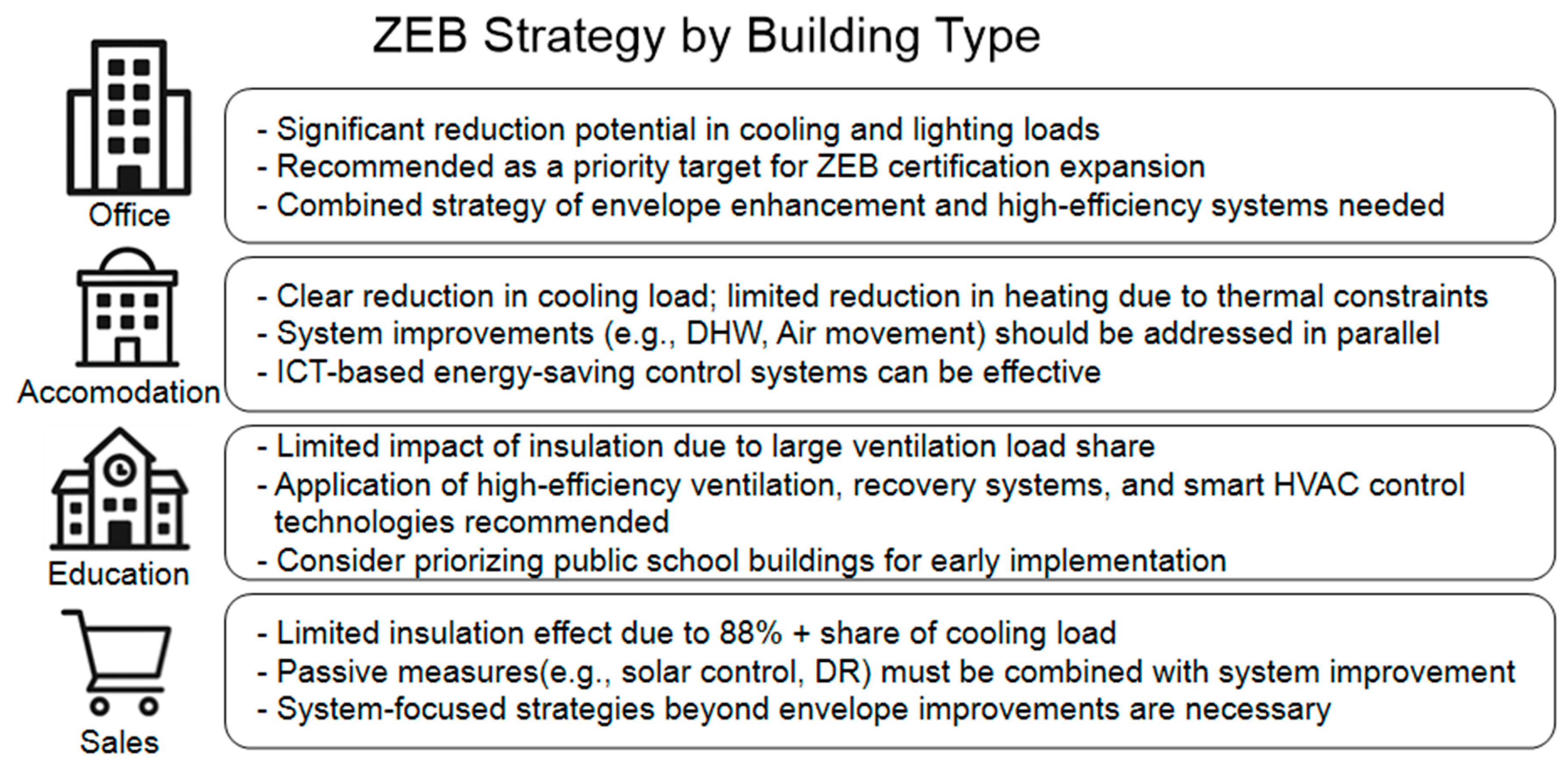
Figure 5 summarizes the key findings into practical ZEB strategy pathways by building type. To enhance clarity, it now includes specific recommendations, such as night ventilation and high-efficiency cooling systems for sales buildings, and dynamic shading for office buildings.

5.3. Reference Building Model Validation

To evaluate the validity of the simulation results for the RB models developed in this study, comparisons were made with energy consumption data from major domestic and international studies by building type. The key reference studies were (1) Kim et al. (2017) [6], who developed statistics-based RB models; (2) Deru et al. (2011) [15], who presented the US DOE office model using EnergyPlus simulations; and (3) Song et al. (2020) [28], who reported measured energy consumption by end-use category for office buildings in Seoul (Table 4).
First, Kim et al. (2017) [6] developed RB models for 11 building types, including private offices, based on statistical data from Korea’s Ministry of Land, Infrastructure and Transport (MOLIT), and presented energy consumption by end-use category. The total energy consumption for office buildings was 380.5 kWh/m2, more than double the value reported in this study. This discrepancy arises from the use of a statistics-based approach that simply aggregates energy use by facility type, without adjusting for system efficiency or actual operating conditions. High shares were reported for heating (31%), cooling (25%), and ventilation (12%), with “other” uses also contributing significantly at 60.5 kWh/m2. These results highlight the limitations of the statistical method in accurately capturing real-world operational characteristics.
Next, Deru et al. (2011) [15] conducted EnergyPlus-based simulations of a medium-sized US DOE office building and reported a total energy consumption of approximately 80.0 kWh/m2, significantly lower than the results in this study. This is mainly due to the adoption of high-efficiency equipment in accordance with U.S. standards and different climate conditions. However, the relative proportions of heating, cooling, and lighting were similar to those in this study, which supports the model’s validity in terms of energy load structure.
Bhatnagar et al. (2019) [7] developed an RB model for commercial buildings—including high-rise office buildings—based on India’s Energy Conservation Building Code (ECBC). Using EnergyPlus simulations, they reported annual energy consumption of 158.4 kWh/m2 for mixed climate regions, assuming 8-h daily operations. While slightly lower than this study’s value (189.9 kWh/m2), the simulation-based nature of both studies allows for direct comparison. Although absolute values for each end-use were not presented, category-wise percentages were: other equipment (30%), lighting (21%), cooling (20%), domestic hot water (15%), ventilation (13%), and heating (1%). These reflect the characteristics of hot-climate buildings with cooling-dominated energy consumption and minimal heating needs.
Song et al. (2020) [28] reported energy consumption based on one year of measured data from 48 office buildings in Seoul, including heating, cooling, domestic hot water, lighting, ventilation, and miscellaneous uses. Given its geographic and categorical similarity, this study serves as a highly reliable comparison. The total energy consumption was 133.6 kWh/m2, compared to 189.9 kWh/m2 in this study. “Other” uses (e.g., plug loads, elevators, office automation equipment) accounted for 47.0 kWh/m2 in Song et al.’s study. Excluding these, the total for core energy uses was 86.6 kWh/m2, indicating a gap of 103.3 kWh/m2 compared to the simulation results. This difference is attributed to idealized conditions in EnergyPlus, such as continuous lighting operation and assumptions regarding internal heat gains.
For category-specific comparisons,
  • Heating: 47.5 kWh/m2 (this study) vs. 36.6 kWh/m2 [28]
  • Ventilation: 13.5 kWh/m2 vs. 5.2 kWh/m2
  • Cooling: 60.7 kWh/m2 vs. 25.5 kWh/m2
  • Lighting: 52.7 kWh/m2 vs. 15.1 kWh/m2
These discrepancies, particularly in cooling and lighting, are likely due to assumptions about solar radiation, window characteristics, and continuous system operation in simulations.
In summary, the RB models in this study show comparable trends with measured data in some categories (e.g., heating and ventilation), but notable deviations in others (e.g., cooling and lighting), which are more sensitive to simulation input values. While limitations exist in quantitative convergence, the models provide a valuable basis for analyzing energy use structures by building type and for exploring scenario-based ZEB strategies. Refining input parameters and conducting sensitivity analyses—particularly for lighting and equipment density—based on measured data could further enhance model reliability.

6. Discussions & ZEB Strategy

This study quantitatively analyzed changes in energy performance according to envelope insulation levels for four types of non-residential buildings: office, accommodation, educational, and sales facilities. The results demonstrated that improving insulation performance is an effective strategy to reduce both energy loads and energy consumption. However, the sensitivity to insulation and the key factors influencing energy savings varied significantly by building type.
In summary, strategies for realizing Zero Energy Buildings (ZEBs) should be tailored to the energy consumption characteristics of each building type. For building types where insulation improvements alone are insufficient, equipment efficiency enhancement and operational control technologies—such as smart HVAC operation and demand-responsive systems—should play a central role (see Figure 5). When developing ZEB implementation policies, decision-makers should adopt a customized zero-energy approach that reflects each building’s usage pattern and corresponding energy reduction potential.
  • Office buildings showed the highest performance improvement under the ZEB-level scenario, with a 24.6% reduction in energy load and a 34.7% reduction in total energy consumption. Significant savings came from cooling and lighting energy, reflecting the benefits of high-efficiency lighting and enhanced solar radiation control. Thus, office buildings are strong candidates for ZEB certification prioritization and policy incentives.
  • Accommodation facilities achieved a 25.0% reduction in total energy consumption, with primary savings in cooling and lighting. However, domestic hot water and ventilation energy remained nearly unchanged across scenarios, suggesting that equipment efficiency improvements in these areas are necessary to achieve further reductions.
  • Educational facilities saw a 23.1% decrease in energy consumption, mainly from cooling and lighting. However, ventilation energy accounted for over 40% of the total load and remained constant across insulation scenarios. This highlights the need to install high-efficiency ventilation systems and heat-recovery devices, and to adopt smart control technologies to improve indoor air quality while reducing heating and cooling demand.
  • Sales facilities had the most cooling-intensive load structure, with cooling accounting for over 88% of the total energy load. In some scenarios, the cooling load even increased due to thermal storage effects from improved insulation. The total energy reduction was only 23.3% under the ZEB scenario, highlighting that insulation-focused strategies alone are insufficient. Therefore, a comprehensive approach combining high-efficiency cooling systems, advanced glazing or dynamic shading, and night ventilation should be prioritized for these building types.
Figure 5 summarizes the key findings into practical ZEB strategy pathways by building type, illustrating how envelope-based and system-based measures should be prioritized. To enhance clarity, it now presents specific recommendations for each type—for example, adopting dynamic shading and low-SHGC glazing for offices, applying night ventilation and ultra-high-efficiency cooling systems for sales buildings, and introducing heat-recovery ventilation systems for educational facilities.
These findings clearly indicate that ZEB strategies for non-residential buildings must be building-type-specific. Where insulation upgrades alone do not yield significant savings, integrating high-efficiency equipment and intelligent operational controls becomes critical. Prioritizing ZEB certification and policy support for building types with higher energy-saving potential—such as office and accommodation facilities—can be an effective strategy to maximize both policy impact and greenhouse gas (GHG) reduction outcomes.

7. Conclusions

This study aimed to quantitatively analyze changes in energy consumption resulting from enhanced insulation levels for four non-residential building types (office, accommodation, educational, and sales facilities) using Reference Building (RB) models. The analysis visually demonstrated the impact of building energy policies across four insulation levels, providing strategic insights for the implementation of Zero Energy Buildings (ZEBs).
It was confirmed that energy consumption can be reduced by more than 23% at the ZEB level in all four building types through the reinforcement of insulation design standards. These findings indicate that strengthening insulation standards in building energy codes is an effective strategy for transitioning from conventional buildings to ZEBs. The main highlights of this study are as follows: (1) the development of reference building models for four representative non-residential types, (2) scenario-based quantification of insulation effects, and (3) identification of building-type-specific ZEB strategies.
Therefore, international collaboration and policy coordination are needed to improve building envelope performance, which has the greatest impact on heating and cooling demands [1,29]. To accelerate the transition toward a market of low-carbon and energy-efficient construction, policymakers should provide clear and consistent regulatory signals along with enhanced financial mechanisms to support the design and retrofitting of high-performance building envelopes. Building energy codes and performance standards can serve as such signals. Swift adoption and implementation of aggressive codes and standards are required for all countries to achieve carbon neutrality.
This study reaffirms that RBs are a valuable evaluation tool for supporting energy policy applications in buildings, as emphasized in previous studies [4,6,7,8,9]. Although RBs are not actual buildings, they can effectively identify energy loads and consumption patterns by generalizing the representative characteristics of existing structures. Accordingly, RBs can serve as a quantitative foundation for evaluating future energy policy scenarios and applying new technologies under standardized conditions.
This research differs from previous studies by empirically validating the applicability of multiple ZEB strategies using measured data and scenario-based simulations. The results clearly show that insulation-level improvements yield different effects depending on the building type, particularly due to variations in load configuration and reduction sensitivity. This highlights the importance of formulating detailed, building-type-specific ZEB strategies rather than uniformly strengthening insulation codes.
Because the simulations in this study primarily focused on envelope performance, the synergistic effects of HVAC systems, lighting systems, renewable energy equipment, and control technologies were not fully considered. For building types such as sales facilities—with high cooling loads and limited insulation-based savings—integrating high-efficiency equipment and demand–response control systems is essential. Future research should conduct integrated simulations that account for interactions between active systems, renewable energy sources, and insulation performance, combined with optimization analyses to evaluate trade-offs between technical and economic performance.
In addition, this study did not include a cost–benefit analysis or economic feasibility evaluation. To ensure practical policy implementation, future studies should address economic performance, incentive mechanisms, and institutional feasibility in parallel with technical validation. Developing a modular RB system that considers variables such as regional climate, construction year, and operational characteristics—as well as scenario-based validation using real-world measurement data—can be an important direction.
Ultimately, ZEB strategies cannot rely solely on improved insulation performance. Equipment efficiency upgrades, operational control technologies, and renewable energy integration must be combined to achieve meaningful energy savings. The effectiveness and feasibility of broad ZEB adoption will improve if policy measures—such as phased introduction of performance standards, prioritization of public buildings, and building-type-specific incentives—are strategically implemented for those building types demonstrating the highest energy-saving potential. The findings from this study can serve as foundational data for such policy planning and may further support future demonstration-based data accumulation and integrated policy impact analysis.

Author Contributions

Conceptualization, Y.-S.J.; methodology, Y.-S.J.; software, Y.-S.J.; validation, H.-S.J. and Y.-S.J.; formal analysis, H.-S.J.; investigation, H.-S.J.; resources, Y.-S.J.; data curation, H.-S.J.; writing—original draft preparation, H.-S.J.; writing—review and editing, Y.-S.J.; visualization, H.-S.J.; supervision, Y.-S.J.; project administration, Y.-S.J.; funding acquisition, Y.-S.J. All authors have read and agreed to the published version of the manuscript.

Funding

This study was carried out as a project to support research and operational expenses of the Korea Institute of Construction Technology by the Ministry of Science and ICT (Task No. 20250224-001, Study to Build the Foundation for 2050 Architecture and Urban Carbon Neutrality Implementation).

Data Availability Statement

The original contributions presented in this study are included in the article. Further inquiries can be directed to the corresponding author.

Conflicts of Interest

The authors declare no conflicts of interest.

Appendix A

Table A1. Input Parameters According to Building Type and Insulation Level.
Building TypeOfficeAccommodation
Input Parameters RIRPHZEBRIRPHZEB
U-valueExterior WallW/m2·K0.2400.1950.1500.1500.3310.2500.1500.100
RoofW/m2·K0.1380.1380.1380.1380.1700.1700.1700.170
Lowest FloorW/m2·K0.1930.1930.1930.1930.2590.2590.2590.259
WindowW/m2·K3.6752.1001.2001.0003.6752.1001.2001.000
Solar
Heat Gain
Coefficient
Window-0.7600.7600.7600.3000.7600.7600.7600.300
Internal
Heat Gain
Occupancy Densityperon/m218.5818.5818.5818.5826.0126.0126.0126.01
Lighting DensityW/m211.8311.835.911.487.847.843.920.98
Electric Appliances DensityW/m25.255.255.255.2514.3014.3014.3014.30
Etc.Ventilationm3/person·h29.0029.0029.0029.0025.0025.0025.0025.00
InfiltrationACH0.900.900.900.900.900.900.900.90
Set-Point
Temperature
Heating°C2020202020202020
Cooling°C2626262626262626
Building TypeEducationSales
Input Parameters RIRPHZEBRIRPHZEB
U-valueExterior WallW/m2·K0.2620.2500.1500.1000.2590.2500.1500.100
RoofW/m2·K0.1750.1750.1750.1750.1470.1470.1470.147
Lowest FloorW/m2·K0.3230.3230.3230.3230.2040.2040.2040.204
WindowW/m2·K3.6752.1001.2001.0003.6752.1001.2001.000
Solar
Heat Gain
Coefficient
Window-0.7600.7600.7600.3000.7600.7600.7600.300
Internal
Heat Gain
Occupancy Densityperon/m24.004.004.004.006.196.196.196.19
Lighting DensityW/m23.443.441.720.4310.2010.205.101.28
Electric Appliances DensityW/m24.004.004.004.0075.0075.0075.0075.00
Etc.Ventilationm3/person·h36.0036.0036.0036.0029.0029.0029.0029.00
InfiltrationACH0.800.800.800.800.800.800.800.80
Set-Point
Temperature
Heating°C2020202020191919
Cooling°C2626262626242424
R: Reference Year, IR: Insulation Reinforced Level, PH: Passive House Level, ZEB: Zero Energy Building Level.

References

  1. International Energy Agency (IEA). Energy Technology Perspectives 2020; IEA: Paris, France, 2020; Available online: https://www.iea.org/reports/energy-technology-perspectives-2020 (accessed on 30 October 2025).
  2. 2050 Presidential Commission on Carbon Neutrality and Green Growth. 2050 Carbon Neutrality Scenario (Draft): Material for Establishing Carbon Neutrality Vision for the New Administration; 2050 Presidential Commission on Carbon Neutrality and Green Growth: Seoul, Republic of Korea, 2021. [Google Scholar]
  3. Ministry of Land, Infrastructure and Transport (MOLIT). The Third Green Building Master Plan (2021–2025); Ministry of Land, Infrastructure and Transport (MOLIT): Sejong City, Republic of Korea, 2021. [Google Scholar]
  4. Kwak, Y.; Kang, J.-A.; Huh, J.-H.; Jeong, Y.-S.; Huh, J.-H. Development and application of a flexible modeling approach to reference buildings for energy analysis. Energies 2020, 13, 5815. [Google Scholar] [CrossRef]
  5. Kwak, Y.; Kang, J.-A.; Huh, J.-H.; Kim, T.-H.; Jeong, Y.-S. An analysis of the effectiveness of greenhouse gas reduction policy for office building design in South Korea. Sustainability 2019, 11, 7172. [Google Scholar] [CrossRef]
  6. Kim, D.W.; Kim, Y.M.; Lee, S.H.; Park, W.Y.; Bok, Y.J.; Ha, S.K.; Lee, S.Y. Development of reference building energy models for South Korea. In Proceedings of the 15th IBPSA Conference, San Francisco, CA, USA, 7–9 August 2017; pp. 2693–2700. [Google Scholar] [CrossRef]
  7. Bhatnagar, M.; Mathur, J.; Garg, V. Development of reference building models for India. J. Build. Eng. 2019, 21, 267–277. [Google Scholar] [CrossRef]
  8. Schaefer, A.; Ghisi, E. Method for obtaining reference buildings. Energy Build. 2016, 128, 660–672. [Google Scholar] [CrossRef]
  9. Geraldi, M.; Garlet, L.; Gapski, N.; Quevedo, T.; Melo, A.P.; Lamberts, R. Developing reference building models for the non-residential sector to support public policies in Brazil. Energy Build. 2025, 332, 115419. [Google Scholar] [CrossRef]
  10. Brandão de Vasconcelos, A.; Almeida, M.; Ferreira, M. A Portuguese approach to define reference buildings for cost-optimal methodologies. Appl. Energy 2015, 140, 316–328. [Google Scholar] [CrossRef]
  11. Lee, J.; McCuskey Shepley, M.; Choi, J. Exploring the effects of a building retrofit to improve energy performance and sustainability: A case study of Korean public buildings. J. Build. Eng. 2019, 25, 100822. [Google Scholar] [CrossRef]
  12. Krarti, M. Evaluation of large-scale building energy efficiency retrofit program in Kuwait. Renew. Sustain. Energy Rev. 2015, 50, 1069–1080. [Google Scholar] [CrossRef]
  13. Korea Energy Agency. 2023 Energy Consumption Statistics in the Building Sector; Building Energy Information Center, Korea Energy Agency: Ulsan, Republic of Korea, 2023. [Google Scholar]
  14. Crawley, D.B.; Lawrie, L.K.; Winkelmann, F.C.; Buhl, W.F.; Huang, Y.J.; Pedersen, C.O.; Glazer, J. EnergyPlus: Creating a new-generation building energy simulation program. Energy Build. 2001, 33, 319–331. [Google Scholar] [CrossRef]
  15. Deru, M.; Field, K.; Studer, D.; Benne, K.; Griffith, B.; Torcellini, P.; Halverson, M.U.S. DOE Commercial Reference Building Models of the National Building Stock (NREL/TP-5500-46861); National Renewable Energy Laboratory: Golden, CO, USA, 2011. Available online: https://www.nrel.gov/docs/fy11osti/46861.pdf (accessed on 28 September 2025).
  16. Ballarini, I.; Corrado, V.; Madrazo, L. Use of reference buildings to assess the energy saving potentials of the residential building stock: The experience of TABULA project. Energy Policy 2014, 68, 273–284. [Google Scholar] [CrossRef]
  17. Evans, M.; Halverson, M.; Delgado, A.; Yu, S. Building energy code compliance in developing countries: The potential role of outcomes-based codes in India. In 2014 ACEEE Summer Study on Energy Efficiency in Buildings; American Council for an Energy-Efficient Economy (ACEEE): Washington, DC, USA, 2014; pp. 8-61–8-74. [Google Scholar]
  18. Corgnati, S.P.; Fabrizio, E.; Filippi, M.; Monetti, V. Reference buildings for cost optimal analysis: Method of definition and application. Appl. Energy 2013, 102, 983–993. [Google Scholar] [CrossRef]
  19. Institut Wohnen und Umwelt (IWU). Typology Approach for Building Stock Energy Assessment (TABULA); Institut Wohnen und Umwelt (IWU): Darmstadt, Germany, 2010; Available online: https://www.building-typology.eu (accessed on 1 February 2025).
  20. Hong, T.; Sun, K.; Chen, Y.; Taylor-Lange, S.C.; Yan, D. An occupant behavior modeling tool for co-simulation. Energy Build. 2020, 207, 272–281. [Google Scholar] [CrossRef]
  21. Jeong, Y.S.; Jung, H.K.; Jang, H.K.; Yu, K.H. A study on the reference building based on the building design trends for non-residential buildings. J. Korean Sol. Energy Soc. 2014, 34, 1–11. [Google Scholar] [CrossRef]
  22. Ministry of Land, Infrastructure and Transport (MOLIT). 2020 Energy Saving Design Standards; Ministry of Land, Infrastructure and Transport (MOLIT): Sejong City, Republic of Korea, 2020. [Google Scholar]
  23. Passive House Institute Korea. Passive House Requirements. Available online: https://www.phiko.kr (accessed on 1 February 2025).
  24. Ministry of Land, Infrastructure and Transport (MOLIT). Building Energy Efficiency Rating Certification Standards; Ministry of Land, Infrastructure and Transport (MOLIT): Sejong City, Republic of Korea, 2022. [Google Scholar]
  25. Ministry of Land, Infrastructure and Transport (MOLIT). Regulations on the Operation of the Building Energy Efficiency Rating Certification System; Ministry of Land, Infrastructure and Transport (MOLIT): Sejong City, Republic of Korea, 2022. [Google Scholar]
  26. Ministry of Land, Infrastructure and Transport (MOLIT). Regulation for Facility in Building; Ministry of Land, Infrastructure and Transport (MOLIT): Sejong City, Republic of Korea, 2023. [Google Scholar]
  27. American Society of Heating, Refrigerating and Air-Conditioning Engineers (ASHRAE). ASHRAE Standard 90.1-2019: Energy Standard for Buildings Except Low-Rise Residential Buildings; ASHRAE: Peachtree Corners, GA, USA, 2019. [Google Scholar]
  28. Song, S.-Y.; Jin, H.-S.; Ha, S.-Y.; Kim, S.-I.; Kim, Y.-J.; Lee, S.-J.; Suh, I.-A. Detailed office building energy information based on in situ measurements. Energies 2020, 13, 3050. [Google Scholar] [CrossRef]
  29. International Energy Agency (IEA). Energy Technology Perspectives 2017; IEA: Paris, France, 2017; Available online: https://www.iea.org/reports/energy-technology-perspectives-2017 (accessed on 30 October 2025).
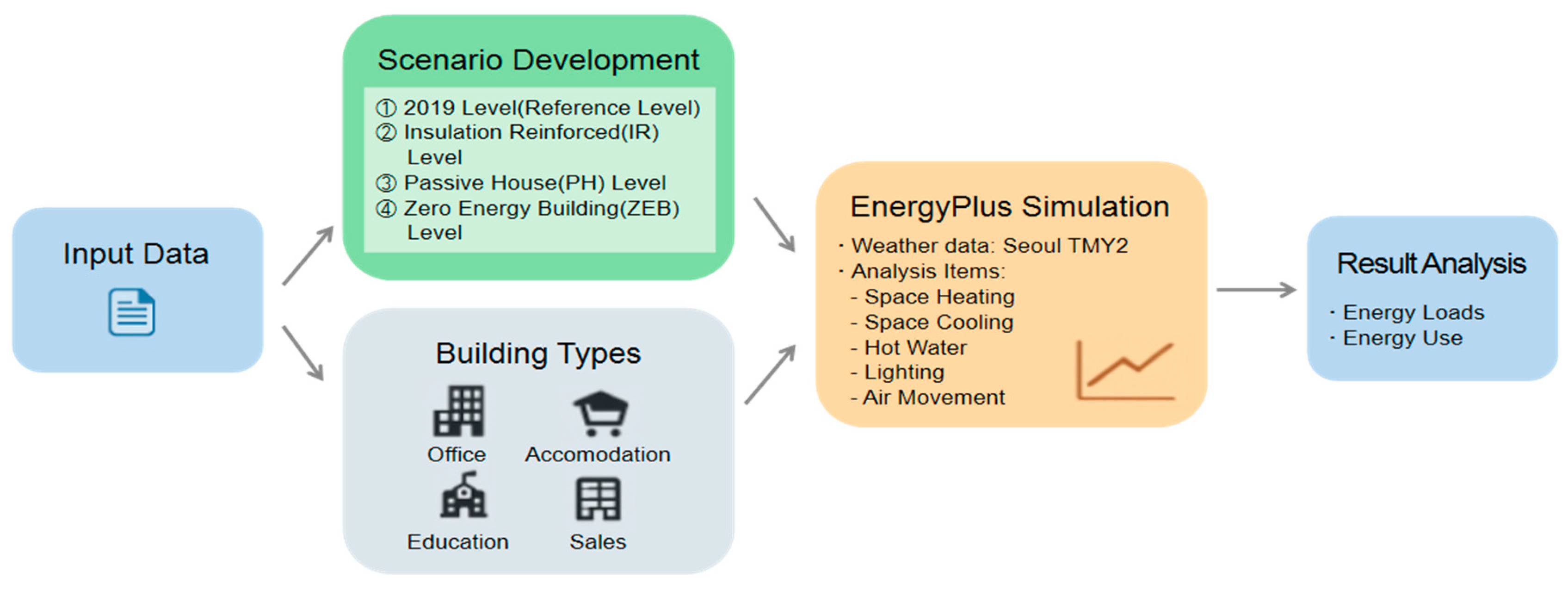
Figure 1. Research flow.
Buildings 15 04366 g001
Figure 2. Trends in input values by building type according to scenario.
Buildings 15 04366 g002aBuildings 15 04366 g002b
Figure 3. Changes in energy load configuration by building type under the insulation reinforcement policy.
Buildings 15 04366 g003
Figure 4. Comparison of energy reduction rates by building type under the ZEB scenario.
Buildings 15 04366 g004
Figure 5. ZEB strategies by building type.
Buildings 15 04366 g005
Table 1. Previous studies on reference building (RB)-based simulation.
CategoryEvaluation ModelResearcherTarget Building TypeMajor Analysis VariableSimulation ToolKey Features
USADOE RB modelDeru et al.
[15]
16 building typesStandard design conditions and operating conditionsEnergyPlus
-
National building group-based simulation model
-
Suitable for comparing scenarios based on the code
EuropeTABULA projectIWU et al. (2010)
[19]
Residential buildings (representative housing type by country)Construction year, insulation thickness, design conditions, etc.PHPP, EnergyPlus
-
Proposal for a European common approach to setting standard housing types based on the retrofit strategies established by country
BrazilRB modelSchaefer&Ghisi (2016)
[8]
Single-family housingWindow configuration and U-valueEnergyPlus
-
Valid for RB-based Retrofit-ZEB evaluation
-
Environment and energy prices by country can be reflected.
IndiaRB modelBhatnagar et al. (2019)
[7]
OfficeForm, envelope conditions, systems, etc.EnergyPlus
DesignBuilder
-
RB-based revision of India’s building energy saving code
South KoreaRB modelHong et al. (2020)
[20]
Apartments (mid/low, middle, and high floor levels)Total floor area, number of floors, window-to-wall ratio, U-value, SHGC, internal heat gain, ACH, etc.EnergyPlus
-
Presents the possibility of constructing representative models based on statistics.
-
Quantification of the difference in energy consumption by apartment type
South KoreaRB modelJeong et al. (2014)
[21]
OfficeU-value, window-to-wall ratio, boiler efficiency, refrigerator COP, etc.ECO2
-
Date-based standard building modeling through the analysis of actual building permits
-
RB construction using statistics-based representative values (e.g., insulation performance, window-to-wall ratio, and equipment efficiency)
South KoreaPresent study Office, accommodation, educational, and sales facilitiesEnvelope U-value, SHGC, internal heat gain, and insulation level scenariosEnergyPlus
-
Quantification of the energy-saving effect resulting from insulation performance improvements by building type
-
Provides a basis for ZEB feasibility evaluation.
Table 2. Summary of Key Simulation Input Parameters by Scenario.
ParameterUnitBaseline
(2019)
Insulation ReinforcedPassive HouseZEB Level
U-valueExterior wallW/m2·K0.2400.1950.1500.150
RoofW/m2·K0.1380.1380.1380.138
Lowest floorW/m2·K0.1930.1930.1930.193
WindowW/m2·K3.6752.1001.2001.000
Window SHGC-0.7600.7600.7600.300
Occupancy densitypersons/m20.10–0.400.10–0.400.10–0.400.10–0.40
Lighting densityW/m211.83
Equipment densityW/m213.6–75.013.6–75.013.6–75.013.6–75.0
Ventilation ratem3/person·h25–3625–3625–3625–36
Infiltration rateACH0.8–0.90.8–0.90.8–0.90.8–0.9
Set-point temperature
(Heating/Cooling)
°C20/2620/2620/2620/24
Table 3. Simulation results by building types and insulation levels.
Building TypeOfficeAccommodation
Output RIRPHZEBRIRPHZEB
Energy
Demand
Space HeatingkWh/m227.8025.0628.4234.6351.8042.9142.5650.83
Space CoolingkWh/m255.6058.5547.2923.4656.3759.8652.6931.25
Air CirculationkWh/m217.0916.8217.1917.6723.1022.6122.5023.78
TotalkWh/m2100.48100.4392.9075.75131.26125.37117.75105.86
Energy
Use
Space HeatingkWh/m247.5143.6047.9652.7947.9639.2839.9349.15
Space CoolingkWh/m260.6763.5154.6641.7520.4721.6618.8811.23
Domestic Hot WaterkWh/m215.5615.5415.5615.5634.7634.7634.7634.76
LightingkWh/m252.6652.6526.316.5940.0740.0720.035.01
Air CirculationkWh/m213.5213.8011.0710.8422.4021.6719.4016.01
TotalkWh/m2189.92189.09155.55127.53165.66157.43133.01116.16
Building TypeEducationSales
Output RIRPHZEBRIRPHZEB
Energy
Demand
Space HeatingkWh/m27.096.216.467.617.576.035.695.80
Space CoolingkWh/m244.1345.9543.9030.58330.58358.38344.82309.88
Air CirculationkWh/m236.2435.6835.6637.8935.4337.9637.9038.55
TotalkWh/m287.4687.8486.0276.08373.57402.37388.42354.22
Energy
Use
Space HeatingkWh/m214.3712.4212.4715.495.083.953.743.87
Space CoolingkWh/m27.727.887.325.02117.00131.89126.47114.03
Domestic Hot WaterkWh/m23.073.073.073.0710.5510.5510.5510.55
LightingkWh/m217.2017.208.602.1553.9053.9026.956.76
Air CirculationkWh/m23.753.873.682.5469.9680.1576.1370.27
TotalkWh/m246.1144.4435.1428.27256.49280.44243.84205.48
R: Reference Year, IR: Insulation Reinforced Level, PH: Passive House Level, ZEB: Zero Energy Building Level.
Table 4. Consumption of energy consumption for office buildings in the present study and previous studies.
ClassificationEnergy Use (kWh/m2)
This StudyKim et al.
[6]
Deru et al.
[15]
Bhatnagar et al.
[7]
Song et al.
[29]
Space Heating47.5125%118.531%26.033%-1%36.627%
Space Cooling60.6732%93.625%21.727%-20%25.519%
Domestic Hot Water (DHW)15.568%12.23%5.37%-15%4.23%
Lighting52.6628%51.013%21.827%-21%15.111%
Air Movement13.527%44.712%5.27%-13%5.24%
Others--60.516%---30%47.035%
Total189.90100%380.5100%80.0100%-100%133.6100%
Disclaimer/Publisher’s Note: The statements, opinions and data contained in all publications are solely those of the individual author(s) and contributor(s) and not of MDPI and/or the editor(s). MDPI and/or the editor(s) disclaim responsibility for any injury to people or property resulting from any ideas, methods, instructions or products referred to in the content.