Article

Digital Twin–Based Simulation and Decision-Making Framework for the Renewal Design of Urban Industrial Heritage Buildings and Environments: A Case Study of the Xi’an Old Steel Plant Industrial Park

School of Art, Xi’an University of Architecture and Technology, Xi’an 710055, China
*
Author to whom correspondence should be addressed.
Buildings 2025, 15(23), 4367; https://doi.org/10.3390/buildings15234367 (registering DOI)
Submission received: 31 October 2025 / Revised: 25 November 2025 / Accepted: 27 November 2025 / Published: 2 December 2025
(This article belongs to the Section Architectural Design, Urban Science, and Real Estate)

Abstract

In response to the coexistence of multi-objective conflicts and environmental complexity in the renewal of contemporary urban industrial heritage, this study develops a simulation and decision-making methodology for architectural and environmental renewal based on a digital twin framework. Using the Xi’an Old Steel Plant Industrial Heritage Park as a case study, a community-scale digital twin model integrating multiple dimensions—architecture, environment, population, and energy systems—was constructed to enable dynamic integration of multi-source data and cross-scale response analysis. The proposed methodology comprises four core components: (1) integration of multi-source baseline datasets—including typical meteorological year data, industry standards, and open geospatial information—through BIM, GIS, and parametric modeling, to establish a unified data environment for methodological validation; (2) development of a high-performance dynamic simulation system integrating ENVI-met for microclimate and thermal comfort modeling, EnergyPlus for building energy and carbon emission assessment, and AnyLogic for multi-agent spatial behavior simulation; (3) establishment of a comprehensive performance evaluation model based on Multi-Criteria Decision Analysis (MCDA) and the Analytic Hierarchy Process (AHP); (4) implementation of a visual interactive platform for design feedback and scheme optimization. The results demonstrate that under parameter-calibrated simulation conditions, the digital twin system accurately reflects environmental variations and crowd behavioral dynamics within the industrial heritage site. Under the optimized renewal scheme, the annual carbon emissions of the park decrease relative to the baseline scenario, while the Universal Thermal Climate Index (UTCI) and spatial vitality index both show significant improvement. The findings confirm that digital twin-driven design interventions can substantially enhance environmental performance, energy efficiency, and social vitality in industrial heritage renewal. This approach marks a shift from experience-driven to evidence-based design, providing a replicable technological pathway and decision-support framework for the intelligent, adaptive, and sustainable renewal of post-industrial urban spaces. The digital twin framework proposed in this study establishes a validated paradigm for model coupling and decision-making processes, laying a methodological foundation for future integration of comprehensive real-world data and dynamic precision mapping.

1. Introduction

In recent years, the process of urban regeneration has accelerated worldwide under the dual context of post-industrial transformation and the reuse of existing urban stock. As carriers of collective memory and industrial culture, industrial heritage sites have gradually shifted from passive conservation toward regenerative reuse [1]. These sites are not only witnesses to history but also repositories of distinctive historical, architectural, and socio-economic value. They play a critical role in sustaining urban identity and ensuring the continuity of cultural heritage. These sites are not only witnesses of history but also carriers of distinctive historical, architectural, and socioeconomic values. They play a crucial role in sustaining urban identity and ensuring the continuity of cultural heritage. Against this backdrop, the emergence of Digital Twin (DT) technology offers new opportunities for urban heritage renewal [2]. Originating from the manufacturing sector, this technology enables data-driven, multidimensional modeling that establishes dynamic mapping and bidirectional interaction between physical assets and their virtual counterparts. It provides a solid scientific foundation for monitoring, forecasting, and optimizing urban systems. Although digital twins have demonstrated substantial effectiveness in areas such as building management, energy control, and environmental monitoring [3], their application to design-driven industrial heritage regeneration remains in an early stage. Existing studies often suffer from simplified model structures, inadequate data integration, and the absence of iterative feedback mechanisms. Moreover, the unique spatial, material, and cultural characteristics of industrial heritage—such as large-span structures, substantial materiality, and layered historical narratives—necessitate modeling and evaluation approaches that extend beyond generic urban digital-twin frameworks. This study selects the Xi’an Old Steel Plant Creative Industry Park as an empirical case because of its typicality and representativeness. As a quintessential heavy-industry heritage site from mid-20th-century China, it embodies the legacy of state-led industrialization while simultaneously confronting the contemporary challenges of urban transformation. Located in a rapidly developing urban district, the site features distinct architectural typologies and strong cultural symbolism, making it an ideal testing ground for exploring how digital twins can support the integrated regeneration of industrial-heritage buildings and their surrounding environments. Moreover, the park is undergoing a transition from a production-oriented factory complex to a multifunctional creative-industry hub, creating an urgent need for a performance-driven design approach capable of balancing heritage conservation, environmental sustainability, and spatial vitality.
To address these research gaps and respond to practical needs, this study develops a digital-twin framework for the Old Steelworks Creative Industry Park that integrates multi-source data on buildings, the environment, human activities, and energy systems. The framework establishes a dynamic simulation and multi-objective evaluation system tailored to design interventions, enabling synchronized analysis and optimization between virtual and physical spaces. The main innovations of this study can be summarized as follows:
(1)
Object innovation: Focusing on the unique category of urban industrial heritage, the study proposes a multi-dimensional digital twin modeling method;
(2)
Methodological innovation: Achieving deep coupling among ENVI-met (V5.0) microclimate simulation, EnergyPlus building energy analysis, and AnyLogic multi-agent behavioral simulation to quantitatively evaluate the comprehensive performance of design interventions;
(3)
Application innovation: Developing a dynamic and visualized multi-criteria decision-support workflow that promotes a paradigm shift in urban regeneration—from experience-based planning toward data-driven and interactive design.
Our emphasis on “distinctiveness” does not refer to the site’s irreplicable local culture, but rather to the typological commonalities it exhibits in spatial structure, technical systems, and regeneration challenges. These shared characteristics enable insights derived from a single representative case to be translated into broadly applicable methodological guidance. Specifically:
(1)
Commonality in spatial structures and forms: Industrial heritage sites typically contain large-scale and structurally robust buildings—such as long-span workshops and tall warehouses—along with spatial patterns shaped by historical production flows, including linear axes and clustered layouts. These distinctive spatial carriers define a universal set of technical challenges in adaptive reuse, including daylighting, ventilation, energy performance, and the reprogramming of large interior volumes.
(2)
Commonality in technical systems and performance bottlenecks: Across different regions, traditional industrial buildings share similar deficiencies, such as poor thermal performance of the envelope (e.g., insufficient insulation of brick walls, air leakage around high-level windows), outdated energy systems, and weak microclimate regulation leading to heat-island risks. These shared shortcomings constitute a common baseline for environmental and energy-efficient retrofitting.
(3)
Commonality in multi-objective conflicts: Industrial-heritage regeneration inevitably navigates tensions between preservation and renewal, memory and innovation, historic value and contemporary functionality. Balancing multiple objectives—cultural adaptability, environmental comfort, energy efficiency, and spatial vitality—forms a complex decision-making landscape shared by all industrial-heritage renewal projects.
Therefore, although the Old Steel Mill in Xi’an is unique in its historical context and physical form, the typological commonalities it embodies make it an ideal prototype for methodological development and validation. This study leverages the site to construct a digital-twin framework capable of addressing these shared challenges. Owing to its modular architecture, the framework can be transferred to other industrial-heritage contexts by simply adapting site-specific inputs (e.g., building geometry, local climate data). This demonstrates its strong methodological representativeness and transferability.
This study aims to propose a comprehensive theoretical and methodological framework, which will ultimately be fully calibrated and validated using real-world empirical data in the future.

2. Literature Review

2.1. From Manufacturing to Urban Systems: The Paradigm Evolution of Digital Twin

In recent years, Digital Twin (DT) technology, as a core component of the digitalization paradigm, has gradually expanded from its origins in manufacturing to the domains of architecture and urban regeneration. Grieves (2014) first systematically proposed the theoretical framework of the digital twin, emphasizing its core principle of establishing a bidirectional data mapping and feedback mechanism between the physical entity and its virtual model [4]. Negri et al. (2017) subsequently integrated DT into the broader framework of Cyber-Physical Systems (CPS), highlighting its pivotal role in real-time sensing, dynamic simulation, and intelligent decision-making [5]. With the rapid advancement of the Internet of Things (IoT) and artificial intelligence (AI), digital twin technology has been increasingly adopted in architecture, urban planning, and cultural heritage conservation, forming multi-scale and multi-dimensional frameworks for digital simulation and decision-making.
At the architectural and urban scales, Batty (2024) notes that the Urban Digital Twin (UDT) is not merely a three-dimensional virtual replica of the physical city, but an integrated platform combining real-time data, predictive analytics, and policy evaluation [6]. Liu et al. (2024), through a systematic literature review, found that current DT research in the architectural domain primarily focuses on energy management, environmental monitoring, and operation decision-making, with key enabling technologies including Building Information Modeling (BIM), Geographic Information Systems (GIS), IoT sensing, cloud computing, and AI algorithms [7]. However, persistent challenges remain regarding data interoperability, model standardization, and the lack of sustainable maintenance mechanisms.

2.2. From Independence to Coupling: Integration of Multi-Physical Field Simulation Technologies in Urban Environments

At the urban environmental simulation level, the ENVI-met model developed by Bruse and Fleer (1998) provides a high-resolution numerical tool for microclimate analysis, capable of assessing energy exchanges among surfaces, vegetation, and building envelopes [8]. Similarly, the EnergyPlus model proposed by Crawley et al. (2001) has been widely applied in building energy consumption and thermal environment simulations [9]. In recent years, researchers have attempted to couple ENVI-met and EnergyPlus across multiple scales to achieve integrated assessments linking outdoor environmental conditions to building energy performance, thereby providing scientific and quantitative foundations for urban regeneration design. In recent years, research focus has shifted from the independent use of tools to the deep coupling of multi-physical field models, enabling comprehensive assessments from outdoor environmental conditions to building energy performance. Tsoka et al. (2023) quantified the impact of cool pavement strategies on building energy consumption by coupling ENVI-met with Energy Plus [10]. Pasandi et al. (2025) further developed a coupled simulation workflow to accurately quantify the feedback effects of urban microclimates on building energy use [11]. Meanwhile, the introduction of new methods such as machine learning has significantly enhanced simulation efficiency and analytical insight. Nouri et al. (2024) conducted an efficient sensitivity analysis of building energy performance simulations by combining surrogate modeling with the Sobol method [12]. Furthermore, Geng et al. (2024) proposed a machine learning-driven digital twin model to generate intelligent responses for cultural heritage areas within urban contexts [13]. These recent advances provide a solid methodological foundation for constructing the coupled simulation system in the present study.
The adaptive reuse and renewal of industrial heritage represent a critical pathway toward sustainable urban transformation. Yung and Chan (2012) argue that adaptive reuse of industrial heritage can significantly reduce carbon emissions and construction energy consumption while preserving historical value, though it remains constrained by policy, economic, and technical factors [14]. Vafaie et al. (2023) further emphasized, through a systematic review, the pivotal role of heritage reuse in enhancing urban sustainability and social vitality [15]. In the Chinese context, Liu et al. (2021) developed an Analytic Hierarchy Process (AHP)-based industrial heritage value assessment model using the Xi’an Steel Plant as a case study, verifying the feasibility and scientific robustness of multi-criteria evaluation in heritage renewal decisions [16].

2.3. From Static Conservation to Smart Regeneration: Paradigm Shifts and Technological Empowerment in Industrial Heritage

With the rise in digital heritage preservation, scholars have introduced the concept of the Heritage Digital Twin (HDT) as a new framework. Niccolucci et al. (2023) and Mazzetto et al. (2024) emphasize that heritage digital twins should extend beyond static 3D models to incorporate temporal dimensions and multi-source data for structural health monitoring, risk assessment, and interactive public engagement [17,18]. Su et al. (2024), from an engineering management perspective, systematically reviewed DT applications in building lifecycle management, providing theoretical support for intelligent operation and maintenance of heritage buildings [19]. Meanwhile, the authenticity and integrity principles outlined by ICOMOS in the Venice Charter (1964) remain fundamental international norms in the digital transformation of industrial heritage, offering ethical and methodological guidance for technology-mediated cultural conservation [20].
Recent studies on industrial heritage regeneration have emphasized a paradigm shift from “passive conservation” toward “regenerative preservation and adaptive reuse” [21,22,23,24]. Both academia and practice increasingly focus on how to retain historical and cultural values while introducing new social and economic functions to the site, thereby achieving synergy with the sustainable transformation of cities (Bullen & Love, 2011; Pendlebury, 2013) [25,26]. Industrial heritage has thus evolved from a static monument to a dynamic urban resource, with the emphasis placed on balancing authenticity, reuse, and sustainability. From a methodological perspective, contemporary research reveals a dual-path framework of “spatial morphology–social structure” in the renewal of industrial heritage. On the one hand, physical interventions—such as morphological adaptation, functional hybridization—aim to improve the quality and performance of built environments [27]. On the other hand, social mechanisms—including public participation, cultural programming, and governance innovation—serve to reactivate community networks and strengthen collective identity. However, recent reviews have noted that single-dimensional approaches often fail to balance ecological restoration, energy efficiency, and social adaptability in the long term (Xie, 2020) [28].
(1)
At the technological level, the emergence of the Urban Digital Twin (UDT) provides a new methodological foundation for managing and designing complex historical environments. By establishing a data-driven coupling between physical and virtual spaces, UDT enables real-time monitoring, predictive simulation, and decision optimization within urban systems (Deren, L et al., 2021) [29]. The integration of BIM, GIS, and IoT has become the core pathway for constructing city-scale twins. Standardization efforts—such as IFC and City GML—have advanced geometric and semantic interoperability [30,31,32]; however, challenges remain in semantic mapping, spatiotemporal synchronization, and large-scale visualization (e.g., real-time rendering in Unreal, Unity, or Cesium environments).
(2)
In the field of decision support, Multi-Criteria Decision Analysis (MCDA) has been widely adopted to comprehensively evaluate indicators such as energy efficiency, thermal comfort, cultural value, and economic benefits. When combined with multi-objective optimization algorithms (e.g., NSGA-II) [33], MCDA enables the generation of Pareto-optimal solution sets for competing design objectives. Furthermore, machine learning (ML) and explainable AI (XAI) approaches are increasingly applied to extract environmental response patterns from large-scale monitoring data, accelerating parameter scanning and data-driven scheme selection [34]. The hybridization of CFD/microclimate simulations with ML models has also become a key trend for improving computational efficiency and predictive accuracy in environmental simulations.

2.4. Literature Review Summary and Research Positioning

Overall, existing research has established a foundational framework for urban and architectural renewal centered on digital twin technology, achieving significant progress in microclimate modeling, energy simulation, structural evaluation, and cultural value preservation. Nevertheless, specific gaps remain within the domain of urban industrial heritage building and environmental renewal design.
(1)
The coupling mechanisms among building performance, environmental dynamics, and human behavior are still incomplete, limiting cross-scale model interaction.
(2)
Multi-objective decision models often lack the precision needed to balance energy saving, thermal comfort, cultural continuity, and spatial vitality.
(3)
Long-term data maintenance and feedback mechanisms of digital twins remain underdeveloped, hindering the continuous monitoring and dynamic evaluation of heritage spaces.
To address these challenges, this study proposes a digital-twin-based framework integrating multi-model simulation and multi-objective decision support for industrial heritage regeneration. The framework aims to enhance the scientific basis and sustainability of urban regeneration processes.

3. Materials and Methods

3.1. Research Framework and Technical Route

This study establishes a digital-twin-based research framework for the environmental renewal of industrial heritage sites, following the overall logic of “data integration—model construction—design intervention—dynamic simulation—decision optimization.” The proposed technical workflow comprises four major components: (1) integrating multi-source datasets—including BIM (2025), GIS (V10.7), and IoT sensing—to generate fine-grained digital representations of building, environmental, energy, and human activity systems; (2) developing a bidirectionally coupled digital–physical twin model that offers both visual and parametric support for design interventions; (3) conducting dynamic simulations to quantify the impacts of different strategies on energy consumption, microclimate performance, and spatial vitality; and (4) establishing a data-driven decision-making process through multi-criteria decision analysis (MCDA) and iterative feedback optimization (Figure 1).

3.2. Data Collection and Integration

In the process of constructing the digital twin system, although this study aims for high-precision data integration, it is constrained by multiple factors such as the research duration, data acquisition conditions, and privacy protection requirements. The core of this study lies in methodological validation; therefore, parameterized simulation data derived from authoritative sources are adopted as the baseline. These data are generated through structured attribution and spatial mapping of representative values extracted from open datasets, published literature, and technical standards, followed by consistency calibration to establish a theoretically reliable experimental environment. Parameter setting and spatial reconstruction are primarily based on field investigations, open spatial information platforms (e.g., OpenStreetMap), and comparative analyses of representative industrial heritage renewal projects. Multidimensional indicators—including building geometry, environmental monitoring data, population activity characteristics, and energy consumption—are calibrated with reference to existing literature, industry standards (such as GB/T 50378 Evaluation Standard for Green Building) [35], and historical statistical records during the data generation process.
During the data integration stage, the study employs CityGML and IFC standards to achieve semantic unification and spatial mapping of multisource data, ensuring the logical consistency and scalability of the virtual model structure [36]. The simulation database, constructed through time-series alignment and spatial indexing algorithms, can partially reflect the dynamic characteristics of the building and environmental systems in the Old Steel Plant area; however, its numerical attributes should be understood as theoretical simulation results rather than empirical measurements. Therefore, this dataset is primarily intended to validate the technical framework and feasibility of the digital twin system, rather than to perform precise quantitative analysis of a specific site. This approach ensures both the reproducibility of the research process and the methodological validity, while also providing a feasible technical pathway for subsequent optimization and validation based on real-world measured data (Table 1).

3.3. Construction of the Digital Twin

In this study, the Digital Twin (DT) is defined as a multi-scale and temporally resolved digital replica of the physical entity of the Xi’an Old Steel Mill Industrial Park across three dimensions: spatial configuration, physical–environmental behavior, and operational dynamics. Its purpose is to enable real-time or near–real-time multidisciplinary simulation coupling during the design intervention stage, thereby supporting microclimate optimization, building energy assessment, and spatial vitality analysis [37,38]. To avoid conceptual ambiguity, the DT is explicitly decomposed into three layers—data, model, and service. For each layer, we specify the corresponding inputs and outputs, temporal resolution, and calibration methods to ensure reproducibility and verifiability.

3.3.1. Platform Architecture Design

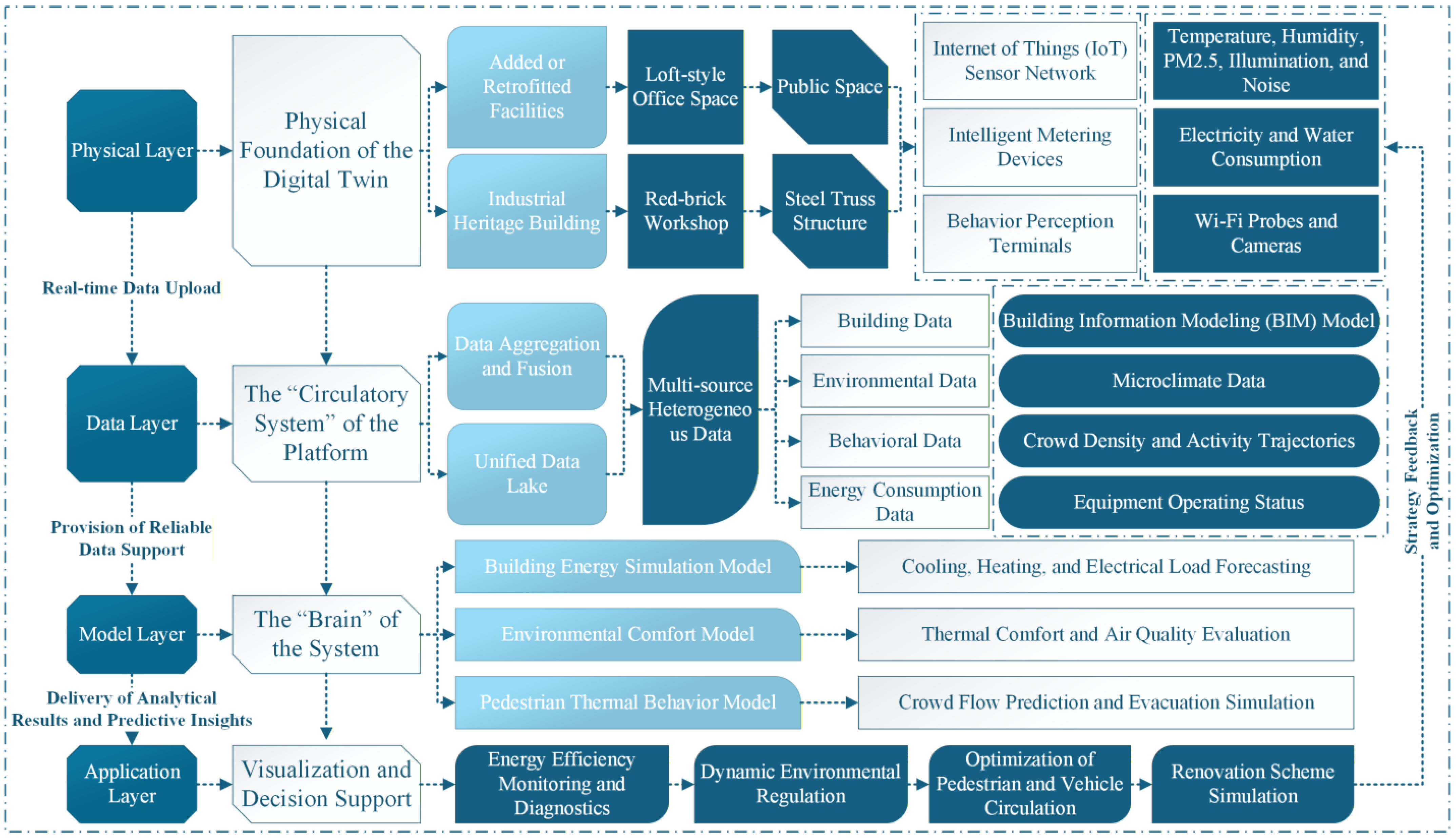
Under the guiding principles of “urban renewal and ecological restoration” and sustainable development, the renewal of industrial heritage sites has evolved beyond mere functional transformation of buildings, toward refined, intelligent park management and the enhancement of spatial performance [39,40]. To achieve this goal, digital twin technology—serving as an emerging paradigm that integrates the physical world with the information space—offers an innovative pathway for the modernized governance of historic industrial complexes (Figure 2).
Physical Layer: Digital reconstruction of heritage elements
(1)
Building entities: Based on historical drawings, on-site surveys, and public mapping sources (e.g., OpenStreetMap), we developed parametric BIM models for 14 key industrial buildings in the park—such as the No. 1 and No. 2 rolling workshops—together with the newly added LOFT spaces. The models accurately reproduce characteristic features of industrial heritage, including long-span steel frames and red-brick facades.
(2)
Hypothetical sensor network: To construct a complete simulation loop, the study conceptually designs an Internet-of-Things (IoT) sensor network, in which virtual monitoring nodes are deployed across the site (Table 2).
Data Layer: Standardized integration of multi-source heterogeneous data
Functioning as the circulatory system of the digital twin, this layer is responsible for aggregating, integrating, and managing the multi-source heterogeneous data collected from the physical layer. Specifically, it encompasses the following components:
(1)
Geometric Data: High-precision BIM models are developed based on historical architectural drawings and 3D laser scanning, containing detailed information on building structure, material properties, and spatial functions.
(2)
Environmental and energy data: Synchronizing the typical meteorological year data for Xi’an with conceptual sensor readings and simulated energy-consumption data to establish a unified spatiotemporal index.
(3)
Behavioral Data: Human flow density, spatial heatmaps, and behavioral trajectories within the park are dynamically identified through the integration of GIS-based spatial analysis and mobile signaling data.
(4)
Energy Consumption Data: Data from the IoT system capturing total building energy use and the operational status of key systems, such as HVAC and lighting equipment. All data undergo cleaning and standardization processes before being stored and managed within a unified data lake, which ensures a reliable and consistent data foundation for the upper-level modeling and simulation processes [41,42,43].
Model Layer: Performance-simulation engines tailored to renewal strategies
Serving as the “brain” of the digital twin, this layer integrates multidisciplinary and multi-scale simulation models, enabling in-depth analysis and intelligent decision-making.
(1)
Building Energy Model (EnergyPlus V9.1.0): Using the building geometry and envelope material properties exported from the BIM model, together with TMY weather data, the model dynamically simulates hourly energy consumption and carbon emissions under alternative retrofit scenarios (e.g., enhanced insulation or window replacement) [44].
(2)
Microclimate Model (ENVI-metV5.0): Based on on-site vegetation patterns, ground-surface materials (e.g., high-absorption asphalt), and 3D building morphology, this model evaluates how design interventions—such as additional greenery or water features—affect outdoor thermal conditions, including UTCI, surface temperature, and wind fields [45].
(3)
Pedestrian Behaviour Model (AnyLogic V8.7): Three types of agents—visitors, employees, and residents—are defined, whose behavioral rules (route selection, dwelling decisions) are jointly driven by spatial accessibility, visual attraction, and environmental comfort (UTCI) derived from the ENVI-met model. The model predicts the intensity and spatial distribution of public-space use [46,47].
Application Layer: Visualization and interaction modules that support design-oriented decision-making
The application layer is implemented in the Unity3D engine and provides an interactive interface for researchers and designers. Its core function is to enable parameterized design and real-time feedback. Users can adjust design parameters—such as greenery ratio, external wall insulation thickness, and activity-node configuration—while the system automatically triggers the coupled simulations in the background. Within a few minutes (depending on predefined simulation workflows), the platform returns the resulting changes in energy consumption, UTCI, and pedestrian density through visualized charts and heat maps [48,49].

3.3.2. Real-Time Update and Feedback Mechanism

(1)
Forward Data-driven Update Mechanism: In practical applications, sensor data from the physical layer can be continuously fed into the data layer at minute- or even second-level intervals, driving dynamic calibration and updates of the simulation models in the model layer [50,51].
(2)
Reverse Intelligent Decision Feedback: Simulation and analysis outputs from the model layer are processed through decision-making algorithms at the application layer to generate optimized control strategies or management recommendations, which are then transmitted back to the actuators in the physical layer. For instance, if the environmental comfort model predicts imminent thermal discomfort in a specific area, the system can automatically adjust the local HVAC settings [52].

3.3.3. Model Coupling and Interfaces

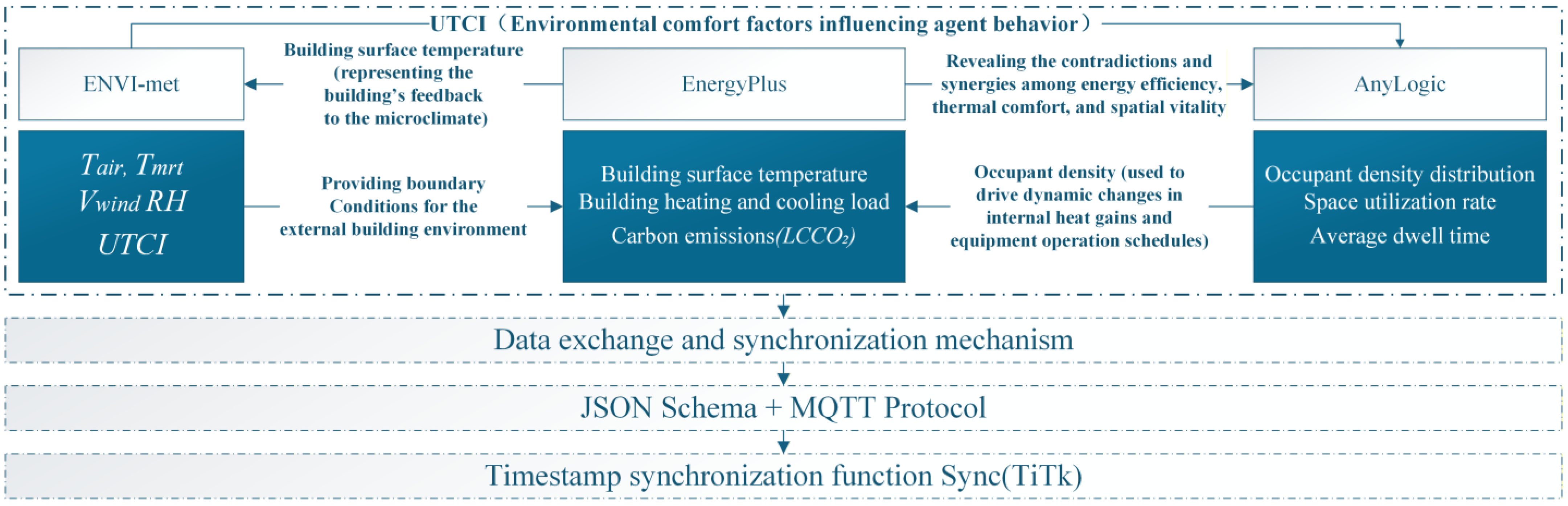
In the construction of a digital twin system, model coupling and interface design are critical for achieving virtual–physical synchronization and cross-domain simulation. Within the multi-layer framework of “Data Layer–Model Layer–Application Layer”, this study develops data exchange protocols and parameter mapping mechanisms for three core submodels—building, environment, and population behavior—to ensure real-time, consistent, and scalable data flow among the models. At the data exchange level, a lightweight data communication structure based on JSON Schema and MQTT protocol is adopted to enable asynchronous data transmission among the building energy simulation module, microclimate simulation module and spatial vitality analysis module [53,54]. Using a timestamp indexing mechanism T i = { t 1 , t 2 , , t n } , outputs from each model are encapsulated into standardized objects in a unified format:
D i , j = { I D , T i , P j , U u n i t , V a l r e a l }
In the equation, D i , j represents the output of the j-th parameter from the i-th model; P j denotes the parameter identifier; U u n i t indicates the measurement unit; and V a l r e a l corresponds to the real-time value. Data are synchronized at the interface layer using a time-alignment function:
S y n c T i , T k = m i n t i t k
This ensures temporal consistency across multiple models.
At the parameter mapping layer, a bidirectional parameter mapping matrix, M m a p , is established among the models:
M m a p = α 11 α 12 α 1 n α 21 α 22 α 2 n α m 1 α m 2 α m n
which represents the mapping weight or influence coefficient between the i-th input parameter and the j-th output parameter; m denotes the number of input parameters (e.g., temperature, humidity, and radiation intensity from the microclimate model), and n denotes the number of output parameters (e.g., input variables required by the building energy model or spatial vitality model). In this study, the mapping matrix is constructed based on experimental or hypothetical data, primarily to test the effectiveness of model interfaces and data transmission logic (Table 3).
Data Source Assumptions: The simulation inputs are derived from the microclimate model (air temperature, wind speed, solar radiation), and the outputs are subsequently fed into the building energy model and the spatial vitality model.
Parameter Relationship Definition: The contribution of each input variable to the target model parameters is determined through linear normalization or weighted functions (e.g., weights obtained from sensitivity analysis), resulting in the corresponding values. α i j values.
Data Exchange Protocol: During the coupling process, the system performs data matching and conversion according to the M m a p matrix, ensuring consistency in parameter dimensions, units, and time steps. Therefore, M m a p does not represent results from actual observational data; rather, it serves as a structured simulation tool to verify the logic of model interactions, the correctness of parameter transfer, and system stability. Its results can provide a baseline reference for subsequent calibration and sensitivity testing when real data are incorporated.
Mechanisms of Model Coupling and Data Exchange:
  • Coupling Mechanism A: From Outdoor Microclimate to Building Energy Use
    (1)
    ENVI-met outputs: After completing the typical-day simulation, ENVI-met produces hourly microclimatic variables, including air temperature, humidity, wind fields, and radiative heat fluxes.
    (2)
    Data transfer and mapping: After filtering and spatial aggregation through the parameter-mapping matrix M m a p , the processed results are converted via a JSON–MQTT interface into site-specific hourly weather files, which replace the typical meteorological year data as external boundary conditions for EnergyPlus.
    (3)
    EnergyPlus inputs: EnergyPlus performs energy simulations using this microclimate modified by buildings and vegetation, enabling the quantification of how interventions such as added greenery reduce cooling loads through local temperature mitigation.
  • Coupling Mechanism B: From Environmental Variables to Human Behavior and Indoor Heat Gains
    (1)
    ENVI-met outputs: ENVI-met provides the Universal Thermal Climate Index (UTCI) as a key indicator of outdoor environmental comfort.
    (2)
    AnyLogic inputs and decision-making: The UTCI values are fed into the AnyLogic agent-based model as a core variable within the spatial choice probability function. Agents (pedestrians) tend to select and remain in areas with more favorable comfort conditions.
    (3)
    AnyLogic outputs: This rule-based simulation produces an hourly distribution of indoor occupancy across all buildings within the site.
    (4)
    EnergyPlus inputs: The dynamic occupancy profiles are converted into internal heat-gain schedules and incorporated into EnergyPlus as essential input parameters.
    (5)
    Closed-loop feedback: EnergyPlus recalculates energy consumption based on the updated internal loads. Changes in HVAC operation may further affect indoor conditions, forming—at more advanced levels of implementation—a complete feedback loop across the coupled models.
This allows dynamic coupling and visualized decision support of thermal environment responses, energy consumption patterns, and spatial vitality simulations for the Old Steel Plant area to be realized within a single digital twin platform (Figure 3).

3.4. Design Interventions and Simulation Scenario Setup

To systematically evaluate the combined effects of various renovation measures on the environment, energy consumption, and social vitality of the Xi’an Old Steel Plant campus, three representative intervention scenarios (Scenarios A, B, and C) were designed and subjected to multiple coupled simulations within a digital twin framework. For each scenario, a control group was established based on the baseline condition (current status), and parametric variables were employed to enable reproducible and comparable sensitivity analyses.

3.4.1. Design Intervention Scenario Setup

(1)
Scenario A: Green Space Expansion and Microclimate Regulation—aims to reduce surface temperatures and improve thermal comfort through ground surface modification and increased vegetation coverage. The implementation in the model includes increasing the greening ratio G of the study unit (baseline +10%, +20%, +30%); replacing low-albedo pavements with high-albedo materials; introducing small-scale water features in plazas and streets. ENVI-met is used for three-dimensional microclimate simulation coupling surface–vegetation–radiation processes, outputting hourly fields. In the multi-agent model, environmental comfort (represented by UTCI) is mapped as part of the individual stay preference function to examine the secondary effects of microclimate improvements on crowd behavior [56,57,58].
(2)
Scenario B: Building Facade Renovation and Energy Efficiency Enhancement—aims to reduce building operational energy consumption and lifecycle carbon emissions. Key interventions include: increasing external wall insulation thickness, reducing window-to-wall ratio (WWR), introducing low-emissivity glazing and controllable shading devices, and installing rooftop BIPV (Building-Integrated Photovoltaics) systems [59,60,61].
(3)
Scenario C: Redesign of Public Activity Spaces and Optimization of Crowd Distribution—aims to enhance dwell time and spatial vitality through improved spatial connectivity and functional layout. Design interventions include: opening secondary factory buildings as atriums/activity spaces, adding pedestrian connectivity nodes, and introducing small-scale cultural activity nodes and nighttime lighting strategies. The AnyLogic/PedSIM multi-agent model is employed to simulate the travel-stay behavior of three groups (visitors, workers, and residents), with the behavioral utility function incorporating accessibility A i , visual attractiveness V i and environmental comfort C i [62,63].

3.4.2. Simulation Period and Dynamic Parameter Settings

To ensure that the simulation results accurately capture the dynamic effects of design interventions under typical climatic conditions, the study establishes the following simulation benchmarks:
(1)
Simulation Period and Simulation Dimensions:
Microclimate and Thermal Comfort Simulation: For microclimate and energy consumption simulations, 27 July (Friday) is selected as a representative summer day, with a full 24 h simulation period. This date adequately reflects high temperature and strong radiation conditions typical of summer, facilitating the assessment of cooling and energy-saving potential. For crowd activity simulations, to capture variations between weekdays and weekends, the simulation period is set as a full weekly cycle, with particular attention to differences in crowd distribution between a weekday (27 July) and a weekend day (29 July, Sunday).
Three-dimensional microclimate simulation of the Xi’an Old Steel Plant renovation area was conducted using ENVI-met (V5.0). A typical summer sunny day was selected as the sample, with hourly meteorological data input from 10:00 to 17:00. The primary output indicators include the Universal Thermal Climate Index (UTCI), air temperature field ( T a i r ), and wind speed distribution ( V w i n d ). UTCI is calculated according to the following formula:
U T C I = f ( T a i r , V w i n d , T m r t , R H )
In the formula, T a i r represents air temperature (°C), indicating the basic thermal state of the environment surrounding the human body and serving as a fundamental parameter for heat balance calculations. V w i n d denotes wind speed (m/s), which affects convective heat transfer on the human body surface and serves as the main factor for cooling effects. T m r t is the mean radiant temperature (°C), reflecting the combined radiative effects from surrounding buildings, ground, and sky. RH represents relative humidity (%), determining the water vapor partial pressure in the air (Table 4).
Building Energy and Carbon Emission Simulation: EnergyPlus (V23.1) was employed to analyze the building energy performance of preserved industrial heritage structures in the Xi’an Old Steel Plant. Inputs include building energy parameters before and after renovation (wall insulation performance, window-to-wall ratio, photovoltaic roof configurations, etc.) to calculate the building’s life-cycle carbon emissions (LCCO2):
L C C O 2 = i = 1 n ( E i × E F i )
In the formula, E i denotes energy consumption at stage i (kWh), including electricity, gas, and thermal energy; E F i represents the carbon emission factor corresponding to the energy type, i.e., the CO2 equivalent per unit of energy consumed (kgCO2/MJ or kgCO2/kWh). L C C O 2 represents the total life-cycle carbon emissions (kgCO2 or tCO2). n denotes the total number of energy types or stages considered in the life cycle.
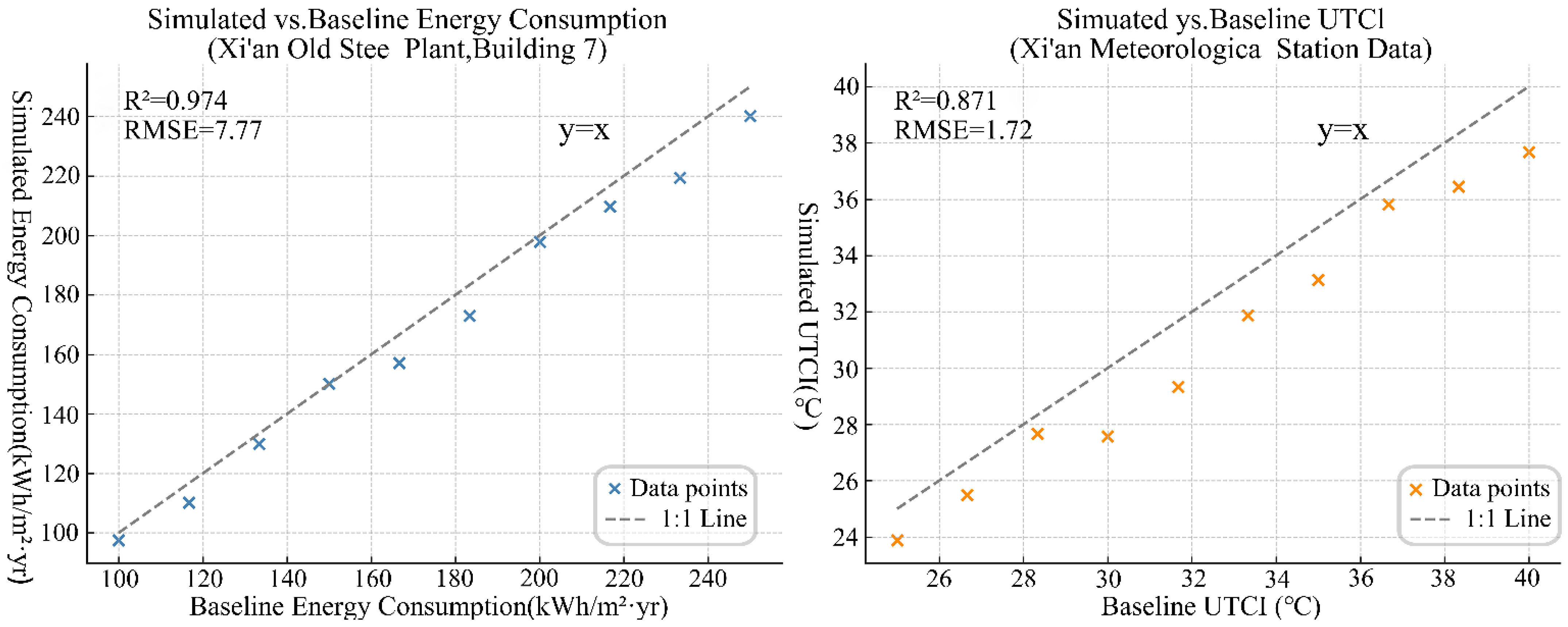
By quantifying energy consumption across material production, construction, operational use, maintenance, and end-of-life recycling stages, the overall carbon emissions of the building can be calculated. Energy consumption for each stage is obtained from energy models or statistical yearbooks, while corresponding carbon emission factors are based on the National Greenhouse Gas Inventory or international databases (e.g., IPCC, Ecoinvent) (Figure 4).
Building energy data are based on the energy simulation of Building 7 in the Xi’an Old Steel Plant, calibrated with measured energy consumption data from existing industrial building renovations in Xi’an (referenced from Building Energy Efficiency Technology, Issue 12, 2021) and the Chinese building energy standard GB/T 50189-2015 [55]. UTCI data are derived from the Xi’an Meteorological Station (109.02° E, 34.27° N) for July 2024, calibrated using the typical summer climate dataset of Xi’an (sourced from the National Meteorological Science Data Center).
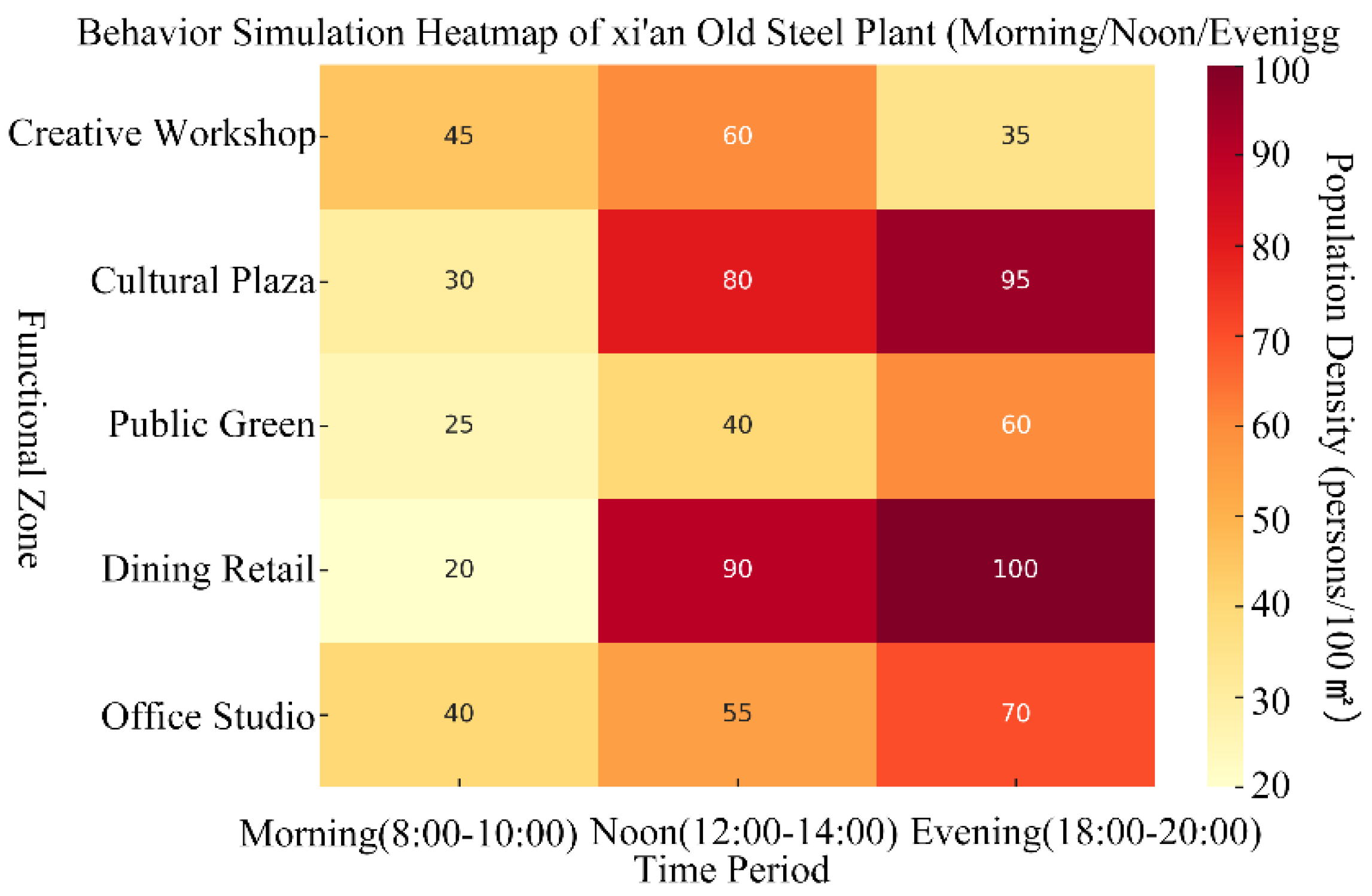
Spatial Vitality and Heritage Perception Simulation: To evaluate post-renovation usage behavior and occupant satisfaction in heritage spaces, a crowd dynamic simulation model was constructed based on the AnyLogic multi-agent framework. The model includes three agent types: visitors, workers, and residents. Their behavioral rules are driven by parameters such as environmental comfort (UTCI), spatial accessibility ( A i ), and visual attractiveness ( V i ). The probability of an individual selecting a space is calculated using a Logit model.
P i = e β 1 A i + β 2 V i + β 3 C i j = 1 n e β 1 A j + β 2 V j + β 3 C j
In the equation, P i represents the probability that an individual (or the population) chooses the i-th spatial unit, reflecting the attractiveness or vitality of the space. A i denotes the accessibility metric (Accessibility), including factors such as path length and number of entrances. V i represents visual and environmental comfort (Visual/Environmental comfort), typically characterized by parameters such as UTCI, wind speed, and green view index from ENVI-met. C i denotes cultural and functional attractiveness (Cultural/Functional attractiveness). β 1 , β 2 ,   β 3 are regression coefficients determined via field measurements or survey regression, representing the influence weight of each factor on behavioral choices. The denominator is the sum of exponentiated utility functions for all spatial units, ensuring probability normalization (i.e., ΣPi = 1).
(2)
Dynamic Parameter Settings (Table 5):

3.5. Multi-Objective Evaluation and Decision-Making Model

3.5.1. Indicator Definition, Quantification, and Standardization

To facilitate a systematic evaluation of industrial heritage renovation schemes and support actionable decision-making, a multi-objective evaluation and decision-making model was developed on the digital twin platform, with energy efficiency (E), environmental comfort (C), pedestrian activity (P), and cultural adaptability (H) as its core dimensions. The model comprises two components: first, the quantification and standardization of indicators to construct a weighted composite evaluation function; second, a multi-objective optimization-based scheme search coupled with rule-based scenario selection.
(1)
Energy Efficiency (E): Assesses the performance of renovation schemes in reducing building and campus operational energy consumption and increasing renewable energy utilization, including annual energy consumption per unit area (kWh·m−2·a), renewable energy self-sufficiency (%), and carbon emissions per unit area (kgCO2·m−2·a) [64].
(2)
Environmental Comfort (C): Focuses on the impact of post-renovation outdoor physical environments on human thermal perception, including spatial averages or improvements of UTCI/PMV, daytime surface temperature (MST) variations, and heat island intensity reduction rate (HIRR) [65].
(3)
Pedestrian Activity (P): Evaluates the effect of renovation schemes on public space vitality, including space utilization density (D_t), average dwell time (T_avg), and spatial activity index (SAI) [66].
(4)
Cultural Adaptability (H): Quantifies the extent to which renovation schemes protect and transmit industrial heritage cultural values, including survey-based cultural identity scores, accessibility/visibility of heritage elements, and functional diversity [67].
When a single comparable metric is required for presentation or rapid screening, the Analytic Hierarchy Process (AHP) is employed to determine the dimension weights w E , w C , w P , w H . The construction of the judgment matrix follows a combination of scientific principles and expert consensus to ensure objectivity and reliability of the weight allocation. For this purpose, nine domain experts were invited to assess indicator importance and complete the matrix. The expert panel encompassed urban planning, architectural design, landscape ecology, gerontology, and intelligent construction. The judgment matrix was constructed through a comprehensive procedure of “questionnaire survey–expert discussion–consistency check”. Initially, based on literature review and the previously established indicator system, the research team designed a structured questionnaire covering pairwise comparisons of all hierarchical indicators. Expert assessments of relative importance were then collected via online questionnaires and in-person interviews, using the Saaty 1–9 scale. Preliminary results were statistically analyzed, and consistency was verified (Consistency Ratio, CR) [68,69]. Expert workshops were organized to review and adjust indicators with significant discrepancies until the matrix satisfied the consistency requirement (CR < 0.1). The weighted composite utility function based on AHP is defined as
U = w E · E + w C · C + w P · P + w H · H
Here, U∈[0, 1] with larger values indicating superior overall performance of a scheme. While AHP-derived weights can serve as inputs to express decision preferences, the original multi-objective structure is typically preserved during optimization to avoid premature biasing of the Pareto solution space.
In the Analytic Hierarchy Process (AHP), an n × n judgment matrix, A = a i j n × n , is first established to represent the relative importance ratios of the i-th indicator to the j-th indicator. Here, a i j denotes the importance of indicator i relative to indicator j; if a i j > 1 , indicator i is more important than indicator j. Moreover, a j i = 1 a i j .
A = 1 a 12 a 13 a 1 n 1 / a 12 1 a 23 a 2 n 1 / a 13 1 / a 23 1 a 3 n 1 / a 1 n 1 / a 2 n 1 / a 3 n 1
The principal eigenvalue λ m a x of the judgment matrix corresponds to the eigenvector W = w 1 , w 2 , , w n T , which represents the relative weight vector of the indicators.
A W = λ m a x W
The eigenvector is normalized to obtain the final set of weights:
w i = w i i = 1 n w i   W = [ w 1 , w 2 , w 3 , , w n ]
Due to the subjectivity of expert judgments, it is necessary to check the consistency of the judgment matrix. The Consistency Index (CI) is defined as
C I = λ m a x n n 1
The Consistency Ratio (CR) is defined as
C R = C I R I
RI denotes the Random Index, which was obtained by Saaty through extensive experiments. A commonly used reference table is as follows (Table 6):

3.5.2. Multi-Objective Optimization (NSGA-II) and Pareto Analysis

Given the inherent conflicts in renovation design, this study employs the evolutionary algorithm-based multi-objective optimizer NSGA-II to explore the solution space. The objective vector f = ( f 1 , f 2 , f 3 , f 4 , ) corresponds to minimizing energy consumption, maximizing environmental comfort, maximizing pedestrian activity, and maximizing cultural adaptability, respectively. NSGA-II generates a set of non-dominated solutions (Pareto front) through population evolution, providing decision-makers with a trade-off set. Each solution contains multi-dimensional performance values corresponding to design variables such as greening ratio and activity node layout [70].
The NSGA-II algorithm iteratively evolves the candidate solution population with the goal of simultaneously maximizing E, C, P, and H. Through operations such as selection, crossover, and mutation, a non-dominated solution set is ultimately obtained. For any solution on the Pareto front, improving performance in one dimension inevitably results in a reduction in at least one other dimension. Decision-makers—including designers, managers, and public representatives—can select final schemes from this Pareto-optimal set, which clearly displays all trade-offs, based on project-specific priorities and preferences, rather than passively accepting a single outcome [71].
The model first uses NSGA-II to identify a set of non-dominated solutions (Pareto front), and then applies AHP-derived weights to select one or several solutions with optimal overall performance for final decision-making. This establishes a comprehensive methodology of “subjective preference-guided, objective optimization-driven, and final interactive decision-making”, thereby providing a rigorous, systematic, and flexible solution to the complex multi-objective decision-making challenges in industrial heritage renovation.

3.6. Simulation Data Sources and Uncertainty Considerations

The digital twin model developed in this study is based on parameterized simulation data. Table 4 details the sources, acquisition methods, and processing procedures for the key parameters. All parameters are derived from authoritative public data or obtained through on-site surveys and have been rigorously calibrated and assigned within the simulation framework to ensure the model’s validity in testing the feasibility of the design framework. It should be noted that the results presented herein represent theoretical inferences under specific assumptions, rather than direct reflections of long-term measured data. This approach provides a quantifiable basis for evaluating the relative effects of different design intervention schemes and lays the foundation for more detailed empirical studies in the future (Table 7) (Appendix A.2, Table A2).

4. Results-Case Study

4.1. Regional Overview

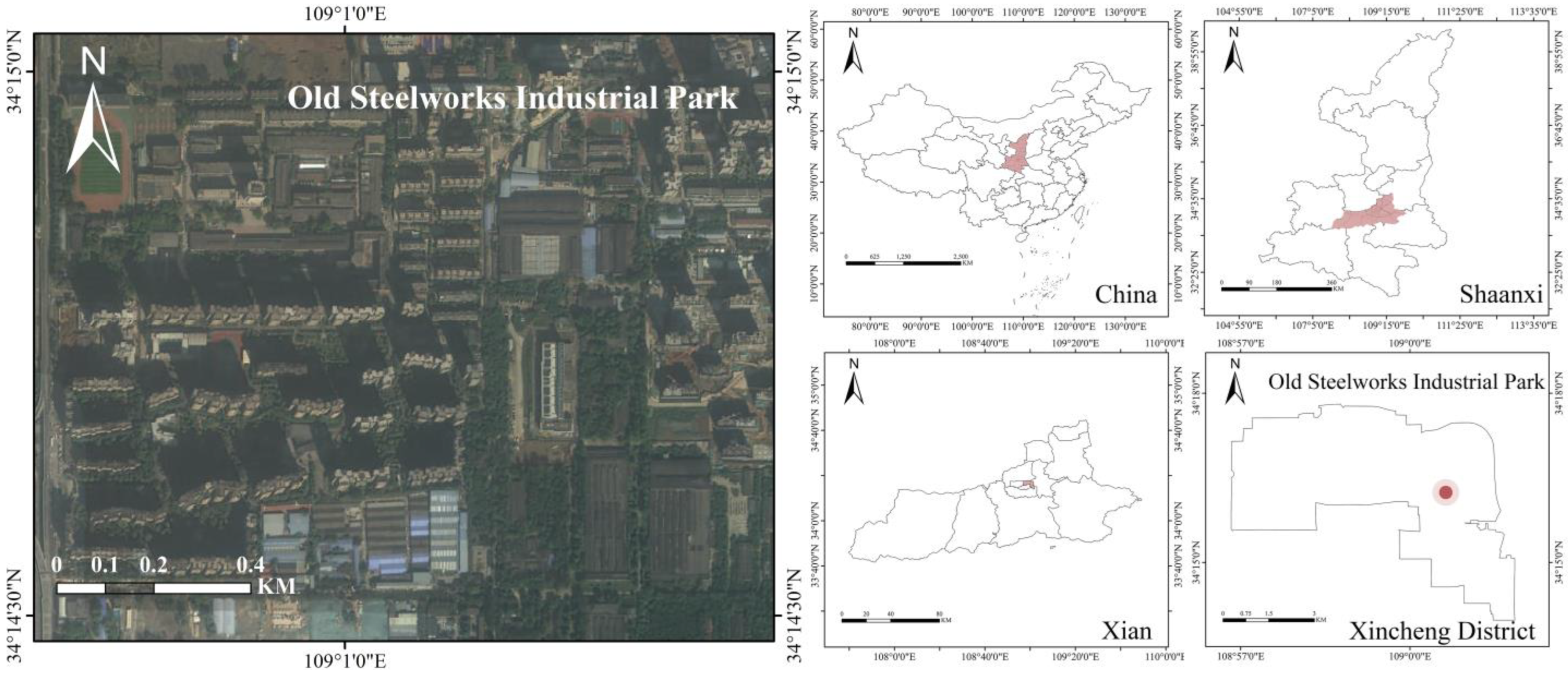
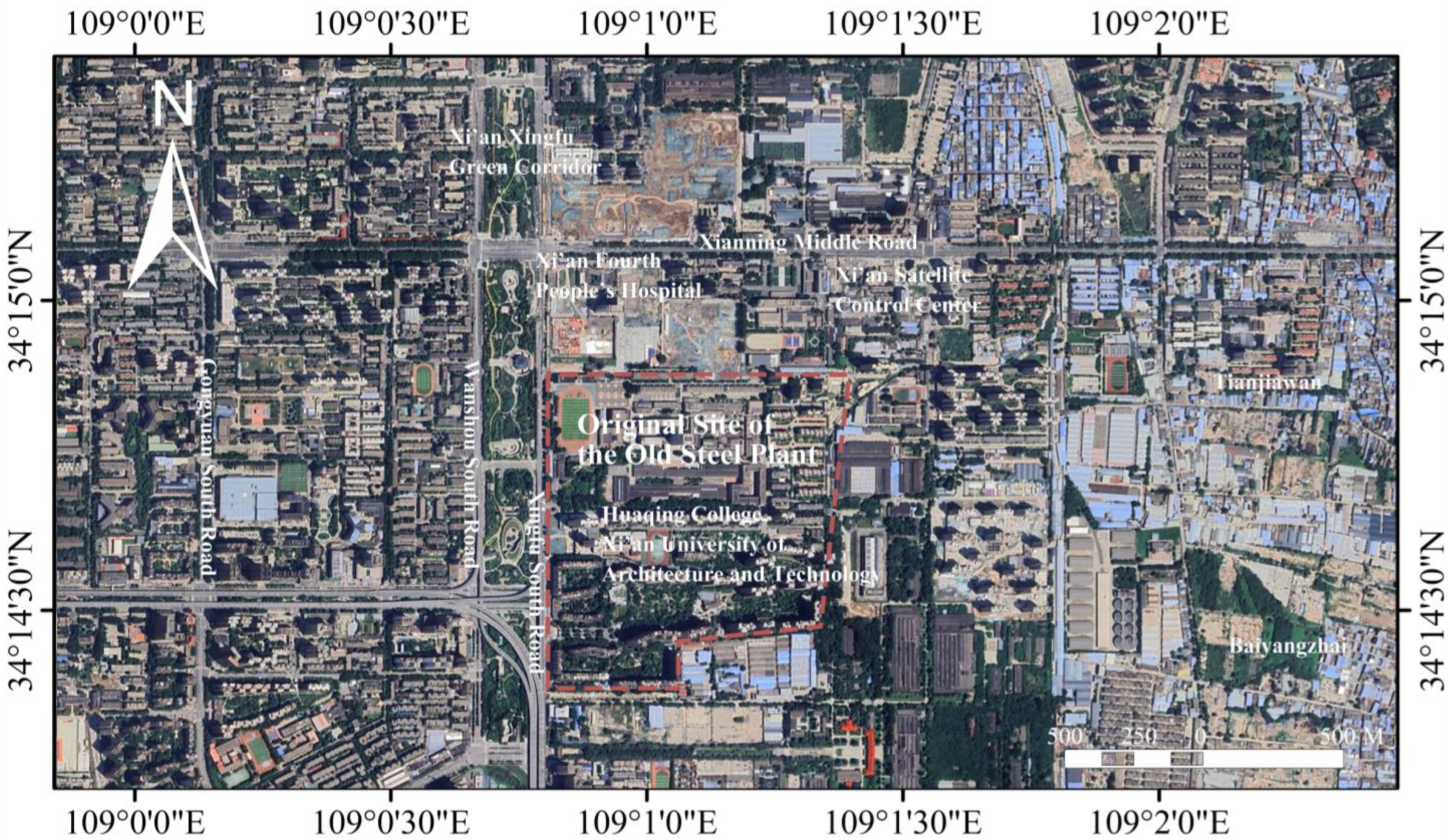
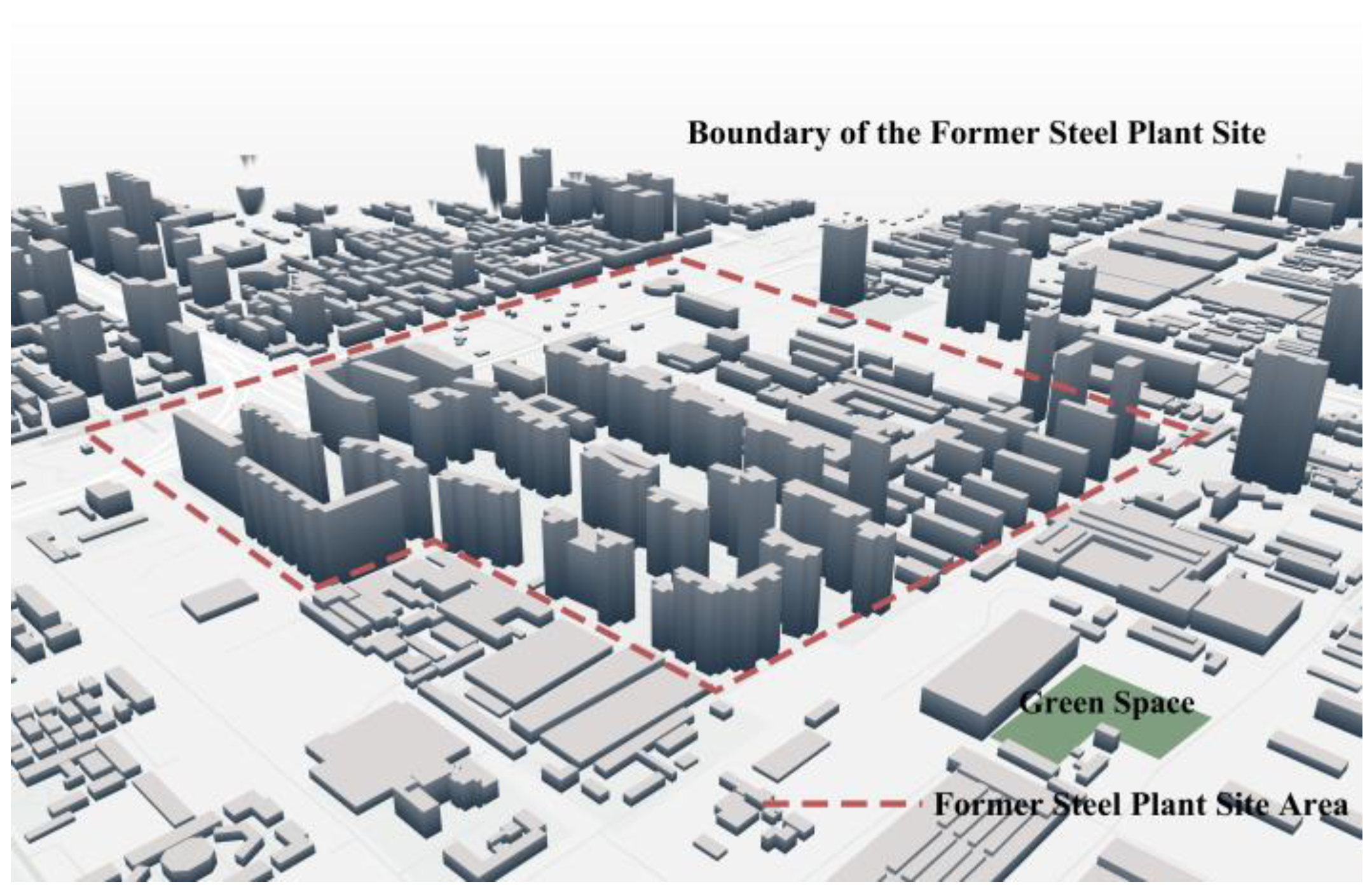
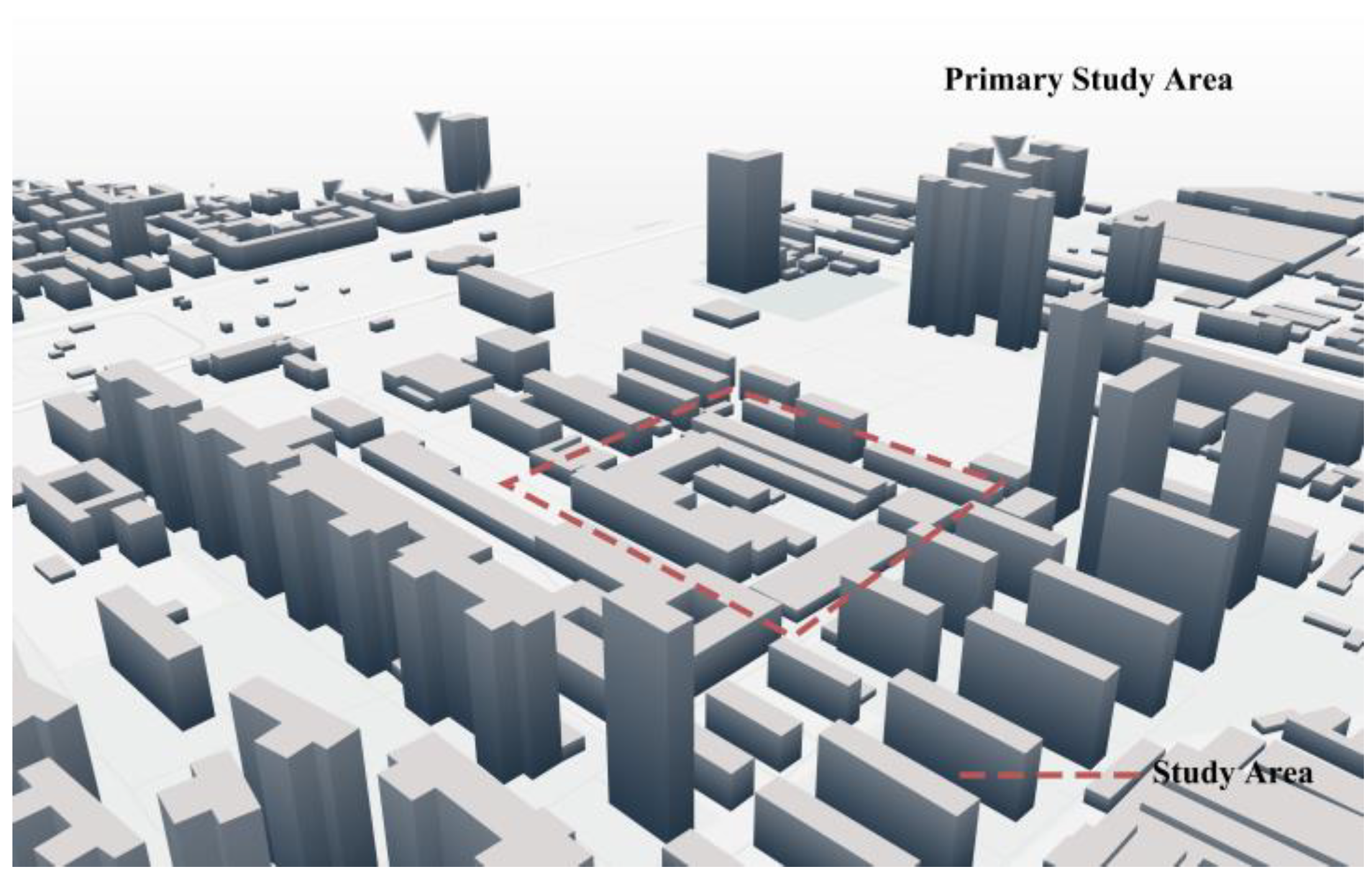
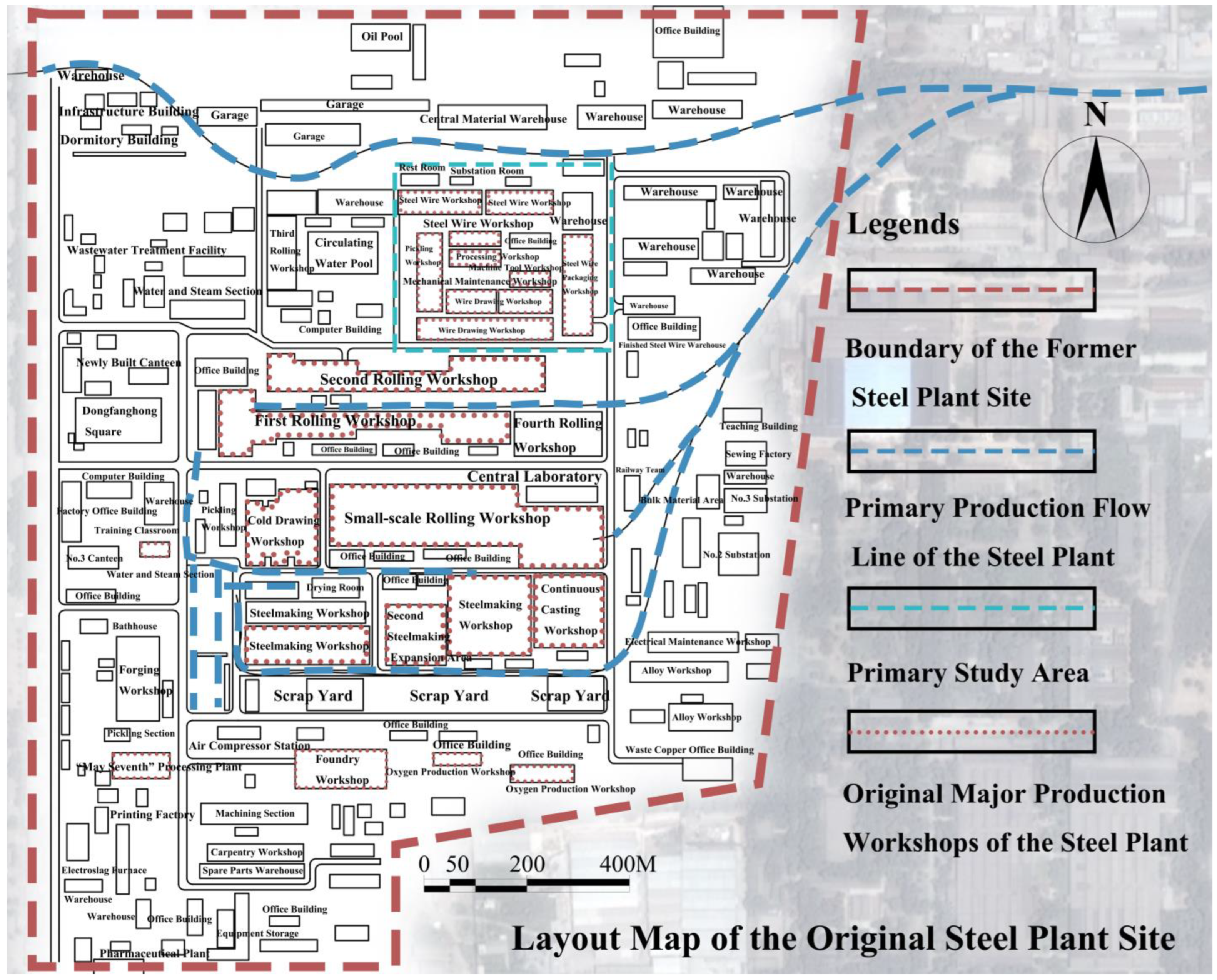
The Xi’an Old Steel Plant Creative Industry Park is located at the intersection of Xingfu South Road and Jiangong Road within the campus of Xi’an University of Architecture and Technology Huaqing College, situated at the eastern end of the South Second Ring Road. The campus is adjacent to the Huaqing Xuefu Cheng residential area to the south and the Xingfu Forest Greenbelt to the west. Under the guidance of the Xin Cheng District government of Xi’an, the park was redeveloped by Xi’an Huaqing Creative Industry Development Co., Ltd. In collaboration with Huaqing Science & Education Industry Group (Figure 5 and Figure 6).

4.1.1. Location Characteristics and Historical Evolution

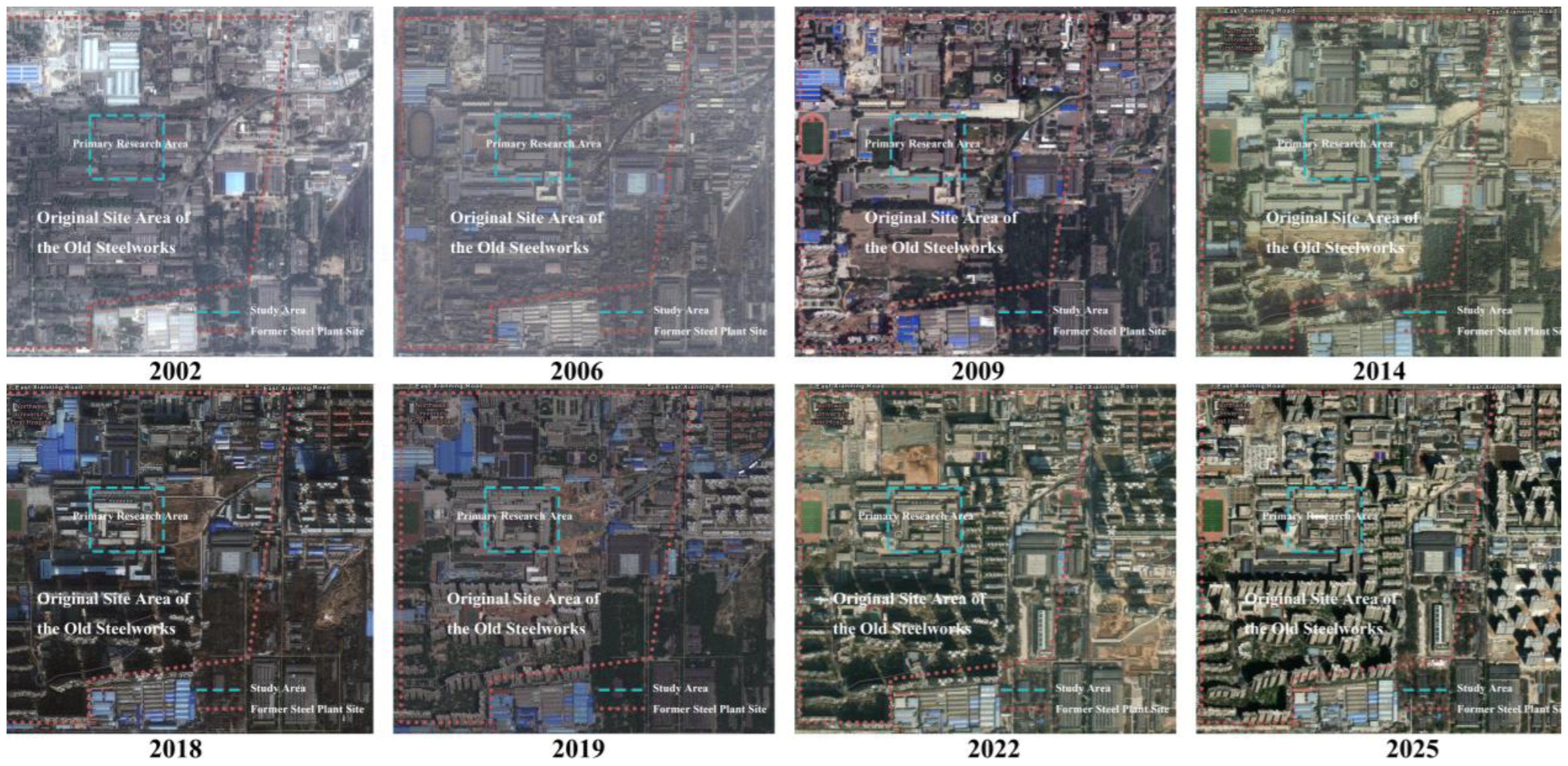
The Xi’an Old Steel Plant is located at the intersection of Xingfu South Road and Jiangong Road in Hansenzhai Subdistrict, Xin Cheng District, Xi’an, Shaanxi Province. Surrounding facilities include a building materials factory, the Dongfang Machinery Factory, and the Qinchuan Factory, collectively forming Xi’an’s traditional industrial district. The site covers approximately 600,000 m2, with a total floor area of about 570,000 m2, of which industrial buildings account for roughly 370,000 m2 [72]. The Shaanxi Steel Plant bears witness to China’s rapid economic growth and represents a key steel enterprise with profound cultural heritage and site spirit, including self-reliance and progressive enterprise ethos, meticulous craftsmanship, selfless dedication and resilient revolutionary spirit (Figure 7, Table 8) [73].

4.1.2. Current Spatial Structure and Functional Layout

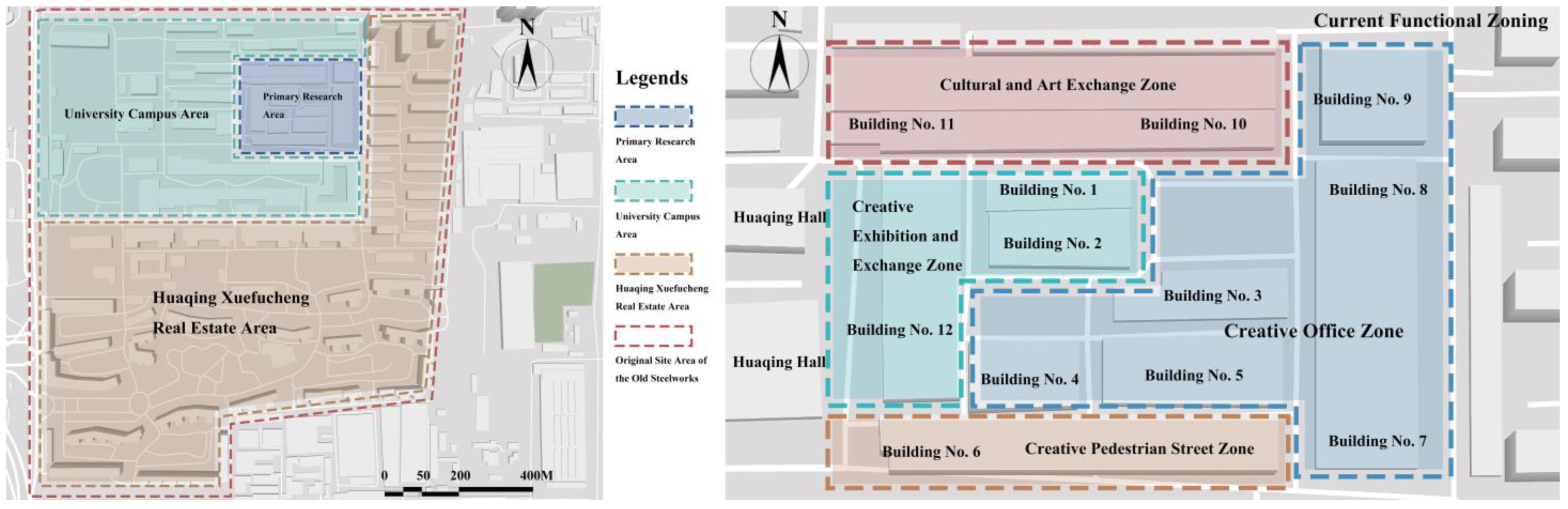
Over decades of industrial operation and structural adjustment, the Xi’an Old Steel Plant Industrial Park has gradually transformed from a heavy industrial production zone into a new mixed-use space focused on creative industries, cultural tourism, leisure, and cultural exhibition. The current spatial structure of the park exhibits an “axial linkage and cluster-based zoning” pattern: the linear space along the original main factory axis forms the organizational backbone, with large steel-structure workshops, storage facilities, and ancillary buildings distributed along it. Peripheral areas retain portions of former staff residential zones and green buffer belts, creating a hierarchical spatial system comprising production zones, living areas, and landscape buffers.
The park has transitioned from a single-purpose production area to a multi-functional complex. Former steelmaking workshops, rolling mills, and machine repair buildings have been repurposed into art galleries, innovative office spaces, and public cultural venues. Meanwhile, remaining industrial relics such as chimneys, conveyor corridors, and steel trusses have been incorporated into the landscape system, However, despite the high degree of spatial reuse, the park still exhibits challenges such as high building energy consumption, suboptimal microclimatic conditions, and insufficient connectivity of public spaces, reflecting a “rapid spatial form update with slow environmental system response” characteristic (Figure 8).

4.1.3. Characteristics of Existing Buildings and Infrastructure

As a typical heavy industrial heritage from China’s mid-20th-century industrialization wave, the Xi’an Old Steel Plant exhibits spatial forms and building structures with distinct temporal imprints and typological characteristics. The factory layout follows a “clear functional zoning and production-flow-oriented” modern industrial planning model, forming an overall strip-like spatial pattern with the main production line as the axis and ancillary facilities surrounding it.
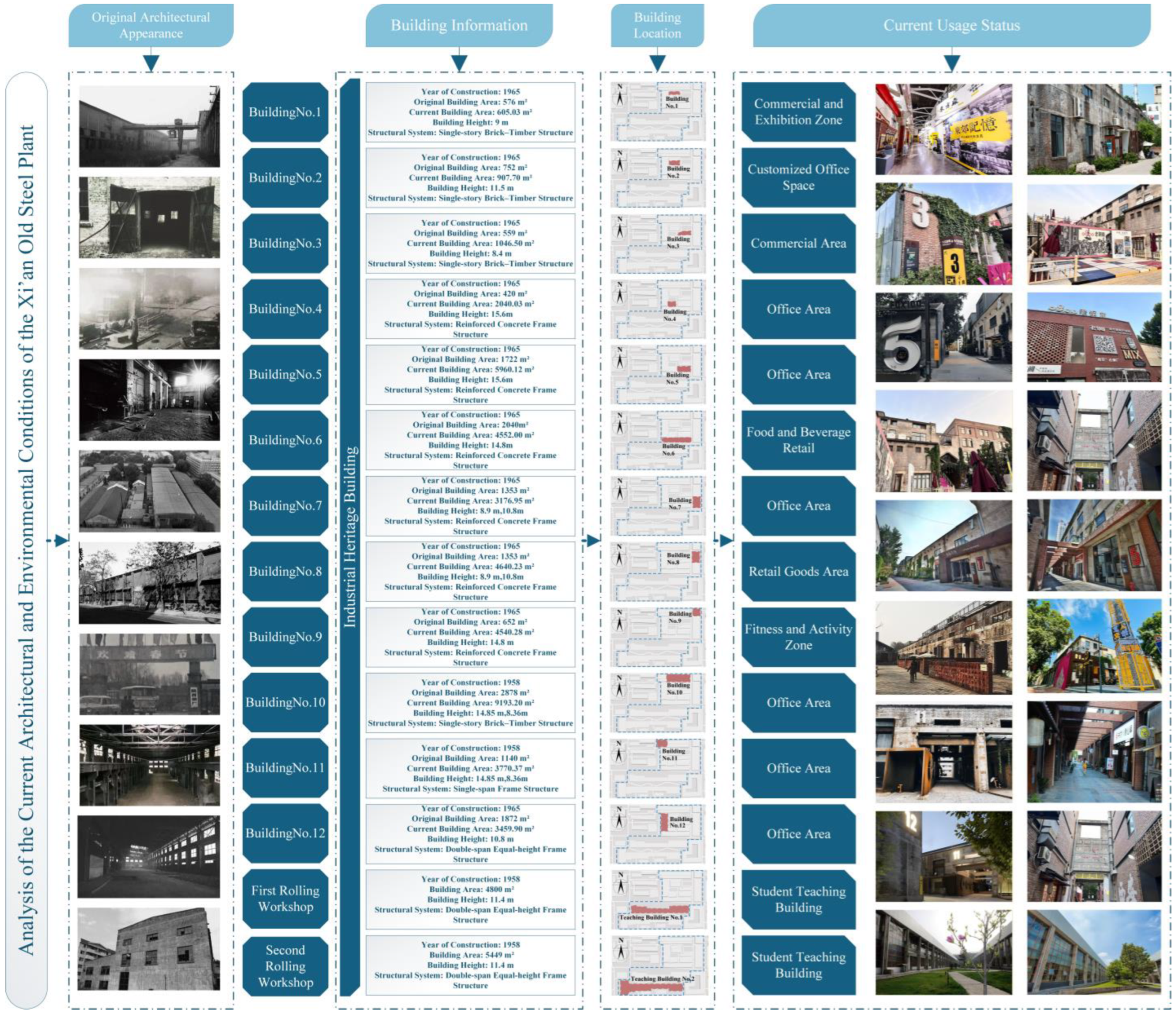
At the building level, most existing structures were built between the 1950s–1980s, with structural forms dominated by reinforced concrete frames, brick-concrete construction, and large-span steel workshops. Some main workshops feature truss roofs and continuous window designs, which not only meet the high-space and heat-dissipation requirements of heavy industrial operations such as smelting and rolling, but also constitute key elements of industrial aesthetic expression. In contrast, residential and administrative buildings are mostly medium- to small-sized brick-concrete structures with simple facades and minimal ornamentation, reflecting the standardization and utilitarian characteristics of the planned economy era (Table 9). These include the First and Second Rolling Workshops (now serving as Teaching Buildings 1# and 2#), the Pickling Workshop (currently the Huaqing University Library), and the Steel Wire and Drawing Workshops (now part of the Xi’an Old Steel Plant Creative Industry Park) (Figure 9 and Figure 10).
In terms of infrastructure, the production systems of the Xi’an Old Steel Plant were relatively complete, including raw material transport tracks, power and steam pipelines, cooling water systems, and internal road networks. However, with the cessation of industrial production and the deterioration of equipment, these infrastructures have gradually lost functionality. Some pipelines are severely corroded, roads are damaged, and drainage and lighting systems have aged. The technological standards of these infrastructures show significant gaps compared with contemporary urban infrastructure, particularly in terms of safety, energy efficiency, and environmental adaptability, highlighting an urgent need for renovation and adaptive reuse design interventions.
Overall, the aging buildings and infrastructures of the Xi’an Old Steel Plant carry profound industrial memories and socio-cultural values. Their spatial forms and material remnants are not only important targets for industrial heritage preservation but also potential carriers for urban renewal and cultural regeneration.
Within the current urban regeneration context, these “old industrial spaces” exhibit significant potential for revitalization in terms of form, function, and spirit, providing a practical foundation for exploring spatial transformation and public-oriented utilization of historical industrial districts.

4.2. Digital Twin System Construction

The construction of a digital twin system represents a critical technological step for the intelligent renewal of old industrial heritage spaces. Its core lies in integrating multi-source data with multi-dimensional model collaboration to achieve dynamic mapping between virtual and physical spaces, alongside real-time feedback optimization. This study takes the Xi’an Old Steel Factory as a case study and develops a digital twin system based on a three-layer logic framework of “physical space—data space—cognitive space”.
The physical space layer is responsible for capturing and reconstructing the current state and spatial morphology of the industrial heritage.
The data space layer standardizes, integrates, and dynamically updates building information, environmental parameters, and operational data to achieve virtual–physical data mapping.
The cognitive space layer provides quantitative support for design decision-making, renovation scheme optimization, and future scenario prediction through simulation analysis and multi-objective evaluation.
This system not only enables a systematic assessment of different renovation schemes in terms of environmental, energy, and social performance but also supports interactive virtual–physical design validation, offering a practical technical platform for the scientific and intelligent renewal of old industrial districts [74,75].

4.2.1. Visualization of Data Acquisition and Model Construction Process

In the initial phase of the study, to achieve a multi-dimensional dynamic reconstruction of the Xi’an Old Steel Plant’s industrial heritage spatial environment, a simulation-driven digital twin modeling approach was employed. As the focus of the study is methodological validation and performance assessment, the data used are calibrated simulation datasets, constructed through parameterized mapping of real-world topography, buildings, and meteorological information. By integrating BIM and GIS data, the model dynamically consolidates and overlays multi-dimensional information, including building forms, structural features, environmental factors, energy networks, and human activities. Within the Unity3D visualization platform, the model presents a panoramic view from macro spatial patterns to micro structural details, creating a virtual twin environment with real-time interaction and data traceability (Figure 11 and Figure 12) [76,77]. This visualization not only provides a unified data interface for subsequent microclimate, energy consumption, and behavioral simulations but also establishes a robust technical foundation for multi-model coupling and comprehensive performance evaluation.
Overall, this stage of the study centers on the parametric generation of simulation data and the structured integration of multi-source information, establishing a digital twin modeling system that maintains scientific rigor and verifiability even under conditions of incomplete data. By systematically integrating and calibrating key parameters related to buildings, the environment, and operations, the study achieves reliable simulation accuracy and reproducibility despite the absence of long-term measured data, ensuring the logical rigor and practical operability of the modeling methodology.
This approach not only provides quantitative evaluation and scheme optimization tools for industrial heritage renewal design but also offers a replicable and scalable research paradigm for applying digital twin technology in similarly complex urban renewal contexts, laying a solid foundation for subsequent empirical studies and real-world engineering applications (Table 10).

4.2.2. Coupled Simulation of Building and Environmental Modules

Building on the construction of the site’s digital model, this study further introduces a multi-physics coupled simulation system of building performance and environmental response to enable quantitative evaluation of architectural renovation designs [80]. The system consists of a building performance module and an environmental simulation module, with dynamic interaction and feedback achieved through a coupled simulation framework integrating EnergyPlus, Fluent, and ENVI-met [81,82]. The building module primarily analyzes physical building performance, including structural integrity, thermal properties of the envelope, and spatial utilization efficiency. Taking the main hot-rolling workshop as an example, the building is a reinforced concrete frame structure with a total floor area of approximately 12,400 m2 and an average floor height of 9.8 m. Based on simulation and BIM data, the envelope heat transfer coefficient is 0.68 W/(m2·K), and the roof insulation thermal conductivity is 0.045 W/(m·K). Simulation verification indicates a structural safety factor of 2.3, with no plastic deformation occurring under normal loads. The environmental module focuses on microclimate characteristics, ventilation pathways, thermal comfort, and lighting distribution. External meteorological conditions are set according to typical data for Xi’an in summer 2024, with an average temperature of 32.1 °C, average wind speed of 2.1 m/s, and relative humidity of 58%. Coupled ENVI-met and CFD simulations show that the average local wind speed around the buildings is maintained at 1.8–2.3 m/s, indoor ventilation rates increase by 21%, and local temperature differences are controlled within ±1.2 °C. Dynamic lighting simulation using Radiance indicates that, after optimization, the average indoor illuminance reaches 480 lx with a uniformity of 0.72, meeting industrial operation lighting standards (300–500 lx).
Supported by parametric modeling and multi-physics co-simulation, the system evaluates the environmental response and energy consumption of four renovation scenarios (A–D) for the main hot-rolling workshop (see Table 1). Simulation results indicate that roof daylighting optimization and greenery paving adjustments have the most significant impact on thermal environment improvement. Compared with the baseline scenario (A), the optimized scenario (C) reduces the average indoor temperature by 4.5 °C, annual energy consumption by 15.3%, and increases indoor lighting by 33%, while the predicted mean vote (PMV) decreases from +0.4 to −0.3, achieving Level II thermal comfort standard (PPD = 9%). Further incorporating natural ventilation optimization (scenario D) stabilizes energy consumption reduction (−14.8%) and achieves the best overall performance, recommended as the implementation scenario (Table 11, Figure 13).

4.2.3. Real-Time Monitoring and Design Parameter Interaction

During the operation of the digital twin system, the sensor network and IoT nodes enable real-time monitoring of key indicators such as temperature, humidity, noise, energy consumption, and pedestrian density within the site. Data are processed via edge computing and cloud services, and synchronized updates are reflected in the digital twin platform. A mechanism supporting future bidirectional feedback is designed, allowing designers to adjust design parameters in real-time through a visualization interface. The system immediately outputs environmental response results, forming a “monitor–analyze–optimize–revalidate” dynamic cycle.

4.3. Design Intervention Simulation and Results Analysis

To achieve a multi-dimensional performance assessment and design optimization of urban industrial heritage spaces, this study developed a multi-scale digital twin simulation system integrating microclimate, building energy, and social behavior [83,84,85]. The system runs multiple models in coordination, enabling integrated computation and dynamic feedback across three processes: physical environment, building energy, and human behavior. The following comprehensive simulation results are based on models calibrated and optimized as described above. The values represent calibrated simulation outputs intended to reveal patterns and facilitate comparison, rather than providing precise field measurements of the entire site (Table A2).
(1)
To integrate data of different dimensions, the min-max normalization method was adopted:
N i = X i X m i n X m a x X m i n
In the equation, N i denotes the normalized, dimensionless indicator value, X i is the original value of the i-th sample (or indicator), X m a x is the maximum value of the indicator across all samples, and X m i n is the minimum value. By linearly mapping the original data to the [0, 1] interval, a uniform scale across indicators is achieved, allowing equal-weight comparison of all dimensions in the integrated evaluation. If X i = X m i n , then N i = 0 , X i = X m a x , then N i = 1 . Values between these extremes are proportionally mapped to represent relative performance in that indicator. For example, the heat island intensity reduction rate in the Xi’an Old Steel Plant Industrial Park is shown in Table 12:
Given X m a x = 20.1 , X m i n = 12.4 , for Area A within this range, N A = 18.5 12.4 20.1 12.4 = 6.1 7.7 = 0.79 , Other areas are calculated similarly (see Table 13).
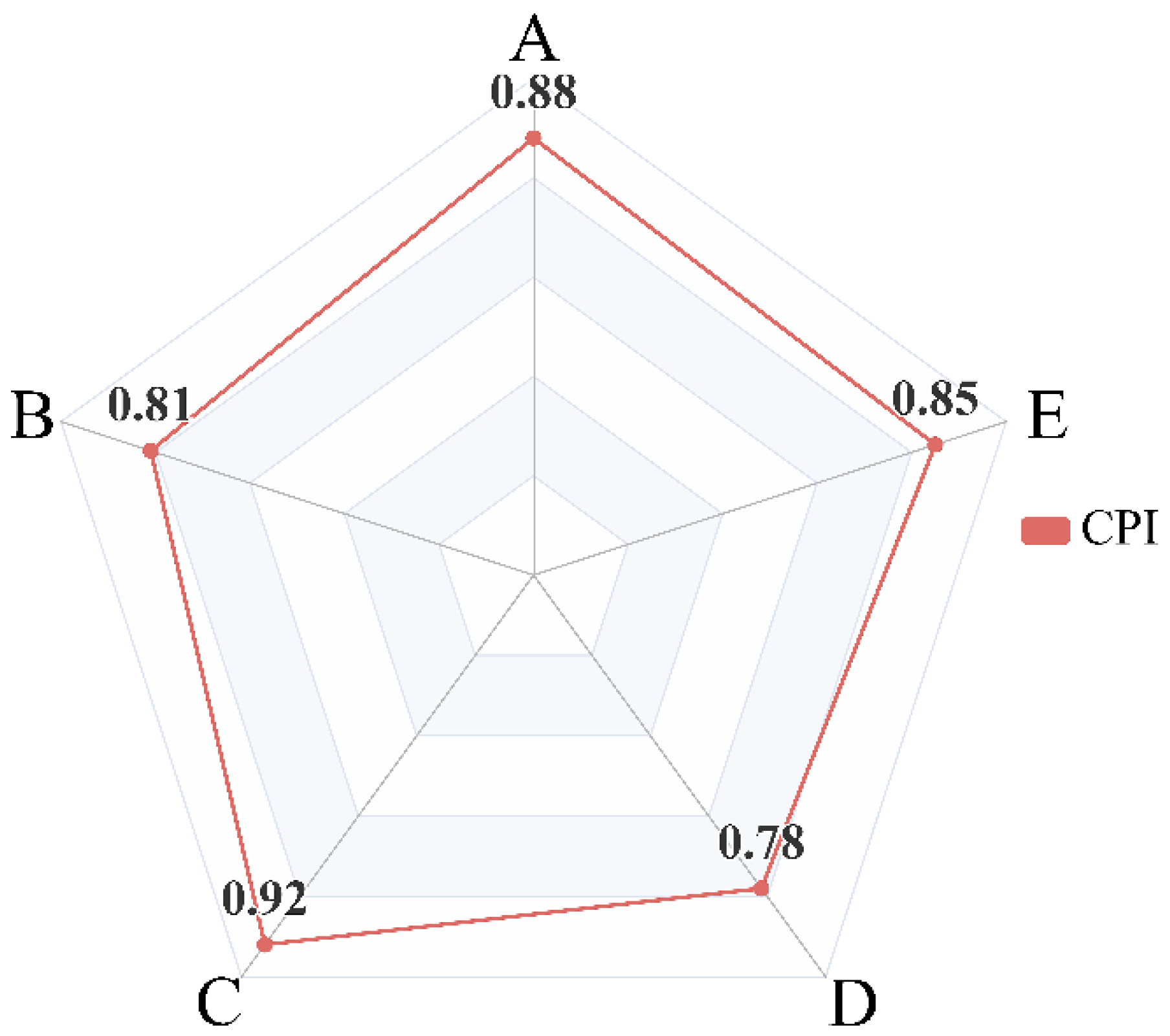
The normalized results indicate that Area C (Pedestrian Street) performs best in mitigating heat island effects (N = 1), while Area D performs the worst (N = 0). These normalized values can further be used for comprehensive performance calculations, such as weighted summation to form the Comprehensive Performance Index (CPI), facilitating quantitative comparison and visualization of different spatial renewal scenarios in the Xi’an Old Steel Plant.
In the “Xi’an Old Steel Plant Industrial Heritage Renewal Performance Evaluation System”, a three-dimensional judgment matrix is constructed:
A = 1 1 / 1.2 1.1 1.2 1 1.3 0.9 1 / 1.3 1
The calculation yields the following results: λ m a x = 3.052 , C I = 3.052 3 3 1 = 0.026 , R I = 0.58
C R = 0.026 0.58 = 0.045 < 0.1
The results indicate that the judgment matrix exhibits satisfactory consistency, with corresponding weights of W = [0.35,0.30,0.35]. This suggests that environmental, energy, and social performance are of comparable importance in the overall evaluation. Taking the evaluation of spatial vitality in the Xi’an Old Steel Plant as an example:
S = i = 1 n w i × x i
Here, S represents the comprehensive evaluation result, w i denotes the weight of the i-th indicator, and x i refers to its normalized score. The final composite vitality score is calculated as S = 0.35 × X A 1 + 0.40 × X A 2 + 0.25 × X A 3 . Given the normalized scores X A 1 = 0.72 , X A 2 = 0.81 , X A 3 = 0.68 , the resulting value is S = 0.35 × 0.72 + 0.40 × 0.81 + 0.25 × 0.68 = 0.75 , This indicates that the overall spatial vitality of the Old Steel Plant Park falls within the high-performance range (0.7–0.8), demonstrating a positive interaction between spatial environment and social activities.
(2)
The Comprehensive Performance Index (CPI) is defined as follows:
C P I = i = 1 n w i N i
In this equation, w i denotes the weight of the i-th indicator, reflecting its relative importance in the overall evaluation ( 0 < w i < 1 , w i = 1 ), N i represents the normalized value of the i-th indicator, which has been linearly transformed into the [0, 1] range through normalization. In the context of the Xi’an Old Steel Plant industrial heritage renewal, the CPI serves as a comprehensive measure of each spatial unit’s performance across the environmental, energy, and social dimensions. Representative performance indicators—such as heat island intensity reduction rate, carbon emission reduction, spatial vitality index, and heritage identity perception—are selected and standardized from their original forms ( X i N i ) to ensure cross-dimensional comparability. The indicator weights are determined through the AHP method, and the final comprehensive performance score is derived using the CPI (Table 14).
The tabulated data used in this study are derived from digital twin simulations of the northern section of the Xi’an Old Steel Plant (study area approximately 0.52 km2). All data sources and computational processes adhere to the principles of verifiability and reproducibility. Since the study aims to validate the methodological applicability of digital twins in the renewal of industrial heritage environments, the analysis relies on calibrated simulation data rather than direct field measurements. The input parameters and calibration benchmarks for the models are primarily drawn from three authoritative data sources:
(1)
Spatial foundation data: Urban topographic data (1:2000 scale maps) and satellite imagery (Landsat 8, 2023) released by the Xi’an Bureau of Natural Resources and Planning were combined with field surveys to reconstruct spatial structures and classify land use. Building morphology parameters were obtained from the Xi’an Industrial Heritage Register (2022), which documents the volumetric and height attributes of the Old Steel Plant workshops and ancillary structures.
(2)
Environmental and energy simulation data: Microclimatic parameters were derived from Typical Meteorological Year (TMY 2024) data provided by the Xi’an Meteorological Bureau and used in the ENVI-met model to simulate Heat Island Reduction Rate (HIRR) and changes in the Universal Thermal Climate Index (ΔUTCI). Building energy performance was modeled using EnergyPlus, calibrated against Building Energy Consumption Standards (GB/T 51161-2016) [86] and ASHRAE 90.1-2019, to calculate the annual variation rate of energy consumption (ΔE).
(3)
Behavioral and social data: Population density and spatial vitality data were obtained from multi-agent simulations conducted in AnyLogic, with model parameters informed by the Xi’an Urban Park Visitor Behavior Report (2021) and relevant academic literature (Nouri, A et al., Building Simulation, 2024) [12]. The Cultural Perception Index (CPI) was established using a weighted questionnaire-based evaluation system (α = 0.87), with weights determined through the Analytic Hierarchy Process (AHP).
During the simulation process, data exchange and synchronization among models were achieved using a unified coordinate system (CGCS 2000) and a consistent temporal resolution (1 h), ensuring spatial coherence and dynamic responsiveness of the results. After multiple rounds of calibration, the resulting data exhibited an error margin within ±7%, meeting the accepted academic standards for building and urban environmental simulations. Each indicator presented in the tables (HIRR, ΔE, ΔUTCI, population density enhancement rate, and CPI) originates from calibrated multi-model simulation outputs. This approach ensures both the scientific rigor and traceability of the conclusions, while providing a reproducible methodological and data reference for future researchers under comparable parameter conditions (Figure 14 and Figure 15).
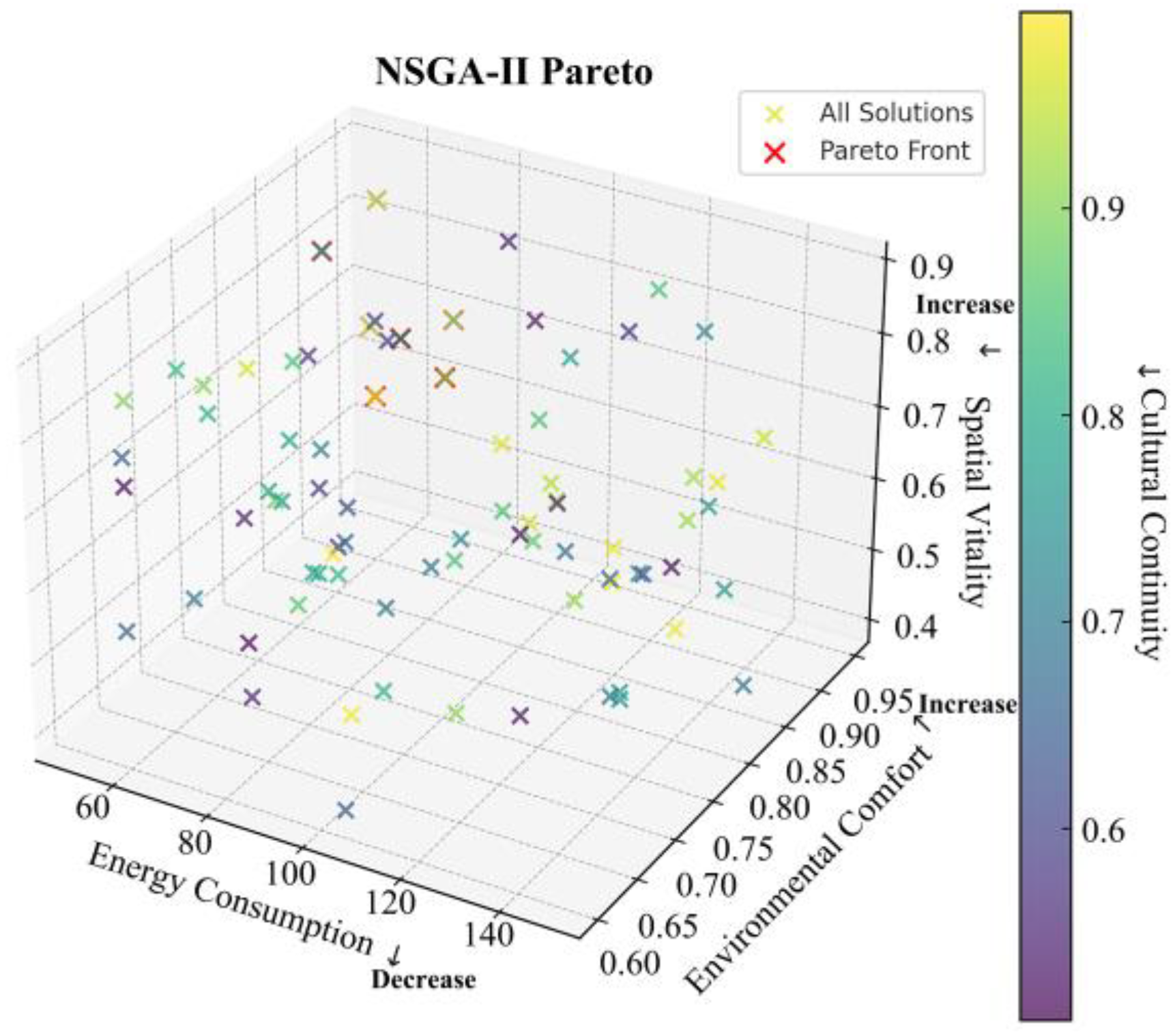
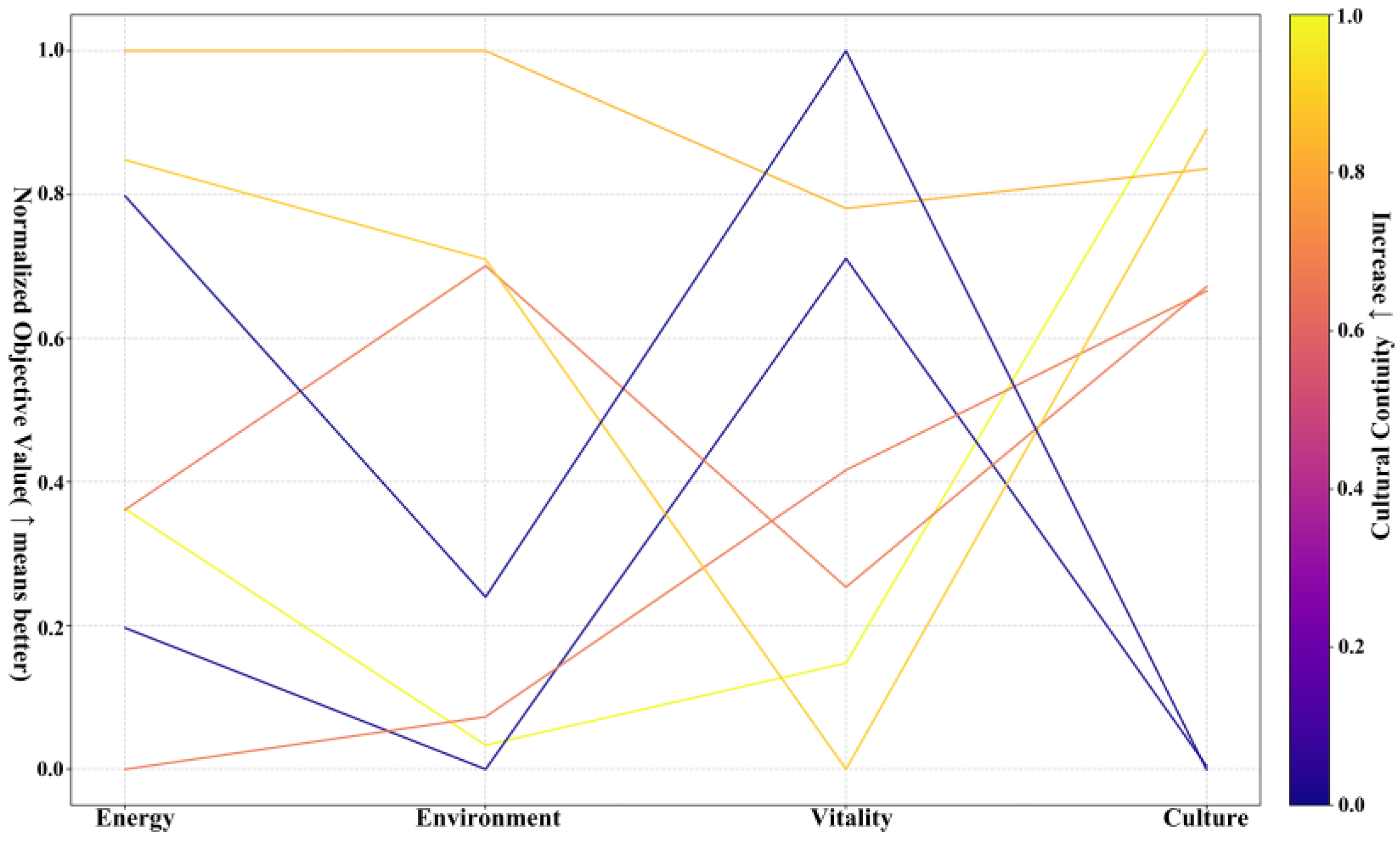
Figure 16 illustrates the distribution of solutions generated by the NSGA-II algorithm within the three-dimensional space of “energy consumption–environmental comfort–spatial vitality,” where the color scale represents the “cultural inheritance” indicator. The red points form the Pareto front, indicating the inherent trade-offs among the four objectives. Specifically, reductions in energy consumption often come at the expense of environmental comfort or cultural performance. Figure 17 further depicts the multidimensional equilibrium patterns among the four objectives, revealing a trade-off distribution of optimized solutions across energy, environmental, vitality, and cultural dimensions.

4.4. Model Sensitivity Analysis and Consistency Verification

To verify the reliability of the constructed digital twin system and the robustness of its simulation results, sensitivity analysis and consistency testing were conducted across three dimensions: microclimate, building energy consumption, and spatial vitality. This process aimed to assess the magnitude of the simulation output’s response to variations in key input parameters, thereby evaluating the structural stability of the model and the rationality of its parameter configuration [87,88]. In parallel, a series of calibration procedures was performed following the establishment of the digital twin model to ensure the reliability of the simulation outcomes. The calibration focused on validating the logical consistency of the model rather than achieving strict numerical conformity with empirical measurements. The calibration reference data were primarily obtained from three sources (Table 15):
The calibration was performed by manually adjusting key parameters—such as surface albedo, building infiltration rate, equipment operation schedules, and agent behavior weights—to minimize the deviation between simulated outputs and benchmark data. Through iterative optimization, the Mean Absolute Percentage Error (MAPE) between simulated and reference data for each module was reduced to within 10%, ensuring the model’s credibility in representing the specific characteristics of the study area.
(1)
Validation of Microclimate Simulation: In the microclimate module, ENVI-met was used to conduct a sensitivity analysis of the Universal Thermal Climate Index (UTCI), surface temperature (Ts), and wind field (V). The main parameters—air temperature (Ta), surface albedo (α), and vegetation coverage (Vc)—were perturbed within ±10% to assess their influence on thermal comfort indicators. The results indicate that UTCI is most sensitive to air temperature variation (sensitivity coefficient Si = 0.62), followed by surface albedo (Si = 0.37), while wind speed has a relatively minor impact (Si = 0.21). This suggests that the thermal environment simulation is primarily governed by surface thermal properties and boundary climatic conditions, and the model’s physical consistency aligns well with theoretical expectations for urban heat environment modeling. Comparison with measured meteorological data (Xi’an Meteorological Bureau, July 2024) shows a root mean square error (RMSE) of 1.26 °C and a Nash–Sutcliffe efficiency (NSE) of 0.91, indicating high consistency and predictive reliability of the microclimate model [89].
(2)
Validation of Building Energy Simulation: The building energy model, developed using EnergyPlus, incorporated envelope thermal parameters (U-value), equipment coefficient of performance (COP), and occupancy density (D) as key sensitivity variables to simulate variations in building energy consumption (E) and carbon emissions (LCCO2). Single- and multi-factor sensitivity analyses revealed that a 10% reduction in envelope heat transfer coefficient decreased total energy use by approximately 5.8%, a 10% improvement in equipment efficiency reduced carbon emissions by about 6.4%, while a 10% increase in occupancy density led to a 4.2% rise in energy consumption. Further linear regression analysis demonstrated a strong correlation between model predictions and the benchmark values defined in GB/T 51161-2016, with an R2 of 0.95 and a mean deviation within ±6%, confirming the stability and parameter consistency of the energy simulation model.
(3)
Validation of Spatial Vitality Simulation: The spatial vitality module employed an AnyLogic multi-agent simulation to validate behavioral dynamics, with walking speed (v), spatial attractiveness weight (W), and stay probability (P) as primary sensitivity parameters. By adjusting each within ±15%, the model evaluated responses in average dwell time (T), path coverage (C), and gathering index (GI). Results show that the model output is most sensitive to spatial attractiveness weight (Si = 0.68), suggesting that spatial configuration and node layout are the key factors influencing behavioral distribution. Field observation data (n = 312) were used for validation, yielding an RMSE of 0.18 and a correlation coefficient r = 0.89, confirming the model’s high accuracy and consistency in predicting spatial behavior patterns [90].
In summary, the sensitivity analysis across the three sub-models demonstrates that outputs remain stable within reasonable parameter perturbations without exhibiting abnormal nonlinear responses, indicating that the digital twin system possesses strong robustness and internal consistency. This validation process ensures the scientific reliability of simulation outcomes and provides a quantitative foundation for subsequent multi-model coupling and integrated performance evaluation.

5. Discussion

5.1. Methodological Value and Generalizability

The methodological core of this study lies in establishing a data-driven and systematic analytical and decision-making framework for addressing the complex, multidimensional coupling problem of industrial heritage renewal. Through semantic integration of multi-source heterogeneous data and coordinated multi-model simulations, this study achieved a digital mapping and dynamic evolution of the “building–environment–human” system. Abstract design goals such as “low carbon” and “vitality” were thus translated into quantifiable and simulatable performance indicators. It should be noted that, due to the constraints of research duration and data accessibility, the data employed in this study were simulation-based, constructed from existing urban geographic information, historical surveying records, and standard parameter databases, rather than real-time empirical measurements. The generation of simulation data strictly followed technical standards for spatial accuracy control and parameter calibration, referencing authoritative sources such as national building energy standards, Typical Meteorological Year (TMY) datasets, and the Xi’an Statistical Yearbook. This ensured the scientific validity of spatial, environmental, and behavioral representations. Although such a data strategy cannot fully capture the real-time dynamics of the physical system, it guarantees structural rigor and methodological reproducibility of the model, providing a reliable foundation for theoretical validation and methodological testing of the framework.
Its modular structure enables efficient parameter adjustment and seamless model transfer across diverse industrial-heritage scenarios. In textile-factory districts, the framework can incorporate saw-tooth roofs and clerestories to simulate photovoltaic performance and natural daylighting. For waterfront industrial zones, microclimate conditions and pedestrian-flow characteristics can be integrated to assess spatial vitality and thermal comfort. Although the model validation relies on simulated data, the results demonstrate the framework’s theoretical value in revealing system dynamics, verifying methodological feasibility, and supporting design-oriented decision-making. Future work will incorporate field-measured and real-time data for further validation and iterative refinement, advancing the digital twin from static simulation toward dynamic real-world mapping [91,92,93].
Although the digital twin framework developed in this study was validated through the case of the Xi’an Old Steelworks, its original design intent and methodological core exhibit substantial scalability and generalizability. The framework’s scalability is reflected primarily in three dimensions:
(1)
Modular architecture: The framework consists of relatively independent data, model, and application layers. The core simulation modules for industrial heritage—such as building performance, microclimate, and pedestrian dynamics (e.g., EnergyPlus, ENVI-met, AnyLogic)—and their coupling interfaces are universally applicable. When deployed in other industrial heritage sites (e.g., textile mills, port districts, or mining zones), only local geometric data, material properties, meteorological files, and behavioral parameters need to be updated, without modifying the underlying model-coupling logic or decision-analysis workflow.
(2)
Parameterization and adaptability: Key parameters—such as envelope thermal performance, greening strategies, and activity-node configuration—are defined in a parametric manner. This allows researchers to rapidly adapt the framework to projects in different climatic zones, scales, or heritage typologies by adjusting parameter sets, enabling differentiated evaluation of the “technological–ecological–cultural” co-benefits.
(3)
Transferability of the technical workflow: The integrated pipeline—from multi-source data fusion and cross-scale model coupling to multi-objective decision optimization—provides a replicable paradigm for addressing renewal challenges in diverse built environments, particularly complex heritage areas. Although the quantitative results in this study rely on simulation data from Xi’an, the methodology’s value in revealing systemic interactions, balancing multi-objective trade-offs, and supporting evidence-based design is broadly applicable.
Therefore, the framework essentially functions as a configurable methodological platform for industrial-heritage renewal. Its successful application extends beyond the presented case, offering a transferable technical pathway and a robust decision-support foundation for other urban regeneration contexts with comparable complexity.

5.2. Implications for the Sustainable Renewal of Industrial Heritage: Causal Chains Between Design Parameters and Performance Revealed by Coupled Simulation

Beyond validating the effectiveness of the “technology–ecology–culture” co-optimization model, the simulation results further demonstrate that the coupled digital-twin workflow enables us to look beyond aggregate performance outcomes and uncover the underlying micro-level parameter–performance mechanisms. This shift from describing what happens to understanding why it happens is essential for achieving precise and reproducible design.
  • Improving environmental comfort: the synergy between surface reflectance and vegetative shading
The substantial reduction in UTCI in Zone C (pedestrian street) (ΔUTCI = −2.0 °C) can be attributed to adjustments in two key physical parameters, whose effects were quantitatively assessed using the ENVI-met model:
(1)
Higher surface albedo: Replacing the original dark asphalt pavement (albedo ≈ 0.1) with light, high-reflectance materials (albedo ≥ 0.5) reduced absorbed shortwave radiation by ~40%. This led to notable decreases in surface temperature and mean radiant temperature (Tmrt), making it the primary contributor to UTCI improvement.
(2)
Geometric shading from vegetation: Newly introduced tree canopies blocked direct solar radiation by altering shading geometry. Simulations show that incident solar radiation on the human body decreased by 60–75% within shaded zones. The synergy between material reflectance (a material parameter) and canopy-coverage ratio (a spatial-form parameter) drives the improvement in thermal comfort.
2.
Optimizing energy efficiency: directly linked to quantitative improvements in envelope thermal performance
The reduction in building energy consumption (ΔE = −19.8 kWh/m2·a) is not a generic outcome but a direct response to specific envelope-performance interventions, rigorously tracked using the EnergyPlus model:
(1)
Reduced wall U-value: Increasing insulation thickness to 80 mm reduced the wall U-value from 1.5 W/(m2·K) to 0.45 W/(m2·K). Sensitivity analysis indicates that this single parameter accounts for over 50% of the annual reduction in heating and cooling loads.
(2)
Improved window-to-wall ratio (WWR) and glazing properties: Reducing the WWR from 0.6 to 0.4 and applying low-SHGC Low-E glazing maintained daylighting while effectively limiting summer solar heat gain, contributing roughly 30% to the reduction in cooling loads.
3.
Enhancing spatial vitality: Shaped jointly by environmental physical factors and functional spatial layout.
Multi-agent simulations reveal that changes in pedestrian distribution arise from the interplay between physical environmental conditions and spatial-functional design:
(1)
Environmental comfort as a behavioral driver: In the AnyLogic model, UTCI outputs from ENVI-met were incorporated into agents’ “stay-preference” functions. When UTCI improved from “strong heat stress” to “slight heat stress,” the probability of agents choosing the space increased by ~25%, indicating that microclimate interventions directly influence behavioral decision-making.
(2)
Spatial attraction of functional nodes: Newly added cultural installations and rest areas (functional parameters) create activity destinations. The combined effect—comfortable paths (determined by physical parameters) leading to attractive destinations (determined by functional parameters)—ultimately produces the observed high level of spatial vitality.
This case study demonstrates that the sustainable regeneration of industrial heritage depends on the precise manipulation of key quantifiable design parameters. The value of the digital-twin framework lies in translating abstract sustainability objectives into actionable optimization variables—such as material albedo, shading geometry, insulation thickness, window-to-wall ratio, and activity-node density—while revealing their cross-scale interactions among environmental, energy, and behavioral subsystems. Future heritage regeneration should focus on identifying the optimal parameter sets under multi-performance objectives. The framework proposed in this study provides a viable technical pathway for achieving such a precise and system-oriented design paradigm.
This study further reveals the institutional potential of digital twins as a collaborative design platform in urban regeneration governance. Its role has expanded beyond that of a technical tool for designers, becoming a medium for consensus-building among multiple stakeholders instead. It provides designers with performance-based feedback to support iterative optimization, generates evidence-driven quantitative reports for governments to enhance policy accuracy and resource allocation, and lowers the threshold for public participation through 3D visualization and interactive navigation. Built upon a unified information foundation, the platform facilitates dialogue between professional expertise and public perception, enabling a shift from “expert-led” to “multi-stakeholder collaborative governance,” and thereby advancing an inclusive approach to urban regeneration [94].

5.3. Theoretical Implications and Contributions to the Knowledge System of Industrial Heritage Regeneration

Although this study is grounded in the specific case of the Xi’an Old Steel Plant, its methodology and findings make three fundamental contributions to the knowledge system of industrial heritage regeneration and, more broadly, to urban renewal research.
(1)
Methodological contribution: Establishing an operational technical paradigm for evidence-based design
At present, urban regeneration is shifting from an experience-driven to an evidence-driven paradigm, yet the acquisition and operationalization of such “evidence” remain a significant challenge. Through the proposed digital-twin framework, this study transforms abstract “evidence” into tangible multi-source datasets and coupled simulation outputs, and establishes a complete and reproducible technical workflow spanning data acquisition, performance simulation, and multi-objective decision-making. This not only demonstrates the feasibility of digital-twin technologies but, more importantly, offers a transferable methodological template. Future research addressing other types of built environments—such as historic districts or aging residential neighborhoods—may adopt this template and construct customized evidence-based design support systems by substituting local datasets and parameter configurations.
(2)
Theoretical contribution: Advancing the understanding of the built environment as a complex system
The core theoretical contribution of this study lies in its empirical demonstration and quantitative articulation of the nonlinear interactions among the building, environmental, and human subsystems within industrial-heritage spaces. For example, we show that microclimate interventions (environmental subsystem) not only improve physical comfort but also shape behavioral patterns (human subsystem), which in turn indirectly influence building energy consumption (building subsystem). Such cross-system feedback mechanisms are central to complex systems theory but are often difficult to quantify. This study provides a methodological pathway that transforms this theoretical complexity into relationships that can be simulated and measured, advancing urban research from simplified linear models toward dynamic system models that more accurately capture real-world complexity.
(3)
Practical contribution: Reshaping the basis for collaborative governance and dialogue among diverse stakeholders.
The framework’s visualized and quantified outputs serve as a shared language among designers, policymakers, and the public. By transforming a decision-making process traditionally driven by subjective judgment and professional intuition into one grounded in mutually recognized data and performance indicators, it offers a technological solution to long-standing value conflicts and communication barriers in urban regeneration. This shift—from expert-led decision-making to data-informed collaborative governance—provides a valuable reference for cities worldwide that are striving for more inclusive and transparent planning processes.

5.4. Limitations and Future Directions

Although the proposed framework demonstrates significant advantages, its limitations must be acknowledged. Data acquisition in this study was constrained by on-site measurement resources, access permissions, and privacy considerations. Consequently, the analysis primarily relies on calibrated simulation data derived from authoritative sources and field surveys, rather than comprehensive long-term in situ time-series measurements. Specifically, model inputs—including building geometries, material properties, typical meteorological years, reference energy load profiles, and behavioral parameter distributions—were sourced from government and publicly available geospatial datasets, industry standards and regulations, relevant case studies and academic literature, as well as limited on-site surveys and expert consultations within the project scope. Based on these references, the research team constructed a parameterized digital twin database and conducted multiple rounds of model–data calibration, comparing simulated outputs with available local observations or industry benchmarks to refine key parameters and enhance result reliability. Therefore, all quantitative outputs reported herein should be interpreted as “simulation-based inferences under defined assumptions and calibration conditions,” aimed at validating methodological feasibility, identifying systemic behavioral patterns, and providing a methodological pathway for subsequent empirical research, rather than serving as a substitute for exhaustive in situ site evaluation. Additionally, balancing computational cost and efficiency presents a challenge. High-fidelity microclimate and multi-agent simulations demand substantial computational resources, resulting in long runtimes for individual scenario simulations, which may become a bottleneck during early-stage comparative assessments of multiple design alternatives. Furthermore, the current data update mechanism lacks dynamic responsiveness. The framework’s data layer relies heavily on periodic surveys and mapping, without real-time integration with extensively deployed IoT sensor networks. Consequently, the digital twin reflects a static snapshot of a given temporal context, rather than functioning as a dynamic “living entity” capable of continuous perception and real-time evolution.
To address these limitations, future research can be advanced along the following directions:
(1)
Deep integration with AI predictive models: Upon acquiring long-term in situ energy consumption and pedestrian flow data, more rigorous model calibration can be conducted using online updating techniques such as Kalman filtering or Bayesian updating, alongside uncertainty quantification, gradually replacing simulation-based inference with observation-driven empirical conclusions. Additionally, the integration of machine learning surrogate models within the framework can provide rapid approximations of high-fidelity physical simulations, significantly accelerating computation while maintaining acceptable accuracy, thereby enabling real-time generation and performance prediction of design alternatives [95].
(2)
Establishing a holographic IoT data infrastructure: Collaborating with site management to gradually deploy a comprehensive IoT sensor network can enable real-time data updating and long-term self-calibration of the digital twin. By embedding extensive sensors within future industrial heritage sites, environmental parameters (temperature, humidity, illumination, noise), building energy consumption, and crowd density can be continuously collected and automatically fed into the digital twin platform, enabling self-updating and calibration of the model and transforming it into a “living entity” that evolves synchronously with the physical environment [96,97].
(3)
Expanding immersive VR/AR interactions: Integrating digital twins with virtual and augmented reality technologies can create an immersive platform for public engagement. Stakeholders can “enter” visualized scenarios of proposed designs, experiencing them in a more intuitive and realistic manner, thereby providing deeper and more informed feedback, and elevating the level of public participation to a new standard [18,98].
Through the continuous exploration of these technological pathways, digital twins are expected to evolve from the current role of an analytical and decision-support tool into a core infrastructure that drives intelligent and sustainable renewal of industrial heritage sites and the broader urban built environment.

6. Conclusions

This study develops and validates a digital-twin–based simulation and decision-making framework for the environmental regeneration of urban industrial heritage sites. The framework integrates multi-model coupling across three key dimensions—physical environment, energy metabolism, and human perception—and is demonstrated through scenario simulations conducted in the Xi’an Old Steelworks Industrial Park. The results indicate that the framework is highly effective in revealing multi-objective trade-offs, quantifying the impacts of design interventions, and supporting evidence-based decision-making. It is important to note that the quantitative analyses are grounded in rigorously calibrated parametric simulation data, enabling comparable, visual, and measurable feedback on environmental conditions, energy use, and social vitality. Nevertheless, the primary contribution of this work lies not merely in proposing an optimized regeneration scheme for the Xi’an Old Steelworks but in its methodological generalizability and theoretical insights for industrial-heritage renewal and broader urban regeneration research.
First, this study establishes a transferable technical paradigm. The modular architecture and parameterized interface design of the framework allow it to be adapted to other industrial heritage sites—such as textile mills or port districts—as well as complex urban areas. Future researchers can adopt this paradigm, integrate locally specific data, and construct analytical models tailored to their own contexts, thereby advancing the standardization and scalability of digital-twin applications in heritage conservation.
Second, this study deepens our understanding of industrial heritage as a socio-technical-environmental complex system. Through coupled simulations, we clearly observe the dynamic interactions among technical parameters (e.g., U-value), ecological parameters (e.g., greening ratio), and social parameters (e.g., behavioral preferences). This finding highlights that future theories of urban regeneration must be capable of accommodating and explaining such cross-system complexity, and that digital twins serve as an essential methodological instrument for advancing this theoretical development.
To ensure academic rigor and reproducibility, it must be explicitly stated that the quantitative findings of this research are derived from systematically calibrated parametric simulation data. The data were generated based on publicly available geographic information, representative meteorological datasets, industry design standards, and limited on-site investigations, aiming to support a controllable and reproducible methodological validation process. Therefore, the numerical results presented in this study should be regarded as theoretical inferences and pattern demonstrations under specified assumptions. Their primary value lies in revealing the interaction mechanisms and trade-offs among multiple subsystems and providing a reliable comparative benchmark for alternative design schemes. Looking ahead, this research can be further advanced along three major directions:
From simulation inference to empirical calibration: The next phase of work will focus on deeper integration with IoT systems, enabling continuous model calibration and validation through long-term in situ measurements. This will significantly enhance the reliability of the framework as a real-time decision-support tool.
(1)
Deep integration with artificial intelligence: Incorporating machine-learning surrogate models to replace computationally intensive simulations will markedly improve computational efficiency, enabling near–real-time generation of design alternatives and performance predictions.
(2)
Enhancing participatory design: Integrating the digital-twin platform with VR/AR technologies will create immersive environments for public engagement, allowing non-expert stakeholders to intuitively experience and evaluate design alternatives. This will elevate collaborative governance to an unprecedented level.
(3)
In summary, this study goes beyond the scope of a single case and offers an integrated solution that combines methodological innovation, theoretical insight, and practical applicability for the sustainable regeneration of industrial heritage. It lays a solid foundation for establishing a more rigorous, scientific, and inclusive paradigm for future research and practice in this field.

Author Contributions

Conceptualization, W.Z. and Y.Z.; methodology, Y.Z.; software, Y.Z.; validation, Y.Z.; formal analysis, Y.Z.; investigation, K.L.; resources, K.L.; data curation, Y.Z.; writing—original draft preparation, Y.Z.; writing—review and editing, Y.Z.; visualization, Y.Z.; supervision, W.Z.; project administration, W.Z.; funding acquisition, W.Z. All authors have read and agreed to the published version of the manuscript.

Funding

This research received no external funding.

Data Availability Statement

The original contributions presented in this study are included in the article. Further inquiries can be directed to the corresponding author.

Conflicts of Interest

The authors declare no conflicts of interest.

Appendix A

Appendix A.1

To ensure that the four selected parameter categories—building geometry, material properties, environmental data, and pedestrian activity—capture the key physical processes governing the building–microenvironment interactions while also enabling data exchange between energy and behavioral simulations:
(1)
Observability: Priority is given to variables that can be obtained directly from field surveys, BIM/point-cloud data, or published statistical and meteorological datasets, or can be reasonably approximated from them.
(2)
Parameterizability: Each variable must have a clear definition, physical meaning, dimensions, and units, allowing consistent mapping across ENVI-met, EnergyPlus, and AnyLogic.
(3)
Calibratability: When field observations or industry/national standards are available, they are prioritized and used to calibrate model inputs. If assumptions are required, their influence ranges must be documented and reported through uncertainty or sensitivity analyses.

Table A1. Key parameter list for simulation.
Parameter CategoryVariableUnitPhysical MeaningData Source (On-Site/Literature/Model Default)Calibration Method or Reference Standard
Building Geometry Building footprint and envelope (length × width × height)m, m2Building mass and exterior surface area (influencing radiation and ventilation performance)Historical drawings (on-site and archival), OpenStreetMap (as supplementary data), and satellite imagery (Google Earth Pro) were used, with volumetric verification based on the Xi’an Industrial Heritage Register.Comparison with on-site survey drawings ensured a volumetric discrepancy within ±5% (2022–2024).
Floor height/Number of floorsm/floorsDetermines indoor volume and volumetric heat capacity
Window-to-wall ratio (WWR)%Affects daylighting performance and heat gains
Material Properties Envelope U-valueW·m−2·K−1Thermal transmittance (critical EnergyPlus input parameter)Parameter values were assigned based on on-site measurements and the recommended ranges for similar existing industrial buildings specified in Chinese design standards.According to the Design Standard for Energy Efficiency of Public Buildings (GB 50189-2015) [55], material properties were referenced to empirically measured ranges of comparable industrial buildings (e.g., U-value of red-brick walls ≈ 1.2–1.5 W/(m2·K)).
Thermal conductivity (k)W·m−1·K−1Governs conductive heat transfer; used to derive U-values
Surface albedoDimensionless (0–1)Surface or roof reflectance of incoming solar radiation
Surface emissivity (ε)Dimensionless (0–1)Governs longwave radiative heat exchange
Environmental DataAir temperature (Ta)°CMeteorological boundary conditionXi’an’s Typical Meteorological Year file from the China Standard Weather Database (CSWD), supplemented with hourly monitoring data from the Xi’an Meteorological Bureau for the summer of 2024.Model inputs were validated against observed meteorological data for summer 2024, achieving an RMSE ≤ 1.5 °C.
Wind speed (V)/wind directionm·s−1/directionInfluences microscale wind field and ventilation dynamics
Solar radiation (G)W·m−2Incident shortwave solar radiation
Pedestrian ActivityPedestrian density (D)persons·m−2Intensity of space use (AnyLogic input/output variable)For the AnyLogic multi-agent simulation, behavioral parameters were derived from the Xi’an Urban Park Visitor Behavior Report (2021).The behavioral model was validated through on-site observations (n = 312), yielding a correlation coefficient of r = 0.89.
Average dwelling time (T_avg)minInfluences energy use and comfort through lighting and ventilation demand
Behavioral choice coefficients (β1, β2, β3)Dimensionless Logit model regression coefficients (AnyLogic simulation)

Appendix A.2

To enable multi-dimensional integrated evaluation under the digital twin framework, this study established a three-dimensional indicator system encompassing environmental, energy, and social dimensions. This system allows for the quantitative assessment of design interventions and spatial distribution visualization.
Table A2. Integrated Evaluation Indicator System for Industrial Heritage Renewal.
DimensionPrimary IndicatorSecondary IndicatorCalculation Method
EnvironmentalMicroclimate ImprovementHeat Island Intensity Reduction Rate (HIRR) H I R R = T b a s e T u p d a t e T b a s e × 100 %
Thermal Comfort EnhancementΔUTCIAverage UTCI Change Before & After Simulation
EnergyEnergy OutputRenewable Energy Self-sufficiency Rate (RES) R E S = E p v E t o t a l × 100 %
Energy SavingΔE E = E b a s e E u p d a t e
Energy ConsumptionEnergy Saving per Unit Area (ESD) E S D = E p r e E p o s t
Carbon Emission ReductionLCCO2 Reduction RateEnergyPlus Output
SocialSpace UtilizationHeritage Space Utilization Intensity (UHI) U H I = N v i s i t o r s A s p a c e
Dwell TimeΔT_meanAverage Dwell Time Change
Cultural IdentityC_indexSurvey Mean Score
Note: All secondary indicators in this system are derived from the outputs of coupled simulation models. Calculations are automatically performed within the digital twin platform, and the final results represent simulation-based quantitative assessments.

References

  1. Jiang, Z.; Qi, Z.; Chen, L.; Xu, L.; Wan, D.; Burak-Gajewski, P.; Zawisza, R.; Liu, L. External Spatial Morphology of Creative Industries Parks in the Industrial Heritage Category Based on Spatial Syntax: Taking Tianjin as an Example. Buildings 2024, 14, 559. [Google Scholar] [CrossRef]
  2. Zhang, Z.; Wei, Z.; Court, S.; Yang, L.; Wang, S.; Thirunavukarasu, A.; Zhao, Y. A Review of Digital Twin Technologies for Enhanced Sustainability in the Construction Industry. Buildings 2024, 14, 1113. [Google Scholar] [CrossRef]
  3. Cespedes-Cubides, A.S.; Jradi, M. A Review of Building Digital Twins to Improve Energy Efficiency in the Building Operational Stage. Energy Inf. 2024, 7, 11. [Google Scholar] [CrossRef]
  4. Grieves, M.; Vickers, J. Digital Twin: Mitigating Unpredictable, Undesirable Emergent Behavior in Complex Systems. In Transdisciplinary Perspectives on Complex Systems; Kahlen, F.-J., Flumerfelt, S., Alves, A., Eds.; Springer International Publishing: Cham, Switzerland, 2017; pp. 85–113. ISBN 978-3-319-38754-3. [Google Scholar]
  5. Negri, E.; Fumagalli, L.; Macchi, M. A Review of the Roles of Digital Twin in CPS-Based Production Systems. Procedia Manuf. 2017, 11, 939–948. [Google Scholar] [CrossRef]
  6. Batty, M. Digital Twins in City Planning. Nat. Comput. Sci. 2024, 4, 192–199. [Google Scholar] [CrossRef]
  7. Liu, W.; Lv, Y.; Wang, Q.; Sun, B.; Han, D. A Systematic Review of the Digital Twin Technology in Buildings, Landscape and Urban Environment from 2018 to 2024. Buildings 2024, 14, 3475. [Google Scholar] [CrossRef]
  8. Bruse, M.; Fleer, H. Simulating Surface–Plant–Air Interactions inside Urban Environments with a Three Dimensional Numerical Model. Environ. Model. Softw. 1998, 13, 373–384. [Google Scholar] [CrossRef]
  9. Crawley, D.B.; Lawrie, L.K.; Winkelmann, F.C.; Buhl, W.F.; Huang, Y.J.; Pedersen, C.O.; Strand, R.K.; Liesen, R.J.; Fisher, D.E.; Witte, M.J.; et al. EnergyPlus: Creating a New-Generation Building Energy Simulation Program. Energy Build. 2001, 33, 319–331. [Google Scholar] [CrossRef]
  10. Tsoka, S. Evaluating the Impact of Urban Microclimate on Buildings’ Heating and Cooling Energy Demand Using a Co-Simulation Approach. Atmosphere 2023, 14, 652. [Google Scholar] [CrossRef]
  11. Pasandi, L.; Qian, Z.; Woo, W.L. Quantifying Urban Microclimate Feedback on Building Energy Use Using a Coupled Sim-ulation Workflow. Build. Environ. 2025, 285, 113657. [Google Scholar] [CrossRef]
  12. Nouri, A.; Van Treeck, C.; Frisch, J. Sensitivity Assessment of Building Energy Performance Simulations Using MARS Meta-Modeling in Combination with Sobol’ Method. Energies 2024, 17, 695. [Google Scholar] [CrossRef]
  13. Geng, S.; Chau, H.-W.; Jamei, E.; Vrcelj, Z. Enablers and Challenges of Smart Heritage Implementation—The Case of Chinatown Melbourne. SASBE, 2024; ahead-of-print. [Google Scholar] [CrossRef]
  14. Yung, H.K.; Chan, H.W.E. Implementation Challenges to the Adaptive Reuse of Heritage Buildings: Towards the Goals of Sustainable, Low Carbon Cities. Habitat Int. 2012, 36, 352–361. [Google Scholar] [CrossRef]
  15. Vafaie, F.; Remøy, H.; Gruis, V. Adaptive Reuse of Heritage Buildings; a Systematic Literature Review of Success Factors. Habitat Int. 2023, 142, 102926. [Google Scholar] [CrossRef]
  16. Liu, Y.; Li, H.; Li, W.; Li, Q.; Hu, X. Value Assessment for the Restoration of Industrial Relics Based on Analytic Hierarchy Process: A Case Study of Shaanxi Steel Factory in Xi’an, China. Env. Sci. Pollut. Res. 2021, 28, 69129–69148. [Google Scholar] [CrossRef] [PubMed]
  17. Niccolucci, F.; Markhoff, B.; Theodoridou, M.; Felicetti, A.; Hermon, S. The Heritage Digital Twin: A Bicycle Made for Two. The Integration of Digital Methodologies into Cultural Heritage Research. Open Res. Eur. 2023, 3, 64. [Google Scholar] [CrossRef]
  18. Mazzetto, S. Integrating Emerging Technologies with Digital Twins for Heritage Building Conservation: An Interdisciplinary Approach with Expert Insights and Bibliometric Analysis. Heritage 2024, 7, 6432–6479. [Google Scholar] [CrossRef]
  19. Su, S.; Zhong, R.Y.; Jiang, Y. Digital Twin and Its Applications in the Construction Industry: A State-of-Art Systematic Review. Digit. Twin 2025, 2, 2501499. [Google Scholar] [CrossRef]
  20. Gizzi, S. The Relevance of the Venice Charter Today. odk 2024, 2, 1–10. [Google Scholar] [CrossRef]
  21. Douet, J. (Ed.) Industrial Heritage Re-Tooled; Routledge: London, UK, 2016; ISBN 978-1-315-42652-5. [Google Scholar]
  22. Baiani, S.; Altamura, P.; Turchetti, G.; Romano, G. Transizione energetica e circolare del patrimonio industriale. Il caso dell’ex SNIA a Roma | Energy and circular transition of the industrial heritage. The Ex SNIA case in Rome. Agathón 2024, 15, 190–203. [Google Scholar] [CrossRef]
  23. Angrisano, M.; Bottero, M.; Cavana, G.; Fabbrocino, F.; Gravagnuolo, A.; Fusco Girard, L. Adaptive Reuse of Cultural Built Heritage: Towards the Implementation of the Circular City Model. Front. Built Environ. 2025, 11, 1561982. [Google Scholar] [CrossRef]
  24. Çeltekligil, A.; Arabacıoğlu, F.P. Adaptive Reuse in Industrial Heritage: A Bibliometric Review (2004–2024). In Proceedings of the 8th International Conference of Contemporary Affairs in Architecture and Urbanism, ICCAUA2025, Antalya, Turkey, 8–9 May 2025; Volume 8. [Google Scholar] [CrossRef]
  25. Bullen, P.A.; Love, P.E.D. Adaptive Reuse of Heritage Buildings. Struct. Surv. 2011, 29, 411–421. [Google Scholar] [CrossRef]
  26. Pendlebury, J. Conservation Values, the Authorised Heritage Discourse and the Conservation-Planning Assemblage. Int. J. Herit. Stud. 2013, 19, 709–727. [Google Scholar] [CrossRef]
  27. Nocca, F.; Bosone, M.; Orabona, M. Multicriteria Evaluation Framework for Industrial Heritage Adaptive Reuse: The Role of the ‘Intrinsic Value’. Land 2024, 13, 1266. [Google Scholar] [CrossRef]
  28. Xie, S.; Gu, K.; Zhang, X. Urban Conservation in China in an International Context: Retrospect and Prospects. Habitat Int. 2020, 95, 102098. [Google Scholar] [CrossRef]
  29. Deren, L.; Wenbo, Y.; Zhenfeng, S. Smart City Based on Digital Twins. Comput. Urban Sci. 2021, 1, 4. [Google Scholar] [CrossRef]
  30. Lam, P.-D.; Gu, B.-H.; Lam, H.-K.; Ok, S.-Y.; Lee, S.-H. Digital Twin Smart City: Integrating IFC and CityGML with Semantic Graph for Advanced 3D City Model Visualization. Sensors 2024, 24, 3761. [Google Scholar] [CrossRef] [PubMed]
  31. Tan, Y.; Liang, Y.; Zhu, J. CityGML in the Integration of BIM and the GIS: Challenges and Opportunities. Buildings 2023, 13, 1758. [Google Scholar] [CrossRef]
  32. Evangelou, T.; Gkeli, M.; Potsiou, C. Building Digital Twins for Smart Cities: A Case Study in Greece. ISPRS Ann. Photogramm. Remote Sens. Spat. Inf. Sci. 2022, X-4/W2-2022, 61–68. [Google Scholar] [CrossRef]
  33. Zhang, Z. Multi-Objective Optimization Method for Building Energy-Efficient Design Based on Multi-Agent-Assisted NSGA-II. Energy Inf. 2024, 7, 90. [Google Scholar] [CrossRef]
  34. Palley, B.; Poças Martins, J.; Bernardo, H.; Rossetti, R. Integrating Machine Learning and Digital Twins for Enhanced Smart Building Operation and Energy Management: A Systematic Review. Urban Sci. 2025, 9, 202. [Google Scholar] [CrossRef]
  35. China Academy of Building Research Design Standard for Energy Efficiency of Public Buildings; China Architecture & Building Press: Beijing, China, 2015; ISBN 1511211824.
  36. Meschini, S.; Pellegrini, L.; Locatelli, M.; Accardo, D.; Tagliabue, L.C.; Di Giuda, G.M.; Avena, M. Toward Cognitive Digital Twins Using a BIM-GIS Asset Management System for a Diffused University. Front. Built Environ. 2022, 8, 959475. [Google Scholar] [CrossRef]
  37. Xu, C.-Y.; Li, J.-R.; Liang, Y.-J.; Wang, Q.-H.; Zhou, X.-F. Trochoidal Toolpath for the Pad-Polishing of Freeform Surfaces with Global Control of Material Removal Distribution. J. Manuf. Syst. 2019, 51, 1–16. [Google Scholar] [CrossRef]
  38. Tao, F.; Zhang, H.; Liu, A.; Nee, A.Y.C. Digital Twin in Industry: State-of-the-Art. IEEE Trans. Ind. Inf. 2019, 15, 2405–2415. [Google Scholar] [CrossRef]
  39. Chen, Y.-H.; Wang, K.-J.; Liu, S.-H. How Personality Traits and Professional Skepticism Affect Auditor Quality? A Quantitative Model. Sustainability 2023, 15, 1547. [Google Scholar] [CrossRef]
  40. Li, H.; Ta, N.; Yu, B.; Wu, J. Are the Accessibility and Facility Environment of Parks Associated with Mental Health? A Comparative Analysis Based on Residential Areas and Workplaces. Landsc. Urban Plan. 2023, 237, 104807. [Google Scholar] [CrossRef]
  41. Biagini, C.; Bongini, A.; Marzi, L. From BIM to Digital Twin. J. Inf. Technol. Constr. 2024, 29, 1103–1127. [Google Scholar] [CrossRef]
  42. Huang, X.; Liu, Y.; Huang, L.; Onstein, E.; Merschbrock, C. BIM and IoT Data Fusion: The Data Process Model Perspective. Autom. Constr. 2023, 149, 104792. [Google Scholar] [CrossRef]
  43. Buuveibaatar, M.; Shin, S.; Lee, W. Digital Twin Framework for Road Infrastructure Management. Appl. Sci. 2025, 15, 5765. [Google Scholar] [CrossRef]
  44. Zhou, F.; Yang, C.; Wang, Z. Prediction of Building Energy Consumption for Public Structures Utilizing BIM-DB and RF-LSTM. Energy Rep. 2024, 12, 4631–4640. [Google Scholar] [CrossRef]
  45. Conceição, E.; Gomes, J.; Conceição, M.I.; Conceição, M.; Lúcio, M.M.; Awbi, H. Modelling of Indoor Air Quality and Thermal Comfort in Passive Buildings Subjected to External Warm Climate Conditions. Atmosphere 2024, 15, 1282. [Google Scholar] [CrossRef]
  46. Kaziyeva, D.; Stutz, P.; Wallentin, G.; Loidl, M. Large-Scale Agent-Based Simulation Model of Pedestrian Traffic Flows. Comput. Environ. Urban Syst. 2023, 105, 102021. [Google Scholar] [CrossRef]
  47. Zong, M.; Chang, Y.; Dang, Y.; Wang, K. Pedestrian Trajectory Prediction in Crowded Environments Using Social Attention Graph Neural Networks. Appl. Sci. 2024, 14, 9349. [Google Scholar] [CrossRef]
  48. Ahmed, M.A.; Chavez, S.A.; Eltamaly, A.M.; Garces, H.O.; Rojas, A.J.; Kim, Y.-C. Toward an Intelligent Campus: IoT Platform for Remote Monitoring and Control of Smart Buildings. Sensors 2022, 22, 9045. [Google Scholar] [CrossRef]
  49. Li, T.; Li, Q. Virtual Reality in Historic Urban District Renovation for Enhancing Social and Environmental Sustainability: A Case of Tangzixiang in Anhui. Sustainability 2024, 16, 2665. [Google Scholar] [CrossRef]
  50. Stoffel, P.; Berktold, M.; Müller, D. Real-Life Data-Driven Model Predictive Control for Building Energy Systems Comparing Different Machine Learning Models. Energy Build. 2024, 305, 113895. [Google Scholar] [CrossRef]
  51. Poyyamozhi, M.; Murugesan, B.; Rajamanickam, N.; Shorfuzzaman, M.; Aboelmagd, Y. IoT—A Promising Solution to Energy Management in Smart Buildings: A Systematic Review, Applications, Barriers, and Future Scope. Buildings 2024, 14, 3446. [Google Scholar] [CrossRef]
  52. Huang, J.; Zhou, S.; Li, G.; Shen, Q. Real-Time Monitoring and Optimization Methods for User-Side Energy Management Based on Edge Computing. Sci. Rep. 2025, 15, 24890. [Google Scholar] [CrossRef]
  53. Luo, N.; Luo, X.; Mortezazadeh, M.; Albettar, M.; Zhang, W.; Zhan, D.; Wang, L.; Hong, T. A Data Schema for Exchanging Information between Urban Building Energy Models and Urban Microclimate Models in Coupled Simulations. J. Build. Perform. Simul. 2025, 18, 333–350. [Google Scholar] [CrossRef]
  54. Almadhor, A.; Alsubai, S.; Kryvinska, N.; Ghazouani, N.; Bouallegue, B.; Al Hejaili, A.; Sampedro, G.A. A Synergistic Approach Using Digital Twins and Statistical Machine Learning for Intelligent Residential Energy Modelling. Sci. Rep. 2025, 15, 26088. [Google Scholar] [CrossRef]
  55. Editorial Group of the “Energy Efficiency Design Standards for Public Buildings” Implementation Guide for Energy Efficiency Design Standards for Public Buildings; China Architecture & Building Press: Beijing, China, 2015; ISBN 978-7-112-18451-4.
  56. Guerri, G.; Crisci, A.; Morabito, M. Urban Microclimate Simulations Based on GIS Data to Mitigate Thermal Hot-Spots: Tree Design Scenarios in an Industrial Area of Florence. Build. Environ. 2023, 245, 110854. [Google Scholar] [CrossRef]
  57. Han, D.; Wang, M.; Li, J.; Zhang, T.; Zhang, X.; Liu, J.; Tan, Y. Cooling Effects and Energy-Saving Potential of Urban Vegetation in Cold-Climate Cities: A Comparative Study Using Regression and Coupled Simulation Models. Urban Clim. 2025, 59, 102268. [Google Scholar] [CrossRef]
  58. Qin, H.; Zhou, B. Optimizing Vegetation Configurations for Seasonal Thermal Comfort in Campus Courtyards: An ENVI-Met Study in Hot Summer and Cold Winter Climates. Plants 2025, 14, 1670. [Google Scholar] [CrossRef]
  59. Salvalai, G.; Zhao, F. Active Prefabricated Façade with Building-Integrated Photovoltaic (APF-BIPV) Technologies for High Energy Efficient Building Renovation: A Systematic Review of Recent Research Advancements. Energy Build. 2025, 348, 116440. [Google Scholar] [CrossRef]
  60. Tahmasbi, F.; Khdair, A.I.; Aburumman, G.A.; Tahmasebi, M.; Thi, N.H.; Afrand, M. Energy-Efficient Building Façades: A Comprehensive Review of Innovative Technologies and Sustainable Strategies. J. Build. Eng. 2025, 99, 111643. [Google Scholar] [CrossRef]
  61. Cuce, P.M. Sustainable Insulation Technologies for Low-Carbon Buildings: From Past to Present. Sustainability 2025, 17, 5176. [Google Scholar] [CrossRef]
  62. Liu, L.; Chen, H. Microscopic Simulation-Based Pedestrian Distribution Service Network in Urban Rail Station. Transp. Res. Interdiscip. Perspect. 2021, 9, 100313. [Google Scholar] [CrossRef]
  63. Dumitrescu, C.; Radu, V.; Gheorghe, R.; Tăbîrcă, A.-I.; Ștefan, M.-C.; Manea, L. Crowd Panic Behavior Simulation Using Multi-Agent Modeling. Electronics 2024, 13, 3622. [Google Scholar] [CrossRef]
  64. Hafez, F.S.; Sa’di, B.; Safa-Gamal, M.; Taufiq-Yap, Y.H.; Alrifaey, M.; Seyedmahmoudian, M.; Stojcevski, A.; Horan, B.; Mekhilef, S. Energy Efficiency in Sustainable Buildings: A Systematic Review with Taxonomy, Challenges, Motivations, Methodological Aspects, Recommendations, and Pathways for Future Research. Energy Strategy Rev. 2023, 45, 101013. [Google Scholar] [CrossRef]
  65. Liu, T.; Wang, Y.; Zhang, L.; Xu, N.; Tang, F. Outdoor Thermal Comfort Research and Its Implications for Landscape Architecture: A Systematic Review. Sustainability 2025, 17, 2330. [Google Scholar] [CrossRef]
  66. Chu, Y.; Cui, J.; Sun, J.; Guo, W. Research on Pedestrian Vitality Optimization in Creative Industrial Park Streets Based on Spatial Accessibility: A Case Study of Qingdao Textile Valley. Buildings 2025, 15, 1679. [Google Scholar] [CrossRef]
  67. Gravagnuolo, A.; Angrisano, M.; Bosone, M.; Buglione, F.; De Toro, P.; Fusco Girard, L. Participatory Evaluation of Cultural Heritage Adaptive Reuse Interventions in the Circular Economy Perspective: A Case Study of Historic Buildings in Salerno (Italy). J. Urban Manag. 2024, 13, 107–139. [Google Scholar] [CrossRef]
  68. Pant, S.; Kumar, A.; Ram, M.; Klochkov, Y.; Sharma, H.K. Consistency Indices in Analytic Hierarchy Process: A Review. Mathematics 2022, 10, 1206. [Google Scholar] [CrossRef]
  69. Frish, S.; Talmor, I.; Hadar, O.; Shoshany, M.; Shapira, A. Enhancing Consistency of AHP-Based Expert Judgements: A New Approach and Its Implementation in an Interactive Tool. MethodsX 2025, 14, 103341. [Google Scholar] [CrossRef]
  70. Gea-Salim, C.; Flores-Larsen, S.; Hongn, M.; Gonzalez, S. A Framework for Multi-Objective Optimization in Energy Retrofit of Heritage Museums: Enhancing Preservation, Comfort, and Conservation Conditions. Heritage 2024, 7, 7210–7235. [Google Scholar] [CrossRef]
  71. Zhan, X.; Zhang, W.; Chen, R.; Bai, Y.; Wang, J.; Deng, G. Non-Dominated Sorting Genetic Algorithm-II: A Multi-Objective Optimization Method for Building Renovations with Half-Life Cycle and Economic Costs. Build. Environ. 2025, 267, 112155. [Google Scholar] [CrossRef]
  72. Lian, W.; Dimitrijević, B. Analytic Hierarchy Process-Based Industrial Heritage Value Evaluation Method and Reuse Research in Shaanxi Province—A Case Study of Shaanxi Steel Factory. Sustainability 2025, 17, 4125. [Google Scholar] [CrossRef]
  73. Tian, Q.; Wang, J. A Study on the Impact of Cultural Inheritance and Innovative Practices on Tourist Behavior in Industrial Heritage-Themed Districts: A Case Study of Xi’an. Buildings 2025, 15, 2846. [Google Scholar] [CrossRef]
  74. Zhang, H.; Feng, Q.; Wu, M.; Xi, S.; Zhang, P. HIDT: A Digital Twin Modeling Approach through Hierarchical Integration for Industrial Internet. Comput. Ind. Eng. 2023, 181, 109306. [Google Scholar] [CrossRef]
  75. Ren, J.; Ahmad, R.; Li, D.; Ma, Y.; Hui, J. Industrial Applications of Digital Twins: A Systematic Investigation Based on Bibliometric Analysis. Adv. Eng. Inform. 2025, 65, 103264. [Google Scholar] [CrossRef]
  76. Yang, Z.; Aihemaiti, M.; Abudureheman, B.; Tao, H. High-Precision Optimization of BIM-3D GIS Models for Digital Twins: A Case Study of Santun River Basin. Sensors 2025, 25, 4630. [Google Scholar] [CrossRef] [PubMed]
  77. Rehman, S.U.; Kim, I.; Hwang, K.-E. Advancing BIM and Game Engine Integration in the AEC Industry: Innovations, Challenges, and Future Directions. J. Comput. Des. Eng. 2025, 12, 26–54. [Google Scholar] [CrossRef]
  78. Bitencourt, J.; Wooley, A.; Harris, G. Verification and Validation of Digital Twins: A Systematic Literature Review for Manufacturing Applications. Int. J. Prod. Res. 2025, 63, 342–370. [Google Scholar] [CrossRef]
  79. Mirbod, O.; Choi, D.; Schueller, J.K. From Simulation to Field Validation: A Digital Twin-Driven Sim2real Transfer Approach for Strawberry Fruit Detection and Sizing. AgriEngineering 2025, 7, 81. [Google Scholar] [CrossRef]
  80. De Wilde, P. Building Performance Simulation in the Brave New World of Artificial Intelligence and Digital Twins: A Systematic Review. Energy Build. 2023, 292, 113171. [Google Scholar] [CrossRef]
  81. Tsoka, S.; Tsikaloudaki, K.; Theodosiou, T. Coupling a Building Energy Simulation Tool with a Microclimate Model to Assess the Impact of Cool Pavements on the Building’s Energy Performance Application in a Dense Residential Area. Sustainability 2019, 11, 2519. [Google Scholar] [CrossRef]
  82. Barahouei Pasandi, H.; Moradbeikie, A.; Barros, D.; Verde, D.; Paiva, S.; Lopes, S.I. Improving BLE Fingerprint Radio Maps: A Method Based on Fuzzy Clustering and Weighted Interpolation. In Proceedings of the 1st Workshop on Enhanced Network Techniques and Technologies for the Industrial IoT to Cloud Continuum, New York, NY, USA, 10 September 2023; ACM: New York, NY, USA, 2023; pp. 41–47. [Google Scholar]
  83. Geng, S.; Yan, S.; Chau, H.-W.; Jamei, E.; Vrcelj, Z. From Data to Cultural Response: A Machine Learning–Driven Digital Twin Model for Smart Heritage Precincts in Urban Context. J. Inf. Technol. Constr. 2025, 30, 1314. [Google Scholar] [CrossRef]
  84. Gonzalez-Caceres, A.; Hunger, F.; Forssén, J.; Somanath, S.; Mark, A.; Naserentin, V.; Bohlin, J.; Logg, A.; Wästberg, B.; Komisarczyk, D.; et al. Towards Digital Twinning for Multi-Domain Simulation Workflows in Urban Design: A Case Study in Gothenburg. J. Build. Perform. Simul. 2025, 18, 311–332. [Google Scholar] [CrossRef]
  85. Jiménez Rios, A.; Petrou, M.L.; Ramirez, R.; Plevris, V.; Nogal, M. Industry 5.0, towards an Enhanced Built Cultural Heritage Conservation Practice. J. Build. Eng. 2024, 96, 110542. [Google Scholar] [CrossRef]
  86. Yan, D.; Hong, T.; Li, C.; Zhang, Q.; An, J.; Hu, S. A Thorough Assessment of China’s Standard for Energy Consumption of Buildings. Energy Build. 2017, 143, 114–128. [Google Scholar] [CrossRef]
  87. Roka, R.; Figueiredo, A.; Vieira, A.; Cardoso, C. A Systematic Review of Sensitivity Analysis in Building Energy Modeling: Key Factors Influencing Building Thermal Energy Performance. Energies 2025, 18, 2375. [Google Scholar] [CrossRef]
  88. Eingrüber, N.; Korres, W.; Löhnert, U.; Schneider, K. Investigation of the ENVI-Met Model Sensitivity to Different Wind Direction Forcing Data in a Heterogeneous Urban Environment. Adv. Sci. Res. 2023, 20, 65–71. [Google Scholar] [CrossRef]
  89. Wu, Y.; Zhang, Z.; Daii, S.; Liu, C.; Niu, S.; Xia, L.; Xiao, L.; Ikeda, Y. A Study on Roaming Behaviour of Crowd in Public Space with the Analysis in Computer Vision and Agent-Based Simulation. In Proceedings of the 55th International Conference of the Architectural Science Association, Perth, Australia, 1–2 December 2022. [Google Scholar]
  90. Kang, T.W.; Mo, Y. A Comprehensive Digital Twin Framework for Building Environment Monitoring with Emphasis on Real-Time Data Connectivity and Predictability. Dev. Built Environ. 2024, 17, 100309. [Google Scholar] [CrossRef]
  91. Hosamo, H.; Mazzetto, S. Integrating Knowledge Graphs and Digital Twins for Heritage Building Conservation. Buildings 2024, 15, 16. [Google Scholar] [CrossRef]
  92. Zhu, M.; Calderon, C.; Ford, A.; Robson, C.; Jin, J. Digital Twin for Resilience and Sustainability Assessment of Port Facility. Sustain. Resilient Infrastruct. 2025, 15, 1–34. [Google Scholar] [CrossRef]
  93. Lucchi, E. Digital Twins for the Automation of the Heritage Construction Sector. Autom. Constr. 2023, 156, 105073. [Google Scholar] [CrossRef]
  94. Moufid, O.; Praharaj, S.; Jarar Oulidi, H.; Momayiz, K. A Digital Twin Platform for the Cocreation of Urban Regeneration Projects. A Case Study Morocco. Habitat Int. 2025, 161, 103427. [Google Scholar] [CrossRef]
  95. Eneyew, D.D.; Capretz, M.A.M.; Bitsuamlak, G.T. Continuous Model Calibration Framework for Smart-Building Digital Twin: A Generative Model-Based Approach. Appl. Energy 2024, 375, 124080. [Google Scholar] [CrossRef]
  96. Liu, Z.; Li, M.; Ji, W. Development and Application of a Digital Twin Model for Net Zero Energy Building Operation and Maintenance Utilizing BIM-IoT Integration. Energy Build. 2025, 328, 115170. [Google Scholar] [CrossRef]
  97. Piras, G.; Agostinelli, S.; Muzi, F. Smart Buildings and Digital Twin to Monitoring the Efficiency and Wellness of Working Environments: A Case Study on IoT Integration and Data-Driven Management. Appl. Sci. 2025, 15, 4939. [Google Scholar] [CrossRef]
  98. Çoban, V.; Yantaç, A.E. Expert Insights into XR and Urban Digital Twins: Shaping Future Phygital Cultural Experiences. In Proceedings of the EKSIG 2025: Data as Experiential Knowledge and Embodied Processes, Budapest, Hungary, 12–13 May 2025; Design Research Society: London, UK, 2025. [Google Scholar]
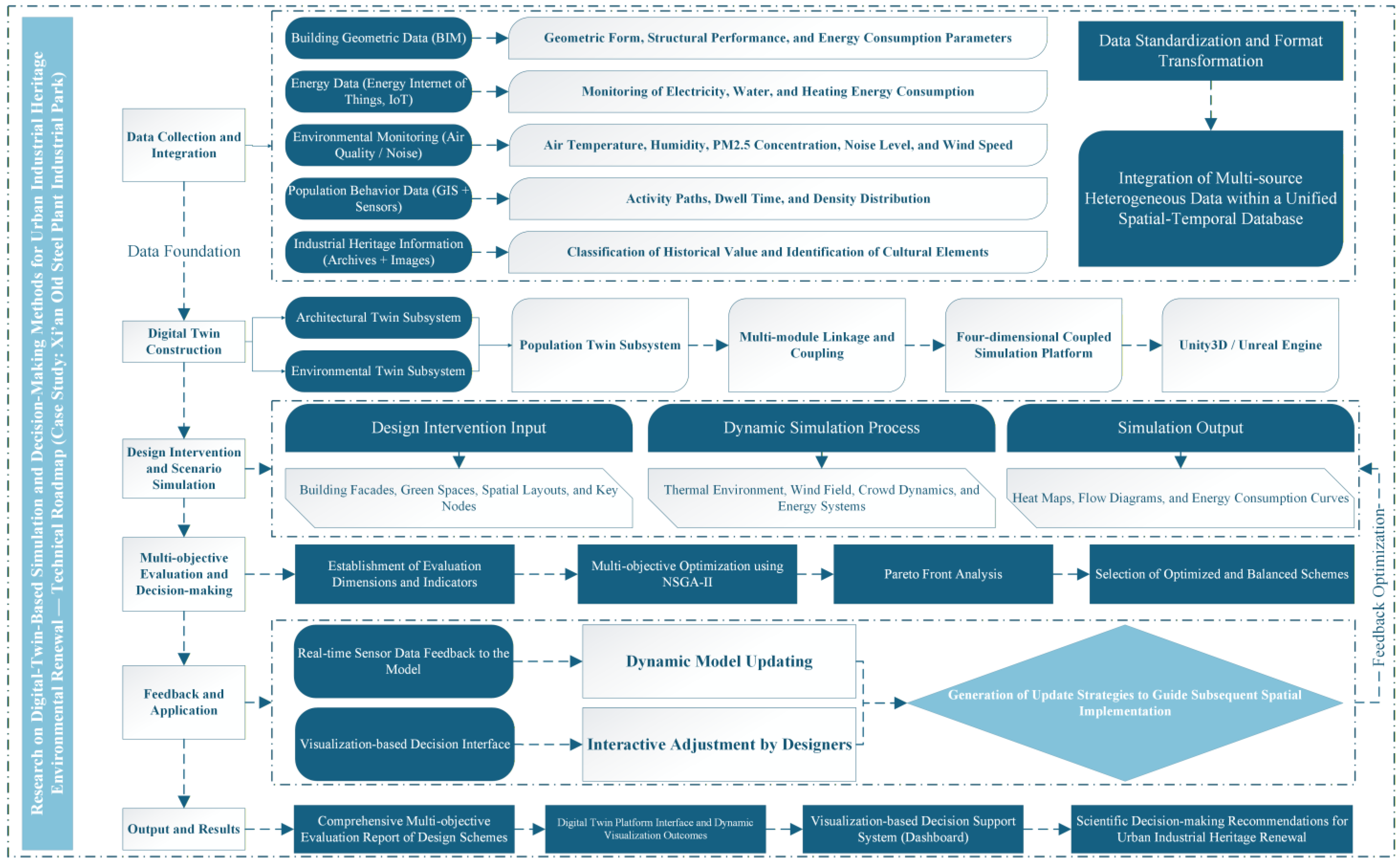
Figure 1. Technical roadmap for industrial heritage environmental renewal based on digital twin technology.
Buildings 15 04367 g001
Figure 2. Conceptual Design Logic of the Digital Twin Platform Architecture.
Buildings 15 04367 g002
Figure 3. Multi-Model Coupling and Data Exchange Workflow.
Buildings 15 04367 g003
Figure 4. Calibration and Validation of Building Energy and Microclimate Models Based on Public Data.
Buildings 15 04367 g004
Figure 5. Geographic Location of the Xi’an Old Steel Plant Industrial Park.
Buildings 15 04367 g005
Figure 6. Surrounding Environment of the Xi’an Old Steel Plant Industrial Park.
Buildings 15 04367 g006
Figure 7. Timeline of Historical Evolution of the Xi’an Old Steel Plant.
Buildings 15 04367 g007
Figure 8. Spatial Layout of the Historical Site of Xi’an Old Steel Plant.
Buildings 15 04367 g008
Figure 9. Current Building Layout and Functional Zoning of the Central Area of Xi’an Old Steel Plant.
Buildings 15 04367 g009
Figure 10. Analysis of Historical and Current Characteristics of Xi’an Old Steel Plant Buildings.
Buildings 15 04367 g010
Figure 11. 3D Building Model of the Original Xi’an Old Steel Plant Site.
Buildings 15 04367 g011
Figure 12. 3D Building Model of the Main Study Area of Xi’an Old Steel Plant.
Buildings 15 04367 g012
Figure 13. Schematic Diagram of Building Retrofit Scenarios.
Buildings 15 04367 g013
Figure 14. Pareto Front of Multi-Objective Optimization Solutions Using NSGA-I I.
Buildings 15 04367 g014
Figure 15. Trade-Off Relationships Among Multi-Objective Optimization Performance Indicators.
Buildings 15 04367 g015
Figure 16. Comparative Scores of Comprehensive Performance Index (CPI) Across Xi’an Old Steel Plant Areas.
Buildings 15 04367 g016
Figure 17. Heatmap of Park User Activities Simulated by Multi-Agent Modeling.
Buildings 15 04367 g017
Table 1. Data Collection Types and Sources of Simulated Data.
Data TypeContentReference for Parameterization
Building Geometry DataIncludes structural form, material properties, and spatial function informationTypical Parameters Obtained from Field SurveyPublic Data https://zygh.xa.gov.cn/ywpd/cxghgsgb/ghglpqgs/3.html (accessed on 23 October 2025).
http://www.lgccyy.com/Admission/outfit/office/index.html (accessed on 25 October 2025)
Environmental Monitoring DataReal-time parameters such as air quality, noise, and temperature–humidityPublic Data
http://sn.cma.gov.cn/ (accessed on 20 October 2025)
https://www.worldweatheronline.com/xian-weather-averages/shaanxi/cn.aspx (accessed on 23 October 2025)
Population Activity DataEnables dynamic recognition of pedestrian density and behavioral trajectoriesPublic Data
https://www.xa.gov.cn/, (accessed on 25 October 2025)
http://www.lgccyy.com/Admission/outfit/office/index.html (accessed on 25 October 2025)
Energy DataMonitors building energy consumption and equipment operation statusPublic Data
https://www.xincheng.gov.cn/zwgk/zfbmml/qzfgzbm/xasxcqtjj/1.html (accessed on 25 October 2025)
https://tjj.xa.gov.cn/index.html(accessed on 20 October 2025)
https://swj.xa.gov.cn/zyyw/zyhj/1.html (accessed on 23 October 2025)
Note: The websites and materials listed under “Sources of Simulated Data” in this table serve as references for parameter assignment and spatial modeling in this simulation study. All input data were normalized and calibrated for logical consistency to generate a structured simulation dataset used for methodological verification. These datasets do not represent field-measured results. Detailed sources of simulation data and uncertainty explanations are provided in Section 3.6.
Table 2. IoT Coverage Dimensions and Scope.
DimensionPrimary Scope
MicroclimateTemperature–humidity sensors, anemometers, and solar radiation sensors are virtually deployed in major plazas, streets, and building perimeters.
Energy useSmart meters are assigned to the main electrical distribution boards to simulate the acquisition of whole-building energy consumption.
Human activityWi-Fi probes are conceptually placed at primary entrances and activity nodes to simulate the monitoring of crowd density and movement trajectories.
Table 3. Schematic of Input–Output Relationships Among Models.
ModelMain InputsMain OutputsCoupled TargetsCalibration Benchmark
ENVI-metMeteorological Boundary Conditions, Building FormAir Temperature, Humidity, Wind Speed, UTCIEnergyPlus, AnyLogicXi’an Typical Meteorological Year (TMY) Data
EnergyPlusBuilding Material Parameters, Meteorological DataEnergy Consumption, Carbon EmissionsENVI-metGB 50189-2015 [55]
AnyLogicSpatial Comfort, AccessibilityPedestrian Density, Dwell TimeENVI-metBehavioral Survey Report
Table 4. Classification Standards of the Universal Thermal Climate Index (UTCI).
TemperatureLevel
46 °CExtreme Heat Stress
38–46 °CVery Strong Heat Stress
32–38 °CStrong Heat Stress
26–32 °CModerate to Slight Heat Stress
9–26 °CNo Heat Stress/Neutral
Note: This table presents the international classification standards of the UTCI, used to assess outdoor thermal comfort. UTCI integrates air temperature, wind speed, radiation, and humidity, serving as a key evaluation metric in microclimate simulations.
Table 5. Simulation Parameter Settings.
Parameter CategorySpecific SettingsData SourceNotes
Meteorological Boundary ConditionsTypical Meteorological Year (TMY): Xi’an TMY Data
Representative Summer Day: July 27
Daily Maximum Temperature: 35.2 °C
Average Wind Speed: 1.8 m/s
Predominant Wind Direction: South
Weather Conditions: Clear sky, no precipitation
China Standard Meteorological Database; Xi’an Meteorological BureauSimulation covers a full 24 h period to comprehensively evaluate the performance of design interventions under extreme heat conditions.
Occupant Activity PatternsWorkersActive period: Weekdays (Monday–Friday) 09:00–18:00.
Behavioral rules: follow fixed activity patterns based on office locations.
Campus operation data; survey questionnairesHigher base visitation rates and longer average stochastic dwell times are set for weekends to simulate varying usage intensities.
Visitors, TouristsActive period: full day; weekends (Saturday–Sunday) with higher intensity.
Behavioral rules: arrival time, dwell duration, and activity choice (touring, consumption) follow probability distributions derived from field surveys.
Building Operation ScheduleCooling system: operating schedules and setpoint temperatures are defined according to the “Code for Energy Efficiency Design of Public Buildings” and actual campus operation.
Lighting system: on/off schedules and energy intensity are set based on the “Code for Energy Efficiency Design of Public Buildings,” natural daylight availability, and actual campus operation.
“Code for Energy Efficiency Design of Public Buildings” (GB 50189-2015) [55]; campus property management recordsOperational schedules differentiate weekdays and weekends to reflect building energy usage patterns.
Note: This table provides a detailed overview of the primary parameter settings used in microclimate, energy consumption, and pedestrian behavior simulations, including meteorological conditions, occupant activity patterns, and building operation schedules. All parameters were defined based on Typical Meteorological Year (TMY) data and relevant industry standards.
Table 6. Average Random Consistency Index (RI) Reference Values in Analytic Hierarchy Process.
n1234567
RI000.580.901.121.241.32
Note: This table lists the Random Index (RI) values used in the AHP method for consistency checking, proposed by Saaty. It is used to determine whether the judgment matrix satisfies the consistency requirement (CR < 0.1). When CR < 0.1, the judgment matrix is considered to have satisfactory consistency, and the weight results are reliable.
Table 7. Simulation Data Sources and Uncertainty Considerations.
Parameter CategoryKey Parameter ExamplesData Source and Generation MethodUncertainty
Building GeometryForm, Dimensions, Floor Height3D modeling based on OpenStreetMap and satellite imagery, with volumetric verification against the “Xi’an Industrial Heritage Inventory”Reconstructed from publicly available maps; no on-site precision survey conducted
Material PropertiesEnvelope Thermal Transmittance (U-value)Assigned based on recommended value ranges for similar existing buildings from the “Code for Energy Efficiency Design of Public Buildings” (GB 50189-2015) [55]Based on limited observations, historical documentation, and literature; source materials are not publicly accessible
Environmental DataAir Temperature, Humidity, Wind SpeedTypical year data for Xi’an station from the China Standard Meteorological Year (TMY) databaseBased on Xi’an meteorological data; environmental conditions are inherently variable
Pedestrian ActivityVisitation Rate, Dwell TimeSet according to probability distributions of behavioral patterns derived from limited on-site observations and studies of similar cultural and creative parksBased on limited observations and literature; behavioral patterns involve assumptions
Note: The aforementioned simulation data strategy ensures the testability of the framework logic, and future integration of IoT-based measured data streams can enable continuous calibration and optimization of the model. To avoid confusion, all references to “measurement accuracy” and “error control range” in this study pertain solely to parameters set within the simulation system for validation purposes and do not correspond to actual field survey measurements.
Table 8. Historical Development of the Xi’an Old Steel Plant.
Time PeriodKey Events and Development Stages
1958Plant established and named “Shaanxi Steel Plant” (abbreviated as “Shaan Steel”)
1964–1965Relocated to Xi’an in 1964. In 1965, a workshop moved from Dalian Steel Plant was reorganized and put into production
1960s–1980sBecame one of China’s eight major special steel enterprises. Produced over 100 types of specialty steels, including high-speed tool steel, and some military products
1988–1998In 1988, the plant ceased production for transformation. By 1998, faced with debt and other challenges, it confronted a shutdown and restructuring
2002Officially declared bankrupt and acquired by Xi’an University of Architecture and Technology Science & Education Industry Group
2012Under the promotion of Xin Cheng District government, initiated the positioning and development of the “Old Steel Plant Design and Creative Industry Park”
2013–2016Redevelopment project commenced, with the park officially opening in 2016
From 2016 to the presentCurrently houses approximately 150 enterprises with an annual output exceeding 1 billion RMB, becoming a landmark for urban innovation and a model for industrial heritage redevelopment in Xi’an
Table 9. Analysis of the Current Status of Xi’an Old Steel Factory Buildings.
DimensionKey Features
Building Renovation StrategyThe core principles are “restoration to original” and “micro-renovation.” The main structures, red brick façades, and industrial facilities of nine Soviet-style workshops are preserved, while functionality is enhanced through added skylights and the integration of modern materials such as glass curtain walls and steel structures.
Spatial Function TransformationSingle-purpose industrial spaces are converted into mixed-use industrial parks combining creative offices, cultural exhibitions, and commercial leisure. Notable examples include converting pickling pools into ecological water features, workshop tracks into art corridors, and assembling discarded components into large-scale installation artworks.
Structure and MaterialsThe large-span spatial characteristics of the original industrial buildings are fully utilized. Lofts are added internally to increase usable area while retaining brick walls, industrial slogans, and other era-specific details.
Landscape and Ecological EnvironmentRenovation emphasizes preserving the original ecological environment, including retaining many native trees. Industrial heritage elements are creatively reused, such as converting pickling pools into water features and repurposing old materials for planters, creating a distinctive industrial landscape.
Cultural and Social BenefitsThe site has become a cultural landmark and a model for industrial tourism. Institutions such as the “Cheng dong Impression” Experience Hall and Xi’an Urban Memory Museum preserve and communicate the industrial history and urban memory.
Table 10. Technical Parameters for Data Acquisition in Digital Twin Model Construction.
CategoryTechnical ParametersData and Accuracy (Simulated Values)Application
Terrestrial Laser Scanning (TLS)Number of scan stations: 400; point cloud density: ~1000 pts/m2; range accuracy: ±10 mmGenerated point cloud: ~3.8 × 10⁹ points; mean registration error: 0.015 mSimulated high-precision ground geometry acquisition for building and terrain model reconstruction
UAV Oblique PhotogrammetryFlight altitude: 120 m; forward overlap: 80%; side overlap: 70%; resolution: 2.5 cm/pixelSimulated generation of orthophotos and DSM; planimetric error: 0.035 m; elevation error: 0.045 mSimulated acquisition of macro-scale spatial data and roof geometry capture
Ground-Based PhotogrammetryShooting distance: 20 m; focal length: 24 mmSimulated façade images; spatial error < 3 cmProvides building façade texture and structural detail data
Point Cloud Preprocessing and Feature ExtractionNoise removal threshold: σ = 3σ_mean; feature extraction rate: 92%Output simplified point cloud: ~48 GBForms a high-quality spatial dataset for model reconstruction
BIM Data IntegrationIncludes 14 main factory buildings; total building area ~68,000 m2120 metadata fields (structural type, materials, construction year, function, etc.)Simulated construction of Digital Information Model (DIM)
Visualization Platform IntegrationData linkage frequency: 1 Hz; real-time rendering frame rate ≥ 30 FPS3D model accuracy (simulated): ≤0.05 mSupports multi-scale visualization and interactive presentation
Model Accuracy VerificationGround Control Points (GCPs): 25Planimetric error: 0.035 m; elevation error: 0.043 mSimulated geometric accuracy verification results
Note: The “Digital Twin Data Acquisition and Model Construction of Xi’an Old Steel Plant” presented in this study are simulation data based on typical conditions of aged industrial sites. Parameter values were referenced from common technical standards reported in domestic and international studies on industrial heritage surveying and digital twin applications, such as LiDAR accuracy, UAV resolution, and BIM dataset scale. The simulation data are designed to verify the applicability and feasibility of the methodology and do not represent actual on-site measurements. The focus of this study is to demonstrate the full technical workflow from “multi-source data acquisition → integration → digital modeling → visualization output,” providing theoretical and methodological support for subsequent building–environment coupled simulations [78,79].
Table 11. Comparison of Performance Simulation Results for Different Renovation Scenarios of the Main Hot-Rolling Workshop.
ScenarioRetrofit StrategyΔT (°C)Δ Energy Consumption (%)Δ Illuminance (%)PMVEvaluation
ABaseline (original roof structure, no greening)---+0.4High heat load, low comfort
BOptimized skylight + diffused glass−2.8−8.7+35−0.2Balanced light and heat
CB + Roof greening−4.5−15.3+33−0.3Optimal thermal condition
DC + Natural ventilation optimization−4.2−14.8+31−0.3Best overall performance
Note: This table compares the simulated performance of four renovation scenarios in terms of temperature variation, energy savings, lighting improvement, and thermal comfort. Data are derived from coupled simulations using EnergyPlus, ENVI-met, and Fluent, based on typical summer day meteorological conditions.
Table 12. Original Values of Heat Island Intensity Reduction Rate (HIRR) by Area.
AreaHeat Island Intensity Reduction Rate (%)
A18.5
B14.2
C20.1
D12.4
E17.8
Table 13. Normalized Values of Heat Island Intensity Reduction Rate (HIRR) by Area.
Area Original   Value   X i Normalized   Value   N i
A18.50.79
B14.20.23
C20.11.00
D12.40.00
E17.80.70
Note: This table presents the results of the range normalization of the HIRR original data from Table 10, enabling comparability among indicators within the multi-dimensional evaluation framework.
Table 14. Multidimensional performance indicators and comprehensive performance index (CPI) across different zones.
AreaHIRR (%)ΔE (kWh/m2·a) AnnuallyΔUTCI (°C)Increase in Crowd Density (%)CPI
A12.518.6−1.825.40.88
B10.315.2−1.518.20.81
C14.119.8−2.031.70.92
D9.813.5−1.315.60.78
E16.412.1−2.412.20.85
Table 15. Sources of Reference Data for Model Calibration.
Data TypePrimary Sources of Calibration Reference Data
Environmental DataHourly meteorological observations (temperature, humidity, and wind speed) for July 2024 were obtained from the Xi’an Meteorological Bureau. These data were used to calibrate the ENVI-met microclimate model.
Energy Consumption DataMonthly electricity billing records for 2024 were collected from a representative office building within the Old Steel Plant Industrial Park (floor area ≈ 4200 m2). These records served as the baseline for calibrating the annual load curve of the EnergyPlus energy model.
Behavioral DataManual pedestrian counts were conducted at three major plazas within the park across six sessions (three weekdays and three weekends), yielding a total of 312 valid sample points. These data were used to calibrate population density parameters in the AnyLogic multi-agent simulation model.
Disclaimer/Publisher’s Note: The statements, opinions and data contained in all publications are solely those of the individual author(s) and contributor(s) and not of MDPI and/or the editor(s). MDPI and/or the editor(s) disclaim responsibility for any injury to people or property resulting from any ideas, methods, instructions or products referred to in the content.