



Symmetry, Volume 17, Issue 11 (November 2025) – 234 articles
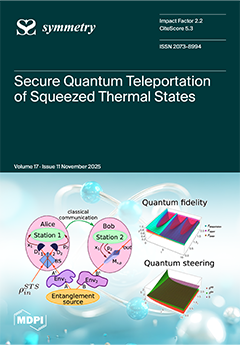
Cover Story (view full-size image):
Quantum teleportation is a fundamental protocol in quantum information science. It represents a critical resource for quantum communication and distributed quantum computing. We derive an analytical expression of the fidelity of teleportation of an input squeezed thermal state using a bipartite Gaussian resource state shared between Alice and Bob for teleportation. Each mode of the resource state is susceptible to the influence of the environment. We employ the characteristic function approach in conjunction with the covariance matrix formalism. The fidelity of teleportation is expressed in terms of input and resource state covariance matrices. A successful quantum teleportation requires meeting two criteria: the presence of two-way quantum steering and a teleportation fidelity exceeding the classical threshold. View this paper
- Issues are regarded as officially published after their release is announced to the table of contents alert mailing list.
- You may sign up for e-mail alerts to receive table of contents of newly released issues.
- PDF is the official format for papers published in both, html and pdf forms. To view the papers in pdf format, click on the "PDF Full-text" link, and use the free Adobe Reader to open them.
Previous Issue
Next Issue