1. Introduction
A nonholonomic mechanical system refers to a system with nonintegrable differential constraints, and their motion is typified by comparatively intricate motion equations. There are a large number of engineering problems with nonholonomic constraints in fields such as rigid body dynamics [
1], vehicle dynamics [
2], aerospace vehicle dynamics [
3], celestial mechanics [
4], and so on. It is particularly important to efficiently model and accurately simulate the dynamic behavior of a system. The traditional modeling method is to handle nonholonomic constraints by introducing constraint multipliers based on the d’Alembert-Lagrange principle in the inertial frame [
5,
6]. Nevertheless, the d’Alembert-Lagrange principle has flaws in the long-term numerical simulation and in preserving the intrinsic structure of continuous systems, as it is not a variational principle. Additionally, the introduction of constraint multipliers indirectly increases the number of system variables and leads to error accumulation [
7,
8,
9]. Therefore, the traditional modeling method in the inertial frame is not the optimal choice for a long-term simulation of the dynamic behavior of nonholonomic systems.
Hamel’s formalism directly constructs dynamic equations in the space of degrees of freedom allowed by constraints. These equations have more intuitive physical meanings and facilitate the analysis of the system’s dynamic behaviors (such as stability, energy transfer, etc.) [
10]. By means of non-material velocities and quasi-coordinates, Hamel equations can transform the dynamic equations of nonholonomic constraint systems into ones that are similar to unconstrained equations, simplifying the process of handling nonholonomic constraints [
11,
12,
13]. They are particularly suitable for modeling engineering systems with nonholonomic constraints, such as those in robotics and vehicle dynamics. The Hamel integrator has inherent advantages in simulating nonholonomic systems [
11]. These advantages are reflected in two aspects. On the one hand, they avoid the introduction of redundant variables such as constraint multipliers [
12,
13]. On the other hand, they prevent the error accumulation of traditional differential-algebraic mathematical models [
14,
15]. It can also preserve the geometric properties of nonholonomic systems (such as the energy conservation of autonomous systems and the time reversal invariance of the d’Alembert-Lagrange manifold in nonholonomic dynamics) [
16,
17].
The classical Chaplygin sleigh is a typical nonholonomic constraint system [
18,
19]. In the Hamel framework, the mathematical model of the Chaplygin sleigh is obtained in a moving frame [
20,
21,
22]. The numerical simulation can more accurately and efficiently predict the trajectory and other dynamic behaviors of hydrodynamic sleds [
23,
24,
25]. In the hydrodynamic version, the motion of underwater vehicles is inherently a coupled process of the hydrodynamic constraints and nonholonomic constraints. Their propulsion (propellers) and steering (fins) correspond to the “sleigh blade”-type nonholonomic constraints [
26,
27,
28]. Kirchhoff proposed a hydrodynamic model for free rigid bodies in the potential flow [
29]. The potential flow’s influence on objects is fully described by added mass and inertia terms, which depend only on the geometry shape of the bodies [
30]. This method for a potential flow fluid–structure interaction has been extended to the hydrodynamic Chaplygin sleigh [
31,
32]. It was also considered in the presence of circulation [
26,
33]. Ref. [
34] considered the asymptotic behavior and the trajectory generation problem for the Chaplygin sleigh interacting with a potential fluid. The objective of Ref. [
35] was to analyze the parameters affecting the roll-angle stability of an autonomous fish-like underwater swimmer. These modeling forms provide a feasible method for the theoretical analysis of underwater vehicles based on hydrodynamic sleigh models.
However, the modeling of a hydrodynamic sleigh is mainly based on the d’Alembert-Lagrange principle, to establish DAE models. The approach to handling nonholonomic constraints still relies on introducing redundant variables, namely Lagrange multipliers, which increases the complexity of the system’s analytical analysis. To overcome the shortcomings of constraint multipliers and DAE models in numerical computation, we establish a hydrodynamic sleigh model with the Hamel framework. The Hamel integrator, based on the discrete variational principle, can improve the efficiency and stability of numerical computation.
The rest of the paper is organized as follows. In
Section 2.1, the kinematic model of a classic Chaplygin sleigh is reviewed, and the Lie symmetries of the sleigh are derived in
Section 2.2;
Section 3.1 briefly introduces the characteristics of potential flow and the mechanism by which potential flow acts on the sleigh and derives the form of the sleigh’s Lagrangian function in a potential flow environment; in
Section 3.2, the mathematical model without multipliers of the hydrodynamic Chaplygin sleigh is constructed in a moving frame;
Section 4 obtains the Hamel integrator via the discrete variational principle, and uses the Hamel integrator to simulate the dynamic behaviors of Model I (where the blade contact point is at the sleigh’s geometric center) and Model II (where the blade contact point has an offset), so as to verify the advantages of the Hamel integrator in the process of hydrodynamic sleigh modeling. Some conclusions are obtained in
Section 5.
3. The Motion of Hydrodynamic Chaplygin Sleigh in Hamel Framework
In the absence of a potential flow, the kinetic energy tensor of a rigid body is determined solely by its own inertia. After introducing a potential flow, the kinetic energy tensor becomes the sum of the rigid body inertia and the added fluid inertia. This change affects the manifestation of symmetry in the kinetic energy through the added fluid inertia tensor. However, the existence of the potential flow does not alter the uniformity, isotropy of the space of the sleigh itself, or the corresponding group symmetry structure. Therefore, in a potential flow environment, we construct a moving frame based on the aforementioned symmetry generators to realize the modeling of the hydrodynamic sleigh within the Hamel framework.
3.1. Hydrodynamic
Consider a Chaplygin sleigh moving in a potential fluid. Assume that the flow of a fluid is irrotational and inviscid, with a zero velocity at the fluid boundary; no cavities are produced in the fluid. The effect of adding the fluid to the system can be represented by a fluid inertia tensor added to that of the body. Most of the material covered in this section can be found, for instance, in [
40], as well as in the classic works of Lamb [
30].
The classic Chaplygin sleigh is essentially a flat rigid body of mass, m, moving in the plane, supported at three points, two of which slide freely without friction while the third is a knife-edge constraint which allows no motion perpendicular to its edge.
A simple yet interesting case is an elliptical planar body with semi-axes
A >
B > 0. We define a kinetic energy Lagrangian
. This time
is a scalar,
is a two-dimensional row vector, and
is a 2 × 2 matrix. Thus, the Lagrangian for the system is
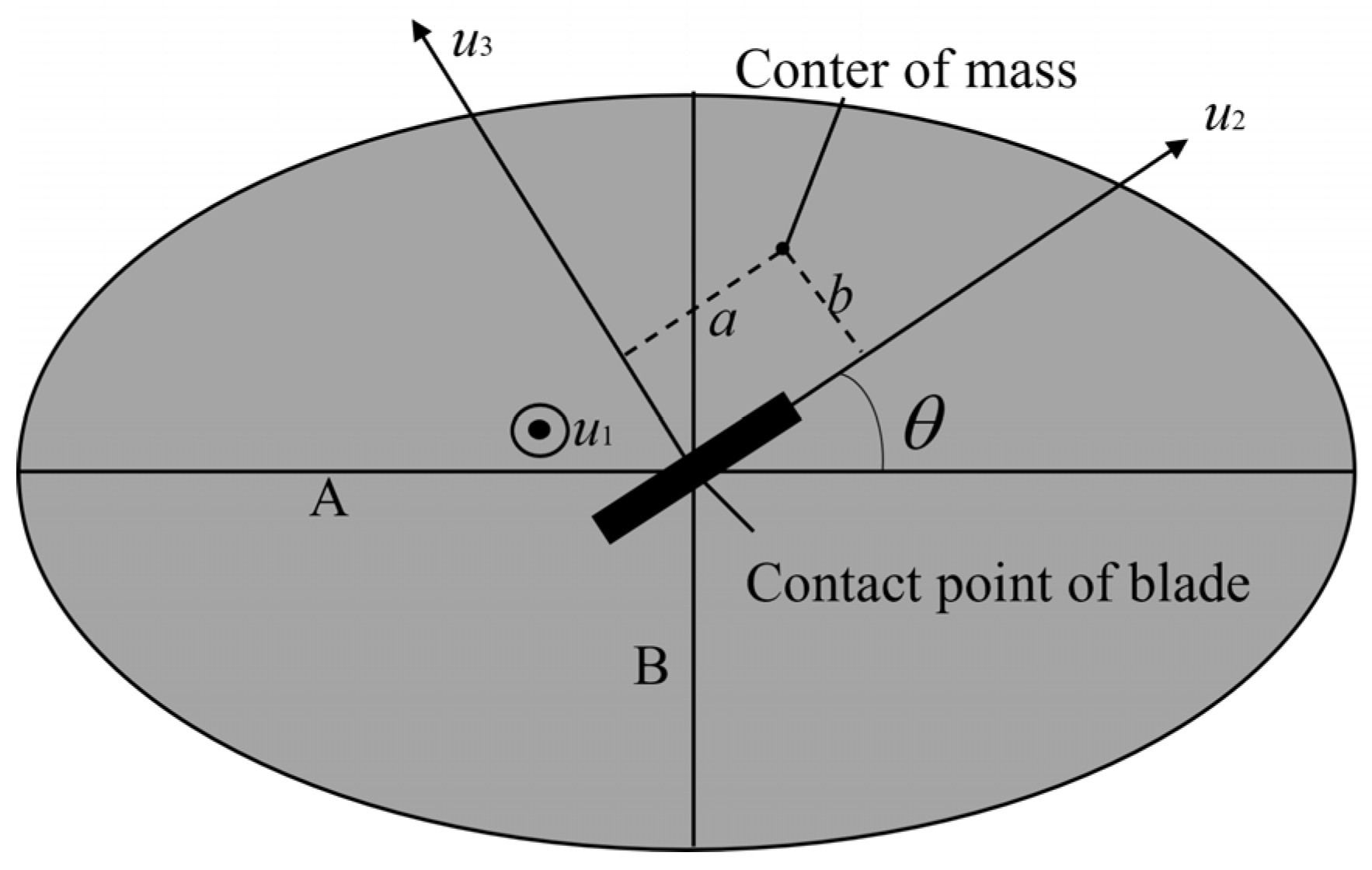
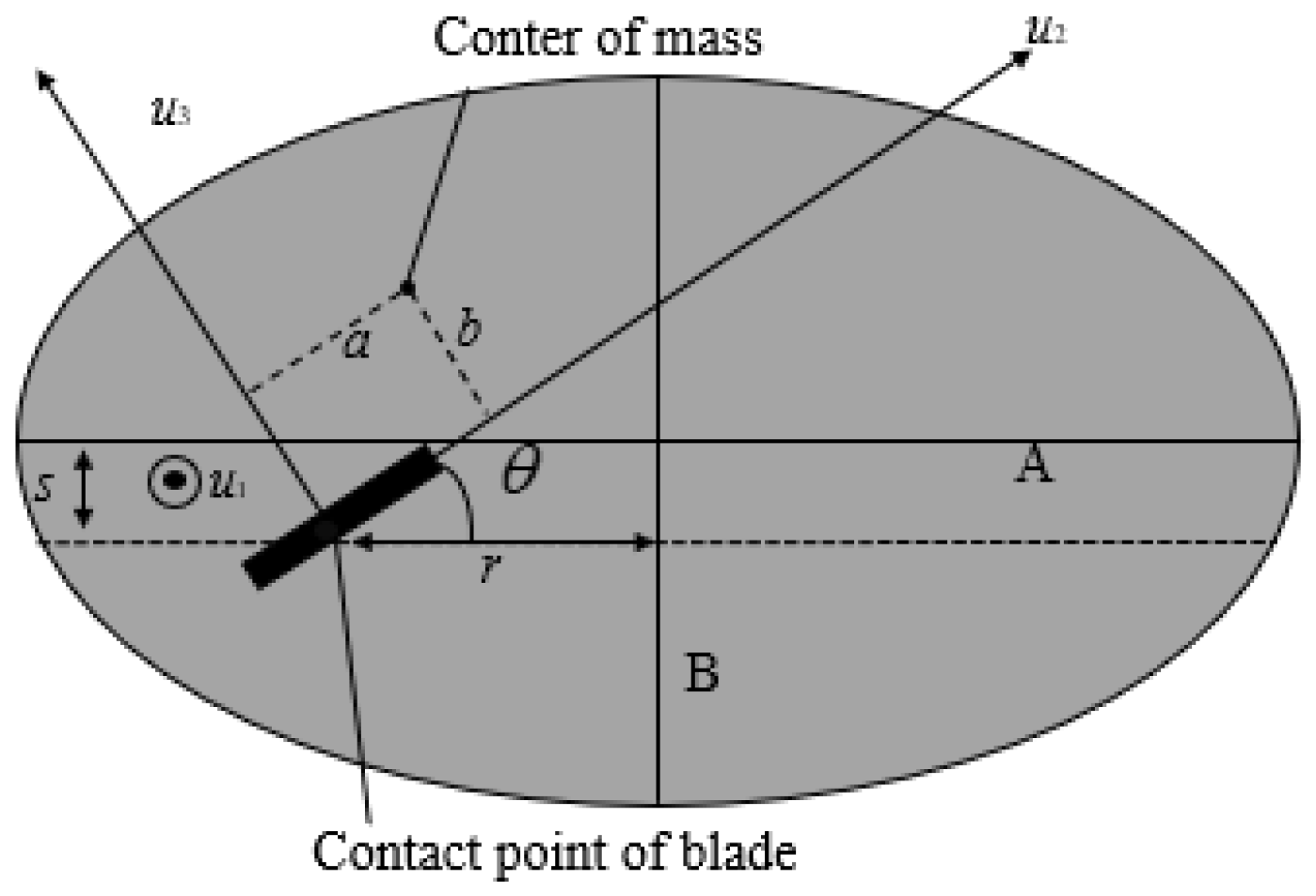
First, assume that the origin is at the center of the ellipse, and the blade makes an angle θ with the major axis of the ellipse, as illustrated in
Figure 1.
We consider an elliptic planar rigid body of mass
m, major semi-axis
A, and minor semi-axis
B, immersed in a potential incompressible fluid. By applying Kirchhoff decomposition and added masse theory, the kinetic energy of the fluid can be expressed as the quadratic form
and the elements of
depend solely on the body shape. The body inertia tensor is
where m is the mass of the body, (
a,
b) are the body coordinates of the center of mass, and
is the moment of inertia of the body about the center of mass.
Suppose the total inertia tensor of the fluid-body system is then given by
where
Among them: J is the angular diagonal component of the total inertia tensor, representing the total rotational inertia of the system around the origin of the body coordinate system; M is the translational diagonal component of the total inertia tensor, representing the total translational inertia of the system along the blade-edge direction; N stands for translational diagonal component of the total inertia tensor, representing the total translational inertia of the system perpendicular to the blade edge direction; L1 and L2 are the coupling components of the total inertia tensor, reflecting the dynamic coupling between angular velocity and translational velocity; and Z stands for the translational–translational cross component of the total inertia tensor, reflecting the dynamic coupling between the two translational directions.
Immersing a sleigh in a fluid will lead to the coupling of its motions in different axial directions, and its dynamic behaviors will change drastically. Due to the high nonlinearity of real fluids (which are viscous and rotational), the interaction can be very complicated. In this paper, we study the hydrodynamic Chaplygin sleigh in an ideal fluid. The interaction between a fluid and a rigid body depends only on the body, and the results may provide a “solvable basic framework” for complex problems in real fluids.
3.2. The Hamel Equations of Sleigh Without Multipliers
A local coordinate chart induces a frame,
, that forms a basis of the tangent fiber,
, which we refer to as the coordinate-induced frame. Then, given a coordinate chart and a frame field,
, there exists
at each q, such that, in coordinates,
Then, the components of
are likewise expressible in terms of the new frame, according to the equation
So that
Next, we rewrite the Lagrangian in terms of the new velocity components, so that in coordinates
For nonholonomic systems, the distribution
can be regarded as a collection of linear subspaces with an assumption that the distribution is nonsingular, smooth, and of a constant rank smaller than dim Q. We assume that there exists a unique orthogonal complementary distribution,
, such that
for each
. Select the velocity operators
on
; then, there exist two closed subspaces
and
, such that
and
, where
maps from
to
and
maps from
to the complementary space of
in
[
11,
14]. Then, each velocity,
, can be uniquely decomposed as
Then, the velocity constraints read
or
. Likewise, each variation
can be decomposed as
and the variation constraints read
or
.
The d’Alembert-Lagrange principle in the combination of (26) proves the following theorem [
11,
21]:
Theorem 2.
The dynamics of a nonholonomic system is represented by the constrained Hamel’s equationscoupled with the kinematic equation .
In order to more naturally handle the blade constraint, we utilize a moving frame for the sleigh. We write
as
. Many references showed that the equations of motion of the classic Chaplygin sleigh have a simpler structure when it is written using velocity components measured against a frame that is unrelated to the system’s local configuration coordinates [
11,
12]. Next, we briefly discuss the Hamel equations. The frame is considered, based on these Lie symmetry vectors
of (19) and the constraint distribution (16). The intersection of the group trajectory and the constraint space are spanned by
which is the frame of the system and consistent with the results of Refs. [
11,
21]. The moving frame consists of three vectors: a vector directed perpendicular to the sleigh’s plane to measure the angular position, a vector along the blade direction, and another vector perpendicular to the blade in the sleigh’s plane.
In the moving frame (29)–(31), the Lagrangian in terms of non-material velocity for the sleigh is
Based on Theorem 1, the continuous Hamel equation is
This is a system of first-order ordinary differential equations with corresponding analytical solutions. It is simpler than the sleigh dynamics equations in the inertial frame (a system of second-order differential-algebraic equations). In terms of numerical computation, there are also various numerical algorithms that can be directly applied, such as single-step methods (Euler method, Runge–Kutta method, etc.) and linear multi-step methods (Adams–Bashforth method, Adams–Moulton method, etc.), as well as their corresponding extended algorithms.
Next, based on the Lagrangian function in the moving frame, we adopt the discrete variational principle to obtain the variational integrator in the Hamel framework. In addition to advantages in terms of accuracy and stability, this numerical algorithm, which operates on the system’s constraint distribution, also has obvious structure-preserving characteristics compared with traditional algorithms.
4. Hamel Integrator for Hydrodynamic Chaplygin Sleigh in
For the hydrodynamic Chaplygin sleigh, the nonholonomic systems (8) can be written as the constrained Euler–Lagrange equation
where
. Given a discrete Lagrangian
with
and
, the discrete nonholonomic constraints
and
, the augmented Lagrangian
and
Based on the discrete variational principle
, that is
In the above derivation, we employed the discrete integration by parts. This method essentially involves rearranging the sum and conditions,
. Taking into account the independence of
, we can obtain the discrete Euler–Lagrange equation
where
and
Consider a sequence of configurations,
. Define an interpolation point
for the given parameter
. A discrete analog of the kinematic is
, the discrete constraints are
, the discrete Lagrangian
is a function of
and reads
, which is constructed by the formula
Under the same assumptions for the frame selection as in the continuous systems, the variation in the discrete action of (43) is taken to obtain the integrator in the Hamel frame. We interpolate the variation
and the discrete conjugate momentum
by
with
.
Using the discrete variational principle, we have
Considering the boundary term and the independence of
, we have
In the above derivation, the following relation is used
Based on our modeling of constrained distributions, the dynamics of a discrete nonholonomic system is then given by the constrained Hamel equations
The approximation order is one, in general, and becomes two when
. We refer the reader to Theorem 2.2 in [
11] or Theorem 2.2 in [
23] for more details. In this paper,
is taken in numerical simulation. The discrete Lagrangian of the sleigh is
Based on the construction of (35), we take the variation
We have the
where
.
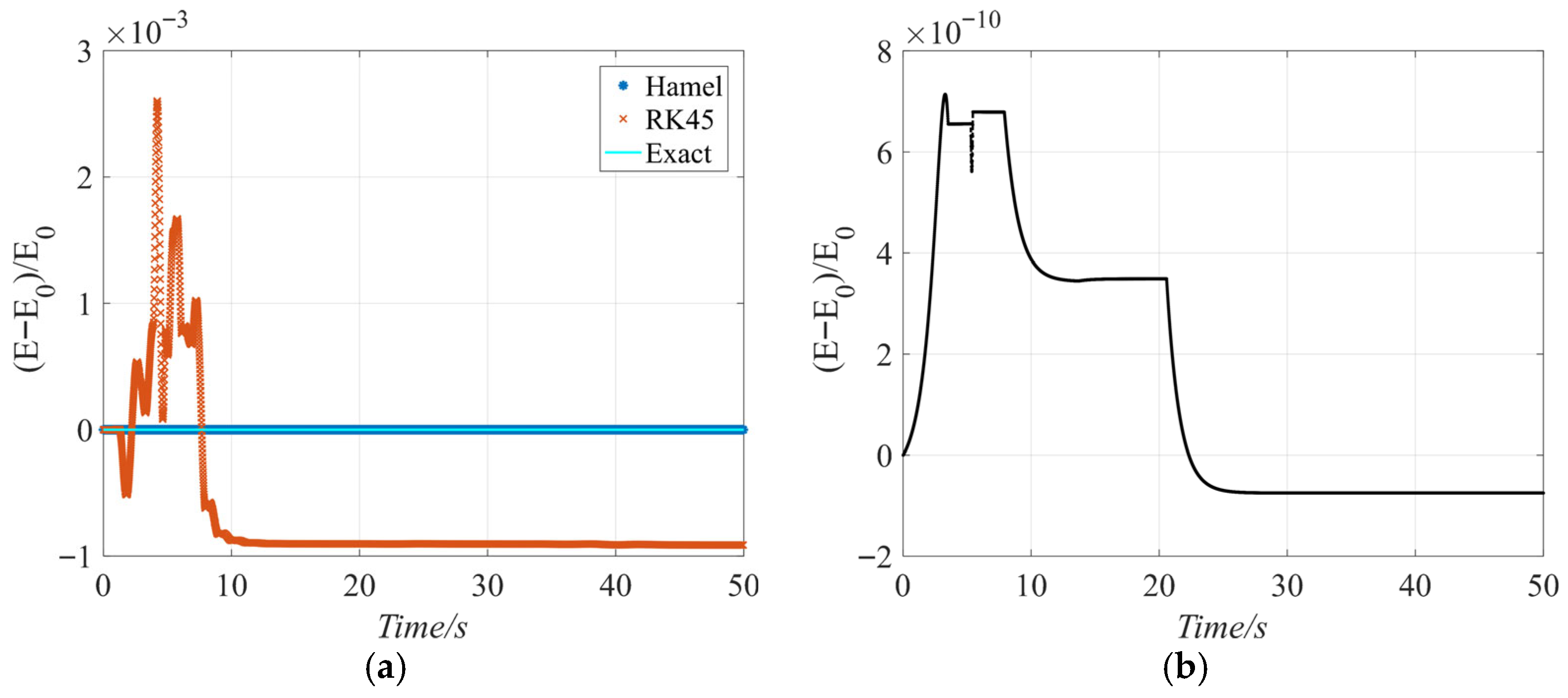
Figure 2a shows the error of the total energy of the hydrodynamic Chaplygin sleigh with the Hamel integrator, the RK45, and the analytical results. The Hamel integrator has more precise numerical results than those from the standard RK45 under the initial conditions
m = 1 kg,
= 0.5 kg·m
2,
x0 =
y0 = 0 m,
a = 0.2 m,
b = 0 m,
h = 0.001,
A = 0.5 m,
B = 0.3 m,
, and
.
Figure 2b shows the energy error with the Hamel integrator method. For the comparison of the Hamel integrator with simulations, use the RK45 and the analytical solution. Compared with traditional numerical algorithms, the Hamel integrator has higher accuracy.
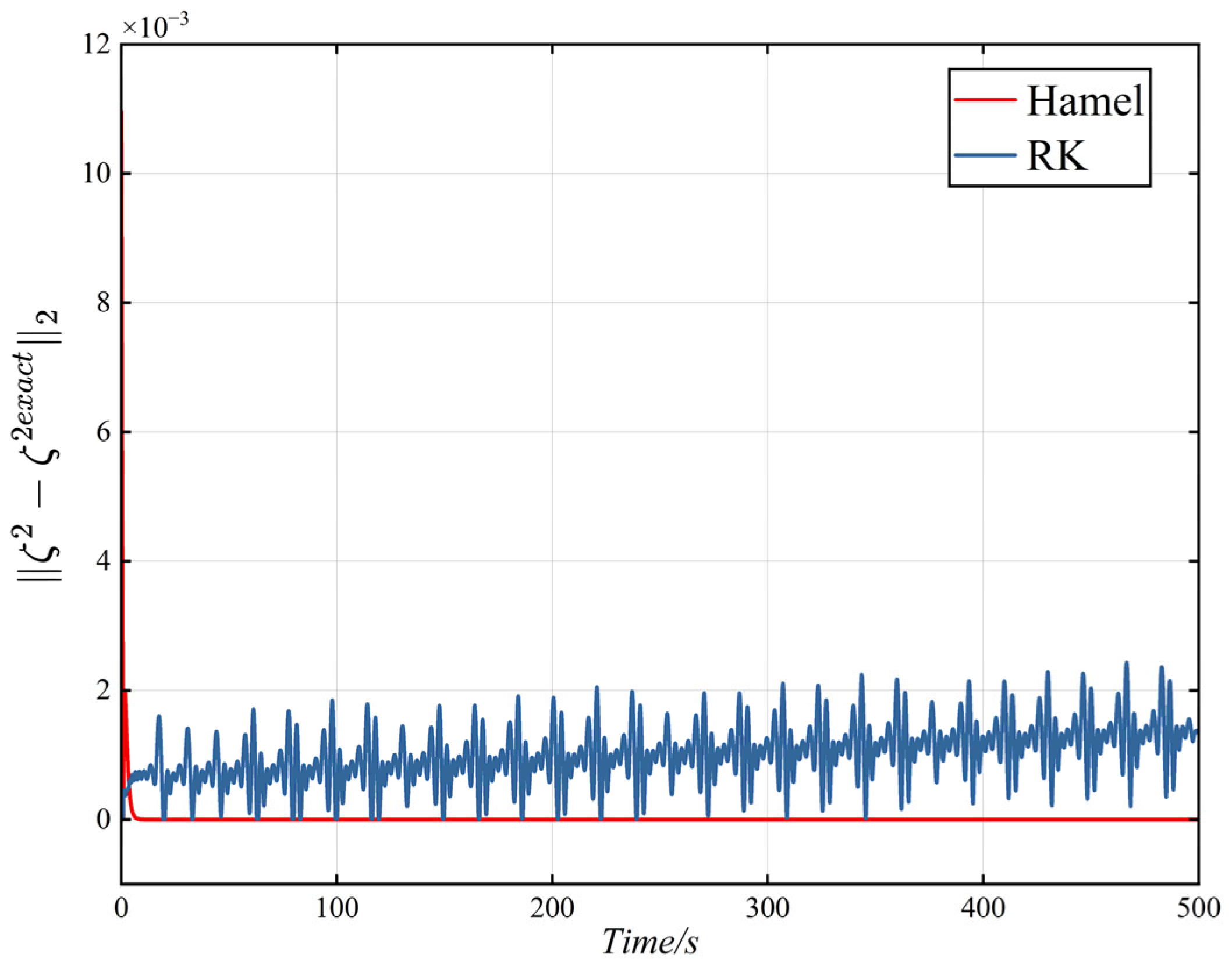
Figure 3 shows the 2-norm of angular velocity. It shows that the convergence of the Hamel integrator is better than that of the RK45.
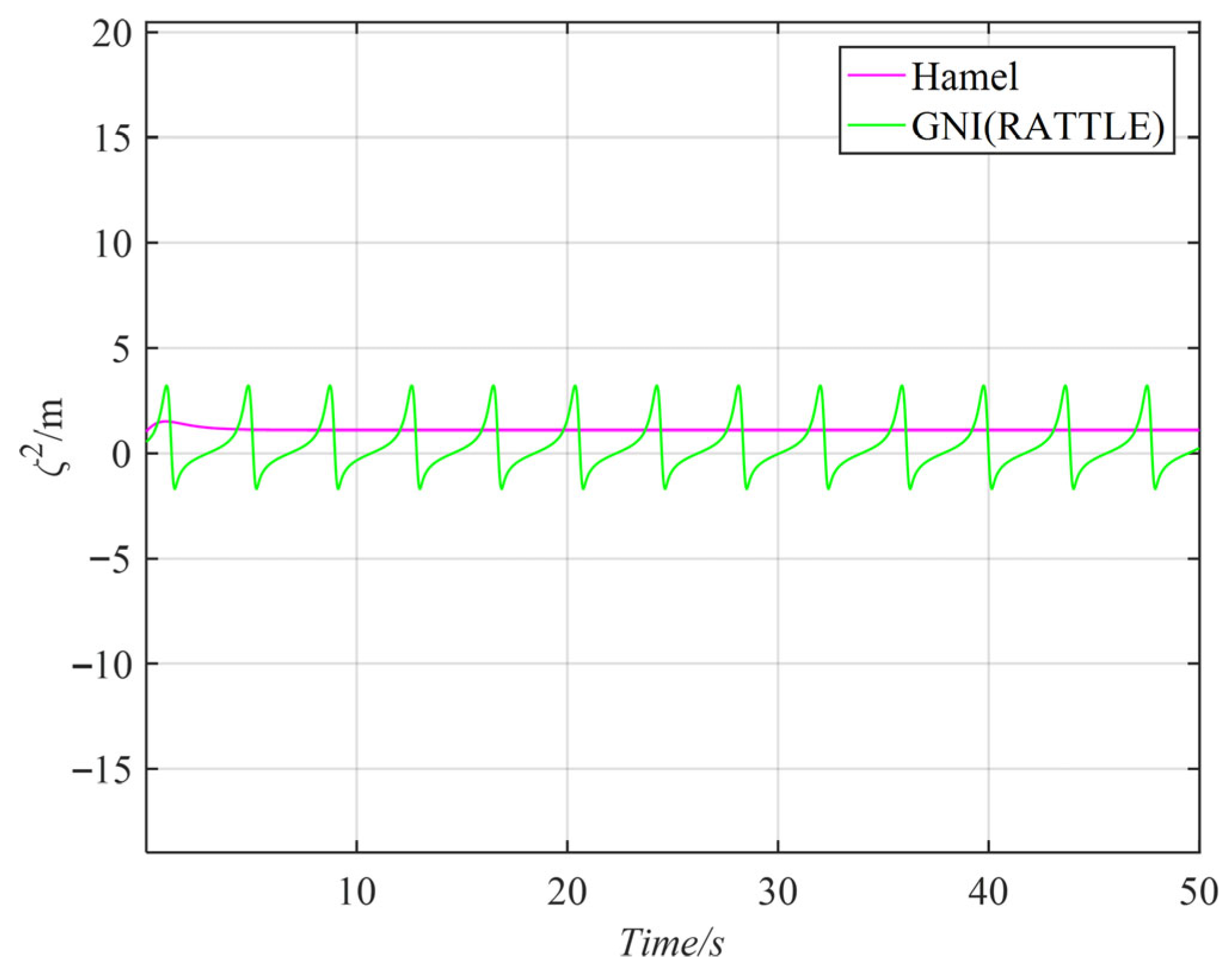
The nonholonomic RATTLE method extends RATTLE to nonholonomic constraint scenarios by means of the framework of geometric nonholonomic integrators (GNI), so as to meet the discretization requirements of nonholonomic mechanical systems. As an extension of the RATTLE algorithm for nonholonomic constraint systems, this method was first proposed in Reference [
41]. Based on this geometric method, this paper briefly verifies the variation trends of the energy and linear velocity. When compared with the Hamel numerical algorithm proposed in this paper, it can be seen from
Figure 4 (
a = 0.7 m,
b = 0 m) that the Hamel numerical algorithm still has advantages in terms of accuracy and stability over the nonholonomic RATTLE method.
Figure 4 shows the Euclidean norm error of the configuration. The error (on the vertical axis) continues to decrease and approaches 0 as the number of iterations increases, indicating that the Hamel product integrator is convergent.
Figure 5 shows the trajectory of the sleigh when the center of mass changes from (
a,
b) = (0.2 m, 0 m) to (
a,
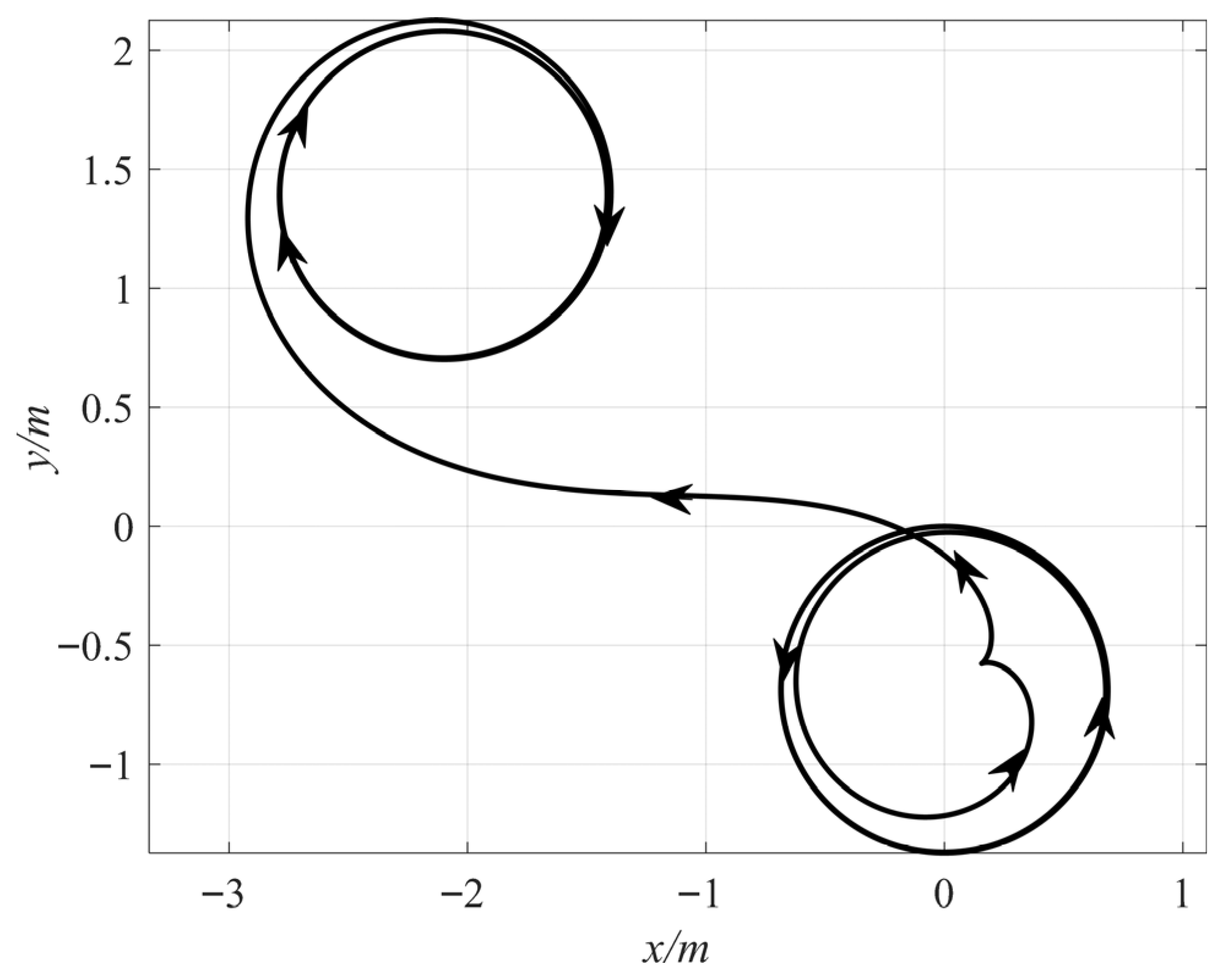
b) = (0.2 m, 0.1 m). The arrows in the figure indicate the direction of the sled’s movement. The same applies to the following figures. The classical sleigh trajectory is an asymptotic straight line. In a potential flow environment, due to the coupling terms induced by added inertia, the trajectory of the elliptic sleigh displays asymptotic evolution from one circular motion to another one, in opposite directions. The Hamel integrator exhibits the unique dynamic phenomenon of asymptotic circular motion under potential flow.
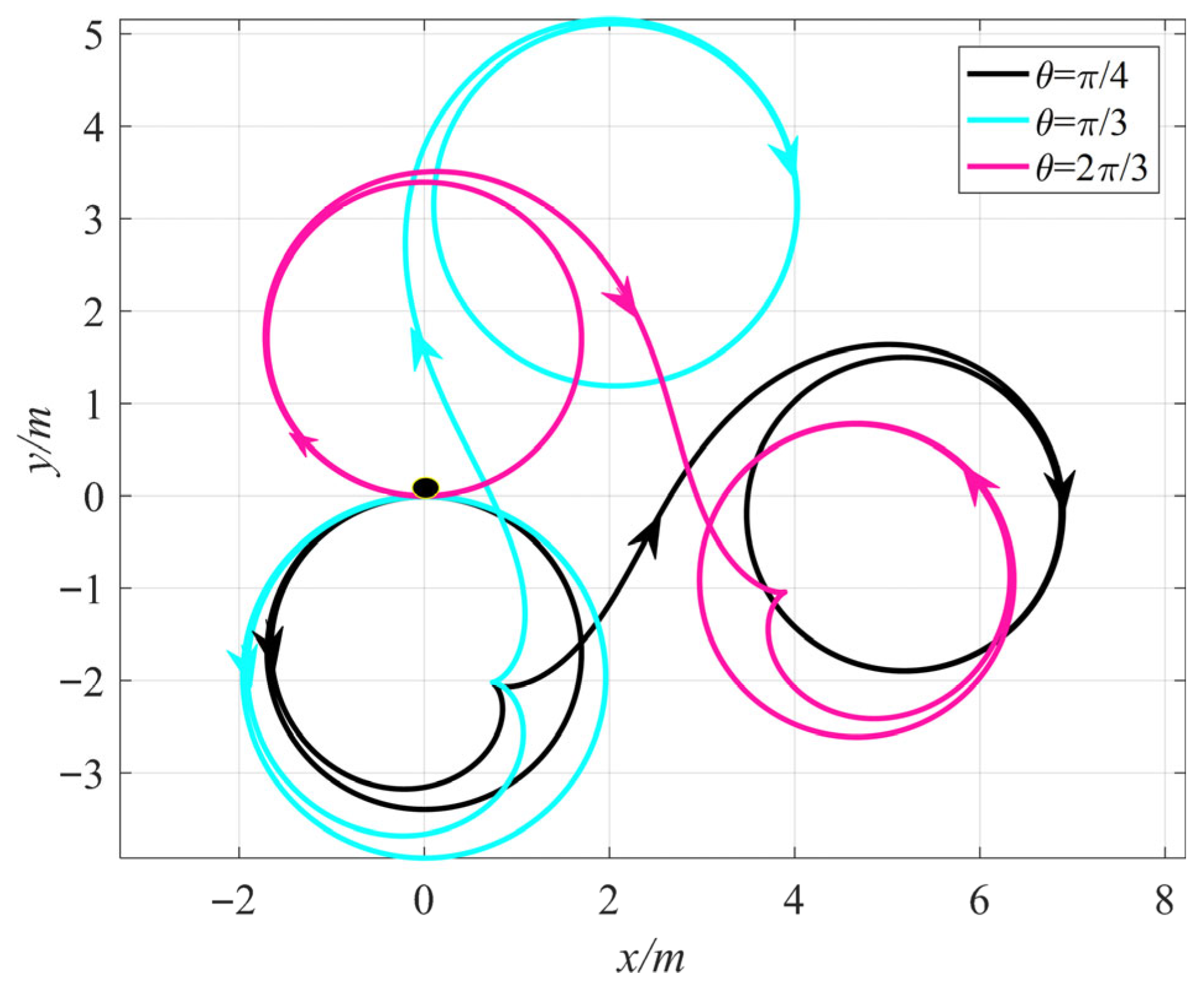
The hydrodynamic sleigh has different motion trajectories when the angle between the blade and the main shaft is changed. In
Figure 6, when
a > 0 and
, the turning direction is counterclockwise, and the sleigh eventually moves in a clockwise limit circular motion. When the angle is greater than π/2 (in red), it causes the direction of the limit circle radius to change, and the turning direction shifts from clockwise to counterclockwise. The movement path and direction of the sleigh can be controlled by adjusting the angle,
, from the simulation results of the Hamel integrator.
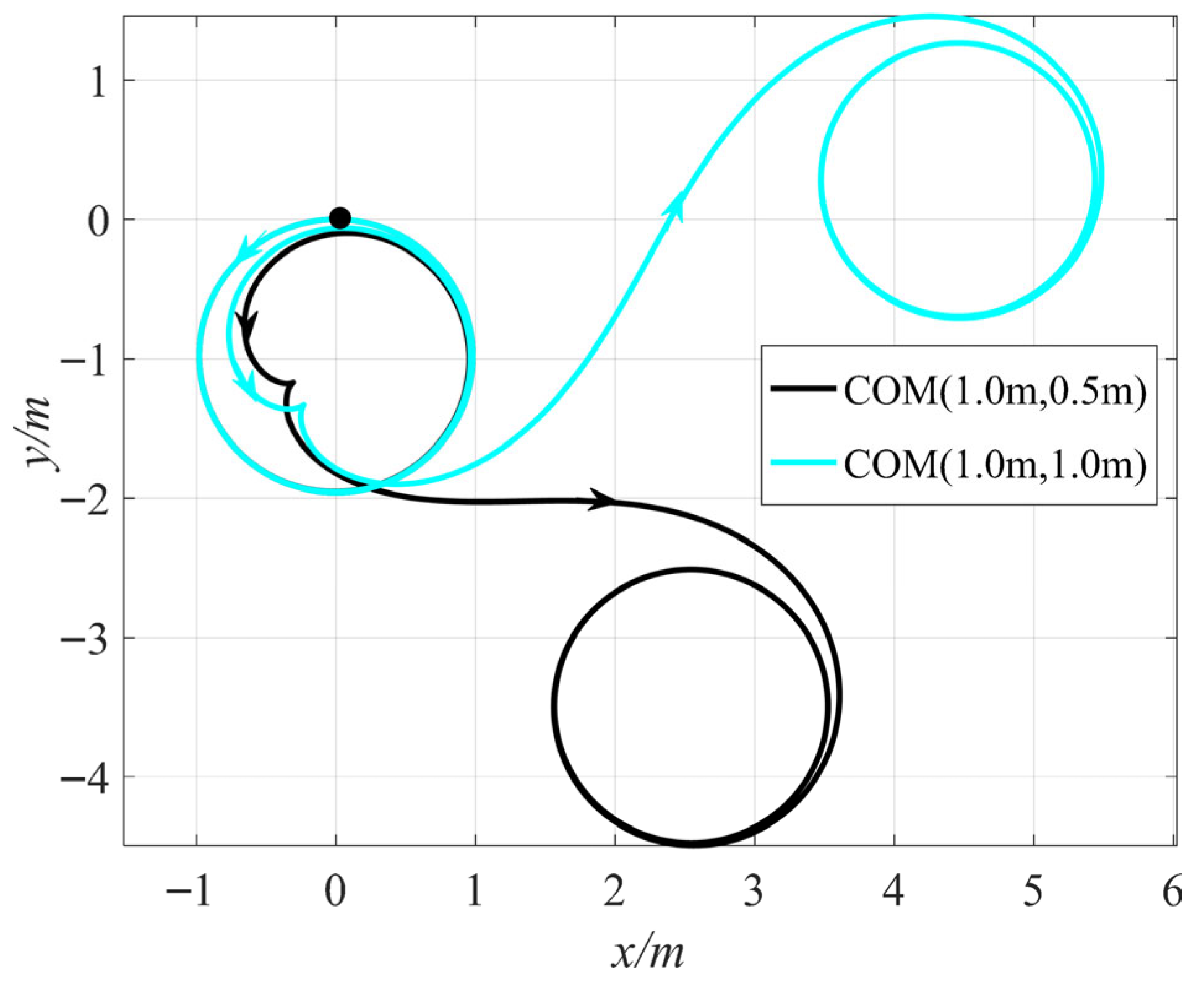
Figure 7 simulates the trajectories of the system with centers of mass (COM) (
a,
b) = (0.5 m, 0 m) and (
a,
b) = (0.5 m, 1 m), respectively. The Hamel integrator accurately yields the analytical results of Ref. [
26]: that is, the spacing between the centers of the limit circles is related to the structural parameters of the inertia tensor. Selecting different mass distributions corresponds to different spacings between the centers of the limit circles.
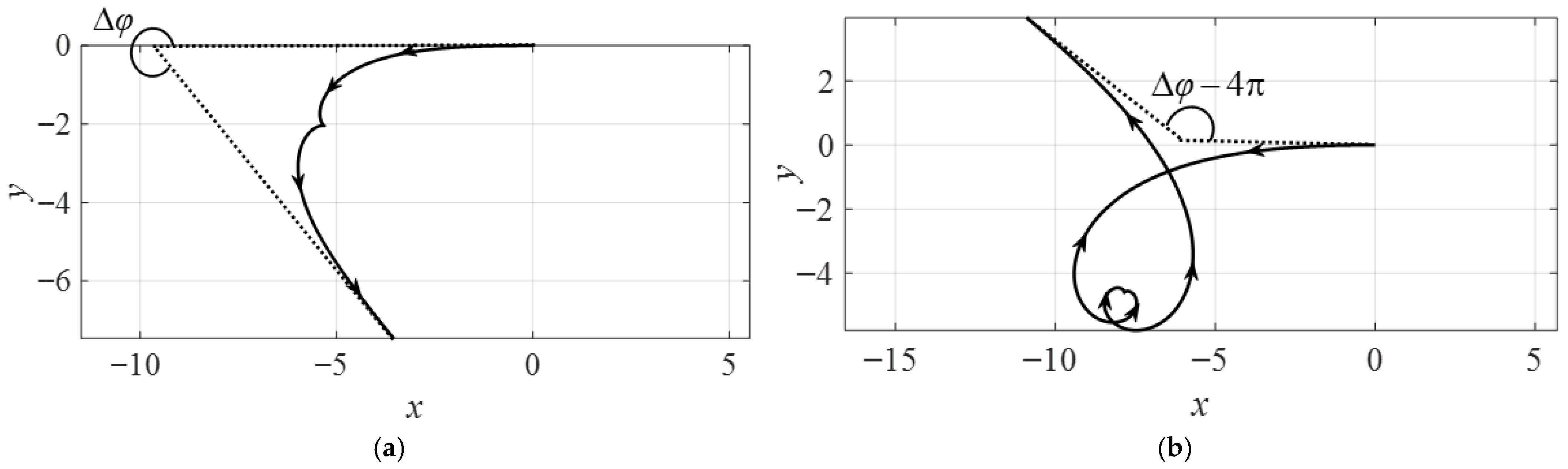
For comparison, the trajectory of the contact point and the looping phenomenon of the classical Chaplygin sleigh are simulated in
Figure 8, using the Hamel integrator. If the limiting difference in the sleigh’s rotation angle is 1.73π, the angle change does not reach 2π, which is insufficient to form a complete loop. As the angle between the limiting straight lines gradually increases, multiple loops will be formed. Therefore, there are significant differences between the dynamic behaviors of the classical sleigh and the hydrodynamic sleigh; the latter exhibits more diverse manifestations in the fluid environment.
Next, we consider the most general case, in which every possible entry of the total inertia tensor is able to vary independently of the rest. That is, the origin of the moving frame is not in the center of the ellipse. Assume that the origin has coordinates (
r,
s), with respect to the frame that is aligned with the principal axes of the ellipse, and that the coordinate axes
u2 and
u3 are not aligned with the axes of the ellipse, forming an angle,
(measured counter-clockwise), as illustrated in
Figure 9. Then, the tensor takes a more general form with
and
non-zero, which can be calculated explicitly and lead to the corresponding modification of the total tensor,
. For this geometry, the kinetic energy of the fluid can be expressed as the quadratic form [
30,
31].
So, every entry of the total inertia tensor in (22) is
Figure 9 is an extension of
Figure 1. Next, we employ the Hamel integrator to explore its dynamic behavior. The contact point (
r,
s), with respect to the frame, is determined by the principal axes of the ellipse. As the contact point deviates from the center of the ellipse, the off-diagonal terms of the fluid-added inertia tensor become more complex. This results in a more generalized form of the total inertia tensor, which contains more non-zero cross terms. These cross terms in the total inertia tensor act together, leading to stronger coupling between translational velocity and angular velocity. Such strong coupling complicates the transition process of the system from initial motion to asymptotic circular motion.
Figure 9.
Arbitrary position and orientation of the body frame.
Figure 9.
Arbitrary position and orientation of the body frame.
Specifically,
Figure 1 shows the case where the contact point is at the center of mass (referred to as “Model I” in this paper), while
Figure 9 depicts the scenario where the contact point does not coincide with the center of mass (designated as “Model II” herein). As shown in
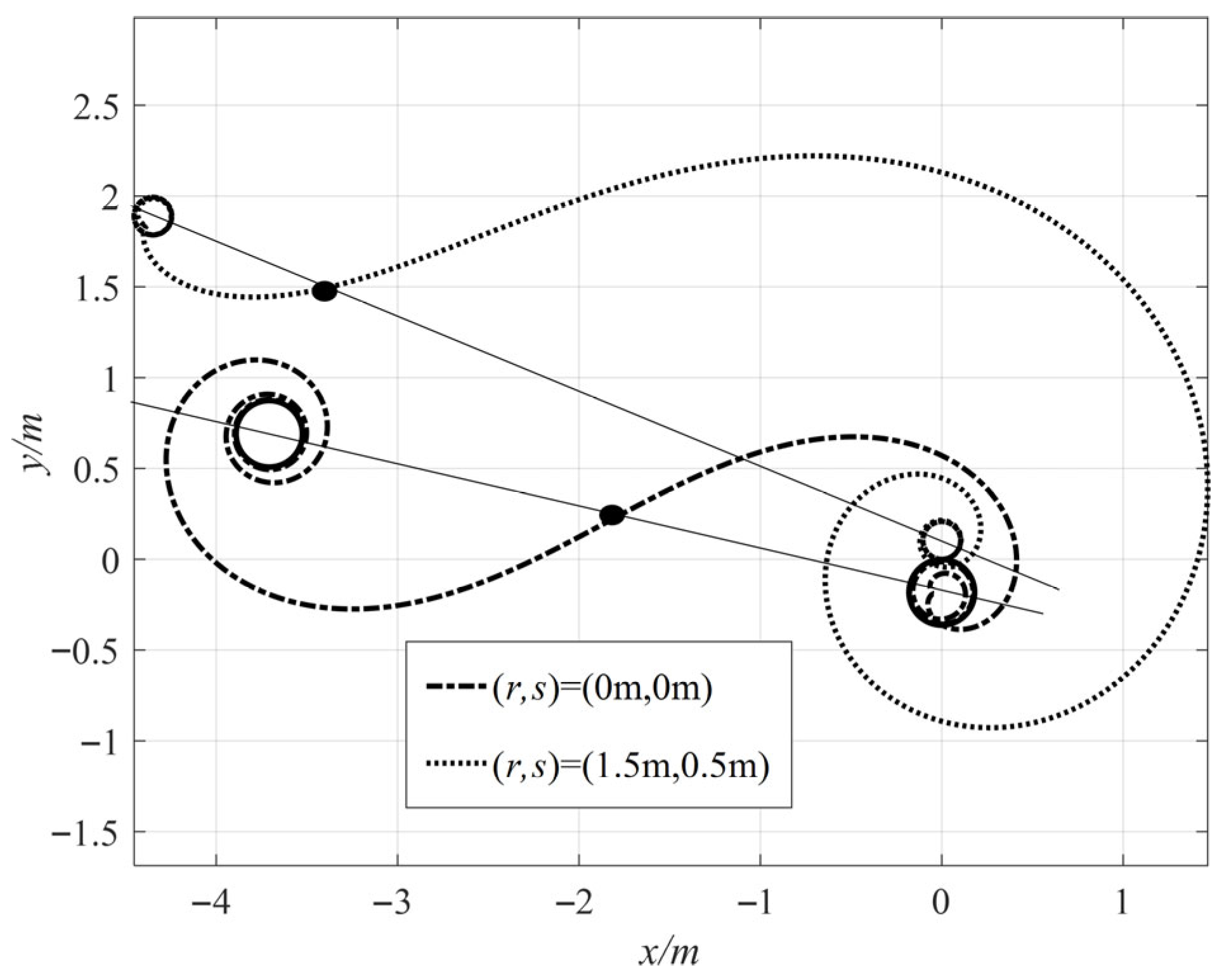
Figure 10, the trajectories of these two models are presented under the conditions
A = 2,
B = 1.5,
, (
a,
b) = (0.5, 0.2), and (
r,
s) = (0.5, 1.5). Through detailed trajectory analysis, this paper systematically illustrates the trajectory trends, variations in blade deflection angles, and key characteristics of contact points. This, in turn, verifies that the Hamel integrator is capable of accurately simulating the dynamic behavior of the target system.
It can be seen that (i) compared to Model I, the distance between the centers of the trajectory’s stable limit cycle and the unstable limit cycle of Model II is larger, and the transition path of the trajectory bends more sharply; (ii) Model I’s trajectory transition path has a relatively uniform “degree of curvature”. Its trajectory symmetry is relatively high (the two circles are approximately symmetric about an axis). But, for Model II, the line connecting the centers of the two circles no longer passes through the trajectory’s “geometric center”. It shows stronger asymmetry overall; for example, one circle has greater curvature and the transition path is biased toward one direction.
The reason for the above phenomenon is that the sleigh has non-zero components on both body coordinate axes simultaneously, and the path is affected by strong coupling from the center-of-mass offset and contact point offset.
The increased complexity of the total inertia tensor induced by the offset of the contact point leads to enhanced motion coupling, and also changes in asymptotic parameters (radius, spacing). However, the basic asymptotic law (the transition from one circular motion to the reverse circular motion) remains preserved. This coupling also breaks the system’s symmetry and conserved quantities, such as the conserved quantity of momentum. The conserved quantity of momentum in the classical Chaplygin sleigh system has its root of symmetric transformation in spatial translation symmetry. According to the symmetry-conserved quantity correspondence of Noether’s theorem, it ultimately manifests as the conservation of the total momentum. In a potential flow environment, the presence of fluid causes the system momentum (total momentum, including the momentum of the rigid body and the fluid-added momentum) to no longer be conserved. The core reason is related to the coupling effect of the fluid on the rigid body and non-holonomic constraints. The corresponding symmetries are broken by the added mass tensor.