You are currently viewing a new version of our website. To view the old version click .

Cells, Volume 9, Issue 4

April 2020 - 277 articles

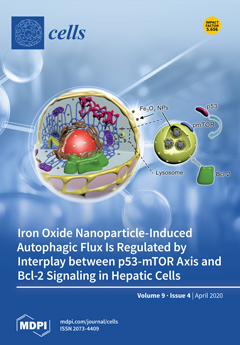
Cover Story: Despite decades of intensive research, the clinical translation of nanoparticle-based treatments remains relatively unexplored. Recent literature has criticized the lack of knowledge on interactions and fates of nanomaterials within living cells. Therefore, we investigated how lysosomal-mediated signaling is affected by iron oxide nanoparticles in hepatic cell lines. We found that alterations in the sub-cellular localization of p53 protein induced by nanoparticles greatly affected the autophagic flux. Our findings indicate that mild lysosomal dysfunction induced by nanoparticles promotes autophagy. Furthermore, cells with high levels of Bcl-2 were resistant to autophagy initiated by nanoparticles. Altogether, our data identify lysosomes as a central hub that control nanoparticle-mediated responses in hepatic cells. View this paper.
  • Issues are regarded as officially published after their release is announced to the table of contents alert mailing list .
  • You may sign up for email alerts to receive table of contents of newly released issues.
  • PDF is the official format for papers published in both, html and pdf forms. To view the papers in pdf format, click on the "PDF Full-text" link, and use the free Adobe Reader to open them.

Articles (277)

  • Review
  • Open Access
134 Citations
11,148 Views
28 Pages

Mechanisms of the Epithelial–Mesenchymal Transition and Tumor Microenvironment in Helicobacter pylori-Induced Gastric Cancer

  • Jacek Baj,
  • Izabela Korona-Głowniak,
  • Alicja Forma,
  • Amr Maani,
  • Elżbieta Sitarz,
  • Mansur Rahnama-Hezavah,
  • Elżbieta Radzikowska and
  • Piero Portincasa

23 April 2020

Helicobacter pylori (H. pylori) is one of the most common human pathogens, affecting half of the world’s population. Approximately 20% of the infected patients develop gastric ulcers or neoplastic changes in the gastric stroma. An infection als...

  • Feature Paper
  • Article
  • Open Access
11 Citations
5,738 Views
18 Pages

Exploring Biased Agonism at FPR1 as a Means to Encode Danger Sensing

  • Jieny Gröper,
  • Gabriele M. König,
  • Evi Kostenis,
  • Volker Gerke,
  • Carsten A. Raabe and
  • Ursula Rescher

23 April 2020

Ligand-based selectivity in signal transduction (biased signaling) is an emerging field of G protein-coupled receptor (GPCR) research and might allow the development of drugs with targeted activation profiles. Human formyl peptide receptor 1 (FPR1) i...

  • Article
  • Open Access
24 Citations
5,682 Views
18 Pages

23 April 2020

We previously showed that in polarized Madin–Darby canine kidney (MDCK) cells, aquaporin-2 (AQP2) is continuously targeted to the basolateral plasma membrane from which it is rapidly retrieved by clathrin-mediated endocytosis. It then undertake...

  • Article
  • Open Access
17 Citations
5,334 Views
17 Pages

Ca2+–Calmodulin Dependent Wound Repair in Dictyostelium Cell Membrane

  • Md. Shahabe Uddin Talukder,
  • Mst. Shaela Pervin,
  • Md. Istiaq Obaidi Tanvir,
  • Koushiro Fujimoto,
  • Masahito Tanaka,
  • Go Itoh and
  • Shigehiko Yumura

23 April 2020

Wound repair of cell membrane is a vital physiological phenomenon. We examined wound repair in Dictyostelium cells by using a laserporation, which we recently invented. We examined the influx of fluorescent dyes from the external medium and monitored...

  • Article
  • Open Access
37 Citations
5,366 Views
27 Pages

Extracellular Vesicles isolated from Mesenchymal Stromal Cells Modulate CD4+ T Lymphocytes Toward a Regulatory Profile

  • Flavia Franco da Cunha,
  • Vinicius Andrade-Oliveira,
  • Danilo Candido de Almeida,
  • Tamiris Borges da Silva,
  • Cristiane Naffah de Souza Breda,
  • Mario Costa Cruz,
  • Eliana L. Faquim-Mauro,
  • Marcos Antonio Cenedeze,
  • Meire Ioshie Hiyane and
  • Alvaro Pacheco-Silva
  • + 3 authors

23 April 2020

Mesenchymal stromal cells (MSCs) can generate immunological tolerance due to their regulatory activity in many immune cells. Extracellular vesicles (EVs) release is a pivotal mechanism by which MSCs exert their actions. In this study, we evaluate whe...

  • Article
  • Open Access
13 Citations
5,967 Views
15 Pages

23 April 2020

Lithium chloride (LiCl) is a widely used drug for the treatment of bipolar disorders, but as a side effect, 40% of the patients develop diabetes insipidus. LiCl affects the activity of the glycogen synthase kinase 3 (GSK3), and mice deficient for GSK...

  • Article
  • Open Access
21 Citations
5,869 Views
16 Pages

MiR-337-3p Promotes Adipocyte Browning by Inhibiting TWIST1

  • Indira G.C. Vonhögen,
  • Hamid el Azzouzi,
  • Servé Olieslagers,
  • Aliaksei Vasilevich,
  • Jan de Boer,
  • Francisco J. Tinahones,
  • Paula A. da Costa Martins,
  • Leon J. de Windt and
  • Mora Murri

23 April 2020

The prevalence of metabolic syndrome (MetS) and obesity is an alarming health issue worldwide. Obesity is characterized by an excessive accumulation of white adipose tissue (WAT), and it is associated with diminished brown adipose tissue (BAT) activi...

  • Review
  • Open Access
60 Citations
11,243 Views
33 Pages

Nicotine in Senescence and Atherosclerosis

  • Ann Marie Centner,
  • Pradeep G. Bhide and
  • Gloria Salazar

22 April 2020

Cigarette smoke is a known exacerbator of age-related pathologies, such as cardiovascular disease (CVD), atherosclerosis, and cellular aging (senescence). However, the role of nicotine and its major metabolite cotinine is yet to be elucidated. Consid...

  • Article
  • Open Access
12 Citations
4,750 Views
18 Pages

A Matter of Choice: Inhibition of c-Rel Shifts Neuronal to Oligodendroglial Fate in Human Stem Cells

  • Lucia Mercedes Ruiz-Perera,
  • Johannes Friedrich Wilhelm Greiner,
  • Christian Kaltschmidt and
  • Barbara Kaltschmidt

22 April 2020

The molecular mechanisms underlying fate decisions of human neural stem cells (hNSCs) between neurogenesis and gliogenesis are critical during neuronal development and neurodegenerative diseases. Despite its crucial role in the murine nervous system,...

of 28

Get Alerted

Add your email address to receive forthcoming issues of this journal.

XFacebookLinkedIn
Cells - ISSN 2073-4409