You are currently viewing a new version of our website. To view the old version click .

Diversity, Volume 12, Issue 9

September 2020 - 48 articles

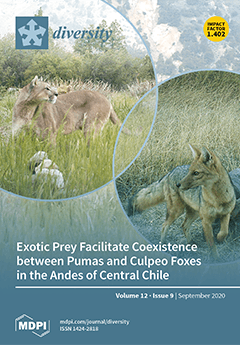
Cover Story: Species with similar ecological niches must segregate along one or more niche axes in order to coexist. We examined segregation along the main niche axes, i.e., space, time, and trophic resources, to explore coexistence mechanisms between pumas (Puma concolor) and culpeo foxes (Lycalopex culpaeus) in the Andes of Central Chile. We found high spatial and temporal overlap between the carnivores lending little support for segregation along these axes. In contrast, we found low dietary overlap, indicating trophic niche segregation: puma diet was dominated by hares, while foxes appeared to shift away from hares to rabbits, small mammals, and seeds. View this paper
  • Issues are regarded as officially published after their release is announced to the table of contents alert mailing list .
  • You may sign up for email alerts to receive table of contents of newly released issues.
  • PDF is the official format for papers published in both, html and pdf forms. To view the papers in pdf format, click on the "PDF Full-text" link, and use the free Adobe Reader to open them.

Articles (48)

  • Article
  • Open Access
3 Citations
4,034 Views
18 Pages

22 September 2020

Frustulia tunariensis sp. nov. is originated from a high-altitude peatland in the Tunari Cordillera, a branch of the Andean range in Bolivia. The new taxon is distinguished by the thick longitudinal ribs, the globose polar nodule with faint helictogl...

  • Article
  • Open Access
10 Citations
6,234 Views
16 Pages

Phragmites australis Associates with Belowground Fungal Communities Characterized by High Diversity and Pathogen Abundance

  • Carolyn S. Schroeder,
  • Susannah Halbrook,
  • Christina Birnbaum,
  • Paweł Waryszak,
  • William Wilber and
  • Emily C. Farrer

22 September 2020

Microbial symbionts are gaining attention as crucial drivers of invasive species spread and dominance. To date, much research has quantified the net effects of plant–microbe interactions on the relative success of native and invasive species. H...

  • Article
  • Open Access
9 Citations
6,567 Views
23 Pages

A New Species of Andean Gymnophthalmid Lizard (Squamata: Gymnophthalmidae) from the Peruvian Andes, and Resolution of Some Taxonomic Problems

  • Luis Mamani,
  • Juan C. Chaparro,
  • Claudio Correa,
  • Consuelo Alarcón,
  • Cinthya Y. Salas and
  • Alessandro Catenazzi

21 September 2020

The family Gymnophthalmidae is one of the most speciose lineages of lizards in the Neotropical region. Despite recent phylogenetic studies, the species diversity of this family is unknown and thus, its phylogenetic relationships remain unclear and it...

  • Article
  • Open Access
7 Citations
4,586 Views
10 Pages

Intraguild Predation by the Eagle Owl Determines the Space Use of a Mesopredator Carnivore

  • Emilio Virgós,
  • Noemí Baniandrés,
  • Tamara Burgos and
  • Mariano R. Recio

18 September 2020

Top predators shape the communities of sympatric predators by killing and displacing smaller predators. Predation risk pushes smaller predators to select enemy-free spaces irrespective of food availability, which results in changes in their behaviour...

  • Article
  • Open Access
10 Citations
9,600 Views
19 Pages

Recent and Rapid Radiation of the Highly Endangered Harlequin Frogs (Atelopus) into Central America Inferred from Mitochondrial DNA Sequences

  • Juan P. Ramírez,
  • César A. Jaramillo,
  • Erik D. Lindquist,
  • Andrew J. Crawford and
  • Roberto Ibáñez

18 September 2020

Populations of amphibians are experiencing severe declines worldwide. One group with the most catastrophic declines is the Neotropical genus Atelopus (Anura: Bufonidae). Many species of Atelopus have not been seen for decades and all eight Central Am...

  • Article
  • Open Access
10 Citations
4,284 Views
15 Pages

A Hot Spot of Olive Biodiversity in the Tunisian Oasis of Degache

  • Olfa Saddoud Deddabi,
  • Cinzia Montemurro,
  • Sihem Ben Maachia,
  • Fathi Ben Amar,
  • Valentina Fanelli,
  • Susanna Gadaleta,
  • Milad El Riachy,
  • Ali Chehade,
  • Mona Siblini and
  • Saliha Boucheffa
  • + 1 author

17 September 2020

Tunisia is one of the world’s largest producers of olive oil, and it preserves pools of olive genetic diversity that are still unexplored. A recent prospection and collection program of the National Gene Bank of Tunisia (NGBT) focused on the va...

  • Editorial
  • Open Access
26 Citations
6,096 Views
3 Pages

16 September 2020

Coral reefs are one of the most diverse marine ecosystems on Earth and one of the richest in terms of species interactions. Scleractinian corals are usually the most likely to provide numerous different habitats and to support many symbiotic relation...

  • Communication
  • Open Access
13 Citations
4,458 Views
11 Pages

Pug-Headedness Anomaly in a Wild and Isolated Population of Native Mediterranean Trout Salmo trutta L., 1758 Complex (Osteichthyes: Salmonidae)

  • Francesco Palmas,
  • Tommaso Righi,
  • Alessio Musu,
  • Cheoma Frongia,
  • Cinzia Podda,
  • Melissa Serra,
  • Andrea Splendiani,
  • Vincenzo Caputo Barucchi and
  • Andrea Sabatini

15 September 2020

Skeletal anomalies are commonplace among farmed fish. The pug-headedness anomaly is an osteological condition that results in the deformation of the maxilla, pre-maxilla, and infraorbital bones. Here, we report the first record of pug-headedness in a...

  • Article
  • Open Access
10 Citations
3,321 Views
12 Pages

Assessing the Diversity of the Form of Age-Specific Changes in Adult Mortality from Captive Mammalian Populations

  • Victor Ronget,
  • Jean-François Lemaître,
  • Morgane Tidière and
  • Jean-Michel Gaillard

15 September 2020

Actuarial senescence (i.e., the age-specific increase in mortality rate) is pervasive across mammalian species, but our current understanding of the diversity of forms that actuarial senescence displays across species remains limited. Although severa...

  • Feature Paper
  • Article
  • Open Access
3 Citations
5,199 Views
16 Pages

Class Conflict: Diffuse Competition between Mammalian and Reptilian Predators

  • Christopher R. Dickman,
  • Aaron C. Greenville,
  • Glenda M. Wardle and
  • Jenna P. Bytheway

15 September 2020

(1) Diffuse competition affects per capita rates of population increase among species that exploit similar resources, and thus can be an important structuring force in ecological communities. Diffuse competition has traditionally been studied within...

of 5

Get Alerted

Add your email address to receive forthcoming issues of this journal.

XFacebookLinkedIn
Diversity - ISSN 1424-2818