

You are currently viewing a new version of our website. To view the old version click .

Foods, Volume 14, Issue 3

February-1 2025 - 209 articles

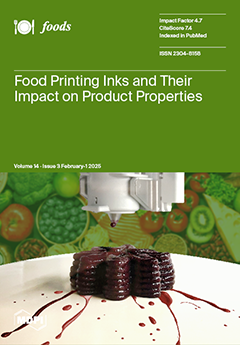
Cover Story: The application of three-dimensional printing in the food industry facilitates the development of innovative products characterised by distinctive compositions, shapes and textures. A primary challenge in this field pertains to the formulation of optimal ink compositions, which must exhibit the appropriate rheology and texture and meet nutritional and sensory requirements. Food inks are mainly categorised as being non-naturally extrudable (e.g., plant-based inks derived from fruits and vegetables and meat-based inks) or natively extruded (e.g., dairy, hydrogel- and confectionery-based inks). The discussion covers properties like rheology, texture, stability, and print fidelity. The article describes new uses for food inks and gives a complete picture of the latest developments. View this paper
  • Issues are regarded as officially published after their release is announced to the table of contents alert mailing list .
  • You may sign up for email alerts to receive table of contents of newly released issues.
  • PDF is the official format for papers published in both, html and pdf forms. To view the papers in pdf format, click on the "PDF Full-text" link, and use the free Adobe Reader to open them.

Articles (209)

  • Article
  • Open Access
1 Citations
2,220 Views
13 Pages

6 February 2025

In this study, corn oil and essential oils from thirteen spices were used as the oil phase, with glyceryl monostearate (GMS) serving as the gelling agent to prepare the oleogels. The effects of varying the concentrations of the gel additives (2%, 4%,...

  • Article
  • Open Access
1,736 Views
15 Pages

6 February 2025

Semicarbazide (SEM), a metabolite of nitrofurazone (NFZ), is widely used to detect the illegal application of NFZ in crustaceans. The conventional detection method involves chemical derivatization combined with reversed-phase liquid chromatography&nd...

  • Article
  • Open Access
1 Citations
1,848 Views
19 Pages

Application of Isochoric Impregnation: Effects on Microbial and Physicochemical Parameters and Shelf Life of Strawberries Stored Under Refrigeration

  • Sumeyye Atci,
  • Cristina Bilbao-Sainz,
  • Valerie S. McGraw,
  • Jiayuan Li,
  • Gary Takeoka,
  • Tara McHugh and
  • Boris Rubinsky

6 February 2025

This study evaluates the effectiveness of isochoric impregnation during isochoric cold storage in extending the shelf life of strawberries. Strawberries in two different impregnation solutions—(1) sucrose solution and (2) sucrose solution conta...

  • Article
  • Open Access
2,466 Views
17 Pages

Oyster Mushroom (Pleurotus ostreatus) and Okara Flour as Nutritional Enhancers in Wheat Biscuits: A Study on Storage Stability

  • Emmanuella Ifunanya Nwaudah,
  • Ifeoma Elizabeth Mbaeyi-Nwaoha,
  • Deborah Chinwendu Ofoegbu and
  • Helen Onyeaka

6 February 2025

In response to the scarcity and high cost of wheat in Nigeria, this study investigates the potential of oyster mushroom (Pleurotus ostreatus) and okara flour to enhance the nutritional quality and storage stability of wheat biscuits. By incorporating...

  • Article
  • Open Access
1,225 Views
14 Pages

6 February 2025

Ciprofloxacin (CIP), a widely used broad-spectrum antibiotic, poses a serious threat to human health and environmental safety due to its residues. The complementary monomers molecularly imprinted electrochemiluminescence sensor (MIECLS) based on a po...

  • Article
  • Open Access
2 Citations
1,479 Views
12 Pages

A Comprehensive Investigation of Lipid Profile During the Solid-State Fermentation of Rice by Monascus purpureus

  • Lan Lan,
  • Yimin Cao,
  • Jiajia Yuan,
  • Rui Feng,
  • Huiqin Pan,
  • Xiuhong Mao,
  • Shen Ji,
  • Qing Hu and
  • Heng Zhou

6 February 2025

Red yeast rice is a nutraceutical fermented product used worldwide for the symptomatic relief of dyslipidemia and cardiovascular disease. However, the fermentation-induced lipid transformation from rice to red yeast rice remains unclear. Herein, an u...

  • Article
  • Open Access
7 Citations
1,877 Views
15 Pages

Research on Rapid and Non-Destructive Detection of Coffee Powder Adulteration Based on Portable Near-Infrared Spectroscopy Technology

  • Fujie Zhang,
  • Xiaoning Yu,
  • Lixia Li,
  • Wanxia Song,
  • Defeng Dong,
  • Xiaoxian Yue,
  • Shenao Chen and
  • Qingyu Zeng

6 February 2025

This study explores the feasibility of using portable near-infrared spectroscopy for the rapid and non-destructive detection of coffee adulteration. Spectral data from adulterated coffee samples in the 900–1700 nm range were collected and proce...

  • Communication
  • Open Access
2 Citations
3,484 Views
17 Pages

Bioactive Peptides from Milk Proteins with Antioxidant, Anti-Inflammatory, and Antihypertensive Activities

  • Thaís Borges,
  • Pedro Coelho,
  • Cristina Prudêncio,
  • Ana Gomes,
  • Paula Gomes and
  • Ricardo Ferraz

6 February 2025

Background/Objectives: Peptides from protein ingredients exhibit key biological activities, including antimicrobial, antihypertensive, antioxidant, anti-inflammatory, analgesic, and immunomodulatory effects. Aligning with the One Health approach, the...

  • Article
  • Open Access
2 Citations
1,796 Views
19 Pages

Storage Quality Improvement of Duck Breast Meat: Role of Ultrasound-Assisted Slightly Acidic Electrolyzed Water

  • Anqi Xu,
  • Siyi Zhang,
  • Chuanming Huan,
  • Sumin Gao,
  • Hengpeng Wang,
  • Ziwu Gao,
  • Ruiyun Wu,
  • Zhenyu Wang and
  • Xiangren Meng

6 February 2025

This study evaluated the effects of ultrasound-assisted slightly acidic electrolyzed water (SAEW) treatment on duck breast meat storage quality. The impact of different treatments—ultrasound combined with SAEW, SAEW alone, ultrasound combined w...

  • Article
  • Open Access
2 Citations
1,787 Views
24 Pages

Exploring Genetic Influences on Equine Meat Quality: A Bioinformatics Approach

  • Martin Šimon,
  • Sanja Bogićević,
  • Ana Kaić,
  • Barbara Luštrek and
  • Klemen Potočnik

6 February 2025

Horsemeat, known for its high nutritional value and lower environmental impact compared to beef, faces cultural and ethical challenges. Despite its potential, genetic research on horsemeat quality remains limited and no Quantitative Trait Loci (QTLs)...

of 21

Get Alerted

Add your email address to receive forthcoming issues of this journal.

XFacebookLinkedIn
Foods - ISSN 2304-8158