

You are currently viewing a new version of our website. To view the old version click .

Cells, Volume 9, Issue 4

April 2020 - 277 articles

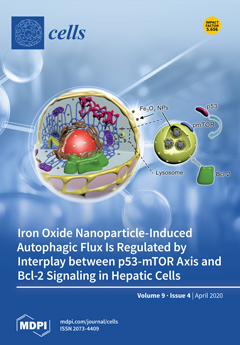
Cover Story: Despite decades of intensive research, the clinical translation of nanoparticle-based treatments remains relatively unexplored. Recent literature has criticized the lack of knowledge on interactions and fates of nanomaterials within living cells. Therefore, we investigated how lysosomal-mediated signaling is affected by iron oxide nanoparticles in hepatic cell lines. We found that alterations in the sub-cellular localization of p53 protein induced by nanoparticles greatly affected the autophagic flux. Our findings indicate that mild lysosomal dysfunction induced by nanoparticles promotes autophagy. Furthermore, cells with high levels of Bcl-2 were resistant to autophagy initiated by nanoparticles. Altogether, our data identify lysosomes as a central hub that control nanoparticle-mediated responses in hepatic cells. View this paper.
  • Issues are regarded as officially published after their release is announced to the table of contents alert mailing list .
  • You may sign up for email alerts to receive table of contents of newly released issues.
  • PDF is the official format for papers published in both, html and pdf forms. To view the papers in pdf format, click on the "PDF Full-text" link, and use the free Adobe Reader to open them.

Articles (277)

  • Article
  • Open Access
16 Citations
6,589 Views
15 Pages

Modification of Adenosine196 by Mettl3 Methyltransferase in the 5’-External Transcribed Spacer of 47S Pre-rRNA Affects rRNA Maturation

  • Olga Sergeeva,
  • Philipp Sergeev,
  • Pavel Melnikov,
  • Tatiana Prikazchikova,
  • Olga Dontsova and
  • Timofei Zatsepin

24 April 2020

Ribosome biogenesis is among the founding processes in the cell. During the first stages of ribosome biogenesis, polycistronic precursor of ribosomal RNA passes complex multistage maturation after transcription. Quality control of preribosomal RNA (p...

  • Article
  • Open Access
18 Citations
4,650 Views
22 Pages

Inhibiting Monocyte Recruitment to Prevent the Pro-Tumoral Activity of Tumor-Associated Macrophages in Chondrosarcoma

  • Michele Minopoli,
  • Sabrina Sarno,
  • Gioconda Di Carluccio,
  • Rosa Azzaro,
  • Susan Costantini,
  • Flavio Fazioli,
  • Michele Gallo,
  • Gaetano Apice,
  • Lucia Cannella and
  • Domenica Rea
  • + 6 authors

24 April 2020

Chondrosarcomas (CHS) are malignant cartilaginous neoplasms with diverse morphological features, characterized by resistance to chemo- and radiation therapies. In this study, we investigated the role of tumor-associated macrophages (TAM)s in tumor ti...

  • Article
  • Open Access
24 Citations
4,291 Views
15 Pages

AR/ER Ratio Correlates with Expression of Proliferation Markers and with Distinct Subset of Breast Tumors

  • Nelson Rangel,
  • Milena Rondon-Lagos,
  • Laura Annaratone,
  • Andrés Felipe Aristizábal-Pachon,
  • Paola Cassoni,
  • Anna Sapino and
  • Isabella Castellano

24 April 2020

The co-expression of androgen (AR) and estrogen (ER) receptors, in terms of higher AR/ER ratio, has been recently associated with poor outcome in ER-positive (ER+) breast cancer (BC) patients. The aim of this study was to analyze if the biological ag...

  • Review
  • Open Access
68 Citations
8,784 Views
23 Pages

24 April 2020

Mitochondria plays privotal role in diverse pathways that regulate cellular function and survival, and have emerged as a prime focus in aging and age-associated motor neuron diseases (MNDs), such as amyotrophic lateral sclerosis (ALS) and frontotempo...

  • Review
  • Open Access
37 Citations
8,128 Views
19 Pages

Visualising Silicon in Plants: Histochemistry, Silica Sculptures and Elemental Imaging

  • Gea Guerriero,
  • Ian Stokes,
  • Nathalie Valle,
  • Jean-Francois Hausman and
  • Christopher Exley

24 April 2020

Silicon is a non-essential element for plants and is available in biota as silicic acid. Its presence has been associated with a general improvement of plant vigour and response to exogenous stresses. Plants accumulate silicon in their tissues as amo...

  • Review
  • Open Access
40 Citations
7,039 Views
20 Pages

The Role of Autophagy in Pancreatic Cancer: From Bench to the Dark Bedside

  • Kıvanç Görgülü,
  • Kalliope N. Diakopoulos,
  • Ezgi Kaya-Aksoy,
  • Katrin J. Ciecielski,
  • Jiaoyu Ai,
  • Marina Lesina and
  • Hana Algül

24 April 2020

Pancreatic cancer is one of the deadliest cancer types urgently requiring effective therapeutic strategies. Autophagy occurs in several compartments of pancreatic cancer tissue including cancer cells, cancer associated fibroblasts, and immune cells w...

  • Article
  • Open Access
34 Citations
5,657 Views
25 Pages

Progenitor Cells Activated by Platelet Lysate in Human Articular Cartilage as a Tool for Future Cartilage Engineering and Reparative Strategies

  • Simonetta Carluccio,
  • Daniela Martinelli,
  • Maria Elisabetta Federica Palamà,
  • Rui Cruz Pereira,
  • Roberto Benelli,
  • Ana Guijarro,
  • Ranieri Cancedda and
  • Chiara Gentili

23 April 2020

Regenerative strategies for human articular cartilage are still challenging despite the presence of resident progenitor cell population. Today, many efforts in the field of regenerative medicine focus on the use of platelet derivatives due to their a...

  • Article
  • Open Access
47 Citations
5,851 Views
21 Pages

Intraglomerular Monocyte/Macrophage Infiltration and Macrophage–Myofibroblast Transition during Diabetic Nephropathy Is Regulated by the A2B Adenosine Receptor

  • Ángelo Torres,
  • Katherin Muñoz,
  • Yessica Nahuelpán,
  • Angelo-Paolo R. Saez,
  • Pablo Mendoza,
  • Claudia Jara,
  • Claudio Cappelli,
  • Raibel Suarez,
  • Carlos Oyarzún and
  • Claudia Quezada
  • + 1 author

23 April 2020

Diabetic nephropathy (DN) is considered the main cause of kidney disease in which myofibroblasts lead to renal fibrosis. Macrophages were recently identified as the major source of myofibroblasts in a process known as macrophage–myofibroblast t...

  • Article
  • Open Access
6 Citations
3,855 Views
8 Pages

23 April 2020

Satellite cells (SCs) participate in skeletal muscle plasticity/regeneration. Activation of SCs implies that nuclear changes underpin a new functional status. In hibernating mammals, periods of reduced metabolic activity alternate with arousals and r...

  • Article
  • Open Access
40 Citations
5,283 Views
18 Pages

Lactate Increases Renal Cell Carcinoma Aggressiveness through Sirtuin 1-Dependent Epithelial Mesenchymal Transition Axis Regulation

  • Vera Miranda-Gonçalves,
  • Ana Lameirinhas,
  • Catarina Macedo-Silva,
  • João Lobo,
  • Paula C. Dias,
  • Verónica Ferreira,
  • Rui Henrique and
  • Carmen Jerónimo

23 April 2020

Background: Renal cell carcinoma (RCC) displays a glycolytic phenotype (Warburg effect). Increased lactate production, impacting on tumor biology and microenvironment modulation, has been implicated in epigenetic mechanisms’ regulation, leading...

of 28

Get Alerted

Add your email address to receive forthcoming issues of this journal.

XFacebookLinkedIn
Cells - ISSN 2073-4409