


You are currently viewing a new version of our website. To view the old version click .

Toxins, Volume 10, Issue 7

July 2018 - 52 articles

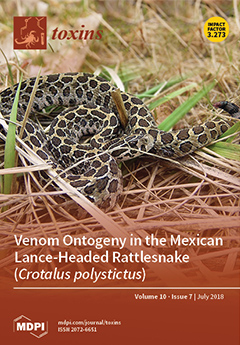
Cover Story: The Mexican Lance-headed Rattlesnake (Crotalus polystictus) occupies native and modified grasslands in central México and feeds primarily on rodents. Ontogeny of the venom proteome follows a typical type I pattern, with neonates showing very low venom SVMP activity that increases dramatically as snakes age, while PLA2 shows the opposite pattern. Increases in SVMP activity with age are due to increases in PIII and PI metalloproteinases in adult venoms, as demonstrated via MALDI-TOF-MS/MS. Venom ontogeny appears to be driven by changes in prey size rather than type as was observed in other species such as Crotalus oreganus helleri and C. o. oreganus. (Photo by Estrella Mociño-Deloya and Kirk Setser) View this paper.
  • Issues are regarded as officially published after their release is announced to the table of contents alert mailing list .
  • You may sign up for email alerts to receive table of contents of newly released issues.
  • PDF is the official format for papers published in both, html and pdf forms. To view the papers in pdf format, click on the "PDF Full-text" link, and use the free Adobe Reader to open them.

Articles (52)

  • Article
  • Open Access
26 Citations
5,457 Views
14 Pages

Determination of the Role of Microcystis aeruginosa in Toxin Generation Based on Phosphoproteomic Profiles

  • Jiangqi Qu,
  • Liping Shen,
  • Meng Zhao,
  • Wentong Li,
  • Chengxia Jia,
  • Hua Zhu and
  • Qingjing Zhang

23 July 2018

Microcystis aeruginosa is the most common species responsible for toxic cyanobacterial blooms and is considered a significant contributor to the production of cyanotoxins, particularly the potent liver toxins called microcystins. Numerous studies inv...

  • Review
  • Open Access
78 Citations
12,949 Views
25 Pages

The Impact of Uremic Toxins on Cerebrovascular and Cognitive Disorders

  • Maryam Assem,
  • Mathilde Lando,
  • Maria Grissi,
  • Saïd Kamel,
  • Ziad A. Massy,
  • Jean-Marc Chillon and
  • Lucie Hénaut

22 July 2018

Individuals at all stages of chronic kidney disease (CKD) have a higher risk of developing cognitive disorders and dementia. Stroke is also highly prevalent in this population and is associated with a higher risk of neurological deterioration, in-hos...

  • Article
  • Open Access
36 Citations
5,032 Views
16 Pages

The PHD Transcription Factor Rum1 Regulates Morphogenesis and Aflatoxin Biosynthesis in Aspergillus flavus

  • Yule Hu,
  • Guang Yang,
  • Danping Zhang,
  • Yaju Liu,
  • Yu Li,
  • Guanglan Lin,
  • Zhiqiang Guo,
  • Shihua Wang and
  • Zhenhong Zhuang

20 July 2018

Aspergillus flavus produces mycotoxins especially aflatoxin B1 and infects crops worldwide. As a PHD transcription factor, there is no report on the role of Rum1 in the virulence of Aspergillus spp. yet. This study explored the biological function of...

  • Feature Paper
  • Review
  • Open Access
24 Citations
9,291 Views
22 Pages

20 July 2018

The adenylate cyclase toxin (CyaA) is one of the major virulence factors of Bordetella pertussis, the causative agent of whooping cough. CyaA is able to invade eukaryotic cells where, upon activation by endogenous calmodulin, it synthesizes massive a...

  • Review
  • Open Access
108 Citations
10,844 Views
11 Pages

Intestinal Barrier Function in Chronic Kidney Disease

  • Björn Meijers,
  • Ricard Farré,
  • Sander Dejongh,
  • Maria Vicario and
  • Pieter Evenepoel

19 July 2018

The kidneys are key contributors to body homeostasis, by virtue of controlled excretion of excessive fluid, electrolytes, and toxic waste products. The syndrome of uremia equals the altered physiology due to irreversible loss of kidney function that...

  • Feature Paper
  • Article
  • Open Access
51 Citations
8,832 Views
10 Pages

Botulinum Toxin for the Treatment of Hand Tremor

  • Nicki Niemann and
  • Joseph Jankovic

19 July 2018

The aim of this study is to review our longitudinal experience with onabotulinumtoxinA (onaBoNT-A) injections for medically refractory hand tremor. We performed a retrospective review of our database of patients treated with onaBoNT-A for hand tremor...

  • Review
  • Open Access
124 Citations
10,861 Views
21 Pages

Impact of Altered Intestinal Microbiota on Chronic Kidney Disease Progression

  • Esmeralda Castillo-Rodriguez,
  • Raul Fernandez-Prado,
  • Raquel Esteras,
  • Maria Vanessa Perez-Gomez,
  • Carolina Gracia-Iguacel,
  • Beatriz Fernandez-Fernandez,
  • Mehmet Kanbay,
  • Alberto Tejedor,
  • Alberto Lazaro and
  • Marta Ruiz-Ortega
  • + 4 authors

19 July 2018

In chronic kidney disease (CKD), accumulation of uremic toxins is associated with an increased risk of CKD progression. Some uremic toxins result from nutrient processing by gut microbiota, yielding precursors of uremic toxins or uremic toxins themse...

  • Feature Paper
  • Article
  • Open Access
16 Citations
5,256 Views
12 Pages

Differential Toxicity of Cyanobacteria Isolated from Marine Sponges towards Echinoderms and Crustaceans

  • Ana Regueiras,
  • Sandra Pereira,
  • Maria Sofia Costa and
  • Vitor Vasconcelos

18 July 2018

Marine sponges and cyanobacteria have a long history of co-evolution, with documented genome adaptations in cyanobionts. Both organisms are known to produce a wide variety of natural compounds, with only scarce information about novel natural compoun...

  • Article
  • Open Access
11 Citations
6,353 Views
22 Pages

Unilateral Botulinum Neurotoxin-A Injection into the Striatum of C57BL/6 Mice Leads to a Different Motor Behavior Compared with Rats

  • Veronica Antipova,
  • Andreas Wree,
  • Carsten Holzmann,
  • Teresa Mann,
  • Nicola Palomero-Gallagher,
  • Karl Zilles,
  • Oliver Schmitt and
  • Alexander Hawlitschka

17 July 2018

Different morphological changes in the caudate-putamen (CPu) of naïve rats and mice were observed after intrastriatal botulinum neurotoxin-A (BoNT-A) injection. For this purpose we here studied various motor behaviors in mice (n = 46) longitudin...

  • Article
  • Open Access
23 Citations
7,981 Views
21 Pages

Biomarker Evaluation and Toxic Effects of an Acute Oral and Systemic Fumonisin Exposure of Pigs with a Special Focus on Dietary Fumonisin Esterase Supplementation

  • Hanna Schertz,
  • Sven Dänicke,
  • Jana Frahm,
  • Dian Schatzmayr,
  • Ilse Dohnal,
  • Gerlinde Bichl,
  • Heidi E. Schwartz-Zimmermann,
  • Sonia Colicchia,
  • Gerhard Breves and
  • Jens P. Teifke
  • + 1 author

17 July 2018

The mycotoxin fumonisin B1 (FB1) is a frequent contaminant of feed. It causes a disruption of sphingolipid metabolism and pulmonary, hepatic, and immunological lesions in pigs depending on the exposure scenario. One sensitive biomarker for FB1 exposu...

of 6

Get Alerted

Add your email address to receive forthcoming issues of this journal.

XFacebookLinkedIn
Toxins - ISSN 2072-6651