

Skip Content
You are currently on the new version of our website. Access the old version .

Diversity, Volume 12, Issue 5

2020 May - 43 articles

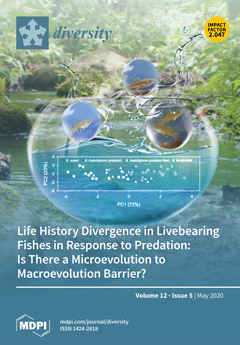
Cover Story: We tested for congruence in mechanisms of microevolution and macroevolution by comparing patterns of life history divergence among three closely related species of the livebearer genus Brachyrhaphis (Poeciliidae). Within B. rhabdophora, populations occur in either predator or predator-free environments, and sister species B. roseni and B. terrabensis are similarly segregated. Size at maturity, clutch size, and offspring size all diverged according to predation environment, and differences were amplified through evolutionary time. Variation observed among nascent species is a good predictor of variation among established species. Macroevolution in these species can be understood as an accumulation of micro-evolutionary changes. View this paper
  • Issues are regarded as officially published after their release is announced to the table of contents alert mailing list .
  • You may sign up for email alerts to receive table of contents of newly released issues.
  • PDF is the official format for papers published in both, html and pdf forms. To view the papers in pdf format, click on the "PDF Full-text" link, and use the free Adobe Reader to open them.

Articles (43)

  • Review
  • Open Access
8 Citations
6,671 Views
21 Pages

A Review of Galaxias (Galaxiidae) Fossils from the Southern Hemisphere

  • Uwe Kaulfuss,
  • Daphne E. Lee,
  • Jeffrey H. Robinson,
  • Graham P. Wallis and
  • Werner W. Schwarzhans

25 May 2020

The Galaxiidae is a Southern Hemisphere family of freshwater fish, considered to be of Gondwanan origin based on the current distribution of species in New Zealand, Australia (including Tasmania), New Caledonia, Africa, South America, and on some ass...

  • Editorial
  • Open Access
30 Citations
5,079 Views
5 Pages

Hotspots of Subterranean Biodiversity

  • Tanja Pipan,
  • Louis Deharveng and
  • David C. Culver

25 May 2020

Worldwide, caves and groundwater habitats harbor thousands of species modified and limited to subterranean habitats in karst. Data are concentrated in Europe and USA, where a number of detailed analyses have been performed. Much less is known with re...

  • Review
  • Open Access
21 Citations
9,137 Views
16 Pages

Diversity of Rhizobia and Importance of Their Interactions with Legume Trees for Feasibility and Sustainability of the Tropical Agrosystems

  • Emanoel G. Moura,
  • Cristina S. Carvalho,
  • Cassia P. C. Bucher,
  • Juliana L. B. Souza,
  • Alana C. F. Aguiar,
  • Altamiro S. L. Ferraz Junior,
  • Carlos A. Bucher and
  • Katia P. Coelho

24 May 2020

Symbiotic biological nitrogen fixation (BNF) is a complex process that involves rhizobia, a diverse group of α and β-proteobacteria bacteria, and legume species. Benefits provided by BNF associated with legume trees in tropical environment...

  • Article
  • Open Access
4 Citations
4,113 Views
12 Pages

24 May 2020

The Mediterranean fruit fly, Ceratitis capitata Wied., is among the most serious pests in horticulture worldwide, due to its high reproductive potential, difficulty of control and broad polyphagy. The aim of this study was to measure—by means o...

  • Article
  • Open Access
9 Citations
5,911 Views
17 Pages

Diversity of Seagrass-Associated Decapod Crustaceans in a Tropical Reef Lagoon Prior to Large Environmental Changes: A Baseline Study

  • Patricia Briones-Fourzán,
  • Luz Verónica Monroy-Velázquez,
  • Jaime Estrada-Olivo and
  • Enrique Lozano-Álvarez

23 May 2020

The community composition of decapods associated with subtidal tropical seagrass meadows was analyzed in a pristine reef lagoon on the Mexican Caribbean coast in the summer of 1995 and winter of 1998. The macrophyte community was dominated by Thalass...

  • Article
  • Open Access
28 Citations
9,398 Views
22 Pages

Biological Control of Salvinia molesta (D.S. Mitchell) Drives Aquatic Ecosystem Recovery

  • Samuel N. Motitsoe,
  • Julie A. Coetzee,
  • Jaclyn M. Hill and
  • Martin P. Hill

21 May 2020

Salvinia molesta D.S. Mitchell (Salviniaceae) is a damaging free-floating invasive alien macrophyte native to South America. The biological control programme against S. molesta by the weevil Cyrtobagous salviniae Calder and Sands (Erirhinidae) has be...

  • Article
  • Open Access
34 Citations
14,228 Views
20 Pages

Meiofauna Life on Loggerhead Sea Turtles-Diversely Structured Abundance and Biodiversity Hotspots That Challenge the Meiofauna Paradox

  • Jeroen Ingels,
  • Yirina Valdes,
  • Letícia P. Pontes,
  • Alexsandra C. Silva,
  • Patrícia F. Neres,
  • Gustavo V. V. Corrêa,
  • Ian Silver-Gorges,
  • Mariana M.P.B. Fuentes,
  • Anthony Gillis and
  • Giovanni A. P. dos Santos
  • + 7 authors

20 May 2020

Sea turtles migrate thousands of miles annually between foraging and breeding areas, carrying dozens of epibiont species with them on their journeys. Most sea turtle epibiont studies have focused on large-sized organisms, those visible to the naked e...

  • Article
  • Open Access
10 Citations
4,357 Views
16 Pages

A Midsummer Night’s Diet: Snapshot on Trophic Strategy of the Alpine Salamander, Salamandra atra

  • Luca Roner,
  • Andrea Costa,
  • Paolo Pedrini,
  • Giorgio Matteucci,
  • Stefano Leonardi and
  • Antonio Romano

17 May 2020

Information on the trophic ecology of the Alpine salamander, Salamandra atra, is scattered and anecdotal. We studied for the first time the trophic niche and prey availability of a population from an area located in Italian Dolomites during the first...

  • Article
  • Open Access
5 Citations
3,861 Views
10 Pages

16 May 2020

Despite the ubiquity of multiple plant invasions, the underlying mechanisms of invasive-invasive interactions remain relatively unknown. Given the importance of plant–soil feedback (PSF) in contributing to single species invasions, it may be an...

  • Article
  • Open Access
17 Citations
4,799 Views
11 Pages

15 May 2020

Detecting patterns of species co-occurrence is among the main tasks of plant community ecology. Arable plant communities are important elements of agroecosystems, because they support plant and animal biodiversity and provide ecosystem services. Thes...

of 5

Get Alerted

Add your email address to receive forthcoming issues of this journal.

XFacebookLinkedIn
Diversity - ISSN 1424-2818