Skip to Content
  • 3.9
    Impact Factor
  • 8.3
    CiteScore
  • 17 days
    Submission to First Decision
  • 4 days
    Acceptance to Publication

Energies

Energies is a peer-reviewed, open access journal of related scientific research, technology development, engineering policy and management studies related to the general field of energy (from technologies of energy supply, conversion, dispatch and final use to the physical and chemical processes behind such technologies), and is published semimonthly online by MDPI. The European Biomass Industry Association (EUBIA), Association of European Renewable Energy Research Centres (EUREC), Institute of Energy and Fuel Processing Technology (ITPE), International Society for Porous Media (InterPore), CYTED and others are affiliated with Energies and their members receive discounts on the article processing charges.

Get Alerted

Add your email address to receive forthcoming issues of this journal.

All Articles (65,364)

  • Article
  • Open Access

Anti-reflective coatings (ARCs) offer an effective strategy to increase the electrical energy output of perovskite solar cells (PSCs) by improving light harvesting without altering device architecture. Here, MTMS-modified porous SiO2 ARCs were fabricated through a sol–gel process to simultaneously optimize optical transmittance and photovoltaic performance. The hybrid modification produced a porous cross-linked network with optimized transmittance, while dip-coating and thermal treatment enabled regulation of film thickness and microstructure. The optimized coating exhibited an average transmittance of 98.23% and a peak transmittance of 99.67% over 400–800 nm, along with a water contact angle of 100°, and it also improved wear resistance. When integrated onto the rear non-conductive glass side of FTO glass substrates for perovskite solar cells, the ARC significantly enhanced light harvesting, the ARC significantly enhanced light harvesting, increasing the short-circuit current density from 24.12 to 24.93 mA cm−2, while leaving Voc and FF essentially unchanged, resulting in a power conversion efficiency improvement from 23.44% to 24.27%. EQE analysis confirms that the performance enhancement originates from increased photon utilization rather than changes in internal electrical properties. Energy-yield analysis further predicts an additional 4.278 × 10⁶ kWh of annual electricity generation for a representative 100 MW photovoltaic plant, demonstrating that front-side optical engineering is a practical route toward higher-energy-output perovskite photovoltaics.

Energies

8 November 2026
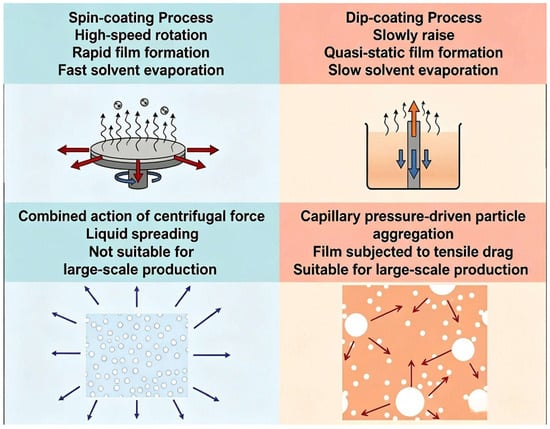
Schematic diagram illustrating the differences in film formation kinetics and structural evolution between spin-coating and dip-coating processes (The arrow indicates the direction of solution diffusion).
  • Article
  • Open Access

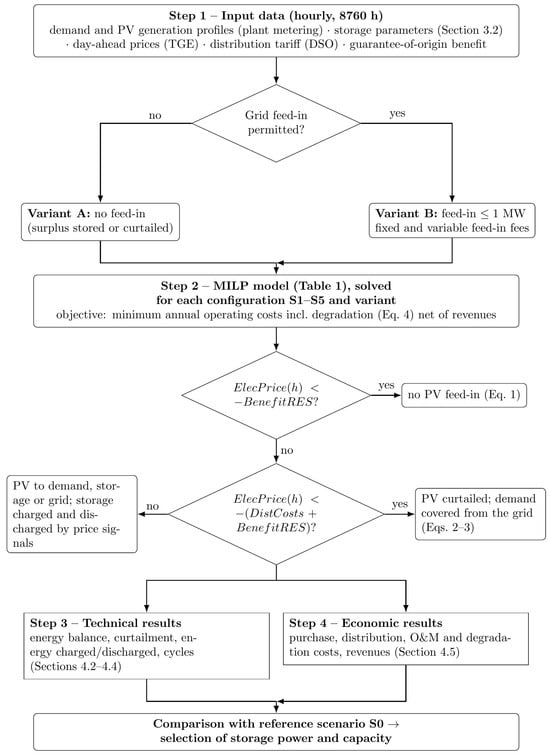
In recent years, energy-intensive enterprises have faced increasing prices of primary and final energy carriers, combined with significant volatility in electricity market prices. In this regard, own low-cost generation and energy storage have become an effective strategy to mitigate this risk. This work addresses the challenge of sizing battery energy storage systems in energy-intensive enterprises with photovoltaic installations, taking into account distribution charges, and evaluates their effect on the energy balance and operating costs. For this purpose, a mixed-integer linear programming model is employed to optimize the operation of generation units and the storage charging and discharging schedule, considering variable and fixed distribution charges, price-driven curtailment of photovoltaic generation and battery degradation. The model is applied to the case study of a Polish energy-intensive enterprise with a 2.5 MWp photovoltaic installation, using one year of hourly data. Five storage configurations, with and without grid feed-in, are investigated. The results reveal that battery storage can reduce annual operating costs by up to about EUR 266 thousand (approx. 5%), depending on its power and capacity, whereas the fixed feed-in fee exceeds the additional sales revenues in all configurations. The proposed approach can support storage investment decisions in industry under volatile market conditions.

Energies

8 November 2026

Flowchart of the research procedure: input data, scenario definition, hourly decisions of the optimization model, technical and economic results and comparison with the reference scenario; the four steps are described in the text. Source: own elaboration.
  • Article
  • Open Access

Electrical Response of Inclined Composite Insulator Surfaces to Discrete Water Droplets

  • Chorphaka Plaengpraphan,
  • Sutinun Chingkaew and
  • Krischonme Bhumkittipich
  • + 3 authors

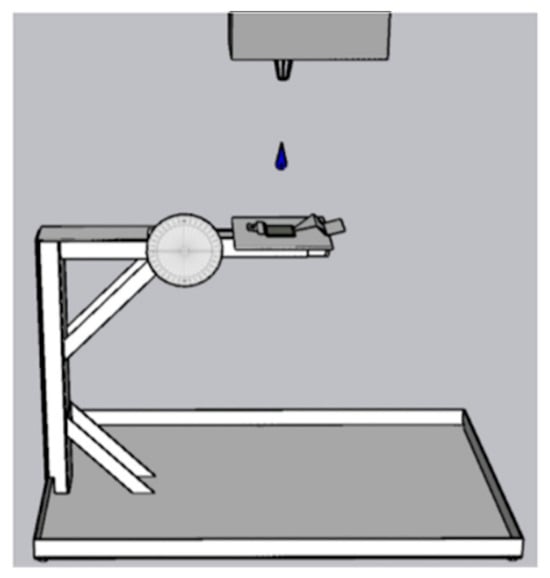
Droplets on composite insulator surfaces can change surface conductivity and affect leakage current. In this study, an Adjustable Inclined Plane Test system (AIPT) was developed to examine the effect of inclination on the electrical behaviour of a composite insulator with a controlled discrete water droplet. Tests were performed at inclination angles from 0° to 90°, 15-step increment, for 3 h. Leakage current was recorded continuously, while contact angle and hydrophobicity were measured before and after the test. Scanning Electron Microscopy (SEM) analysis was used to examine the surface after testing. Higher mean leakage current was observed at 0°, 15°, and 30° than at 45°, 60°, and 75°. At the lower inclination angles, droplets remained on the surface before evaporating, whereas at the higher angles, droplets tended to elongate and move downward under gravity. The contact angle and hydrophobicity results also indicated greater surface changes at the lower inclination angles. SEM images showed higher levels of surface change at lower angles and less change at higher angles. At 90°, the droplet did not remain on the insulator surface, so the sample stayed dry and showed a relatively smooth surface. These results show that inclination affects water retention, leakage current, and surface condition. The AIPT can be used for controlled evaluation of composite insulator performance under different water and inclination conditions.

Energies

8 November 2026

AIPT 3D design.
  • Article
  • Open Access

This research investigates strategies for improving oil recovery from the highly heterogeneous conglomerate deposits of the Lower Karamay Formation in the Bai 21 Well Block of the Junggar Basin. Particular attention is given to the coordinated application of hydraulic fracturing and waterflooding to enhance the effectiveness of infill well development. An integrated approach combining geomechanical modeling, numerical hydraulic-fracturing simulation, and reservoir performance analysis was employed to systematically investigate the effects of proppant ratio, temporary plugging, and proppant placement intensity on fracture propagation, waterflood response, and stress-field evolution. The results show that a proppant ratio of 0.15 and a proppant placement intensity of 2.5 m3/m, combined with temporary plugging and diversion fracturing, can generate short and wide fractures with half-lengths of 40–45 m, effectively mitigating early water channeling and reducing interwell interference. In situ, stress-field simulations further indicate that the stress field evolves non-uniformly during injection and production. The average formation stress initially decreases and subsequently increases, with a maximum reduction of 13.7% relative to the initial value. As waterflooding progresses, the stress gradually recovers, resulting in a final reduction of 10.7%. These findings provide an important reference for the coordinated design of infill-well hydraulic fracturing and waterflooding development in similarly highly heterogeneous conglomerate reservoirs.

Energies

8 November 2026

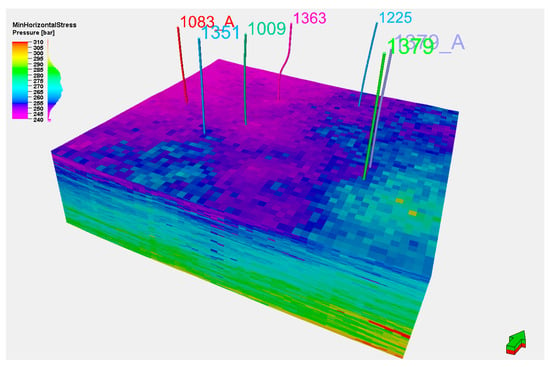
Minimum horizontal principal stress model.

Highly Accessed Articles

News & Conferences

Latest Issues

Open for Submission

Journal Sections

XFacebookLinkedIn
Energies - ISSN 1996-1073