



Separations, Volume 12, Issue 11 (November 2025) – 36 articles
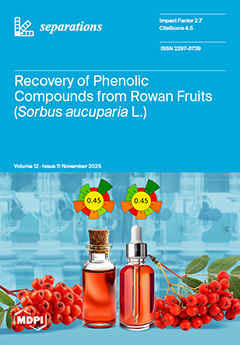
Cover Story (view full-size image):
Rowan (Sorbus aucuparia L.) is a resilient, polyphenol-rich fruit that is still underutilized. This study investigated how pre-treatment and extraction strategy affected the recovery of health-promoting phenolics and antioxidant activity from its fruits. Convective drying was compared with freeze-drying, followed by rotor–stator homogenization, ultrasound-assisted extraction, and Soxhlet extraction in ethanol. Freeze-drying roughly doubled total phenolics, and freeze-dried samples treated with ultrasound showed the strongest antioxidant capacity and favorable greenness scores. Soxhlet maximized phenolic and flavonoid yields but at a higher environmental cost. The findings guided the design of sustainable processes to valorize rowan as a source of natural antioxidants. View this paper
- Issues are regarded as officially published after their release is announced to the table of contents alert mailing list.
- You may sign up for e-mail alerts to receive table of contents of newly released issues.
- PDF is the official format for papers published in both, html and pdf forms. To view the papers in pdf format, click on the "PDF Full-text" link, and use the free Adobe Reader to open them.
Previous Issue
Next Issue
