Article

Design, Simulation, and Parametric Analysis of an Ultra-High Purity Phosphine Purification Process with Dynamic Control


1
School of Chemical Engineering, Hebei University of Technology, Tianjin 300130, China
2
Key Laboratory of Pollution Processes and Environmental Criteria, Ministry of Education, Tianjin 300350, China
3
Tianjin Key Laboratory of Environmental Remediation and Pollution Control, Tianjin 300350, China
4
Tianjin Engineering Center of Environmental Diagnosis and Contamination Remediation, Tianjin 300350, China
5
College of Environmental Science and Engineering, Nankai University, Tianjin 300350, China
*
Author to whom correspondence should be addressed.
Separations 2025, 12(11), 309; https://doi.org/10.3390/separations12110309
Submission received: 14 October 2025 / Revised: 30 October 2025 / Accepted: 5 November 2025 / Published: 7 November 2025
(This article belongs to the Special Issue Novel Solvents and Methods in Distillation Process)

Abstract

Phosphine (PH3) is an important functional material that plays a pivotal role in semiconductor fields. As semiconductor technology rapidly advances toward smaller sizes and higher performance, the requirements for the purity of phosphine in chip manufacturing are becoming increasingly stringent. To address this, this study has designed a purification process for ultra-high purity phosphine, capable of achieving a purity level of 6N (99.9999%) for phosphine products. The process was simulated and analyzed using Aspen Plus to investigate the influence of various factors on the purity of phosphine products. In this design, the sensitivity analysis function was used to determine the optimal number of theoretical stages, feed stage, and reflux ratios for each rectifying column in the process. It was also found that an increase in rectifying column pressure is detrimental to the removal of low-boiling-point substances such as N2 and O2 from phosphine. Furthermore, a double-effect distillation process was designed. After adopting the double-effect distillation process, the heat duty on all condensers and reboilers would decrease by 27%, but the purity of the phosphine product would decrease from 99.999943% to 99.999936%. Finally, a control scheme was designed for the distillation column used to extract phosphine products, and the control effect was dynamically simulated and tested using Aspen Plus Dynamics. The test results showed that disturbances caused by a decrease in feed were much more difficult to control than those caused by an increase in feed, and that low-boiling-point impurities had a much greater impact on the purity of phosphine products than high-boiling-point impurities. In addition, the results of steady-state simulation indicate that CO2 in phosphine is difficult to remove through distillation processes. Adding adsorption processes or membrane separation processes after distillation to remove CO2 from phosphine is a research direction for improving the purity of phosphine.

1. Introduction

Driven by the synergy of 5G communication systems, intelligent computing clusters, and the Internet of Everything, the global semiconductor industry is entering a new period of accelerated technological iteration. Ultra-pure phosphine (PH3), as a typical representative of electronic-grade gases, has irreplaceable value in the doping process of semiconductor manufacturing [1,2,3]. In the core processes of semiconductor manufacturing, PH3 primarily serves two critical functions: acting as a dopant source in ion implantation processes [4] and as a precursor material supporting chemical vapor deposition (CVD) systems [5]. In advanced chip manufacturing processes, semiconductor device sizes have been significantly reduced and internal structures have become increasingly complex, resulting in extremely low tolerance for impurity content. Even the slightest impurities can have a serious negative impact on the performance of semiconductor devices, which means that the purity of upstream electronic chemicals must be strictly controlled [6]. Therefore, as semiconductor technology continues to evolve, chip manufacturing processes are becoming increasingly demanding in terms of phosphine purity. To meet this demand, continuously optimizing and improving the production process for ultra-high purity PH3 has become a top priority.
Currently, the main industrial synthesis methods for phosphine include the acid method, the alkali method, and the hydrolysis method [7,8]. The acid method [9] is a method of producing phosphine by directly reacting phosphorus and water, with phosphoric acid as a by-product. The reaction equation is as follows:
2P4 + 12H2O → 3H3PO4 + 5PH3
The reaction is carried out at temperatures above 250 °C. In this method, the yield of phosphine can reach more than 94%, and the purity can exceed 90%. The alkaline method [8] is a method for preparing phosphine by reacting phosphorus with alkali. The reaction process is as follows:
P4 + 3NaOH + 3H2O → 3NaH2PO2 + PH3
NaH2PO2 + NaOH → Na2HPO3 + H2
The reaction can be carried out at 25–60 °C, so the requirements for reaction equipment are low, but the yield of PH3 in this reaction is only 30%. Na2HPO3 can be converted into a mixture of H3PO2 and H3PO3 in inorganic acid solution, and the mixture will continue to produce PH3 gas under 200–250 °C, which can achieve a PH3 yield of 50%. But it is still far below the PH3 yield obtained through the acid method. Additionally, due to the generation of H2 in side reactions, the purity of PH3 produced by this method is also low. The hydrolysis method [7,10] is a method of preparing PH3 by adding metal phosphides to dilute H2SO4 to hydrolyze the metal phosphides. The reaction equation is as follows:
Zn3P2 + 3H2SO4 → 3ZnSO4 + 2PH3
This method yields PH3 with high yield and purity, but the reaction is very violent and releases a large amount of heat during the reaction, making it dangerous to operate.
Currently, methods for purifying phosphine production include adsorption, membrane separation, and low-temperature distillation. Adsorption methods are based on the screening mechanism of high-specific-surface-area adsorption materials. They use transition metal compounds, alloys, zeolite molecular sieves, and other media with selective adsorption functions to achieve purity improvement by directionally capturing gas impurity components. McManus et al. [11] proposed a method for semiconductor process gases that can effectively remove impurities such as O2 and H2O from phosphine. Membrane separation technology, as a relatively new purification technique, is based on the selective permeation principle of polymer membranes. Pascal B et al. [12] proposed a method for purifying gaseous hydrides using membrane separation technology, which can remove H2 from PH3. Cryogenic distillation is a method that utilizes the differences in boiling points between different components to purify phosphine. Yuan et al. [13] proposed a method for purifying phosphine using cryogenic distillation technology, which can achieve a purity of over 99%.
Adsorption methods are limited by the adsorption materials, so they are not ideal for removing certain substances that are difficult to adsorb. Membrane separation methods are currently not suitable for large-scale production due to limitations in membrane flux. Therefore, distillation is an indispensable process for obtaining ultra-high purity phosphine. In recent years, much research on phosphine purification technology has centered on the distillation process. Wang et al. [14] proposed an efficient azeotropic distillation process that utilizes azeotropic properties to selectively remove stubborn impurities at the top of the azeotropic column, ultimately achieving phosphine product purity of exceeding 99.99999% (7N-grade). The process developed by Zeng et al. [15] combines distillation technology with adsorption technology, effectively removing impurities such as H2O, O2, CO2, H2S, and H2 from industrial phosphine gas. This yields 7N-grade electronic-grade phosphine. Cai et al. [16] proposed an eco-friendly synthesis route using sodium hydroxide and yellow phosphorus as raw materials. By optimizing reaction temperature, pressure, and dispersant ratio, they achieved a phosphine yield of 15–35%, with the by-product salt solution being recycled. Subsequent low-temperature double-effect distillation elevated phosphine purity to 7N while achieving ≥30% energy savings. It is noteworthy that although the purity of phosphine obtained through the aforementioned purification methods has reached electronic-grade levels, to our knowledge, no publicly available information specifically investigates the effects of various factors on product purity during the purification of phosphine using distillation techniques. This indicates that the current understanding of phosphine purification techniques remains largely empirical, lacking concrete data to support it. To address this gap, this study designed a distillation process for producing high-purity phosphine and simulated it using Aspen Plus V14. Based on the simulation results, the study analyzed the impact of various factors on phosphine product purity and proposed several optimization strategies. In addition, this study conducted the first dynamic simulation analysis of potential disturbances during phosphine purification while also considering the value of phosphoric acid generated during phosphine production via the acid method. These findings provide research insights and theoretical data references for advancing ultra-high-purity phosphine purification technology.

2. Process Design and Model Validation

2.1. Process Design

Given that the acid method for producing phosphine offers high purity, high yield, and the ability to sell by-products after processing, this design is based on phosphine produced via the acid method as the feedstock for the distillation process design, with the following assumptions being made:
(1)
Only impurities that are more prevalent or difficult to remove in the production process are considered, while other impurities, dust, and gases are ignored.
(2)
The system is assumed to operate in a steady state, and pressure drops within the tower and pipelines are ignored.
(3)
The heat transfer process is assumed to be adiabatic, and equipment heat dissipation is not considered.
(4)
For all rectifying columns, the Murphree Tray Efficiency (MTE) is assumed to be 100%, i.e., the simulation is based on “theoretical plates” rather than actual trays.
Additionally, it is worth noting that the feed conditions and initial equipment parameters used in this simulation are based on an industrial-scale phosphine production unit. However, due to confidentiality agreements, specific plant information and certain operational parameters have been normalized or processed. The feed parameters for the specific reactor are shown in Table 1.
The reaction product is cooled to 70 °C in a condenser and then sent to the refining process. Considering only reaction (1) and calculating based on a phosphorus inversion rate of 90%, the feed parameters for the refining process are shown in Table 2. The boiling point data for each component were sourced from the National Institute of Standards and Technology (NIST).
The design of the phosphine refining process is based on the traditional five-tower distillation process used for tetrafluoroethylene refining [17], which consists of five distillation columns. This is a very classic distillation process, in which the main product and by-products can be purified separately, making it very suitable for the purification of phosphine prepared by the acid method. The simulated process is shown in Figure 1.
In this process, the function of the T0101 column is to separate PH3 from H2O, H3PO4, and phosphorus, which are high-boiling-point substances. After the separation of phosphine and other low-boiling substances from the top of the T0101 column into the T0102 column, phosphoric acid and other high-boiling substances from the bottom of the T0101 column are transferred into the T0201 column. The T0102 column is used to remove the non-condensable gases such as N2, H2, and O2 from PH3. In the T0103 column, PH3 is separated from H2S and AsH3, and electronic-grade phosphine products are obtained from the top of the T0103 column. The role of the T0201 column and the T0202 column is to further purify phosphoric acid, the by-product phosphoric acid from the bottom of the T0202 column.
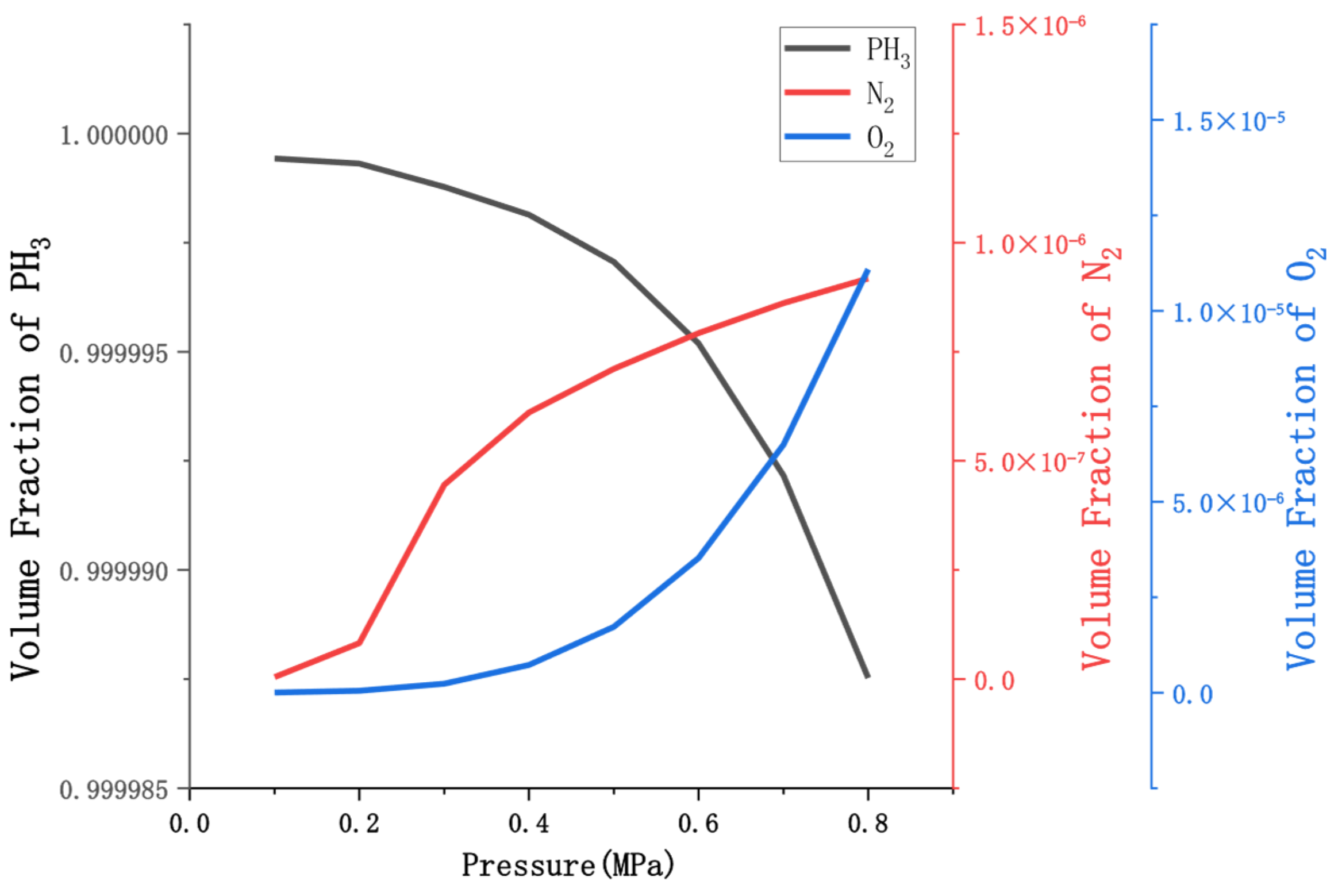
Given that the boiling point of PH3 at atmospheric pressure is −87.5 °C, which differs significantly from the feed temperature, the heat duty on the top condenser would be very high. Therefore, the T0101 column is designed as a pressurized column to increase the boiling point of PH3. However, excessively high temperatures can cause thermal decomposition of phosphoric acid at the bottom. After testing, the top pressure of the T0101 column is set to 0.2 MPa. Other columns are atmospheric pressure columns, with a top pressure of 0.1 MPa. It is worth noting that the main components at the top of the T0102 column are H2, H2, and O2, while the main component at the top of the T0103 column is PH3. The temperatures at the tops of these two columns are very low. The top temperature of the T0103 column approaches the boiling point of PH3, which is −87.5 °C at atmospheric pressure. The top temperature of the T0102 column lies between the boiling point of PH3 and the boiling point of O2, which is approximately −130 °C at atmospheric pressure in this process. Therefore, these two columns are generally designed as pressurized columns to increase the top temperature. However, the simulation results indicate that increasing the pressure in the T0102 column significantly reduces the purity of the phosphine product. This is because increased pressure causes more N2 and O2 to enter the liquid phase at the bottom of the T0102 column. The specific impact of pressure in the T0102 column on phosphine product purity is shown in Figure 2.
As shown in Figure 2, when the pressure in the T0102 column is 0.3 MPa, the product purity is already below 6N (99.9999%). When the pressure in the T0102 column is 0.8 MPa, the product purity drops below 5N (99.999%). Therefore, the T0102 column is set as an atmospheric pressure column. For the T0103 column, although increasing the pressure does not significantly reduce the purity of the phosphine product, since the top temperature of the T0102 column is much lower than that of the T0103 column, the excess cooling capacity can be fully utilized for the T0103 column. Therefore, the T0103 column does not need to be set as a pressurized tower. Additionally, since the top pressure of the T0101 column is 0.2 MPa, the feed pressure is set to 0.2 MPa. Furthermore, since this system contains phosphoric acid, the ELECNRTL (Electrolyte Non-Random Two-Liquid) calculation method is selected, which is widely recognized in industrial modeling of electrolyte systems [18].

2.2. Model Validation

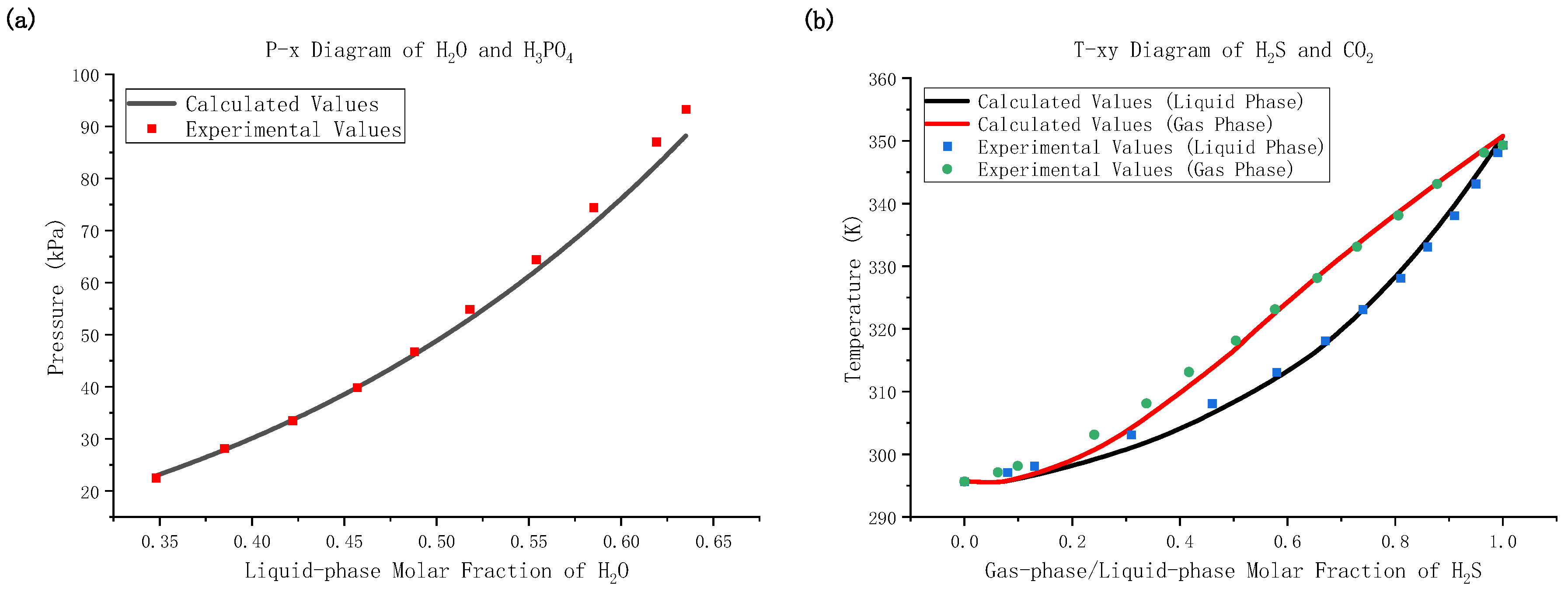
To ensure the reliability of the simulation results, experimental verification was conducted on the two key binary systems in the process: H2O-H3PO4 and H2S-CO2. These systems, respectively, represent the electrolyte environment and non-ideal gas separation behavior within the process. The validation results are shown in Figure 3 and Table 3. It is noteworthy that this study could not perform direct experimental verification for the binary system involving phosphine. This is primarily due to phosphine’s extreme toxicity, flammability, and explosive properties, coupled with the exceptionally high experimental hazards involved, resulting in a near absence of reliable experimental data in the public domain.
As summarized in Table 3, for the H2S-CO2 system, the model demonstrates exceptional accuracy in temperature calculations, with an average relative deviation of only 0.3% and a maximum relative deviation of 0.7%. This level of computational precision is highly commendable for industrial applications. For the simulated H2O-H3PO4 system, the average relative deviation in pressure calculations was 2.6%, with a maximum relative deviation of 5.5%. It is worth noting that in low-pressure systems below 100 kPa, this deviation falls entirely within the acceptable range for industrial process design. In summary, this model is applicable and reliable for simulating and analyzing subsequent complex phosphine purification processes.

3. Sensitivity Analysis

In order to thoroughly investigate the impact of key parameters on the purification efficiency of phosphine, this study utilized the sensitivity analysis function of the Aspen Plus software to systematically analyze the number of theoretical stages, molar reflux ratio, and feed stage for each tower, thereby determining the optimal parameters. It is worth noting that the primary objective of parameter screening in this study is to ensure that the target product purity is achieved. Under this premise, parameter selection also considers engineering economics, manifested by the decision to cease further investment and energy consumption once the separation efficiency reaches a plateau.

3.1. Effect of the Number of Theoretical Stages

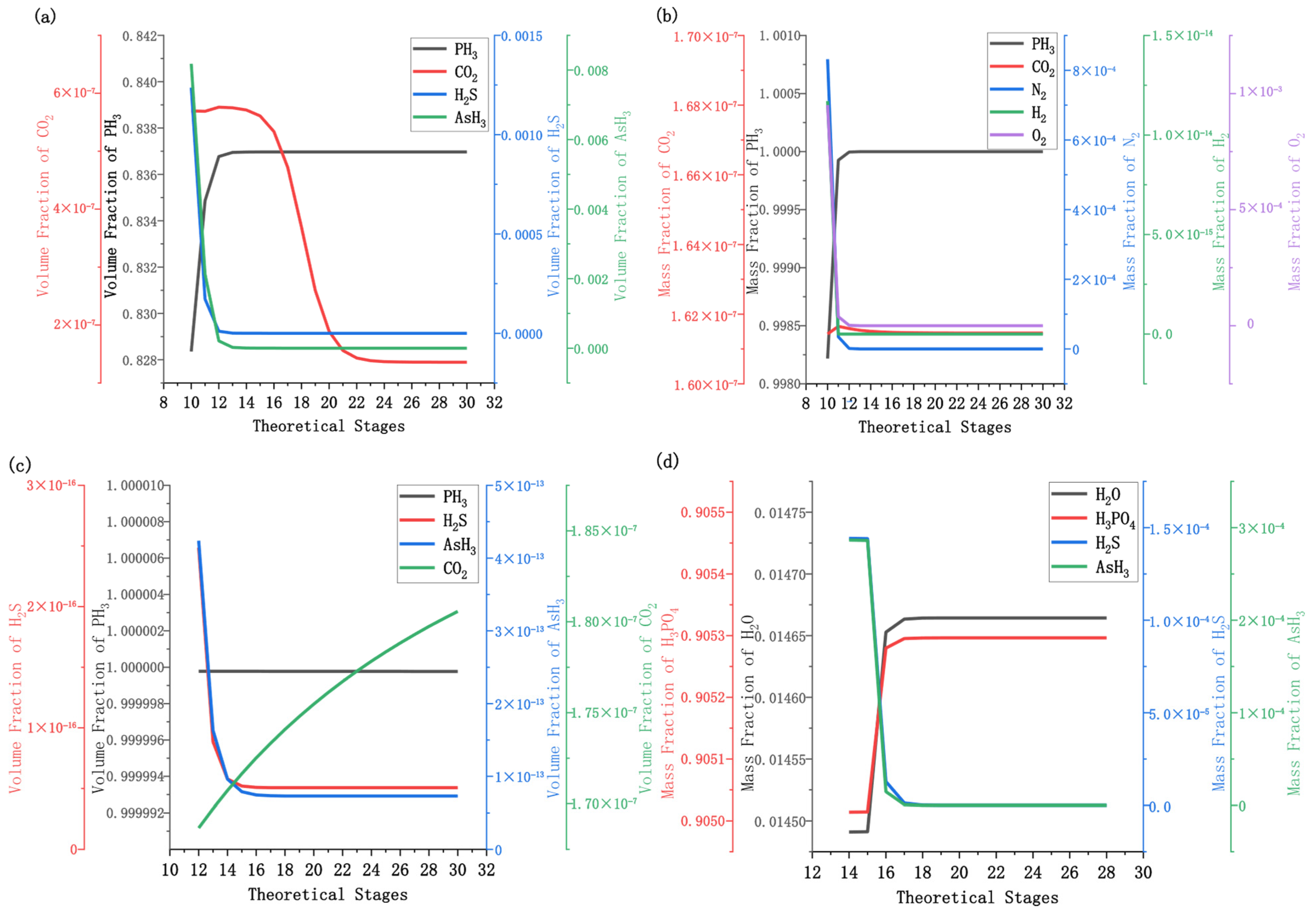
The number of stages is an important design parameter in the distillation process; the higher the number of stages, the better the separation of each substance. However, as the number of stages increases, the cost of manufacturing the rectifying column increases. Therefore, a sensitivity analysis was carried out to ensure the design of a reasonable number of tower stages. The relationship between the component content at the top or bottom of the rectifying column and the number of stages is shown in Figure 4.
From Figure 4a, it can be seen that in the composition of the top of the T0101 column, the content of PH3 increases with the increase in the number of theoretical stages, and then stabilizes when the number of theoretical stages is about 15, while with the increase in the number of theoretical stages, the content of H2S and AsH3 decreases and then stabilizes when the number of theoretical stages is about 14. Furthermore, the content of CO2 also decreases and stabilizes with the theoretical stages of 26. The role of the T0101 column is to separate the phosphine and the high-boiling-point components initially; so, considering the separation effect and economic factors, the number of theoretical tower stages of the T0101 column was set to 28.
At the bottom of the T0102 column, as shown in Figure 4b, the content of PH3 increases with the increase in the number of theoretical stages, and stabilizes when the number of theoretical stages is about 13, and the content of N2, H2, and O2 decreases with the increase in the number of theoretical stages, and stabilizes when the number of theoretical stages is about 13, and the content of CO2 basically does not change with the change in the number of theoretical stages. The role of the T0102 column is to separate PH3 from H2, N2, and O2, which are non-condensable gases, and the number of theoretical stages was set to 14 for the sake of separation effect and economic considerations.
At the top of the T0103 column, as shown in Figure 4c, the content of PH3 basically does not change with the change in the number of theoretical stages, CO2 content increases with the increase in the number of theoretical stages, while H2S and AsH3 contents decrease, and tend to stabilize when the number of theoretical stages is about 16. The role of the T0103 column is to separate PH3 from AsH3 and H2S. Considering this, the number of theoretical stages was set to 16.
The purpose of the towers T0201 column and T0202 column is to purify the by-product phosphine, as shown in Figure 4d. At the bottom of the T0101 column, the content of H3PO4 first increases with the increase in the number of theoretical stages, and tends to stabilize when the number of theoretical stages is about 19. The content of H2S and AsH3 first decreases with the increase in the number of theoretical stages, and tends to stabilize when the number of theoretical stages is about 18. For the separation effect and economic consideration, the number of theoretical stages was designed to be 20. In addition, it can be seen from Figure 3b that the mass fraction of the H3PO4 content at the bottom of the T0201 column reaches 90%, and the mass fraction of AsH3 is less than 0.0001 when the number of theoretical stages is 20, which meets the requirements of the Chinese national standard GB/T 2091-2008 [21] for 85% phosphoric acid of superior quality in Chinese industry, so the T0202 column is no longer subjected to sensitivity analysis.

3.2. Effect of Feed Stage

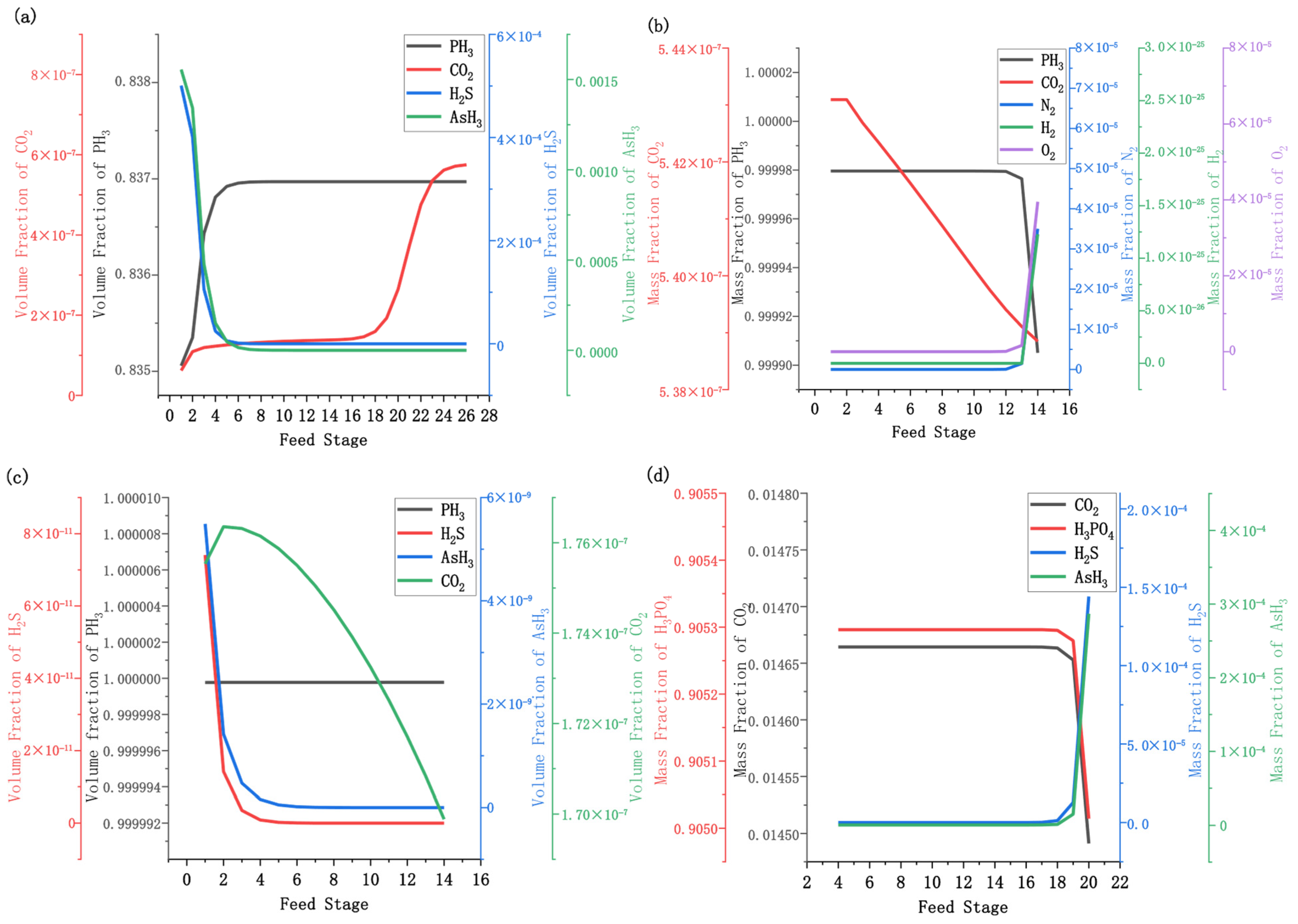
In the distillation process, the feed stage is an important parameter that affects the distillation effect. An excessively high or low feed stage may result in reduced product purity at the top or bottom of the rectifying column. Therefore, a sensitivity analysis was performed to ensure a reasonable feeding stage. The relationship between the component content at the top or bottom of the T0101 column, T0102 column, T0103 column, and T0201 column and the feeding stage is shown in Figure 5.
As shown in Figure 5a, at the top of the T0101 column, the content of PH3 increases with decreasing feed stage when feeding between the 1st stage and the 6th stage, and the content of PH3 basically does not change with the feed stage when feeding at the stage below the 6th stage. The H2S and AsH3 contents decreased with the decrease in feeding stage from the 1st stage to the 7th stage, and the H2S and AsH3 contents were basically unchanged when the feeding stage was under the 7th stage. The CO2 content first increased slowly with the decrease in the feeding stage, and then increased rapidly with the decrease in the feeding stage under the 16th stage. Based on the separation effect and considering the difficulty of removing CO2 in the subsequent distillation process, the feed stage was designed to be above the 6th stage.
For the bottom of the T0102 column, as shown in Figure 5b, the content of PH3 remains basically unchanged when the feed stage is between the 1st and 11th stage, and decreases as the feed position decreases when the feed stage is below the 11th stage. In the feeding stage from the 1st stage to the 12th stage, the content of N2, H2, and O2 basically did not change with the change in feeding position, and when the feeding stage was under the 12th stage, the content of N2, H2, and O2 increased with the decrease in the feeding stage. The content of CO2 increased slightly with the decrease in the feeding stage. According to the separation effect and considering the difficulty of removing CO2 in the subsequent distillation process, the feed stage was designed to be above the 11th stage.
For the top of the T0103 column, as shown in Figure 5c, the content of PH3 is essentially unchanged by the change in the feed stage. The content of H2S, AsH3 decreases with the decrease in the feed stage when the feed stage is between the 1st stage and the 5th stage, and the content of H2S and AsH3 basically does not change with the change in the feed stage when the feed stage is in the 5th stage. When the feeding stage is between the 1st stage and the 3rd stage, the content of CO2 increases with the decrease in the feeding stage, and when the feeding stage is under the 3rd stage, the content of CO2 decreases with the decrease in the feeding stage. By comprehensive consideration, the feeding stage was set to be above the 14th stage.
For the bottom of tower T0201, as shown in Figure 5d, the content of H3PO4 basically does not vary with the feed stage when fed between the 1st stage and the 18th stage, and the content of H3PO4 decreases with decreasing feed stage when the feed stage is below the 18th stage. When feeding between the 1st stage and the 17th stage, the content of H2S and AsH3 basically does not change with the change in feeding position, and when the feeding stage is under the 17th stage, the content of H2S and AsH3 decreases with the decrease in the feeding stage. Considering this, the feeding stage was set to be above the 15th stage.

3.3. Effect of Molar Reflux Ratio

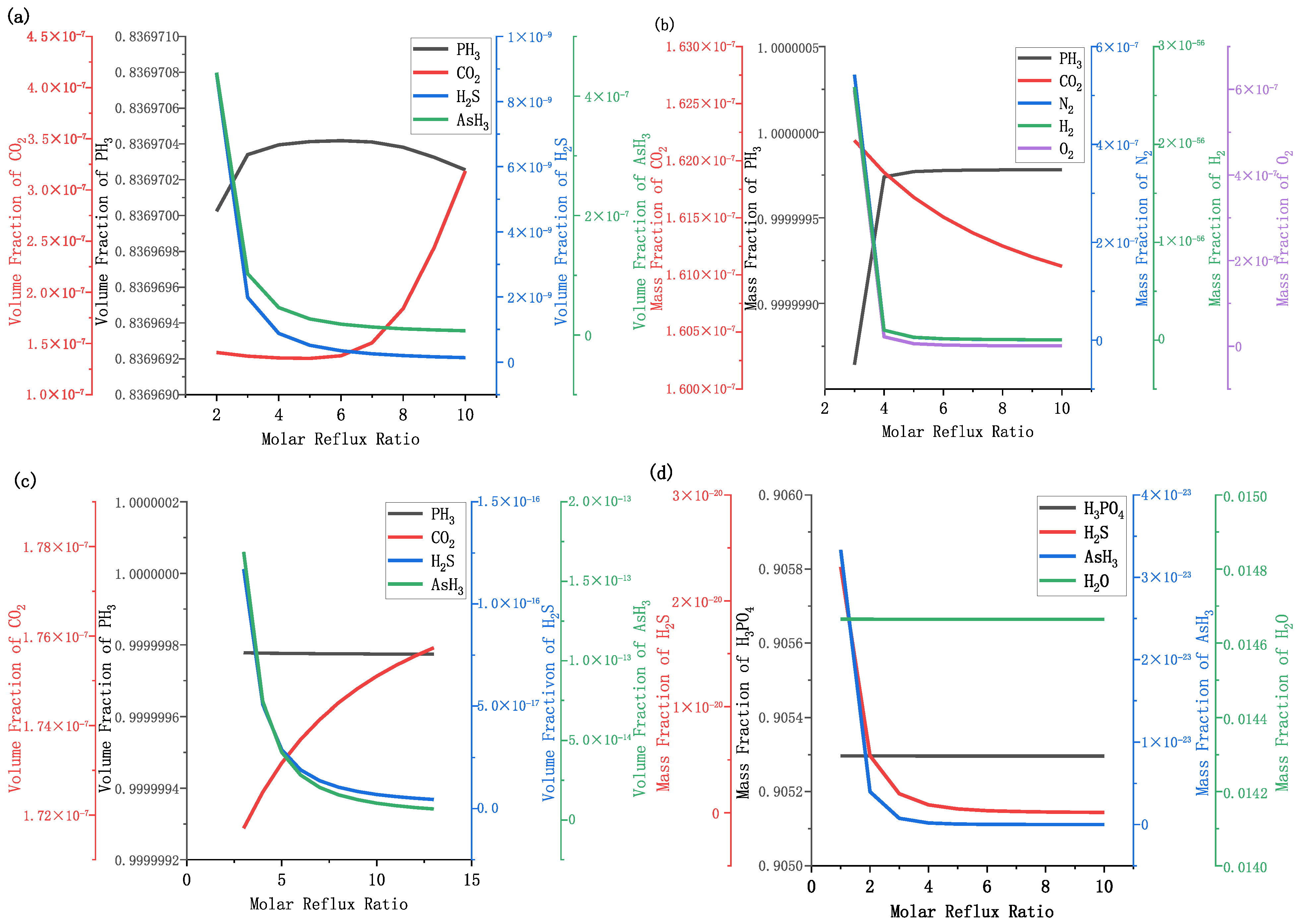
The reflux ratio is an important operating parameter for rectifying columns. The larger the reflux ratio, the better the separation effect. However, as the reflux ratio increases, the overhead condenser heat duty of the column increases, which results in more energy consumption and operating costs. In addition, an increase in the reflux ratio can also lead to a decrease in the output of the product at the top of the rectifying column. Therefore, a sensitivity analysis of the reflux ratio is required to ensure that the proper reflux ratio is selected. The relationship between the component content at the top or bottom of the rectifying column and the reflux ratio for the T0101 column, T0102 column, T0103 column, and T0201 column is shown in Figure 6.
As shown in Figure 6a, at the top of the T0101 column, the content of PH3 increases with the increase in reflux ratio at the beginning, but between reflux ratios of 4 and 8, the change in phosphine content with the increase in the reflux ratio is very small. The content of H2S and AsH3 first declines with the increase in the reflux ratio, and then stabilizes after the reflux ratio reaches 4. The content of CO2 changes very little at first with the increase in the reflux ratio, but after the reflux ratio reaches 6, the content of CO2 starts to increase with the increase in the reflux ratio. Considering this, the reflux ratio of the T0101 column was set to 4.
For the T0102 column, as shown in Figure 6b, at the bottom of the T0102 column, the content of PH3 first rises with the increase in reflux, and then stabilizes after the reflux ratio reaches 6. The content of CO2 decreases with the increase in the reflux ratio. The content of N2, O2, and H2 first decreases with the increase in the reflux ratio, and then stabilizes after the reflux ratio reaches 6. The main purpose of the T0102 column is to remove H2, O2, and N2 from PH3 gas, and the reflux ratio was set to 6 for the comprehensive economic factors.
As shown in Figure 6c, at the top of the T0103 column, the content of PH3 basically does not change with the change in the reflux ratio, and the content of AsH3 and H2S decreases with the increase in the reflux ratio, and after the reflux ratio reaches to 5, the content of AsH3 and H2S decreases with the increase in the reflux ratio to a lesser extent. The content of CO2 increases with the increase in the reflux ratio. For comprehensive consideration, the reflux ratio was set to 4.
As shown in Figure 6d, at the bottom of the T0201 column, the content of H3PO4 basically does not change with the change in the reflux ratio. The content of H2S and AsH3 first decreases with the increase in the reflux ratio, and the content of H2S basically reaches the minimum after the reflux ratio reaches 8, and the content of AsH3 basically reaches the minimum after the reflux ratio reaches 5. The purpose of the T0201 column is to remove the impurity content of phosphoric acid; after comprehensive economic considerations, the reflux ratio was set to 8.
Based on the above sensitivity analysis, the operating parameters of each rectifying column are shown in Table 4.

4. Simulation Results and Optimization

4.1. Simulation Results

The simulations were carried out according to the process flow rate in Figure 1 and the operating parameters in Table 4, and the simulation results are shown in Table 5 and Table 6.
The simulation results indicate that this process can purify PH3 to 99.99994%, with a product mass flow rate of 304.5 kg/h. The purity of the by-product phosphoric acid can be purified to 95.5%, with a mass flow rate of 696.7 kg/h. Additionally, the simulation results indicate that PH3 and CO2 are difficult to separate in this process, so it is essential to strictly control the CO2 content in the feedstock.

4.2. Process Optimization

4.2.1. Four-Column Refining Process

According to the simulation results, although the abovementioned five-tower distillation process can purify the purity of the by-product phosphoric acid to 95.5%, the product cannot meet the requirements of the Chinese national standard GB/T 28159-2011 [22] for electronic-grade phosphoric acid due to the large amount of P present in the product. However, as can be seen from the simulation results, the mass fraction of H3PO4 at the bottom of the T0201 column is 89.4%, and the mass fraction of As is not more than 10−7, which meets the requirements of the Chinese national standard GB/T 2091-2008 [21] for 85% phosphoric acid of superior quality in the Chinese industry. Therefore, for economic and energy considerations, the T0202 column in the five-column refining process was omitted and turned into a four-column refining process. In the four-column refining process, the purity of the phosphoric acid product is 89.4%, and the product flow rate is 744.7 kg/h.

4.2.2. Double-Effect Distillation

The basic principle of double-effect distillation is to use the top vapor of one rectifying column as the heating medium for the reboiler of the other rectifying column, which can effectively save the amount of heat transfer medium and reduce the heat duty of these two columns [23]. Cai et al. [24] developed a double-effect distillation system for purifying phosphine, achieving a 30% energy savings compared to traditional processes during the purification stage. In this design, the double-effect distillation process is considered for the T0102 and T0103 columns to reduce the energy consumption and the amount of heat transfer medium.
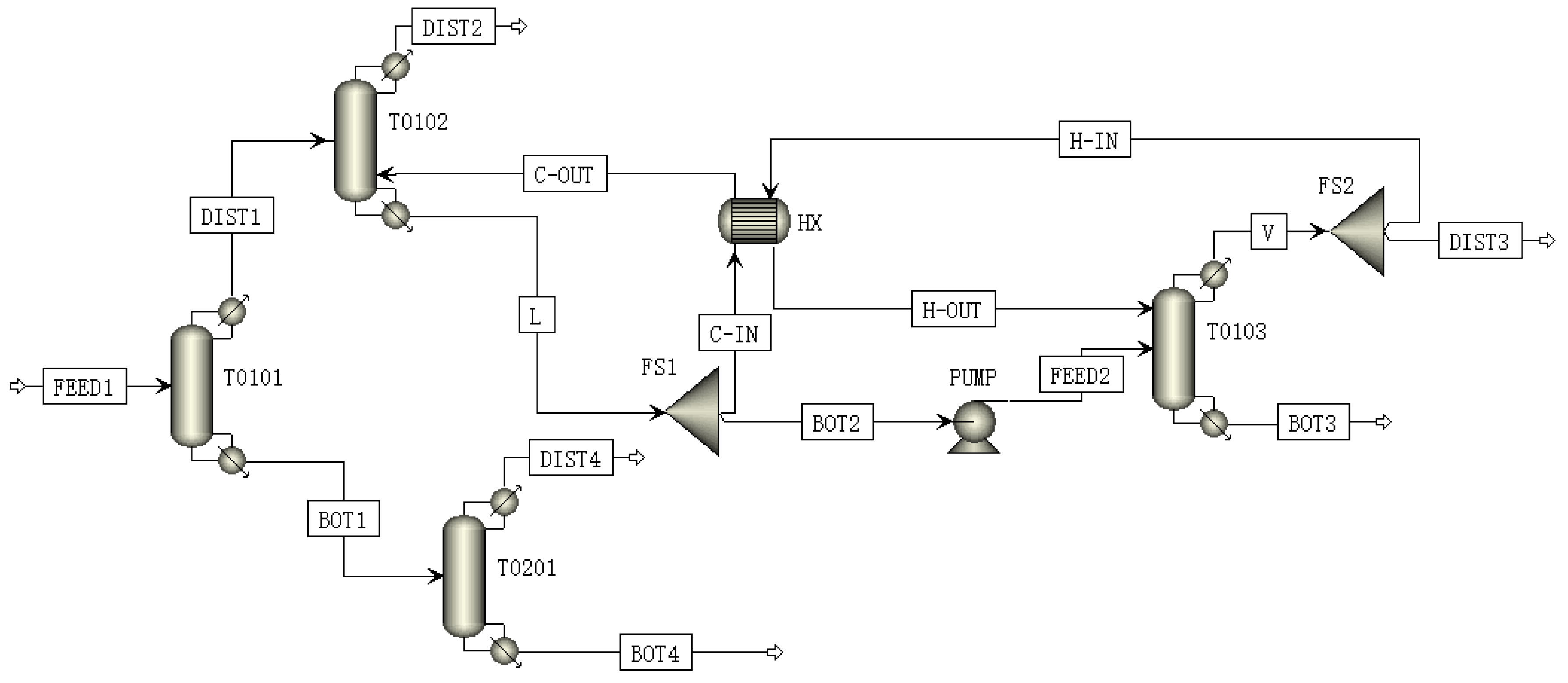
In order to adopt a double effect distillation process for the T0102 column and T0103 column, it is necessary to adjust the operating parameters of both columns so that the heat duty of the condenser in one column and the heat duty of the reboiler in the generator in the other column are both zero. Since the content of PH3 at the top of the T0103 column does not change significantly with the reflux ratio, as shown in Figure 5c, it is proposed to adjust the reflux ratio of the T0103 column to ensure that the algebraic sum of the heat duty on the reboiler of the T0102 column and the condenser heat duty of the T0103 column is zero. Additionally, to ensure a certain temperature difference between the reboiler of the T0102 column and the condenser of the T0103 column, the top pressure of the T0103 column is adjusted to 0.2 MPa. The process of double-effect distillation is shown in Figure 7. After adjustment, the molar reflux ratio of the T0103 column is 1.7.
Running the above process simulation, the heat duty results for each column are obtained as shown in Table 7.
Due to the reflux ratio of the T0103 column in this optimization process, the purity of the top product of the T0103 column will change, and there will also be slight changes in the results of other streams. Therefore, in addition to the total heat duty of the four columns, comparisons were also made for other important stream results, as shown in Table 8. It should be noted that the high-precision purity values (e.g., 99.999943%) appearing in the process comparison section of this paper are relative values calculated internally by the process simulation software. They are primarily used to sensitively compare subtle differences between various process schemes. We fully recognize that in actual industrial applications, product specifications are confirmed by verifying whether the total impurity content falls below the 6N grade threshold, rather than by directly measuring the main substance’s purity to such a high number of significant digits.
As shown in Table 8, after adopting double-effect distillation, the total heat duty of the four columns in the four-column process was reduced by 285.9 kW, accounting for 27.0% of the total heat duty of the condensers and reboilers of the four columns before. However, the yield and purity of phosphine products and phosphoric acid by-products were almost unchanged.

5. Dynamic Simulation Analysis

The purity, yield, operational safety, economic viability of the process, and equipment efficiency of a product are all influenced by various factors. Dynamic simulation can effectively predict and address the issues caused by these factors and has become an important area of research in the chemical industry. Due to the stringent requirements for phosphine purity in the electronics industry, even minor changes in conditions during distillation can result in non-conforming products. Therefore, dynamic analysis of the product T0103 column is essential. This study employs the Pressure-Driven model within the Aspen Plus Dynamics platform to establish a dynamic simulation system.

5.1. Dynamic Simulation Parameter Design

To transition from a steady-state simulation to a dynamic simulation, control valves and pressure sensors must be configured. In this process, valves are used to regulate feed flow rate and liquid levels in the reflux drum and sump. The initial valve opening is typically set to 50%, with a uniform pressure drop reference value of 0.3 MPa. Pressure sensors are installed at the top and bottom of the refining column. Since the top of the refining column requires gas separation, an isentropic compressor with an efficiency of 0.8 is installed. A pump device with an efficiency of 0.8 is installed at the bottom of the refining column. The pressure drops of both are consistent with the reference pressure drop (0.3 MPa).
Since the feed flow rate of the T0103 column is relatively low, it is designated as a packing column. Hydraulic calculations indicate that the packing height is 4.2 m and the diameter is 0.3 m. The volume of the reflux drum and column base of the T0103 column was calculated based on the liquid level when the liquid stays for 5 min, which occupies half of the tank volume [25], and their length and diameter were calculated based on a length-to-diameter ratio of 2. The calculated length and diameter of the reflux drum are 0.85 m and 0.425 m, respectively, while the length and diameter of the column base are 1.03 m and 0.151 m, respectively. All the other parameters use the default values in the Aspen Plus software.

5.2. Selection of Control Schemes

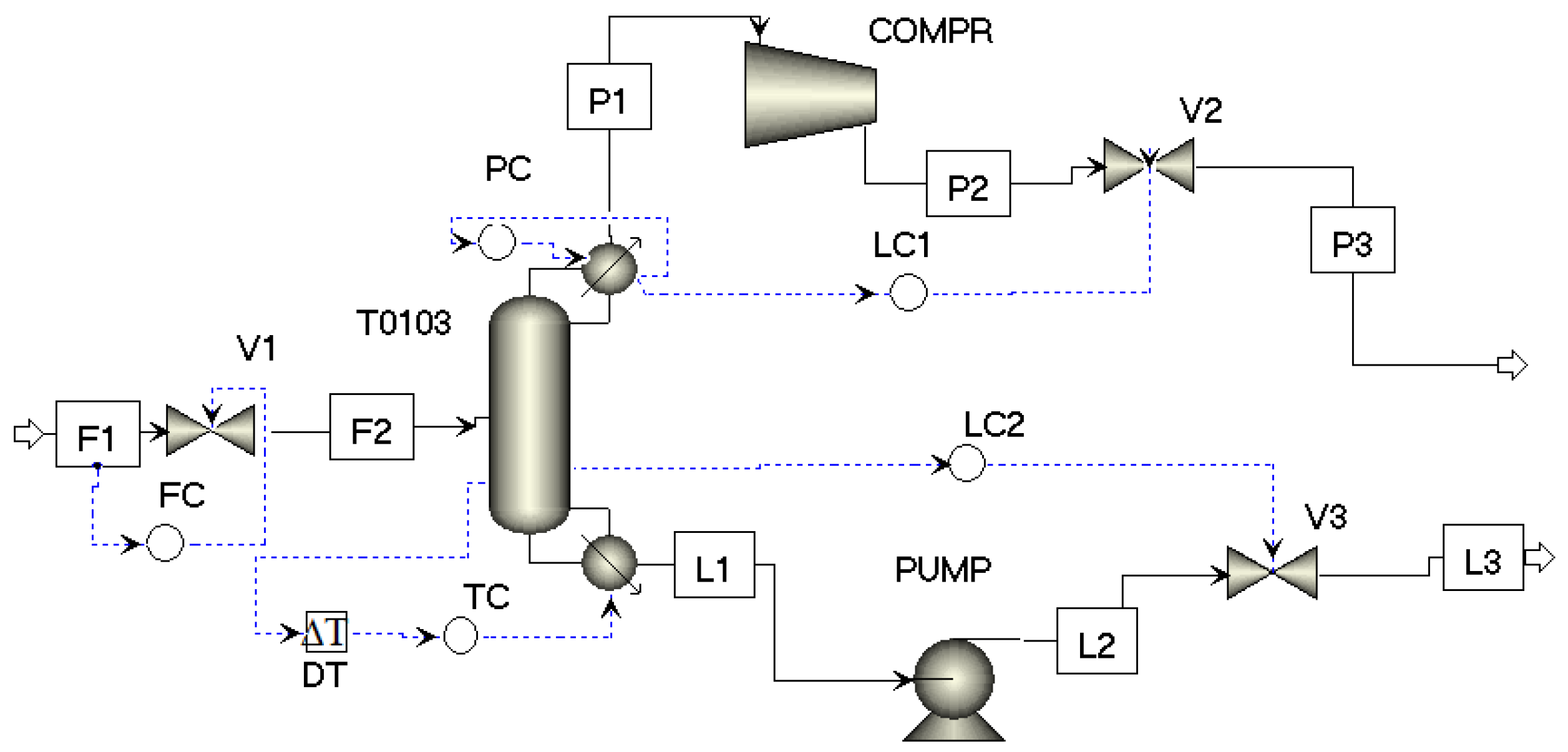
Classic refining column control schemes include temperature control schemes and composition control schemes. The principle of temperature control is to indirectly control the composition by controlling the temperature, and its advantage is that it can respond quickly to interference. Composition control directly measures the composition using a composition analyzer and then controls it, but since it takes a certain amount of time to measure the composition, its response to interference is relatively slow, typically 5–10 min [26]. In actual practice, the temperature control scheme should be given priority [27]. Therefore, this design adopts a temperature control scheme to control T0103. In addition to setting the temperature controller, a series of proportional–integral controllers for the top liquid level, bottom liquid level, and feed flow rate have been established to control the T0103 column, ensuring continuous and stable production operations.
The specific control structure is shown in Figure 8, where FC is the feed controller, which controls the feed flow rate through the opening of valve V1; TC is the temperature controller, which controls the temperature of the column stage by adjusting the heat duty of the reboiler; LC1 and LC2 are the liquid level controllers for the top reflux drum and column base, respectively, which control the liquid level through the opening of valves V2 and V3; and PC is the pressure controller.

5.3. Selection of Temperature-Sensitive Stage and Controller Parameter Tuning

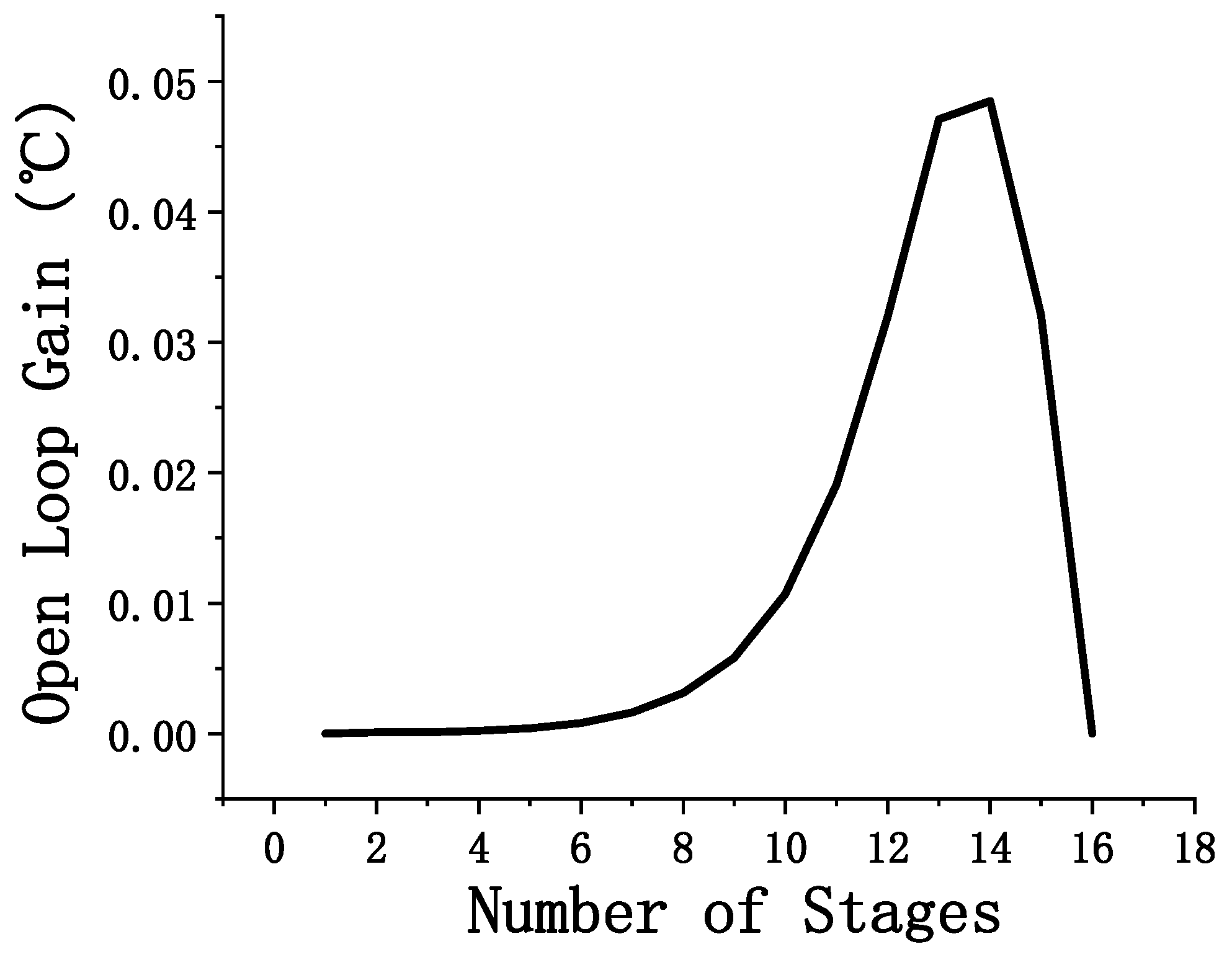
The key to temperature control is selecting temperature-sensitive stages in the refining column [27], and the primary selection methods include the slope criterion and the sensitivity criterion. The slope criterion involves selecting the stage with the largest temperature difference between stages as the sensitive stage, while the sensitivity criterion involves selecting the stage with the largest temperature change when the manipulated variable changes as the sensitive stage. Since the sensitivity criterion is more intuitive, this design uses the sensitivity criterion to select the sensitive stage. The open-loop gain of each stage for the reboiler heat duty was calculated based on a 0.1% increase in the heat duty of the reboiler of T0103 column, and the calculation results are shown in Figure 9.
As shown in Figure 9, when the heat duty of the reboiler for the T0103 column changes, the temperature changes most significantly on the 13th and 14th stages. Since the 14th stage is the feed stage, the 13th stage is selected as the sensitive stage. Additionally, due to the time lag of the temperature controller, a deadband time must be considered. Calculating a 6 s delay per stage [26], the deadband time is set to 18 s.
The controller parameters for the pressure, level, and flow loops were set based on well-established industrial heuristics for fast-response processes [25]. Specifically, the liquid level controllers (LC1 and LC2) were configured with a pure proportional mode (large integral time) to implement an averaging control strategy, which helps to smooth flow fluctuations to downstream units. In contrast, the temperature controller (TC) parameters for the critical and slower temperature loops were systematically determined using the relay feedback test and the Tyreus–Luyben tuning rule. The controller parameters are detailed in Table 9.

5.4. Disturbance Testing

Considering the possible disturbances caused to the T0103 column by staff misoperation and upstream equipment failures, disturbance tests were conducted on the control system by changing the feed flow rate and feed composition of the T1013 column after the T0103 column had been operating stably for 0.5 h, and the tests lasted for 20 h.

5.4.1. Feed Flow Rate Disturbance Test

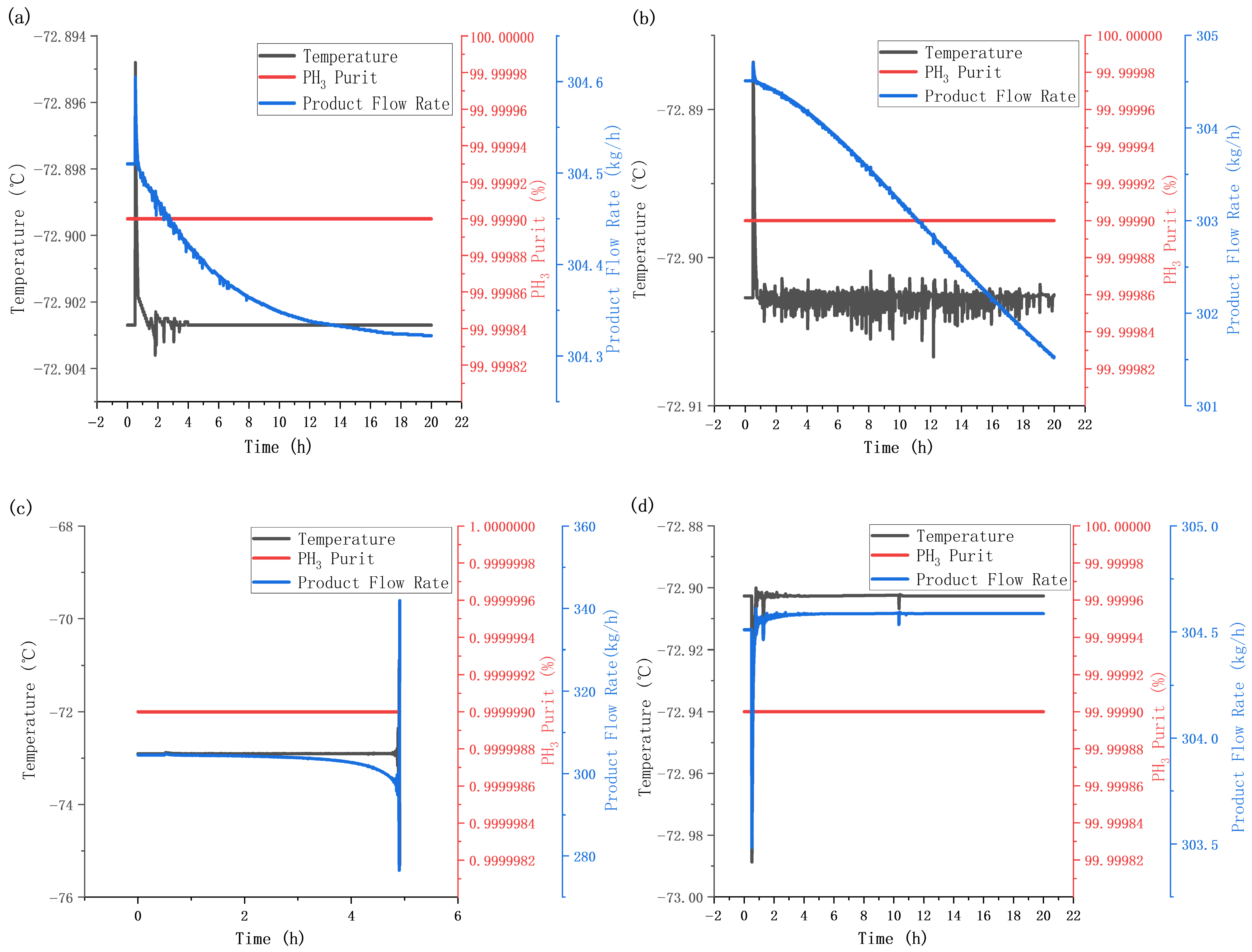
The control system was subjected to disturbance tests involving reductions in feed flow rate of 10%, 20%, and 30%, and an increase in feed flow rate of 100%. The test results are shown in Figure 10.
As shown in Figure 10, when the feed flow rate is reduced by 10%, the temperature of the sensitive stage suddenly increases and then decreases to near the initial temperature after approximately 1.3 h, beginning to oscillate. After approximately 4 h of operation, it begins to stabilize. The product flow rate suddenly increases and then decreases, stabilizing after approximately 20 h of operation and ultimately falling below the initial value. The product purity remains consistently at 99.9999%. When the feed flow rate is reduced by 20%, the sensitive stage temperature also suddenly increases and then rapidly recovers, oscillating around the initial temperature thereafter. When the feed flow rate is reduced by 30%, the control system is unable to effectively control this disturbance, and after approximately 5 h of operation, the control system fails. However, for feed flow rate increases, even when increased by 100%, the control system could effectively and rapidly control the system. After approximately 3 h of operation, both temperature and product flow rate began to stabilize, both exceeding the initial values, with product purity consistently maintained at 99.9999%. It is evident that for this rectifying column with a small feed flow rate, the impact of reducing the feed flow rate is far greater than that of increasing it. Therefore, it is essential to ensure that the feed flow rate for this rectifying column is not reduced.

5.4.2. Feed Composition Disturbance Test

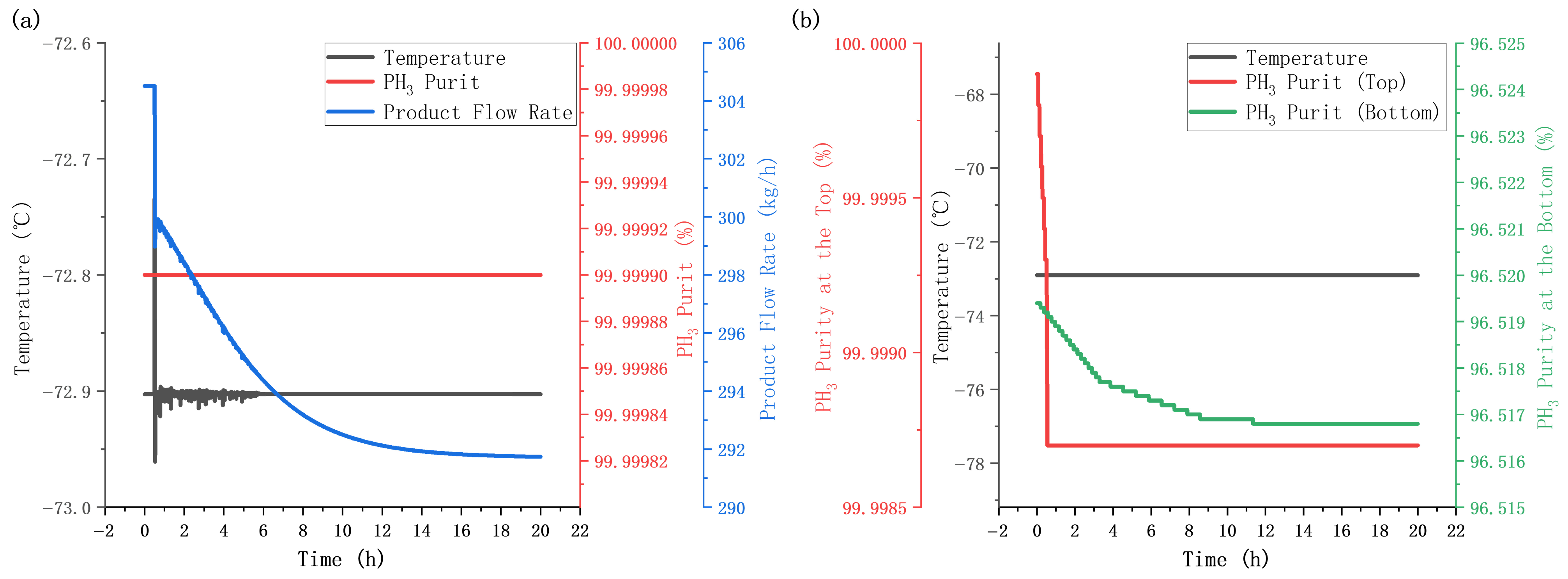
The control effect of the system on feed composition disturbances was tested by increasing the content of low-boiling-point impurities and high-boiling-point impurities in the original feed, respectively. The results are shown in Figure 11.
As shown in Figure 11, when the content of PH3 in the feedstock decreases by 1% due to the increase in impurities such as ASH3, H2S, H3PO4, and H2O, which have higher boiling points than PH3, the control system can effectively maintain the product purity at 99.9999%. During operation, the sensitive stage temperature initially fluctuates under disturbances but stabilizes after approximately 3.5 h of operation. The product flow rate continuously decreases and stabilizes after approximately 18 h of operation. When the content of PH3 in the feed decreases due to the increase in impurities such as O2, N2, and H2 with boiling points lower than PH3, even if the PH3 content in the feed decreases by only 0.001%, the product purity cannot be maintained above 99.9999%. Therefore, it is essential to strictly control the content of impurities with boiling points lower than PH3 during operation.

5.4.3. Steady-State Simulation After Disturbance

It is worth noting that the Aspen Plus Dynamics V14 only allows for a maximum of six significant digits in its data. This means that although some of the above tests can maintain product purity at 99.9999%, in reality, this can only confirm that the product purity is between 99.99985% and 99.99995%. Therefore, to obtain more specific data on product purity after disturbances, steady-state simulations must be conducted under the aforementioned conditions. The product flow rate at 20 h of dynamic simulation operation is used as the distillate flow rate at the top of the rectifying column during steady-state simulation, and the simulation results are shown in Table 10. As shown in Table 10, under disturbances such as a 10% reduction in feed rate, a 100% increase in feed rate, and a 1% decrease in PH3 content in the feed caused by the increase in impurities with higher boiling points than PH3 (AsH3, H2S, H3PO4, and H2O), this control system can indeed maintain product purity above 99.9999%. It should be noted that this purity value is an internal calculation of the simulation software. Its high precision is used for sensitive assessment of the control system’s performance. Its practical significance lies in the trend of its relative changes rather than absolute accuracy, consistent with the explanation in Section 4.2.2.

6. Conclusions

In this work, a purification process for ultra-high-purity phosphine was designed based on phosphine prepared by the acid method, and simulated using the Aspen Plus software. Based on the simulation results, the optimal number of theoretical stages, feed stage, and reflux ratios for the four columns were determined. The final simulation results showed that the design could achieve a phosphine product purity of 99.999943% and a product flow rate of 304.5 kg/h. The process also produced phosphoric acid as a by-product, with a flow rate of 744.7 kg/h and a purity of 89.3%. Additionally, considering energy consumption, a double-effect distillation process was applied to two of the columns, and the process was compared with the previous one. The comparison results showed that after adopting the double-effect distillation process, the total heat duty of the condensers and reboilers in the four columns decreased by 285.9 kW, which was 27% of the previous total heat duty of the condensers and reboilers in the four columns. After adopting the double-effect distillation process, the purity of the phosphine product decreased to 99.999936%, and the product flow rate remained essentially unchanged. This indicates that the double-effect distillation process can effectively reduce energy consumption during purification while maintaining product purity and flow rate with minimal changes. In other words, if product purity requirements are not particularly stringent, the double-effect distillation process offers an excellent method for lowering energy consumption. Of course, the costs associated with pressurizing one of the rectifying columns must also be considered. In addition, considering the stringent purity requirements for phosphine products, a dynamic control scheme was designed for the rectifying column used to extract phosphine products, and the control scheme was simulated and tested using the Aspen Plus Dynamics software. The test results showed that when the feed flow rate was reduced by 20%, the control system could no longer provide effective control. However, even when the feed flow rate was increased by 100%, the control system could still provide effective control. An increase in impurities with a boiling point higher than that of PH3, resulting in a 1% reduction in the PH3 component in the feed, does not prevent the control system from maintaining the purity of the phosphine product above 99.9999%. However, an increase in impurities with boiling points lower than PH3 reduces the PH3 component in the feed by only 0.001%, and the control system cannot maintain the product purity above 99.9999%. Therefore, in actual operation, special attention should be paid to reductions in feed flow rate and increases in impurities with boiling points lower than PH3 in the feed composition. Additionally, the steady-state simulation results indicate that the process has poor separation efficiency for PH3 and CO2. Therefore, considering the use of adsorption or membrane separation equipment to remove CO2 from the product is a direction for producing higher-purity phosphine.

Author Contributions

Conceptualization, J.W., Y.D. and X.T.; Methodology, J.G., Y.L. and S.Z.; Software, J.G. and S.Z.; Validation, Y.L. and S.Z.; Writing—original draft, J.G.; Visualization, J.G.; Supervision, J.W., Y.D. and X.T.; Project administration, J.W., Y.D. and X.T. All authors have read and agreed to the published version of the manuscript.

Funding

This research received no external funding.

Data Availability Statement

The original contributions presented in this study are included in the article. Further inquiries can be directed to the corresponding author.

Acknowledgments

The authors would like to acknowledge the technical support from the School of Chemical Engineering, Hebei University of Technology, and the College of Environmental Science and Engineering, Nankai University during the simulation.

Conflicts of Interest

The authors declare no conflicts of interest.

References

  1. Gui, J.; Ji, M.W.; Liu, J.J.; Xu, M.; Zhang, J.T.; Zhu, H.S. Phosphine-Initiated Cation Exchange for Precisely Tailoring Composition and Properties of Semiconductor Nanostructures: Old Concept, New Applications. Angew. Chem. Int. Ed. 2015, 54, 3683–3687. [Google Scholar] [CrossRef] [PubMed]
  2. Wang, G.P.; Zhang, K.; Wang, Z.; Wang, J.; Xu, R.G.; Li, L.; Xu, X.W.; Li, Y.; Xiao, S.; Zheng, S.Z.; et al. Boosting performance and stability of inverted perovskite solar cells by modulating the cathode interface with phenyl phosphine-inlaid semiconducting polymer. Nano Energy 2021, 89, 106374. [Google Scholar] [CrossRef]
  3. Kim, C.Y.; Lee, H.H. Phosphine Electrochemical Sensor Using Gold-Deposited Polytetrafluoroethylene Membrane. J. Nanosci. Nanotechnol. 2020, 20, 5654–5657. [Google Scholar] [CrossRef] [PubMed]
  4. Hershcovitch, A.; Gushenets, V.I.; Seleznev, D.N.; Bugaev, A.S.; Dugin, S.; Oks, E.M.; Kulevoy, T.V.; Alexeyenko, O.; Kozlov, A.; Kropachev, G.N.; et al. Molecular ion sources for low energy semiconductor ion implantation (invited). Rev. Sci. Instrum. 2016, 87, 02B702. [Google Scholar] [CrossRef] [PubMed]
  5. Peng, X.; Lv, Y.F.; Zhao, S.C. Chemical Vapor Deposition and Thermal Oxidation of Cuprous Phosphide Nanofilm. Coatings 2022, 12, 68. [Google Scholar] [CrossRef]
  6. Liu, X.B.; Gao, Z.G.; Cheng, J.C.; Gong, J.B.; Wang, J.K. Research progress on preparation and purification of fluorine-containing chemicals in lithium-ion batteries. Chin. J. Chem. Eng. 2022, 41, 73–84. [Google Scholar] [CrossRef]
  7. Zhao, W.J. A System for Preparing Phosphine and Its Preparation Method. CN114620695B, 7 July 2023. [Google Scholar]
  8. Zhou, Y.H.; Shi, C.J.; Xu, X. A Method for Preparing Phosphine. CN103253640A, 21 August 2013. [Google Scholar]
  9. Lowe, E.J.; Ridgway, F.A. Production of Phosphine. US3371994, 5 March 1968. [Google Scholar]
  10. Chen, G.F.; Gong, S.J.; Chen, J.B. Phosphine Synthesis and Purification Methods. CN111892030A, 6 November 2020. [Google Scholar]
  11. Tom, G.M.; McManus, J.V. Process and Composition for Purifying Semiconductor Process Gases to Remove Lewis Acid and Oxidant Impurities Therefrom. DE69427357, 31 October 2001. [Google Scholar]
  12. Bouard, P.; Labrune, P.; Villermet, A.; Gastiger, M. Process for the Separation of a Gaseous Hydride or a Mixture of Gaseous Hydrides with the Aid of a Membrane. FR2710044, 24 March 1995. [Google Scholar]
  13. Yuan, X.L. Low-Temperature, Low-Pressure Capture Device for Phosphine and Its Preparation Process. CN1384107, 11 December 2002. [Google Scholar]
  14. Wang, Y.; Xiong, Y.J.; Xu, Q.Y. A Method and Apparatus for Efficiently Purifying Electronic-Grade Phosphine by Azeotropic Distillation. CN120502120A, 19 August 2025. [Google Scholar]
  15. Zeng, J.S.; Xia, Z.Y.; Yang, Z.; Heng, Z.B.; Ye, R.; Liu, Y.; Wan, F.Q.; Cai, J.X.; Tian, K.; Lu, S. An Electronic-Grade Phosphine Purification System and Method. CN117339340A, 5 January 2024. [Google Scholar]
  16. Cai, J.; Zeng, X.Y. A Method and Apparatus for the Synthesis and Purification of Electronic-Grade Phosphine. CN111453708A, 28 July 2020. [Google Scholar]
  17. Yang, L.M.; Chen, Y.; Wang, J.Z.; Luo, Y.Z.; Zhou, P.F.; Zhang, X.L. The Simulation and Optimization of the Tetrafluoroethylene Rectification Process. Separations 2024, 11, 37. [Google Scholar] [CrossRef]
  18. Lin, Y.; ten Kate, A.; Mooijer, M.; Delgado, J.; Fosbol, P.L.; Thomsen, K. Comparison of Activity Coefficient Models for Electrolyte Systems. AIChE J. 2010, 56, 1334–1351. [Google Scholar] [CrossRef]
  19. MacDonald, D.I.; Boyack, J.R. Density, Electrical Conductivity, and Vapor Pressure of Concentrated Phosphoric Acid. J. Chem. Eng. Data 1969, 14, 380–384. [Google Scholar] [CrossRef]
  20. Bierlein, J.A.; Kay, W.B. Phase Equilibrium Properties of System Carbon Dioxide-Hydrogen Sulfide sulfide. Ind. Eng. Chem. 1953, 45, 618. [Google Scholar] [CrossRef]
  21. GB/T 2091-2008; Phosphoric Acid for Industrial Use. Standardization Administration of the People’s Republic of China, General Administration of Quality Supervision, Inspection and Quarantine of the People’s Republic of China: Beijing, China, 2008.
  22. GB/T 28159-2011; Electronic Grade Phosphoric Acid. Standardization Administration of the People’s Republic of China, General Administration of Quality Supervision, Inspection and Quarantine of the People’s Republic of China: Beijing, China, 2011.
  23. Zhang, J.T.; Liang, S.R.; Feng, X.A. A novel multi-effect methanol distillation process. Chem. Eng. Process.-Process Intensif. 2010, 49, 1031–1037. [Google Scholar] [CrossRef]
  24. Cai, J.; Zeng, X.Y. A Synthesis and Purification Apparatus for Electronic-Grade Phosphine. CN212982473U, 16 April 2021. [Google Scholar]
  25. Luyben, W.L. Design and Control of a Methanol Reactor/Column Process. Ind. Eng. Chem. Res. 2010, 49, 6150–6163. [Google Scholar] [CrossRef]
  26. Cantero, C.A.T.; Zúñiga, R.P.; García, M.M.; Cabral, S.R.; Calixto-Rodriguez, M.; Martínez, J.S.V.; Enriquez, M.G.M.; Estrada, A.J.P.; Torres, G.O.; Vázquez, F.D.S.; et al. Design and Control Applied to an Extractive Distillation Column with Salt for the Production of Bioethanol. Processes 2022, 10, 1792. [Google Scholar] [CrossRef]
  27. Chen, M.; Li, P.L.; Hu, C.; Luo, J.H.; Wen, M.; Yu, B.; Jiang, F.; An, Y.T.; Shi, Y.; Song, J.F.; et al. Dynamic simulation of a cryogenic batch distillation process for hydrogen isotopes separation. Int. J. Hydrogen Energy 2022, 47, 11955–11961. [Google Scholar] [CrossRef]
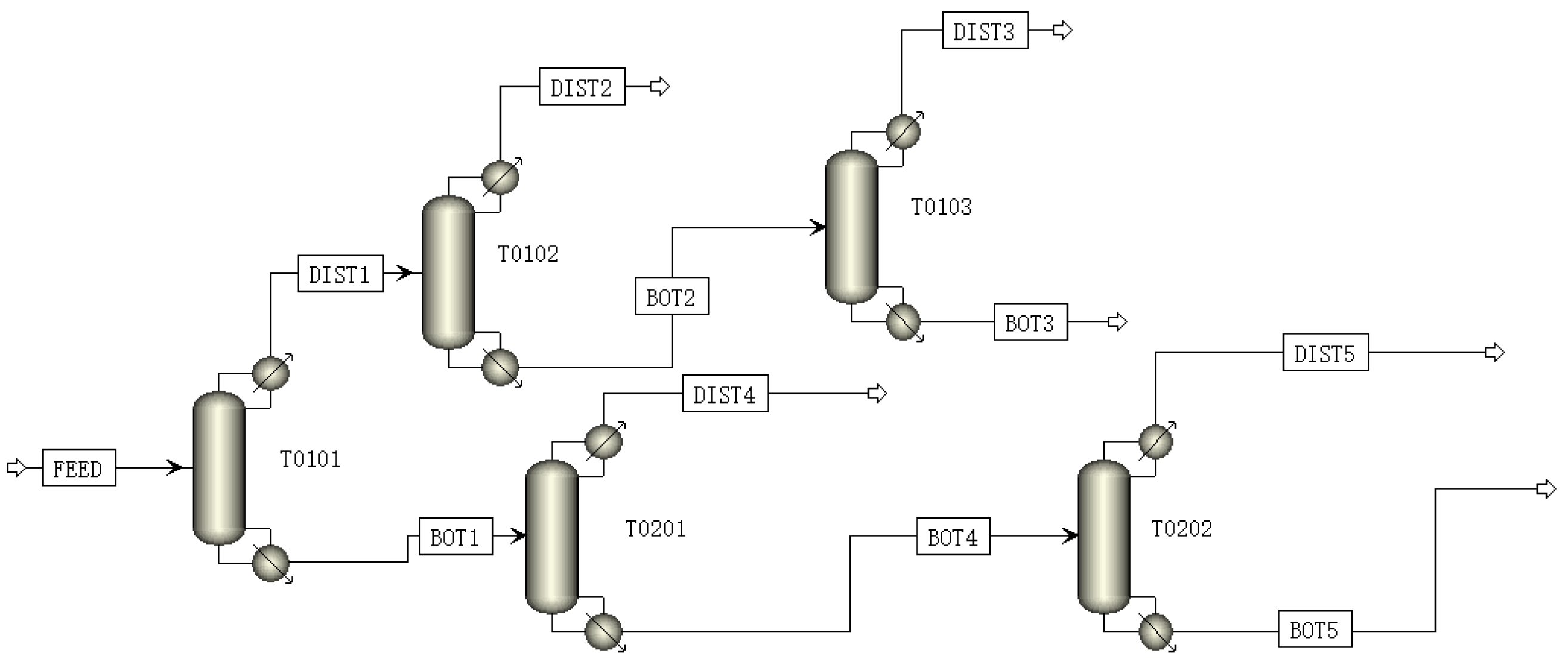
Figure 1. Simulation of the five-column distillation process.
Separations 12 00309 g001
Figure 2. Effect of pressure on the purity of phosphine products in the T0102 column.
Separations 12 00309 g002
Figure 3. Model validation results: (a) P-x diagram of the H2O-H3PO4 system at 403 K. (b) T-xy diagram of the H2S-CO2 system at 6.08 MPa.
Separations 12 00309 g003
Figure 4. Sensitivity analysis of the number of theoretical stages of the rectifying column: (a) T0101, (b) T0102, (c) T0103, (d) T0201.
Separations 12 00309 g004
Figure 5. Sensitivity analysis of feed stage of rectifying columns: (a) T0101, (b) T0102, (c) T0103, (d) T0201.
Separations 12 00309 g005
Figure 6. Sensitivity analysis of reflux ratio of rectifying columns: (a) T0101, (b) T0102, (c) T0103, (d) T0201.
Separations 12 00309 g006
Figure 7. Simulation of double-effect distillation process.
Separations 12 00309 g007
Figure 8. Temperature control structure of T0103 column.
Separations 12 00309 g008
Figure 9. Open-loop gain of reboiler heat load for each tower stage temperature.
Separations 12 00309 g009
Figure 10. Feed flow rate disturbance test: (a) feed flow rate reduced by 10%, (b) feed flow rate reduced by 20%, (c) feed flow rate reduced by 30%, (d) feed flow rate increased by 100%.
Separations 12 00309 g010
Figure 11. Feed composition disturbance test: (a) Increasing the content of AsH3, H2S, H3PO4, and H2O reduces the PH3 content by 1%. (b) Increasing the content of O2, N2, and H2 reduces the PH3 content by 0.001%.
Separations 12 00309 g011
Table 1. Feed parameters of the reactor.
ComponentMole Flow Rate (kmol/h)Mole Fraction (%)Mass Flow Rate (kg/h)Mass Fraction (%)
P2038.55619.4850.96
H2O2853.97504.4341.49
H3PO40.040.083.920.32
N21.22.3133.622.77
H21.22.312.420.20
H2S0.120.234.090.34
O21.22.3138.403.16
AsH30.120.239.350.77
CO26 × 10−6-2.64 × 10⁻⁴-
Table 2. Feed parameter rectifying process.
ComponentMole Flow Rate (kmol/h)Mole Fraction (%)Mass Flow Rate (kg/h)Mass Fraction (%)Normal Boiling Point (°C)
PH311.2545.22382.4731.46−87.69
H2O14.0218.021.48100.01
H3PO46.7927.29665.3954.73Decomposes
P28.0461.955.10Sublimes
CO26 × 10−6-2.64 × 10⁻⁴-Sublimes
N21.24.8233.622.77−195.75
H21.24.822.420.20−252.76
H2S0.120.484.090.34−60.32
O21.24.8238.403.16−182.96
ASH30.120.239.350.77−62.40
Table 3. Summary of Model Validation Results.
Verification SystemsValidation VariablesData SourceNumber of Data PointsAverage Relative DeviationMaximum Relative Deviation
H2O-H3PO4Pressurefrom [19]102.6%5.5%
H2S-CO2Temperaturefrom [20]140.3%0.7%
Table 4. Operating parameters of each rectifying column.
ModelTheoretical Stages NumberMolar Reflux RatioFeed StageMolar Distillate Feed Ratio
T010128460.6
T0102146110.25
T0103164140.8
T0201208150.02
T0202204150.2
Table 5. Flow rates in significant streams.
MatterDIST1
(kg/h)
BOT1
(kg/h)
BOT2
(kg/h)
DIST3
(kg/h)
BOT4
(kg/h)
BOT5
(kg/h)
PH3382.56.0 × 10−9378.0304.51.9 × 10−140
H2O2 × 10−2618.00017.37.2 × 10−10
H3PO43 × 10−82665.400665.4665.4
P5 × 10−4761.90061.931.4
CO22.6 × 10−42.0 × 10−132.6 × 10−42.2 × 10−400
N233.62.6 × 10−391.1 × 10−61.1 × 10−600
H22.42.3 × 10−2216.3 × 10−56000
H2S1.62.51.61.6 × 10−91.1 × 10−41.7 × 10−16
O238.41.0 × 10−341.2 × 10−61.2 × 10−600
AsH32.37.02.31.9 × 10−76.5 × 10−55.7 × 10−17
Table 6. Heat duty of each rectifying column of the five-column process.
ModelCondenser Heat Duty
(kW)
Reboiler Heat Duty
(kW)
T0101−273.5255.4
T0102−107.360.0
T0103−143.8179.8
T0201−18.819.3
T0202−107.6227.2
Table 7. Heat duty results for each column of the four-column process with double-effect.
ModelCondenser Heat Duty
(kW)
Reboiler Heat Duty
(kW)
T0101−273.5255.4
T0102−107.40
T0103097.6
T0201−18.819.3
Table 8. Comparison before and after adopting double-effect distillation process.
ComparisonBefore Adopting Double-Effect DistillationAfter Adopting
Double-Effect Distillation
Total heat duty (kW)1057.9771.9
Flow rate of phosphine products (kg/h)304.5304.5
Purity of phosphine products (%)99.99994399.999936
Flow rate of phosphoric acid products (kg/h)744.7744.7
Purity of phosphoric acid products (%)89.489.4
Table 9. Controller parameters.
ControllerController ActionGainIntegral Time (min)
Flow rate controller FCReverse0.50.3
Pressure controller PCDirect1060
Liquid level controller LC1Direct29999
Liquid level controller LC2Direct29999
Temperature controller TCReverse21.24.0
Table 10. Product purity after disturbance.
DisturbancePurity of Phosphine Products (%)
Undisturbed99.999936
Feed flow rate reduced by 10%99.999937
Feed flow rate increased by 100%99.999924
PH3 content reduced by 1%99.999929
Disclaimer/Publisher’s Note: The statements, opinions and data contained in all publications are solely those of the individual author(s) and contributor(s) and not of MDPI and/or the editor(s). MDPI and/or the editor(s) disclaim responsibility for any injury to people or property resulting from any ideas, methods, instructions or products referred to in the content.