Article

Quantitative Analysis of Chlorogenic Acid, Rutin, and Isoquercitrin in Extracts of Cudrania tricuspidata Leaves Using HPLC-DAD


1
Division of Environmental and Forest Science, Gyeongsang National University, Jinju 52725, Republic of Korea
2
Department of Environmental Health Science, Konkuk University, Seoul 05029, Republic of Korea
*
Author to whom correspondence should be addressed.
Separations 2025, 12(11), 298; https://doi.org/10.3390/separations12110298
Submission received: 26 September 2025 / Revised: 15 October 2025 / Accepted: 28 October 2025 / Published: 31 October 2025

Abstract

A high-performance liquid chromatography (HPLC) method using a diode array detector (DAD) was developed and validated for the simultaneous quantification of chlorogenic acid, rutin, and isoquercitrin, which are key bioactive compounds in Cudrania tricuspidata leaves. The method demonstrated excellent specificity, precision, and accuracy in accordance with the guidelines of the International Council for Harmonisation of Technical Requirements for Pharmaceuticals for Human Use (ICH). Calibration curves showed outstanding linearity (r2 > 0.99), with recovery rates of 101.63%, 101.81%, and 102.18% for chlorogenic acid, rutin, and isoquercitrin, respectively. The limits of detection (LOD) were 0.286, 0.411, and 0.201 μg/mL, and the limits of quantification (LOQ) were 1.246, 0.866, and 0.608 μg/mL for chlorogenic acid, rutin, and isoquercitrin, respectively. Additionally, response surface methodology (RSM) based on a Box–Behnken design was employed to optimize the extraction conditions of the three marker compounds. The second-order regression models showed high coefficients of determination (r2) and significant ANOVA results (p < 0.05). RSM analysis revealed that extraction temperature and ethanol concentration exerted the most significant effects on the extraction yields, while extraction time played a supportive role. The optimal conditions (70 °C, 40% ethanol, 120 min) significantly enhanced compound recovery while reducing solvent and energy consumption, thereby contributing to the development of efficient and sustainable extraction processes. Collectively, the validated HPLC-DAD method and the optimized extraction strategy developed in this study provide a reliable framework for the quality standardization and industrial application of C. tricuspidata leaf extracts in functional food, cosmetic, and pharmaceutical products.

1. Introduction

Cudrania tricuspidata (Carrière) Bureau ex Lavallée is a deciduous, broad-leaved shrub of the Moraceae family, predominantly distributed across East Asia, including Korea, China, and Japan. Ten species of C. tricuspidata grow worldwide, with only one growing in Korea. C. tricuspidata mainly grows in sunny areas of mountains and fields in southern regions, such as Chungcheongnam-do, Jeolla-do, and Gyeongsang-do of Republic of Korea, and grows to approximately 6 m in height. Red fruit matures around October from which a white liquid is extruded that contributes to the known high resistance of C. tricuspidata to pests and diseases [1].
The leaves of C. tricuspidata are rich in diverse bioactive compounds, making them a promising resource for functional ingredients. Recent studies have reported that chlorogenic acid, rutin, and isoquercitrin are pivotal in mitigating oxidative damage and inflammation through their antioxidant, anti-inflammatory, and antihypertensive effects [2,3,4]. These findings underscore the need for precise analytical methods to fully harness the functional potential of C. tricuspidata leaves (Ctl) in developing health-related products [5,6,7]. Chlorogenic acid, a hydroxycinnamic acid derivative, has demonstrated the ability to inhibit lipid peroxidation and prevent DNA damage caused by oxidative stress, thereby reducing the risk of chronic diseases associated with oxidative damage [8,9]. Rutin, a flavonoid glycoside, strengthens vascular structures, suppresses inflammatory responses, and enhances the activity of endogenous antioxidant enzymes. Isoquercitrin, another flavonoid glycoside, contributes to improving immune modulation and skin health by reducing oxidative damage and promoting cellular defense mechanisms [2,3,4]. The presence of these bioactive compounds supports the potential of Ctl as a functional ingredient in the nutraceutical, pharmaceutical, and cosmetic industries. Furthermore, these compounds can serve as essential quality markers for the standardization of plant-based extracts, ensuring consistent product efficacy and safety. This highlights the importance of developing robust analytical methods to accurately quantify these compounds, thereby facilitating the industrial application of Ctl for health-functional products.
Although significant attention has been paid to the pharmacological properties of C. tricuspidata, existing research has largely focused on its qualitative analysis or the biological activities of its bioactive compounds. The lack of validated methods for precise quantification of these compounds, particularly in the leaves, represents a critical gap. This study addresses this unmet need by developing and validating a robust HPLC-DAD method for quantifying key marker compounds in Ctl. By focusing on the leaves, an underexplored resource compared to the fruit, this study expands the understanding of C. tricuspidata and highlights its untapped potential in functional product development.
C. tricuspidata has been traditionally used in various forms of medicine, with different plant parts serving distinct purposes. The roots have been employed to treat paralysis and diuresis, while the bark and stems are known for their efficacy in relieving coughs and other respiratory issues [8,9,10,11]. Due to its high sugar content, C. tricuspidata fruit is commonly used to produce jams, fruit wines, and other food products, offering a rich source of bioactive compounds such as flavonoids, glycoproteins, and phenolic components. Recent studies have demonstrated its diverse physiological activities, including antioxidant properties that support food preservation [12], anti-inflammatory effects beneficial for colonic health [13], and neuroprotective benefits that improve cognitive functions [14]. Additional research has been reported on the fruit’s role in managing metabolic disorders and obesity through regulating fat accumulation and metabolic parameters [15] and its protective effects on gastrointestinal health [16]. These effects are attributed to bioactive components, including xanthones, glycoproteins, prenylated flavonoids, and flavonol glycosides. These phytochemicals exhibit various physiological activities, including anti-inflammatory, antimicrobial, antioxidant, antihypertensive, and anticancer effects [7,17]. Recently, the demand for health-related products using forest-derived materials has been increasing. C. tricuspidata is a natural resource that satisfies these needs and it has received considerable attention for the development of functional foods, cosmetics, and medicines [5]. In particular, chlorogenic acid, rutin, and isoquercitrin, present in excess in Ctl, are widely recognized polyphenolic compounds with diverse biological activities. These compounds exhibit potent antioxidant, anti-inflammatory, and anticancer effects, making them valuable in nutraceutical and pharmaceutical applications [5,7,17]. Chlorogenic acid has been shown to modulate glucose metabolism and exert anti-diabetic effects [18]. Rutin, a flavonoid glycoside, possesses neuroprotective and cardioprotective properties by enhancing endothelial function and reducing oxidative stress [19]. Isoquercitrin, a quercetin derivative, demonstrates anti-allergic and anti-inflammatory effects by inhibiting mast cell degranulation and cytokine release [20]. These findings suggest that chlorogenic acid, rutin, and isoquercitrin hold promise as therapeutic agents for managing chronic diseases, including diabetes, cardiovascular disorders, and neurodegenerative conditions.
To utilize plant-derived substances as functional ingredients, it is necessary to develop, standardize, and validate an efficient analytical method [21] that can be used to determine the concentration of at least one marker compound in the product. Analytical method validation is required to show that an analytical approach is reproducible and gives dependable results suitable for its intended use. These validation processes are widely recognized as essential for assessing the reliability of analytical methods employed in the quality control of health-related functional foods and pharmaceuticals [22].
This study addresses a critical gap in the quantitative analysis of bioactive compounds in Ctl. To overcome this limitation, a high-performance liquid chromatography coupled with a diode array detector (HPLC–DAD) method was developed and rigorously validated to provide a reliable and efficient analytical platform for quantifying key marker compounds—chlorogenic acid, rutin, and isoquercitrin. Although several UV-HPLC methods for these compounds have been reported in other plant species such as Periploca aphylla, Ginkgo biloba, and Morus alba, these methods have not been validated for C. tricuspidata and fail to account for its distinct metabolite composition [23,24,25]. The secondary metabolite profile of C. tricuspidata differs substantially from those of previously studied species, which can lead to incomplete separation or inaccurate quantification when using pre-established protocols. Furthermore, variations in calibration ranges, detection limits, and mobile phase compositions used in prior UV-HPLC studies may not be suitable for the quantification of these compounds in C. tricuspidata.
In this study, the HPLC–DAD method was refined and validated specifically for C. tricuspidata, demonstrating high precision, accuracy, and reproducibility suitable for quality control applications. This validated analytical approach enables accurate assessment and standardization of C. tricuspidata extracts, reinforcing their potential as high-value raw materials for pharmaceuticals, cosmetics, and nutraceuticals. Moreover, these findings provide a methodological foundation for future investigations into the phytochemical dynamics of C. tricuspidata under different environmental conditions and developmental stages, thereby broadening its commercial and scientific relevance.

2. Materials and Methods

2.1. Equipment and Reagents

Extracts from the leaves of C. tricuspidata were analyzed using a high-performance liquid chromatography (HPLC) system (Shimadzu M20A series, Kyoto, Japan) equipped with a UV-DAD and an Agilent Polaris C18 (4.6 × 250 mm) column. For mass spectrometric confirmation, an LC–MS/MS system (Q Exactive, Thermo Fisher Scientific, Waltham, MA, USA) equipped with an electrospray ionization (ESI) source was also employed under negative ion mode. Standard compounds—chlorogenic acid (CAS No. 327-97-9), rutin (CAS No. 153-18-4), hyperoside (CAS No. 482-36-0), isoquercitrin (CAS No. 482-35-9), and hesperidin (CAS No. 520-26-3)—were purchased from Sigma-Aldrich (St. Louis, MO, USA) with ≥95% purity. Reagents, including HPLC-grade methanol (99.8%), acetonitrile (99.8%), deionized water (JT Baker 4218-03, Phillipsburg, PA, USA), and formic acid (99%, Daejung, Republic of Korea), were used for all analyses.

2.2. Plant Materials and Preparation of Analytical Sample

Ctl were harvested in July from a cultivation farm in Sucheol-ri, Sancheong-gun, Gyeongsangnam-do, Republic of Korea, corresponding to peak biomass production and optimal accumulation of bioactive compounds. The samples were dried in a drying oven at 60 °C and used as experimental material. The dried leaves were finely ground using a blender (Hanil, SHMF-3260S, Seoul, Korea). Ethanolic extraction of the C. tricuspidata leaves was conducted at 60 °C using a reflux extractor for 3 h with 20 L of 50% aqueous ethanol (v/v) and 1 kg of dried, ground leaves. The resulting 50% ethanolic extract was filtered through filter paper (grade 2; Whatman, Maidstone, UK) and then concentrated using a rotary evaporator (Sunil: N-1300E, Seongnam, Republic of Korea). The concentrated extract was freeze-dried (Hanil, HyperCOOL, Seoul, Korea) to make it into a powder form, and the powder was accurately measured and re-dissolved in 50% aqueous ethanol for HPLC analysis.

2.3. Analytical Conditions for HPLC and Mass Spectrometry

HPLC analysis was performed with a reverse-phase HPLC system with an Agilent Polaris C18 column (4.6 × 250 mm). The injection volume was 20 μL and the detection wavelength was 340 nm. The analysis was performed at room temperature with a flow rate of 1.0 mL/min. A gradient elution system was used for separation; the mobile phase consisted of 0.1% formic acid in water as solvent A and acetonitrile (ACN) as solvent B [26,27]. The elution conditions were: from 90 to 68.6% A (0–25 min); from 68.6 to 0% A (25–26 min); from 0 to 100% A (26–30 min); from 100 to 90% A (30–31 min); isocratic 90% A (35 min).
To verify the identity of the key compounds in the Ctl extract, mass spectrometric analysis was performed using an LC-MS/MS system (Q Exactive, Thermo Fisher Scientific, USA) equipped with an electrospray ionization (ESI) source. The system was operated under negative ion mode, scanning ions within the range of m/z 100 to 1000. Instrument parameters were set: a capillary voltage of 3.5 kV, a nebulizer pressure of 35 psi, a dry gas flow rate of 8.0 L/min, and a gas temperature of 300 °C. For sample preparation, 10 mg of freeze-dried extract was dissolved in 1 mL of 50% ethanol. The solution was then passed through a 0.22 μm syringe filter to remove any suspended solids. The filtered sample was injected into the LC-MS/MS system at a 0.3 mL/min flow rate. Compound identification was achieved by comparing retention times and mass-to-charge ratios of molecular and fragment ions detected in the MS/MS spectra with reference data.

2.4. Method Validation

The HPLC method was validated for specificity, accuracy, precision, linearity, limit of detection (LOD), and limit of quantification (LOQ) following the guidelines of the International Council for Harmonisation of Technical Requirements for Pharmaceuticals for Human Use (ICH) [21]. Specificity was assessed to determine whether other compounds with the same UV profile eluted with the same retention time as the marker compounds in the standard material and Ctl samples. The accuracy of the HPLC method was evaluated by adding four different concentrations of authentic substances to the Ctl extract and calculating the recovery (%) of the compounds in the extract. Precision was validated by intra-day (repeatability) analysis with three different concentrations of sample extracts and inter-day (intermediate precision) analysis was determined with one concentration repeated five times. Intra- and inter-day precisions were assessed by calculating the relative standard deviation (%RSD) relative to the standard deviation of triplicate analyses on the same day and on three different days, respectively. Linearity was determined using five different concentrations of the standard solution (0.25–50 μg/mL), with samples of each concentration injected three times. A calibration curve was then created based on the known concentrations of the standard solutions. Standard curves of chlorogenic acid, rutin, and isoquercitrin were analyzed using linear least-squares regression, and the correlation coefficient (r2) was used to confirm linearity. The LOD and LOQ values were determined by calculating the standard deviation of the intercept (σ) and the slope (S). LOD represents the lowest detectable concentration, whereas LOQ indicates the lowest quantifiable concentration with acceptable repeatability and accuracy; the formulas used were: LOD = 3.3 (σ/S) and LOQ = 10 (σ/S).

2.5. Calibration Curves

Calibration curves were constructed by plotting the peak areas of the standard solutions against their respective concentrations. The linearity of the curves was assessed using the correlation coefficient (r2). The concentrations of chlorogenic acid, rutin, and isoquercitrin in the samples were calculated based on calibration curves. The calibration equations were derived from the relationship between peak area (y) and concentration (x, mg/mL), with the results represented as mean ± standard deviation (n = 3).

2.6. Data Analysis

Data analysis was performed to validate the reliability and reproducibility of the HPLC method. Statistical analysis was conducted to calculate the mean, standard deviation (SD), and relative standard deviation (%RSD) for all precision and recovery experiments. Regression analysis was used to assess the linearity of the calibration curves, with the correlation coefficient (r2) serving as the primary indicator of linearity. Recovery rates were expressed as percentages and averaged across all trials for accuracy validation. The LOD and LOQ values were determined using the slope and standard deviation of the calibration curve. Statistical consistency across intra-day and inter-day trials was confirmed by comparing %RSD values, with acceptable precision criteria set at ≤2%.

2.7. Experimental Design for the Development of the Response Surface Methodology Model

To evaluate the extraction efficiency of marker compounds concerning variations in ethanol concentration, extraction time, and extraction temperature, a preliminary analysis was conducted before constructing a predictive model using response surface methodology (RSM). Based on preliminary experiments, the optimal ranges of ethanol concentration (%), extraction time (min), and extraction temperature (°C) were determined for application in RSM. In this study, three independent variables—ethanol concentration (X1), extraction temperature (X2), and extraction time (X3)—were coded at three levels (−1, 0, and +1), and the experimental design was based on the Box–Behnken Design (BBD) [28,29,30]. 17 experimental combinations were constructed, and all experiments were carried out in random order to minimize systematic bias. The observed responses (Y) were fitted to a second-order polynomial model, expressed as follows:
Y = β0 + ∑ᵢ = 13 βᵢXᵢ + ∑ᵢ = 13 βᵢᵢXᵢ2 + ∑ᵢ = 13 ∑ⱼ = ᵢ+13 βᵢⱼXᵢXⱼ
here, Y denotes the predicted or observed response, β0 is the intercept term, βᵢ are the linear coefficients, βᵢᵢ are the quadratic coefficients, and βᵢⱼ are the interaction coefficients between variables. Xᵢ and Xⱼ represent the coded independent variables, with Xᵢ2 and XᵢXⱼ referring to the quadratic and interaction terms, respectively. The model’s goodness of fit was evaluated using the coefficient of determination (r2). The variables’ individual effects and statistical significance were assessed via analysis of variance (ANOVA) at the coded levels. All statistical analyses, including regression modeling and graphical assessments, were performed using R statistical software (version 4.3.2; R Foundation for Statistical Computing, Vienna, Austria).

3. Results and Discussion

3.1. HPLC Analysis of Marker Substances in Ctl

An efficient analytical method for determining the marker compounds in Ctl extract was developed using HPLC-DAD. The reliability of the analytical method was assessed with respect to sensitivity, elution time, and resolution. HPLC-DAD analysis of the Ctl extract revealed more than 20 metabolites, seven of which were selected for further analysis (Figure 1A(ii)). As depicted in Figure 1A, the seven major metabolites were categorized into two groups according to their UV absorbance profiles. Hydroxycinnamic acids, such as caffeic acid and ferulic acid, and their conjugates, such as chlorogenic acid, have common characteristics of UV absorbance. These compounds generally show a maximum UV absorbance around 325 nm [31] (Figure 1B). Therefore, it is likely that peaks 1–3 correspond to hydroxycinnamic acids or their conjugates. Peaks 4–7 show similar UV absorbance in the HPLC DAD analysis, which indicates that the associated compounds share similar backbone structures (Figure 1B). In addition, the resolution (Rs) value between peaks S3 and S4 was calculated to be 1.87, indicating complete baseline separation between the two adjacent peaks and confirming the high efficiency of the developed chromatographic system. The UV absorbance of these compounds is similar to that of flavonol. The maximum absorbances of the benzoyl and cinnamoyl band groups of flavonol are approximately 250 and 360 nm, respectively [31]. However, the maximum UV absorbance of the cinnamoyl moiety was 345–353 nm [32]. This phenomenon can be attributed to a hypochromic shift caused by the attachment of a sugar molecule to the carbon at the 3-position of the flavonol, which subsequently decreases the maximum absorbance of the cinnamoyl moiety. To clarify these results, a comparative analysis of the major metabolites was performed using standard compounds.
Major peaks (Peaks 1, 4, and 5), which matched with authentic compounds (Figure 1A(i)), were further analyzed using MS/MS (Figure 1C). The MS/MS fragmentation of Peak 1 (m/z 353.4 [chlorogenic acid-H]) revealed a primary cleavage at the ester bond, generating a dominant fragment ion at m/z 191.2 [quinic acid-H]. Further dehydration of quinic acid resulted in a secondary product ion at m/z 173.2 [dehydrated quinic acid-H]. Additionally, cleavage at the caffeoyl moiety led to m/z 179.1 [caffeic acid-H] formation, which subsequently decarboxylated to form m/z 135.1 [caffeic acid-CO2]. These fragmentation patterns are typical characteristics of chlorogenic acid. In addition, Peak 1 exhibited the same UV absorbance and retention time as a chlorogenic acid standard. Based on this combined evidence, Peak 1 was unequivocally identified as chlorogenic acid. In the negative ion mode, the parent ion of Peak 4 was detected at m/z 609.5 [rutin-H], corresponding to the deprotonated molecular ion of rutin. Upon MS/MS fragmentation, the glycosidic bond cleavage resulted in the formation of the fragment ion at m/z 463.6 [quercetin-glucoside-H], indicating the sequential loss of a rhamnose moiety (−146 Da). Further fragmentation of m/z 463.6 [quercetin-glucoside-H] led to the formation of the aglycone quercetin at m/z 301.4 [quercetin-H], confirming the stepwise removal of the glucose moiety (−162 Da). The fragmentation pattern is consistent with the known dissociation pathways of rutin, in which the loss of sugar units occurs sequentially under negative ionization conditions. Additionally, Peak 4 exhibited the same retention time, UV absorbance, and m/z value (m/z 609.5 [rutin-H]) as the authentic rutin standard. Based on these results, peak 4 was identified as rutin. In the negative ion mode, Peak 5 exhibited a deprotonated molecular ion at m/z 463.5 [isoquercitrin-H], corresponding to quercetin conjugated with a glucose moiety. Upon MS/MS fragmentation, the loss of glucose (−162 Da) generated m/z 301.3 [quercetin-H], confirming the presence of the quercetin aglycone. Further fragmentation of m/z 301.3 [quercetin-H] led to the formation of m/z 245.1 [quercetin-C2H4O2-H], a characteristic product ion resulting from Retro-Diels–Alder (RDA) cleavage of the flavonoid C-ring. Additionally, the m/z 203.1 [quercetin-C6H4O3-H] ion was observed, indicating further structural rearrangements and functional group losses (−42 Da), yielding a resonance-stabilized oxygen anion. The fragmentation patterns observed for Peak 5 are consistent with known dissociation pathways of isoquercitrin, supporting its structural identification. Furthermore, the retention time and UV absorbance were identical to an authentic isoquercitrin standard, confirming its identity. Based on these combined results, Peak 5 was definitively identified as isoquercitrin. Among the seven major compounds identified in the C. tricuspidata leaf extract (Figure 2), chlorogenic acid, rutin, and isoquercitrin were selected as reference compounds based on their well-documented health benefits and commercial availability, which facilitate standardization. These compounds have significant bioactive properties and are recognized markers for assessing the quality and efficacy of botanical extracts [33,34].

3.2. Validation of the HPLC Analysis Method for Marker Substances from Ctl

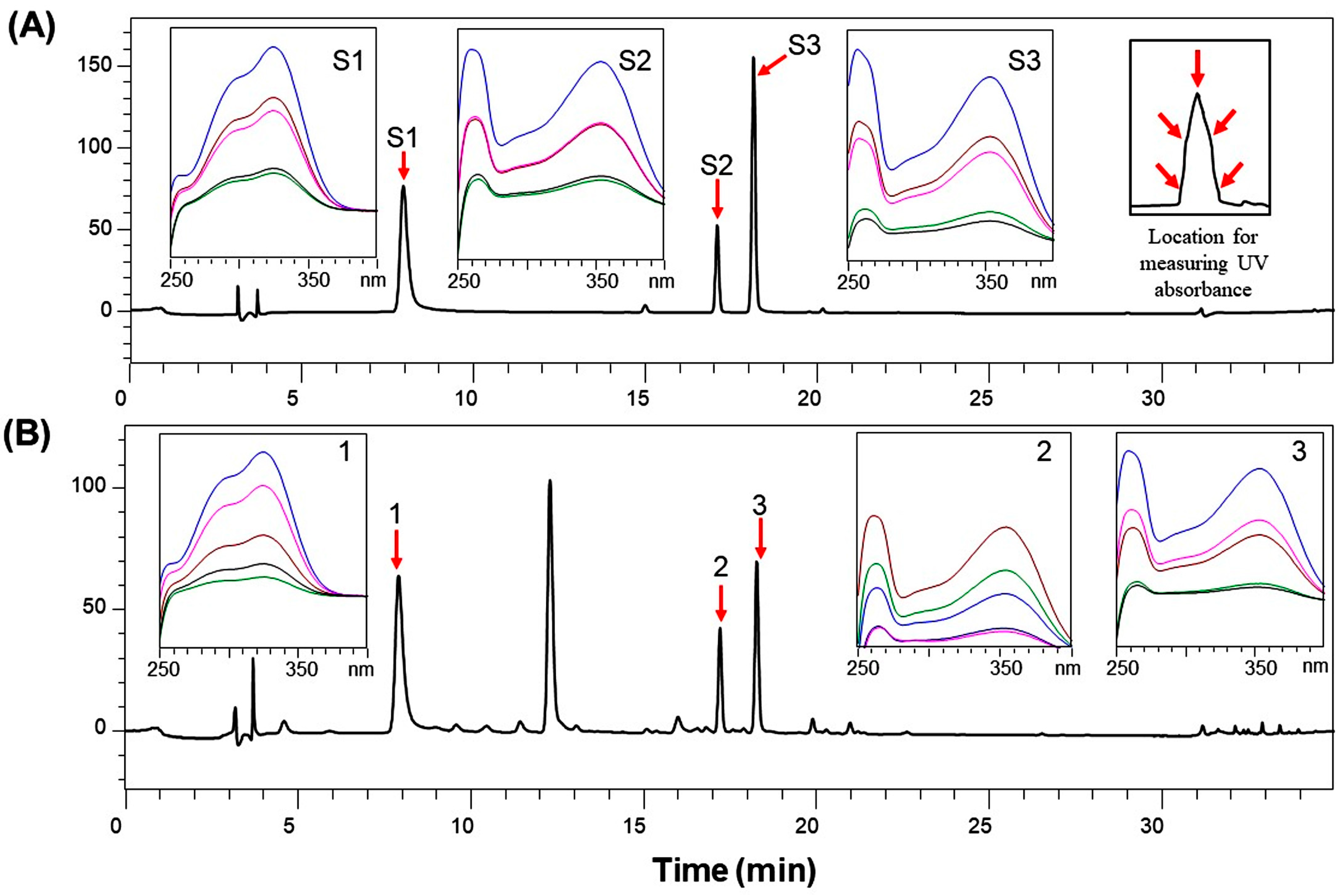
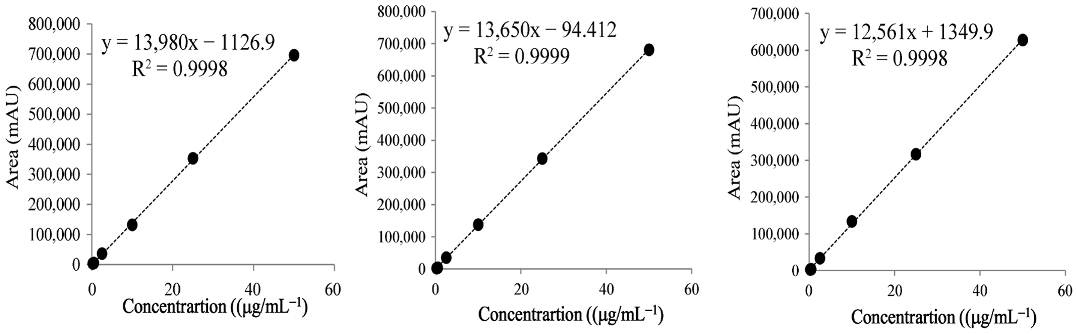
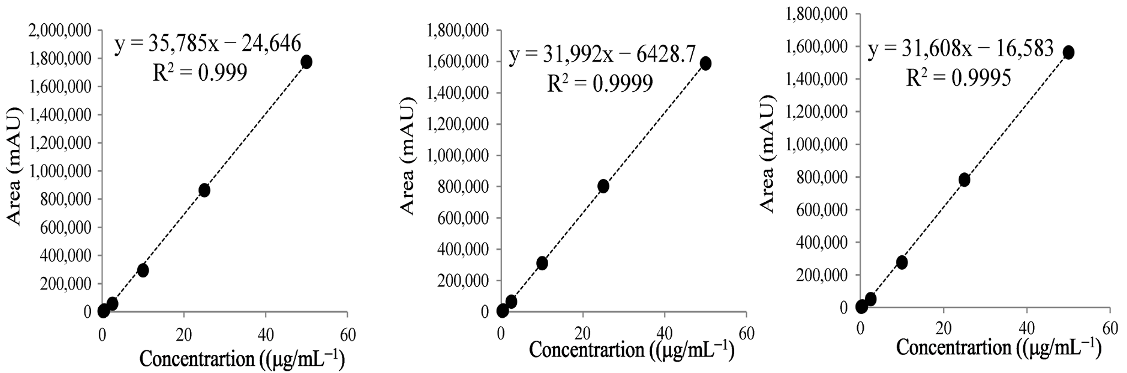
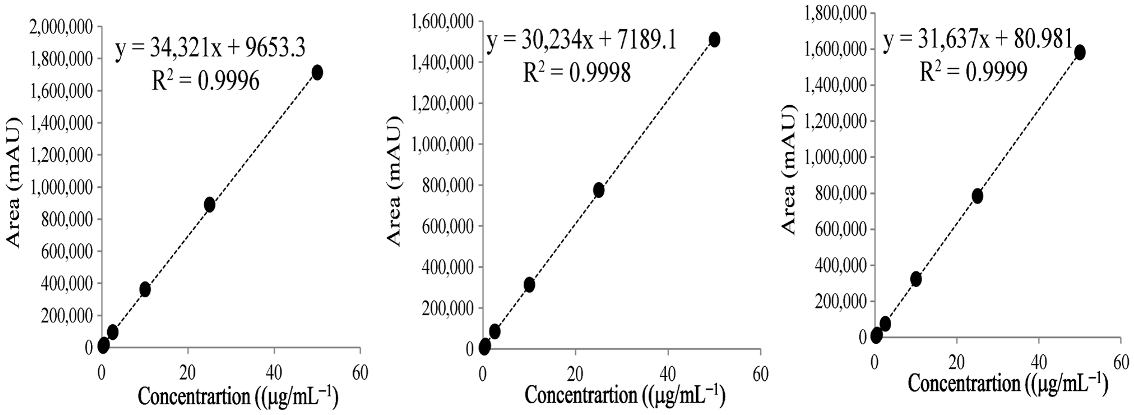
The analytical HPLC method utilizing HPLC-DAD was validated for the quantification of chlorogenic acid, rutin, and isoquercitrin in the Ctl extract. The HPLC-DAD method enabled excellent separation, with retention times of 7.96 min (chlorogenic acid), 12.07 min (rutin), and 18.18 m (isoquercitrin) (Figure 2A). HPLC-DAD analysis was conducted at a single wavelength (340 nm), based on preliminary studies that evaluated its suitability for detecting the major compounds. Although chlorogenic acid (325 nm), rutin (353 nm), and isoquercitrin (352 nm) each have distinct maximum absorption wavelengths (λmax), the chosen wavelength was selected to balance sensitivity across all target compounds and ensure practical applicability in routine quality control. Monitoring at 340 nm served as a compromise to allow simultaneous detection of the compounds with minimal sensitivity loss. Additionally, the DAD recorded the full UV-Vis spectrum during analysis, and no significant interferences were observed under these conditions. The absence of impurity peaks during the quantification of chlorogenic acid, rutin, and isoquercitrin facilitated the accurate determination of these compounds, contributing to the overall reliability of the method (Figure 2B). The specificity of the developed HPLC-DAD method was evaluated by comparing the chromatograms of the standard compounds (chlorogenic acid, rutin, and isoquercitrin) with those of the Ctl extraction solution. As shown in Figure 2, chlorogenic acid, rutin, and isoquercitrin were identified in the Ctl extraction solution. These results indicate that the developed HPLC-DAD analysis method has excellent resolution and high specificity for the marker compounds. Calibration curves for chlorogenic acid, rutin, and isoquercitrin were constructed by calculating the peak areas of the prepared concentrations, and linearity was assessed using linear regression. Solutions of five different concentrations (n = 3) were used to evaluate the linearity. Regression equations were calculated by plotting the peak area (y) against the concentration (x) of each substance expressed in mg/mL. Table 1 shows that the correlation coefficient (r2) obtained for the regression linearity showed a robust linear relationship between the peak area and concentration of each substance.
The LOD is the lowest detectable compound concentration determined using an analytical method and an HPLC instrument. The LOQ is the lowest concentration of an analyte that can be precisely and accurately quantified using an HPLC instrument and analytical methods. The LOD values for chlorogenic acid, rutin, and isoquercitrin were 0.29, 0.41, and 0.20 μg/mL, respectively, and the LOQ values were 1.25, 0.87, and 0.61 μg/mL, respectively (Table 1).
These results indicate that the HPLC-DAD method used to calculate chlorogenic acid, rutin, and isoquercitrin derived from Ctl was sufficiently sensitive for quantification of the marker compounds. To verify the linearity of the analysis method developed in this study, five concentrations (0.25, 0.5, 2.5, 10, and 50 μg/mL) were selected within the standard solution concentration range (0.1–100 μg/mL) used for a limit of quantification assessment, ensuring optimal linearity. Triplicate measurements were performed at each concentration to evaluate reproducibility and error margins. As presented in Table 2, all test groups exhibited excellent linearity, with correlation coefficients (r2) of 0.999 or higher. These findings demonstrate that the analytical method developed in this study ensures high precision and accuracy, confirming its reliability for quantifying target analytes across the specified concentration range.
The accuracy of the HPLC-DAD method was evaluated by determining the recovery of added known concentrations of chlorogenic acid, rutin, and isoquercitrin standard solutions (1.0–4.0 μg/mL). The recovery of each substance was determined by comparing the amount detected with the amount of the compound originally spiked. Accuracy tests were conducted at least four times. As listed in Table 3, the recoveries were 101.04–102.68% for chlorogenic acid, 100.23–102.89% for rutin, and 100.30–104.43% for isoquercitrin. All the values obtained using the analytical method developed in this study were within acceptable ranges (90–108%).
Precision was evaluated by measuring the intra- and inter-day precisions of the HPLC-DAD method. As shown in Table 4 and Table 5, the coefficient of variance for the precision evaluation of chlorogenic acid was 0.08–0.46% for intra-day precision experiments and 0.24–0.38% for inter-day precision evaluation experiments. For rutin, the coefficient of variance in the precision assessment was 0.32–0.72% for intra-day precision trials and 0.57–0.68% for inter-day precision evaluations. The precision values for isoquercitrin showed a variance of 0.29–0.51% in intra-day precision experiments and 0.26–0.58% in inter-day precision experiments. These values were below 2%, thus meeting the criteria set by ICH guidelines. Therefore, the developed HPLC-DAD method demonstrates high reliability as an analytical method for quantifying chlorogenic acid, rutin, and isoquercitrin in Ctl extracts [35].
Extensive research has focused on flavonoids and hydroxycinnamic acid derivatives and highlighted their multifaceted roles. Flavonoids protect plants against abiotic stressors, such as drought, extreme temperatures, and ultraviolet (UV) radiation, as well as biotic stressors, such as fungi and microorganisms [34,36]. Furthermore, flavonoids are known to protect the skin from UV radiation and prevent photoaging, and they exhibit many physiological activities, including anticancer, anti-inflammatory, antiallergic, hepatoprotective, neuroprotective, antidiabetic, and antimicrobial properties [34,36]. Hydroxycinnamic acid derivatives also demonstrate various physiological benefits, encompassing antioxidant, anti-inflammatory, anti-HIV, analgesic, and neuroprotective effects [37,38].
While numerous UV-HPLC methods have been reported for the quantification of flavonoids, previous studies primarily focused on specific plant species with limited applicability to Ctl extracts. Moreover, many existing methods lack standardized validation approaches, which are essential for ensuring reproducibility. This study establishes a validated HPLC-DAD method optimized for Ctl extracts, providing a reproducible and sensitive approach for marker compound quantification. Unlike previous studies, this method includes a comprehensive validation process to enhance reliability in quality control applications. In this study, we developed and validated an HPLC analytical method to quantify chlorogenic acid, a type of hydroxycinnamic acid, along with the flavonol glycosides, rutin and isoquercitrin, as marker compounds of Ctl.
The successful quantification and validation of the markers in the Ctl extract using HPLC/DAD represents a novel contribution to analytical methodologies. The developed HPLC-DAD method exhibits several advantages. First, the technique demonstrates exceptional sensitivity, with LOD and LOQ values significantly lower than those documented in similar studies. This ensures the accurate detection of bioactive compounds even at trace levels. Second, the method’s high precision and accuracy, with recovery rates exceeding 100% and intra/inter-day precision well below the 2% threshold, underscore its reliability for routine analysis. Additionally, the method’s robustness across different sample matrices supports its applicability in diverse industrial settings, such as functional food standardization, pharmaceutical development, and cosmetics formulation. Compared to conventional approaches, gradient elution with a diode array detector significantly improves compound separation and specificity, minimizing interference from impurities. These advantages position this method as an exceptional tool for the quality control and standardization of botanical extracts like C. tricuspidata. To our knowledge, this is the first study to establish an HPLC/DAD-based method for quantifying these marker compounds in Ctl extract. The developed approach is effective and robust, performs with satisfactory accuracy and precision, and is suitable for routine analytical applications. However, as this study primarily focused on developing and validating quantification methods for selected marker compounds in Ctl extracts, it did not examine variations in bioactive compounds influenced by geographical location, growth stage, or environmental conditions. Future research should explore how these factors affect the composition of bioactive substances in Ctl.
Consuming bioactive compounds in plant-derived foods or products is a promising strategy for bolstering immunity and preventing minor and severe diseases. Chlorogenic acid and flavonoid glycosides, such as rutin and isoquercitrin, offer numerous health advantages. These bioactive compounds have significant potential to address a variety of health issues. The validation parameters of specificity, precision, and accuracy established for the methodology developed in this study were within the limits set in the ICH guidelines. The analytical results described in this study allow the precise identification and quantification of chlorogenic acid, rutin, and isoquercetin in Ctl extract, enabling the methodology to be used for routine analyses and content determination in large-scale extraction processes. Moreover, this study lays the groundwork for developing health-functional products, thereby contributing to the pharmaceutical industrialization of Ctl.

3.3. Optimization of Extraction Conditions and Analysis of Variable Interactions for Chlorogenic Acid, Rutin, and Isoquercitrin

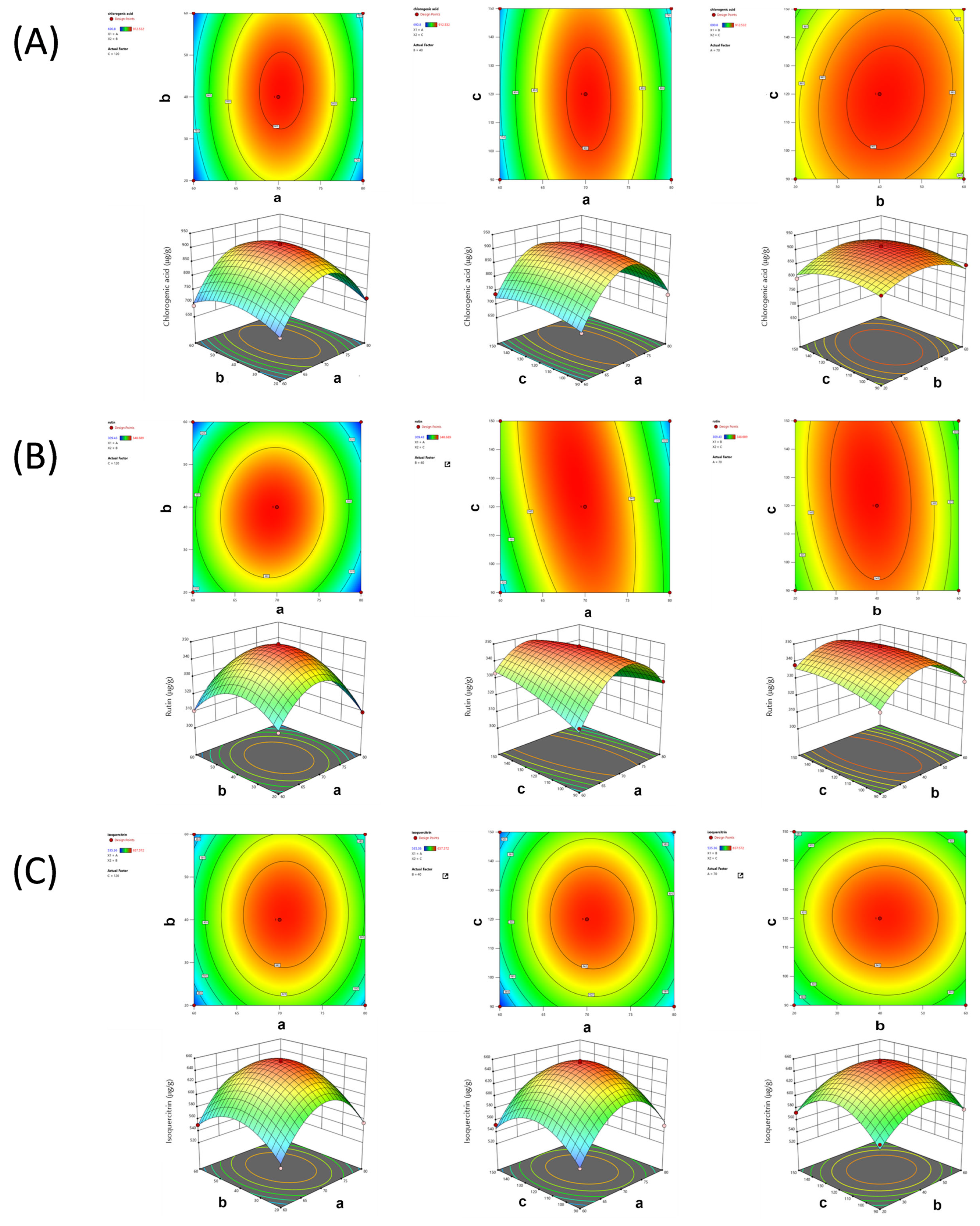
Chlorogenic acid, rutin, and isoquercitrin values obtained after the experimental study are presented in Table 6. Response surface methodology (RSM) was employed to quantitatively evaluate the effects of extraction temperature (A), solvent concentration (B), and extraction time (C) on the yields of three major phenolic compounds—chlorogenic acid, rutin, and isoquercitrin. The fitting results based on a second-order polynomial regression model yielded statistically significant equations for all three compounds. The models showed high coefficients of determination (r2) and analysis of variance (ANOVA) confirmed their significance (p < 0.05), demonstrating the reliability and adequacy of the models. These results are consistent with prior RSM-based extraction studies on phenolic-rich matrices showing strong non-linear and interactive effects of temperature and solvent concentration on extraction responses [31]. Response surface and contour plot analyses indicated that all three independent variables exerted non-linear effects on the extraction yields, and that their interactions played a critical role in determining extraction efficiency. Notably, temperature and solvent concentration exhibited the most pronounced main and interactive effects for all three compounds, while extraction time had a positive influence at moderate levels but showed a declining trend at prolonged durations for some compounds.
For chlorogenic acid, the interaction between temperature and solvent concentration was the most prominent, producing a characteristic convex paraboloid-shaped response surface. Findings similar to our optimal moderate temperature/medium solvent window have been reported for chlorogenic-acid-rich botanicals (e.g., elderberry flowers) using RSM [28], and for other CGA sources optimized with Box–Behnken/Design-Expert protocols [39]. The highest predicted yield was observed near 70 °C and 40% solvent concentration, with the maximum actual yield obtained at approximately 120 min of extraction (Figure 3A). Low temperature and low concentration conditions resulted in limited release due to insufficient cell wall disruption, whereas excessively high temperature and concentration conditions led to partial thermal degradation and oxidation of phenolic compounds, thereby reducing the yield. These findings indicate that chlorogenic acid is relatively heat-labile and highlight the importance of balancing temperature and solvent concentration within an optimal range to maximize extraction efficiency.
In the case of rutin, temperature exerted the most dominant influence among the three variables, and its interactions with solvent concentration and time were also statistically significant. The response surface showed a rapid increase in extraction yield with increasing temperature, peaking near 70 °C, followed by a gradual decline at higher temperatures (Figure 3B). A comparable “rise-to-optimum then decline” temperature profile for rutin was documented in Carica papaya leaves under microwave-assisted and ultrasound-assisted extraction methods optimized using RSM [29]. The highest yield was achieved around 40% solvent concentration and 120 min of extraction, with no notable increase beyond this duration.
This suggests that elevated temperatures promote the disruption of cell walls and tissue structures, thereby enhancing rutin release, whereas excessively high temperature and prolonged extraction can induce oxidative or thermal degradation, reducing the yield. Given that rutin is relatively heat-stable among flavonoids, these results support the conclusion that moderate-to-high temperature conditions improve its extraction efficiency.
Isoquercitrin exhibited relatively balanced effects from all three variables, but the quadratic terms of temperature and time were statistically significant, producing a typical paraboloid-shaped response surface centered near the midpoints of the design space. Similar behavior—improved recovery at moderate temperature and solvent conditions, but loss of yield under over-severe settings—has been reported for isoquercetin (the 3-O-glucoside of quercetin) in ultrasound-assisted extractions optimized by RSM [40]. The maximum extraction yield in our study was obtained around 70 °C, 40% solvent concentration, and 120 min, while high concentration combined with prolonged extraction time resulted in a reduction in yield, likely due to oxidative/thermal degradation and solute–solvent equilibrium disturbances. The maximum extraction yield in our study was obtained around 70 °C, 40% solvent concentration, and 120 min, while high concentration combined with prolonged extraction time resulted in a reduction in yield, likely due to oxidative/thermal degradation and solute–solvent equilibrium disturbances (Figure 3A,C).
Overall, these results indicate that temperature and solvent concentration act as key determinants of extraction efficiency for all three compounds, while an appropriate extraction time serves as a supporting factor. The optimal conditions derived from RSM are expected to maximize the recovery of functional phenolic compounds while minimizing unnecessary energy and solvent consumption, thereby contributing to the development of cost-effective and environmentally sustainable extraction processes.

4. Conclusions

In this study, a robust and validated HPLC-DAD method was successfully developed for the simultaneous quantification of chlorogenic acid, rutin, and isoquercitrin in Ctl. The method demonstrated excellent specificity, linearity, precision, accuracy, and sensitivity, fully complying with ICH guidelines, and can be applied as a reliable tool for the quality control of plant-derived materials. Furthermore, response surface methodology (RSM) based on a Box–Behnken design was employed to optimize the extraction conditions for these marker compounds, and the RSM analysis revealed that extraction temperature and ethanol concentration were the most influential factors affecting extraction yields, while extraction time played a supportive role. The optimal extraction conditions (70 °C, 40% ethanol, 120 min) markedly improved the recovery of all three compounds while reducing solvent and energy consumption, demonstrating that the RSM-based optimization strategy can support the establishment of standardized extraction processes and the reduction in resource and energy use in industrial applications. To further verify the practical applicability of the developed method, the validated HPLC-DAD protocol was preliminarily applied to commercial Ctl extract samples obtained from local markets, confirming comparable chromatographic profiles and consistent quantitative results with those of laboratory-prepared extracts. These findings support that the developed method is suitable for routine analysis of real samples in industrial settings. By offering a reliable approach to quantifying essential bioactive compounds, this study contributes to the broader utilization of C. tricuspidata in the functional food, cosmetic, and pharmaceutical industries, and the validated HPLC-DAD method developed herein can further serve as a cornerstone for the industrial standardization of Ctl extracts [27,41]. In practical applications, this method can be implemented at the raw material quality control stage, enabling manufacturers to monitor batch-to-batch variations in bioactive compound content and ensure regulatory compliance for functional food and cosmetic products. Moreover, the quantification of chlorogenic acid, rutin, and isoquercitrin as marker compounds will facilitate the establishment of reference specifications and support the development of pharmacopeial monographs for C. tricuspidata leaves. By integrating this validated method into large-scale production pipelines, industries can achieve consistent quality, improve consumer safety, and accelerate the commercialization of health-functional products derived from forest resources.

Author Contributions

Conceptualization, J.-Y.K. and B.-G.K.; methodology, J.-Y.K. and H.-R.N.; software, J.-Y.K.; validation, J.-Y.K. and H.-R.N.; formal analysis, J.-Y.K. and H.-R.N.; data curation, J.-Y.K.; writing—original draft preparation, J.-Y.K. and B.-G.K.; writing—review and editing, Y.Y. and B.-G.K.; visualization, J.-Y.K.; supervision, B.-G.K.; project administration, B.-G.K.; funding acquisition, B.-G.K. All authors have read and agreed to the published version of the manuscript.

Funding

This research was funded by from the Research and Development Program for Forest Science Technology (Project No. FTIS 2023478B10-2325BC036) and the Forest Service’s Forest industry-customized human resources training project (Short-term Income Forest products governance education center. Project No. RS-2024-00405196) provided by the Korea Forest Service (Korea Forestry Promotion Institute).

Data Availability Statement

The article contains all the information required to support its conclusions.

Conflicts of Interest

The authors declare no conflicts of interest.

Abbreviations

The following abbreviations are used in this manuscript:
HPLCHigh-performance liquid chromatography
DADDiode array detector
LODLimit of detection
ROSReactive oxygen species
ATPAdenosine triphosphate
CtlC. tricuspidata leaves
ACNAcetonitrile
ICHInternational Council for Harmonisation of Technical Requirements for Pharmaceuticals
for Human Use
%RSDRelative standard deviation

References

  1. Choi, M.H.; Yang, S.H.; Kim, D.S.; Shin, H.S. Comparative analysis of biological activity between domestic Cudrania tricuspidata fruit extract and fermented fruit extract using Lactobacillus plantarum. KSBB J. 2021, 36, 247–253. [Google Scholar] [CrossRef]
  2. Działo, M.; Mierziak, J.; Korzun, U.; Preisner, M.; Wojtasik, W.; Szopa, J. The potential of plant phenolics in prevention and therapy of skin disorders. Int. J. Mol. Sci. 2016, 17, 160. [Google Scholar] [CrossRef]
  3. Espino, J.; Cosme, P.; Rodríguez, A.B.; Garrido, M. Plant phenolics: Bioavailability as a key determinant of their potential health-promoting applications. Antioxidants 2020, 9, 1263. [Google Scholar] [CrossRef]
  4. Nisa, R.U.; Nisa, A.U.; Tantray, A.Y.; Shah, A.H.; Jan, A.T. Plant phenolics with promising therapeutic applications against skin disorders: A mechanistic review. J. Agric. Food Chem. 2024, 16, 101090. [Google Scholar] [CrossRef]
  5. Kim, J.; Cho, N.; Kim, E.M.; Park, K.S.; Kang, Y.W.; Nam, J.H.; Nam, M.S.; Kim, K.K. Cudrania tricuspidata leaf extracts and its components, chlorogenic acid, kaempferol, and quercetin, increase claudin 1 expression in human keratinocytes, enhancing intercellular tight junction capacity. Appl. Biol. Chem. 2020, 63, 23. [Google Scholar] [CrossRef]
  6. Yu, C.; Wang, D.; Yang, Z.; Wang, T. Pharmacological effects of polyphenol phytochemicals on the intestinal inflammation via targeting TLR4/NF-κB signaling pathway. Int. J. Mol. Sci. 2022, 23, 6939. [Google Scholar] [CrossRef] [PubMed]
  7. Xin, L.T.; Yue, S.J.; Fan, Y.C.; Wu, J.S.; Yan, D.; Guan, H.S.; Wang, C.Y. Cudrania tricuspidata: An updated review on ethnomedicine, phytochemistry and pharmacology. RSC Adv. 2017, 7, 31807–31832. [Google Scholar] [CrossRef]
  8. Ko, W.; Kim, N.; Lee, H.; Woo, E.R.; Kim, Y.C.; Oh, H. Anti-inflammatory effects of compounds from Cudrania tricuspidata in HaCaT human keratinocytes. Int. J. Mol. Sci. 2021, 22, 7472. [Google Scholar] [CrossRef]
  9. Shin, J.; Oh, T.H.; Kim, J.Y.; Shim, J.J.; Lee, J.L. Efficacy and safety of the Cudrania tricuspidata extract on functional dyspepsia: A randomized double-blind placebo-controlled multicenter study. J. Clin. Med. 2021, 10, 5323. [Google Scholar] [CrossRef]
  10. Rhee, M.H.; Shin, J.H.; Kwon, H.W. Antiplatelet effect of cudraxanthone L isolated from Cudrania tricuspidata via inhibition of phosphoproteins. Nat. Prod. Sci. 2020, 26, 350–357. [Google Scholar] [CrossRef]
  11. Lee, D.H.; Son, Y.H.; Jang, J.H.; Lee, S.Y.; Kim, H.J. The growth characteristics and the active compounds of Cudrania tricuspidata fruits in different cultivation environments in South Korea. Plants 2023, 12, 2107. [Google Scholar] [CrossRef]
  12. Kim, H.; Chin, K.B. Evaluation of antioxidant activity of Cudrania tricuspidata leaves, fruit powder, and fruit in pork patties during storage. Food Sci. Anim. Resour. 2020, 40, 771–785. [Google Scholar] [CrossRef]
  13. Park, J.B.; Kim, D.W.; Lim, K.T.; Oh, S.; Lee, S.J. A 75 kDa glycoprotein isolated from Cudrania tricuspidata Bureau induces colonic epithelial proliferation and ameliorates mouse colitis. Chin. J. Nat. Med. 2021, 19, 250–260. [Google Scholar] [CrossRef]
  14. Jee, S.C.; Lee, K.M.; Kim, M.; Lee, Y.J.; Kim, S. Neuroprotective effect of Cudrania tricuspidata fruit extracts on scopolamine-induced learning and memory impairment. Int. J. Mol. Sci. 2020, 21, 9202. [Google Scholar] [CrossRef]
  15. Choi, J.H.; Kim, M.K.; Yeo, S.H.; Kim, S. Short-term Cudrania tricuspidata fruit vinegar administration attenuates obesity in high-fat diet-fed mice by improving fat accumulation and metabolic parameters. Sci. Rep. 2020, 10, 78166. [Google Scholar] [CrossRef] [PubMed]
  16. Nan, L.; Nam, H.H.; Choo, B.K. Protective effect of fermented Cudrania tricuspidata fruit extracts on acute rat reflux esophagitis. Pharmacogn. Mag. 2022, 18, 435–442. [Google Scholar]
  17. Li, X.; Yao, Z.; Jiang, X.; Sun, J.; Ran, G.; Yang, X.; Zhao, Y.; Yan, Y.; Chen, Z.; Tian, L.; et al. Bioactive compounds from Cudrania tricuspidata: A natural anticancer source. Crit. Rev. Food Sci. Nutr. 2020, 60, 494–514. [Google Scholar] [CrossRef] [PubMed]
  18. Smith, J.; Doe, A. The role of chlorogenic acid in glucose metabolism and diabetes management. J. Nutr. Biochem. 2021, 34, 123–135. [Google Scholar]
  19. Johnson, R.; Wang, H. Rutin and cardiovascular health: Mechanistic insights and therapeutic applications. Cardiovasc. Pharmacol. 2020, 45, 210–225. [Google Scholar]
  20. Yang, S.C.; Chang, Z.Y.; Hsiao, C.Y.; Alshetaili, A.; Wei, S.H. Topical Anti-Inflammatory Effects of Quercetin Glycosides on Atopic Dermatitis-Like Lesions: Influence of the Glycone Type. Inflammation 2025, 48, 2236. [Google Scholar]
  21. Green, J.M. Peer reviewed: A practical guide to analytical method validation. Anal. Chem. 1996, 68, 305A–309A. [Google Scholar] [CrossRef]
  22. Shabir, G.A. Validation of high-performance liquid chromatography methods for pharmaceutical analysis: Understanding the differences and similarities between validation requirements of the US Food and Drug Administration, the US Pharmacopeia and the International Conference on Harmonization. J. Chromatogr. A 2003, 987, 57–66. [Google Scholar] [PubMed]
  23. Orfali, R.; Perveen, S.; Aati, H.Y.; Alam, P.; Noman, O.M.; Palacios, J.; Al-Kurbi, B.S.S.; Al-Taweel, A.M.; Khan, A.; Mehmood, R.; et al. High-performance thin-layer chromatography for rutin, chlorogenic acid, caffeic acid, ursolic acid, and stigmasterol analysis in Periploca aphylla Extracts. Separations 2021, 8, 44. [Google Scholar] [CrossRef]
  24. Dai, Y.; Row, K.H. Determination of rutin from Ginkgo biloba L. leaves by ultrasound-assisted extraction with natural deep eutectic solvent-based cellulose polymers and high-performance liquid chromatography (HPLC). Anal. Lett. 2021, 55, 566–579. [Google Scholar] [CrossRef]
  25. Himshweta; Singh, M.; Verma, N.; Trehan, N. Identification of chlorogenic acid from Morus alba leaves by UV-vis spectroscopy, FTIR, UPLC-QTOF-MS and quantification by HPTLC. Commun. Soil Sci. Plant Anal. 2022, 54, 706–722. [Google Scholar] [CrossRef]
  26. Kostikova, V.A.; Petrova, N.V.; Shaldaeva, T.M.; Koval, V.V.; Chernonosov, A.A. Non-targeted screening of metabolites in aqueous-ethanol extract from Spiraea hypericifolia (Rosaceae) using LC-HRMS. Int. J. Mol. Sci. 2023, 24, 13872. [Google Scholar] [CrossRef]
  27. Vollmannová, A.; Bojňanská, T.; Musilová, J.; Lidiková, J.; Cifrová, M. Quercetin as one of the most abundant represented biological valuable plant components with remarkable chemoprotective effects—A review. Heliyon 2024, 10, e33342. [Google Scholar] [CrossRef]
  28. Oziembłowski, M.; Kapusta, I.; Popiół, J.; Piorun, M.; Wójcik, J.; Kaszuba, M.; Szymczak, A. optimization of chlorogenic acid in ethanol extracts of Elderberry flowers using Response Surface Methodology. Appl. Sci. 2023, 13, 3201. [Google Scholar] [CrossRef]
  29. Chew, S.K.; Teoh, W.H.; Hong, S.L.; Yusoff, R. Rutin extraction from female Carica papaya Linn. using ultrasound and microwave-assisted extractive methods: Optimization and extraction efficiencies. Heliyon 2023, 9, e20260. [Google Scholar] [CrossRef]
  30. Lin, L.Z.; Harnly, J.; Zhang, R.W.; Fan, X.E.; Chen, H.J. Quantitation of the hydroxycinnamic acid derivatives and the glycosides of flavonols and flavones by UV absorbance after identification by LC-MS. J. Agric. Food Chem. 2012, 60, 544–553. [Google Scholar] [CrossRef]
  31. Belwal, T.; Dhyani, P.; Bhatt, I.D.; Rawal, R.S.; Pande, V. Optimization extraction conditions for improv-ing phenolic content and antioxidant activity in Berberis asiatica fruits using Response Surface Methodol-ogy (RSM). Food Chem. 2016, 207, 115–124. [Google Scholar] [CrossRef] [PubMed]
  32. Taniguchi, M.; LaRocca, C.A.; Bernat, J.D.; Lindsey, J.S. Digital database of absorption spectra of diverse flavonoids enables structural comparisons and quantitative evaluations. J. Nat. Prod. 2023, 86, 1087–1119. [Google Scholar] [CrossRef] [PubMed]
  33. Sova, M.; Saso, L. Natural sources, pharmacokinetics, biological activities and health benefits of hydroxycinnamic acids and their metabolites. Nutrients 2020, 12, 2190. [Google Scholar] [CrossRef] [PubMed]
  34. Dias, M.C.; Pinto, D.C.G.A.; Silva, A.M.S. Plant flavonoids: Chemical characteristics and biological activity. Molecules 2021, 26, 5377. [Google Scholar] [CrossRef]
  35. Ivanauskas, L.; Uminska, K.; Gudžinskas, Z.; Heinrich, M.; Georgiyants, V.; Kozurak, A.; Mykhailenko, O. Phenological variations in the content of polyphenols and triterpenoids in Epilobium angustifolium Herb originating from Ukraine. Plants 2024, 13, 120. [Google Scholar] [CrossRef]
  36. Kumar, S.; Pandey, A.K. Chemistry and biological activities of flavonoids: An overview. Sci. World J. 2013, 162750. [Google Scholar] [CrossRef]
  37. da Silva, A.P.G.; Sganzerla, W.G.; John, O.D.; Marchiosi, R. A comprehensive review of the classification, sources, biosynthesis, and biological properties of hydroxybenzoic and hydroxycinnamic acids. Phytochem. Rev. 2023, 22, 1061–1090. [Google Scholar] [CrossRef]
  38. Fredsgaard, M.; Kaniki, S.E.K.; Antonopoulou, I.; Chaturvedi, T.; Thomsen, M.H. Phenolic compounds in Salicornia spp. and their potential therapeutic effects on H1N1, HBV, HCV, and HIV: A review. Molecules 2023, 28, 5312. [Google Scholar] [CrossRef]
  39. Luo, M.; Liu, X.; Zhao, Z.; Wang, F.; Shao, C. Optimization of glycerol extraction of chlorogenic acid from honeysuckle by Response Surface Methodology. Processes 2023, 11, 110. [Google Scholar] [CrossRef]
  40. El Maaiden, E.; Qarah, N.; Ezzariai, A.; Mazar, A.; Nasser, B.; Moustaid, K.; Boukcim, H.; Hirich, A.; Kouisni, L.; El Kharrassi, Y. Ultrasound-assisted extraction of isoquercetin from Ephedra alata (Decne): Optimization using Response Surface Methodology and in vitro bioactivities. Antioxidants 2023, 12, 725. [Google Scholar] [CrossRef]
  41. Goudjil, S.; Boussekine, S.; Goudjil, S.; Goudjil, H.; Yilmaz, M.A.; Ola, M.S.; Ali, A.; Cakir, O. Investigation of Algerian Crataegus monogyna Jacq phenolic compounds (using LC-ESI-MS/MS analysis, antioxidant activity, and enzyme inhibition) and their potential implications for food and nutraceutical applications. Antioxidants 2024, 13, 1350. [Google Scholar] [CrossRef]
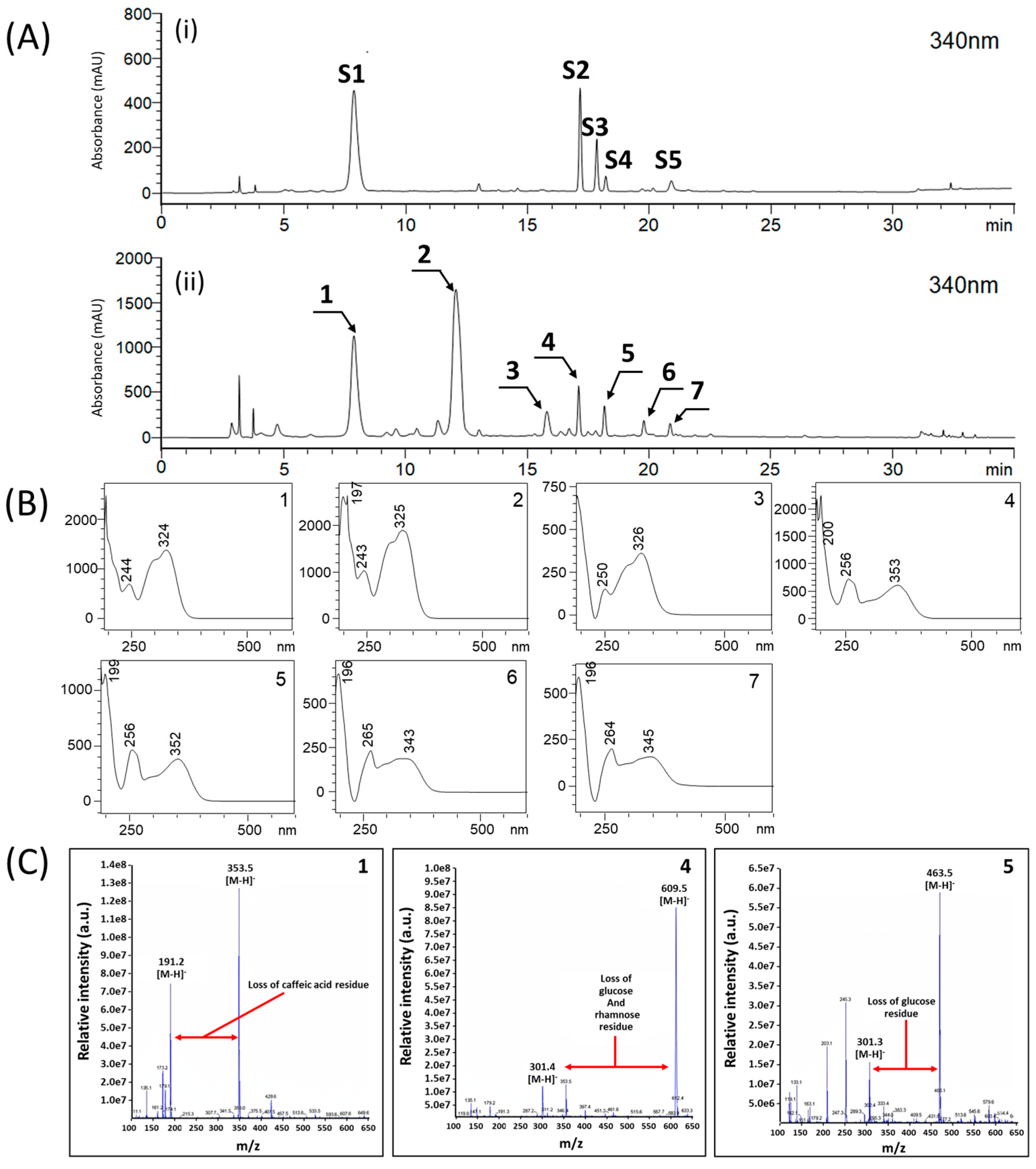
Figure 1. HPLC and MS/MS analyses of major metabolites in Ctl. (A) HPLC chromatograms of (i) standard mixture (S1–S5) and (ii) leaf extract showing seven major peaks. (B) UV spectra of peaks 1–7 showing hydroxycinnamic acid- and flavonol-type absorbance. (C) MS/MS fragmentation patterns of peaks 1 (chlorogenic acid), 4 (rutin), and 5 (isoquercitrin).
Separations 12 00298 g001
Figure 2. HPLC chromatograms of (A) authentic chlorogenic acid (S1), rutin (S2), and isoquercitrin (S3), and (B) the ethanolic extract of C. tricuspidata leaves for the evaluation of specificity.
Separations 12 00298 g002
Figure 3. Response surface methodology (RSM) plots for the optimization of extraction conditions for chlorogenic acid (A), rutin (B), and isoquercitrin (C). Extraction variables: a, extraction temperature (°C); b, ethanol concentration (%); c, extraction time (min).
Separations 12 00298 g003
Table 1. LOD and LOQ for chlorogenic acid, rutin, and isoquercitrin by HPLC analysis of Ctl.
CompoundRepetitionRange (μg/mL)Regression Equationr2
Chlorogenic acid10.1–100y = 9183.3x − 30350.999
20.1–100y = 9148.1x − 19801.000
30.1–100y = 9139.8x − 14810.999
Mean of slope (S0)9157.07SD of intercept (σ)793.361
LOQ (10 × σ/s)1.25 (μg/mL)
LOD (3.3 × σ/s)0.29 (μg/mL)
Rutin10.1–100y = 44,092x − 12,8590.999
20.1–100y = 45,190x − 21,9720.996
30.1–100y = 44,007x − 16,0730.994
Mean of slope (S0)37,084.67SD of intercept (σ)4621.954
LOQ (10 × σ/s)0.87 (μg/mL)
LOD (3.3 × σ/s)0.41 (μg/mL)
Isoquercitrin10.1–100y = 42,269x − 11,2080.999
20.1–100y = 42,318x − 68330.999
30.1–100y = 42,143x − 66900.999
Mean of slope (S0)42,243.33SD of intercept (σ)2568.098
LOQ (10 × σ/s)0.61 (μg/mL)
LOD (3.3 × σ/s)0.20 (μg/mL)
Table 2. The linearity and standard curves for chlorogenic acid (A), rutin (B), and isoquercitrin (C) analysis.
(A) Chlorogenic acid
RepetitionRange(μg/mL)Regression
Equation
r2Separations 12 00298 i001
10.25–50y = 13,980x − 11270.999
20.25–50y = 13,650x − 940.999
30.25–50y = 12,561x + 13500.999
(B) Rutin
RepetitionRange(μg/mL)Regression
Equation
r2Separations 12 00298 i002
10.25–50y = 35,785x − 24,6460.999
20.25–50y = 31,992x − 64290.999
30.25–50y = 31,608x − 16,5830.999
(C) Isoquercitirn
RepetitionRange(μg/mL)Regression
Equation
r2Separations 12 00298 i003
10.25–50y = 34,321x + 96530.999
20.25–50y = 30,234x + 71890.999
30.25–50y = 31,637x + 810.999
Table 3. Recovery of chlorogenic acid, rutin, and isoquercitrin in Ctl.
CompoundRepetitionSpiked Amounts (μg/mL)
1.02.03.04.0
Chlorogenic acid1101.34100.60102.68102.00
2101.60100.52102.60102.04
3101.04100.54102.61102.16
4101.14100.92102.49102.11
5101.28100.69102.49101.74
Mean recovery rate (%)101.28100.65102.57102.01
Net recovery rate (%)101.63
Range of recovery rate (%)101.04–102.68
Rutin1102.39100.88102.50101.99
2101.90100.28102.36102.14
3102.05100.57102.76101.96
101.36100.23102.89102.08
101.95100.48102.22102.16
Mean recovery rate (%)101.93100.49102.55102.07
Net recovery rate (%)101.76
Range of recovery rate (%)100.23–102.89
Isoquercitrin1100.81100.32103.70104.15
2100.67100.37103.61104.30
3100.73100.31103.39104.22
4100.71100.30103.27104.22
5100.71100.32103.14104.43
Mean recovery rate (%)100.73100.32103.42104.26
Net recovery rate (%)102.18
Range of recovery rate (%)100.30–104.43
Table 4. Intra-day precision (repeatability) of the HPLC analysis.
Amount of Ethanolic Extract of Ctl
1.0 g2.0 g3.0 g
RepetitionChlorogenic acid (μg/g)Chlorogenic acid (μg/g)Chlorogenic acid (μg/g)
1715.62721.01724.12
2711.22722.12729.13
3716.06720.69730.22
4710.68721.12724.15
5718.25721.03729.54
Mean714.37721.19727.43
SD3.280.543.03
RSD0.460.080.42
RSD (%) 0.08–0.46
RepetitionRutin (μg/g)Rutin (μg/g)Rutin (μg/g)
1319.62323.13328.65
2316.56326.23329.63
3319.55329.46328.46
4318.42326.59326.71
5315.48324.88328.10
Mean317.93326.06328.32
SD1.842.341.06
RSD0.580.720.32
RSD (%): 0.32–0.72
RepetitionIsoquercitrin (μg/g)Isoquercitrin (μg/g)Isoquercitrin (μg/g)
1532.62541.05546.54
2539.23542.21548.97
3537.89544.22549.32
4537.66546.47546.42
5539.14546.99549.77
Mean537.31544.19548.21
SD2.722.591.60
RSD0.510.480.29
RSD (%) 0.29–0.51
Table 5. Inter-day precision (reproducibility) of the HPLC analysis.
Amount of Ethanolic Extract of Ctl
Chlorogenic acid (μg/g)Rutin (μg/g)Isoquercitrin (μg/g)
DayRepetition1.5 g3.0 g1.5 g3.0 g1.5 g3.0 g
11723.67724.30324.12327.72544.37546.62
2727.78725.16322.58326.85541.95547.27
3726.66725.00322.32325.72543.66544.11
4724.09726.82322.63326.15541.96555.42
5723.66726.98322.94330.01543.39547.83
21727.72724.82326.06320.14543.95542.92
2727.17729.88326.12329.64544.89543.94
3727.08723.68325.00323.45545.06548.61
4726.98721.11325.24328.54545.93547.18
5726.98729.63325.95326.57546.28544.73
31723.32725.80324.81328.89541.34542.33
2723.29724.65324.29326.54542.73549.67
3724.63729.87324.26329.75541.37547.81
4724.24723.65325.03328.04542.39541.11
5724.39726.99324.90328.01543.56542.01
41723.75729.22329.26328.85542.67548.11
2724.02724.68327.68327.41542.35546.83
3723.49725.58327.13328.79543.13544.71
4723.38729.46324.55325.54542.05549.56
5723.31720.68326.72327.75542.20549.67
51727.16728.89328.20328.56541.43545.80
2724.94729.63327.56326.98541.84544.74
3726.48722.56325.93326.87543.35542.93
4724.55728.57324.59324.82541.89547.95
5722.41724.48327.15324.33542.43549.18
Mean725.01726.08325.40327.03543.05546.42
SD1.712.761.862.221.393.19
RSD (%)0.240.380.570.680.260.58
Net RSD (%) 0.38Net RSD (%) = 0.68Net RSD (%) = 0.58
Table 6. Chlorogenic acid, rutin, and isoquercitrin values of the extracts obtained in the study.
Experiment
Number
Extraction
Temperature
(°C)
Extraction
Concentration
(%)
Extraction Time
(Min)
Chlorogenic Acid
(μg/g)
Rutin
(μg/g)
Isoquercitrin
(μg/g)
16020120696.64316.75535.36
28020120718.94309.43553.75
36060120690.80310.27550.16
48060120736.22310.90573.56
5604090715.10319.15536.49
6804090735.46328.18550.84
76040150737.91333.02552.21
88040150736.81311.85556.96
9702090844.28328.15573.10
10706090847.45328.33578.28
117020150799.77337.96572.83
127060150843.64328.92571.42
137040120908.30348.44654.57
147040120908.41348.25654.01
157040120912.53347.48652.14
167040120911.52348.30653.72
177040120907.92348.69657.57
Disclaimer/Publisher’s Note: The statements, opinions and data contained in all publications are solely those of the individual author(s) and contributor(s) and not of MDPI and/or the editor(s). MDPI and/or the editor(s) disclaim responsibility for any injury to people or property resulting from any ideas, methods, instructions or products referred to in the content.