You are currently viewing a new version of our website. To view the old version click .

Antibiotics, Volume 10, Issue 1

January 2021 - 95 articles

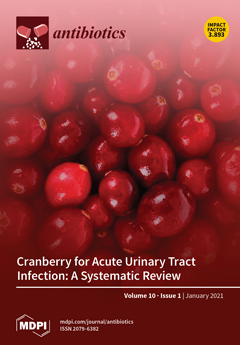
Cover Story: There is growing interest in the use of non-antibiotic treatments for common bacterial infections. One such option is the use of cranberry extract for urinary tract infections (UTIs). Cranberry extract contains proanthocyanidins with A-type linkages; these polyphenols, or their metabolites, are believed to be the active ingredient inhibiting the binding of Escherichia coli to the uroepithelium. Multiple studies have assessed the use of cranberry extract in the prevention of UTIs, with mixed results. Fewer studies have assessed the potential for cranberry extract to treat an acute UTI, despite many women using cranberry products for this indication. Through systematic review, the authors synthesize the evidence for the use of cranberry products in the management of acute, uncomplicated UTIs. View this paper.
  • Issues are regarded as officially published after their release is announced to the table of contents alert mailing list .
  • You may sign up for email alerts to receive table of contents of newly released issues.
  • PDF is the official format for papers published in both, html and pdf forms. To view the papers in pdf format, click on the "PDF Full-text" link, and use the free Adobe Reader to open them.

Articles (95)

  • Article
  • Open Access
8 Citations
3,424 Views
18 Pages

(1) Background: Resistance plasmids are under selective conditions beneficial for the bacterial host, but in the absence of selective pressure, this carriage may cause fitness costs. Compensation of this fitness burden is important to obtain competit...

  • Review
  • Open Access
14 Citations
4,661 Views
13 Pages

Tuberculosis (TB) remains a global health emergency, with an estimated 2 billion people infected across the world, and 1.4 million people dying to this disease every year. Many aspects of the causative agent, Mycobacterium tuberculosis, make this dis...

  • Review
  • Open Access
46 Citations
4,849 Views
25 Pages

Diarylureas: Repositioning from Antitumor to Antimicrobials or Multi-Target Agents against New Pandemics

  • Alessia Catalano,
  • Domenico Iacopetta,
  • Michele Pellegrino,
  • Stefano Aquaro,
  • Carlo Franchini and
  • Maria Stefania Sinicropi

Antimicrobials have allowed medical advancements over several decades. However, the continuous emergence of antimicrobial resistance restricts efficacy in treating infectious diseases. In this context, the drug repositioning of already known biologic...

  • Article
  • Open Access
15 Citations
4,534 Views
16 Pages

Implementation of Antibiotic Stewardship in a University Hospital Setting

  • Milan Kolar,
  • Miroslava Htoutou Sedlakova,
  • Karel Urbanek,
  • Patrik Mlynarcik,
  • Magdalena Roderova,
  • Kristyna Hricova,
  • Kristyna Mezerova,
  • Pavla Kucova,
  • Jana Zapletalova and
  • Katerina Fiserova
  • + 1 author

The article describes activities of an antibiotic center at a university hospital in the Czech Republic and presents the results of antibiotic stewardship program implementation over a period of 10 years. It provides data on the development of resist...

  • Article
  • Open Access
26 Citations
6,554 Views
13 Pages

Drivers of Broad-Spectrum Antibiotic Overuse across Diverse Hospital Contexts—A Qualitative Study of Prescribers in the UK, Sri Lanka and South Africa

  • Carolyn Tarrant,
  • Andrew M. Colman,
  • David R. Jenkins,
  • Edmund Chattoe-Brown,
  • Nelun Perera,
  • Shaheen Mehtar,
  • W.M.I. Dilini Nakkawita,
  • Michele Bolscher and
  • Eva M. Krockow

Antimicrobial stewardship programs focus on reducing overuse of broad-spectrum antibiotics (BSAs), primarily through interventions to change prescribing behavior. This study aims to identify multi-level influences on BSA overuse across diverse high a...

  • Article
  • Open Access
31 Citations
5,195 Views
11 Pages

The impact of the COVID-19 pandemic on multidrug-resistant (MDR) bacteria is unknown. The purpose of this study was to assess prevalence, etiology, and association with mortality of MDR bacteria in older adult patients before and after the first peak...

  • Review
  • Open Access
38 Citations
12,278 Views
26 Pages

Clavulanic acid (CA) is an irreversible β-lactamase enzyme inhibitor with a weak antibacterial activity produced by Streptomyces clavuligerus (S. clavuligerus). CA is typically co-formulated with broad-spectrum β‑lactam antibiotics such as...

  • Article
  • Open Access
22 Citations
14,573 Views
13 Pages

Grapefruit Seed Extract as a Natural Derived Antibacterial Substance against Multidrug-Resistant Bacteria

  • Hee-Won Han,
  • Jin-Hwan Kwak,
  • Tae-Su Jang,
  • Jonathan Campbell Knowles,
  • Hae-Won Kim,
  • Hae-Hyoung Lee and
  • Jung-Hwan Lee

Multidrug-resistant (MDR) bacteria are increasing due to the abuse and misuse of antibiotics, and nosocomial infections by MDR bacteria are also increasing. The aim of this study was to identify new substances that can target MDR bacteria among 12 pl...

  • Article
  • Open Access
13 Citations
3,889 Views
18 Pages

Facile In-Situ Fabrication of a Ternary ZnO/TiO2/Ag Nanocomposite for Enhanced Bactericidal and Biocompatibility Properties

  • Priyadarshini Sakthi Mohan,
  • Faridah Sonsuddin,
  • Azizah Binti Mainal,
  • Rosiyah Yahya,
  • Gopinath Venkatraman,
  • Jamuna Vadivelu,
  • Dunia A. Al-Farraj,
  • Amal M. Al-Mohaimeed and
  • Khaloud Mohammed Alarjani

This paper presents for the first time a successful fabrication of ternary ZnO/TiO2/Ag nanocomposites consisting of zinc oxide (ZnO), titania (TiO2) and silver (Ag) nanoparticles (NPs) synthesised using Morinda citrifolia fruit (MCF) extract. ZnONPs...

  • Article
  • Open Access
11 Citations
5,725 Views
19 Pages

Bistable Bacterial Growth Dynamics in the Presence of Antimicrobial Agents

  • Nelly Frenkel,
  • Ron Saar Dover,
  • Eve Titon,
  • Yechiel Shai and
  • Vered Rom-Kedar

The outcome of an antibiotic treatment on the growth capacity of bacteria is largely dependent on the initial population size (Inoculum Effect). We characterized and built a model of this effect in E. coli cultures using a large variety of antimicrob...

of 10

Get Alerted

Add your email address to receive forthcoming issues of this journal.

XFacebookLinkedIn
Antibiotics - ISSN 2079-6382