

You are currently viewing a new version of our website. To view the old version click .

Journal of Functional Biomaterials, Volume 16, Issue 8

August 2025 - 36 articles

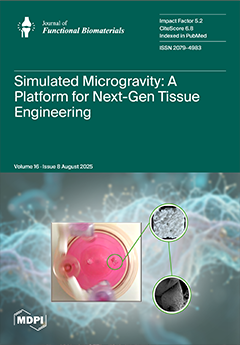
Cover Story: Simulated microgravity, achieved through rotating wall vessel bioreactors, provides a unique 3D dynamic culture environment that enhances tissue engineering by mimicking space-like conditions. In bone tissue research, 3D-printed trabecular scaffolds cultured under such conditions show a specific cell response. The absence of sedimentation and the continuous rotation allow uniform cell distribution, improve the delivery of nutrients and oxygen, and facilitate the removal of metabolic waste. Beyond bone, simulated microgravity offers a powerful platform for advancing all tissue engineering fields, enabling more physiologically relevant models and accelerating biomedical innovation to support space medicine. View this paper
  • Issues are regarded as officially published after their release is announced to the table of contents alert mailing list .
  • You may sign up for email alerts to receive table of contents of newly released issues.
  • PDF is the official format for papers published in both, html and pdf forms. To view the papers in pdf format, click on the "PDF Full-text" link, and use the free Adobe Reader to open them.

Articles (36)

  • Article
  • Open Access
1,827 Views
13 Pages

Impact of Autoclaving on the Dimensional Stability of 3D-Printed Surgical Guides for Aesthetic Crown Lengthening

  • Albert González-Barnadas,
  • Anna Ribas-Garcia,
  • Adrià Jorba-García,
  • Rui Figueiredo,
  • Eduard Valmaseda-Castellón and
  • Octavi Camps-Font

The aim of this study was to evaluate the impact of autoclaving on the dimensional stability of surgical guides (SGs) for aesthetic crown lengthening (ACL) using different resins/printing methods. Fifty SGs for ACL were printed using five different r...

  • Article
  • Open Access
1,112 Views
13 Pages

Controlling Sodium Titanate Crystal Size to Improve Wettability and Early Osseointegration of Titanium Implants: Insights from an Animal Model

  • Saray Fernández-Hernández,
  • Javier Gil,
  • Marta Sanjuán-Álvarez,
  • Ignacio Sanz,
  • Mariano Herrero-Climent and
  • Aritza Brizuela-Velasco

The thermo-chemical treatment of dental implants leads to the formation of sodium titanate crystals on their surface. When in contact with blood, these crystals dissolve and trigger an ionic exchange cascade, resulting in the formation of a calcium a...

  • Article
  • Open Access
1,319 Views
15 Pages

Impact of Pre- and Post-Dilatation on Long-Term Outcomes After Self-Expanding and Balloon-Expandable TAVI

  • Alexandru Stan,
  • Ayman Elkahlout,
  • Marius Mihai Harpa,
  • Marian Pop,
  • Mihaly Veres,
  • Antonela Delia Stan,
  • Paul-Adrian Călburean,
  • Anda-Cristina Scurtu,
  • Klara Brînzaniuc and
  • Horatiu Suciu

The main objective of this study was to compare the long-term outcomes of transcatheter aortic valve implantation (TAVI) in patients with severe aortic stenosis, focusing on differences between self-expanding valve (SEV) versus balloon-expandable val...

  • Article
  • Open Access
1 Citations
1,615 Views
15 Pages

The Effect of Collagen Membrane Fixation with Pins on Buccal Bone Regeneration in Immediate Dental Implant Sites: A Preclinical Study in Dogs

  • Yuma Hazama,
  • Takahisa Iida,
  • Niklaus P. Lang,
  • Fernando M. Muñoz Guzon,
  • Giovanna Iezzi,
  • Daniele Botticelli and
  • Shunsuke Baba

Background: The role of collagen membrane fixation during guided bone regeneration (GBR) remains debatable, particularly in post-extraction sockets with buccal defects and concomitant immediate implant placement. This study evaluated whether or not f...

  • Article
  • Open Access
3 Citations
2,163 Views
36 Pages

Laser powder bed fusion (LPBF) is an advanced additive manufacturing technology that is gaining increasing interest for biomedical implants because it can produce dense, patient-specific metallic components with controlled microstructures. This study...

  • Review
  • Open Access
3,219 Views
16 Pages

Histological Processing of Scaffolds: Challenges and Solutions

  • Tomas Ragauskas,
  • Ilona Uzieliene and
  • Eiva Bernotiene

Scaffolds are widely used in bioengineering, both as 3D native tissue-mimicking models for investigating mechanisms under physiological and pathological conditions and also as implantable agents in regenerative medicine. Histological approaches, main...

  • Systematic Review
  • Open Access
2 Citations
3,076 Views
29 Pages

Three-dimensional printing is commonly used to fabricate provisional dental restorations. Studies have reported that changes in printing orientation affect the physical and mechanical properties of 3D-printed polymeric provisional restorations; howev...

  • Article
  • Open Access
2,009 Views
15 Pages

The dimensional accuracy of the intaglio surface of complete dentures fabricated using liquid crystal display (LCD) three-dimensional (3D) printing might be influenced by the build angle and post-processing storage conditions. This study evaluated th...

  • Article
  • Open Access
1,119 Views
14 Pages

On the Interplay Between Roughness and Elastic Modulus at the Nanoscale: A Methodology Study with Bone as Model Material

  • Alessandro Gambardella,
  • Gregorio Marchiori,
  • Melania Maglio,
  • Marco Boi,
  • Matteo Montesissa,
  • Jessika Bertacchini,
  • Stefano Biressi,
  • Nicola Baldini,
  • Gianluca Giavaresi and
  • Marco Bontempi

Atomic force microscopy (AFM)-based nanoindentation enables investigation of the mechanical response of biological materials at a subcellular scale. However, quantitative estimates of mechanical parameters such as the elastic modulus (E) remain unrel...

  • Article
  • Open Access
1,582 Views
13 Pages

Interaction of MG63 Human Osteosarcoma-Derived Cells on S53P4 Bioactive Glass: An In Vitro Study

  • Valentin Schmidt,
  • Beáta Polgár,
  • Vanda Ágnes Nemes,
  • Tímea Dergez,
  • László Janovák,
  • Péter Maróti,
  • Szilárd Rendeki,
  • Kinga Turzó and
  • Balázs Patczai

Bioactive glass materials have been used for decades in orthopedic surgery, traumatology, and oral and maxillofacial surgery to repair bone defects. This study aimed to evaluate in vitro the survival and proliferation of MG63 human osteosarcoma-deriv...

of 4

Get Alerted

Add your email address to receive forthcoming issues of this journal.

XFacebookLinkedIn
J. Funct. Biomater. - ISSN 2079-4983