


You are currently viewing a new version of our website. To view the old version click .

Pathogens, Volume 10, Issue 6

June 2021 - 149 articles

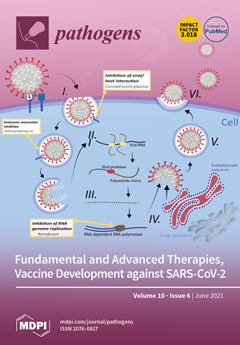
Cover Story: This review article summarizes the gradual development of various treatments and vaccines as they emerged a year after the outbreak of the pandemic—from fundamental therapies, repurposed drugs previously used to treat other diseases with presumed antiviral, anti-inflammatory, and antimicrobial effects (remdesivir, antimalarial drugs, glucocorticoids, ivermectin etc.), through passive immunization/antibody therapy to innovative strategies, such as peptides, and ACE inhibitors. We also address cell therapy with mesenchymal stromal cells as a potential treatment strategy. Because it is generally accepted that vaccines are the critical tools to intervene in the COVID-19 pandemic, we also characterize recently approved vaccines, their types, and reported side effects so far. View this paper
  • Issues are regarded as officially published after their release is announced to the table of contents alert mailing list .
  • You may sign up for email alerts to receive table of contents of newly released issues.
  • PDF is the official format for papers published in both, html and pdf forms. To view the papers in pdf format, click on the "PDF Full-text" link, and use the free Adobe Reader to open them.

Articles (149)

  • Article
  • Open Access
4 Citations
3,123 Views
9 Pages

Prevalence of Hepatitis E Virus Infection among Laboratory Rabbits in China

  • Lin Wang,
  • Chunnan Liang,
  • Xiaobo Li,
  • Ji Wang,
  • Rui Fu,
  • Jin Xing,
  • Jingyi Shu,
  • Chenyan Zhao and
  • Weijin Huang

Hepatitis E virus (HEV) is zoonotic and the leading cause of acute viral hepatitis worldwide. Rabbit HEV can infect humans and is prevalent globally. It is reported that laboratory rabbits are also naturally infected with HEV. Therefore, it is import...

  • Review
  • Open Access
15 Citations
8,755 Views
17 Pages

Streptococcus pyogenes (group A streptococci; GAS) is an exclusively human pathogen. It causes a variety of suppurative and non-suppurative diseases in people of all ages worldwide. Not all can be successfully treated with antibiotics. A licensed vac...

  • Article
  • Open Access
7 Citations
3,971 Views
11 Pages

Wild Small Mammals and Ticks in Zoos—Reservoir of Agents with Zoonotic Potential?

  • Pavlína Pittermannová,
  • Alena Žákovská,
  • Petr Váňa,
  • Jiřina Marková,
  • František Treml,
  • Lenka Černíková,
  • Marie Budíková and
  • Eva Bártová

Wild small mammals and ticks play an important role in maintaining and spreading zoonoses in nature, as well as in captive animals. The aim of this study was to monitor selected agents with zoonotic potential in their reservoirs and vectors in a zoo,...

  • Article
  • Open Access
6 Citations
3,431 Views
14 Pages

The Population Diversity of Candidate Genes for Resistance/Susceptibility to Coronavirus Infection in Domestic Cats: An Inter-Breed Comparison

  • Jana Bubenikova,
  • Leona Vychodilova,
  • Karla Stejskalova,
  • Jan Futas,
  • Jan Oppelt,
  • Petra Cerna,
  • Martin Plasil and
  • Petr Horin

Feline coronavirus (FCoV) is a complex pathogen causing feline infectious peritonitis (FIP). Host genetics represents a factor contributing to the pathogenesis of the disease. Differential susceptibility of various breeds to FIP was reported with con...

  • Article
  • Open Access
10 Citations
4,381 Views
16 Pages

Molecular Detection and Genotyping of Coxiella-Like Endosymbionts in Ticks Collected from Animals and Vegetation in Zambia

  • Toshiya Kobayashi,
  • Elisha Chatanga,
  • Yongjin Qiu,
  • Martin Simuunza,
  • Masahiro Kajihara,
  • Bernard Mudenda Hang’ombe,
  • Yoshiki Eto,
  • Ngonda Saasa,
  • Akina Mori-Kajihara and
  • Edgar Simulundu
  • + 5 authors

Ticks are obligate ectoparasites as they require to feed on their host blood during some or all stages of their life cycle. In addition to the pathogens that ticks harbor and transmit to vertebrate hosts, they also harbor other seemingly nonpathogeni...

  • Article
  • Open Access
7 Citations
3,764 Views
13 Pages

E6/E7 Variants of Human Papillomavirus 16 Associated with Cervical Carcinoma in Women in Southern Mexico

  • Ramón Antaño-Arias,
  • Oscar Del Moral-Hernández,
  • Julio Ortiz-Ortiz,
  • Luz Del Carmen Alarcón-Romero,
  • Jorge Adán Navor-Hernández,
  • Marco Antonio Leyva-Vázquez,
  • Marco Antonio Jiménez-López,
  • Jorge Organista-Nava and
  • Berenice Illades-Aguiar

Persistent infection with the human papillomavirus 16 (HPV 16) is the cause of half of all cervical carcinomas (CC) cases. Moreover, mutations in the oncoproteins E6 and E7 are associated with CC development. In this study, E6/E7 variants circulating...

  • Article
  • Open Access
23 Citations
5,665 Views
12 Pages

SARS-CoV-2 Seroprevalence and Neutralizing Antibody Response after the First and Second COVID-19 Pandemic Wave in Croatia

  • Tatjana Vilibic-Cavlek,
  • Vladimir Stevanovic,
  • Maja Ilic,
  • Ljubo Barbic,
  • Krunoslav Capak,
  • Irena Tabain,
  • Jasna Lenicek Krleza,
  • Thomas Ferenc,
  • Zeljka Hruskar and
  • Renata Zrinski Topic
  • + 11 authors

Severe acute respiratory syndrome coronavirus 2 (SARS-CoV-2) is a novel coronavirus with a pandemic spread. So far, a total of 349,910 SARS-CoV-2 cases and 7687 deaths were reported in Croatia. We analyzed the seroprevalence and neutralizing (NT) ant...

  • Article
  • Open Access
17 Citations
4,590 Views
10 Pages

Genetic Characterization of Cryptosporidium cuniculus from Rabbits in Egypt

  • Doaa Naguib,
  • Dawn M. Roellig,
  • Nagah Arafat and
  • Lihua Xiao

Rabbits are increasingly farmed in Egypt for meat. They are, however, known reservoirs of infectious pathogens. Currently, no information is available on the genetic characteristics of Cryptosporidium spp. in rabbits in Egypt. To understand the preva...

  • Article
  • Open Access
4 Citations
3,744 Views
10 Pages

Establishment of Babesia bovis In Vitro Culture Using Medium Free of Animal Products

  • Jesús A. Álvarez Martínez,
  • Julio V. Figueroa Millán,
  • Massaro W. Ueti and
  • Carmen Rojas-Martínez

Babesia bovis, an etiological agent of bovine babesiosis, causes a significant burden to the cattle industry worldwide. The most efficient method to mitigate bovine babesiosis is a live vaccine produced by serial passage in splenectomized cattle. How...

  • Review
  • Open Access
2 Citations
5,861 Views
18 Pages

Alphaviruses are positive-sense RNA arboviruses that are capable of causing severe disease in otherwise healthy individuals. There are many aspects of viral infection that determine pathogenesis and major efforts regarding the identification and char...

of 15

Get Alerted

Add your email address to receive forthcoming issues of this journal.

XFacebookLinkedIn
Pathogens - ISSN 2076-0817