

You are currently viewing a new version of our website. To view the old version click .

Toxins, Volume 12, Issue 2

February 2020 - 79 articles

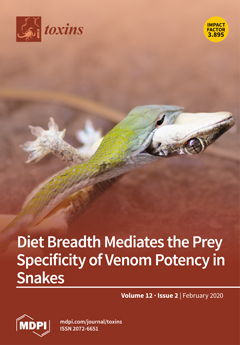
Cover Story: Some snake venoms have been found to have prey-specific potencies, yet the role of diet breadth on venom potencies has yet to be tested on large scales. Using data from 100 snake species, this study shows how the evolution of prey-specific potencies is dependent on the taxonomic richness or breadth of a snakes’ diet rather than species richness. This indicates that the physiological diversity of a species’ diet is an important driver of the evolution of generalist venom potencies and that species’ venoms with taxonomically rich diets may be better equipped for incapacitating novel prey species within changing environments. View this paper
  • Issues are regarded as officially published after their release is announced to the table of contents alert mailing list .
  • You may sign up for email alerts to receive table of contents of newly released issues.
  • PDF is the official format for papers published in both, html and pdf forms. To view the papers in pdf format, click on the "PDF Full-text" link, and use the free Adobe Reader to open them.

Articles (79)

  • Article
  • Open Access
61 Citations
4,442 Views
10 Pages

Effect of Ozone and Electron Beam Irradiation on Degradation of Zearalenone and Ochratoxin A

  • Kai Yang,
  • Ke Li,
  • Lihong Pan,
  • Xiaohu Luo,
  • Jiali Xing,
  • Jing Wang,
  • Li Wang,
  • Ren Wang,
  • Yuheng Zhai and
  • Zhengxing Chen

24 February 2020

Zearalenone (ZEN) and ochratoxin A (OTA) are key concerns of the food industry because of their toxicity and pollution scope. This study investigated the effects of ozone and electron beam irradiation (EBI) on the degradation of ZEN and OTA. Results...

  • Communication
  • Open Access
16 Citations
3,957 Views
10 Pages

24 February 2020

Deoxynivalenol is one of the most ubiquitous mycotoxins in the Western diet through its presence in cereals and cereal products. A vast amount of studies indicate the worrying level of exposure to this toxin, while even high percentages of the popula...

  • Article
  • Open Access
7 Citations
3,596 Views
10 Pages

Composite Uremic Load and Physical Performance in Hemodialysis Patients: A Cross-Sectional Study

  • Karsten Vanden Wyngaert,
  • Amaryllis H. Van Craenenbroeck,
  • Els Holvoet,
  • Patrick Calders,
  • Wim Van Biesen and
  • Sunny Eloot

22 February 2020

Impaired physical performance is common in patients on hemodialysis (HD) and is associated with poor prognosis. A patient relevant marker of adequacy of dialysis is lacking. Previous studies evaluated uremic toxicity by assessing the impact of differ...

  • Article
  • Open Access
56 Citations
5,627 Views
12 Pages

22 February 2020

Type-B aflatoxins (AFB1 and AFB2) frequently contaminate food, especially nuts and fried figs, and seriously threaten human health; hence, it is necessary for the newly rapid and sensitive detection methods to prevent the consumption of potentially c...

  • Article
  • Open Access
14 Citations
4,052 Views
10 Pages

22 February 2020

Destruxin A (DA), a cyclodepsipeptidic mycotoxin produced by entomopathogenic fungus Metarhizium anisopliae, has good insecticidal activity and potential to be a new pesticide. However, the mechanism of action is still obscure. Our previous experimen...

  • Communication
  • Open Access
12 Citations
4,484 Views
15 Pages

21 February 2020

Bacillus thuringiensis (Bt) produces insecticidal proteins that are either secreted during the vegetative growth phase or accumulated in the crystal inclusions (Cry proteins) in the stationary phase. Cry1I proteins share the three domain (3D) structu...

  • Article
  • Open Access
36 Citations
5,731 Views
15 Pages

Toxicity Characterisation of Gambierdiscus Species from the Canary Islands

  • Araceli E. Rossignoli,
  • Angels Tudó,
  • Isabel Bravo,
  • Patricio A. Díaz,
  • Jorge Diogène and
  • Pilar Riobó

21 February 2020

In the last decade, several outbreaks of ciguatera fish poisoning (CFP) have been reported in the Canary Islands (central northeast Atlantic Ocean), confirming ciguatera as an emerging alimentary risk in this region. Five Gambierdiscus species, G. au...

  • Article
  • Open Access
71 Citations
8,232 Views
12 Pages

20 February 2020

The phospholipase A2 (PLA2) inhibitor Varespladib (LY315920) and its orally bioavailable prodrug, methyl-Varespladib (LY333013) inhibit PLA2 activity of a wide variety of snake venoms. In this study, the ability of these two forms of Varespladib to h...

  • Review
  • Open Access
6 Citations
6,380 Views
11 Pages

20 February 2020

Herein, we review the characteristics of the six predominant venomous snakes in Taiwan and the effects of traditional Chinese medicine on the long-term outcomes of snakebite venom. We electronically searched databases, including PubMed, ClinicalKey,...

  • Article
  • Open Access
27 Citations
6,636 Views
14 Pages

Contamination of Pet Food with Mycobiota and Fusarium Mycotoxins—Focus on Dogs and Cats

  • Natalia Witaszak,
  • Agnieszka Waśkiewicz,
  • Jan Bocianowski and
  • Łukasz Stępień

19 February 2020

A wide range of pet food types are available on the market; the dominant type is dry food formulated in croquets. One of the most common ingredients of dry food are cereals—vectors of harmful mycotoxins posing the risk to pet health. In this st...

of 8

Get Alerted

Add your email address to receive forthcoming issues of this journal.

XFacebookLinkedIn
Toxins - ISSN 2072-6651