

You are currently viewing a new version of our website. To view the old version click .

Viruses, Volume 11, Issue 2

February 2019 - 107 articles

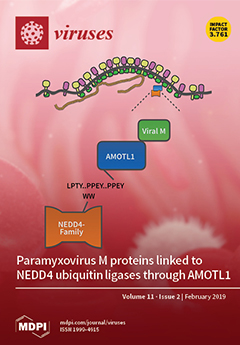
Cover Story: Many enveloped viruses employ late domains such as PPXY to recruit the host ESCRT machinery needed for budding and particle release. Paramyxoviruses typically lack late domain sequences, yet budding of these viruses is often ESCRT-dependent. Here, we provide evidence for a model in which paramyxoviruses use AMOTL1 as a linker to indirectly recruit the same WW domain-containing NEDD4 ubiquitin ligases for budding that other enveloped viruses recruit directly through PPXY late domains. View this paper.
  • Issues are regarded as officially published after their release is announced to the table of contents alert mailing list .
  • You may sign up for email alerts to receive table of contents of newly released issues.
  • PDF is the official format for papers published in both, html and pdf forms. To view the papers in pdf format, click on the "PDF Full-text" link, and use the free Adobe Reader to open them.

Articles (107)

  • Review
  • Open Access
98 Citations
12,828 Views
17 Pages

Influenza Virus Infections and Cellular Kinases

  • Robert Meineke,
  • Guus F. Rimmelzwaan and
  • Husni Elbahesh

20 February 2019

Influenza A viruses (IAVs) are a major cause of respiratory illness and are responsible for yearly epidemics associated with more than 500,000 annual deaths globally. Novel IAVs may cause pandemic outbreaks and zoonotic infections with, for example,...

  • Review
  • Open Access
25 Citations
7,198 Views
20 Pages

20 February 2019

Over the past decades, infection of mice with lymphocytic choriomeningitis virus (LCMV) has provided an invaluable insight into our understanding of immune responses to viruses. In particular, this model has clarified the central roles that type I in...

  • Review
  • Open Access
28 Citations
8,001 Views
18 Pages

Targeting the Viral Polymerase of Diarrhea-Causing Viruses as a Strategy to Develop a Single Broad-Spectrum Antiviral Therapy

  • Marcella Bassetto,
  • Jana Van Dycke,
  • Johan Neyts,
  • Andrea Brancale and
  • Joana Rocha-Pereira

20 February 2019

Viral gastroenteritis is an important cause of morbidity and mortality worldwide, being particularly severe for children under the age of five. The most common viral agents of gastroenteritis are noroviruses, rotaviruses, sapoviruses, astroviruses an...

  • Review
  • Open Access
270 Citations
35,773 Views
17 Pages

Global Epidemiology of Bat Coronaviruses

  • Antonio C. P. Wong,
  • Xin Li,
  • Susanna K. P. Lau and
  • Patrick C. Y. Woo

20 February 2019

Bats are a unique group of mammals of the order Chiroptera. They are highly diversified and are the group of mammals with the second largest number of species. Such highly diversified cell types and receptors facilitate them to be potential hosts of...

  • Review
  • Open Access
95 Citations
13,747 Views
26 Pages

Tropism of the Chikungunya Virus

  • Giulia Matusali,
  • Francesca Colavita,
  • Licia Bordi,
  • Eleonora Lalle,
  • Giuseppe Ippolito,
  • Maria R. Capobianchi and
  • Concetta Castilletti

20 February 2019

Chikungunya virus (CHIKV) is a re-emerging mosquito-borne virus that displays a large cell and organ tropism, and causes a broad range of clinical symptoms in humans. It is maintained in nature through both urban and sylvatic cycles, involving mosqui...

  • Article
  • Open Access
47 Citations
9,981 Views
26 Pages

Identification of Broad-Spectrum Antiviral Compounds by Targeting Viral Entry

  • Michela Mazzon,
  • Ana Maria Ortega-Prieto,
  • Douglas Imrie,
  • Christin Luft,
  • Lena Hess,
  • Stephanie Czieso,
  • Joe Grove,
  • Jessica Katy Skelton,
  • Laura Farleigh and
  • Joachim J. Bugert
  • + 8 authors

20 February 2019

Viruses are a major threat to human health and economic well-being. In recent years Ebola, Zika, influenza, and chikungunya virus epidemics have raised awareness that infections can spread rapidly before vaccines or specific antagonists can be made a...

  • Review
  • Open Access
45 Citations
8,419 Views
13 Pages

GII.4 Human Norovirus: Surveying the Antigenic Landscape

  • Michael L. Mallory,
  • Lisa C. Lindesmith,
  • Rachel L. Graham and
  • Ralph S. Baric

20 February 2019

Human norovirus is the leading cause of viral acute onset gastroenteritis disease burden, with 685 million infections reported annually. Vulnerable populations, such as children under the age of 5 years, the immunocompromised, and the elderly show a...

  • Article
  • Open Access
49 Citations
5,506 Views
14 Pages

20 February 2019

The complete sequence and genome organization of a novel Endornavirus from the hypovirulent strain GD-2 of Rhizoctonia solani AG-1 IA, the causal agent of rice sheath blight, were identified using a deep sequencing approach and it was tentatively nam...

  • Article
  • Open Access
16 Citations
4,732 Views
11 Pages

The Application and Interpretation of IgG Avidity and IgA ELISA Tests to Characterize Zika Virus Infections

  • Fátima Amaro,
  • María P. Sánchez-Seco,
  • Ana Vázquez,
  • Maria J. Alves,
  • Líbia Zé-Zé,
  • Maria T. Luz,
  • Teodora Minguito,
  • Jesús De La Fuente and
  • Fernando De Ory

20 February 2019

In the absence of viremia, the diagnostics of Zika virus (ZIKV) infections must rely on serological techniques. In order to improve the serological diagnosis of ZIKV, ZIKV-IgA and ZIKV-IgG avidity assays were evaluated. Forty patients returning from...

  • Technical Note
  • Open Access
37 Citations
12,913 Views
4 Pages

19 February 2019

Counting labeled cells, after immunofluorescence or expression of a genetically fluorescent reporter protein, is frequently used to quantify viral infection. However, this can be very tedious without a high content screening apparatus. For this reaso...

of 11

Get Alerted

Add your email address to receive forthcoming issues of this journal.

XFacebookLinkedIn
Viruses - ISSN 1999-4915