


Next Issue
Volume 19, January
Previous Issue
Volume 18, November


J. Risk Financial Manag., Volume 18, Issue 12 (December 2025) – 67 articles
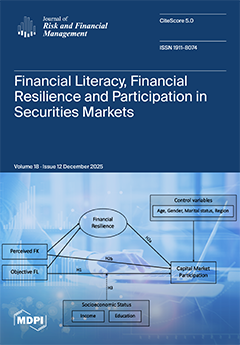
Cover Story (view full-size image): This study investigates the mechanisms linking financial literacy (FL) to capital market participation. The findings show that FL substantially enhances financial resilience, which in turn is a strong predictor of engagement in securities markets. Moreover, perceived financial knowledge emerges as a more powerful direct driver of participation than objective knowledge. These pathways are moderated by income and education, indicating that socioeconomic status constitutes a key boundary condition for converting knowledge into investment behavior. Overall, the results challenge simplistic direct-effects models and suggest that policy initiatives aimed at boosting market participation must extend beyond knowledge dissemination to also strengthen financial resilience, promote self-efficacy, and address structural inequalities. View this paper
  • Issues are regarded as officially published after their release is announced to the table of contents alert mailing list.
  • You may sign up for e-mail alerts to receive table of contents of newly released issues.
  • PDF is the official format for papers published in both, html and pdf forms. To view the papers in pdf format, click on the "PDF Full-text" link, and use the free Adobe Reader to open them.
Order results
Result details
Section
Select all
Export citation of selected articles as:
21 pages, 1452 KB  
Article
No Guarantee, Still Gains? Rethinking the Relation Between Loans Without Personal Guarantees and Bank Profitability
by Yuto Yoshinaga and Kanjiro Onishi
J. Risk Financial Manag. 2025, 18(12), 725; https://doi.org/10.3390/jrfm18120725 - 18 Dec 2025
Viewed by 575
Abstract
Japanese financial authorities have been promoting lending without personal guarantees, with the aim of enhancing the stability of the banking sector. However, banks’ willingness to provide loans without personal guarantees varies. Furthermore, no prior study has directly examined the impact of such loans [...] Read more.
Japanese financial authorities have been promoting lending without personal guarantees, with the aim of enhancing the stability of the banking sector. However, banks’ willingness to provide loans without personal guarantees varies. Furthermore, no prior study has directly examined the impact of such loans on bank profitability. Since Japanese regional banks recently began disclosing the proportion of the concerned loans, this study aims to clarify their impacts on bank profitability, utilizing 352 bank/year observations from fiscal years 2019 to 2023. The results indicate that the statistical significance of the impacts of the proportion of loans without personal guarantees on bank profitability is not robust, and that the impacts are economically insignificant. This study contributes to the literature by providing the first empirical evidence on the impact of personal guarantees on bank profitability. It also offers practical insights to financial authorities, demonstrating that loans without personal guarantees do not significantly affect the profitability of regional banks, at least during the examined sample period. Full article
(This article belongs to the Special Issue Financial Markets and Institutions and Financial Crises)
Show Figures

Figure 1

44 pages, 1431 KB  
Article
Balancing Fairness and Accuracy in Machine Learning-Based Probability of Default Modeling via Threshold Optimization
by Essodjolo Kpatcha
J. Risk Financial Manag. 2025, 18(12), 724; https://doi.org/10.3390/jrfm18120724 - 17 Dec 2025
Viewed by 657
Abstract
This study presents a fairness-aware framework for modeling the Probability of Default (PD) in individual credit scoring, explicitly addressing the trade-off between predictive accuracy and fairness. As machine learning (ML) models become increasingly prevalent in financial decision-making, concerns around bias and transparency have [...] Read more.
This study presents a fairness-aware framework for modeling the Probability of Default (PD) in individual credit scoring, explicitly addressing the trade-off between predictive accuracy and fairness. As machine learning (ML) models become increasingly prevalent in financial decision-making, concerns around bias and transparency have grown, particularly when improvements in fairness are achieved at the expense of predictive performance. To mitigate these issues, we propose a model-agnostic, post-processing threshold optimization framework that adjusts classification cut-offs using a tunable parameter, enabling institutions to balance fairness and performance objectives. This approach does not require model retraining and supports a scalarized optimization of fairness–performance trade-offs. We conduct extensive experiments with logistic regression, random forests, and XGBoost, evaluating predictive accuracy using Balanced Accuracy alongside fairness metrics such as Statistical Parity Difference and Equal Opportunity Difference. Results demonstrate that the proposed framework can substantially improve fairness outcomes with minimal impact on predictive reliability. In addition, we analyze model-specific trade-off behaviors and introduce diagnostic tools, including quadrant-based and ratio-based analyses, to guide threshold selection under varying institutional priorities. Overall, the framework offers a scalable, interpretable, and regulation-aligned solution for deploying responsible credit risk models, contributing to the broader goal of ethical and equitable financial decision-making. Full article
Show Figures

Figure 1

27 pages, 3103 KB  
Systematic Review
Mapping the Impact of Business Model Innovation on Firm Productivity: A Bibliometric Analysis and Global Perspective
by Kafa Al Nawaiseh
J. Risk Financial Manag. 2025, 18(12), 723; https://doi.org/10.3390/jrfm18120723 - 17 Dec 2025
Viewed by 469
Abstract
The study explores the impact of business model innovation on firm productivity with the help of a systematic bibliometric analysis. The purpose is to distill key themes, critical research needs, and possible future directions. A systematic search was performed with the Web of [...] Read more.
The study explores the impact of business model innovation on firm productivity with the help of a systematic bibliometric analysis. The purpose is to distill key themes, critical research needs, and possible future directions. A systematic search was performed with the Web of Science database (2011 to 2024) using PRISMA 2020 guidelines. Of these studies, after applying defined inclusion and exclusion criteria, the study retained 273 studies; of those, 217 explicitly considered productivity at the firm level. This results in the following three central research themes: digitalization, business model innovation, and sustainability, which reflect how firms adjust to technological and environmental as well as strategic demands. The paper discusses three examples: theoretical fragmentation and regional biases within research on health worker migration and less integration of institutional and contextual factors. One of the gaps here is that there is a paucity of empirical evidence from emerging economies where firms face their own unique set of barriers to innovation and productivity. This work adds a level of clarity to what has been studied and what is unexplored, both enhancing academic knowledge and setting clear directions for managers and policymakers. It is time for more geographic ranges and collaboration across fields, such as with health care or business models that are likely to unfold over time. Full article
(This article belongs to the Special Issue Firms’ Behavior, Productivity and Economics of Innovation II)
Show Figures

Figure 1

15 pages, 412 KB  
Article
Perceived Severity, Anxiety, and Protection Motivation in Shaping Protection Insurance Product Purchase Intentions: Evidence from the COVID-19 Public Health Crises
by Su-Hui Kuo, Hung-Ming Lin and Hsin-Ching Chiang
J. Risk Financial Manag. 2025, 18(12), 722; https://doi.org/10.3390/jrfm18120722 - 17 Dec 2025
Viewed by 292
Abstract
This study examines how consumers’ perceptions of threat severity and anxiety during public health crises influence their motivation to protect themselves and, subsequently, their intentions to purchase protection insurance products. Drawing on Protection Motivation Theory (PMT), we develop an integrated framework that links [...] Read more.
This study examines how consumers’ perceptions of threat severity and anxiety during public health crises influence their motivation to protect themselves and, subsequently, their intentions to purchase protection insurance products. Drawing on Protection Motivation Theory (PMT), we develop an integrated framework that links cognitive risk assessments and emotional responses to financial protection decisions. Using survey data collected from 437 respondents in Taiwan during the COVID-19 pandemic, the research model is tested through partial least squares structural equation modeling (PLS-SEM). The empirical results indicate that both perceived severity and anxiety significantly enhance protection motivation, with perceived severity exerting a stronger effect. These two antecedents also directly strengthen consumers’ intentions to purchase protection insurance. Furthermore, protection motivation partially mediates the effects of perceived severity and anxiety on purchase intention. These findings extend the application of PMT to the financial and insurance domains by demonstrating how cognitive and affective factors jointly shape demand for protection insurance in high-risk environments. The practical implications of these results for insurers include risk communication strategies, product positioning, and the development of crisis-responsive insurance solutions. Full article
(This article belongs to the Special Issue Behaviour in Financial Decision-Making)
Show Figures

Figure 1

21 pages, 1084 KB  
Article
Encouraging SMEs’ Green Innovation Through Stakeholder Pressure: The Moderating and Mediating Role of Environmental Commitment and Ethics
by Umme Kulsum, Anamul Haque, Rubayet Hasan and Fakhrul Hasan
J. Risk Financial Manag. 2025, 18(12), 721; https://doi.org/10.3390/jrfm18120721 - 17 Dec 2025
Viewed by 460
Abstract
This study investigates how stakeholder pressures (SSTPR) prompt SMEs to perform green innovation (GRNI) activities by grounding the analysis exclusively in stakeholder theory. It employs a survey questionnaire to gather information from 141 top- and mid-level executives working in various SME manufacturing firms [...] Read more.
This study investigates how stakeholder pressures (SSTPR) prompt SMEs to perform green innovation (GRNI) activities by grounding the analysis exclusively in stakeholder theory. It employs a survey questionnaire to gather information from 141 top- and mid-level executives working in various SME manufacturing firms (listed in DSE, CSE, foreign SMEs) in Bangladesh. The structural equation modeling (SEM) technique is used to analyze data and test hypotheses. The study’s findings reveal that SSTPR, both primary and secondary, have a significant positive impact on the firm’s degree of GRNI. Moreover, it has also been found that environmental commitment (ENVC) has a positive moderating effect on the relation between stakeholder influences and GRNI. On the other hand, environmental ethics (ENVE) has a partial mediation impact on this relationship. The results shed light on the crucial role of stakeholder influence, ENVC, and ENVE in promoting GRNI behavior. These findings will fill knowledge gaps on the factors that drive SMEs’ investments in GRNIs with insightful implications for regulators, managers, and policymakers. This study also assists Bangladesh’s sustainable agenda by bolstering green and sustainable innovation activities. Full article
(This article belongs to the Special Issue Behavioral Finance and Sustainable Green Investing)
Show Figures

Figure 1

27 pages, 558 KB  
Systematic Review
Bridging Regulation and Innovation: A Systematic Review of Cryptocurrency Taxation and Fiscal Policy (2020–2025)
by Rosario Violeta Grijalva-Salazar, Jose Antonio Caicedo-Mendoza, Arturo Jaime Zúñiga-Castillo, Erikson Olivas-Valencia and Víctor Hugo Fernández-Bedoya
J. Risk Financial Manag. 2025, 18(12), 720; https://doi.org/10.3390/jrfm18120720 - 16 Dec 2025
Viewed by 666
Abstract
Taxation on cryptocurrency is becoming critical in global fiscal governance as digital assets adapt to the modern reality of existing outside of traditional regulatory constructs. Theoretical and practical understanding of cryptocurrency taxation is quite new, and so a systematic review was designed to [...] Read more.
Taxation on cryptocurrency is becoming critical in global fiscal governance as digital assets adapt to the modern reality of existing outside of traditional regulatory constructs. Theoretical and practical understanding of cryptocurrency taxation is quite new, and so a systematic review was designed to present the most recent empirical research evidence on the legal, fiscal and behavioral aspects of cryptocurrency taxation from across the globe. Using the PRISMA-2020 guidelines, a structured search was applied to the Scopus database on 21 May 2025, with the search terms “crypto-currency”, “cryptoasset” and “taxation.” The inclusion criteria consisted of original research articles published between the years of 2020 and 2025 in English or Spanish, that could be accessed via institutional library support, and that were related to taxation, legal regulation and/or compliance. Out of the original identified 224 records, 36 met the eligibility criteria after screening and verification through seven different stages of review. Socially, five themes were produced by the findings: legal ambiguity surrounding fiscal treatment, limited tax literacy and compliance issues, macroeconomic and monetary issues, application of digital technologies for fiscal tracking, and environmental repercussions from crypto mining. Many countries do not have any coherent tax frameworks to govern the risk that emerges from cryptocurrency taxation, creating uncertainty for both regulators and investors. The findings outlined in this systematic review point to the urgent need for creating a coherent approach to cryptocurrency taxation based on definitions, digital approaches to traceability, and tax literacy compliance strategies. In order to create effective cryptocurrency taxation, there must be a base balance between ensuring innovation, fiscal responsibility, transparency, equity and sustainability in the developing digital economy. Full article
(This article belongs to the Special Issue Commercial Banking and FinTech in Emerging Economies, 2nd Edition)
Show Figures

Figure 1

23 pages, 989 KB  
Article
Resilience, Valuation, and Governance Interactions in Shaping Financial Accounting Manipulation: Evidence from Asia
by Janet Claresta Wibowo, Moch. Doddy Ariefianto, Lizvin Laurence and Gatot Soepriyanto
J. Risk Financial Manag. 2025, 18(12), 719; https://doi.org/10.3390/jrfm18120719 - 16 Dec 2025
Viewed by 401
Abstract
Financial accounting manipulation (FAM) remains a persistent concern in emerging Asian markets, yet existing studies typically assess firm resilience, market valuation, and institutional governance separately. This study addresses this gap by examining how the Resilience Factor (RF), Market Valuation (VAL), and Country Governance [...] Read more.
Financial accounting manipulation (FAM) remains a persistent concern in emerging Asian markets, yet existing studies typically assess firm resilience, market valuation, and institutional governance separately. This study addresses this gap by examining how the Resilience Factor (RF), Market Valuation (VAL), and Country Governance Index (CGI), along with their interaction effects, shape FAM. Using a panel dataset of 4303 non-financial firms across 17 Asian countries from 2012 to 2023 (51,636 observations), the analysis employs an Instrumental Variable–Two-Stage Least-Squares (IV-2SLS) approach to address endogeneity related to simultaneity and omitted variable bias. The results show that financially resilient firms are more prone to manipulation, market valuation reduces manipulation incentives, and stronger country governance constrains manipulation. Moreover, valuation moderates the governance–manipulation relationship, suggesting complementary monitoring roles between markets and institutions. Robustness checks across regions, industries, and the COVID-19 period confirm the findings. The study contributes to agency and institutional theory by highlighting how firm-level and country-level mechanisms jointly influence manipulation, offering policy implications for regulators and investors in Asian capital markets. Full article
(This article belongs to the Special Issue Corporate Finance: Financial Management of the Firm)
Show Figures

Figure 1

17 pages, 618 KB  
Article
Unmasking Short-Term Wealth Effects of M&A Deals in India: A Multi-Model Analysis
by Debi Prasad Satapathy, Tarun Kumar Soni and Ashok Kumar Mishra
J. Risk Financial Manag. 2025, 18(12), 718; https://doi.org/10.3390/jrfm18120718 - 16 Dec 2025
Viewed by 355
Abstract
This study analyzes the short-term capital market wealth effects of acquiring companies in India. The study has taken 449 cases of merger and acquisition announcement effects on shareholder wealth by using multiple models, including the market model, CAPM, and matched firm analysis. This [...] Read more.
This study analyzes the short-term capital market wealth effects of acquiring companies in India. The study has taken 449 cases of merger and acquisition announcement effects on shareholder wealth by using multiple models, including the market model, CAPM, and matched firm analysis. This study documents that the acquiring firm generates a positive and significant return in the pre-announcement period, suggesting possible market anticipation or possible market reaction, and that the acquiring firm tends to be negative in the post-announcement period. We also find that shareholder wealth is eroded by acquiring firms during the announcement period. These results are consistent with agency theory, which explains how managerial motivations and information asymmetries contribute to the observed erosion of shareholder wealth around M&A announcements, and signaling theory, which suggests that market reactions reflect investors’ interpretations of the quality of the signals. The results of this study point towards improving transparency and compliance standards in the case of Indian M&As, which can help in preventing speculative trading and information asymmetry, which can skew market reactions. The results also highlight the importance of adopting rigorous due diligence and enhanced transparency procedures by firms regarding the strategic rationale for mergers, which could help mitigate negative post-announcement returns and market skepticism. Full article
(This article belongs to the Special Issue Emerging Trends and Innovations in Corporate Finance and Governance)
Show Figures

Figure 1

26 pages, 3813 KB  
Article
Deep Learning for the Greenium: Evidence from Green Bonds, Risk Disclosures, and Market Sentiment
by Meryem Raissi, Abdelhadi Darkaoui, Souhail Admi and Hind Bouzid
J. Risk Financial Manag. 2025, 18(12), 717; https://doi.org/10.3390/jrfm18120717 - 16 Dec 2025
Viewed by 414
Abstract
This study examines how physical and transition climate risks affect the greenium, assuming that implied volatility serves as a proxy for investor sentiment generated by these risks. Applying a Gated Recurrent Unit (GRU) deep learning model to daily data from January 2020 to [...] Read more.
This study examines how physical and transition climate risks affect the greenium, assuming that implied volatility serves as a proxy for investor sentiment generated by these risks. Applying a Gated Recurrent Unit (GRU) deep learning model to daily data from January 2020 to June 2025 with a rigorous train–test split to get around the drawbacks of full-sample estimations and guarantee strong out-of-sample generalizability is a significant empirical contribution. Our findings show that adding the interaction between these climate risks and the sentiment proxy slightly increases predictive power. The GRU model outperforms random forest and linear regression benchmarks in terms of generalizability, but it remains sensitive to different data splits and hyperparameter tuning. This highlights the use of complex, non-linear models for risk forecasting and portfolio allocation for investors and risk managers, as well as the need for regular climate disclosure for policymakers to reduce information asymmetry. The GRU’s stringent validation framework directly enables more reliable pricing and exposure management. Full article
(This article belongs to the Topic Sustainable and Green Finance)
Show Figures

Figure 1

17 pages, 875 KB  
Article
Predicting the Risk of Death for Cryptocurrencies Using Deep Learning
by Doğa Elif Konuk and Halil Altay Güvenir
J. Risk Financial Manag. 2025, 18(12), 716; https://doi.org/10.3390/jrfm18120716 - 15 Dec 2025
Viewed by 829
Abstract
The rapid rise in the popularity of cryptocurrencies has drawn increasing attention from investors, entrepreneurs, and the public in recent years. However, this rapid growth comes with risk: many coins fail early and become what are known as “dead coins”, defined by a [...] Read more.
The rapid rise in the popularity of cryptocurrencies has drawn increasing attention from investors, entrepreneurs, and the public in recent years. However, this rapid growth comes with risk: many coins fail early and become what are known as “dead coins”, defined by a lack of recorded activity for more than a year. This study applies deep learning techniques to estimate the short-term risk of a cryptocurrency’s death. Specifically, three Recurrent Neural Network architectures, Long Short-Term Memory (LSTM), Bidirectional LSTM (BiLSTM), and Gated Recurrent Unit (GRU), were trained on 18-month time series of daily closing prices and trading volumes using a stratified five-fold cross-validation framework. The models’ predictive performances were compared across input windows ranging from 10 to 180 days. Using the previous 180 days of data as input, GRU achieved the highest point accuracy of 0.7134, whereas BiLSTM exhibited the best performance when evaluated across input sequence lengths varying from 10 to 180 days, reaching an average accuracy of 0.676. These findings show the ability of recurrent architectures to anticipate short-term failure risks in cryptocurrency markets. Theoretically, the study contributes to financial risk modeling by extending time series classification methods to cryptocurrency failure prediction. Practically, it provides investors and analysts with a data-driven early-warning tool to manage portfolio risk and reduce potential losses. Full article
(This article belongs to the Special Issue The Road towards the Future: Fintech, AI, and Cryptocurrencies)
Show Figures

Figure 1

29 pages, 1709 KB  
Article
The Impact of Corporate Biodiversity Information Disclosure on Green Investment Confidence and Willingness of Retail Investors in China: The Moderating Roles of Risk Aversion and Climate Risk Awareness
by Zhibin Tao
J. Risk Financial Manag. 2025, 18(12), 715; https://doi.org/10.3390/jrfm18120715 - 15 Dec 2025
Viewed by 466
Abstract
The growing emphasis on environmental sustainability and green finance has intensified the need for effective corporate disclosures, particularly regarding biodiversity. Despite the increasing relevance of biodiversity in global investment strategies, there remains a significant research gap in understanding how corporate biodiversity information disclosure [...] Read more.
The growing emphasis on environmental sustainability and green finance has intensified the need for effective corporate disclosures, particularly regarding biodiversity. Despite the increasing relevance of biodiversity in global investment strategies, there remains a significant research gap in understanding how corporate biodiversity information disclosure influences retail investors, particularly in emerging markets such as China. Based on this, in order to fill this research gap, this study conducts an empirical analysis using valid sample data from 464 retail investors in China and the structural equation modeling method. The results indicate that: (1) Corporate biodiversity information disclosure (CD) has a positive impact on investors’ investment confidence (IC) and investment willingness (IW). (2) Investors’ IC positively influences their IW. (3) Risk aversion (QA) weakens (negatively moderates) the effect of CD on enhancing investors’ IC. (4) QA also weakens (negatively moderates) the effect of CD on promoting investors’ IW. (5) Climate risk awareness (CA) positively moderates the effect of CD on enhancing investors’ IC. (6) CA also positively moderates the effect of CD on promoting investors’ IW. This study enriches relevant theories by emphasizing how psychological factors influence investment behavior and provides important insights for companies, policymakers, and financial intermediaries to promote sustainable investment practices. Full article
(This article belongs to the Special Issue Sustainable Finance and ESG Investment)
Show Figures

Figure 1

33 pages, 6079 KB  
Article
Stock Return Prediction on the LQ45 Market Index in the Indonesia Stock Exchange Using a Machine Learning Algorithm Based on Technical Indicators
by Indra, Sudradjat Supian, Sukono, Riaman, Moch Panji Agung Saputra, Astrid Sulistya Azahra and Dede Irman Pirdaus
J. Risk Financial Manag. 2025, 18(12), 714; https://doi.org/10.3390/jrfm18120714 - 14 Dec 2025
Viewed by 1010
Abstract
Stock return prediction in emerging markets remains difficult due to the gap between theoretical efficiency and empirical irregularities. This study assesses the statistical and economic performance of Linear Regression, Ridge Regression, Random Forest, and XGBoost in forecasting 5-day and 21-day returns for six [...] Read more.
Stock return prediction in emerging markets remains difficult due to the gap between theoretical efficiency and empirical irregularities. This study assesses the statistical and economic performance of Linear Regression, Ridge Regression, Random Forest, and XGBoost in forecasting 5-day and 21-day returns for six LQ45 stocks (2016–2025). Momentum, volatility, trend, and volume indicators are used as predictors, while model performance is evaluated using MAE, RMSE, R2, and backtested trading metrics that include transaction costs. All models yield near-zero or negative R2, directional accuracy of 49–54%, and AUC around 0.50–0.53, indicating weak signals overshadowed by noise. XGBoost offers the lowest statistical errors, but Ridge Regression achieves slightly better risk-adjusted outcomes (Sharpe 0.1232), although every strategy underperforms Buy & Hold. SHAP results show volatility and volume features as most influential, but with minimal absolute impact. Overall, the LQ45 market exhibits semi-efficiency: patterns exist but fail to translate into profitable trading once real-world frictions are considered, underscoring the gap between statistical predictability and economic viability in algorithmic trading. This research was conducted in order to support the achievement of various goals through SDG 8 (Decent Work and Economic Growth). Full article
(This article belongs to the Section Financial Technology and Innovation)
Show Figures

Figure 1

14 pages, 494 KB  
Article
Stock Market Returns and Crude Oil Price Volatility: A Comparative Study Between Oil-Exporting and Oil-Importing Countries
by Salman Almutawa, Hussein Hassan and Jayendira P. Sankar
J. Risk Financial Manag. 2025, 18(12), 713; https://doi.org/10.3390/jrfm18120713 - 13 Dec 2025
Viewed by 575
Abstract
This study employs a modern GARCH framework to conduct a comparative analysis of the volatility transmission between crude oil prices and a comprehensive set of financial assets, including sectoral equities, precious metals, and cryptocurrencies, across oil-exporting and oil-importing countries. Our central finding reveals [...] Read more.
This study employs a modern GARCH framework to conduct a comparative analysis of the volatility transmission between crude oil prices and a comprehensive set of financial assets, including sectoral equities, precious metals, and cryptocurrencies, across oil-exporting and oil-importing countries. Our central finding reveals a stark pre-pandemic dichotomy: before COVID-19, oil price volatility exhibited a significant positive correlation with nearly all sectoral stock returns in oil-exporting countries (the United States and Canada), reflecting a systemic, demand-driven linkage. In contrast, this relationship was largely insignificant in oil-importing countries (the United Kingdom, France, and Japan), with the exception of the energy sector. The COVID-19 crisis temporarily erased this fundamental distinction, as sectoral stock markets in both country groups moved in significant positive correlation with oil, driven by the synchronized global demand shock. This transition underscores that the oil–equity relationship is structurally determined by a country’s net oil trade position, a dynamic that can be overridden during systemic global crises. These findings offer crucial insights for international portfolio diversification and risk management. Full article
(This article belongs to the Section Economics and Finance)
Show Figures

Figure 1

15 pages, 1846 KB  
Article
Tracking the Unseen: AI-Driven Dashboards for Real-Time Detection of Calendar Anomalies in Cryptocurrency Markets
by Dima Alberg and Elroi Hadad
J. Risk Financial Manag. 2025, 18(12), 712; https://doi.org/10.3390/jrfm18120712 - 12 Dec 2025
Viewed by 493
Abstract
This study introduces a novel AI-powered Business Intelligence Dashboard System (AIBIDS) designed to detect and visualize calendar-based anomalies in cryptocurrency returns. Focusing on Bitcoin as a case study, the system integrates unsupervised machine learning algorithms to identify periods of abnormal market behavior across [...] Read more.
This study introduces a novel AI-powered Business Intelligence Dashboard System (AIBIDS) designed to detect and visualize calendar-based anomalies in cryptocurrency returns. Focusing on Bitcoin as a case study, the system integrates unsupervised machine learning algorithms to identify periods of abnormal market behavior across multiple temporal resolutions. The proposed system leverages a star-schema OLAP data warehouse, enabling real-time anomaly detection, dynamic visualization, and drill-down exploration of market irregularities. Empirical results confirm the presence of pronounced calendar effects in Bitcoin returns, such as heightened anomalies during Q1 and Q4, and reveal model-specific sensitivities to local versus global volatility. Our novel platform offers a practical, scalable innovation for investors, analysts, and regulators seeking to monitor cryptocurrency markets more effectively, and contributes to the emerging FinTech literature on AI-driven anomaly detection and behavioral market dynamics. Full article
(This article belongs to the Special Issue Investment Data Science with Generative AI)
Show Figures

Figure 1

21 pages, 460 KB  
Article
The Relationship Between Earnings Management and Inventory Management in Emerging Markets: The Case of Moroccan Companies Listed on the Casablanca Stock Exchange
by Mounir Bellari, Manal Benatiya Andaloussi, Hanane El Amraoui and Zineb Rahim
J. Risk Financial Manag. 2025, 18(12), 711; https://doi.org/10.3390/jrfm18120711 - 12 Dec 2025
Viewed by 588
Abstract
This study examines how inventory management influences accrual-based earnings management in emerging markets. Specifically, it analyzes the effect of three inventory performance indicators—Inventory Turnover Ratio (ITR), Inventory Service Level (ISL), and Inventory Coverage Rate (ICR)—on discretionary accruals (AVDA), measured as the absolute value [...] Read more.
This study examines how inventory management influences accrual-based earnings management in emerging markets. Specifically, it analyzes the effect of three inventory performance indicators—Inventory Turnover Ratio (ITR), Inventory Service Level (ISL), and Inventory Coverage Rate (ICR)—on discretionary accruals (AVDA), measured as the absolute value of discretionary accruals estimated using the Kothari model. The Moroccan context offers a relevant setting due to the scarcity of research linking operational supply-chain metrics to financial reporting practices in emerging economies. The empirical analysis relies on 321 firm-year observations from 41 non-financial companies listed on the Casablanca Stock Exchange between 2016 and 2023. A panel fixed-effects regression model is employed to assess the association between inventory indicators and AVDA. Results show a significant negative relationship between ISL and discretionary accruals, while ITR and ICR exhibit no significant effects. These findings indicate that higher inventory service reliability is associated with reduced earnings management, highlighting the governance role of inventory-related SCM practices in Morocco. Full article
(This article belongs to the Section Financial Markets)
Show Figures

Figure 1

14 pages, 739 KB  
Systematic Review
Assessing Digital Transformation Strategies in Retail Banks: A Global Perspective
by Bothaina Alsobai and Dalal Aassouli
J. Risk Financial Manag. 2025, 18(12), 710; https://doi.org/10.3390/jrfm18120710 - 12 Dec 2025
Viewed by 1051
Abstract
This paper presents a PRISMA-guided systematic literature review (2015–2025) of 20 empirical studies on digital transformation in retail banking, examining how artificial intelligence (AI) strengthens cybersecurity, enables FinTech collaboration through interoperable APIs and open-banking infrastructures, and embeds data-driven decision-making across core functions. We [...] Read more.
This paper presents a PRISMA-guided systematic literature review (2015–2025) of 20 empirical studies on digital transformation in retail banking, examining how artificial intelligence (AI) strengthens cybersecurity, enables FinTech collaboration through interoperable APIs and open-banking infrastructures, and embeds data-driven decision-making across core functions. We searched major databases, applied predefined eligibility criteria, appraised study quality, and coded outcomes related to digital adoption, operational resilience, and customer experience. The synthesis indicates that AI-enabled controls and API-mediated partnerships are consistently associated with higher digital-maturity indicators, conditional on robust model-risk governance and prudent third-party/outsourcing management. Benefits span improved customer experience, efficiency, and inclusion; however, legacy systems, regulatory fragmentation, cyber threats, and organizational resistance remain binding constraints. We propose a unified framework linking technology choices, regulatory design, and organizational outcomes, and distill actionable guidance for policymakers (e.g., interoperable standards, proportional AI governance, sector-wide cyber resilience) and bank managers (sequencing AI use cases, risk controls, and partnership models). Future research should assess emerging technologies—including quantum-safe security and central bank digital currencies (CBDCs)—and their implications for digital-banking stability and trust. Full article
(This article belongs to the Section Banking and Finance)
Show Figures

Figure 1

21 pages, 479 KB  
Article
AI-Driven Business Model Innovation and TRIAD-AI in South Asian SMEs: Comparative Insights and Implications
by Md Mizanur Rahman
J. Risk Financial Manag. 2025, 18(12), 709; https://doi.org/10.3390/jrfm18120709 - 12 Dec 2025
Viewed by 683
Abstract
Artificial Intelligence (AI) is a transformational force reshaping business processes, financial decision-making, and enabling firms to create, deliver and capture value more effectively. While large corporations in South Asian countries, particularly Bangladesh, India, Pakistan and Sri Lanka have started leveraging AI to drive [...] Read more.
Artificial Intelligence (AI) is a transformational force reshaping business processes, financial decision-making, and enabling firms to create, deliver and capture value more effectively. While large corporations in South Asian countries, particularly Bangladesh, India, Pakistan and Sri Lanka have started leveraging AI to drive Business Model Innovation (BMI), Small and Medium Enterprises (SMEs) continue to face significant challenges. These include limited infrastructure, poor bandwidth penetration, unreliable electricity, weak institutional capacity and governance immaturity, along with ethics and compliance concerns. These challenges hinder SMEs from fully exploiting AI-driven BMI and reduce their financial resilience and competitiveness in increasingly digital and globalised markets. This paper examines how South Asian countries are adopting AI technologies in SMEs by comparing patterns and variations in adoption, capability, ethics, risks, compliance, and financial outcomes. The paper proposes a tailored, actionable framework, called TRIAD (Target, Restructure, Integrate, Accelerate, and Democratise)-AI, designed to address technical, organisational and institutional challenges that shape AI-driven BMI across South Asian SMEs and to meet regional and global SME needs. The framework integrates the best practices from global AI leaders such as China, Estonia and Singapore, emphasising responsible AI adoption through robust ethics and compliance standards, and risk management, and offering practical guidance for South Asian SMEs. By adopting this framework, South Asian countries can gain a competitive advantage, enhance operational efficiency, support GDP growth across the region and ensure adherence to all relevant international AI standards for responsible, sustainable, and financially sound innovation. Full article
Show Figures

Figure 1

30 pages, 461 KB  
Article
Financial Literacy in Contexts of Vulnerability: Determinants Among Women Horticulturists in Guinea-Bissau
by Ani Caroline Grigion Potrich, Ana Luiza Paraboni, Teju Ducanda, Karen Susele Gimenes Machado, Gabriel Leite Barcelos Moreira, Amanda de Arcega Innocente and Natália Machado
J. Risk Financial Manag. 2025, 18(12), 708; https://doi.org/10.3390/jrfm18120708 - 12 Dec 2025
Viewed by 413
Abstract
Financial literacy plays a crucial role in promoting social and economic resilience, particularly in vulnerable contexts where access to education and financial services is limited. This study provides the first empirical analysis of the determinants of financial literacy among women horticulturists in Guinea [...] Read more.
Financial literacy plays a crucial role in promoting social and economic resilience, particularly in vulnerable contexts where access to education and financial services is limited. This study provides the first empirical analysis of the determinants of financial literacy among women horticulturists in Guinea Bissau in West Africa, a group that sustains household income and local markets through informal work. A survey with face-to-face data collection was employed, using a structured questionnaire to assess financial literacy across three dimensions: financial attitude, financial behavior, and financial knowledge. All 978 women horticulturists at the Pessubé Farm were invited to participate in the survey, and 200 valid questionnaires were returned and used as the final sample. Data were analyzed using descriptive statistics and multiple linear regression. Results revealed prudent and consistent financial behaviors, mid to low financial attitudes marked by concern about expenses and short-term planning, and limited conceptual financial knowledge, with frequent uncertainty on basic topics such as inflation, interest, and diversification. Regression analysis showed that financial satisfaction and food sufficiency are positively associated with higher levels of financial literacy, while overdue debts exert a negative effect. These findings highlight that strengthening financial literacy in low income and informal settings requires context sensitive strategies integrating financial education, debt management, and food security initiatives, emphasizing the multidimensional nature of financial literacy and its role in inclusive and sustainable development. Full article
Show Figures

Figure 1

47 pages, 733 KB  
Review
From Compliance to Strategic Partnerships: The Role of Internal Audit in Enterprise Risk Management and Opportunities for Future Research
by Porschia Nkansa, Dereck Barr-Pulliam and Kimberly Walker
J. Risk Financial Manag. 2025, 18(12), 707; https://doi.org/10.3390/jrfm18120707 - 11 Dec 2025
Viewed by 1089
Abstract
Implementing enterprise risk management (ERM) helps organizations identify, assess, and manage emerging risks. As global ecosystems face intensifying environmental, social and governance (ESG) pressures—including climate risks, regulatory demands for sustainability reporting and stakeholder expectations for ecosystem protection —the internal audit function (IAF) plays [...] Read more.
Implementing enterprise risk management (ERM) helps organizations identify, assess, and manage emerging risks. As global ecosystems face intensifying environmental, social and governance (ESG) pressures—including climate risks, regulatory demands for sustainability reporting and stakeholder expectations for ecosystem protection —the internal audit function (IAF) plays an increasingly critical role in helping organizations monitor and respond to these risks. Internal auditors’ expertise supports risk identification and assessment, though management maintains responsibility for risk management and control. Using the Committee of Sponsoring Organizations’ (COSO) ERM framework, we review 77 studies across 23 journals published between 2004 and 2024. Prior research primarily examines internal audit’s assurance and consulting roles, with considerably less attention given to activities that compromise independence. While evidence suggests that internal audit quality enhances risk management effectiveness, uncertainty remains about boundaries for consulting activities and technology-enabled assurance. Our synthesis highlights limited empirical insight into internal audit’s strategic partnership role in ERM and identifies future research opportunities for scholars, practitioners and standard setters. Full article
(This article belongs to the Special Issue Judgment and Decision-Making Research in Auditing)
Show Figures

Figure 1

21 pages, 693 KB  
Article
Specific Features of the Application of IFRS 17—Valuation of Insurance Contracts and Profit and Loss Management
by Radostin Vazov and Zhelyo Hristozov
J. Risk Financial Manag. 2025, 18(12), 706; https://doi.org/10.3390/jrfm18120706 - 11 Dec 2025
Viewed by 679
Abstract
The scope of this topic stems from the change in insurance companies and the subsequent transition to IFRS 17. The new code came into force on 1 January 2023. Therefore, the purpose of this article is to compare the two standards in terms [...] Read more.
The scope of this topic stems from the change in insurance companies and the subsequent transition to IFRS 17. The new code came into force on 1 January 2023. Therefore, the purpose of this article is to compare the two standards in terms of methodology and process logic. To highlight the new aspects of the new standard and to present the author’s view that IFRS 17 provides more opportunities for timely action and intervention by company management in the processes and improvement of results compared to IFRS 4. To examine how the application of the standard has affected the strategy for recognising, measuring, and reporting liabilities under insurance contracts, as well as financial results in the insurance sector in China. The study uses a mixed approach, combining a comparison of IFRS 4 and IFRS 17 with examples illustrating actual practice in the sector to examine differences in accounting treatment. It cites examples from European and Asian traders to assess how things will develop in practice. Contribution: This study adds new evidence on the impact of IFRS 17 on value and profit management. Our study found that the new standard introduces a single model for measuring insurance contracts, which significantly increases transparency and comparability in financial statements. Furthermore, one of its most important findings is that, with the equalisation of the margin on contractual services and the recognition of profits over the entire term of insurance contracts, the balance sheets for all years will show more consistent reports of profits and losses. It also calls for attention to the challenges insurers met in developing cash flow discounting methods or putting the general measurement model into effect. Overall, the report found that search engine IFRS 17 has made comparability and transparency better while making suggestions to industry stakeholders about what problems came out when they were discovered afterwards. Full article
(This article belongs to the Special Issue Applied Public Finance and Fiscal Analysis)
Show Figures

Figure 1

26 pages, 855 KB  
Article
Regulation, Disclosure, and the Displacement of Internal Governance in Saudi Banks
by Ali Al-Sari
J. Risk Financial Manag. 2025, 18(12), 705; https://doi.org/10.3390/jrfm18120705 - 11 Dec 2025
Viewed by 692
Abstract
This study examines whether strengthened prudential supervision reduces the marginal influence of internal governance mechanisms on the performance of Saudi banks during the Vision 2030 reform period. Using a panel of ten listed Saudi banks from 2018 to 2024, governance measures are hand [...] Read more.
This study examines whether strengthened prudential supervision reduces the marginal influence of internal governance mechanisms on the performance of Saudi banks during the Vision 2030 reform period. Using a panel of ten listed Saudi banks from 2018 to 2024, governance measures are hand collected to align with Saudi Central Bank definitions, focusing on insider ownership and board independence. To address endogeneity arising from performance persistence and reverse causality, two-step system generalized method of moments with collapsed lagged internal instruments and Windmeijer-corrected standard errors are employed. The results reveal that insider ownership and board independence are statistically and economically insignificant for accounting performance and market valuation, whereas lagged performance remains the dominant predictor. Hansen J and Arellano–Bond AR(2) diagnostics support instrument validity, and robustness checks using alternative estimators and variable specifications produce consistent findings. The results suggest that in contexts where prudential oversight is comprehensive and consistently enforced, internal governance mechanisms may provide limited incremental monitoring value. However, they do not imply that boards or insiders are irrelevant during crises or when enforcement is uneven. Therefore, refining supervisory tools and disclosure practices should be prioritized over imposing additional structural mandates on boards or ownership configurations. Full article
(This article belongs to the Special Issue Financial Markets and Institutions and Financial Crises)
Show Figures

Figure 1

23 pages, 2068 KB  
Article
Assessing the Effectiveness of Some Defensive Assets in Global Stock Portfolios: Evidence from Daily Data (2021–2024)
by Marco Tronzano
J. Risk Financial Manag. 2025, 18(12), 704; https://doi.org/10.3390/jrfm18120704 - 10 Dec 2025
Viewed by 476
Abstract
This paper analyzes the effectiveness of some defensive assets inside global stock portfolios by applying a standard VaR approach to daily data from 2021 to 2024. The 5Y US note is by far the best hedging instrument for single-hedged portfolios, while in multiple-hedged [...] Read more.
This paper analyzes the effectiveness of some defensive assets inside global stock portfolios by applying a standard VaR approach to daily data from 2021 to 2024. The 5Y US note is by far the best hedging instrument for single-hedged portfolios, while in multiple-hedged portfolios further VaR reductions are obtained including commodities, utilities, and real estate stocks. Bitcoin’s hedging performance is strongly negative, displaying an average VaR difference of more than two basis points with respect to the best-performing multiple-hedged portfolio in moderately defensive scenarios. This gap implies much higher maximum potential daily losses for Bitcoin’s single-hedged portfolios. Dynamic risk profiles of multiple-hedged portfolios display a smoother pattern than single-hedged portfolios, particularly during turbulent periods corresponding to the start of the Russia–Ukraine war, emphasizing the crucial benefits of higher asset diversification. Full article
(This article belongs to the Special Issue Long-Term Risk and Portfolio Optimization)
Show Figures

Figure 1

18 pages, 1209 KB  
Article
Insurance, Environment, and Growth: A Panel Study Across European Countries
by Nemanja Lojanica, Vladimir Stancic and Sergej Gricar
J. Risk Financial Manag. 2025, 18(12), 703; https://doi.org/10.3390/jrfm18120703 - 9 Dec 2025
Cited by 1 | Viewed by 633
Abstract
This study examines the impact of insurance market development on Carbon dioxide (CO2) emissions and economic growth in the European Union (EU-15) and Central and Eastern European (CEE-11) countries over the period 1996–2022. Long-run relationships are analysed using panel cointegration tests [...] Read more.
This study examines the impact of insurance market development on Carbon dioxide (CO2) emissions and economic growth in the European Union (EU-15) and Central and Eastern European (CEE-11) countries over the period 1996–2022. Long-run relationships are analysed using panel cointegration tests and Mean Group (MG), Pooled Mean Group (PMG), and Dynamic Fixed Effects (DFE) estimators. At the same time, causal links are assessed through the Granger non-causality test. Results show that in EU-15 countries, insurance development positively affects both environmental quality via reduced CO2 emissions (elasticities between 0.2078 and 0.2860), and economic growth (0.109–0.829). In CEE-11 countries, a positive effect on growth (0.102–0.205) is confirmed, but no significant environmental impact is observed. The findings highlight the need for policies that support green insurance initiatives and investments in low-carbon transition projects, especially in the CEE-11 region. Full article
Show Figures

Figure A1

21 pages, 714 KB  
Article
Perspectives on Audit Opinions and Key Audit Matters in the Global Airline Industry and the COVID-19 Pandemic
by Umutcan Dansık and Can Öztürk
J. Risk Financial Manag. 2025, 18(12), 702; https://doi.org/10.3390/jrfm18120702 - 9 Dec 2025
Viewed by 512
Abstract
The present study investigates whether the COVID-19 pandemic had a negative effect on audit opinion and led to differences in the composition of key audit matters (KAMs) observed in the airline industry. This study uses a sample of 55 airlines whose financial statements [...] Read more.
The present study investigates whether the COVID-19 pandemic had a negative effect on audit opinion and led to differences in the composition of key audit matters (KAMs) observed in the airline industry. This study uses a sample of 55 airlines whose financial statements are based on International Financial Reporting Standards (IFRSs) and whose financial statement audit follows National or International Standards on Auditing (ISAs) for audit opinion, as well as a sample of 42 airlines whose financial statements are based on IFRSs and whose financial statement audit follows ISAs for the composition of KAMs. A textual analysis, a content analysis, a frequency distribution, and a chi-square test were conducted for the periods before, during, and after the COVID-19 pandemic. The findings reveal that the COVID-19 pandemic had no significant effect on audit opinion, except for one airline whose audit report declared a disclaimer of opinion. In contrast, the impairment of goodwill and intangible assets (as an industry-specific KAM) and going concern (as a KAM specific to the COVID-19 pandemic) were the two KAMs that were typically observed during the COVID-19 pandemic due to increased uncertainty. This was found to be the case, even though the main KAMs in the airline industry are usually revenue recognition; lease accounting; property, plant, and equipment (PPE); and hedge accounting. This study contributes to the debate on the effect of the COVID-19 pandemic on audit opinions and KAMs by offering evidence from the underexplored airline industry. Full article
(This article belongs to the Special Issue Emerging Issues in Economics, Finance and Business—2nd Edition)
Show Figures

Figure 1

21 pages, 297 KB  
Article
The Evolution of Corporate Shadow Banking Behavior Under Climate Risk: Insights from Resilience and Capital Structure
by Sushan Lan, Onaikhan Zhadigerova, Zhanna Yermekova, Nazgul Syrlybayeva and Yerbol Sigayev
J. Risk Financial Manag. 2025, 18(12), 701; https://doi.org/10.3390/jrfm18120701 - 9 Dec 2025
Viewed by 438
Abstract
In the context of green transformation, climate change and its economic implications are attracting increasing attention. Based on the Trade-off Theory framework, this study examines how climate risk affects firms’ shadow banking activities in emerging markets. This study focuses on emerging market economies, [...] Read more.
In the context of green transformation, climate change and its economic implications are attracting increasing attention. Based on the Trade-off Theory framework, this study examines how climate risk affects firms’ shadow banking activities in emerging markets. This study focuses on emerging market economies, using a panel dataset of Chinese A-share non-financial listed firms from 2007 to 2023 to systematically examine the relationship between climate risk and shadow banking activities, that is, financing conducted outside the formal banking system. The empirical findings reveal that climate risk significantly dampens the shadow banking activities of non-financial firms. Further mechanism analysis suggests that this effect operates through two key channels: the weakening of corporate resilience and adjustments in capital structure decisions. Moreover, the analysis uncovers heterogeneous impacts of climate risk on shadow banking, depending on the quality of information disclosure, industry characteristics, and the degree of financing constraints. This research provides new insights into the evolution of corporate financial behavior under climate risk and offers empirical evidence to support firms in optimizing their financial strategies and enhancing their financial risk management capabilities. Full article
(This article belongs to the Special Issue Green Finance and Corporate Strategy: Challenges and Opportunities)
20 pages, 1360 KB  
Article
Modeling Volatility of the Bahraini Stock Index: An Empirical Analysis
by Zeina Al-Ahmad, Zahid Muhammad and Nazneen Khan
J. Risk Financial Manag. 2025, 18(12), 700; https://doi.org/10.3390/jrfm18120700 - 8 Dec 2025
Viewed by 375
Abstract
This study investigates the volatility dynamics of the Bahrain All Share Index (BAX) between 2010 and 2025, a period marked by COVID-19 and regional geopolitical shocks. Using ARMA (1,1) to model returns and four GARCH-family models (ARCH, GARCH, EGARCH, GJR-GARCH) to capture volatility, [...] Read more.
This study investigates the volatility dynamics of the Bahrain All Share Index (BAX) between 2010 and 2025, a period marked by COVID-19 and regional geopolitical shocks. Using ARMA (1,1) to model returns and four GARCH-family models (ARCH, GARCH, EGARCH, GJR-GARCH) to capture volatility, we provide new evidence from a bank-based frontier market that has received limited empirical attention. The results reveal that returns are stationary and exhibit volatility clustering. Among the competing models, EGARCH (1,1) provides the best fit—exhibiting the lowest AIC and SIC values and the highest log-likelihood—revealing a significant leverage effect whereby negative shocks generate stronger volatility than positive shocks. This asymmetric volatility pattern contradicts earlier findings for Bahrain but aligns with theoretical expectations for bank-based financial systems. The findings carry implications for investors in terms of portfolio risk management, derivative pricing, and asset allocation. They also have important implications for regulators and policymakers, suggesting that counter-cyclical buffers and interest rate adjustments could be applied to stabilize the market in anticipation of negative shocks. These insights enrich the scarce literature on volatility in small frontier markets and contribute to a more nuanced understanding of the volatility dynamics in the MENA region. Full article
(This article belongs to the Special Issue Risk Management in Capital Markets)
Show Figures

Figure 1

30 pages, 431 KB  
Article
Does Alignment with the IIRF Influence Capital Markets? Evidence from South Africa and the UK
by Mbalenhle Khatlisi and Tafirei Mashamba
J. Risk Financial Manag. 2025, 18(12), 699; https://doi.org/10.3390/jrfm18120699 - 8 Dec 2025
Viewed by 252
Abstract
This study examines whether integrated reports that are more closely aligned with the International Integrated Reporting Framework (IIRF) are differently associated with firm value compared to those less aligned. Using panel estimated generalised least squares and other robust estimations, the analysis covers the [...] Read more.
This study examines whether integrated reports that are more closely aligned with the International Integrated Reporting Framework (IIRF) are differently associated with firm value compared to those less aligned. Using panel estimated generalised least squares and other robust estimations, the analysis covers the Top 100 firms listed on South Africa’s Johannesburg Stock Exchange and the United Kingdom’s London Stock Exchange from 2011 to 2018. South Africa presents a mandatory integrated reporting (IR) setting, while the UK adopts a voluntary approach, offering a natural comparative context. An IR quality index was constructed to measure the degree of alignment with the IIRF, and market value of equity and Tobin’s Q are used as proxies for firm value. The results show no evidence of capital market differentiation in South Africa between more and less IIRF-aligned reports. In contrast, UK capital markets may differentiate, with less-aligned reports showing a significant negative association with firm value. These findings suggest that low-quality integrated reports may undermine firm value in voluntary IR settings. Full article
(This article belongs to the Section Financial Markets)
20 pages, 630 KB  
Article
Can Corporate Governance Structures Reduce Fraudulent Financial Reporting in the Banking Sector? Insights from the Fraud Hexagon Framework
by Imang Dapit Pamungkas, Melati Oktafiyani, Prasada Agra Swatyayana, Rahma Kurniawati, Annisa Amelia Putri and Mohamed Abdulwahb Ali Alfared
J. Risk Financial Manag. 2025, 18(12), 698; https://doi.org/10.3390/jrfm18120698 - 5 Dec 2025
Viewed by 627
Abstract
This study investigates the determinants of Fraudulent Financial Reporting (FFR) in the banking sector from 2021 to 2024 by integrating the Fraud Hexagon framework within a risk and financial management perspective. Using panel data comprising 140 bank-year observations (35 banks over four years), [...] Read more.
This study investigates the determinants of Fraudulent Financial Reporting (FFR) in the banking sector from 2021 to 2024 by integrating the Fraud Hexagon framework within a risk and financial management perspective. Using panel data comprising 140 bank-year observations (35 banks over four years), the research applies an empirical analysis to examine six key elements—pressure, opportunity, rationalization, capability, arrogance, and collusion—that shape fraud risk behavior in financial institutions. The results indicate that leverage does not significantly influence fraud incentives, suggesting that financial pressure alone is insufficient to drive fraudulent reporting without weak governance structures. In contrast, factors related to ineffective monitoring, auditor switching, and director change show varying effects on FFR. The findings also reveal that CEO image does not reflect arrogance, which has no significant effect on FFR, and political connections of entities do not automatically reduce fraud risk unless supported by strong and independent governance mechanisms. The study underscores the crucial moderating role of the audit committee in enhancing financial reporting integrity. From a policy perspective, the research provides strategic insights for regulators and supervisory bodies such as the Financial Services Authority (OJK) to strengthen governance frameworks, enforce stricter disclosure requirements, and integrate fraud risk management practices into corporate oversight. Overall, this study contributes to the financial governance literature by demonstrating how effective risk management and governance alignment can reduce fraudulent reporting and improve the sustainability of the banking sector. Full article
(This article belongs to the Special Issue Research on Corporate Governance and Financial Reporting)
Show Figures

Figure 1

21 pages, 2250 KB  
Systematic Review
ESG Signals, Investor Psychology and Corporate Financial Policy: A Bibliometric Study
by Ngoc Phu Tran, Ariful Hoque and Thi Le
J. Risk Financial Manag. 2025, 18(12), 697; https://doi.org/10.3390/jrfm18120697 - 4 Dec 2025
Viewed by 777
Abstract
This study undertakes a systematic literature review combined with bibliometric analysis to examine how abnormal returns are studied in relation to environmental, social, and governance (ESG) factors, investor sentiment, and dividend policy. Using RStudio version 2025.09.0+387 and VOSviewer version 1.6.20, we conduct a [...] Read more.
This study undertakes a systematic literature review combined with bibliometric analysis to examine how abnormal returns are studied in relation to environmental, social, and governance (ESG) factors, investor sentiment, and dividend policy. Using RStudio version 2025.09.0+387 and VOSviewer version 1.6.20, we conduct a bibliometric study that integrates performance analysis, science mapping, and network analysis. The dataset consists of 532 publications published between 2000 and 2025 and indexed in the Web of Science and Scopus databases. Our results show that scholarly work on abnormal returns is organised around three main thematic areas. First, investor sentiment is closely linked with event study applications, behavioural finance explanations, and sentiment analysis, which underscores the importance of psychological influences in understanding market anomalies. Second, prior studies on dividend policy continue to rely heavily on event study designs to evaluate how markets react to dividend announcements. Third, investor sentiment and dividend policy are connected through their common focus on abnormal returns, which operate as a central conceptual link between these strands of literature. Although interest in behavioural and policy-related determinants of abnormal returns has grown over time, work that explicitly incorporates ESG considerations remains relatively marginal. This peripheral position points to an important gap, suggesting that the dynamic relationships among ESG performance, investor sentiment, dividend decisions, and abnormal returns are still not fully explored. The contribution of this study lies in bringing these elements together by mapping research on event studies while treating ESG performance as a potential market signal that may shape both investor sentiment and corporate financial policy. Full article
(This article belongs to the Special Issue Behaviour in Financial Decision-Making)
Show Figures

Figure 1

24 pages, 387 KB  
Article
From Fintech to Financial Stability: The Role of ESG, Basel III Liquidity Ratios, and Default Risk in European Banking
by Minh Nhat Linh Nguyen and Phuong Thao Do
J. Risk Financial Manag. 2025, 18(12), 696; https://doi.org/10.3390/jrfm18120696 - 4 Dec 2025
Viewed by 643
Abstract
Our study examines the relationship between fintech adoption and liquidity management in European banking, investigating how digital transformation influences Basel III liquidity compliance and default risk. Using a sample of 45 European banks from the STOXX 600 index over 2019–2024, we employ textual [...] Read more.
Our study examines the relationship between fintech adoption and liquidity management in European banking, investigating how digital transformation influences Basel III liquidity compliance and default risk. Using a sample of 45 European banks from the STOXX 600 index over 2019–2024, we employ textual analysis of annual reports to construct a fintech adoption index and examine its effects on liquidity coverage ratio (LCR) and net stable funding ratio (NSFR). Our findings demonstrate that fintech adoption significantly enhances banks’ liquidity management capabilities. However, ESG performance moderates this relationship, with higher ESG commitments weakening the positive fintech-liquidity association, suggesting resource allocation conflicts between sustainability and technological investments. Through mediation analysis, we find that liquidity management partially mediates the fintech-default risk relationship, revealing complex trade-offs where fintech-driven liquidity improvements may increase default risk through alternative channels. Robustness tests using lagged variables, propensity score matching, alterative proxies, and size-based subsamples confirm our findings. Notably, smaller banks derive substantially greater liquidity benefits from fintech adoption compared to larger institutions. Our results provide the first comprehensive analysis of how digital transformation affects regulatory liquidity compliance in European markets, offering important implications for bank management and regulatory oversight in the post-Basel III era. Full article
(This article belongs to the Special Issue Market Liquidity, Fintech Innovation, and Risk Management Practices)
Show Figures

Figure 1

Previous Issue
Next Issue
Back to TopTop
