

Article

Stock Market Returns and Crude Oil Price Volatility: A Comparative Study Between Oil-Exporting and Oil-Importing Countries

by
Salman Almutawa
1,2,*,
Hussein Hassan
1 and
Jayendira P. Sankar
3
1
Department of Economics, University of Reading, Whiteknights RG6 6AA, UK
2
College of Business, Euro University of Bahrain, Manama 305, Bahrain
3
College of Administrative and Financial Sciences, University of Technology Bahrain, Salmabad 712, Bahrain
*
Author to whom correspondence should be addressed.
J. Risk Financial Manag. 2025, 18(12), 713; https://doi.org/10.3390/jrfm18120713 (registering DOI)
Submission received: 29 October 2025 / Revised: 28 November 2025 / Accepted: 11 December 2025 / Published: 13 December 2025
(This article belongs to the Section Economics and Finance)

Abstract

This study employs a modern GARCH framework to conduct a comparative analysis of the volatility transmission between crude oil prices and a comprehensive set of financial assets, including sectoral equities, precious metals, and cryptocurrencies, across oil-exporting and oil-importing countries. Our central finding reveals a stark pre-pandemic dichotomy: before COVID-19, oil price volatility exhibited a significant positive correlation with nearly all sectoral stock returns in oil-exporting countries (the United States and Canada), reflecting a systemic, demand-driven linkage. In contrast, this relationship was largely insignificant in oil-importing countries (the United Kingdom, France, and Japan), with the exception of the energy sector. The COVID-19 crisis temporarily erased this fundamental distinction, as sectoral stock markets in both country groups moved in significant positive correlation with oil, driven by the synchronized global demand shock. This transition underscores that the oil–equity relationship is structurally determined by a country’s net oil trade position, a dynamic that can be overridden during systemic global crises. These findings offer crucial insights for international portfolio diversification and risk management.

1. Introduction

The empirical literature on the relationship between oil prices and financial markets is vast, yet it is characterized by profound ambiguity. These mixed findings can be broadly categorized into three conflicting strands, which themselves are underpinned by different theoretical mechanisms. The inability of existing methodologies to resolve these contradictions creates a clear imperative for a new approach. The first strand of literature finds a significant positive relationship. This is often explained by demand-side theories (Kilian & Park, 2009), where a surge in global industrial demand boosts corporate revenues and stock prices simultaneously with the price of oil. From a corporate valuation perspective, this occurs because higher expected future cash flows, driven by strong economic activity, lead to an increase in firm equity valuations. This effect is particularly pronounced in oil-exporting countries (Bjørnland, 2009; Ramos & Veiga, 2013), where higher oil revenues directly improve fiscal and corporate health.
Conversely, a second strand concludes that the relationship is negative, a finding aligned with traditional supply-side theories (Hamilton, 1983). Here, an oil price spike acts as a tax on consumers and increases production costs, depressing corporate earnings and stock valuations, especially in oil-importing countries (Park & Ratti, 2008; Xiao et al., 2018). The transmission channel works through both reduced consumer disposable income, which lowers demand for non-essential goods and services, and higher operating expenses for firms, which compress profit margins and thus equity values. This negative impact is most acute for energy-intensive sectors. A third and final strand finds the link to be weak, unstable, or non-existent. This ambiguity can be theoretically explained by offsetting forces (e.g., a demand shock creating a positive effect while a simultaneous supply shock creates a negative one) or by effective corporate hedging strategies that insulate firms from oil price volatility (Sadorsky, 1999). Studies such as Apergis and Miller (2009) and Huang et al. (2017) support this view, as do mixed results for exchange rates, interest rates, and commodities like gold, which can be influenced by their perceived role as safe-haven assets versus industrial inputs (Buetzer et al., 2012; Reboredo, 2012).
The persistence of these conflicting strands points to a critical methodological limitation: many studies are constrained by econometric models that cannot simultaneously account for a large number of variables. This forces a narrow focus on aggregate indices, a limited set of sectors, or a single country type, preventing a comprehensive analysis that could isolate the conditions under which one theoretical mechanism dominates another. However, few studies have systematically compared the full spectrum of sectoral equities and key financial assets across both oil-exporting and oil-importing countries within a unified framework. To systematically test these competing theoretical channels, this study is guided by the following hypotheses: H1: The demand-side channel dominates in oil-exporting countries, resulting in a significant positive volatility correlation between crude oil prices and a broad spectrum of sectoral stock returns. H2: The supply-side channel is more pronounced in oil-importing countries, leading to a weak or insignificant volatility correlation between crude oil prices and most sectoral stock returns (excluding the energy sector). H3: The systemic, demand-driven nature of the COVID-19 pandemic shock temporarily overrides the structural differences between oil-exporting and oil-importing countries, causing a convergence in the oil–stock market volatility relationship during this period. By empirically evaluating these hypotheses, we directly assess the relevance of competing theories and provide a conditional map of financial market interdependencies.
Our study is designed to cut through this ambiguity. We employ the modern GARCH framework of Gibson et al. (2017) to overcome these dimensionality constraints. This allows for a first-of-its-kind comparative investigation into the volatility transmission from oil to the full spectrum of sectoral equities and key financial assets across both oil-exporting and oil-importing countries. By doing so, we do not merely test for a generic relationship; we directly assess the empirical relevance of these competing theoretical channels. We examine whether the demand-side effect (positive correlation) dominates in exporters, whether the supply-side effect (negative or weak correlation) is more visible in importers, and how a systemic shock like the COVID-19 pandemic alters this dynamic, thereby providing new evidence on which theories hold more accurately and in which contexts.

2. Data

Daily data for sixteen variables are employed in our empirical investigation, obtained from Bloomberg, for a period between 24 September 2015 and 31 December 2021. The reason behind selecting the former starting date is data availability for the Japanese real estate sectoral stock index. We selected five OECD countries classified as two oil-exporting (i.e., the United States (USA) and Canada (CAN)) and three oil-importing (i.e., the United Kingdom (UK), France (FRA), and Japan (JAP)). This classification is based on their persistent net oil trade position throughout the majority of our sample period (2015–2021). It remained a net exporter of crude oil and petroleum products for key years within our sample (2020–2021). These were selected solely based on their significant roles in the oil and financial markets. In addition, the variables Bitcoin, gold price, nominal effective exchange rate, and 3-month deposit rate were selected to assess whether crude oil price volatility can be translated into the volatility of cryptocurrencies, precious metals, and the macroeconomy, respectively.
The volatility of our primary variable, the crude oil price, was heavily influenced by several significant events during our sample period. Figure 1 plots the daily price of West Texas Intermediate (WTI) crude oil and demarcates six key events that drove significant price movements, beginning with the three events that took place before the pandemic (i.e., between 24 September 2015 and 30 December 2019). On 20 January 2016, oil prices decreased to $26 per barrel, mainly due to the removal of sanctions imposed on Iran. In October 2018, oil prices increased to a peak of $86 per barrel following the re-imposition of US sanctions on Iranian oil exports and hints of supply cuts from leading producers. On 31 December 2018, another severe drop to $51 per barrel occurred as U.S. crude output growth exceeded expectations. The pandemic period was marked by three further notable events: On 21 April 2020, prices reached a record low of $9 per barrel due to a collapse in global demand from lockdowns. In the second half of 2020, prices recovered to $45.50 per barrel with the introduction of vaccines and OPEC+ production cuts. Lastly, on 20 October 2021, a sharp increase returned prices to $86 per barrel, driven by relaxing restrictions and replenishing crude stores. It is from this price series that we model oil price volatility using our GARCH framework.
Over to the three notable events that happened during the pandemic. On 21 April 2020, there was a considerable decline in oil prices, reaching a record low of $9 per barrel. Global consumption and demand for oil dramatically decreased as a result of lockdowns, travel restrictions, and business closures. Secondly, in the second half of 2020, oil prices recovered, reaching $45.50 per barrel. With the introduction of various COVID-19 vaccines, easing of lockdowns in certain countries, and OPEC agreeing to reduce crude oil production, demand and supply for oil were gradually stabilizing. Lastly, there was a sharp upward increase in oil prices, reaching the highest value in our sample period (again) of $86 per barrel on 20 October 2021. During this period, there was an additional relaxation of COVID-19 and travel restrictions, a drastic increase in vaccination rates, and stores of crude oil, which had been running out during the pandemic, started to replenish. Hence, global oil demand began increasing more quickly than the supply, given the agreed-upon cut in oil production by OPEC in 2020.
To examine whether oil price volatility can explain the volatility of stock market returns, we incorporated eleven FTSE-100 sectoral stock indices: real estate, which accounts for the performance of real estate investment trusts and firms that invest in real estate via ownership, development or management, etc.; health care, which comprises pharmaceutical companies, health care service providers and their equipment, along with biotechnology; energy, which takes into consideration businesses involved in oil and gas refining, developing, drilling and exploring; telecommunication, which is made up of organisations dealing with telecom services, internet, mobile communications and their equipment; materials, which includes firms that take part in refining, mining, processing and developing raw materials such as arboriculture, chemicals, metals, etc.; industrials, comprising firms that primarily produce capital goods (such as machinery, vehicles, tools, etc.) used in construction and manufacturing; consumer discretionary, which contains firms that offer non-essential consumer goods (for example, jewellery, apparel, home furniture, electronics, automobiles, etc.); consumer staples, which takes into consideration firms that sell essential consumer goods (such as hygiene products, food and beverages, etc.); financials, which accounts for insurance companies, banks, and other financial institutions; information technology, which represents firms that are engaged in technology, research and development of computer software, electronics, mobile phones, televisions and any product related to information technology; and finally utilities, which accounts for firms that provide basic services of infrastructure (i.e., water, electricity, gas, etc.). All of the above variables (except for gold, oil, and Bitcoin, as they are international) will have the country name as a subscript so that they correspond to the country in question.
We now take the natural logarithm of all variables aside from IR to conduct the Phillips–Perron (PP) and Augmented Dicky–Fuller (ADF) unit root tests. These will guide us in understanding the order of integration of variables in our model. Table 1 and Table 2 below present the outcomes of the two tests at the level and first-order difference, respectively, using a drift without a trend for each country. We reject the null hypothesis that the series has a unit root for variables containing asterisks at the corresponding significance levels. For variables that are stationary at the level, they are integrated at order 0 (i.e., I (0)). At the same time, those that are stationary at first-order difference are integrated at order 1 (i.e., I (1)).

3. Methodology

To model the time-varying volatility that characterizes financial time series, GARCH models are the standard empirical tool. A natural choice for analyzing volatility transmission is a Multivariate GARCH (MGARCH) model. Among these, the BEKK model (Engle & Kroner, 1995) is a well-known specification that ensures the conditional covariance matrix is positive-definite. However, it presents a significant dimensionality challenge. For a system with B variables, a BEKK-GARCH(1,1) model, for instance, requires the estimation of 2 B 2 + B ( B + 1 ) 2 parameters. With 16 variables in our study, this would mean estimating 648 parameters, which is computationally infeasible and prone to convergence issues (Caporin & Mcaleer, 2012).
Alternative MGARCH models, such as the Constant Conditional Correlation (CCC) and Dynamic Conditional Correlation (DCC) models, reduce dimensionality by decomposing the covariance matrix. It is important to clarify that the DCC model, unlike the CCC, does not assume a constant correlation structure; it allows for time-varying correlations in a parsimonious way. While DCC is more flexible than CCC, the specific high-dimensional challenge cited by Caporin and Mcaleer (2012) pertains to the BEKK and DCC specifications in large systems. The core issue remains: any conventional MGARCH model becomes intractable with the number of assets in our study.
To overcome this limitation and achieve our goal of a comprehensive multi-asset analysis, we employ the modern GARCH technique proposed by Gibson et al. (2017). This framework enables the construction of large, time-varying conditional covariance matrices through a non-complex computational technique. The core insight is that the conditional covariance between any two variables, vt and wt, can be derived from their individual conditional variances and the conditional variance of their sum, under a zero-mean assumption:
C o v v t w t ε t = V a r v t + w t ε t V a r v t ε t V a r w t ε t / 2
The derivation of Equation (1) relies on the assumption that the variables have a conditional mean of zero. This is a standard and reasonable assumption in volatility modeling of financial returns, which typically exhibit near-zero autocorrelation in their first moments. In our empirical implementation, this assumption is satisfied by modeling the returns (first differences of log prices) and ensuring that any remaining serial correlation is captured by the mean equation, specified below in Equation (2). We obtain these three required conditional variances by estimating a univariate GARCH(1,1) model for each variable individually and for the sum of oil prices with each other variable. Gibson et al. (2017) demonstrate that this approach yields consistent estimates of the conditional covariances and correlations, bypassing the curse of dimensionality inherent in traditional MGARCH models.
Our empirical implementation involves two steps. First, we estimate the mean equation for each variable as an error correction model:
w i t = d i + i = 1 16 j = 1 k θ i j w i t j + i = 1 16 γ i w i t 1 + ε i t             ε t I t 1 ~ N ( 0 , z t )
where w i t is the current return, k is the optimal lag length, and ε i t is the innovation term. For the univariate GARCH(1,1) models to be valid and the resulting conditional covariance matrices to be meaningful, certain regularity conditions must be met. The model specified in Equation (3) requires:
z i t = h + λ ε i t 1 2 + α z i t 1 ,         h > 0 ,         λ + α < 1
where z i t where is the conditional variance, λ is the ARCH effect, and α is the GARCH effect. The model is estimated via maximum likelihood. The resulting daily conditional variance series are then used to compute the time-varying conditional covariances and correlations between oil prices and all other variables, allowing us to test for volatility transmission across markets and over time. In our empirical analysis, these conditions were verified and satisfied for all estimated univariate GARCH(1,1) models, ensuring the stability and validity of the estimated conditional variance series. The use of stationary return series, as confirmed by the unit root tests in Section 2, provides a solid foundation for this modeling approach.

4. Results and Interpretation

Our empirical analysis begins with estimating the univariate GARCH models specified in Equations (2) and (3) for each of the sixteen variables individually, as well as for the sum of crude oil prices with each of the remaining fifteen variables for each country. The findings are illustrated in Table 3 below.

4.1. Impacts of Oil Prices Pre-COVID-19

The core distinction between country groups is immediately apparent in Table 3, which summarizes the pre-COVID-19 conditional correlations. For oil-exporting countries (USA and Canada), oil price volatility exhibits a significant positive correlation with the volatility of nearly all sectoral stock returns. The only exceptions are the Utilities sector, likely due to stable demand and hedging strategies, and the macroeconomic variables NEER and IR, which show an insignificant and significant negative relationship, respectively. This broad-based positive linkage underscores the profound and pervasive influence of oil on the entire stock market in these economies.
In stark contrast, the results for oil-importing countries (UK, France, Japan) are overwhelmingly insignificant for most sectors. The sole exception is the Energy sector itself, which displays a significant positive correlation, reflecting its direct operational ties to global oil markets. This apparent dichotomy strongly validates our comparative approach: oil-exporting economies are systemically and uniformly exposed to oil price volatility, whereas in oil-importing economies, this relationship is far more muted and sector-specific. This finding resolves the ambiguity noted in prior literature and provides a clear empirical baseline.
Following Xiao et al. (2018), we distinguish between the association of oil prices with energy-intensive (i.e., CD, EN, IND, UTI, and MAT) and non-energy-intensive sectoral stock indices (i.e., FIN, CS, TEL, IT, RE, and HC). Hamilton (1983) classifies the latter as defensive sectors since they are less vulnerable to oil price volatility. However, this relies on their energy cost structures and dependence on oil as a source of input in the production process. The same applies to UTIs resulting from a stable demand for services. Supporting the interpretations of the time-varying conditional correlations using the Granger causality test, we begin by analyzing both sectors and then explain the link between oil prices and all other variables.
In other words, when oil prices are highly volatile, returns of both sets of sectoral stock indices will also experience high volatility. To put it differently, the returns volatility of sectoral stock indices Granger causes volatility in oil prices. This broad-based positive correlation supports a demand-side interpretation, where a surge in global industrial demand drives both oil prices and broad stock market performance (Kilian & Park, 2009). Non-energy-intensive sectors exhibit similar results to those of energy-intensive ones, as investors’ apprehension about stock markets and economic uncertainty is explained by these findings, which is consistent with the evidence presented by Alsalman and Herrera (2015), Hamdi et al. (2019), and Kilian and Park (2009). Uncertainty in transportation costs associated with importing or delivering healthcare products, mobile equipment, and essential consumer goods could also explain these findings.
However, there are three notable differences in our findings when compared to those obtained for the USA and CAN. First, the existence of an insignificant association between oil prices and returns of CD and UTI is explained by the theory presented by Sadorsky (1999). Second, the insignificant association between oil prices and non-energy-intensive sectors mentioned earlier falls under Hamilton’s (1983) classification of defensive sectors. Their energy cost structures and dependence on oil as a source of input in the production process are low, which means they are less vulnerable to oil price volatility. This direction of volatility relationship is in sharp contrast to what has been observed for other countries. According to Workman (2023), JAP is ranked as the fifth-largest oil-importing country in the world, which means that oil still plays a significant role in the Japanese economy. It also indicates that Japan’s economy is less diversified when compared to other countries in question. These results are consistent with Hamilton’s (1983) theory, which posits that oil price volatility affects the stability of the macroeconomy, making it difficult for non-energy-intensive firms to predict macroeconomic conditions, which in turn impacts their stock returns. There also exist significant cost uncertainties for energy-intensive firms, as they rely heavily on oil as an input factor. This is because firms may use financial derivatives (such as options, forwards, and futures) to hedge against this impact, which itself raises costs (Arouri, 2011; Sadorsky, 1999). As a result, it becomes challenging to manage costs efficiently, which impacts profitability and volatility in the stock market.
This finding is consistent with several studies of oil-exporting economies (e.g., Basher et al., 2012; Chen & Chen, 2007). Similarly, the association between oil price volatility and IR is ambiguous for oil-importing countries, while it is negative for oil-exporting ones. The negative relationship in exporters could reflect central banks lowering rates to stimulate the non-oil sector if an oil price rise causes currency appreciation and hurts competitiveness, or conversely, raising rates to combat inflation fueled by oil revenues. Thus, this is plausible, as, according to Filis and Chatziantoniou (2014), the response of interest rates (IR) to an oil price shock (or vice versa) relies heavily on the monetary policy regime of each country.
The significant positive oil–gold volatility correlation aligns with their role as complementary assets in investor portfolios during periods of uncertainty. This co-movement is frequently driven by common macroeconomic factors; for instance, rising oil prices can signal future inflation, increasing the appeal of gold as a store of value, hence leading to an increase in the volatility of oil prices and a hike in the share prices of gold-producing firms. Our findings are also consistent with the existing literature on the relationship between gold and oil prices (see, for example, Gkillas et al. (2022), Hammoudeh and Yuan (2008), Hazgui et al. (2022), and Zhang and Wei (2010)). Chancharat and Butda (2021) attribute this to investors’ sentiment and hedging against inflation as the primary factors explaining these results.

4.2. Impacts of Oil Prices Intra COVID-19

As discussed in Section 1, the volatility of oil prices during the COVID-19 pandemic was quite erratic. We detect three key differences in the relationship between oil price volatility and the variables in question when compared to the period before the pandemic. This pattern is again consistent with a dominant demand-side shock, in this case, the unprecedented collapse and subsequent recovery in global consumption due to the pandemic (Kilian & Park, 2009). We also attribute the pandemic to be a contributing factor behind these results.
Regarding the TEL sector, this is due to a sudden shift towards work-from-home and e-learning practices. Hence, this would require importing or delivering equipment to be used for both, thereby explaining the significant positive correlation. When considering UTI, the transition is meaningful, as during lockdowns, households’ consumption of electricity, water, and gas has dramatically increased. For CD, CS, and IT, the transition is explained by a sudden increase in the sale of hygiene products, food, and beverages caused by panic buying, the requirement of immediate advancement to computer software and electronics to cope with the new standard means that there is significant uncertainty in returns of these sectoral stock indices resulting from the COVID-19 pandemic. Given that the volatility of returns in these sectors Granger-causes volatility in oil prices, this reinforces Kilian and Park’s (2009) theory regarding the surge in global demand for commodities, which drives oil price volatility.
This transition to an insignificant correlation is consistent with recent evidence that Bitcoin failed to act as a reliable hedge for oil during the market stress of the pandemic (e.g., Maghyereh & Abdoh, 2022). During the peak of the crisis, Bitcoin’s price was likely driven more by extreme investor risk-aversion and liquidity needs, which decoupled it from its previously observed relationship with oil. Despite BTC’s energy-intensive mining process being associated with energy prices, the relationship was inadequate to generate significant correlations with the volatility of oil prices, especially during times of extreme uncertainty caused by the pandemic Doblas et al. (2024), Foroutan and Lahmiri (2024), Ibrahim et al. (2025), Maghyereh and Abdoh (2022), Natarajan et al. (2021), and Zha et al. (2023). Similarly, the association between oil price volatility and IR remains ambiguous for oil-importing countries and negative for oil-exporting countries.

5. Robustness Checks and Summary of Results

Using the conditional variance from the GARCH Equation (3) for each variable, we employed the Granger causality test in Section 4.1 and Section 4.2 to confirm the results obtained in the time-varying conditional correlations. The goal is to understand the lagged transmission between the volatility of oil prices and all variables in our model. In simple terms, does volatility in oil prices cause volatility in the variable in question? If the answer is yes, then lags in oil prices must be significant in the equation of the variable in question. Therefore, this would be classified as unidirectional causality, or, in other words, the volatility of oil prices Granger-causes the volatility of the variable in question.
Additionally, if the volatility of the variable in question also causes volatility in oil prices, then we have a case of bidirectional causality. As a result, the lags of the variable in question will definitely be significant in the oil equation. It is important to note, however, that detecting Granger causality does not necessarily mean that variation in one variable explicitly causes variation in the other. Instead, it merely refers to the historical or sequential ordering of variation in two-time series. More specifically, one can say that variations in one variable appear to drive the variation of the other (for example, by correlating existing values of a variable with the previous values of the other). Hence, most of the effect is captured within 2 days.
As additional confirmation of our results, we assess the sign (whether positive or negative) of oil price volatility and the volatility of all variables in question using the kernel density distribution (KDD).
According to Table 4, when considering oil-exporting countries, Bitcoin and gold exhibit a significant positive correlation with oil prices before the pandemic. Similarly, in most cases, returns of all energy and non-energy-intensive sectoral stock indices reveal a significant positive correlation with oil prices. However, the relationship is significantly negative for the 3-month deposit rate, while it is ambiguous for the nominal effective exchange rate. When examining oil-importing countries, the relationship between oil prices and all variables in question (except gold prices) is ambiguous. During the pandemic, we uncovered three transitions where both oil-exporting and importing countries now report an insignificant association between Bitcoin and oil prices. Finally, oil-importing countries now present a significant positive correlation between returns of most sectoral stock indices and oil prices. Therefore, this confirms the conclusions made by Huang et al. (2018), who found that the relationship between sectoral stock index returns and oil prices varies over time before and during (intra) COVID.

6. Conclusions

This study set out to resolve the long-standing ambiguity in the literature regarding the relationship between oil price volatility and financial markets. Our comprehensive, multi-asset comparative analysis yields one overarching discovery: the fundamental driver of this relationship is a country’s status as an oil exporter or importer, a distinction that was blurred but not erased by the unprecedented COVID-19 pandemic. Our most significant finding is the stark pre-pandemic dichotomy. In oil-exporting countries, oil price volatility exhibited a significant positive correlation with the volatility of nearly every sectoral stock index. This reveals that these economies are systemically exposed to oil markets; an oil shock is a shock to the entire stock market. This supports the demand-side theory of Kilian and Park (2009), where global industrial demand simultaneously drives oil prices and corporate profits across the board.
In contrast, for oil-importing countries, this relationship was overwhelmingly insignificant for most sectors. For them, oil price movements are not a primary driver of broad stock market volatility, aligning with theories of sectoral insulation and effective hedging. The pandemic caused a critical transition. The synchronized global demand collapse and recovery temporarily overrode these structural differences. During this period, both exporter and importer stock markets moved in significant positive correlation with oil, as the entire global economy became tethered to the same demand shock. This finding powerfully confirms that during systemic crises, traditional country-level distinctions can be superseded by a common global risk factor.
The pre-pandemic era offered clear diversification benefits. Allocating assets from an oil-exporting country to an oil-importing country was an effective strategy to hedge against oil-induced equity volatility. Our results show this strategy would have been less effective during a systemic pandemic-style crisis. The “one-size-fits-all” approach to assessing oil risk is flawed. In exporters, all firms, regardless of sector, must account for oil volatility in their risk management. In importers, attention can be more focused on energy-intensive sectors. This study provides large-scale empirical evidence that helps reconcile conflicting strands in the literature. The positive correlation strand broadly describes oil-exporters, the negative/weak correlation strand describes importers, and the relative strength of these effects depends on the presence of a pervasive global demand shock.
Therefore, this paper demonstrates that the contradictory findings in the existing literature are not random but are systematically explained by a country’s underlying economic structure. The key is not whether oil and stocks are correlated, but under which structural conditions these correlations emerge. By moving beyond aggregate indices and employing a methodology capable of this broad comparison, we have provided a more precise, more conditional map of financial market interdependencies.

Author Contributions

S.A. and H.H. designed the study and were responsible for ensuring the quality of the study results. S.A. and H.H. were responsible for the quality assurance of interpreting the results. S.A. and H.H. were primarily responsible for analyzing the data for this manuscript, and J.P.S. drafted the manuscript in close collaboration with S.A. and H.H. All authors have read and agreed to the published version of the manuscript.

Funding

No funding was received to conduct this study.

Institutional Review Board Statement

This study was conducted in accordance with the ethical standards and guidelines of the Department of Economics at the University of Reading, Whiteknights, United Kingdom. The study did not involve human participants, the collection of identifiable personal data, or clinical procedures requiring formal consent; therefore, clinical trial registration and informed consent to participate were not applicable. Where secondary or publicly available data were used, all relevant usage rights and data handling protocols were strictly followed in line with the University of Reading’s data protection policies and research ethics framework. All methods and analyses were carried out in accordance with relevant institutional and disciplinary guidelines. The authors affirm that the study complies with the University of Reading’s Code of Good Research Practice and upholds the principles of integrity, transparency, and accountability.

Informed Consent Statement

This research does not involve human participants in a clinical trial. Hence, registration is not applicable.

Data Availability Statement

The data supporting the findings of this study are secondary and are available from the corresponding author, Dr. Salman Almutawa, upon reasonable request. This article is based on research conducted as part of the author’s doctoral thesis titled “Essays on the Impacts and Spillover Effects of Energy Prices and the Stock Market: Evidence from the United States and Its Main Trading Partners,” which was submitted to and accepted by the University of Reading in fulfillment of the requirements for the Doctor of Philosophy (PhD) degree. The PhD was awarded in 2024. This manuscript includes revised content from that thesis.

Acknowledgments

The authors would like to thank the editor and reviewers for their valuable suggestions, which helped improve the quality of the article. They also extend their heartfelt thanks to the Euro University of Bahrain, Manama, Kingdom of Bahrain, and the Department of Economics at the University of Reading, Whiteknights, United Kingdom. Also, special thanks to Gulf Financial House (GFH) for their continuous support.

Conflicts of Interest

The authors declare no competing interests.

References

  1. Alsalman, Z., & Herrera, A. M. (2015). Oil price shocks and the U.S. stock market: Do sign and size matter? Energy Journal, 36(3), 171–188. [Google Scholar] [CrossRef]
  2. Apergis, N., & Miller, S. M. (2009). Do structural oil-market shocks affect stock prices? Energy Economics, 31(4), 569–575. [Google Scholar] [CrossRef]
  3. Arouri, M. E. H. (2011). Does crude oil move stock markets in Europe? A sector investigation. Economic Modelling, 28(4), 1716–1725. [Google Scholar] [CrossRef]
  4. Basher, S. A., Haug, A. A., & Sadorsky, P. (2012). Oil prices, exchange rates and emerging stock markets. Energy Economics, 34(1), 227–240. [Google Scholar] [CrossRef]
  5. Bjørnland, H. C. (2009). Oil price shocks and stock market booms in an oil exporting country. Scottish Journal of Political Economy, 56(2), 232–254. [Google Scholar] [CrossRef]
  6. Buetzer, S., Habib, M. M., & Stracca, L. (2012). Global exchange rate configurations do oil shocks matter? European Central Bank. (No. 1442/June 2012). [Google Scholar]
  7. Caporin, M., & Mcaleer, M. (2012). Do we really need both bekk and dcc? a tale of two multivariate garch models. Journal of Economic Surveys, 26(4), 736–751. [Google Scholar] [CrossRef]
  8. Chancharat, S., & Butda, J. (2021). Return and volatility linkages between bitcoin, gold price, and oil price: Evidence from diagonal BEKK–GARCH model. In Environmental, social, and governance perspectives on economic development in Asia (pp. 69–81). Emerald. [Google Scholar]
  9. Chen, S.-S., & Chen, H.-C. (2007). Oil prices and real exchange rates. Energy Economics, 29(3), 390–404. [Google Scholar] [CrossRef]
  10. Doblas, M. P., Becaro, J. M. G., Sankar, J. P., Natarajan, V. K., Yoganandham, G., & Arumugasamy, G. (2024). Testing integrative models of the change behavior in the intention to adopt cryptocurrency. Sage Open, 14(2), 21582440241253542. [Google Scholar] [CrossRef]
  11. Engle, R. F., & Kroner, K. F. (1995). Multivariate simultaneous generalized ARCH. Econometric Theory, 11(1), 122–150. [Google Scholar] [CrossRef]
  12. Filis, G., & Chatziantoniou, I. (2014). Financial and monetary policy responses to oil price shocks: Evidence from oil-importing and oil-exporting countries. Review of Quantitative Finance and Accounting, 42(4), 709–729. [Google Scholar] [CrossRef]
  13. Foroutan, P., & Lahmiri, S. (2024). Connectedness of cryptocurrency markets to crude oil and gold: An analysis of the effect of COVID-19 pandemic. Financial Innovation, 10(1), 68. [Google Scholar] [CrossRef]
  14. Gibson, H. D., Hall, S. G., & Tavlas, G. S. (2017). A suggestion for constructing a large time-varying conditional covariance matrix. Economics Letters, 156, 110–113. [Google Scholar] [CrossRef]
  15. Gkillas, K., Bouri, E., Gupta, R., & Roubaud, D. (2022). Spillovers in higher-order moments of crude oil, gold, and bitcoin. The Quarterly Review of Economics and Finance, 84, 398–406. [Google Scholar] [CrossRef]
  16. Hamdi, B., Aloui, M., Alqahtani, F., & Tiwari, A. (2019). Relationship between the oil price volatility and sectoral stock markets in oil-exporting economies: Evidence from wavelet nonlinear denoised based quantile and Granger-causality analysis. Energy Economics, 80, 536–552. [Google Scholar] [CrossRef]
  17. Hamilton, J. D. (1983). Oil and the macroeconomy since world war II. Journal of Political Economy, 91(2), 228–248. [Google Scholar] [CrossRef]
  18. Hammoudeh, S., & Yuan, Y. (2008). Metal volatility in presence of oil and interest rate shocks. Energy Economics, 30(2), 606–620. [Google Scholar] [CrossRef]
  19. Hazgui, S., Sebai, S., & Mensi, W. (2022). Dynamic frequency relationships between bitcoin, oil, gold and economic policy uncertainty index. Studies in Economics and Finance, 39(3), 419–443. [Google Scholar] [CrossRef]
  20. Huang, S., An, H., Gao, X., & Sun, X. (2017). Do oil price asymmetric effects on the stock market persist in multiple time horizons? Applied Energy, 185, 1799–1808. [Google Scholar] [CrossRef]
  21. Huang, S., An, H., Huang, X., & Wang, Y. (2018). Do all sectors respond to oil price shocks simultaneously? Applied Energy, 227, 393–402. [Google Scholar] [CrossRef]
  22. Ibrahim, B. A., Elamer, A. A., & Abdou, H. A. (2025). The role of cryptocurrencies in predicting oil prices pre and during COVID-19 pandemic using machine learning. Annals of Operations Research, 345(2–3), 909–952. [Google Scholar] [CrossRef]
  23. Kilian, L., & Park, C. (2009). The impact of oil price shocks on the U.S. stock market. International Economic Review, 50(4), 1267–1287. [Google Scholar] [CrossRef]
  24. Maghyereh, A., & Abdoh, H. (2022). COVID-19 and the volatility interlinkage between bitcoin and financial assets. Empirical Economics, 63(6), 2875–2901. [Google Scholar] [CrossRef]
  25. Natarajan, V. K., Abrar ul Haq, M., Akram, F., & Sankar, J. P. (2021). Dynamic relationship between stock index and asset prices: A long-run analysis. Journal of Asian Finance, Economics and Business, 8(4), 601–611. [Google Scholar]
  26. Park, J., & Ratti, R. A. (2008). Oil price shocks and stock markets in the U.S. and 13 European countries. Energy Economics, 30(5), 2587–2608. [Google Scholar] [CrossRef]
  27. Ramos, S. B., & Veiga, H. (2013). Oil price asymmetric effects: Answering the puzzle in international stock markets. Energy Economics, 38, 136–145. [Google Scholar] [CrossRef]
  28. Reboredo, J. C. (2012). Modelling oil price and exchange rate co-movements. Journal of Policy Modeling, 34(3), 419–440. [Google Scholar] [CrossRef]
  29. Sadorsky, P. (1999). Oil price shocks and stock market activity. Energy Economics, 21(5), 449–469. [Google Scholar] [CrossRef]
  30. Workman, D. (2023). Crude oil imports by country. Worlds Top Exports. Available online: https://www.worldstopexports.com/crude-oil-imports-by-country/ (accessed on 14 October 2023).
  31. Xiao, J., Zhou, M., Wen, F., & Wen, F. (2018). Asymmetric impacts of oil price uncertainty on Chinese stock returns under different market conditions: Evidence from oil volatility index. Energy Economics, 74, 777–786. [Google Scholar] [CrossRef]
  32. Zha, R., Yu, L., Su, Y., & Yin, H. (2023). Dependences and risk spillover effects between Bitcoin, crude oil and other traditional financial markets during the COVID-19 outbreak. Environmental Science and Pollution Research, 30(14), 40737–40751. [Google Scholar] [CrossRef]
  33. Zhang, Y.-J., & Wei, Y.-M. (2010). The crude oil market and the gold market: Evidence for cointegration, causality and price discovery. Resources Policy, 35(3), 168–177. [Google Scholar] [CrossRef]
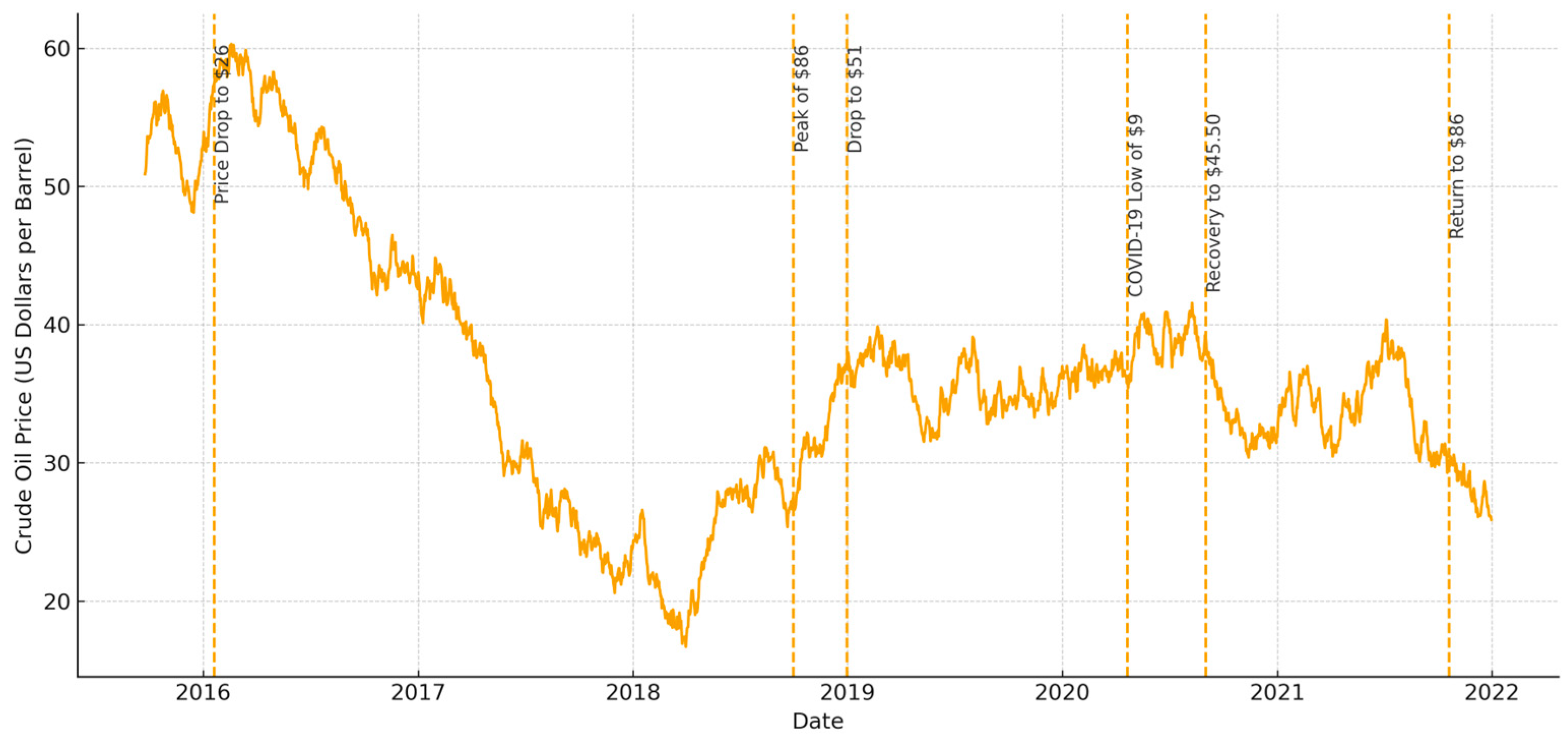
Figure 1. Daily West Texas Intermediate (WTI) Crude Oil Prices with Key Events (September 2015–December 2021). Notes: The figure displays the daily closing price of WTI crude oil (in US Dollars per barrel) from 24 September 2015 to 31 December 2021. Six major geopolitical and pandemic-related events that caused significant price movements are demarcated with vertical dashed lines. Data source: Bloomberg.
Jrfm 18 00713 g001
Table 1. Unit Root Tests at Level.
USACANUKFRAJAP
VariablePPADFPPADFPPADFPPADFPPADF
Bitcoin−1.43−1.433−1.433−1.435−1.443−1.446−1.442−1.444−1.721−1.717
Consumer Discretionary−0.143−0.113−1.531−1.3−2.863 **−2.976 **−1.546−1.104−2.351−2.279
Consumer Staples−0.142−0.05−0.648−0.704−2.903 **−2.913 **−1.09−0.694−2.15−2.219
Energy−1.914−1.958−2.605 ***−2.42−1.688−1.681−2.473−2.18−1.676−1.696
Financials−1.084−1.053−1.51−1.249−2.26−2.284−2.146−2.247−2.686 ***−2.591 ***
Gold−0.806−0.839−0.802−0.833−0.807−0.837−0.804−0.837−0.955−1.041
Health Care−0.201−0.1−4.562 *−4.456 *−1.886−1.692−1.097−0.832−1.737−1.816
Industrials−1.008−0.823−0.885−0.509−1.243−1.159−1.632−1.393−1.534−1.82
Information Technology0.2470.391−0.363−0.192−2.249−2.29−0.515−0.259−0.598−0.677
Materials−1.242−0.977−1.985−1.947−1.532−1.267−1.009−0.818−2.179−2.411
Nominal Effective Exchange Rate−2.302−2.26−2.999 **−2.928 **−3.030 **−2.979 **−1.533−1.46−2.951 **−3.020 **
Crude Oil−2.182−2.703 ***−2.199−2.637 ***−2.195−2.632 ***−2.2−2.641 ***−2.542−2.752 ***
Real Estate−2.347−2.301−2.418−2.476−2.986 **−3.042 **−2.032−1.959−3.304 **−3.094 **
Telecommunication−4.137 *−3.797 *−2.177−1.722−1.378−1.389−1.806−1.526−2.316−2.085
Utilities−1.749−1.224−1.081−0.433−2.113−2.113−2.714 ***−2.958 **−1.083−1.11
3-Month Deposit Rate−1.365−0.686−1.584−0.822−1.538−1.215−3.092 **−2.785 ***−13.947 *−5.308 *
*, ** and *** correspond to significance level at 1%, 5% and 10%, respectively. All variables except the 3-Month Deposit Rate (IR) are in natural logarithms. The null hypothesis indicates that the series contains a unit root (non-stationary).
Table 2. Unit Root Tests at First Order Difference.
USACANUKFRAJAP
VariablePP *ADF *PP *ADF *PP *ADF *PP *ADF *PP *ADF *
D(Bitcoin)−41.185−21.338−41.437−21.645−41.125−21.548−41.314−21.611−39.806−20.119
D(Consumer Discretionary)−45.982−13.144−42.844−10.191−36.571−14.592−38.965−10.527−40.58−16.186
D(Consumer Staples)−45.078−11.831−40.756−12.285−40.062−10.286−39.665−15.927−40.814−20.642
D(Energy)−42.525−10.561−42.057−11.879−36.186−14.288−36.145−13.679−38.135−38.13
D(Financials)−46.533−10.343−42.307−11.004−38.008−14.359−36.796−11.883−38.755−22.962
D(Gold)−38.536−38.529−38.773−38.77−38.573−38.571−38.659−38.657−37.918−37.778
D(Health Care)−46.004−12.151−38.494−10.387−40.718−14.963−39.662−13.772−39.033−16.178
D(Industrials)−44.79−10.672−44.716−12.289−38.189−14.637−38.055−14.845−39.316−22.673
D(Information Technology)−49.252−11.251−40.51−9.177−39.762−14.303−39.54−15.405−39.437−26.077
D(Materials)−42.796−10.993−39.079−39.079−40.06−10.438−42.943−14.069−38.84−22.16
D(Nominal Effective Exchange Rate)−39.316−39.316−38.71−24.517−38.622−20.756−43.144−11.592−39.328−19.337
D(Crude Oil)−41.419−6.385−41.795−6.482−41.599−6.398−41.703−6.446−38.872−8.492
D(Real Estate)−42.677−10.453−38.374−13.64−33.725−14.402−37.525−10.749−34.586−11.437
D(Telecommunication)−44.452−11.528−46.659−9.366−38.537−14.68−40.702−14.021−40.566−10.915
D(Utilities)−44.535−10.304−42.363−13.396−39.5−12.211−37.384−13.26−37.584−16.526
D(3-Month Deposit Rate)−81.149−9.268−87.317−8.834−60.821−19.571−94.561−10.474−88.567−10.731
* correspond to significance level at 1%, respectively. The D corresponds to the first-order difference of a variable. All variables except the 3-Month Deposit Rate (IR) are in natural logarithms. The null hypothesis indicates that the series contains a unit root (non-stationary).
Table 3. Summary of Pre-COVID-19 Conditional Correlations: Oil-Exporting vs. Oil-Importing Countries (24 September 2015–30 December 2019).
SectorOil-Exporting Countries
(USA, CAN)
Oil-Importing Countries
(UK, FRA, JAP)
Energy-Intensive Sectors
Consumer Discretionary (CD)Significant (+)Insignificant
Energy (EN)Significant (+)Significant (+)
Industrials (IND)Significant (+)Insignificant
Materials (MAT)Significant (+)Insignificant
Utilities (UTI)InsignificantInsignificant
Non-Energy-Intensive Sectors
Consumer Staples (CS)Significant (+)Insignificant
Financials (FIN)Significant (+)Insignificant
Health Care (HC)Significant (+)Insignificant
Information Technology (IT)Significant (+)Insignificant
Real Estate (RE)Significant (+)Insignificant
Telecommunication (TEL)Significant (+)Insignificant
Other Variables
Bitcoin (BTC)Significant (+)Insignificant
Gold (GOLD)Significant (+)Significant (+)
3-Month Deposit Rate (IR)Significant (−)Insignificant
Nominal Effective Exchange Rate (NEER)InsignificantInsignificant
Note: (+) = Significant positive correlation; (−) = Significant negative correlation. (+) and (−) denote a significant positive and significant negative conditional correlation, respectively. “Insignificant” denotes a correlation that is not statistically significant.
Table 4. Summary of Volatility Relationships: Pre- and Intra-COVID-19 Periods.
Volatility RelationshipPre COVID-19—(Oil-Exporting)Pre COVID-19—(Oil-Importing)Intra COVID-19—(Oil-Exporting)Intra COVID-19—(Oil-Importing)
Oil—Sectoral Stock IndicesSignificant (+)Ambiguous (Contradictory)Significant (+)Significant (+)
Oil—Nominal Effective Exchange RateAmbiguous (Contradictory)Ambiguous (Contradictory)Ambiguous (Contradictory)Ambiguous (Contradictory)
Oil—3-month Deposit RateSignificant (−)Ambiguous (Contradictory)Significant (−)Ambiguous
Oil—BitcoinSignificant (+)Ambiguous (Contradictory)InsignificantInsignificant
Oil—Gold PriceSignificant (+)Significant (+)Significant (+)Significant (+)
Note: (+) and (−) denote a significant positive and significant negative conditional correlation, respectively. “Ambiguous (Contradictory)” denotes a statistically insignificant or highly unstable relationship that does not align with a clear, stable theoretical prediction. “Insignificant” denotes a lack of statistical significance. Bold text highlights the key transitions in volatility relationships between periods.
Disclaimer/Publisher’s Note: The statements, opinions and data contained in all publications are solely those of the individual author(s) and contributor(s) and not of MDPI and/or the editor(s). MDPI and/or the editor(s) disclaim responsibility for any injury to people or property resulting from any ideas, methods, instructions or products referred to in the content.



