


Abstract
Artificial Intelligence (AI) is a transformational force reshaping business processes, financial decision-making, and enabling firms to create, deliver and capture value more effectively. While large corporations in South Asian countries, particularly Bangladesh, India, Pakistan and Sri Lanka have started leveraging AI to drive Business Model Innovation (BMI), Small and Medium Enterprises (SMEs) continue to face significant challenges. These include limited infrastructure, poor bandwidth penetration, unreliable electricity, weak institutional capacity and governance immaturity, along with ethics and compliance concerns. These challenges hinder SMEs from fully exploiting AI-driven BMI and reduce their financial resilience and competitiveness in increasingly digital and globalised markets. This paper examines how South Asian countries are adopting AI technologies in SMEs by comparing patterns and variations in adoption, capability, ethics, risks, compliance, and financial outcomes. The paper proposes a tailored, actionable framework, called TRIAD (Target, Restructure, Integrate, Accelerate, and Democratise)-AI, designed to address technical, organisational and institutional challenges that shape AI-driven BMI across South Asian SMEs and to meet regional and global SME needs. The framework integrates the best practices from global AI leaders such as China, Estonia and Singapore, emphasising responsible AI adoption through robust ethics and compliance standards, and risk management, and offering practical guidance for South Asian SMEs. By adopting this framework, South Asian countries can gain a competitive advantage, enhance operational efficiency, support GDP growth across the region and ensure adherence to all relevant international AI standards for responsible, sustainable, and financially sound innovation.
1. Introduction
Traditional Small and Medium Enterprises (EMSs) follow fixed, linear models focused on mainly production and selling goods and services within small local areas and limited digital integration (Teece, 2010; Foss & Saebi, 2017). These traditional models reply to costly manual processes, face-to-face or cash transactions and fixed pricing. For example, a local retail shop sells only in-store, a farmer sells his crops directly to a nearby local market and a small service provider offers standard packages only without customization. While stable, traditional business methods are costly, limit revenue diversification, and alienate customers. These traditional business models face mounting challenges and pressures from rapid technological change, shifting customer expectations and global competition, and growing concerns over financial stability, risk management, and long-term sustainability (Amit & Zott, 2012).
Business Model Innovation (BMI) transforms traditional business practices by redesigning how they operate, deliver and add value. BMI enables SMEs to break the challenges of traditional businesses and unlock new revenue streams, engage diverse customers and improve efficiencies (Foss & Saebi, 2017). For example, a local retail shop shifts from purely physical stores to omni-channel platforms incorporating e-commerce, online payment, social media marketing and home delivery. This expansion offers numerous benefits such as higher revenues, more resilient cash flow and reducing operating costs. In agriculture, BMI enables farmers, who previously sold their crops directly to nearby local markets only, to reach urban consumers using cooperative-based digital marketplaces or blockchain-enabled traceability innovation systems, bypassing intermediaries and benefiting from dynamic pricing and improved income stability (Dung & Dung, 2024). For service providers, BMI allows them to adopt digital platforms to offer on-demand services, personalised pricing and low-cost monthly subscription to generate predictable recurring revenues.
Traditional SMEs move to smart businesses adopting BMI and receive numerous benefits. However, adopting Artificial Intelligence (AI) into BMI, resulting in AI-driven BMI, takes SMEs to the next level by enabling data-driven financial and operational decision-making, automation, customer prediction and trends, and personalised experiences at scale (Rai, 2020; Jorzik et al., 2024). AI technologies such as Machine Learning (ML), Natural Language Processing (NLP) and computer vision allow SMEs to tailor offerings dynamically, optimise supply chains, and innovate fasters with reduced costs (Dwivedi et al., 2021). For example, a local retail shop with AI-driven BMI recommends similar products based on their customer preferences, optimises their stocks via demand forecasting and offers customised services (Wamba Taguimdje et al., 2020). Farmers may use AI-driven BMI through pricing models that dynamically adjust to market conditions (Sheikh et al., 2024). Similarly, service providers use AI chatbots for 24/7 customer engagement, ML models to tailor services for client segments, on-demand support to deliver faster service responses, and predictive analytics to optimise resource allocation and enhance financial sustainability (Dwivedi et al., 2021; Wamba Taguimdje et al., 2020).
Despite numerous benefits of using AI-driven BMI in SMEs, South Asian countries—including Bangladesh, Pakistan, and Sri Lanka—lag behind regional peers like India and far behind global leaders such as China, Estonia and Singapore in infrastructure readiness, access to AI tools, and supportive innovation ecosystems (World Bank, 2021; World Economic Forum, 2024; OECD, 2025). The Chinese government aggressively invested in AI infrastructure, with its AI market valued at over $22 billion in 2023, enabling SMEs to access advanced AI tools, backed by government policies and large-scale digital platforms that support the adoption of AI functions, making the country a global AI leader (World Economic Forum, 2024). Whereas Singapore boasts one of the most advanced digital ecosystems globally, with over 90% SMEs adopting digital strategies for AI-enabled solutions, only around 4% currently adopt AI-specific solutions (IMDA, 2025). Estonia stands out with nearly 99% of public services available online, enabling SMEs to seamlessly integrate AI into business operations while benefiting from strong data security and interoperability, with AI adoption more than doubling from 5.19% to 13.89% between 2023 and 2024 (European Commission, 2024). On the other hand, SMEs of South Asian countries like Bangladesh, Pakistan and Sri Lanka still suffer from limited infrastructure, poor bandwidth penetration (below 40% in rural areas), scarce AI talent pools, low AI literacy and fragmentated policy support that hinder AI adoption into businesses (IMDA, 2025; World Bank, 2021; MITRE & USAID, 2022).
This study aims to explore AI-driven BMI in South Asian SMEs, providing comparative insights and an actionable framework, TRIAD (Target, Restructure, Integrate, Accelerate and Democratise)-AI to address adoption challenges and evaluate how AI influences SME competitiveness, financial resilience, and risk management for inclusive and sustainable growth in the region. To achieve this aim, the study pursues the following objectives:
- Identify institutional, technical, and financial barriers and policy-related challenges affecting AI-driven BMI in South Asian SMEs;
- Analyse the state of AI adoption BMI across SMEs in Bangladesh, India, Pakistan, and Sri Lanka;
- Develop the TRIAD-AI framework that integrates global best practices with regional SME contexts to enhance financial sustainability, risk management, and competitiveness;
- Conceptually evaluate the potential implications of the TRIAD-AI framework for SME competitiveness, financial resilience, and responsible AI adoption in South Asia.
Following the introduction, this paper is organised into nine sections. Section 2 reviews current literatures to identify gaps for adopting AI into business functions. Section 3 outlines the research design and methodology, dealing with the type of study, approach, selection of countries, selection criteria and framework validation. Section 4 discusses the theoretical foundation and essence of the proposed framework. Section 5 introduces the AI-driven BMI framework for SMEs in South Asia. Section 6 explains how to operationalise the proposed framework, including compliance with ethics and the management of financial and operational risks. Section 7 represents the results, highlighting cross country patterns and thematic insights. Section 8 discusses the implications of the findings in relation to economic, financial and risk perspectives, Section 9 outlines the study’s limitations and future research directions, and Section 10 concludes this paper.
2. Literature Reviews
BMI refers to the strategic redesign of business functions and the modification of revenue streams, customer engagement channels, and business strategies to create, deliver, and capture value, improve financial performance, and achieve competitive advantage (Teece, 2018; Mehta & Pandit, 2021). AI-driven BMI involves the integration of AI technologies such as ML, NLP and predictive analytics into existing business models to support further development through process automation, personalised customer experiences, streamlined internal operations, demand forecasting, and data-driven financial and risk-informed decision-making (Agostini et al., 2021). Through this transformation, SMEs can enhance agility, efficiency, customer engagement and financial resilience (Aithal & Aithal, 2020). Many SMEs are not merely using AI tools but are actively redesigning their business models to harness technological agility and competitiveness (Luu & Dung, 2024). According to recent research (Popa et al., 2025; Schwaeke et al., 2024; Kopka & Fornahl, 2024), SMEs can dynamically adapt their business models through AI-driven decision-making and digital transformation, thereby reinforcing competitiveness in rapidly evolving environments.
Recently, many studies have reported that AI adoption among SMEs can enhance decision-making, efficiency, and innovation. The British Chambers of Commerce (2025) reports that around 35% of high-performing SMEs are gaining competitive advantages by integrating AI into their core business processes. Globally, Salesforce (2025) reports that 91% of AI-enabled SMEs gain improved revenues, while 87 note that AI helps them scale operations more effectively and quickly than non-AI-enabled (Dwivedi et al., 2021). In Europe, Sage (2025) reports that 90% of SMEs enhance their productivity using AI, while 75% report improved customer interactions, with adoption rates increasing by 85% between early 2023 and mid-2025. Australian SMEs show a steady 5% quarterly increase in AI adoption, with 40% utilising AI by Q4 2024 for financial forecasting, supply chain optimisation, and customer experience management (Department of Industry, Australia, 2024). Indian SMEs using AI tools such as ChatGPT and ML analytics demonstrate tangible improvements in demand forecasting and marketing effectiveness (Economic Times India, 2025). E-commerce also reports that 23% of Indian businesses implement AI by 2024, with 73% planning expanded AI adoption by 2025 (ASSOCHAM & CPA Australia, 2025).
AI-enabled evaluation not only reduces operational costs and increases profits and efficiency but also fosters innovation agility for SMEs to cope with volatile markets and financial risks. A recent study showed that AI innovation enhances firm performance in SMEs by minimising costs and resource use and maximising profits (Jorzik et al., 2024). In the UK, using AI functions, SMEs show productivity gains between 27% and 133%, with over 83% of these businesses regularly using AI tools like ChatGPT (Department for Business and Trade, 2025; The Times, 2024). Similarly, emerging evidence from SME-focused research confirms that AI adoption fosters innovation capability and operational flexibility, leading to measurable gains in performance and productivity across SMEs worldwide (Badghish & Soomro, 2024; Segarra-Blasco et al., 2025).
In low-and middle-income countries, several factors impede AI-adoption. Shabbir et al. (2021) highlight that limited access to finance, insufficient infrastructure readiness and digital skills gaps are among the most significant barriers. Many SMEs also struggle to run and manage their AI-driven operations due to unreliable electricity, high connection costs, and limited access to advanced computing resources, which lead to higher implementation costs and restrict opportunities for iterative development (FNF, 2025; OECD, 2025). OECD (2025) highlights data quality, availability and legacy systems as major challenges that hinder integration with modern AI tools. A shortage of AI and data-driven skills, human capital, organisational readiness, and training opportunities often slows SME development and increases the risks of failed implementations (Oldemeyer et al., 2024; OECD, 2025). Hale (2025) adds that a lack of training time (52%) and internal expertise (29%) are reported by SMEs as significant obstacles. Beyond these technical and organisational challenges, unclear or weak regulations, limited compliance mechanisms, cultural barriers, limited local markets/ecosystems, language, localisation gaps, ethical concerns and data privacy further complicate AI adoption for SMEs (OECD, 2025). Further evidence from recent multi-country studies highlights structural issues such as low trust in AI governance systems among SME owners, weak institutional incentives, and a lack of understanding of responsible AI practices (Zavodna et al., 2024; Oldemeyer et al., 2024). In contrast, global AI leaders have successfully embedded ethics and compliance within their national AI roadmaps, linking AI innovation with regulatory clarity, responsible adoption and risk governance, thereby providing exemplars for South Asian SMEs.
2.1. Bangladesh
Recently, Bangladesh has made significant strides in embedding AI adoption across its economy to support growth and employment, particularly in the microfinance, agri-tech, and ed-tech sectors through frugal, mobile-based AI solutions (Kabir & Chowdhury, 2021). The government promotes AI adoption by focusing on research and development (R&D), skills development, infrastructure, ethics and start-up acceleration as the foundation of future competitiveness (ICT Division, 2020). Recent studies also show that ICT adoption already improves SME performance, with digitally active firms reporting higher revenues, improved access to finance, and greater operational efficiency (IFC, 2025). However, many SMEs continue to struggle with unreliable electricity, high connectivity costs, and limited access to advanced computing resources, resulting in high operational costs and reduced scalability (OECD, 2025; IFC, 2025). T. Rahman and Sultana (2023) highlight that emerging AI applications in marketing and customer engagement, such as predictive analytics and social media-driven sales, are making good progress; however, these remain largely pilot-scale and vendor-dependent, with limited support from government initiatives. Furthermore, the absence of a comprehensive national AI policy and SME-specific support initiatives continues to challenge SME development. This situation, coupled with non-binding, stakeholder-dependent regulations, and uneven infrastructure across rural and urban settings, and insufficient frameworks for financial scalability and risk management, poses ongoing challenges to AI-driven BMI in SMEs (M. Rahman & Siddiqui, 2022; Khan et al., 2023).
2.2. India
India is actively promoting AI adoption among SMEs through numerous initiatives, including the National AI Policy 2025 (e.g., Digital India, Make in India, and Start-up India) and a vibrant startup ecosystem, aiming to facilitate AI access and innovation across sectors, including agriculture, healthcare, education and manufacturing (NITI Aayog, 2018). A majority of Indian rural SMEs (60% to 65%) actively leverage AI for customer relationship management, predictive analytics, supply chain management, financial forecasting, and market analysis, enabling improved decision-making, operational efficiency, cost reductions and competitive advantage (Kumar et al., 2022). SMEs also benefit from affordable cloud computing and government-backed AI-driven BMI due to the widespread availability of AI-as-a-Service (AIaaS) (Saxena & Kumar, 2023). However, SMEs still face challenges, including inequitable access, limited digital literacy, and uneven AI adoption across regions (skewed towards urban areas), and ongoing risks and compliance issues that affect financial stability and competitiveness (Aithal & Aithal, 2020; IAMAI, 2023; Economic Times India, 2025). The country still lacks binding and enforceable AI regulations, raising concerns about fairness, accountability, financial data protection, and potential vulnerabilities such as bias and misuse (NITI Aayog, 2018).
2.3. Pakistan
Pakistan has recently approved the National AI Policy 2025, establishing a nationwide framework to ensure AI access, build capacity, and support innovation across sectors, including SMEs (Hussain & Rizwan, 2024; Pakistan Ministry of Information Technology & Telecommunication, 2025). The government supports SMEs through dedicated research funding, AI centres of excellence, and AI venture funds to encourage AI-driven BMI and entrepreneurship (Business Times, 2025). Although Pakistan’s digital ecosystem is growing, it continues to face challenges such as weak infrastructure, low Internet speed, poor Internet access in rural areas, frequent power outages, limited AI talent, and policy uncertainties (Ali & Khan, 2020; Defence Journal, 2025). The country lacks effective compliance mechanisms and faces ethics-related risks such as privacy breaches, accountability gaps, financial fraud, and potential misuse, all of which contribute to financial instability and threaten long-term sustainability. These challenges largely stem from weak institutional capacity and governance immaturity (Ahmad et al., 2024). The country also faces a significant skills gap, particularly outside major cities, and incurs high implementation costs for data centres and cloud computing, which hinder the development of scalable and financially sustainable AI systems (Defence Journal, 2025).
2.4. Sri Lanka
Sri Lanka is making notable progress in integrating AI into its SMEs, thereby enhancing productivity and competitiveness. The government and various organisations are implementing initiatives to support AI adoption, such as the Scale Up Sri Lanka 2025 programme, which provides a local and practical perspective on how AI can empower SMEs (ICTA, 2025). High levels of digital literacy and English proficiency in urban areas have further accelerated AI uptake, particularly in sectors such as tourism and retail (Perera et al., 2023). However, SMEs continue to face widespread challenges such as limited availability of quality data, the complexity and lack of interpretability of AI models, and ethical concerns that still pose potential operational risks and economic instability. These issues often contribute to outdated manufacturing practices, high production costs, and constrained productivity growth (APO, 2025). Nevertheless, the country continues to face challenges in AI-driven BMI due to economic instability, inconsistent regulatory direction, financial constraints, and low investment in digital infrastructure (Wijesinghe & Jayathilaka, 2021; Fernando & Senanayake, 2022).
Table 1, based on the findings of the literature review, presents a comparison of AI adoption among SMEs across South Asian countries, highlighting both progress and ongoing challenges. The findings highlight the need for a tailored framework to foster a robust innovation ecosystem and unlock the growth potential of SMEs in the region. Such a framework should address challenges including infrastructure, digital literacy, AI skills development, and equitable access to low-cost technologies. It also integrates financial risk management, operational risk mitigation, and regulatory compliance to support diverse economic contexts across South Asian countries. Based on the five selection criteria discussed later, Table 1 compares the progress and challenges of AI adoption in SMEs across Bangladesh, India, Pakistan, and Sri Lanka.
Table 1.
Comparison of AI adoption in SMEs across South Asian countries—Bangladesh, India, Pakistan, and Sri Lanka. Note: Data compiled from national and institutional sources discussed in the Literature Review—Bangladesh (ICT Division, 2020; M. Rahman & Siddiqui, 2022); India (NITI Aayog, 2018, 2025; Kumar et al., 2022; Saxena & Kumar, 2023); Pakistan (Pakistan Ministry of Information Technology & Telecommunication, 2025); Sri Lanka (ICTA, 2025; Perera et al., 2023; Fernando & Senanayake, 2022); and additional sources (Defence Journal, 2025; OECD, 2025; IFC, 2025; APO, 2025).
3. Research Design and Methodology
This study adopted a conceptual and comparative qualitative research design to examine AI adoption in SMEs across the South Asian countries of Bangladesh, India, Pakistan, and Sri Lanka. The aim of this research is to support AI-driven BMI adoption across various institutional, infrastructural, and regulatory environments by developing a practical and context-specific TRIAD-AI framework.
3.1. Type of Study
This study is conceptual and comparative in nature. It focuses on synthesising theoretical ideas and conceptual evidence from secondary sources, including existing literature, institutional reports and policy documents. It analyses these sources and identifies patterns, gaps, and opportunities in SME digital adoption.
3.2. Approach
This study adopted a conceptual framework development approach, supported by a comparative qualitative analysis of four South Asian countries, and connects theory with practice by highlighting how AI-related opportunities and constraints manifest differently across national and institutional contexts.
3.3. Selection of Countries
South Asian countries represent diverse stages of AI readiness, digital transformation, and economic development, offering significant potential for SME growth in the future. India demonstrates relatively advanced AI policies and ecosystem support, whereas Bangladesh, Pakistan, and Sri Lanka continue to face persistent institutional, infrastructural, and regulatory challenges. This diversity offers a comparative framework that highlights country-specific limitations and transferable best practices.
3.4. Selection Criteria
The comparative analysis was based on five selection criteria or factors: (1) Government Policy and Support, (2) SME AI Adoption Progress, (3) Infrastructure and Digital Readiness, (4) Skills and Human capital, and (5) Key barriers. These criteria fully capture the institutional, technological, and human capital dimensions that most strongly influence AI adoption in SMEs across South Asia. They are also aligned with international frameworks such as the OECD (2019a) AI Principles and the World Bank (2024) SME Digital Readiness Indicators. Therefore, these criteria were selected to ensure consistency with globally recognised AI governance and SME development standards.
3.5. Data Sources
This study relies exclusively on secondary sources, including peer-reviewed journal articles, government policy papers, institutional reports (e.g., World Bank, OECD, IMF and ADB) and international case studies on AI and SMEs. It extracts and analyses secondary sources to compare national strategies, institutional capacities, and AI adoption trends in SMEs and integrates qualitative evidence to identify relationships between policy frameworks, infrastructure, and SME innovation potential, even though no quantitative data are used.
3.6. Framework Validation
This study developed the TRIAD-AI framework based on the best practices of global AI innovation, including those of China, Estonia, and Singapore, aligning with the local, regional, and national needs of South Asian countries and integrating global standards for ethical AI governance with financially sustainable strategies. The framework’s validation is theoretical rather than empirical, achieved through its alignment with existing models (e.g., TOE, TAM, and DOI) and global AI policy benchmarks.
3.7. Limitations
This study does not include empirical validation. However, future research could empirically validate the TRIAD-AI framework across diverse SME contexts to evaluate its practical applicability and effectiveness.
4. Theoretical Grounding
The TRIAD-AI framework is grounded in established theoretical models that explain technology adoption and innovation within organisations, particularly the Technology–Organization–Environment (TOE) framework. It aims to provide SMEs in South Asian countries with technological and financial advantages, including enhanced financial stability, risk management, resilience and sustainability. To overcome uncertainty in the financial sector, Awan et al. (2025) proposed a framework that combines AI with foresight techniques, helping firms mitigate risks and maintain competitiveness in volatile markets through predictive analytics. Badghish and Soomro (2024) demonstrated the TOE framework for SMEs adopting AI, identifying factors that influence business performance. The framework indicates that relative advantage, compatibility, and government support are crucial to financial stability and operational outcomes.
Risk management can be a central consideration when SMEs adopt AI for BMI. Sotamaa et al. (2024) showed that SMEs face macro- and micro-environmental risks such as market fluctuations, supply chain disruptions, technology failures, and that AI can help them detect potential challenges, risks and financial instability and uncertainty at an early stage. Connecting all of these insights highlights the important of embedding AI tools in financial forecasting, supply chains and customer engagement to enhance operational resilience and competitiveness.
Finally, the integration of sustainability and Environmental, Social and Governance (ESG) principles into AI-driven BMI is a cornerstone of success. In promoting financial resilience and long-term competitiveness, both AI-driven innovation and technological enablers help SMEs align with the UN’s Sustainable Development Goals (SDGs), including the goal of achieving zero-carbon emissions (Shaik et al., 2023). They promote democratic processes by bridging the gap between urban and rural areas and fostering inclusivity, responsibility, and sustainability. Collectively, these tools, approaches and theories suggest that the proposed TRIAD-AI framework not only helps SMEs in South Asian countries improve operational efficiency and sustainability but also contributes to financial resilience, risk mitigation, and long-term growth. To address these challenges, the TRIAD-AI framework, built on five interrelated pillars, offers both theoretical and practical foundations for AI-driven BMI, supporting financial resilience, risk mitigation, ethical governance, regulatory compliance, and sustainable value creation, as detailed in the following section.
5. Proposed Framework: TRIAD-AI for South Asian SMEs
The comparative review of South Asian countries (Table 1) highlights both opportunities and structural gaps in AI adoption. While India facilitates SMEs through supportive national strategies, targeted initiatives and a vibrant startup ecosystem, other countries—Bangladesh, Pakistan and Sri Lanka continue to face challenges related to infrastructure, skills and equitable access, resulting in high operational costs, financial vulnerability, compliance concerns, operational risks, and limited competitiveness. The findings indicate that a single approach is not suitable for all of these countries; instead, a tailored framework is needed to address the technical, organisational, institutional, financial, and risk-related challenges that shape AI-driven BMI across South Asian SMEs.
This paper proposes the TRIAD-AI framework, designed to guide SMEs through AI-driven BMI for financial sustainability, risk mitigation, and competitive advantage. The framework not only guides technical adoption but also ensures that systems are transparent, explainable and accountable, while complying with emerging international AI standards (e.g., the Organisation for Economic Co-operation and Development (OECD) AI Principles and the EU AI Act).
The TRIAD AI framework draws from the practices of global AI leaders, particularly China’s platform-based scaling of AI, Estonia’s digital-first governance and Singapore’s policy- and ecosystem-driven innovation in SMEs. South Asian countries can adopt this framework to accelerate their SME transformation through inclusive policy, infrastructure readiness, and ecosystem partnerships. An overview of the TRIAD-AI framework’s five pillars is illustrated in Table 2.
Table 2.
TRIAD-AI Framework overview.
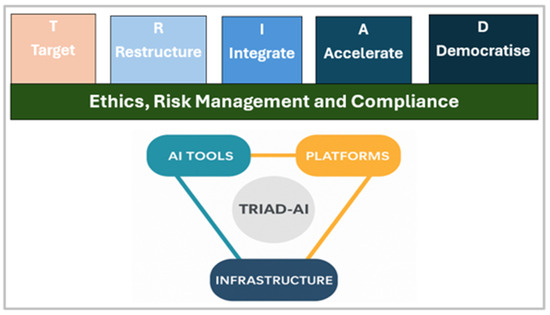
The TRIAD-AI framework’s five pillars are supported by a technological backbone, which consists of AI tools, platforms, and infrastructure and is critical for driving AI adoption across South Asian SMEs. To ensure responsible and sustainable implementation, ethics, risk management, and regulatory compliance are embedded as a cross-cutting layer that underpins all five pillars, aligning adoption practices with the principles of transparency, accountability and fairness. Figure 1 presents the overall structure of the TRIAD-AI framework.
Figure 1.
Structure of the TRIAD-AI framework.
The TRIAD-AI framework aligns with global development priorities by supporting SME competitiveness, inclusive growth, and innovation sustainability, directly contributing to the UN’s SDGs, particularly SDG 8 (Decent Work & Economic Growth), SDG 9 (Industry, Innovation & Infrastructure), and SDG 10 (Reduced Inequalities) (World Bank, 2024).
5.1. Comparison with Existing Frameworks
There are a number of established frameworks related to AI-driven BMI, but they differ from the integrative and regionally adaptive focus of the proposed TRIAD-AI framework. Tornatzky and Fleischer (1990) introduced the TOE framework, which explains technology adoption at the firm level through three contextual dimensions: technological readiness, organizational capability, and environmental support. Although TOE is one of the widely used frameworks to assess adoption drivers, it gives limited attention to ethical, financial, and socio-institutional considerations that influence SMEs in emerging economies.
Davis (1989) proposed the Technology Acceptance Model (TAM), focusing on perceived usefulness and perceived ease of use as key determinants of individual attitudes toward new technologies. The TAM is suitable for predicting user behaviour primarily at the micro (user) level but does not capture system-wide factors such as policy environments or risk governance.
Rogers’ Diffusion of Innovation (DOI) theory (2003) analyses how innovations spread within social systems through the stages of knowledge, persuasion, and decision. The theory focuses primarily on communication and adopter patterns, leaving aside many institutional, regulatory, and ethical factors that play a decisive role for SMEs in developing countries.
Each of the five pillars of the TRIAD-AI framework has a clear design rationale, and together they extend beyond existing models (e.g., TOE, TAM, and DOI). The Target pillar addresses the problem-identification gap in traditional frameworks by helping SMEs define context-specific AI priorities. The Restructure pillar fills organisational and technical gaps identified in TOE by emphasising organisational redesign, governance, and capability building. The Integrate and Accelerate pillars operationalise the diffusion logic absent in TAM and DOI by embedding AI across processes and scaling adoption through ecosystem participation. Finally, the Democratise pillar introduces inclusivity, ethics, and equitable access—dimensions largely missing in existing adoption frameworks.
In contrast, the TRIAD-AI framework integrates and extends these perspectives by embedding financial sustainability, ethical AI governance, and policy alignment as core elements. The framework offers a comprehensive and context-specific methodology for responsible AI-driven BMI in South Asian SMEs, integrating firm-level adoption with national and regional preparedness.
5.2. Key Enablers of the TRIAD-AI Framework
The TRIAD-AI framework offers several strengths, including modular design, global adaptability, inclusivity, financial governance, regulatory compliance, and policy alignment. However, its successful adoption depends on how the following three enabling conditions are applied:
- Institutional Environment—For AI adoption, national policies, infrastructure, compliance with global AI standards, and government support are essential. China’s 2017 AI development Plan, Estonia’s digital governance strategy, and Singapore’s AI roadmaps serve as exemplary models for South Asian countries.
- Organizational Capacity—For the implementation of AI adoption, SMEs require adequate digital literacy, leadership commitment, and internal resources to restructure business operations and integrate AI. Supportive policies will fail if these capabilities are absent. Singapore’s SMEs Go Digital programme, which offers consultancy services, vouchers, and capability-building training, and China’s state-backed incubators, which offer funding and organisational capacity support, represent strong practices that can be applied for South Asia.
- External Networks—Peer learning, accelerators, incentives, and partnerships with universities and large firms are critical for achieving affordable expertise and reducing barriers to entry. AI Singapore, which serves as a national R&D hub connecting universities, government, and SMEs in collaborative projects, and Estonia’s startup- fostering networks, which provide scalable platforms, offer strong exemplars for South Asian countries.
- These enablers also respond to the human-capital gaps identified in the comparative analysis, particularly widespread skills shortages, uneven digital literacy, and limited organisational readiness across SMEs in South Asia. The five pillars of the TRIAD-AI framework support capacity building by enabling context-specific targeting, operational redesign, AI integration, scalable adoption, and inclusive participation, and they can be customised to reflect local, regional and national SME needs. Together, these elements ensure that the framework addresses not only institutional and infrastructural gaps but also the human–capital constraints that hinder SME participation in AI-driven BMI.
6. Operationalising the TRIAD-AI Framework
Operationalising the TRIAD-AI framework requires clear pathways for adoption and practice among South Asian SMEs, tailored to diverse local/regional contexts. The following five steps outline an implementation process for SMEs, policymakers and ecosystem partners.
Step 1—Assessment and Targeting: SMEs begin by systematically mapping their current business models and using tools such as Business Model Canvas (BMC) to identify bottlenecks, financial risks, and opportunities that can be addressed by AI technologies. At this state, risk assessment should be conducted carefully to evaluate exposure and readiness, as well as minimise overall costs. For example, a Bangladeshi textile or agricultural firm may identify inventory or stock volatility and unstable cash flows as critical constraints, and may prioritise AI-driven demand forecasting tools as a solution.
Step 2—Restructuring with AI Capabilities: After conducting the risk assessment and identifying bottlenecks and opportunities, SMEs need to redesign their value creation processes. At this stage, SMEs should choose AI-driven tools carefully to minimise operational risks and reduce the financial burden. AI-driven tools such as digital workflow platforms (e.g., Zoho, HubSpot or Zapier) can help SMEs redesign their business operations. For example, a Sri Lankan tourism SME could shift from offline or partially online booking to an AI-driven digital booking platform, thereby improving revenue predictability and reducing transaction risks.
Step 3—Integration of AI Solutions: SMEs embed AI tools into business processes, including Chatbots for customer support, Optical Character Recognition (OCR) for document digitalisation, and predictive analytics for financial decision-making and risk analysis. Technical integration can be achieved through APIs, low-code/no-code platforms, and consultant-supported onboarding. These tools should align with financial capacity and risk tolerance. For example, with a strong AI ecosystem, India can offer replicable practices, while countries with limited infrastructure (e.g., Bangladesh, Pakistan and Sri Lanka) may reply on cloud-based AIaaS solutions.
Step 4—Acceleration and Scaling: With AI technologies, SMEs can leverage automation to scale operations, enabling personalised customer engagement, multilingual outreach, targeted advertising, and logistics optimisation. This step continues to accelerate growth while maintaining operational stability and managing risks. For example, Pakistani SMEs in e-commerce can adopt AI-driven logistics platforms to improve delivery precision, while Sri Lankan SMEs in tourism can adopt AI-driven recommendation systems to attract international clients, boost revenue, and strengthen foreign exchange stability.
Step 5—Democratisation and Inclusivity: Open-source AI tools, government-supported SME training, and microfinance schemes are essential for successful AI adoption into SMEs. Democratisation ensures both open access to AI and responsible AI practices, helping to reduce gaps between rural and urban areas. For example, mobile-based advisory services in rural areas of Bangladesh and India can provide cost-effective solutions while also upholding transparency, safeguarding data privacy, ensuring financial integrity, enhancing explainability, and maintaining regulatory compliance.
One important feature of the framework is that ethics, risk management and compliance should be implemented at each step. Particularly, the framework reflects the EU AI Act (Article 62, 2025) by embedding support mechanisms such as microfinance scheme, SME training, and regulatory guidance at Step 3 and 5, enabling the adoption of AI responsibly while meeting local and regional needs. It also aligns with the OECD AI principles (OECD, 2019b) by embedding fairness and inclusivity in Step 5, ensuring that both rural and urban SMEs benefit equitably from AI access. However, the success of operationalising AI adoption heavily depends on institutional and ecosystem support, including governments, development agencies, and partner organisations. They must provide clear policies, infrastructures, support initiatives, micro-loans, subsidiaries and context-specific facilities while ensuring robust financial governance, effective risk management, and compliance with all relevant international AI standards.
6.1. Embedding Ethics and Compliance in TRIAD-AI
All SMEs should adopt AI adoption in BMI responsibly and responsively. To comply with the OECD (2019a) AI Principles and the EU (European Union, 2024) AI Act, TRIAD-AI places a strong emphasis on ethics and compliance, embedding them across all pillars as a central focus. This layer includes transparency, explainability, fairness, accountability, and privacy protection. For SMEs, these principles translate into practical responsibilities. Transparency ensures that SMEs understand how AI tools affect business processes and customer interactions. Explainability ensures accessible and understandable outputs for financial and risk management related decision-making applications. Fairness ensures that AI models do not introduce biases in financial dealings, pricing, or exchange rates. Accountability ensures robust governance structures for AI adoption, while privacy protection safeguards customer and financial data in compliance with local, regional, and cross-border regulations.
The TRIAD-AI framework aligns with broader SDGs and establishes competitiveness and social trust not only in the South Asian region but also globally. For example, using the TRIAD-AI framework, SMEs should consider ethics and compliance to ensure inclusive and socially beneficial outcomes at the Target (T) pillar; adopt transparent workflows, privacy-preserving techniques, and quality decision making logics during the Restructure (R) and Integrate (I) pillars; employ explainable tools for personalised services at the Accelerate (A) pillar and support training programmes and microfinance schemes to promote equitable access at the Democratise (D) pillar.
6.2. Managing Financial and Operational Risks in TRIAD-AI
South Asian SMEs are typically smaller in scale and often operate with limited financial resilience. According to the Asian Development Bank (ADB) (2023) report, more than 90% of enterprises operate with marginal profits and face financial barriers. While adopting AI-driven BMI, these firms face multiple risks, including liquidity pressures, which jeopardise their capacity to compete, attract customers, and maintain their financial sustainability (World Bank, 2024). They often face high upfront costs for digital infrastructure, cloud platforms, and skilled labour. Operational risks are also high in South Asian SMEs, particularly during restructuring and the adoption of AI. When AI tools are poorly integrated or inadequately maintained, operations are hampered. Data privacy and cybersecurity threats further increase risks, and many SMEs lack robust systems to safeguard sensitive customer and financial data (OECD, 2019b). Due to compliance and regulatory requirements, some SMEs may struggle and face difficulties operating their businesses effectively.
The TRIAD-AI framework helps SMEs mitigate their financial and operational risks through its structured, step-by-step approach. For example, SMEs prioritise AI adoption only when it has a high impact on the business and focus on low-cost domains at the Target (T) stage. Due to the low cost of cloud-based and modular AI solutions, these tools are ideal for SMEs because they enable firms to extend their capabilities cost-effectively during the Restructure (R) and Integrate (I) phases. The Accelerate (A) pillar supports operational resilience by leveraging automation and predictive tools. The Democratise (D) pillar invests in human capital through training and inclusive funding mechanisms, fostering equality and building trust. As a result, the TRIAD-AI framework assists SMEs in attaining stability and sustainability while managing their operational and financial risks.
7. Results
There are distinct disparities in AI adoption and preparedness among South Asian SMEs. These differences are reflected across the four countries examined in this study. The following subsections present country-specific findings, followed by cross-country patterns and thematic insights.
7.1. Country-Specific Results
The results indicate that each country has made progress, yet their levels of capability, infrastructure, institutional maturity, and readiness for AI-driven BMI differ considerably.
- India is the most prepared South Asian nation for AI adoption by SMEs, supported by strong regional start-up ecosystems (e.g., Bengaluru, Delhi, and Hyderabad) and comprehensive national policy initiatives. However, the country faces a national divide in such development. While urban SMEs use AI for forecasting, logistics, analytics, and customer management, many rural firms still struggle to access even basic digital infrastructure.
- Bangladesh is in an early stage of AI adoption. Although the country’s policy emphasises R&D, skills development, and start-up acceleration, progress in these areas is hampered by the absence of a unified AI policy and by fragmented implementation mechanisms. SMEs in microfinance, agricultural technology (AgriTech), and education technology (EdTech) mainly use AI applications for BMI, but these remain pilot-scale and vendor-dependent. Infrastructure bottlenecks, unreliable power supply, skill shortages, and limited institutional capacity create barriers to scalability and long-term resilience.
- Pakistan has recently introduced several initiatives to support AI adoption, including research funding, new AI centres of excellence, and venture support mechanisms. However, the country faces weak digital infrastructure, frequent power disruptions, and a shortage of AI professionals, along with institutional immaturity and policy uncertainty. Collectively, these factors hamper implementation, increase risks, and place sustainability beyond reach.
- Sri Lanka has recently undertaken targeted initiatives such as Scale Up Sri Lanka 2025 to promote AI adoption and has shown notable progress in sectors such as tourism, retail, and manufacturing, where SMEs are using AI for customer analytics and productivity improvement. This progress has been supported by high digital literacy in urban areas. However, economic instability, data-quality issues, and underinvestment in digital infrastructure make widespread adoption difficult.
7.2. Cross Country Patterns and Thematic Insights
Several regional patters are found from the results:
- Policy and Governance: India leads with coherent AI policies and strategies, whereas Bangladesh, Pakistan and Sri Lanka are behind and still developing their AI policies and strategies to support SMEs. Such fragmented policy and governance structures slow down AI-driven BMI and hinder the adoption of responsible AI standards.
- Infrastructure and Digital Readiness: Digital ecosystems differ significantly across the region. India and Sri Lanka have relatively strong digital infrastructure in their urban areas. On the other hand, Bangladesh and Pakistan, along with rural regions of India, still face challenges related to accessibility, reliable connectivity and the affordability of cloud platforms.
- Economy and Financial Implications: With the integration of AI-driven BMI, urban SMEs in India and Sri Lanka are improving their operations and managing revenue diversification. However, limited financial resilience limits widespread scaling across all South Asian countries.
- Human Capital and Skills: All four countries face AI-related skill gaps, which are the critical bottleneck for the growth of their SMEs, particularly in rural and semi-urban areas.
- Ethics, Risk and Compliance: None of the four South Asian countries possesses a robust regulatory framework comparable to global SME leaders such as China, Estonia, and Singapore. They also face recurring challenges, including ethical risks, data privacy concerns, and inadequate compliance systems.
- Collaboration and Ecosystem Support: South Asian countries lack strong partnerships and coordinated ecosystem support among government, academia, and industry to foster AI-driven BMI. This fragmentation limits shared learning, technology transfer, and innovation scaling.
- Performance Outcomes: Although quantitative metrics vary across countries, the above several patterns point toward potential measurable indicators such as productivity gains, operational efficiency improvements, and strengthened financial resilience, which can be explored in future empirical assessments of AI-driven BMI.
7.3. Framework Derivation
The proposed TRIAD-AI is grounded in the results of the comparative assessments directly. The observed disparities underscore the necessity for a regionally adaptive model that combines technological readiness with institutional and ethical governance.
- Weak infrastructure and skill shortages slow SME growth. The Target and Restructure pillars address these gaps by focusing on foundational readiness and capacity building.
- While many SMEs struggle to integrate AI into their daily operations, the Integrate and Accelerate pillars aim to bring digital tools into regular business use and make growth easier to scale.
- Unequal access and weak governance continue to hold many SMEs back. The Democratise pillar therefore focuses on widening participation and keeping the ethical use of AI at the core of development.
- For collaboration and ecosystem support, the Target pillar identifies key actors (e.g., government agencies, institutions and private enterprises); the Restructure pillar designs policy and institutional mechanisms to enable partnerships; the Integrate pillar links SMEs with these key actors to support knowledge exchange and technology transfer; the Accelerate pillar scales successful AI solutions; and the Democratise pillar ensures equitable access to resources and ethical alignment across the SME ecosystem.
Overall, the analysis shows that India is the leader in AI adoption due to comparatively stronger national policy initiatives and a more mature digital ecosystem among South Asian SMEs. Sri Lanka shows moderate progress in AI adoption, driven by sector-specific initiatives, but challenges persist due to economic instability and uneven digital literacy. Bangladesh and Pakistan demonstrate early stage AI adoption, but progress remains uneven, constrained by skills shortages, infrastructural limitations, and fragmented institutional support. These findings therefore address the study’s objective by presenting a clear comparative overview of the status of AI adoption across SMEs in Bangladesh, India, Pakistan, and Sri Lanka.
8. Implications and Discussion
The results show that South Asian SMEs would benefit from an integrated framework that builds digital and financial resilience while embedding accountability, inclusivity, and sustainability in AI-based business models. This approach could help firms address risks and manage everyday operational challenges more effectively. Building on these results, the broader implications of AI-driven BMI reveal both opportunities and persistent structural challenges across the region. This study highlights the transformative potential of AI-driven BMI for SMEs in South Asian countries, particularly Bangladesh, India, Pakistan, and Sri Lanka. These economies face several common challenges, including limited digital infrastructure, energy instability, talent and skills shortages, financing gaps, and regulatory uncertainty, all of which hinder AI-driven BMI in SMEs. The proposed TRIAD-AI framework, informed by global SME leaders—China, Estonia, and Singapore—offers a pathway to overcoming these challenges. If the framework is adapted to local and regional SME settings, it can directly contribute to the UN’s SDGs, particularly SDG 8, SDG 9, and SDG 10 (World Bank, 2024), while also supporting GDP growth, financial resilience, and inclusive innovation across the region. It also encourages SMEs to comply with all relevant AI standards by embedding ethics, governance, and compliance mechanisms for responsible AI-driven BMI.
The findings of this study align with existing technology adoption frameworks and provide further insights into essential areas such as financial resilience, ethics, inclusivity, and regional collaboration for the sustainable growth of SMEs. The TAM (Davis, 1989) primarily explains how individuals perceive a system’s usefulness and ease of use. In TRIAD-AI, this concept is extended to assess the readiness of both organisations and policy settings for AI adoption. The DOI theory (Rogers, 2003) is also relevant. Within TRIAD-AI, the Integrate and Accelerate pillars illustrate how new practices diffuse as stakeholders collaborate, share learning, and incrementally build on effective solutions rather than follow a single, fixed process. Therefore, the framework moves beyond the boundaries of existing models by linking South Asian SMEs across the micro (firm-level), meso (institutional), and macro (policy) layers of AI adoption, thereby fostering inclusive and sustainable development.
To further illustrate the practical relevance of the TRIAD-AI framework, Table 3 compares the expected outcomes of TRIAD-AI implementation (after adoption) with conventional SME practices (before adoption). The table highlights how the five pillars of the framework collectively enhance operational efficiency, innovation, governance, and risk management, thus translating theoretical value into measurable business benefits, such as strategic readiness, digital capacity, ethical governance, and sustainable growth among South Asian SMEs. Although this study is conceptual, the before-after implications shown in Table 3 can be linked to measurable indicators such as productivity improvements, operational efficiency gains, cost reductions, and enhanced financial resilience, which future empirical studies may quantify in detail.
Table 3.
Comparative overview of TRIAD-AI benefits.
South Asian countries are generally technologically and financially behind their global peers; subsequently, the TRIAD-AI framework emphasises three interconnected technological components—AI tools, digital infrastructure and scalable platforms—as the foundation for operationalisation in SME contexts. Together, these components provide a strategic blueprint for transforming and restructuring business processes, enhancing financial decision-making, and improving risk managing through AI-driven technologies, thereby enabling competitive advantage and sustainable economy growth. The framework aligns with international ethical and regulatory standards, such as the OECD (2019a) AI Principles and the EU (European Union, 2024) AI Act, to ensure the responsible use of AI tools, support responsible innovation, and strengthen compliance across regulatory environments.
South Asian countries can learn from each other due to the similarity of their challenges and structural issues, and can build cross-border external networks and regional collaborations, both of which are critical to the success of the TRIAD-AI framework. For example, Indian SMEs benefit from strong governmental support initiatives and a vibrant AI startup ecosystem (Kumar et al., 2022). Countries like Bangladesh, Pakistan, and Sri Lanka could adopt similar measures by prioritising digital infrastructure expansion, SME-focused financing instruments, capacity building, and sector-specific AI solutions to overcome barriers and accelerate SME adoption of AI technologies. In addition, partnerships with universities and large firms, along with accelerator programmes and joint R&D initiatives, can provide SMEs with affordable expertise, resources, and capacity-building opportunities, thereby playing a critical role in supporting successful AI adoption.
Three interrelated components—platforms, infrastructure, and AI tools—form the backbone of the TRIAD-AI framework and are derived from insights in the comparative analysis. These components are essential for enabling AI-driven BMI in SMEs, facilitating integration across operational, financial, and ethical dimensions, and ensuring that innovation is both scalable and sustainable. Although the TRIAD-AI framework provides a unified structure for AI-driven BMI, its components or pillars can be tailored to align with variations in institutional, infrastructural, and policy environments across South Asian countries, and to meet the needs of local, national, and regional SME ecosystems, as well as their technological capacities and market conditions.
Therefore, the TRIAD-AI framework demonstrates both theoretical and practical value for advancing AI-driven BMI in South Asian SMEs by integrating ethics, financial governance, and inclusivity, while offering policymakers and SME leaders a comprehensive roadmap for achieving sustainable economic growth and contributing to the UN’s SDGs.
9. Limitations and Future Directions
This study presents TRIAD-AI as a conceptual framework to guide AI-driven BMI for South Asian SMEs. Although it provides a robust structure and guidance for overcoming financial bottlenecks and managing potential risks, it has some limitations. As a conceptual contribution, this study replies primarily on secondary research and published sources, which may introduce interpretation bias and limit replicability. Variations in data quality, scope and institutional reporting standards across countries could affect the consistency of comparative insights. First, the framework requires empirical validation through multi-country field studies, pilot implementations, or sector-specific case studies to assess its real-world applicability and conceptual adaptability in various business contexts. Second, its successful adoption largely depends on institutional and financial support, which varies across the region, potentially affecting replicability, transferability and consistency of results across different settings.
To enhance replicability, reproducibility and credibility, future research should aim to test and refine the TRIAD-AI framework and employ standardised tools, consistent data collection methods, quantitative validation, and operational definitions of key variables (e.g., AI readiness, ethical compliance, or financial resilience) across countries. Mixed method designs such as combining surveys, interviews, and longitudinal analyses, would allow for the triangulation of evidence, reduce possible bias, and enhance the reliability of replication across settings. Longitudinal studies could explore how SMEs evolve as they adopt AI-driven BMI under different regulatory and policy settings, while comparative research across developing and advanced economies may further evaluate how TRIAD-AI performs under different governance, cultural, and market conditions.
Policymakers should consider integrating TRIAD-AI into national SME and financial strategies, focusing on infrastructure investment, talent and skills development, regulatory frameworks, and ethical AI adoption. Strong collaborative initiatives among SMEs, universities, and the private sectors will be critical to improving the framework’s practical viability, replicability, and continuous refinement, while bridging gaps between policy and practice and ensuring inclusive and sustainable growth across South Asia.
However, governments across the region must take proactive steps to foster a culture of innovation and risk management, ensuring that AI-driven BMI is not only supported but systematically embedded in national development and financial strategies.
10. Conclusions
This study examined the status of AI adoption and AI-driven BMI among South Asian countries, which was the core objective of this paper. The comparative analysis shows that India demonstrates the strongest progress in AI implementation, supported by mature digital ecosystems and policy initiatives. Sri Lanka shows moderate progress in implementing AI, constrained by economic instability and uneven digital literacy, followed by Bangladesh and Pakistan, which exhibit early stage and uneven adoption patterns. These insights highlight both shared regional challenges and country-specific differences across institutional, infrastructural and human, capital dimensions.
In response to these structural gaps, the proposed TRIAD-AI framework offers a flexible and country-sensitive approach that strengthens organisational capacity, embeds ethical governance, and enhances digital and financial resilience. In addition, the framework is flexible and customisable, allowing its five pillars to be tailored or adjusted to align with the institutional, infrastructural and human capital needs of local, national, and regional SME ecosystems.
While the research is based on secondary evidence, the findings provide a conceptual foundation with operationalising guidelines and potential benefits for future empirical validation. Future research could apply measurable indicators and primary data to evaluate the effectiveness of the TRIAD-AI framework across sectors and countries. Overall, the study contributes to the understanding and progress of AI adoption in developing-country SMEs and offers a theoretically grounded, practically applicable, and flexible framework for sustainable and inclusive growth.
Funding
The author received no external funding for this research.
Data Availability Statement
No new data were created or analyzed in this study. Data sharing is not applicable to this article.
Conflicts of Interest
The author declares no conflict of interest.
Abbreviations
The following abbreviations are used in this manuscript:
| AI | Artificial Intelligence |
| AIaaS | AI-as-a-Service |
| API | Application Programming Interface |
| BMI | Business Model Innovation |
| DOI | Diffusion of Innovation |
| EU | European Union |
| IMF | International Monetary Fund |
| ML | Machine Learning |
| NPL | Natural Language Processing |
| OCR | Optical Character Recognition |
| OECD | Organisation for Economic Cooperation and Development |
| R&D | Research & Development |
| SDG | Sustainable Development Goal |
| SME | Small and Medium Enterprise |
| TAM | Technology Acceptance Model |
| TOE | Technology–Organisation–Environment |
| TRIAD | Target, Restructure, Integrate, Accelerate, Democratise |
References
- Agostini, L., Nosella, A., & Filippini, R. (2021). Business model innovation and digital transformation: The moderating effect of digital maturity. Technological Forecasting and Social Change, 165, 120518. [Google Scholar]
- Ahmad, M., Hussain, M., & Mir, H. (2024). Developing a legal framework for digital policy: A roadmap for AI regulations in Pakistan. Lahore Policy Review, 5(1), 1–20. [Google Scholar]
- Aithal, A., & Aithal, P. S. (2020). Opportunities and challenges of artificial intelligence in Indian business sector. International Journal of Applied Engineering and Management Letters (IJAEML), 4(1), 59–72. [Google Scholar]
- Ali, S., & Khan, M. A. (2020). Digital transformation challenges in Pakistan: A policy perspective. Journal of Information Technology, 35(4), 321–335. [Google Scholar]
- Amit, R., & Zott, C. (2012). Creating value through business model innovation. MIT Sloan Management Review, 53(3), 41–49. [Google Scholar]
- Article 62. (2025). EU artificial intelligence act. Measures for providers and deployers, in particular SMEs, including Start-Ups. Available online: https://artificialintelligenceact.eu/article/62/ (accessed on 2 September 2025).
- Asian Development Bank (ADB). (2023). The digital transformation of SMEs in Asia and the Pacific. ADB. [Google Scholar]
- Asian Productivity Organization. (2025). Driving SME competitiveness in Sri Lanka: AI-powered productivity solutions. Available online: https://www.apo-tokyo.org/aponews/driving-sme-competitiveness-in-sri-lanka-ai-powered-productivity-solutions/ (accessed on 2 September 2025).
- ASSOCHAM & CPA Australia. (2025). Business technology report 2024: Indian businesses and AI adoption. CPA Australia in Collaboration with the Associated Chambers of Commerce and Industry of India. Available online: https://www.cpaaustralia.com.au/-/media/project/cpa/corporate/documents/tools-and-resources/business-management/business-management-research/business-technology-report_2024_digital_v1.pdf (accessed on 2 September 2025).
- Awan, U., Sroufe, R., & Hizam-Hanafiah, M. (2025). Enhancing SME resilience through artificial intelligence and strategic foresight: A framework for sustainable competitiveness. Technology in Society, 81, 102835. [Google Scholar] [CrossRef] [Scilit]
- Badghish, S., & Soomro, Y. A. (2024). Artificial intelligence adoption by SMEs to achieve sustainable business performance: Application of technology-organization-environment framework. Sustainability, 16(5), 1864. [Google Scholar] [CrossRef] [Scilit]
- British Chambers of Commerce. (2025). Turning point as more SMEs unlock AI: 35% of SMEs now actively using AI technologies. Available online: https://www.britishchambers.org.uk/news/2025/09/turning-point-as-more-smes-unlock-ai/ (accessed on 4 October 2025).
- Business Times. (2025). Pakistan rolls out AI policy to shape digital future. SPH Media Limited. Available online: https://www.businesstimes.com.sg/ (accessed on 3 September 2025).
- Davis, F. D. (1989). Perceived usefulness, perceived ease of use, and user acceptance of information technology. MIS Quarterly, 13(3), 319–340. [Google Scholar] [CrossRef] [Scilit]
- Defence Journal. (2025). From vision to reality: Infrastructure challenges in Pakistan’s AI ambitions. Defence Journal Publishers, Karachi, Pakistan. Available online: https://www.defencejournal.com/ (accessed on 3 September 2025).
- Department for Business and Trade. (2025). Small companies are using AI quick ‘wins’ to improve efficiency. The Times. Available online: https://www.thetimes.co.uk/article/small-companies-are-using-ai-to-improve-efficiency-enterprise-network-jhvssm2zm (accessed on 2 September 2025).
- Department of Industry, Australia. (2024). AI adoption in Australian businesses—Q4 2024. Available online: https://www.industry.gov.au/news/ai-adoption-australian-businesses-2024-q4 (accessed on 2 September 2025).
- Dung, L. T., & Dung, T. T. H. (2024). Business model innovation and internationalization in SMEs. Journal of Innovation and Entrepreneurship, 13, 48. [Google Scholar] [CrossRef] [Scilit]
- Dwivedi, Y. K., Hughes, L., Ismagilova, E., Aarts, G., Coombs, C., Crick, T., Duan, Y., Dwivedi, R., Edwards, J. J. D., Eirug, A., Galanos, V., Ilavarasan, P. V., Janssen, M., Jones, P., Kar, A. K., Kizgin, H., Kronemann, B., Lal, B., Lucini, B., … Williams, M. D. (2021). Artificial intelligence (AI): Multidisciplinary perspectives on emerging challenges, opportunities, and agenda. International Journal of Information Management, 57, 101994. [Google Scholar] [CrossRef] [Scilit]
- Economic Times India. (2025). 23% of Indian businesses implemented AI, 73% to adopt tech in 2025. The Economic Times (ET CFO). Available online: https://cfo.economictimes.indiatimes.com/news/cfo-tech/23-indian-businesses-implemented-ai-73-to-adopt-artificial-intelligence-tech-in-2025/117874393 (accessed on 3 September 2025).
- European Commission. (2024). Estonia 2024 digital decade country report. Digital strategy—Shaping Europe’s digital future. Available online: https://digital-strategy.ec.europa.eu/en/factpages/estonia-2024-digital-decade-country-report (accessed on 2 September 2025).
- European Union. (2024). Regulation (EU) 2024/1689 of the European Parliament and of the Council of 13 June 2024 laying down harmonised rules on artificial intelligence (Artificial Intelligence Act). Official Journal of the European Union, L 1689, 12 July 2024. Available online: https://eur-lex.europa.eu/eli/reg/2024/1689/oj/eng (accessed on 2 September 2025).
- Fernando, T., & Senanayake, R. (2022). The digital innovation capabilities of Sri Lankan SMEs: Challenges and future directions. South Asian Journal of Business and Management Cases, 11(2), 134–147. [Google Scholar]
- Foss, N. J., & Saebi, T. (2017). Fifteen years of research on business model innovation: How far have we come, and where should we go? Journal of Management, 43(1), 200–227. [Google Scholar] [CrossRef] [Scilit]
- Friedrich Naumann Foundation for Freedom (FNF). (2025). Examining AI in low and middle-income countries: Barriers and policy recommendations (Policy Paper). Friedrich Naumann Foundation. Available online: https://www.freiheit.org/sites/default/files/2025-05/fnf-policy-report-ai.pdf (accessed on 2 September 2025).
- Hale, C. (2025). Many SMBs say they can’t get to grips with AI, need more training. Available online: https://www.techradar.com/pro/many-smbs-say-they-cant-get-to-grips-with-ai-need-more-training (accessed on 7 September 2025).
- Hussain, A., & Rizwan, R. (2024). The case for an industrial policy approach to AI sector of Pakistan for growth and autonomy. arXiv. [Google Scholar] [CrossRef] [Scilit]
- IAMAI (Internet and Mobile Association of India). (2023). Digital India: Internet penetration report 2023. Available online: https://www.iamai.in/our-initiatives/research (accessed on 2 September 2025).
- ICT Division. (2020). National strategy for artificial intelligence—Bangladesh. Government of the People’s Republic of Bangladesh.
- ICTA. (2025). Empowering SMEs with AI: Highlights from scale up Sri Lanka 2025. Available online: https://www.icta.lk/media/news/empowering-smes-with-ai-highlights-from-scale-up-sri-lanka-2025 (accessed on 2 September 2025).
- IFC. (2025). Bangladesh: Country private sector diagnostic. International Finance Corporation. [Google Scholar]
- IMDA. (2025). SMEs go digital—Singapore. Infocomm Media Development Authority. Available online: https://www.imda.gov.sg/how-we-can-help/smes-go-digital (accessed on 2 September 2025).
- Jorzik, P., Klein, S. P., Kanbach, D. K., & Kraus, S. (2024). AI-driven business model innovation: A systematic review and research agenda. Journal of Business Research, 182, 114764. [Google Scholar] [CrossRef] [Scilit]
- Kabir, H., & Chowdhury, S. A. (2021). The role of artificial intelligence in promoting inclusive SME development in Bangladesh (ICT for development working paper series). United Nations Development Programme. [Google Scholar]
- Khan, R., Nasir, S., & Akter, S. (2023). Digitization and SME growth in Bangladesh: Opportunities for AI applications. Journal of Development Policy and Practice, 8(1), 87–105. [Google Scholar]
- Kopka, A., & Fornahl, D. (2024). Artificial intelligence and firm growth—catch-up processes of SMEs through integrating AI into their knowledge bases. Small Business Economics, 62(1), 63–85. [Google Scholar] [CrossRef] [Scilit]
- Kumar, A., Sharma, P., & Gupta, R. (2022). AI adoption in Indian SMEs: Trends and business impacts. Journal of Small Business Management, 60(4), 1023–1041. [Google Scholar]
- Luu, T. D., & Dung, T. (2024). Business model innovation: A key role in the internationalisation of SMEs in the era of digitalisation. Journal of Innovation and Entrepreneurship, 13, 48. [Google Scholar] [CrossRef] [Scilit]
- Mehta, R., & Pandit, R. (2021). AI-driven startups in India: Government support and entrepreneurial dynamics. Technovation Review India, 14(2), 33–48. [Google Scholar]
- MITRE & USAID. (2022). Small and medium enterprise digitization in Bangladesh, Nepal, Sri Lanka, and India. MITRE. Available online: https://www.mitre.org/news-insights/publication/small-medium-enterprise-digitization-bangladesh-nepal-sri-lanka-india (accessed on 2 September 2025).
- NITI Aayog. (2018). National strategy for artificial intelligence #AIFORALL. Government of India. Available online: https://www.niti.gov.in/sites/default/files/2023-03/National-Strategy-for-Artificial-Intelligence.pdf (accessed on 2 September 2025).
- NITI Aayog. (2025). AI for viksit bharat: The opportunity for accelerated economic growth. Government of India. Available online: https://www.niti.gov.in/sites/default/files/2025-09/AI-for-Viksit-Bharat-the-opportunity-for-accelerated-economic-growth.pdf (accessed on 2 September 2025).
- OECD. (2019a). Recommendation of the council on artificial intelligence. Organisation for Economic Co-Operation and Development. Available online: https://legalinstruments.oecd.org/en/instruments/OECD-LEGAL-0449 (accessed on 19 November 2025).
- OECD. (2019b). What are the OECD principles on AI? Available online: https://www.oecd.org/en/publications/what-are-the-oecd-principles-on-ai_6ff2a1c4-en.html (accessed on 19 November 2025).
- OECD. (2025). Asia capital markets report 2025: AI innovation facilitators in Asia. Organisation for Economic Co-Operation and Development. Available online: https://www.oecd.org/en/publications/asia-capital-markets-report-2025_02172cdc-en.html (accessed on 2 September 2025).
- Oldemeyer, L., Jede, A., & Teuteberg, F. (2024). Investigation of artificial intelligence in SMEs: A systematic review of the state of the art and the main implementation challenges. Management Review Quarterly, 75, 1185–1227. [Google Scholar] [CrossRef] [Scilit]
- Pakistan Ministry of Information Technology & Telecommunication. (2025). National artificial intelligence policy 2025. Government of Pakistan. Available online: https://www.dawn.com/news/1927634/federal-cabinet-approves-national-ai-policy-2025 (accessed on 2 September 2025).
- Perera, K., Gunawardana, D., & Pathirana, R. (2023). Exploring the use of artificial intelligence in SMEs in Sri Lanka: An empirical study. Asian Journal of Business and Technology, 6(1), 24–39. [Google Scholar]
- Popa, R.-G., Popa, I.-C., Ciocodeică, D.-F., & Mihălcescu, H. (2025). Modeling AI adoption in SMEs for sustainable innovation: A PLS-SEM approach integrating TAM, UTAUT2, and contextual drivers. Sustainability, 17(15), 6901. [Google Scholar] [CrossRef] [Scilit]
- Rahman, M., & Siddiqui, N. (2022). Digital skills, AI awareness, and business model transformation in Bangladeshi SMEs. Asian Economic Papers, 21(4), 45–68. [Google Scholar]
- Rahman, T., & Sultana, S. (2023). AI adoption in Bangladeshi SMEs: Opportunities and challenges. Journal of Business and Technology, 18(2), 45–59. [Google Scholar]
- Rai, A. (2020). Explainable AI: From black box to glass box. Journal of the Academy of Marketing Science, 48(1), 137–141. [Google Scholar] [CrossRef] [Scilit]
- Rogers, E. M. (2003). Diffusion of innovations (5th ed.). Free Press. [Google Scholar]
- Sage. (2025). The AI revolution: Accelerating SME adoption. Sage UK. Available online: https://www.sage.com/en-gb/company/digital-newsroom/2025/02/10/the-ai-revolution-accelerating-smes (accessed on 2 September 2025).
- Salesforce. (2025). 91% of SMEs using AI report revenue boosts—While 87% scale operations faster than manual competitors. SME Scale. Available online: https://smescale.com/91-of-smes-using-ai-report-revenue-boosts-while-87-scale-operations-faster-than-manual-competitors (accessed on 2 September 2025).
- Saxena, S., & Kumar, V. (2023). AI-as-a-service adoption among Indian SMEs: Opportunities and challenges. International Journal of AI and Business, 8(2), 45–63. [Google Scholar]
- Schwaeke, J., Peters, A., Kanbach, D. K., Kraus, S., & Jones, P. (2024). The new normal: The status quo of AI adoption in SMEs. Journal of Small Business Management, 63(3), 1297–1331. [Google Scholar] [CrossRef] [Scilit]
- Segarra-Blasco, A., Tomàs-Porres, J., & Teruel, M. (2025). AI, robots and innovation in European SMEs. Small Business Economics, 65, 719–745. [Google Scholar] [CrossRef] [Scilit]
- Shabbir, M. S., Ghazi, A. W., & Yasmeen, R. (2021). Artificial intelligence and SME performance in Pakistan: A conceptual framework. Pakistan Journal of Commerce and Social Sciences, 15(2), 343–359. [Google Scholar]
- Shaik, A. S., Alshibani, S. M., Jain, G., Gupta, B., & Mehrottra, A. (2023). Artificial intelligence-driven strategic business model innovations in small- and medium-sized enterprises: Insights on technological and strategic enablers for carbon neutral businesses. Business Strategy and the Environment, 33(1), 310–327. [Google Scholar] [CrossRef] [Scilit]
- Sheikh, A., Simske, S. J., & Chong, E. K. P. (2024). Evaluating artificial intelligence models for resource allocation in circular economy digital marketplace. Sustainability, 16(23), 10601. [Google Scholar] [CrossRef] [Scilit]
- Sotamaa, T., Reiman, A., & Kauppila, O. (2024). Manufacturing SME risk management in the era of digitalisation and artificial intelligence: A systematic literature review. Continuity & Resilience Review, 6(2), 159–178. [Google Scholar] [CrossRef] [Scilit]
- Teece, D. J. (2010). Business models, business strategy and innovation. Long Range Planning, 43(2–3), 172–194. [Google Scholar] [CrossRef] [Scilit]
- Teece, D. J. (2018). Business models and dynamic capabilities. Long Range Planning, 51(1), 40–49. [Google Scholar] [CrossRef] [Scilit]
- The Times. (2024). Small companies are using AI for quick efficiency gains. Available online: https://www.thetimes.co.uk (accessed on 2 September 2025).
- Tornatzky, L. G., & Fleischer, M. (1990). The processes of technological innovation. Lexington Books. [Google Scholar]
- Wamba Taguimdje, S. L., Fosso Wamba, S., Kala Kamdjoug, J. R., & Tchatchouang Wanko, C. E. (2020). Influence of AI on firm performance: Evidence from SMEs. Business Process Management Journal, 26(7), 1819–1835. [Google Scholar]
- Wijesinghe, C., & Jayathilaka, R. (2021). Artificial intelligence in Sri Lanka: Policy, practice, and potential. Digital South Asia Report Series, 2(3), 12–28. [Google Scholar]
- World Bank. (2021). World development report 2021: Data for better lives. World Bank. Available online: https://www.worldbank.org/en/publication/wdr2021 (accessed on 2 September 2025).
- World Bank. (2024). Leveraging artificial intelligence for inclusive growth in emerging markets. World Bank. Available online: https://www.worldbank.org/en/topic/digitaldevelopment (accessed on 19 November 2025).
- World Economic Forum. (2024). AI Governance Alliance unveils inaugural report on equitable AI Strategies. Available online: https://www.weforum.org/stories/2024/01/ai-governance-alliance-debut-report-equitable-ai-advancement (accessed on 2 September 2025).
- Zavodna, L. S., Überwimmer, M., & Frankus, E. (2024). Barriers to the implementation of artificial intelligence in small and medium-sized enterprises: Pilot study. Journal of Economics and Management, 46(1), 331–352. [Google Scholar] [CrossRef] [Scilit]

Disclaimer/Publisher’s Note: The statements, opinions and data contained in all publications are solely those of the individual author(s) and contributor(s) and not of MDPI and/or the editor(s). MDPI and/or the editor(s) disclaim responsibility for any injury to people or property resulting from any ideas, methods, instructions or products referred to in the content. |
© 2025 by the author. Licensee MDPI, Basel, Switzerland. This article is an open access article distributed under the terms and conditions of the Creative Commons Attribution (CC BY) license (https://creativecommons.org/licenses/by/4.0/).