

You are currently viewing a new version of our website. To view the old version click .

Molecules, Volume 30, Issue 4

February-2 2025 - 218 articles

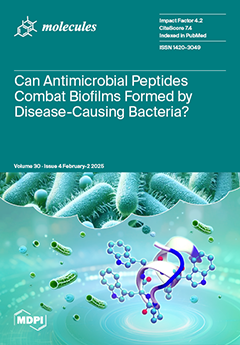
Cover Story: Many pathogenic bacteria can form biofilms, where cells become attached to a surface and are entrapped in a matrix of exopolysaccharides, extracellular DNA, and proteins. Such sessile bacteria are extremely resistant to antibiotics and to the immune system. About two-thirds of all human bacterial infections are now believed to be caused by biofilms, highlighting the need for novel agents that can prevent or reverse biofilm formation. In this work, a 96-well plate screening approach and different detection strategies were used to measure the antibiofilm activity and selectivity of a series of peptides based on the naturally occurring cationic Trp-rich WWW peptide tritrpticin. Structural changes in the peptide backbone and the introduction of a nonnatural amino acid were shown to improve the clinical potential of several peptide variants. View this paper
  • Issues are regarded as officially published after their release is announced to the table of contents alert mailing list .
  • You may sign up for email alerts to receive table of contents of newly released issues.
  • PDF is the official format for papers published in both, html and pdf forms. To view the papers in pdf format, click on the "PDF Full-text" link, and use the free Adobe Reader to open them.

Articles (218)

  • Article
  • Open Access
3 Citations
1,376 Views
17 Pages

Supercritical Fluid Extraction of Lipids from Rowanberry Pomace with Pure CO2 and Its Mixtures with Ethanol Followed by the On-Line Separation of Fractions

  • Viive Sarv,
  • Rajeev Bhat,
  • Laura Jūrienė,
  • Renata Baranauskienė,
  • Dalia Urbonavičienė,
  • Pranas Viškelis and
  • Petras Rimantas Venskutonis

19 February 2025

Fruit processing by-products contain various classes of bioactive constituents, which may find applications as ingredients for foods, nutraceuticals or cosmeceuticals. This study explored the fractionation of lipophilic rowanberry pomace extracts iso...

  • Review
  • Open Access
11 Citations
4,479 Views
24 Pages

19 February 2025

Cardiovascular diseases (CVDs) represent a leading global health crisis, significantly impairing patients’ quality of life and posing substantial risks to their survival. Conventional therapies for CVDs often grapple with challenges such as ina...

  • Article
  • Open Access
2 Citations
1,518 Views
22 Pages

19 February 2025

Molybdenum disulfide (MoS2) is a promising catalyst for hydrogen evolution through water electrolysis with low cost and high efficiency, but its hydrogen evolution performance can be further improved. Using sodium molybdate (Na2MoO4·2H2O) and...

  • Article
  • Open Access
4 Citations
1,843 Views
27 Pages

19 February 2025

This study employed ultrasound-assisted extraction (UAE) to isolate polysaccharides from Lyophyllum decastes, which were subsequently fractionated into two components, LDP-A1 and LDP-B1, using DEAE cellulose-52 and Sephacryl S-500. The structural cha...

  • Review
  • Open Access
5 Citations
2,796 Views
19 Pages

Anticancer Activity of Ether Derivatives of Chrysin

  • Arkadiusz Sokal,
  • Patryk Mruczek,
  • Mateusz Niedoba,
  • Agnieszka Dewalska,
  • Klaudia Stocerz and
  • Monika Kadela-Tomanek

19 February 2025

Chrysin, a naturally occurring flavonoid, exhibits a broad spectrum of biological activities, including showing anticancer properties. However, its clinical application is limited by poor bioavailability and low solubility. The introduction of an ami...

  • Article
  • Open Access
2 Citations
2,469 Views
18 Pages

19 February 2025

This study investigated the capabilities of Yarrowia lipolytica strains to grow in media with different hydrophobic wastes from the meat industry. The yeast growth, cellular lipid accumulation, production of lipases, and degree of utilization of liqu...

  • Article
  • Open Access
2 Citations
1,305 Views
12 Pages

Cytochalasins from the Ash Endophytic Fungus Nemania diffusa DSM 116299

  • Özge Demir,
  • Katharina Schmidt,
  • Barbara Schulz,
  • Theresia E. B. Stradal and
  • Frank Surup

19 February 2025

The secondary metabolome of Nemania diffusa, isolated as an ash endophytic fungus, was analyzed in detail. From its cultures, a previously undescribed cytochalasin 1 was isolated using preparative HPLC, together with six known congeners: 18-dehydroxy...

  • Review
  • Open Access
9 Citations
3,508 Views
23 Pages

Recent Advances in Resveratrol Derivatives: Structural Modifications and Biological Activities

  • Xiaohan Liu,
  • Jian Pei,
  • Jiahui Li,
  • Huiyu Zhu,
  • Xiaoyu Zheng,
  • Xingxing Zhang,
  • Banfeng Ruan and
  • Liuzeng Chen

19 February 2025

Resveratrol, a naturally occurring phenolic stilbene molecule, has been intensively researched for its anti-inflammatory, anticancer, antioxidant, antibacterial, and neuroprotective properties. However, due to its limited absorption and probable hepa...

  • Article
  • Open Access
1 Citations
3,038 Views
14 Pages

Natural Polyamine Spermidine Inhibits the In Vitro Oxidation of LDL

  • Christine Rossmann,
  • Azra Darko,
  • Gerd Kager,
  • Gerhard Ledinski,
  • Willibald Wonisch,
  • Thomas Wagner,
  • Seth Hallström,
  • Gilbert Reibnegger,
  • Margret Paar and
  • Gerhard Cvirn

19 February 2025

Spermidine is a natural autophagy-inducer and anti-aging compound. Herein, we investigated a potential autophagy-independent mechanism of spermidine, namely its capability to directly impede LDL oxidation, an early step in atherogenesis. In our in vi...

  • Article
  • Open Access
1 Citations
2,195 Views
10 Pages

Anti-Melanogenic Effects of L-Theanine on B16F10 Cells and Zebrafish

  • Chih-Li Yu,
  • Haiyue Pang,
  • Zhao Run and
  • Guey-Horng Wang

19 February 2025

L-Theanine, a natural amino acid found in green tea (Camellia sinensis) leaves, is known for its diverse psychotropic effects. This study aimed to evaluate the inhibitory effect of L-theanine on melanin production and uncover its regulatory mechanism...

of 22

Get Alerted

Add your email address to receive forthcoming issues of this journal.

XFacebookLinkedIn
Molecules - ISSN 1420-3049