Skip to Content
  • 1.7
    Impact Factor
  • 2.3
    CiteScore
  • 28 days
    Submission to First Decision
  • 8 days
    Acceptance to Publication

Journal of Nuclear Engineering

Journal of Nuclear Engineering is an international, peer-reviewed, open access journal on nuclear and radiation sciences and applications, published quarterly online by MDPI.

Get Alerted

Add your email address to receive forthcoming issues of this journal.

All Articles (279)

  • Article
  • Open Access

We present a mathematical framework and a numerical solution architecture for the steady-state secondary circuit of the HTR-PM power plant and use it to evaluate physics-based preconditioning for strongly coupled thermo-hydraulic networks. The governing equations are formulated as a non-linear algebraic system partitioned into four physical fields: mass flows, pressures, specific enthalpies, and the internal state of a three-zone once-through helical steam generator, whose economiser and evaporator lengths and helium interface temperatures are solved simultaneously with the cycle. Water and steam properties are evaluated from the IAPWS-IF97 Region 1 and Region 2 basic equations, with exact Newton inversions for all single-phase and states. The system is solved by a Jacobian-free Newton–Krylov (JFNK) method with an Eisenstat–Walker forcing term and Armijo backtracking. Two preconditioners are developed and compared: a field-split preconditioner formed by inverting the four physical field blocks, and an Additive Schwarz Preconditioned Inexact Newton (ASPIN) strategy that performs subdomain Newton sweeps over six physics-motivated subdomains. On the design case, field-split preconditioning needs a single GMRES iteration per Newton step, reducing the Krylov cost of a complete solve by a factor of more than 30 relative to the unpreconditioned iteration and about 12 relative to point Jacobi (diagonal) preconditioning, and it collapses the spectrum of the preconditioned operator onto λ=1, with falling from 4.26 to below 10−9. The condition number alone does not distinguish field-split from point Jacobi; the discriminating property is eigenvalue clustering. In a randomised restart study, in which each component of the initial guess is perturbed by an independent log-uniform factor, field-split converges from 149 of 150 far-from-solution starts within 25 Newton steps, at 6-9 times lower Krylov cost than point Jacobi, and the remaining start converges when the budget is raised. ASPIN converges from 148 of 150 starts, including the only genuine stagnation observed. Our conclusions speak in favour of the physical rather than algebraic considerations for the development of preconditioners for strongly coupled thermal–hydraulics problems.

J. Nucl. Eng.

19 November 2026

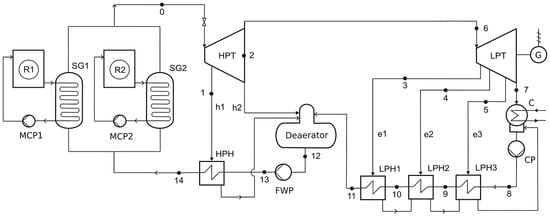
Flow diagram of the HTR-PM steam turbine cycle, where SG—steam generator, R1/2—reactor 1/2, HPT—high-pressure turbine, LPT—low-pressure turbine, LPH-3/2/1—low-pressure feedwater heaters, HPH—high-pressure feedwater heater, DA—direct-contact deaerator, C—condensator, CP—condensate pump, FWP—feedwater pump, e—LPT extraction lines.
  • Article
  • Open Access

Study on Silicon Leaching Behavior for Nuclear Power Plants

  • Jundong Lu,
  • Xiaobin Jiang and
  • Kewei Fang
  • + 4 authors

The boron water system in the primary loop of pressurized water reactors commonly experiences an increase in silicon content. This article combines immersion tests with SEM, FT-IR, and EDX characterization to study the effect of temperature, pH, and boric acid concentration on the silicon leaching behavior of glass fiber filter elements. The results indicate that high temperature, alkaline water environment, and low boric acid concentration will significantly intensify the leaching of silicon. High temperature retards the formation of a surface passivating gel protective layer, OH- destroys the glass silica skeleton, and low boron eliminates the common ion inhibition effect and releases the surface-active sites of glass fiber to accelerate the dissolution of silicon. During the burnup cycle of the unit, the boron concentration decreases, the pH increases, silicon dissolves continuously, and the leached rate increases. The research results also indicate that the glass fiber filter elements used in the primary loop of pressurized water reactor units are one of the stable sources of silicon in the coolant. An increase in silicon content in the primary circuit can cause silicate scaling in the fuel cladding, leading to axial offset anomaly and crud-induced localized corrosion in fuel rods. To ensure the safe and economical operation of the unit, it is necessary to promote the research and development of silicon-free filter replacement and concentrated boron water silicon removal technology.

J. Nucl. Eng.

9 November 2026

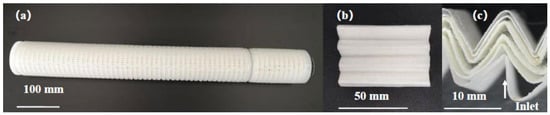
Photographs of the glass fiber filter element (a), the cut sample for testing (b), and the side view of six-layer fabric (slightly separated, (c)).
  • Article
  • Open Access

The removal of decay heat is essential for safety in nuclear power plants, with the Passive Residual Heat Removal System (PRS) serving as a key design feature. The adoption of natural-draft air-cooled heat exchangers provides sustained heat removal without a specified time limit; in these systems, the air-side thermal resistance dominates the overall heat transfer process. However, the lack of applicable empirical correlations presents a significant challenge to the design of the PRS. In this study, a numerical simulation was carried out to investigate the air-side flow and heat transfer characteristics in finned-tube bundles. The effects of key parameters, including tube arrangement, air velocity, and inclination angle, were analyzed. The results indicated that the staggered arrangement achieved a higher heat transfer coefficient than the aligned arrangement, but at the cost of a higher pressure drop. Within the investigated micro-inclination range of 0° to 5°, tube inclination exerts a negligible influence on both the air-side heat transfer coefficient and pressure drop. New correlations for the heat transfer coefficient and pressure drop were developed for staggered circular finned-tube bundles, providing reliable tools for the design of the PRS in pressurized water reactors.

J. Nucl. Eng.

7 November 2026

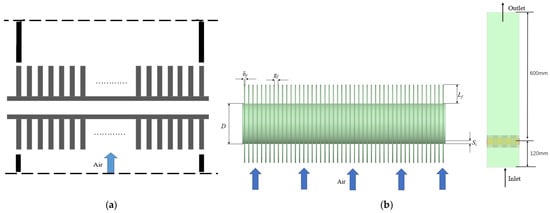
Test section configuration and computational domain. (a) Test section configuration. (b) Computational domain.
  • Article
  • Open Access

Uranium mononitride (UN) is a promising advanced nuclear fuel, but radiation-induced defects compromise its performance and lifespan. Molecular dynamics simulations are indispensable for capturing these atomic-scale behaviors, yet their application to UN has long been limited by the insufficient accuracy of classical empirical potentials. In this study, we employ a high-fidelity neuroevolution potential for the UN system containing C and O impurities to systematically evaluate irradiation damage in both pristine and impurity-bearing UN fuels. Our results show that the defect evolution behavior induced by cascade collisions along different primary knock-on atom (PKA) directions exhibits little difference. The PKA energy is roughly proportional to the residual defect number; however, at the same PKA energy and temperature, the residual defect number in UN is significantly smaller than that in UO2. Over the temperature range investigated, the peak defect number tends to increase with rising temperature, while the residual defect number decreases slightly, corresponding to an increase in annihilation efficiency with temperature. Vacancies are more prone to form clusters than interstitials, and both the cluster number and size in the UN system are significantly smaller than those in UO2. For the impurity-containing systems, increasing impurity concentration slightly reduces the residual defect number, while the variation in annihilation efficiency does not exhibit an obvious concentration dependence. This work provides a systematic atomic-scale reference for the radiation damage behavior of UN and highlights the importance of impurity effects in evaluating its irradiation performance.

J. Nucl. Eng.

5 November 2026

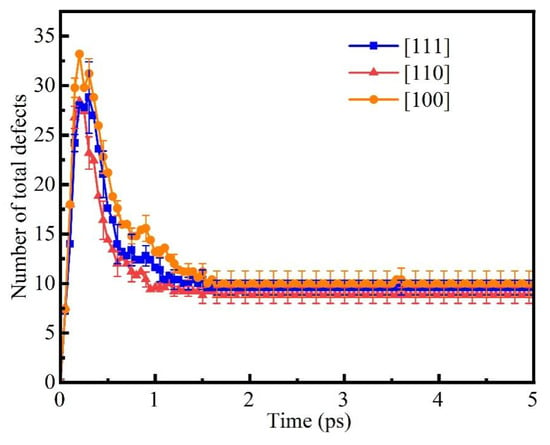
Time evolution of the total number of defects generated by cascade collisions in UN under the conditions of 300 K and a 5 keV U-PKA, for three initial PKA directions.

Highly Accessed Articles

News & Conferences

Latest Issues

Open for Submission

Journal Sections

XFacebookLinkedIn
J. Nucl. Eng. - ISSN 2673-4362