


Abstract
The fashion industry faces growing pressure to demonstrate credible sustainability performance across environmental, social and economic dimensions, yet integrated approaches remain underdeveloped, particularly for small and medium-sized enterprises and social enterprises operating in circular textile systems. This article examines the case of INS3RTEGA, a Spanish textile social enterprise that combines post-consumer textile waste management with protected employment for people with disabilities. Using an exploratory single-case design informed by Triple Bottom Line thinking, the study develops a pragmatic assessment strategy that combines a partial Social Return on Investment (SROI)-style calculation, a simplified carbon-based estimation informed by life cycle thinking, and a set of non-monetised social inclusion and employment indicators. The results reveal a distinctive configuration of integrated sustainability performance: substantial avoided climate-related burden and high textile recovery rates, strong structural inclusion outcomes through disability-inclusive employment, and a modest partial monetised return under conservative and incomplete valuation assumptions. The case illustrates how socially inclusive circular fashion models may generate meaningful sustainability value that remains only partially visible through conventional financial or fully monetised metrics. The article discusses methodological implications for hybrid impact assessment in resource-constrained organisations and policy implications for the emerging European framework on sustainable and circular textiles.
1. Introduction
Sustainability has become a defining challenge for the fashion industry because the sector combines high resource intensity, globalised supply chains, and major social externalities within a business model historically shaped by acceleration, disposability, and cost minimization [1,2,3]. Over the last decade, these concerns have intensified as fast fashion has continued to amplify overproduction, shorten garment lifespans, and increase the volume of post-consumer textile waste, while also reproducing labour vulnerabilities and uneven value distribution across the supply chain [1,3,4]. As a result, the debate has shifted from whether fashion should become more sustainable to how sustainability can be measured in a way that is analytically credible, operationally useful, and resistant to symbolic or selective reporting.
Within this debate, circular fashion has emerged as a central response to the limitations of the linear “take-make-dispose” model. In the specific context of textiles, circular fashion emphasises durability, reuse, repair, redistribution, resale, and recycling as strategies for extending garment lifespans, slowing material throughput, and reducing dependence on virgin resource extraction [3,5]. More broadly, this logic is consistent with circular economy scholarship, which conceptualises circularity as a systemic alternative to linear production and consumption models [6,7]. Yet circularity alone does not automatically ensure sustainability. A model may improve material recovery while still failing to generate equitable labour outcomes, meaningful inclusion, or durable economic viability. This is especially relevant in the textile field, where environmental gains may coexist with fragile organisational structures, low margins, or underexamined social impacts.
The Triple Bottom Line (TBL) has long provided one of the most influential frameworks for conceptualising sustainability as the joint pursuit of economic viability, environmental responsibility, and social value creation [8,9]. In principle, the TBL is particularly well suited to circular fashion because it encourages attention not only to waste reduction and resource efficiency, but also to organisational resilience and human well-being. In practice, however, the TBL has often been criticised for remaining rhetorically powerful yet methodologically diffuse. Scholars have repeatedly noted that environmental, social, and economic dimensions are frequently measured through disconnected indicators, with weak guidance on how to interpret interactions, trade-offs, or combined value creation across the three domains [8,9,10].
These limitations become even more visible in the case of small and medium-sized enterprises and social enterprises. Compared with large corporations, such organisations tend to operate with fewer reporting resources, less standardised data systems, and more localised but socially embedded models of value creation. At the same time, they may play a particularly important role in advancing circular transitions because they often experiment with repair, reuse, community embeddedness, and inclusive employment in ways that large-scale fashion systems do not [2,5]. Their problem is not necessarily the absence of impact, but the difficulty of capturing that impact with metrics that are both credible and feasible.
This challenge is especially significant for organisations that connect circular textile management with labour inclusion. From a sustainability perspective, such organisations are analytically important because they combine two agendas that are too often treated separately in the literature: circularity and social justice. While the environmental case for reuse and recycling has been discussed extensively in fashion sustainability research, fewer empirical studies have examined how circular textile recovery organisations may also function as spaces of inclusive employment, capability development, and community-level social value creation. As clarified in Table 1, this gap concerns the integration of circular textile recovery, social enterprise, disability-inclusive employment and sustainability assessment within the same organisational setting, rather than the absence of research on any of these domains individually [2,11,12,13,14,15,16]. This gap is not merely academic. It also matters for policy, particularly in Europe, where the transition toward sustainable and circular textiles is increasingly linked to regulatory expectations regarding product durability, circularity, reporting, and social responsibility [17,18].
Table 1.
Positioning of the present study in relation to the previous literature.
Against this background, this article examines the case of INS3RTEGA, a Spanish textile social enterprise that combines post-consumer textile waste management with protected employment for people with disabilities. The article does not claim to provide a fully standardised or universally transferable impact measurement model. Instead, it adopts a more modest and, arguably, more defensible aim: to explore how an integrated sustainability assessment can be operationalised in a real organisational setting using a hybrid combination of available data, partial monetisation, simplified carbon-based estimation informed by life cycle thinking, and non-monetised social inclusion indicators. In methodological terms, the study is therefore positioned as an exploratory single-case study informed by TBL theory rather than as a full validation of a new measurement framework.
The article addresses the following research question: How can the integrated sustainability performance of an inclusive circular textile social enterprise be assessed through an exploratory case-based combination of economic, environmental, and social indicators?
In addressing this question, the article contributes to the literature in three connected ways. Empirically, it documents a rare case at the intersection of circular fashion, textile waste management and disability-inclusive employment. Analytically, it develops a pragmatic strategy for combining partial SROI-style reasoning, simplified carbon-based estimation and structural social inclusion indicators within a single assessment design. More broadly, it contributes to debates on sustainability measurement by showing that the central problem for many circular SMEs and social enterprises is not whether impact exists, but how to represent that impact credibly when data, time and reporting capacity are limited. The analysis shows that the case generates strong environmental and inclusion outcomes but only a modest partial monetised return, highlighting both the potential and the constraints of socially inclusive circular fashion models under current data and resource conditions.
The remainder of the article is structured as follows. The next section reviews the literature on circular fashion, social enterprise, and the challenges of integrated sustainability assessment. The third section presents the research design and case selection logic. The fourth section reports the empirical findings for the economic, environmental, and social dimensions of the case. The fifth section discusses the analytical implications, methodological limitations, and policy relevance of the findings. The article concludes by outlining the implications of the case for future research on impact assessment in inclusive circular fashion.
2. Literature Review
2.1. Circular Fashion Beyond Environmental Rhetoric
Fashion sustainability research has shown that the environmental burden of the industry cannot be reduced to isolated questions of materials or eco-efficiency. Rather, it is tied to broader production-consumption dynamics characterised by rapid turnover, normalised disposability, and systemic pressure for low-cost, high-volume output [1,24]. For this reason, circular fashion has gained prominence as a textile-specific sustainability framework that moves beyond incremental efficiency improvements and seeks to redesign fashion systems around longer use cycles, slower material throughput, and value retention strategies such as reuse, repair, resale, and recycling [3,5]. This textile-specific agenda draws on, but should not be conflated with, the broader circular economy literature, which provides a general conceptual foundation for moving beyond linear production and consumption systems [6,7].
However, the circular economy literature has also warned against treating circularity as inherently sustainable. Circular strategies may reduce waste while generating new forms of rebound, displacement, or selective visibility if the broader social and economic conditions of the system remain unchanged [6,7]. In fashion, this concern is particularly relevant because circular narratives are sometimes mobilised in ways that foreground technical recovery while leaving questions of labour justice, inclusion, and organisational viability underexplored. As Fletcher [2] argues, a meaningful transition in fashion requires systemic change, not just improved end-of-life management.
For this reason, circular fashion should not be analysed only through material recovery metrics. It should also be examined as a field in which environmental and social objectives may converge, conflict, or remain unevenly institutionalised. This broader perspective is especially important when considering organisations that combine textile circularity with explicit social missions, since their value creation extends beyond carbon reduction or diversion rates alone.
2.2. Triple Bottom Line and the Problem of Integrated Measurement
The TBL framework remains one of the most widely cited approaches for organising sustainability analysis across economic, environmental, and social dimensions [8,9]. Its enduring appeal lies in its simplicity: it challenges purely financial understandings of organisational success and insists that firms should be evaluated in terms of people, planet, and profit. In the context of fashion, this logic is highly relevant because the sector produces visible impacts in all three domains, from environmental degradation and labour inequality to profitability pressures and reputational competition.
At the same time, the TBL has been criticised for the very breadth that made it influential. Norman and MacDonald [10] argue that the concept has often been used as a rhetorical umbrella without sufficient precision about how the three dimensions should be measured or balanced. Elkington’s own later reassessment similarly emphasised that the TBL was never intended to become a loose reporting checklist, but rather a provocation to rethink value creation and accountability more fundamentally [19]. In empirical research, this challenge translates into a recurrent problem: economic, social, and environmental outcomes are commonly assessed with different units, different time horizons, and different degrees of data quality, making genuine integration difficult.
This problem is particularly acute in impact-oriented and resource-constrained organisations. In such settings, researchers often face a choice between methodological purity and analytical feasibility. Full standardisation may be unattainable, yet purely narrative claims about sustainability are inadequate. What is needed, therefore, is not necessarily a perfect metric, but a transparent analytical design that makes explicit what is measured, what is estimated, what remains unmeasured, and how these elements should be interpreted together. The present study builds on this premise in designing its assessment strategy.
2.3. Social Enterprise, Inclusion, and Hybrid Value Creation in Circular Textile Systems
Social enterprises are especially relevant for sustainability research because they frequently operate through hybrid logics that combine market activity with explicit social missions. In the textile field, this hybridity may take the form of employment creation for vulnerable groups, community-based collection and repair schemes, or value recovery activities linked to circular waste management. Such models complicate conventional performance evaluation because their success cannot be captured through financial indicators alone, nor through environmental metrics detached from organisational and human outcomes.
From a social sustainability perspective, labour inclusion matters not only as an ethical imperative but also as a substantive dimension of development and participation. Sen’s capability approach is particularly useful here because it shifts attention from abstract outputs to the real opportunities people have to participate in social and economic life [11]. In that sense, organisations providing adapted and stable employment to people with disabilities may be contributing to sustainability in ways that are not reducible to narrow market returns. This argument is consistent with the broader normative orientation of the 2030 Agenda, which frames sustainability as inseparable from inclusion, decent work, and reduced inequalities [12]. It also aligns with disability inclusion frameworks that emphasise the importance of employment access, institutional adaptation, and accountability in both public and private organisations [13].
Despite this, empirical studies that examine circular textile organisations through an explicitly integrated social-environmental-economic lens remain limited. Much of the existing literature treats environmental performance, social inclusion, and financial viability separately. This fragmentation is particularly problematic for organisations whose core value proposition depends precisely on connecting these dimensions. The present study responds to this gap by examining an organisation for which circular textile recovery and inclusive employment are not parallel activities, but mutually constitutive features of the same business model.
2.4. Integrated Sustainability Measurement in SMEs and Social Enterprises
A persistent problem in sustainability research is that organisations are increasingly expected to demonstrate integrated performance across environmental, social, and economic dimensions, while the tools available to do so often remain fragmented, data-intensive, or poorly aligned with hybrid organisational models [10,14,20]. This tension is particularly visible in small and medium-sized enterprises and in social enterprises, where the creation of value typically extends beyond conventional financial returns but where reporting capacity, data infrastructure, and measurement expertise are often limited [15,16].
In this context, the challenge is not only technical but also conceptual. Integrated sustainability assessment requires combining indicators that differ in unit, time horizon, causal structure, and stakeholder relevance. Environmental metrics are often expressed in biophysical terms, social outcomes may be qualitative or capability-based, and economic performance is commonly represented through accounting or monetized proxies. As several authors have noted, the main difficulty lies not simply in collecting more indicators, but in determining how heterogeneous forms of value can be represented together without creating false equivalence or analytical overreach [10,20,21].
This issue is especially relevant for social enterprises, whose performance often depends on the simultaneous pursuit of mission-related and market-oriented goals. In such organisations, evaluation systems must address multiple stakeholder groups, different scales of impact, and outcomes that may unfold over uneven time horizons [14,15]. For this reason, social enterprise scholars have increasingly argued against one-size-fits-all impact models and in favour of context-sensitive approaches that align the scope of measurement with the nature of the organisation, the logic of the intervention, and the quality of the available evidence [14,16].
Among the available tools, Social Return on Investment has become one of the most visible approaches for monetizing selected social and environmental outcomes, particularly in mission-driven organisations. Its main strength lies in making otherwise invisible benefits more legible in decision-making environments dominated by economic reasoning. At the same time, SROI remains highly sensitive to proxy selection, attribution assumptions, deadweight estimation, and the boundaries of stakeholder inclusion, which means that its outputs should be interpreted with caution when applied under constrained data conditions [22]. Similarly, life cycle-based approaches offer a strong framework for environmental analysis, but full life cycle assessment often requires a level of technical specification and data granularity that is difficult to achieve in smaller organisations [24,25].
Taken together, these debates suggest that for SMEs and social enterprises, the most credible path may not be the pursuit of a fully unified metric, but the development of transparent hybrid assessment strategies that combine monetized, biophysical, and non-monetized indicators in a theoretically coherent way. Such approaches do not eliminate the underlying tensions of integration, but they can make those tensions analytically visible while still supporting organisational learning, accountability, and policy relevance. This perspective is particularly suitable for circular textile social enterprises, where material recovery, social inclusion, and organisational viability are tightly interwoven but not easily reducible to a single measurement logic.
To clarify the specific position of this article within the existing literature, Table 1 summarises representative contributions related to the three domains addressed in this study: circular fashion and textile recovery, social enterprise and labour inclusion, and integrated sustainability or impact assessment. The table does not aim to provide a systematic review of all studies in these fields. Rather, it identifies how previous work has usually addressed these domains separately or in partial combinations, and it specifies the remaining analytical space addressed by the present case study.
Overall, Table 1 helps to specify the literature gap addressed by this article. Circular fashion research has generated substantial knowledge on textile sustainability, material recovery and circular business models, while social enterprise research has developed important insights into hybrid value creation and impact measurement. In parallel, TBL, SROI and life cycle-based approaches offer useful but partial tools for assessing sustainability performance. However, these streams rarely converge in empirical studies of organisations that simultaneously manage post-consumer textile waste, operate as social enterprises, and provide disability-inclusive employment. The resulting gap is therefore not the absence of literature on circular fashion, social enterprise or sustainability assessment individually, but the limited empirical integration of these domains within the same organisational setting. The present study addresses this gap by examining INS3RTEGA as an exploratory case of inclusive circular fashion and by proposing a methodologically modest assessment strategy that combines monetised, biophysical and non-monetised indicators under constrained data conditions.
3. Materials and Methods
3.1. Research Design and Case Selection
This study adopts an exploratory single-case study design to examine how integrated sustainability performance can be assessed in a small circular textile social enterprise. A case-study approach is appropriate because the research focuses on a contemporary organisational phenomenon in its real-life context, namely the assessment of economic, environmental and social value creation under constrained data conditions [26,27]. The study is theory-informed rather than theory-testing: it uses the Triple Bottom Line (TBL) as an organising framework, while recognising that the economic, environmental and social dimensions of sustainability cannot be fully reduced to a single commensurable metric [8,10].
The empirical case is INS3RTEGA, a Galician (Arteixo, Spain) textile social enterprise located in Arteixo, A Coruña, Spain. The organisation manages post-consumer textile waste through a regional collection and sorting system while operating as a sheltered employment centre for people with officially recognised disabilities. It was selected purposively because it combines two features that are highly relevant to current sustainability debates in fashion: circular textile recovery and disability-inclusive employment. This makes the case analytically useful for exploring how circularity, social inclusion and organisational viability can be assessed together rather than separately.
The purpose of the case is not statistical generalisation. Instead, the article aims to provide analytical insight into a type of organisation that remains underrepresented in mainstream fashion sustainability research: a small, regionally embedded, impact-oriented textile recovery enterprise whose environmental and social missions are structurally interconnected.
3.2. Data Sources and Empirical Boundaries
The empirical material combines documentary, organisational and secondary analytical sources. Part of the initial case documentation originated in an earlier undergraduate research project on INS3RTEGA conducted by Rodríguez Calvo [28] under academic supervision. For the present article, these materials were substantially reworked, complemented with additional organisational evidence and reframed within an article-level research design focused on integrated sustainability assessment.
The main organisational data refer to the 2023 financial year and include information on financial records, workforce composition, textile waste managed, recovery rates, organisational mission and employment model. Secondary sources were used to support the theoretical framework, the policy context and selected estimation parameters, particularly for the avoided-emissions calculation and the monetary valuation of carbon-related benefits.
The study is subject to several empirical boundaries. The analysis does not include worker-level survey data or direct psychometric measures of well-being. The environmental estimate is also limited in scope: it is not a full ISO-compliant life cycle assessment, but a simplified carbon-based estimate informed by life cycle thinking. In addition, one component of the monetised calculation, philanthropic donations, uses a 2024 figure as a proxy because a directly comparable 2023 value was not available. This temporal mismatch is explicitly acknowledged as a limitation. To reduce the risk that this proxy distorts the interpretation of the monetised result, the study reports both the full partial SROI-style ratio including PD and a secondary ratio excluding PD. The latter functions as a sensitivity check, allowing the reader to assess the monetised result without the temporally mismatched donation component. These limitations are made explicit because the aim of the article is not to overstate precision, but to show how a transparent and cautious assessment can be constructed when organisational data are incomplete.
3.3. Assessment Strategy and Formulas
The assessment combines three complementary layers: a partial SROI-style calculation, a simplified carbon-based environmental estimate and a set of non-monetised social inclusion indicators. These layers correspond broadly to the economic, environmental and social dimensions of the TBL, but they are not treated as perfectly equivalent or fully commensurable. The partial monetised socio-environmental value is calculated as: PMV = PS + EB + PD, where PMV is the partial monetised socio-environmental value, PS refers to estimated public expenditure savings associated with employing people with disabilities, EB refers to the monetised environmental benefit derived from avoided carbon emissions, and PD refers to philanthropic donations.
Public expenditure savings are estimated as: PS = Nd × Cd, where Nd is the number of employees with officially recognised disabilities and Cd is the annual public expenditure saving proxy per employed person with a disability.
The environmental component is estimated in two steps. First, avoided emissions are calculated as: AE = TW × EF, where AE is avoided emissions, TW is the total kilograms of textile waste managed, and EF is the avoided-emissions factor per kilogram of textile waste managed.
Second, the monetised environmental benefit is calculated as: EB = AEt × SCC, where AEt is avoided emissions expressed in tonnes of CO2-equivalent and SCC is the social cost of carbon. Importantly, EB represents only the monetised climate-related component of the environmental assessment. It does not represent the full environmental value of the organisation, nor does it include other environmental impact categories such as water consumption, toxicity, land use or resource depletion. For this reason, EB is interpreted as a carbon-only monetary representation of part of the same avoided climate-related burden reported in the environmental dimension, not as an additional separate impact.
In attribution terms, the study assigns EB only to the share of environmental value represented by avoided climate-related burden. This means that the monetised environmental component corresponds to 100% of the estimated avoided CO2-equivalent emissions associated with the textile flow managed by INS3RTEGA in the reference year, but 0% of other environmental impact categories not quantified in the model, such as water use, toxicity, land use, eutrophication, microfibre release or resource depletion. The rationale for this restricted attribution is methodological caution: the available organisational data allow an indicative carbon-based estimate, but they do not support a complete multi-impact environmental valuation. Consequently, EB should be read as a carbon-only monetisation of the avoided emissions estimate, not as a monetary valuation of the organisation’s total environmental performance.
The full partial SROI-style ratio is calculated as: Partial SROI ratio = (PS + EB + PD)/IB, where IB is the investment base used in the model, including direct organisational expenditure and public subsidies mobilised during the reference year.
Because PD is conceptually different from PS and EB, a secondary ratio excluding philanthropic donations is also calculated: Secondary ratio excluding PD = (PS + EB)/IB. In the empirical application, this secondary ratio is reported alongside the full partial SROI-style ratio in order to make the contribution of PD transparent.
3.4. Interpretive Principles
The assessment is guided by a cautious interpretation of each component. The partial SROI-style calculation is not presented as a complete SROI analysis, because the study does not include full stakeholder mapping, deadweight estimation, attribution analysis, displacement analysis or drop-off adjustments. The monetised ratio should therefore be interpreted as a bounded estimate of selected monetisable components rather than as a definitive measure of total organisational value. Similarly, the environmental estimate should be read as an indicative carbon-based approximation, not as a full environmental footprint. The social dimension is also interpreted within a defined evidential boundary: it provides evidence of structural inclusion, but not direct evidence of subjective well-being.
These principles are central to the methodological contribution of the article. The study does not claim to solve all measurement problems associated with integrated sustainability assessment. Rather, it shows how a hybrid, transparent and methodologically modest assessment strategy can make different forms of value visible without forcing them into a misleading single metric.
4. Case Background: INS3RTEGA
4.1. Organisational Profile and Mission
INS3RTEGA is a Galician textile social enterprise founded in 2013 to address two interconnected challenges: post-consumer textile waste and the labour exclusion of people with disabilities. Located in the Sabón industrial area in Arteixo, A Coruña, Spain, the organisation operates as a sheltered employment centre and is structurally oriented toward inclusive job creation.
The organisation combines environmental and social objectives within the same operating model. On the environmental side, it collects, sorts and channels used textiles into reuse and recycling pathways, thereby contributing to the circular management of post-consumer textile waste. On the social side, it creates adapted employment opportunities for people with officially recognised disabilities. In the 2023 reference year used in this article, INS3RTEGA employed 15 workers, all of whom had recognised disability status.
Operationally, INS3RTEGA manages a network of more than 350 textile collection containers across Galicia and operates specialised facilities dedicated to textile treatment and transformation activities. The organisation reports a recovery rate of approximately 90% to 92% of collected textile flows, suggesting that most materials are diverted away from landfill or incineration and redirected toward reuse or recycling pathways. Through its circular innovation line, Equore, the organisation has also developed products derived from recycled textiles and other fibres for architecture and design-related applications.
Table 2 summarises the main organisational characteristics of INS3RTEGA for the reference year considered in the study.
Table 2.
Key characteristics of INS3RTEGA as an inclusive circular textile social enterprise.
4.2. Organisational Scale and 2023 Operating Context
In financial terms, INS3RTEGA remains a relatively small organisation. The source material reports annual turnover of EUR 448,269 in 2023. For the purposes of the partial SROI-style calculation, the total investment base used in the model amounts to EUR 1,020,940.78, including direct organisational expenditure and public subsidies mobilised during the reference period. This scale is important for interpreting both the organisation’s contribution and its constraints: INS3RTEGA generates environmental and social value while operating with limited financial margins and a hybrid support structure.
The 2023 dataset records 58,580 kg of textile waste managed by the organisation. Using the simplified carbon-based estimation adopted in this study, this volume is associated with 1464.5 tonnes of avoided CO2-equivalent emissions. As explained in the methodological section, this figure should be interpreted as an indicative carbon-related estimate rather than as a full environmental footprint or complete life cycle assessment.
The relevance of the case therefore lies in its hybrid organisational configuration. INS3RTEGA is not simply a textile recovery operator, nor only a sheltered employment centre. Its circular activity and its disability-inclusive employment mission are structurally connected. This makes the case suitable for examining how different forms of sustainability value can be represented in an integrated but methodologically cautious assessment.
5. Findings
5.1. Economic Dimension: Partial Monetized Socio-Environmental Value
The economic dimension of the case does not point to strong conventional financial self-sufficiency in isolation. Rather, it reveals the hybrid nature of value creation in an inclusive circular social enterprise. Following the partial SROI-style logic adopted in this study, the total monetized socio-environmental value attributed to INS3RTEGA for the 2023 reference year amounts to EUR 337,201.40. As shown in Table 3, this figure is composed of three elements: estimated public expenditure savings associated with employing people with disabilities (EUR 195,000), a monetized climate-related environmental component based on avoided emissions (EUR 107,201.40), and philanthropic donations used as a proxy indicator of broader social contribution (EUR 35,000) [22]. Table 3 reports the inputs, assumptions and results of the partial SROI-style calculation, including the contribution of each component to the total monetised value.
Table 3.
Inputs, assumptions, and results of the partial SROI-style calculation.
When this monetised value is compared with the total investment base used in the model—EUR 1,020,940.78, including direct organisational expenditure and public subsidies—the resulting ratio is 0.33. In substantive terms, this means that the assessment captures approximately EUR 0.33 of monetised socio-environmental value per euro considered in the investment base. The ratio should therefore be understood as a conservative and explicitly bounded representation of selected monetised outcomes relative to the hybrid financial base required to sustain the organisation, rather than as a full expression of total organisational value. Its apparent modesty does not necessarily indicate weak performance. Instead, it reflects the narrow subset of outcomes that could be credibly monetised under stringent data constraints. A wide range of relevant effects—such as long-term employability prospects, household-level spillovers, worker well-being, and community-level recognition of the organisation—remain outside the monetary boundary of the model and are therefore invisible in the ratio, even though they constitute central elements of the organisation’s contribution.
To address the specific sensitivity associated with philanthropic donations, a secondary ratio was also calculated excluding PD from the numerator. Under this more restrictive specification, the monetised socio-environmental value corresponds only to PS and EB, while the investment base remains unchanged. The resulting value is EUR 302,201.40, which produces a secondary ratio of 0.296, or approximately 0.30 euros of monetised socio-environmental value per euro invested. This compares with the full partial SROI-style ratio of 0.33 when PD is included. The difference shows that philanthropic donations increase the monetised ratio, but they do not fully determine the existence of measurable socio-environmental value. At the same time, both ratios remain partial and should be read as indicative rather than exhaustive representations of organisational performance.
The use of a 2024 value for PD within a 2023 reference-year analysis remains a limitation of the model. However, the secondary ratio excluding PD helps to assess the magnitude of this limitation. PD accounts for EUR 35,000 of the EUR 337,201.40 full monetised value, equivalent to approximately 10.4% of the numerator. When PD is excluded, the ratio decreases from 0.33 to 0.296. This indicates that the donation proxy increases the monetised estimate, but does not by itself drive the finding that the organisation generates a measurable stream of monetised socio-environmental value. For this reason, the PD-inclusive ratio should be interpreted cautiously, while the PD-excluded ratio provides a more conservative benchmark.
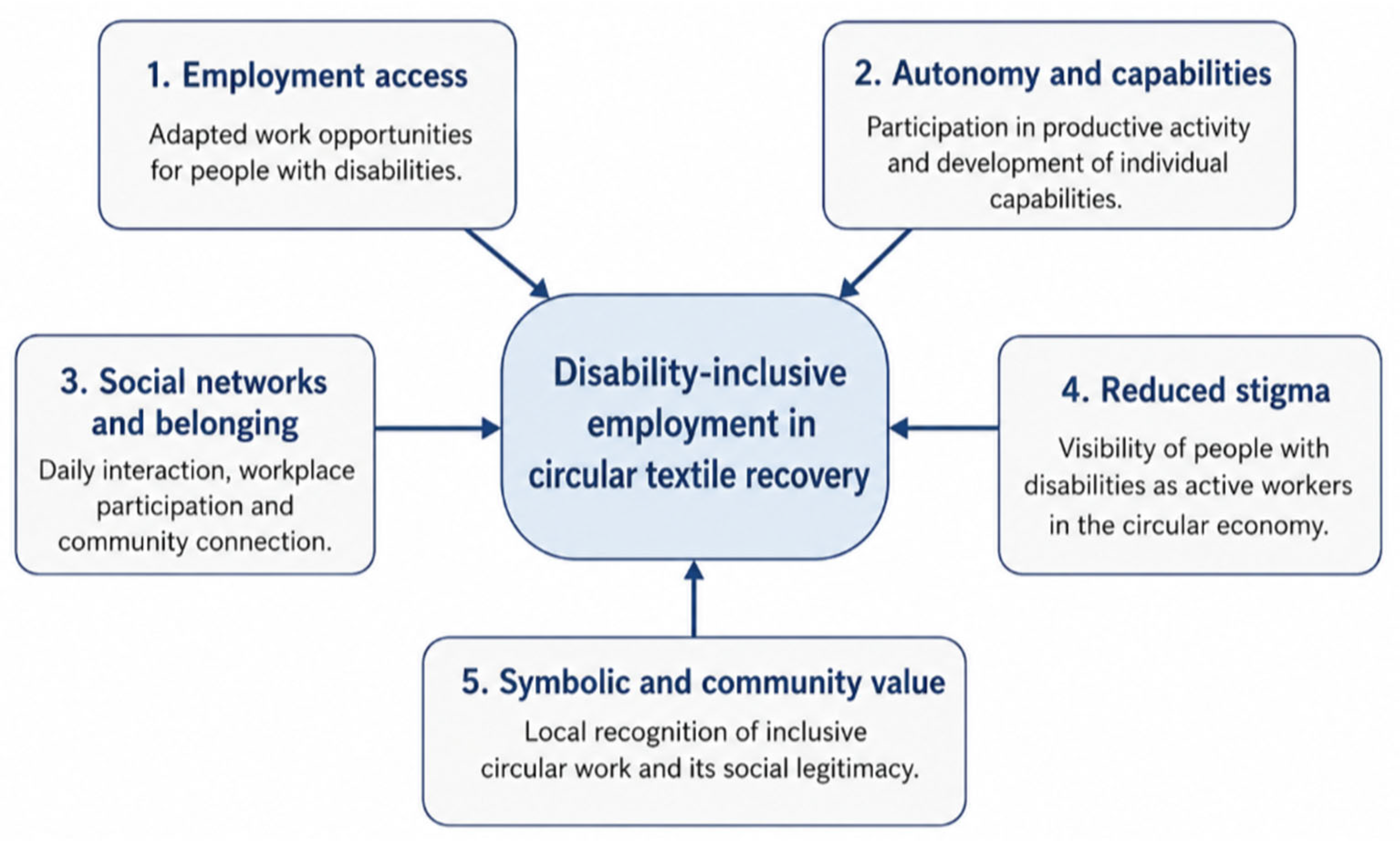
This limitation is particularly evident in relation to the fully disability-inclusive employment model adopted by INS3RTEGA. The assessment framework documents the number of workers with officially recognised disabilities and the associated public expenditure savings, but it does not attempt to monetise the broader social value of operating a fully disability-inclusive workforce. Elements such as increased autonomy and capabilities, reduced stigma, strengthened social networks, and the symbolic importance of visible inclusive workplaces are captured only qualitatively. A more expansive SROI exercise could, in principle, incorporate some of these dimensions through additional proxies, but doing so would introduce further uncertainty and speculative assumptions. The present study therefore deliberately prioritises conservative monetisation over ambitious but potentially fragile valuation claims.
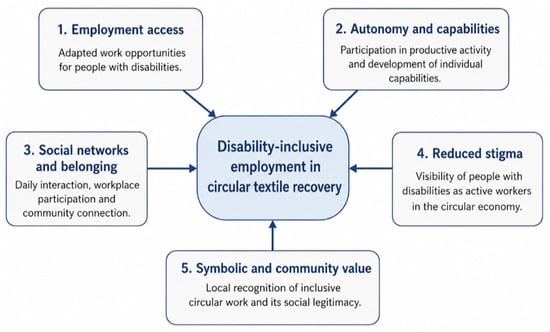
To make these non-monetised dimensions more visible without implying unsupported quantification, Figure 1 provides a qualitative representation of the wider social value associated with disability-inclusive employment in the case of INS3RTEGA. The figure should not be interpreted as a weighted measurement model. Rather, it summarises the main qualitative value components identified in the case and in the conceptual framing of social inclusion, decent work and capability-oriented sustainability.
Figure 1.
Qualitative components of the wider social value of disability-inclusive employment. Note. The figure is illustrative and non-monetised. It does not assign empirical weights to each component, because the study does not include worker-level survey data or direct well-being measures.
This qualitative representation reinforces the distinction between monetised and non-monetised value. While the partial SROI-style calculation captures public expenditure savings and a carbon-related environmental benefit, it does not capture the broader social significance of inclusive employment. In the case of INS3RTEGA, this wider value is linked to employment access, autonomy, social participation, stigma reduction and the symbolic importance of visible inclusive work within a circular textile organisation. These components are therefore discussed as qualitative dimensions of social value rather than incorporated into the monetised ratio.
Overall, the economic finding should be interpreted as a bounded monetary representation of selected externalised benefits, not as a definitive organisational return or an exhaustive measure of total social value. Its analytical value lies in showing both what can be credibly monetised under constrained data conditions and what remains outside the monetary boundary of the model. The partial SROI-style result is therefore treated as one layer of the integrated assessment, alongside the carbon-based environmental estimate and the non-monetised social inclusion evidence [8,10].
5.2. Environmental Dimension: Indicative Evidence of Substantial Climate-Related Benefit
The environmental findings, shown in Table 4, indicate that INS3RTEGA generates a measurable climate-related contribution through post-consumer textile recovery. For the 2023 reference year, the organisation managed 58,580 kg of textile waste. Using the simplified avoided-emissions benchmark adopted in this study, this volume corresponds to an estimated 1464.5 tonnes of avoided CO2-equivalent emissions, based on a factor of 25 kg CO2-eq avoided per kilogram of textile waste managed.
Table 4.
Assumptions and results of the simplified carbon-based environmental estimation.
This estimate represents the carbon-related component of the environmental assessment. It is the only environmental component subsequently monetised as EB in the partial SROI-style calculation. Other environmental dimensions, including water use, toxicity, land use, eutrophication, microfibre release and resource depletion, are not monetised because the available case data do not allow robust quantification of these categories.
The environmental result should therefore be interpreted cautiously. The estimate is not a full ISO-compliant life cycle assessment and does not model the differentiated impacts of collection, sorting, reuse, recycling, transport or downstream substitution pathways. It is better understood as an indicative carbon-based approximation of avoided climate burden associated with the textile flow managed by the organisation.
Even with these restrictions, the result is relevant at the organisational scale. Together with the reported textile recovery rate of approximately 90% to 92%, the avoided-emissions estimate suggests that regionally embedded textile recovery organisations can contribute to circular textile policy objectives. However, this contribution should be framed primarily in relation to textile collection, sorting and routing toward reuse or recycling pathways, which are the activities directly documented in the case, rather than as evidence of broader systemic transformation across the fashion sector.
5.3. Social Dimension: Strong Structural Inclusion, Limited Direct Well-Being Evidence
The social findings show that INS3RTEGA performs strongly as an inclusion-oriented employment organisation. In 2023, all 15 employees had officially recognised disabilities, which is consistent with the organisation’s legal status as a sheltered employment centre and with its mission of creating adapted employment opportunities for people who face structural barriers to labour market participation.
The evidence reported in Table 5 supports a strong claim about structural inclusion. INS3RTEGA does not treat social inclusion as an external or secondary activity; rather, disability-inclusive employment is embedded in the organisation’s core circular textile operations, including collection, sorting, reuse and recycling-related activities. In this sense, the case shows how circular textile recovery can also operate as a vehicle for access to work, participation and local social value creation.
Table 5.
Social inclusion and employment indicators for INS3RTEGA (2023).
At the same time, the strength of the social evidence should not be overstated. The study does not include worker-level survey data, standardised well-being indices or direct psychometric measures of autonomy, self-esteem, quality of life or empowerment. For this reason, the article can make a robust claim about employment access and structural inclusion, but only a cautious claim about experienced well-being. Structural inclusion is a meaningful and policy-relevant outcome, but it should not be conflated with direct evidence of improved subjective or multidimensional well-being [23].
The social dimension therefore reveals both a strong contribution and an important evidential boundary. INS3RTEGA provides a clear example of disability-inclusive employment within a circular textile organisation, but future research would need worker-level primary data to assess psychosocial outcomes, perceived empowerment, quality of working life and longer-term capability development more directly.
5.4. Cross-Dimensional Interpretation of the Findings
When the three dimensions are considered together, the case reveals a distinctive performance configuration. The case shows strong environmental contribution, strong structural social inclusion, and modest monetized return under conservative assumptions. This pattern is analytically more interesting than a uniformly positive profile, because it illustrates how hybrid organisations may create meaningful sustainability value that is unevenly visible across measurement systems.
From a Triple Bottom Line perspective, the case therefore does not suggest balance in the simplistic sense of equal performance across people, planet, and profit. Instead, it shows that integrated sustainability performance may take the form of asymmetric but mutually reinforcing value creation, where environmental and social strengths coexist with constrained monetized returns. This is precisely why an exploratory integrated approach is useful: it avoids the reductionism of single-metric evaluation and makes visible the tensions that define many real-world circular social enterprises [8,9].
6. Discussion
6.1. What the Case Reveals About Integrated Sustainability in Circular Fashion
The case of INS3RTEGA provides a useful empirical illustration of how sustainability performance in circular fashion may be both substantial and unevenly visible depending on the indicators used. The findings suggest that the organisation creates meaningful environmental and social value, while its monetized return remains modest under conservative assumptions. This asymmetry is analytically important because it challenges simplified interpretations of the Triple Bottom Line as requiring balanced or symmetrical performance across all three dimensions [8,9].
Rather than showing a perfectly aligned “people-planet-profit” model, the case reveals a more realistic configuration of integrated sustainability performance. The strongest measurable dimension is environmental, reflected in substantial avoided emissions and high textile recovery rates. The second strongest is structural social inclusion, reflected in the protected employment of people with disabilities and the organisation’s role in reducing barriers to labour market participation. By contrast, the economic dimension appears more constrained when represented through partial monetisation alone. This pattern suggests that hybrid circular organisations may generate socially and environmentally robust forms of value that remain only partially visible through conventional or semi-conventional monetary evaluation tools.
This finding is consistent with broader critiques of sustainability assessment in fashion and related sectors. Scholars have long argued that sustainability frameworks often privilege what is easiest to quantify rather than what is most socially significant [10,19]. In the case of organisations like INS3RTEGA, this means that structural inclusion, local social value, and long-term capability effects may be underrepresented unless deliberately incorporated into the analytical design. The case therefore supports the view that integrated sustainability measurement should not be equated with total commensuration. In many instances, a more honest approach may be to combine monetized and non-monetized evidence while remaining explicit about what each component can and cannot show.
6.2. Implications for Circular Fashion and Social Enterprise Research
The article contributes to circular fashion research by showing that circularity should not be evaluated only through product loops, material efficiency, or technical waste recovery. In practice, some circular textile organisations also function as sites of labour inclusion, community engagement, and social capability creation. This is especially relevant in contexts where sustainability debates have been dominated by large-brand narratives, eco-design discourse, or consumer-facing circular business models such as resale and rental [5,27]. The INS3RTEGA case reminds us that circularity may also be enacted through regionally embedded, socially oriented infrastructures that recover material value while widening access to work.
From a social enterprise perspective, the case reinforces the importance of hybrid value creation. INS3RTEGA does not simply combine a commercial activity with an external social mission; rather, its environmental and social purposes are embedded in the same organisational model. This matters because it suggests that the performance of such organisations cannot be adequately understood through single-domain metrics. Financial data alone would overlook key social and environmental contributions, while a purely environmental assessment would fail to capture the significance of inclusive employment. In that sense, the case supports the argument that hybrid organisations require hybrid evaluation logics.
The findings are also relevant for scholarship on inclusion and sustainability. Drawing on Sen’s [11] capability perspective, access to adapted employment can be understood as more than a labour market outcome. It can also be interpreted as an expansion of participation, recognition, and practical opportunity. The present study cannot demonstrate these wider effects directly through worker-level well-being data, but it does show that structurally inclusive employment is a central dimension of sustainability in this case. For that reason, the article argues that circular fashion research should pay greater attention to disability inclusion and to the role of socially embedded organisations in just transitions.
6.3. Methodological Implications: Toward Transparent Hybrid Assessment
One of the main contributions of the case lies in methodological positioning rather than methodological finality. The article does not claim to solve the problem of integrated sustainability measurement. Instead, it demonstrates that a transparent hybrid approach can still generate useful knowledge under constrained data conditions. This is particularly relevant for SMEs and social enterprises, which often face rising expectations around impact measurement without having the resources required for full-scale standardised reporting.
The case highlights several methodological lessons. Partial monetisation can be useful when its boundaries are clearly stated: in this study, the partial SROI-style estimate makes selected benefits visible, but it should not be treated as a complete expression of organisational value. Simplified carbon-based estimation can also offer policy-relevant environmental evidence, provided that it is framed as indicative rather than exhaustive when system boundaries and impact categories remain limited [24,25]. Structural inclusion indicators are similarly valuable, although they do not substitute for direct well-being evidence. The absence of worker-level primary data should not invalidate the social analysis, but it does delimit the strength of the claims that can be made.
Taken together, these lessons suggest that the core challenge of integrated sustainability assessment is not only technical, but also epistemic. Researchers and practitioners must decide what kind of evidence is sufficient for what kind of claim. In the context of circular social enterprises, a modular and transparent design may often be more credible than an apparently unified but methodologically overstretched framework. The present article therefore advocates not for premature standardisation, but for explicit analytical layering: monetary indicators where justified, environmental estimates where meaningful, and non-monetized social evidence where necessary.
6.4. Policy Relevance for the European Textile Transition
The case has implications for European policy debates on sustainable and circular textiles. Current EU policy increasingly emphasises durability, circularity, waste recovery and product accountability, while also placing growing pressure on organisations to document sustainability performance more systematically [17,18]. Within this policy landscape, INS3RTEGA is relevant because it performs operational functions that are directly connected to the implementation of textile circularity at local and regional scale.
The reference to collection, sorting and routing toward reuse or recycling pathways is grounded in the empirical activities documented in the case. INS3RTEGA manages a network of more than 350 textile collection containers across Galicia, processes 58,580 kg of post-consumer textile waste in the 2023 reference year, and reports a recovery rate of approximately 90% to 92%. These findings support a cautious policy claim: organisations of this type can contribute to circular textile objectives primarily through the operational stages they actually perform, namely collection, sorting and the channelling of textile flows toward reuse or recycling. The case does not demonstrate systemic transformation of the fashion sector as a whole, nor does it provide detailed downstream evidence for every reuse or recycling destination. Its policy relevance is therefore local, operational and bounded.
The case also suggests that circular textile policy should recognise the social dimension of recovery infrastructures. INS3RTEGA does not only divert textile waste from disposal; it does so through a disability-inclusive employment model. This matters because circular transitions may be evaluated too narrowly if policy frameworks focus only on material efficiency, cost reduction or technical recovery rates. In socially inclusive circular enterprises, environmental and social value are produced together, even if they are not equally visible in conventional metrics.
A proportionate policy approach would therefore support impact measurement systems that are rigorous but feasible for SMEs and social enterprises. Excessively data-intensive reporting requirements may disadvantage precisely those organisations that contribute to circularity with limited administrative capacity. More enabling instruments would combine support for textile collection and recovery, recognition of inclusive employment outcomes, and proportionate reporting tools adapted to the scale and data capacity of small circular social enterprises.
6.5. Limitations of the Study
The study has several limitations that should be made explicit. Its single-case design and specific regional context limit the scope for generalisation, since the purpose is analytical insight rather than statistical inference. The economic assessment also relies on a partial SROI-style logic rather than a full stakeholder-based SROI application. The environmental estimate is simplified and climate-focused, not a full multi-category life cycle assessment. The social dimension provides stronger evidence of structural inclusion than of subjective well-being or psychosocial outcomes. A further limitation concerns the philanthropic component included in the monetised estimate, which comes from 2024 rather than 2023 and therefore introduces a temporal inconsistency. This limitation is addressed by reporting a secondary ratio excluding PD. This more conservative specification reduces the ratio from 0.33 to 0.296, showing that the monetised result is sensitive to the inclusion of PD but not wholly dependent on it. Future assessments should ideally use fully year-matched donation data or multi-year averages to reduce this source of uncertainty.
These limitations do not nullify the value of the article, but they do define its appropriate claim. This is not a paper that validates a universal impact measurement model. It is a paper that uses a carefully delimited case to show how integrated sustainability performance can be explored in a real circular social enterprise, and what remains methodologically difficult when data are limited.
7. Conclusions
7.1. Main Conclusions on Integrated Sustainability Performance
This article examined how the integrated sustainability performance of an inclusive circular textile social enterprise can be assessed through an exploratory case-based combination of economic, environmental, and social indicators. Using the case of INS3RTEGA, the study showed that hybrid circular organisations may create substantial value across multiple sustainability dimensions, even when that value is not fully visible through conventional financial or fully monetized metrics.
The findings reveal a distinctive configuration: strong environmental contribution, strong structural social inclusion, and modest monetized return under conservative and incomplete valuation assumptions. This does not weaken the case. On the contrary, it illustrates why integrated sustainability assessment matters. If the organisation were evaluated only through financial or narrowly monetized terms, much of its contribution would remain obscured. If it were evaluated only environmentally, its inclusion mission would be underrepresented. The article therefore argues that the central challenge is not to force all sustainability outcomes into a single metric, but to build transparent assessment designs capable of representing heterogeneous value creation credibly.
7.2. Conceptual and Analytical Contribution
Conceptually, the article contributes to the literature on circular fashion and sustainability assessment by showing how the Triple Bottom Line can be used as a restrained organising lens rather than as a fully integrated reporting template. The case does not develop a new theory or validate a universal model. Instead, it illustrates how different forms of value become visible or remain hidden depending on the measurement approach adopted.
The analytical contribution lies in the layered assessment strategy proposed in the article. By combining a partial SROI-style calculation, a simplified carbon-based environmental estimate and non-monetised social inclusion indicators, the study shows how integrated sustainability performance can be examined without forcing all outcomes into a single metric. This is particularly relevant for circular SMEs and social enterprises, where data limitations make fully standardised assessment difficult.
The case also clarifies the relationship between circularity and inclusion. In INS3RTEGA, disability-inclusive employment is not an additional social programme attached to a circular activity; it is part of the organisational model through which circular textile recovery is performed. This supports a more socially embedded understanding of circular fashion, in which environmental recovery and labour inclusion may be institutionally connected within the same enterprise.
7.3. Practical and Policy Implications
Practically, the article offers a usable orientation for managers and practitioners working in circular SMEs and social enterprises. It suggests that even where data are incomplete, organisations can still move toward more credible impact assessment by combining a limited number of well-justified indicators, making assumptions explicit, and distinguishing clearly between measured, estimated, and non-monetized outcomes. This may be more useful than waiting for perfect data conditions that rarely arrive.
From a policy perspective, the article suggests that socially inclusive circular textile enterprises deserve greater attention within the evolving European sustainability framework. If the circular transition is to be both environmentally effective and socially just, policy instruments must recognise organisations that combine waste recovery with inclusive employment. This includes not only funding and procurement mechanisms, but also proportionate reporting frameworks that do not penalise organisations for lacking the measurement capacity of large corporations.
7.4. Future Research
Future research should build on this case through comparative, longitudinal and mixed-method designs. Comparative multi-case studies could examine whether the performance configuration observed here is common among other circular textile social enterprises. Longitudinal designs could follow the same organisation, or a small panel of comparable organisations, over several years in order to observe whether circular textile recovery, employment inclusion and financial sustainability improve, deteriorate or remain stable over time. In practical terms, this would involve collecting repeated annual measures of textile waste managed, recovery rates, estimated avoided emissions, workforce composition, employment stability, public support, turnover, operating costs and partial SROI-style ratios. Where ethically and organisationally feasible, this could be complemented by periodic worker-level data on perceived well-being, empowerment, job satisfaction, social participation and capability development. Future studies could also refine the environmental component by distinguishing more precisely between reuse, recycling, transport, processing requirements and downstream substitution pathways.
In that sense, the present article should be read not as the end point of integrated sustainability measurement in circular fashion, but as a step toward a more credible and context-sensitive research agenda. Its central message is straightforward: organisations like INS3RTEGA matter not because they solve every sustainability problem, but because they show, in concrete and measurable ways, that circularity and inclusion can be organised together within the same enterprise.
Funding
This research received no external funding.
Data Availability Statement
The data supporting the findings of this study are derived from internal records of INS3RTEGA and are not publicly available due to confidentiality constraints agreed with the organisation. Aggregated data and the main indicators used in the analysis are reported in the article; additional anonymised information may be made available by the author upon reasonable request and with the prior consent of INS3RTEGA.
Acknowledgments
The author would like to thank Aitana Rodríguez Calvo for the original case study on INS3RTEGA developed in her final degree project, which provided the foundation for part of the data and analyses used in this article.
Conflicts of Interest
The author declares no conflicts of interest.
References
- Bick, R.; Halsey, E.; Ekenga, C.C. The global environmental injustice of fast fashion. Environ. Health 2018, 17, 92. [Google Scholar] [CrossRef] [Scilit] [PubMed]
- Fletcher, K. Sustainable Fashion and Textiles: Design Journeys, 2nd ed.; Routledge: London, UK, 2014. [Google Scholar]
- Niinimäki, K.; Peters, G.; Dahlbo, H.; Perry, P.; Rissanen, T.; Gwilt, A. The environmental price of fast fashion. Nat. Rev. Earth Environ. 2020, 1, 189–200. [Google Scholar] [CrossRef] [Scilit]
- Joy, A.; Sherry, J.F., Jr.; Venkatesh, A.; Wang, J.; Chan, R. Fast fashion, sustainability, and the ethical appeal of luxury brands. Fash. Theory 2012, 16, 273–295. [Google Scholar] [CrossRef] [Scilit]
- Ellen MacArthur Foundation. A New Textiles Economy: Redesigning Fashion’s Future; Ellen MacArthur Foundation: Cowes, UK, 2017; Available online: https://www.ellenmacarthurfoundation.org/a-new-textiles-economy (accessed on 15 March 2026).
- Geissdoerfer, M.; Savaget, P.; Bocken, N.M.P.; Hultink, E.J. The circular economy: A new sustainability paradigm? J. Clean. Prod. 2017, 143, 757–768. [Google Scholar] [CrossRef] [Scilit]
- Kirchherr, J.; Reike, D.; Hekkert, M. Conceptualizing the circular economy: An analysis of 114 definitions. Resour. Conserv. Recycl. 2017, 127, 221–232. [Google Scholar] [CrossRef] [Scilit]
- Elkington, J. Cannibals with Forks: The Triple Bottom Line of 21st Century Business; Capstone: Oxford, UK, 1997. [Google Scholar]
- Purvis, B.; Mao, Y.; Robinson, D. Three pillars of sustainability: In search of conceptual origins. Sustain. Sci. 2019, 14, 681–695. [Google Scholar] [CrossRef] [Scilit]
- Norman, W.; MacDonald, C. Getting to the bottom of “triple bottom line”. Bus. Ethics Q. 2004, 14, 243–262. [Google Scholar] [CrossRef] [Scilit]
- Sen, A. Development as Freedom; Oxford University Press: Oxford, UK, 1999. [Google Scholar]
- United Nations. Transforming Our World: The 2030 Agenda for Sustainable Development; United Nations: New York, NY, USA, 2015; Available online: https://sdgs.un.org/2030agenda (accessed on 15 March 2026).
- World Bank. Disability Inclusion and Accountability Framework; World Bank Group: Washington, DC, USA, 2022; Available online: https://documents.worldbank.org/en/publication/documents-reports/documentdetail/437451528442789278 (accessed on 15 March 2026).
- Ebrahim, A.; Rangan, V.K. What impact? A framework for measuring the scale and scope of social performance. Calif. Manag. Rev. 2014, 56, 118–141. [Google Scholar] [CrossRef] [Scilit]
- Arena, M.; Azzone, G.; Bengo, I. Performance measurement for social enterprises. Voluntas 2015, 26, 649–672. [Google Scholar] [CrossRef] [Scilit]
- Grieco, C.; Michelini, L.; Iasevoli, G. Measuring value creation in social enterprises: A cluster analysis of social impact assessment models. Nonprofit Volunt. Sect. Q. 2015, 44, 1173–1193. [Google Scholar] [CrossRef] [Scilit]
- European Commission. Communication from the Commission to the European Parliament, the Council, the European Economic and Social Committee and the Committee of the Regions: EU Strategy for Sustainable and Circular Textiles (COM(2022) 141 Final); European Commission: Brussels, Belgium, 2022; Available online: https://eur-lex.europa.eu/legal-content/EN/TXT/?uri=CELEX:52022DC0141 (accessed on 15 March 2026).
- European Commission. Proposal for a Regulation of the European Parliament and of the Council Establishing a Framework for Setting Ecodesign Requirements for Sustainable Products and Repealing Directive 2009/125/EC (COM(2022) 142 Final); European Commission: Brussels, Belgium, 2022; Available online: https://eur-lex.europa.eu/legal-content/EN/TXT/?uri=CELEX:52022PC0142 (accessed on 15 March 2026).
- Elkington, J. 25 years ago I coined the phrase “triple bottom line.” Here’s why it’s time to rethink it. Harv. Bus. Rev. 2018, 25, 6. Available online: https://hbr.org/2018/06/25-years-ago-i-coined-the-phrase-triple-bottom-line-heres-why-im-giving-up-on-it (accessed on 15 March 2026).
- Hubbard, G. Measuring organisational performance: Beyond the triple bottom line. Bus. Strategy Environ. 2009, 18, 177–191. [Google Scholar] [CrossRef] [Scilit]
- Hahn, T.; Figge, F.; Pinkse, J.; Preuss, L. Trade-offs in corporate sustainability: You can’t have your cake and eat it. Bus. Strategy Environ. 2010, 19, 217–229. [Google Scholar] [CrossRef] [Scilit]
- Nicholls, J.; Lawlor, E.; Neitzert, E.; Goodspeed, T. A Guide to Social Return on Investment; The SROI Network: London, UK, 2012. [Google Scholar]
- Ruggeri, K.; Garcia-Garzon, E.; Maguire, Á.; Matz, S.; Huppert, F.A. Well-being is more than happiness and life satisfaction: A multidimensional analysis of 21 countries. Health Qual. Life Outcomes 2020, 18, 192. [Google Scholar] [CrossRef] [Scilit] [PubMed]
- Hauschild, M.Z.; Rosenbaum, R.K.; Olsen, S.I. Life Cycle Assessment: Theory and Practice; Springer: Cham, Switzerland, 2018. [Google Scholar]
- ISO 14040; Environmental Management—Life Cycle Assessment—Principles and Framework. International Organisation for Standardization: Geneva, Switzerland, 2022.
- Yin, R.K. Case Study Research and Applications: Design and Methods, 6th ed.; SAGE: Thousand Oaks, CA, USA, 2018. [Google Scholar]
- Flyvbjerg, B. Five misunderstandings about case-study research. Qual. Inq. 2006, 12, 219–245. [Google Scholar] [CrossRef] [Scilit]
- Rodríguez Calvo, A. Sustainability in Fashion: Impact Measurement and Case Analysis of INS3RTEGA. Bachelor’s Thesis, Universidade da Coruña, A Coruña, Spain, 2025. [Google Scholar]

Disclaimer/Publisher’s Note: The statements, opinions and data contained in all publications are solely those of the individual author(s) and contributor(s) and not of MDPI and/or the editor(s). MDPI and/or the editor(s) disclaim responsibility for any injury to people or property resulting from any ideas, methods, instructions or products referred to in the content. |
© 2026 by the author. Licensee MDPI, Basel, Switzerland. This article is an open access article distributed under the terms and conditions of the Creative Commons Attribution (CC BY) license.