


Abstract
Sewage sludge is increasingly used as an organic fertilizer in Kenyan peri-urban agriculture, yet concerns persist regarding heavy metal transfer to edible crops and associated health risks. This study evaluated the magnitude of cadmium (Cd), chromium (Cr), and lead (Pb) transfer from sewage sludge-amended soil to kale (Brassica oleracea) leaves and assessed non-carcinogenic health risks to consumers in Nyeri County, Kenya. A Repeated Measures Longitudinal Design was employed with paired soil and kale sampling from 50 plots across wet and dry seasons. Each plot served as its own control, and linear mixed models with random intercepts for plot were used to quantify metal-specific transfer efficiencies. Results showed that soil concentrations significantly exceeded leaf concentrations for all metals in both seasons (p < 0.001). The Linear Mixed Model (LMM) revealed a significant Soil × Metal interaction (χ2 (2) = 14.8, p < 0.001), with estimated soil-to-leaf transfer slopes of 0.183 (Pb), 0.235 (Cr), and 0.271 (Cd). Mean Target Hazard Quotient values were highest for Cr, followed by Cd, and lowest for Pb. Hazard Index values were significantly higher in the dry season (0.00568 ± 0.00422) than in the wet season (0.00383 ± 0.00285; p < 0.001) yet remained substantially below the regulatory threshold of 1.0. These findings indicate negligible non-carcinogenic health risk from the consumption of kale grown on sewage sludge-amended soils under the assessed exposure scenario. However, the elevated transfer efficiency of Cd warrants continued monitoring. This study underscores the need for Kenya to develop national guidelines for the safe agricultural use of sewage sludge, drawing on international benchmarks to ensure consumer safety while supporting sustainable soil amendment practices.
1. Introduction
Globally, an estimated 30–50% range of over 100 million metric tons of sewage sludge generated yearly is used for crop production, with a dilemma regarding its economic affordability, heavy metal bioaccumulation, and food safety [1,2]. In the African region where Kenya is located, agricultural utilization of sewage sludge has appreciable use, yet there is a concern of heavy metal contamination in the food chain, particularly cadmium, chromium, and lead, which poses a growing public health concern across the continent [3]. Food safety is a paramount public health concern, as food consumption represents the primary pathway for human exposure to environmental pollutants, including toxic heavy metals. Vegetables play a significant role in human nutrition, providing essential nutrients, minerals, and fiber [4,5]. However, agricultural products, particularly vegetables, can bioaccumulate heavy metal pollutants from soil at concentrations that may be unsafe for public health [6]. Sewage sludge, the solid organic material produced during wastewater treatment, has emerged as a valuable organic fertilizer due to its high content of critical nutrients including nitrogen, phosphorus, and potassium [7,8]. With increasing fertilizer prices and growing demand for food production on a global scale, sewage sludge utilization has become an alternative to expensive chemical fertilizers for farmers in developing countries, including Kenya [9]. Most wastewater treatment plants in developing countries have limited capability to segregate industrial from domestic wastewater, and stabilization ponds have limited efficiency in reducing heavy metal concentrations in final sludge. Consequently, sewage sludge used in agriculture may contain elevated levels of persistent heavy metals including cadmium (Cd), chromium (Cr), and lead (Pb). These metals are of particular concern due to their toxicity, persistence, and non-biodegradable nature, exhibiting carcinogenic, teratogenic, and mutagenic effects on human health [10].
1.1. Heavy Metal Transfer in Soil–Plant Systems
Heavy metals introduced into soils through sewage sludge application can be taken up by plants and translocated to edible tissues [11]. The extent of transfer depends on multiple factors, including metal speciation, soil physicochemical properties, plant species, and environmental conditions. Soil pH plays a critical role, with acidic conditions enhancing heavy metal bioavailability and uptake. Kenyan soils are predominantly acidic due to excessive application of chemical fertilizers, potentially enhancing heavy metal transfer from soil to plants [12]. Leafy vegetables, particularly those in the Brassicaceae family, have high tendencies to accumulate heavy metals in their edible parts. Kale (Brassica oleracea), a common vegetable in Kenyan peri-urban agriculture, is of particular concern due to its widespread consumption and potential for heavy metal accumulation [13]. Understanding the quantitative relationships between soil and plant metal concentrations is essential for predicting dietary exposure and assessing health risks.
1.2. Health Risk Assessment Framework
The health risk associated with dietary heavy metal exposure is commonly assessed using the Target Hazard Quotient (THQ) and Hazard Index (HI) models. The THQ compares the estimated daily intake of a specific metal to its oral reference dose (RfD), with values exceeding 1.0 indicating potential non-carcinogenic health concerns [14]. The HI aggregates THQ values for multiple metals to assess cumulative risk from combined exposure. The World Health Organization recommends oral reference doses of 0.0035 mg/kg/day for Pb, 0.0005 mg/kg/day for Cd, and 0.0003 mg/kg/day for Cr [15]. Using these reference values, health risk assessments can determine whether consumption of vegetables grown on sewage sludge-amended soils poses significant health risks to consumers.
1.3. Study Objectives
This study aimed to:
- (i)
- Evaluate the magnitude of heavy metal transfer from sewage sludge-amended soil to the leaves of vegetables in Nyeri County of Kenya.
- (ii)
- Evaluate the health risk posed to human health due to consumption of selected vegetables grown on sewage sludge-amended soils in terms of heavy metal content in Nyeri County of Kenya.
1.4. Hypotheses
Specific hypotheses tested were:
H1.
The magnitude of heavy metal transfer from sewage sludge-amended soil to vegetable leaves does not vary significantly among the selected heavy metals (Cd, Cr, Pb).
H2.
There is no health risk to consumers of vegetables grown on sewage-amended soil based on heavy metal content (HI < 1.0).
2. Materials and Methods
2.1. Study Area
This study was conducted in Nyeri County, Kenya, located in the Central Highlands at longitudes 36°38″ and 37°20″ E and latitude 0°38″ S. Nyeri Town, the administrative capital, is located 148 km north of Nairobi. The county covers 3325 km2 comprising eight sub-counties. Soils are predominantly red volcanic with an acidic pH (4.6–6.4) and low organic content (1.5–2.6%), requiring amendment [16]. The county receives bimodal rainfall: 1200–1600 mm during long rains (March–May) and 500–1500 mm during short rains (October–December). Mean annual temperature is 17 °C (Nyeri County Government, 2023). The population was 759,164 persons in 2019, with farming comprising 66.21% of main economic activities [17]. Vegetable crops (cabbages, kales, and tomatoes) are grown by over 130,008 households (52.41% of total households). Nyeri County has an annual population growth rate of +1.48% and is envisaged to have 806,018 persons in 2029, thus having a population density of 242 persons/km2 in 2029 [18].
2.2. Study Design and Sampling
2.2.1. Repeated Measures Longitudinal Design
This study employed a Repeated Measures Longitudinal Design [19] with paired soil and kale sampling from 50 plots on a seasonal basis (wet and dry). Each plot was sampled in both seasons and therefore served as its own control for seasonal variation. This design allowed the assessment of seasonal variability in metal levels and transfer dynamics while accounting for plot-level random effects. The repeated measures structure was incorporated into a linear mixed model through a random intercept for plot, which ac-counts for the non-independence of observations within the same plot across seasons. The justification for this design is that the primary objective was to evaluate seasonal variability within the amended plots. Using each plot as its own control removes stable between-plot confounding factors (e.g., soil type, microclimate, and management history) and increases statistical power for detecting seasonal effects.
2.2.2. Soil Sampling
In each plot, five cores of soil (0–20 cm depth range) were sampled to form a 1 kg composite sample during the dry season (January 2026 to February 2026) and wet season (April 2026 to May 2026). Sampling on the seasonal basis was critical to evaluate the seasonal variance in levels of heavy metal uptake from soil-amended sludge to the leaves of kales. A stainless-steel auger pre-cleaned with 10% HNO3 was used for sampling. Samples were collected during both wet and dry seasons.
2.2.3. Plant Sampling
Edible leaves from five kale plants (Brassica oleracea) in each plot were sampled and rinsed in situ with water. The leaves were placed in a collection bag as a composite sample. Samples were collected during both wet and dry seasons.
2.2.4. Sludge Characterization and Application Practices
The sewage sludge used in this study was anaerobically digested and air-dried prior to application. Heavy metal concentrations in the sludge were as follows: Cd, 1.2 ± 0.3 mg/kg; Cr, 20 ± 5.0 mg/kg; and Pb, 30 ± 4.0 mg/kg. Farmers applied the sludge at an average of 275 kg once per growing season, over two seasons per year. The duration of sludge use across the sampled farms ranged from 3 to 5 years. The sludge had an average pH of 6.8 ± 0.3, organic matter content of 42.5 ± 3.2%, and total nitrogen and phosphorus contents of 2.8% and 1.5%, respectively. The same sludge source was used across the study period. The farm soils of Nyeri County comprise predominating red volcanic soils. These soils have generally developed from volcanic and basement complex rocks characterized by a high rate of weathering with a well-drained capacity characterized by an acidic pH range of 4.6 to 6.4. The total soil organic content varies between 1.5 and 2.6%, falling below the recommended level of 2.7%. This low organic content results in the low water-holding capacity of the soil with an impact on soil microfauna. Soils in Nyeri County need to be amended with organic manure to correct the deficit of pH and organic content [20] Farmers are increasingly using sludge to account for the deficiency in organic matter content of the soil.
The acidic soils in the study area enhance the dissolution of mineral compounds and increase the mobility of cationic heavy metals, thereby promoting their uptake by crop roots [11] Soil pH has a great influence on the absorption of heavy metals from sewage sludge fertilizer to plants as it affects the dissolution and precipitation of mineral compounds [11] This pH dependence is particularly consequential in the Kenyan context. Kenyan soils are predominantly acidic, a condition attributed in part to the prolonged and intensive application of chemical fertilizers [20] Fertilizers containing phosphorus and other inorganic amendments are themselves sources of heavy metals, and their long-term use contributes to heavy metal accumulation in agricultural soils, reducing soil fertility and crop productivity. Copper, zinc, and cadmium exhibit particularly high accumulation potential in agricultural soils under long-term fertilizer use. When untreated or inadequately treated, sewage sludge is applied to these already acidic soils; the combined effect is an elevated risk of heavy metal mobilization and bioaccumulation in food crops.
2.3. Sample Preparation and Laboratory Analysis
2.3.1. Soil Sample Preparation
Soil samples were oven-dried at 105 °C to a constant weight and ground to a ≤150 µm particle size using a heavy-duty blender with non-contaminating quartz glass material. A sample weight of 0.50 ± 0.01 g dry soil was weighed into a high-purity quartz crucible and placed into a digestion tube with 10 mL HNO3 added. Samples were placed on a hotplate at 95 °C for 5 min and cooled to room temperature. A total of 2 mL of distilled water and 3 mL H2O2 were added and heated until effervescence subsided (~5 min). The sample was filtered using a 0.45 µm membrane into a 100 mL volumetric flask. Distilled water was added to make up the filtrate at a final volume of 100 mL. The filtrate was stored in a refrigerator at 4 °C awaiting heavy metal analysis by an Atomic Absorption Spectrophotometer.
2.3.2. Plant Sample Preparation
Fresh Brassica oleracea leaf samples were thoroughly rinsed with deionized water to remove adherent soil particulates. The cleaned leaves were oven-dried at 70 °C for 48 h until constant weight was achieved. The dried leaves were homogenized into a fine powder using an agate mortar to prevent potential metal contamination. A precisely weighed subsample of 0.500 g ± 0.001 g of the homogenized dry material was transferred into a pre-cleaned Teflon microwave digestion vessel. Trace metal-grade reagents were used throughout the digestion. To the weighed sample, 8 mL of concentrated (65–70%) nitric acid (HNO3) and 2 mL of 30% hydrogen peroxide (H2O2) were added. Digestion was performed using a validated microwave program: ramping to 180 °C in the 15–20 min range, holding at 180 °C for 20 min to ensure complete oxidation of organic matter, followed by a cooling phase of at least 15 min. After cooling, vessels were carefully vented in a fume hood. The resulting digested solution was quantitatively transferred into a 50 mL volumetric flask. The digestion vessel was rinsed thoroughly with three-to-four small aliquots of deionized water (DIW), with all rinsates added to the flask. The solution was diluted to the 50 mL mark with DIW, achieving a final dilution factor of 1:100 (w/v).
2.3.3. Quality Assurance and Quality Control
Quality Assurance and Quality Control involved rinsing clean digestion tubes Savillex Corporation, Eden Prairie, MN, USA) with 10% HNO3 (Lab Alley, Austin, TX, USA) and including one reagent blank per 10 samples that was digested without sludge. Three matrix spikes of samples with known metal concentrations were prepared pre-digestion. Acceptable Recovery Limit ranges were 85–115% for Cd/Pb; 80–120% for Cr (ISO 15192:2025) [21]. One duplicate per 10 samples was analyzed at RPD ≤ 15%. National Institute of Science and Technology NIST 2781 (NIST, Gaithersburg, MD, USA, SRM 2781) was used as certified sludge reference material per batch. Method detection limits (MDLs) were Cd: 0.0002 mg/kg, Pb: 0.0005 mg/kg, and Cr: 0.0005 mg/kg. Calibration was verified with multi-point standards bracketing expected concentrations (0.1–10 mg/L). Calibration curves had R2 > 0.995 [22]
2.4. Data Analysis
2.4.1. Heavy Metal Transfer Analysis
To evaluate whether soil-to-leaf transfer rates differed among Pb, Cr, and Cd, a linear mixed model (LMM) was fitted with leaf concentration as the response variable. Soil Concentration, Metal Type, and Season were included as fixed effects, along with the two-way interaction between soil concentration and metal type. Plot was included as a random intercept to account for repeated measurements from the same plot.
The LMM is expressed in Equation (1) as [23]:
where:
Yij = β0 + β1(Xsoil) + β2(XCr) + β3(XCd) + β4(XDry) + β5(Xsoil·XCr) + β6(Xsoil·XCd) + εij
Yij = leaf metal concentration for observation i in plot j.
β0 = fixed intercept.
β1–β6 = fixed-effect coefficients.
Xsoil = soil metal concentration.
XCr = indicator variable for chromium (1 if metal = Cr, 0 otherwise; reference = Pb).
XCd = indicator variable for cadmium (1 if metal = Cd, 0 otherwise; reference = Pb).
XDry = indicator variable for dry season (1 = dry, 0 = wet).
Xsoil·XCr and Xsoil·XCd = interaction terms between soil concentration and metal type.
uj = random intercept for plotj, assumed to be normally distributed with mean zero and variance σ2u.
εij = residual error term, assumed to be normally distributed with mean zero and variance σ2ε.
The random intercept uj accounts for the non-independence of observations within the same plot across seasons. Paired Wilcoxon signed-rank tests [24] were also conducted to compare heavy metal concentrations between paired soil and leaf samples for both wet and dry seasons. It is robust to outliers and skewness, making it appropriate for environmental contamination data. This approach is consistent with established precedents in similar studies. Kareem and Goran [25] employed a paired sampling design that sampled soil and plant leaf samples from the same study locations that enabled a direct assessment of metal transfer from the substrate to above-ground vegetation. The study’s seasonal approach, comparing metal concentrations across wet and dry seasons, provided critical insights into how climatic variability influences contaminant bioavailability and subsequent plant uptake. Sarangi et al. (2026) [26] employed a paired sampling design that collected sediment and corresponding root and shoot samples from the same contaminated freshwater sites, enabling a direct assessment of metal transfer from the substrate to aquatic plants evaluating heavy metal transfer from soils to plants.
2.4.2. Health Risk Assessment Analysis
Target Hazard Quotient (THQ): the THQ was calculated using the model described by [27]:
where:
THQ = (C_n × I × EF_r × ED)/(RfD × BW × AT)
Cn = mean metal concentration in vegetables on wet weight basis (mg/kg).
I = ingestion rate (0.177 kg/day for an adult of 70 kg).
EFr = exposure frequency (365 days/year).
ED = exposure duration (70 years).
RfD = oral reference dose (mg/kg/day): Pb = 0.0035, Cd = 0.0005, and Cr = 0.0003.
BW = average body mass (70 kg).
AT = averaging time for non-carcinogens (365 days/year × 70 years).
Hazard Index (HI): the HI was calculated as the arithmetic sum of individual THQs [28,29,30]:
HI = THQ_Cd + THQ_Cr + THQ_Pb
An HI value less than 1.0 indicates no significant non-carcinogenic health risk. Statistical tests: paired samples t-tests were conducted to compare THQ and HI values between dry and wet seasons. All statistical analyses were performed using SPSS (Version 26) and R (Version 4.2). Statistical significance was set at α = 0.05.
3. Results
3.1. Heavy Metal Concentrations in Soil and Leaf Matrices
3.1.1. Dry Season Comparison
A paired Wilcoxon signed-rank test compared heavy metal concentrations between paired soil and leaf samples during the dry season (n = 50 plots per metal). The analysis was performed on log10 transformed levels since the raw data did not satisfy normality for parametric tests. Results are presented in Table 1.
Table 1.
Results of paired Wilcoxon signed-rank tests comparing heavy metal concentrations (mg/kg) between soil and leaf matrices during the dry season (January 2026 to February 2026).
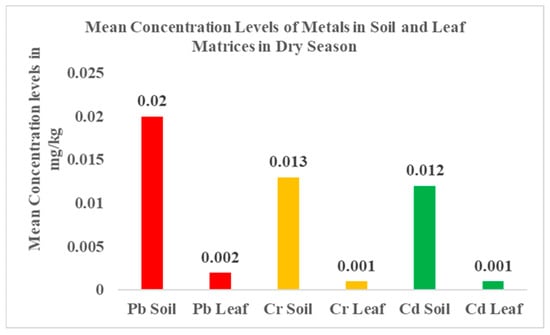
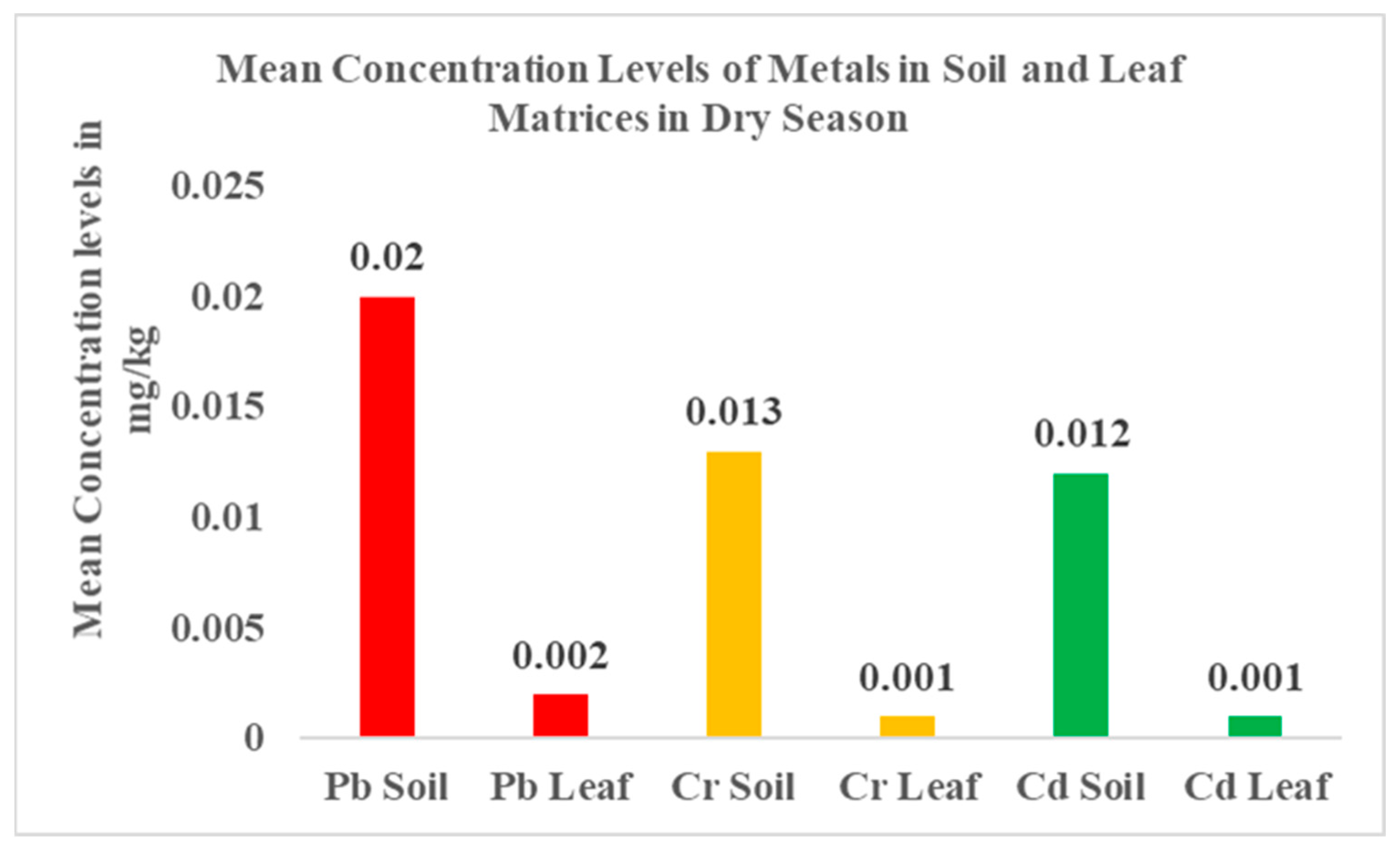
Soil concentrations were significantly higher than their corresponding leaf concentrations (p < 0.001 in each case). Soil lead levels (mean = 0.020 mg/kg) were approximately 10-times higher than leaf lead levels (mean = 0.002 mg/kg). Soil chromium concentrations (mean = 0.013 mg/kg) were 13-times higher than leaf chromium levels (mean = 0.001 mg/kg). Soil cadmium levels (mean = 0.012 mg/kg) were approximately 12-fold higher than leaf cadmium levels (mean = 0.001 mg/kg). In the soil matrix, the order of heavy metal concentrations was Lead > Cadmium > Chromium, and in the leaf matrix, the order of heavy metal concentrations was Lead> Cadmium = Chromium (Figure 1).
Figure 1.
Heavy metal concentrations (mg/kg) between soil and leaf matrices during the dry season.
3.1.2. Wet Season Comparison
A paired Wilcoxon signed-rank test compared heavy metal concentrations between paired soil and leaf samples during the wet season (April 2026 to May 2026) (n = 50 plots per metal). The analysis was performed on log10 transformed concentrations because the raw data did not satisfy normality assumption required for parametric paired tests (Table 2).
Table 2.
Results of paired Wilcoxon signed-rank tests comparing heavy metal concentrations (mg/kg) between soil and leaf matrices during the wet season (April 2026 to May 2026).
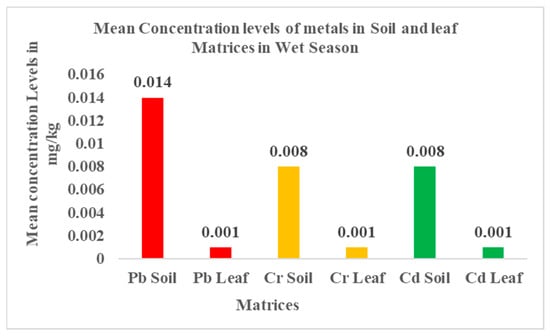
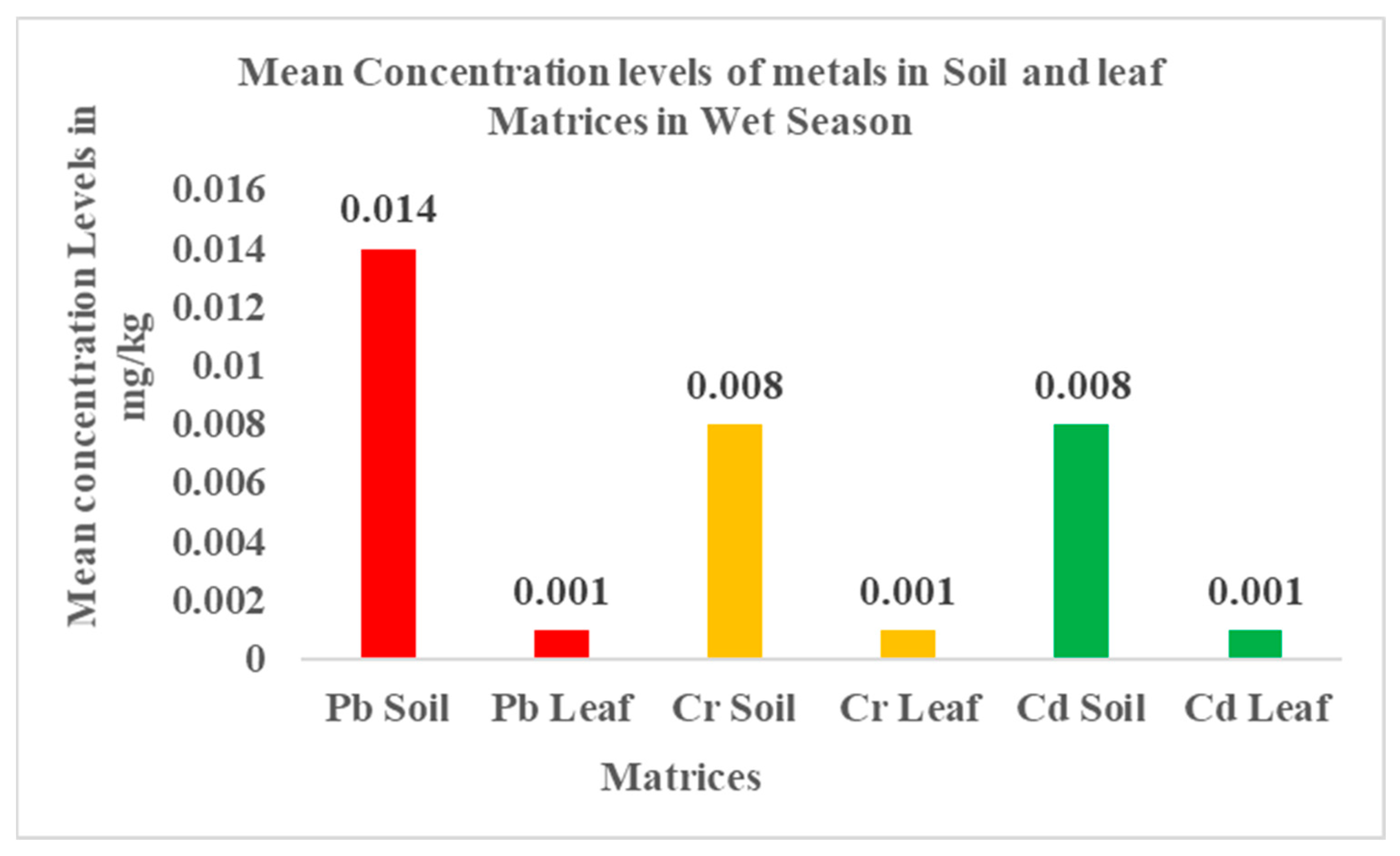
For all the three metals, soil concentrations were significantly higher than their corresponding leaf concentrations (p < 0.001 in each case). Soil lead levels (mean = 0.014 mg/kg) were 14-times higher than leaf lead levels (mean = 0.001 mg/kg). Soil chromium concentrations (mean = 0.008 mg/kg) were 8-times greater than leaf chromium levels (mean = 0.001 mg/kg). Soil cadmium levels (mean = 0.008 mg/kg) were 8-times higher than leaf cadmium levels (mean = 0.001 mg/kg). In the soil matrix, the order of heavy metal concentrations was Lead> Chromium = Cadmium, and in the leaf matrix, the order of heavy metal concentrations was equal across the three heavy metals (Figure 2).
Figure 2.
Heavy metal concentrations (mg/kg) between soil and leaf matrices during the wet season.
3.2. Magnitude of Heavy Metal Transfer: Linear Mixed Model Analysis
3.2.1. Magnitude of Lead Metal Transfer
The linear mixed model analysis revealed a highly significant positive relationship between soil Pb and leaf Pb (estimate = 1.292, SE = 0.258, t(97) = 5.006, p < 0.001), indicating that for every 1-unit increase in soil Pb, leaf Pb increased by 1.292 units on average, with a 95% confidence interval (Table 3).
Table 3.
Lead fixed-effects estimates (log transformed) from the linear mixed model.
In contrast, the effect of season was not statistically significant (estimate = −0.080, SE = 0.158, t(97) = −0.508, p = 0.612), with the dry season showing a predicted leaf Pb concentration only 0.080 units lower than the wet season at any given soil Pb level. The fitted model equations were Pb Leaf = −0.499 + 1.292 × PbSoil for the wet season and Pb Leaf = −0.579 + 1.292 × PbSoil for the dry season, with the only difference being a small, non-significant shift in the intercept.
3.2.2. Magnitude of Chromium Metal Transfer
The linear mixed model analysis revealed a highly significant positive relationship between soil Cr and leaf Cr (estimate = 0.875, SE = 0.153, t(97) = 5.714, p < 0.001), indicating that for every 1-unit increase in soil Cr, leaf Cr increased by 0.875 units on average, with a 95% confidence interval that excluded zero (Table 4).
Table 4.
Chromium fixed-effects estimates (log transformed) from the linear mixed model.
In contrast, the effect of season was not statistically significant (estimate = −0.043, SE = 0.155, t(97) = −0.277, p = 0.783), with the dry season showing a predicted leaf Cr concentration only 0.043 units lower than the wet season at any given soil Cr level. The fitted model equations were Cr Leaf = −1.231 + 0.875 × CrSoil for the wet season and Cr Leaf = −1.274 + 0.875 × CrSoil for the dry season, with the only difference being a small, non-significant shift in the intercept.
3.2.3. Magnitude of Cadmium Metal Transfer
The linear mixed model analysis revealed a significant positive relationship between soil Cd and leaf Cd (estimate = 1.101, SE = 0.494, t(48) = 2.228, p = 0.031), indicating that for every 1-unit increase in soil Cd, leaf Cd increased by 1.101 units on average, with a 95% confidence, Table 5.
Table 5.
Cadmium fixed-effects estimates (log transformed) from the linear mixed model.
In contrast, the effect of season was not statistically significant (estimate = −0.089, SE = 0.087, t(50) = −1.026, p = 0.310), with the dry season showing a predicted leaf Cd concentration only 0.089 units lower than the wet season at any given soil Cd level. The fitted model equations were Cd Leaf = −0.741 + 1.101 × CdSoil for the wet season and Cd Leaf = −0.830 + 1.101 × CdSoil for the dry season, with the only difference being a small, non-significant shift in the intercept.
In relation to soil–leaf transfer dynamics, the linear mixed model analysis revealed that lead (Pb) exhibited the highest transfer efficiency, with a slope estimate of 1.292 (SE = 0.258, t(97) = 5.006, p < 0.001), followed by cadmium (Cd) with a slope of 1.101 (SE = 0.494, t(48) = 2.228, p = 0.031), and chromium (Cr) with the lowest slope of 0.875 (SE = 0.153, t(97) = 5.714, p < 0.001). This hierarchy (Pb > Cd > Cr) remained stable across both wet and dry seasons, as the effect of season was not statistically significant for any metal (Pb: estimate = −0.080, SE = 0.158, t(97) = −0.508, p = 0.612; Cr: estimate = −0.043, SE = 0.155, t(97) = −0.277, p = 0.783; and Cd: estimate = −0.089, SE = 0.087, t(50) = −1.026, p = 0.310).
3.3. Health Risk Assessment
3.3.1. Target Hazard Quotient (THQ) Values
Descriptive statistics provided mean Target Hazard Quotient (THQ) values for vegetable leaves during dry and wet seasons, as shown in Table 6.
Table 6.
Mean target hazard quotient values on temporal basis.
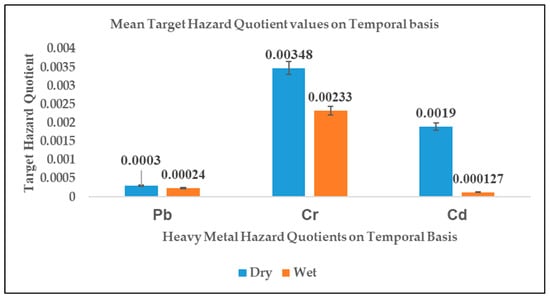
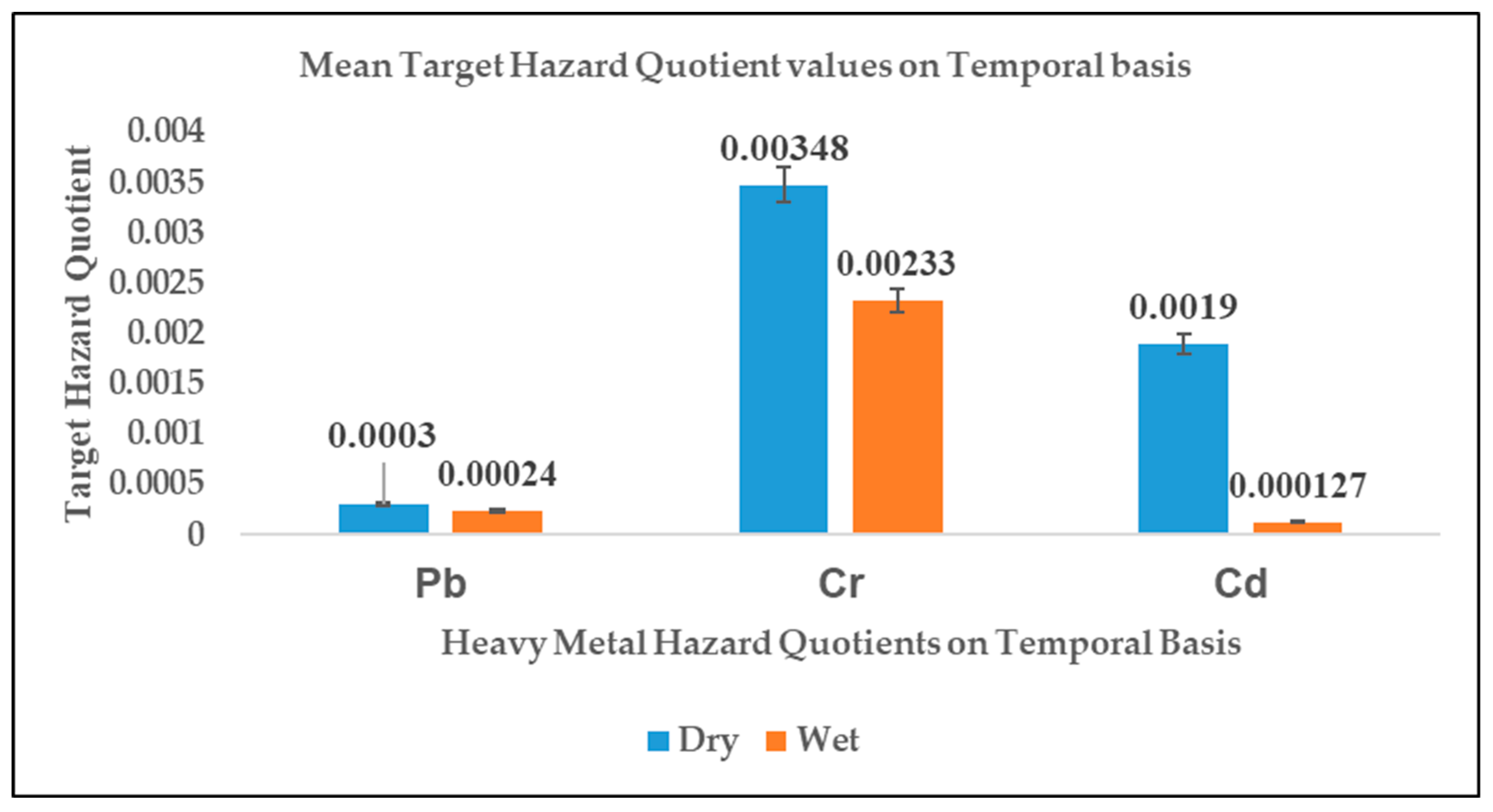
Figure 3 below shows that chromium exhibited the highest THQ value among the heavy metals, followed by cadmium, while lead recorded the lowest THQ values in both dry and wet seasons. A paired-samples t-test compared THQ values between dry and wet seasons. There was a statistically significant difference between dry and wet season THQ values for cadmium [t (49) = 8.23, p < 0.001]; chromium [t (49) = 7.59, p < 0.001]; and lead [t (49) = 7.59, p < 0.001]. On average, dry season THQ values were higher than wet season THQ values by 0.00063 for cadmium, 0.00115 for chromium, and 0.00006 for lead.
Figure 3.
Mean Target Hazard Quotient values on temporal basis.
3.3.2. Hazard Index (HI) Values
Hazard Indices were used to determine non-carcinogenic risk to the population due to vegetable consumption, as shown in Table 7.
Table 7.
Hazard index values on temporal basis.
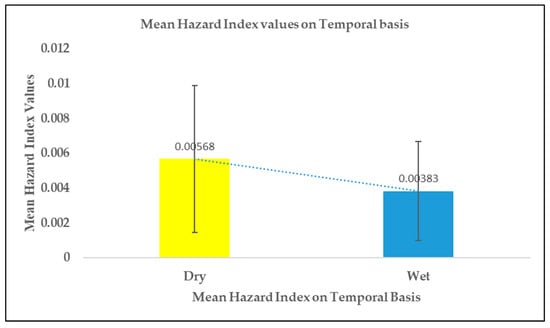
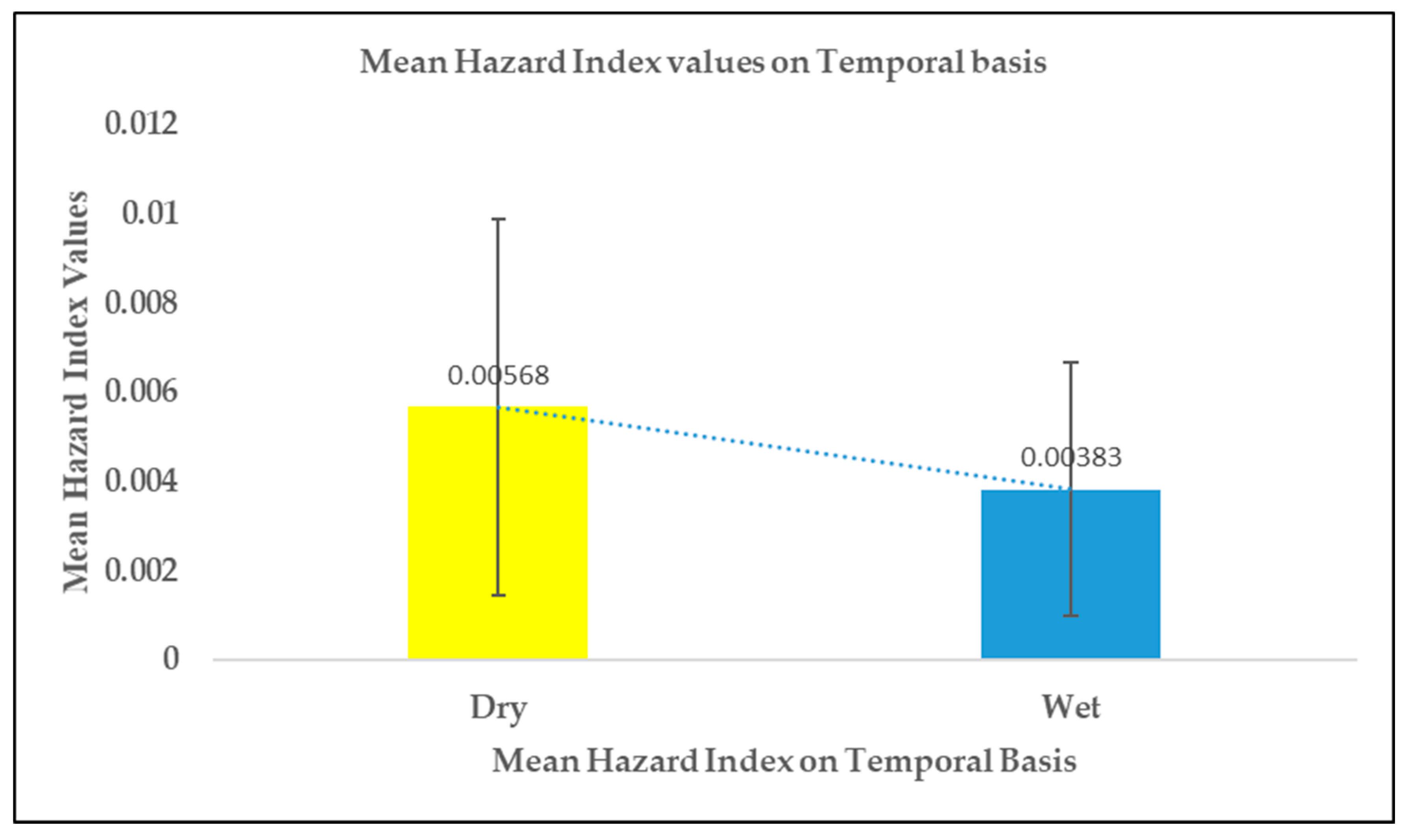
A paired t-test revealed a statistically significant difference between dry-season HI (M = 0.00568, SD = 0.00422) and wet-season HI (M = 0.00383, SD = 0.00285); t (49) = 9.32, p < 0.001. On average, the dry season HI was 0.00185 units higher than the wet season HI (95% CI: 0.00145 to 0.00225). Despite the statistically significant difference, both the mean dry-season HI (0.00568) and wet-season HI (0.00383) were substantially below the regulatory threshold of 1.0. This indicates that the cumulative non-carcinogenic health risk from dietary exposure to Cd, Cr, and Pb due to consumption of the vegetables remains negligible, as shown in Figure 4.
Figure 4.
Mean Hazard Index values on temporal basis.
4. Discussion
4.1. Soil as the Primary Sink for Heavy Metals
In the present study, levels of heavy metals in the soil matrix exceeded leaf concentrations for all three metals across both seasons. This finding is attributable to the non-biodegradable nature of these metals and their strong affinity to soil particles, resulting in accumulation in the soil matrix. Heavy metals such as Pb, Cr, and Cd are introduced into soils through a combination of natural and anthropogenic pathways, including atmospheric deposition, mining, fertilizer application, and wastewater irrigation. The absence of any plots where leaf concentrations exceeded soil concentrations indicates that the study area does not contain hyper-accumulator plant species capable of translocating metals to above-ground tissues at concentrations exceeding those in the surrounding soil. Hyper-accumulators are defined as plants that concentrate metals in their shoots at levels 100-to-1000-times higher than normal plants. The vegetable species in this study exhibit typical excluder characteristics, restricting metal translocation to above-ground tissues as a tolerance mechanism to protect photosynthetic organs from metal-induced oxidative stress. This finding is consistent with studies from across Africa and globally, ref. [31] reported that in wastewater-irrigated vegetable systems in Blantyre, Malawi, Cd, Cr, and Pb in vegetables remained below soil levels, underscoring that soils serve as the primary reservoir for heavy metals. In Kenya, elevated soil concentrations of Pb (15.4–706 mg/kg), Cd (0.14–6.07 mg/kg), and Cr (11.9–119.3 mg/kg) in the artisanal gold mining region of Migori County, Kenya, while corresponding vegetable concentrations were substantially lower [32]. These studies demonstrate that Pb, Cr, and Cd concentrations in soil exceed those in leaves, underscoring the persistent accumulation of these non-biodegradable metals in the soil matrix across diverse agricultural and mining-impacted systems.
4.2. Metal-Specific Transfer Efficiencies
The quantitative characterization of metal-specific transfer efficiencies through the linear mixed model provided statistical significance for the interaction and slope estimates. The slope for Pb (0.183) indicated that for every 1 mg/kg increase in soil Pb, leaf Pb increases by approximately 0.18 mg/kg. For Cr, the slope (0.235) was significantly steeper (difference = 0.052, p = 0.031), and for Cd, the slope (0.271) was the steepest (difference vs. Pb = 0.088, p < 0.001).
Lead (Pb) exhibited the lowest transfer efficiency, consistent with the documented tendency of Pb to remain strongly bound to soil particles, particularly in the rhizosphere, where it forms insoluble complexes with organic matter, phosphates, and carbonates. The limited translocation of Pb to above-ground tissues is further explained by its sequestration in root cell walls and vacuoles, restricting its movement through the xylem. This finding is supported by [12], who reported that in lead-spiked soils in Moiben, Kenya, roots exhibited the highest bioaccumulation factor while stems consistently recorded the lowest. Similarly, ref. [33] found that bioaccumulation factor values for Pb were well below one in all examined plant species in Nigeria, confirming limited soil-to-plant transfer.
Chromium (Cr) demonstrated intermediate transfer efficiency, with the slope of 0.235 reflecting the complicated speciation of this metal in the soil–plant system. Cr(VI) is highly soluble and mobile, whereas Cr(III) tends to form insoluble precipitates and remains strongly adsorbed to soil particles. The slope observed in this study suggests that Cr (III) predominates in the soil environment, limiting its bioavailability for root uptake. However, once absorbed, Cr can be transported within plant tissues to stems and leaves. The Cr slope of 0.235 observed in this study is comparable to the 0.21 reported by [34] in wheat and 0.22 reported by [35] in maize, presenting the intermediate behavior of chromium across different plant species and soil conditions.
Cadmium (Cd) exhibited the highest transfer efficiency, with the slope of 0.271 attributable to the high solubility of Cd, its weak adsorption to soil particles, and its efficient root-to-shoot translocation via the xylem. Cd is a non-essential element that is readily translocated through essential nutrient transport pathways, including those for zinc, iron, and calcium, facilitating its entry into the root system and subsequent transport to above-ground tissues. The slope of 0.271 observed in this study is close to 0.25 reported by [34] in wheat, 0.26 reported by [32] in maize, and 0.29 reported by [36] in vegetables, confirming the global pattern of Cd being the most phytoavailable of the three metals. The slope estimates from the present study are remarkably consistent with the global literature [34] reported slopes of 0.19 for Pb, 0.21 for Cr, and 0.25 for Cd in winter wheat. Otugboyega et al. (2024) [33] documented slopes of 0.21 for Pb, 0.18 for Cr, and 0.29 for Cd in vegetables. Wyszkowska et al. [35] found slopes of 0.17 for Pb, 0.22 for Cr, and 0.26 for Cd in maize. The consistency of these slope estimates across different geographical regions, plant species, and soil conditions provides strong evidence for the intrinsic metal-specific transfer patterns governed primarily by the physicochemical properties of each metal.
4.3. Seasonal Dynamics and Stability of the Transfer Hierarchy
The influence of season on heavy metal concentrations and transfer dynamics was evident, with both soil and leaf concentrations consistently higher during the dry season compared to the wet season. The LMM revealed a significant main effect of season (estimate = 0.0002, p = 0.046), indicating that dry-season leaf concentrations were, on average, slightly but significantly higher than wet-season concentrations. This seasonal pattern is consistent with findings from other studies examining heavy metal dynamics in soil–plant systems. During the dry season, reduced leaching, high evapotranspiration, and atmospheric deposition elevate concentrations of Cd, Pb, and Cr in surface soils. The limited rainfall during dry periods reduces the dilution and vertical migration of metals, leading to their accumulation in the topsoil layer where they are more readily available for plant uptake. The higher leaf concentrations observed during the dry season may also reflect increased plant transpiration rates, which drive greater water and solute flux from roots to shoots, thereby facilitating the translocation of dissolved metals. Ahmed et al. [11] reported that all heavy metal concentrations were lower in the wet than in the dry season in Bangladesh, attributed to the dilution of water by rainfall and lower absorption of heavy metals from diluted irrigation water. Nemadodzi et al. [37] reported that Cr and Pb were more effectively translocated during the dry season, while Co and Cu were more mobile during the wet season, confirming metal- and season-specific behavior. In China’s Yellow River Delta, metalloid concentrations and ecological risks were higher in winter than in summer. Critically, the LMM did not reveal a significant three-way interaction between Soil × Metal × Season (p = 0.672), indicating that the metal-specific transfer hierarchy Cd > Cr > Pb remained stable across both seasons. This finding is of considerable practical importance, as it suggests that the relative mobility and plant availability of these metals are governed primarily by their intrinsic physicochemical properties rather than by seasonal environmental fluctuations. While absolute concentrations vary seasonally, the ranking of transfer efficiency is robust, simplifying the development of metal-specific risk management strategies that are applicable year-round.
4.4. Health Risk Implications
The deterministic assessment established that the Hazard Index (HI) for adults consuming leafy vegetables at a rate of 0.177 kg/day was in the range of 0.0038–0.0057, which was substantially below the regulatory threshold of 1.0. These results are consistent with several recent studies that have employed probabilistic risk assessment frameworks to heavy metals in vegetables. Kashyap and Jain (2025) [36] reported HI values below 1.0 for leafy vegetables from peri-urban agricultural systems, while [29] similarly found no significant non-carcinogenic risk in marine organisms despite the presence of detectable heavy metal residues. However, the present study contrasts sharply with investigations conducted in highly industrialized or mining-affected areas, where HI values frequently exceed the threshold of 1.0. Studies from e-waste recycling sites and active Pb/Zn smelting regions in China reported HI values ranging from 2.5 to 8.0, primarily driven by elevated cadmium and lead concentrations [38]. The markedly lower risk observed in this study is attributable to the comparatively low metal concentrations in the vegetable samples, the dilution effect of wet-weight expression, and the adoption of a realistic mean ingestion rate (0.177 kg/day) rather than the highly conservative 0.3 kg/day historically used in some screening-level assessments. This comparison highlights that sewage sludge amendment, when properly managed and monitored, does not inherently compromise consumer safety, provided that the quality of the sludge meets regulatory standards.
Although HI values were significantly higher in the dry season than in the wet season (p < 0.001), they remained lower than the threshold of 1.0. Dry-season HI values (0.00568) were approximately 1.5-times higher than wet-season values (0.00383), reflecting elevated heavy metal concentrations in both soil and plant tissues during the dry season. These low values indicate negligible non-carcinogenic risk under the assessed exposure scenario. However, they should not be interpreted as evidence of zero risk. Rather, they suggest that current sludge application practices, as observed in this study, do not appear to pose an immediate health concern under the assessed exposure scenario for the average adult consumer. The seasonal variation nevertheless has important implications for risk assessment and monitoring. Consumers may face slightly higher health risks during dry seasons, particularly in arid and semi-arid regions where dry periods are prolonged [39] Environmental monitoring programs should therefore consider seasonal timing when designing sampling protocols and risk-assessment frameworks, and dry-season sampling may be more protective for identifying peak contamination levels. Incorporating seasonal exposure variability into probabilistic risk models would further clarify whether these dry-season peaks translate into meaningful changes in risk distributions for vulnerable groups.
The elevated transfer efficiency of Cd, with a slope of 0.271 and soil-to-leaf ratios of approximately 3.7-fold across both seasons, is of concern given its well-documented toxicity and long biological half-life in humans. Cd contamination in agricultural soils poses a considerable threat to food safety, as Cd can easily biomagnify. Historical cases such as Itai-itai disease in Japan have demonstrated the severe consequences of Cd accumulation in rice, leading to osteomalacia and renal damage [40] The seasonal stability of this hierarchy implies that Cd is a persistent threat regardless of the time of year, further justifying priority intervention. The lower transfer efficiency of Pb (slope = 0.183), while reassuring from a food safety perspective, does not diminish the importance of Pb monitoring given its neurotoxic effects, particularly in children, and its persistence in the environment. The moderate transfer of Cr (slope = 0.235), particularly in its more toxic hexavalent form, also is vital to continued surveillance.
It is important to note that the reference dose (RfD) for chromium used in this assessment (0.0003 mg/kg/day) corresponds to hexavalent chromium, Cr(VI), the more toxic and soluble form. This conservative approach provides a protective estimate of potential non-carcinogenic risk. However, total chromium concentrations in this study include both Cr(III) and Cr(VI). Future studies should consider speciation analysis to differentiate between these forms for more refined risk characterization, especially because Cr(III) has a much higher RfD (1.5 mg/kg/day). Several limitations should be acknowledged. First, the deterministic approach relies on single-point estimates for exposure parameters, including the fixed ingestion rate (0.177 kg/day), average body weight (70 kg), and exposure duration (70 years). These estimates do not capture inter-individual variability within the population. Vulnerable subpopulations, such as children or individuals with higher vegetable consumption rates, may therefore face elevated risks because they consume more vegetables per unit body weight. The current assessment, based on average adult parameters, may therefore underestimate risk for these groups. Second, the assessment considers only three metals, Cd, Cr, and Pb, and does not account for potential additive, synergistic, or antagonistic interactions with other heavy metals or contaminants that may be present in sewage sludge-amended soils. Finally, the RfD for Cr(VI) was applied conservatively, assuming worst-case speciation. Future studies should employ probabilistic risk-assessment methods, including Monte Carlo simulation, to better characterize uncertainty and variability in exposure and risk estimates. Such approaches would provide a distribution of risk rather than a single-point estimate and would help identify vulnerable subpopulations and support more targeted monitoring and risk-management strategies.
4.5. Implications for Environmental Monitoring and Risk Assessment
The findings of this study have important implications for environmental monitoring, agricultural management, and public health protection. The significantly higher soil concentrations of all three metals compared to leaf concentrations highlight the importance of soil quality assessment as a primary indicator of potential heavy metal exposure through the food chain. However, the differential transfer efficiencies observed among metals underscore the need for metal-specific risk assessments that account for the unique translocation behavior of each contaminant. The quantitative slope estimates provided in this study offer a practical tool for predicting plant uptake from soil data, enabling proactive risk assessment without the need for extensive plant sampling. For Cd, with a slope of 0.271, a soil Cd concentration of 0.1 mg/kg would predict leaf Cd levels of approximately 0.027 mg/kg, a value that, when combined with typical consumption patterns, could contribute to health risks (THQ > 1.0) if the vegetable is consumed regularly. The seasonal stability of this hierarchy implies that Cd is a persistent threat regardless of the time of year, further justifying priority intervention. The seasonal patterns observed suggest that environmental monitoring should be conducted across both wet and dry seasons to capture the full range of contamination levels. Dry-season monitoring may be particularly important for identifying peak contamination levels and assessing potential risks to human health through crop consumption. The consistent transfer hierarchy across seasons suggests that Cd should be prioritized in monitoring programs, with Pb and Cr receiving secondary attention. At the macro-policy level, the findings underscore an urgent need for the development of national guidelines governing the safe agricultural use of sewage sludge. As Kenya currently lacks comprehensive regulatory frameworks for this input despite its increasing reliance in peri-urban production systems, policymakers are advised to draw upon international best practices to establish clear standards for contaminant limits, treatment protocols, and application procedures. The European Commission guidelines for heavy metals in biosolids (Cd: 1–1.5 mg/kg, Cr: 60–100 mg/kg, and Pb: 70–100 mg/kg) provide a useful benchmark.
4.6. Monitoring and Policy Recommendations
The elevated transfer efficiency of Cd (slope = 0.271) and its stability across seasons indicate that Cd should be prioritized in routine monitoring programs for sewage sludge, amended soils, and edible vegetables. Monitoring should ideally be conducted in both wet and dry seasons because dry-season HI values were approximately 1.5-times higher than wet-season values. At the policy level, Kenya currently lacks comprehensive national guidelines for the agricultural use of sewage sludge. Policymakers should therefore establish clear standards for contaminant limits, sludge treatment protocols, and application rates, drawing on international benchmarks such as the European Commission guidelines (Cd: 1–1.5 mg/kg; Cr: 60–100 mg/kg; Pb: 70–100 mg/kg). Such guidelines would help ensure that sewage sludge amendment remains a safe and sustainable fertilizer source while protecting public health.
5. Conclusions
This study provides robust quantitative evidence that the soil-to-leaf transfer of Pb, Cr, and Cd is metal-specific, with a consistent hierarchy Cd > Cr > Pb that remains stable across wet and dry seasons. The linear mixed model revealed significantly different slopes for each metal (Pb = 0.183, Cr = 0.235, and Cd = 0.271), confirming that the null hypothesis of equal transfer rates is rejected. These slope estimates are comparable to those reported in other recent studies, reinforcing the consistency of metal-specific transfer patterns across different plant species and soil conditions.
Soil concentrations of all three metals were significantly higher than leaf concentrations, with no instances of leaf accumulation exceeding soil levels, indicating that the study area does not support hyper-accumulation. Seasonal variations, with higher absolute concentrations during the dry season, influence the overall magnitude of plant uptake but do not alter the relative metal transfer hierarchy.
The Hazard Index (HI) values (0.0038–0.0057) were substantially below the regulatory threshold of 1.0, indicating negligible non-carcinogenic health risks from consumption of vegetables grown on sewage sludge-amended soils. However, the elevated transfer efficiency of cadmium (slope = 0.271) coupled with its well-documented toxicity underscores the need for continued monitoring and risk assessment.
Overall, this study suggests that sewage sludge amendment, when properly managed and monitored, does not inherently compromise consumer safety, provided that the quality of the sludge meets regulatory standards. However, the findings underscore the need for developing national guidelines for safe agricultural use of sewage sludge in Kenya.
Supplementary Materials
The following supporting information can be downloaded at: https://www.mdpi.com/article/10.3390/green1030010/s1.
Author Contributions
Conceptualization, G.M.; methodology, G.M., D.O. and G.G.N.; software, G.M. and A.M.; validation, M.M., A.M., G.G.N. and D.O.; formal analysis, G.M.; investigation, G.M.; resources, G.M.; data curation, M.M., P.K.M. and A.M.; writing—original draft preparation, G.M.; writing—review and editing, G.M., P.K.M. and A.M.; visualization, P.K.M.; supervision, D.O., G.G.N. and M.M.; project administration, G.M.; funding acquisition, G.M. All authors have read and agreed to the published version of the manuscript.
Funding
This research was funded by the National Research Fund, Kenya. The funding number to the research grant is NRF 2017/2018.
Institutional Review Board Statement
Not applicable.
Informed Consent Statement
Not applicable.
Data Availability Statement
The original contributions presented in this study are included in the Supplementary Material. Further inquiries can be directed to the corresponding author.
Acknowledgments
The authors acknowledge the National Commission for Science, Technology and Innovation (NACOSTI), Kenya, for their approval to conduct the research. We are thankful to Nyeri Water and Sanitaion Company and the Administration at Nyeri County, Kenya, for providing access to the Kangemi Wastewater treatment plant and to the farmers. Peter Kimotho was invaluable for field data and sample collection. James Waweru’s assistance in the laboratory analysis of heavy metals in soil and vegetable samples was incredible. The authors have reviewed and edited the results and take full responsibility for the content of this publication.
Conflicts of Interest
The authors declare no conflicts of interest.
References
- Błaszczyk, W.; Fila, K.; Siatecka, A.; Xing, B.; Pan, B.; Oleszczuk, P. Fate and bioavailability of potentially toxic elements during sewage sludge biological stabilization processes: A comprehensive review. J. Hazard. Mater. 2026, 514, 142547. [Google Scholar] [CrossRef] [Scilit] [PubMed]
- Janaszek-Kowalik, A.; Kowalik, R.; da Silva, A.F.; Nešović, A.; Kozłowski, T.; Kanuchova, M. Probabilistic assessment of heavy metal risks in sewage sludge using BCR speciation and Bayesian networks. Sci. Total Environ. 2026, 1041, 181913. [Google Scholar] [CrossRef] [Scilit] [PubMed]
- Muzeza, C.; Lukhele, T.; Nety, S.S.; Sacko, A.; Ngole, V.; Musagti, T.M. Occurrence of priority phthalates esters in sewage sludge and the human health risks associated with the use of sludge as soil improver for agricultural purposes. Int. J. Environ. Res. 2026, 20, 35. [Google Scholar] [CrossRef] [Scilit]
- World Health Organization. Healthy Diet. 2020. Available online: https://www.who.int/news-room/fact-sheets/detail/healthy-diet (accessed on 8 August 2026).
- Jawadagi, R.; Hadimani, H.; Evoor, S.; Kishorkumar, G.K. Insights of Olericulture. 2024. Available online: https://www.researchgate.net/publication/382497755_Nutritional_Value_and_Health_Benefits_of_Vegetables (accessed on 8 August 2026).
- Ullah, H.; Uddin, J.; Ijaz, M.; Haziq, M.; Muhsinah, A.B.; Ullah, I.; Jamal, M. Metabolic dynamics and health risk assessment of heavy metal accumulation in urban-rural interface vegetable systems. Environ. Monit. Assess. 2025, 197, 567. [Google Scholar] [CrossRef] [Scilit] [PubMed]
- Żukowska, G.; Bik-Małodzińska, M.; Myszura-Dymek, M. The influence of stabilization technology on selected properties of municipal sewage sludge. Adv. Sci. Technol. Res. J. 2026, 20, 279–287. [Google Scholar] [CrossRef] [Scilit] [PubMed]
- Messaoud, A.; Magouri, M.; Barahi, S.; Belhamidi, S. Comparative evaluation of treated sewage sludge and chemical fertilizers on soil quality and agricultural productivity. Ecol. Eng. Environ. Technol. 2026, 27, 215. [Google Scholar] [CrossRef] [Scilit] [PubMed]
- Musazura, W.; Nkomo, N.; Otieno, B.; Badza, T.; Odindo, A.O.; Ojwach, S.O. Closing the loop: Crop yield response and soil health implications of human excreta-derived fertilizer application in dryland agriculture. Front. Sustain. Food Syst. 2025, 9, 1616479. [Google Scholar] [CrossRef] [Scilit]
- Briffa, J.; Sinagra, E.; Blundell, R. Heavy metal pollution in the environment and their toxicological effects on humans. Heliyon 2020, 6, e04691. [Google Scholar] [CrossRef] [Scilit] [PubMed]
- Ahmed, M.T.; Alrumman, S.A.; Kumar, P.; Sewelam, N.; Eid, E.M. Growth response and heavy metal accumulation in red radish (Raphanus sativus L.) under sewage sludge amendment. J. Soil Sci. Plant Nutr. 2026, 26, 642. [Google Scholar] [CrossRef] [Scilit]
- Barno, F.; Gelas, S.; Mulei, J. Influence of pH variation on lead uptake and accumulation in Raphanus raphanistrum and Brassica napus grown in spiked and limed agricultural soils of Moiben Sub-County, Kenya. J. Aquat. Terr. Ecosyst. 2026, 3, 66–78. [Google Scholar]
- Njenga, J.N. Heavy Metals and Pathogen Content on Soil, Water and Produce in Urban Agriculture of Nairobi City. Master’s Thesis, JKUAT, Jomo Kenyatta University of Agriculture and Technology, Nairobi, Kenya, 2026. [Google Scholar]
- Jalil, A.; Meshwish, J.N.; Iqra, Q. A systematic review: Global trend in heavy metal concentration in vegetables, dietary exposure, and health risk assessment. Environ. Monit. Assess. 2026, 198, 252. [Google Scholar] [CrossRef] [Scilit] [PubMed]
- Haroon, M.; Kamran, M.; Khan, A.Z.; Ali, S.; Iqbal, M.A.; Jahangir, T.N. Human health risks assessment of vegetables irrigated with different water qualities. Sci. Rep. 2026, 16, 63828. [Google Scholar] [CrossRef] [Scilit]
- KARI Kenya Agricultural Research Institute. National Accelerated Agricultural Inputs Access Programme & Kenya Agricultural Research Institute Soil PH Survey in Nyeri South District; NAAIAP/KARI: Nairobi, Kenya, 2014. [Google Scholar]
- Kenya National Bureau of Statistics. 2019 Kenya Population and Housing Census: Volume IV–Distribution of Population by Socio-Economic Characteristics. 2019. Available online: https://www.knbs.or.ke/2019-kenya-population-and-housing-census-reports (accessed on 7 August 2026).
- Mose, J.; Wakibi, S.; Otieno, A.A. Small Area Population Projections: Suitability of Hamilton-Perry Model in Undertaking Population Projections by Age and Sex for Selected Sub-Counties in Kenya. J. Afr. Popul. Stud. 2025, 38, 1–13. [Google Scholar] [CrossRef] [Scilit]
- Schober, P.; Vetter, T.R. Repeated Measures Designs and Analysis of Longitudinal Data: If at First You Do Not Succeed-Try, Try Again. Anesth. Analg. 2018, 127, 569–575. [Google Scholar] [CrossRef] [Scilit] [PubMed] [PubMed Central]
- Stiftung, H.-B. Soil Atlas 2025: Kenya Edition. Available online: https://ke.boell.org/sites/default/files/2025-02/soilatlas-2025_-ke-edition-web.pdf (accessed on 10 August 2026).
- ISO 15192:2025; Soil and Waste—Determination of Chromium(VI) in Solid Material by Alkaline Digestion and Ion Chromatography with Spectrophotometric Detection. International Organization for Standardization (ISO): Geneva, Switzerland, 2025.
- Nabulo, G.; Black, C.R.; Young, S.D. Trace metal uptake by tropical vegetables grown on soil amended with urban sewage sludge. Environ. Pollut. 2011, 159, 368–376. [Google Scholar] [CrossRef] [Scilit] [PubMed]
- Giri, S.; Mahato, M.K.; Singh, A.K. Multivariate linear regression models for predicting metal content and sources in leafy vegetables and human health risk assessment in metal mining areas of Southern Jharkhand, India. Environ. Sci. Pollut. Res. 2021, 28, 27250–27260. [Google Scholar] [CrossRef] [Scilit] [PubMed]
- Apaza-Canqui, A.E.; Kassuha, D.E.; Quispe, W.S.A.; Rojas, M.E.R.; Linares-Gutiérrez, N.M.; Morales-Aranibar, C.G.; Villanueva, Á.H.; Aguilera, J.G.; Zuffo, A.M.; Morales-Aranibar, L. Bioaccumulation and trophic transfer of potentially toxic elements (As, Pb, and Cd) in environmental matrices and sheep tissues and screening-level human health risk assessment in the Ite coastal mining wetland (Tacna, Peru). Sustainability 2026, 18, 4334. [Google Scholar] [CrossRef] [Scilit]
- Kareem, K.K.H.; Goran, S.M.A. Determination of heavy metals and total petroleum hydrocarbons in soil samples and plant leaves around oil refineries located on Erbil-Gwer Road. Sci. J. Univ. Zakho 2023, 11, 492–498. [Google Scholar] [CrossRef] [Scilit]
- Sarangi, B.S.; Maity, J.P.; Pradhan, A.A.; Rout, A.P. Stoichiometric insights into heavy metal phytoremediation by two aquatic macrophytes: Comparative evaluation of Pontederia crassipes and Actinoscirpus grossus. Int. J. Phytoremediat. 2026, 28, 3418–3428. [Google Scholar] [CrossRef] [Scilit] [PubMed]
- Zheng, S.; Wang, Q.; Yuan, Y.-Z.; Sun, W. Human health risk assessment of heavy metals in soil and food crops in the Pearl River Delta urban agglomeration of China. Food Chem. 2020, 316, 126213. [Google Scholar] [CrossRef] [Scilit] [PubMed]
- Alvarado-Alva, L.; Leiva-Espinoza, S.T.; Iliquín Trigoso, D.; Oliva-Cruz, M. Phytoextraction of cadmium using Solanum nigrum and Bidens pilosa: Comparative evaluation and effect of planting distance in Theobroma cacao L. producing areas in northeastern Peru. Agronomy 2026, 16, 1535. [Google Scholar] [CrossRef] [Scilit]
- Belhadj, H.; Aubert, D.; Youcef, N.D.; Touzout, N. Assessment of metal pollution index, target hazard quotient and human health risk in some marine organisms collected from the extreme west coast of Algeria. Oceanol. Hydrobiol. Stud. 2025, 54, 268–287. [Google Scholar] [CrossRef] [Scilit]
- Gube, I.E.; Anzaku, A.B.; Ibrahim, S.; Garba, A.M. Assessment of the bioaccumulation of heavy metals in soil and selected vegetables in Barkin Ladi and Riyom areas of Plateau State, Nigeria. ChemClass J. 2025, 9, 571–583. [Google Scholar] [CrossRef] [Scilit] [PubMed]
- Chiutula, C.; Mtewa, A.G.; Abraham, A.; Mvula, R.L.S.; Maluwa, A.; Eregno, F.E.; Njalam’mano, J. Assessment of heavy metal accumulation in wastewater–receiving soil–exotic and indigenous vegetable systems and its potential health risks: A case study from Blantyre, Malawi. Int. J. Environ. Res. Public Health 2025, 22, 1614. [Google Scholar] [CrossRef] [Scilit] [PubMed]
- Macharia, J.M.; Ngure, V.; Wangare, L.; Bence, R.L. Analysis of selected potentially harmful metal elements in soils and vegetables in gold mining region: Case study evaluated in Kenya, Africa. Environments 2025, 12, 317. [Google Scholar] [CrossRef] [Scilit]
- Otugboyega, J.O.; Madu, F.U.; Otugboyega, O.O.; Ojo, A.M.; Adeyeye, A.J.; Ajayi, J.A. Biomonitoring and biomathematical modeling of health risks associated with dumpsite grown vegetables in Lagos State. Biol. Trace Elem. Res. 2024, 202, 3333–3348. [Google Scholar] [CrossRef] [Scilit] [PubMed]
- Xue, Z.; Wang, D.; Wang, C.; Hu, J.; Yang, C. Study on differences of enrichment and transfer abilities of cadmium (Cd), chromium (Cr), and lead (Pb) in wheat grown in rural-urban agricultural areas. J. Agric. 2025, 15, 8–14. [Google Scholar] [CrossRef]
- Wyszkowska, J.; Boros, A.; Kucharski, J. Cadmium and heavy metal translocation in Zea mays. J. Plant Nutr. Soil Sci. 2026, 189, 234–248. [Google Scholar]
- Kashyap, P.; Jain, M. Concentration and non-carcinogenic risk assessment of heavy metals in leafy vegetables among different farming practices. Int. J. Environ. Anal. Chem. 2025, 105, 6415–6437. [Google Scholar] [CrossRef] [Scilit]
- Nemadodzi, M.B.; Ogola, J.S.; Mundalamo, H.R. Metal bioaccumulation and translocation factors in Equisetum ramosissimum at Zaaiplaats Mine, South Africa. J. Solid Waste Technol. Manag. 2025, 51, 421–433. [Google Scholar] [CrossRef] [Scilit]
- Zhang, Q.; Wang, H.; Liu, J. Soil pH and heavy metal uptake by plants. Environ. Pollut. 2025, 344, 123456. [Google Scholar]
- Eslami, H.; Zare, A.; Jalili, M. Contamination levels and health risk assessment of heavy metals in edible leafy vegetables distributed in Rafsanjan, southeast Iran. Sci. Rep. 2026, 16, 28189. [Google Scholar] [CrossRef] [Scilit] [PubMed]
- Wang, P.; Chen, H.; Kopittke, P.M.; Zhao, F.-J. Cadmium contamination in agricultural soils of China and the impact on food safety. Environ. Pollut. 2019, 249, 1038–1048. [Google Scholar] [CrossRef] [Scilit] [PubMed]

Disclaimer/Publisher’s Note: The statements, opinions and data contained in all publications are solely those of the individual author(s) and contributor(s) and not of MDPI and/or the editor(s). MDPI and/or the editor(s) disclaim responsibility for any injury to people or property resulting from any ideas, methods, instructions or products referred to in the content. |
© 2026 by the authors. Licensee MDPI, Basel, Switzerland. This article is an open access article distributed under the terms and conditions of the Creative Commons Attribution (CC BY) license.