
- Systematic Review

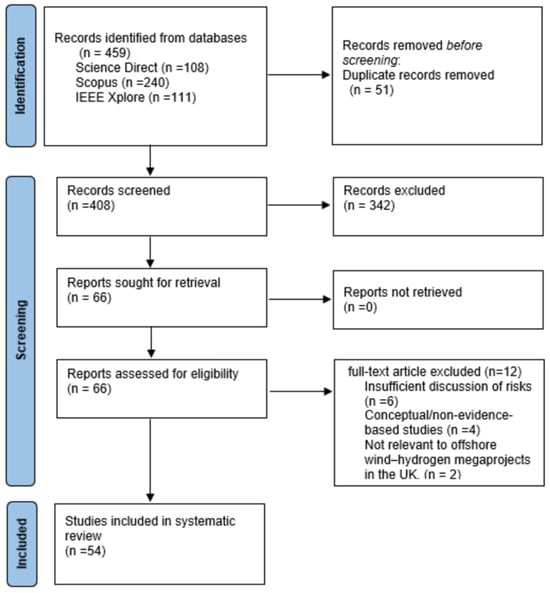
Offshore wind–hydrogen megaprojects are increasingly recognized as a key pathway towards achieving the UK’s Net Zero targets; however, they face complex and interconnected risks across their lifecycle. This paper presents a systematic review, using peer-reviewed articles, conference papers, and industry reports published between 2000 and 2026 to determine the technical, financial, regulatory, environmental, and socio-technical risks affecting large-scale offshore wind–hydrogen energy systems and approaches to their management. Following the Preferred Reporting Items for Systematic Reviews and Meta-Analyses (PRISMA) framework, this paper examines the risks associated with offshore wind turbines, electrolyzer technologies, offshore hydrogen infrastructure, and subsea assets including hydrogen pipelines, power cables, connectors, manifolds, foundations, and seabed structures, as well as energy and hydrogen storage, looking into compressed or liquid hydrogen storage, underground geological storage where applicable, and battery energy storage. System flexibility risks are also examined, particularly the ability of integrated systems to manage wind intermittency while maintaining stable hydrogen production, financing, regulatory compliance, stakeholder acceptance, and environmental performance. The examination of risks indicates that the key technical risks include electrolyzer degradation, offshore equipment reliability, hydrogen leakage, and system integration challenges. Financial risks include high capital costs, electricity price volatility, uncertain hydrogen demand, cost overruns, and market instability. Regulatory and environmental risks include evolving hydrogen standards, permitting delays, governance uncertainty, marine ecosystem impacts, and climate-related uncertainties, while social risks include public opposition, skills shortages, and health and safety concerns associated with offshore hydrogen activities. The risk management measures that were found include phased project development, long-term purchase agreements, flexible governance, advanced monitoring, comprehensive environmental assessment, stakeholder engagement, and risk sharing among partners. The principal contribution of this paper is a novel lifecycle-based risk taxonomy that classifies the risks and maps their interactions, dependencies, and cascading effects from development to decommissioning. Unlike the other approaches that assess risks in isolation, the developed taxonomy provides an integrated framework for lifecycle-wide assessment and systems-based risk management, supporting improved decision-making, project resilience, and investor confidence.
24 November 2026