Skip to Content

Coatings

Coatings is an international, peer-reviewed, open access journal on coatings and surface engineering, published monthly online by MDPI. The Korean Tribology Society (KTS) and Chinese Society of Micro-Nano Technology (CSMNT) are affiliated with Coatings and their members receive discounts on the article processing charges.

Get Alerted

Add your email address to receive forthcoming issues of this journal.

All Articles (13,006)

  • Article
  • Open Access

Carbon fiber reinforced polymer (CFRP) is extensively employed in aerospace and advanced equipment industries for its outstanding mechanical performance and corrosion resistance. As conventional micro-drilling (CMD) easily induces excessive cutting force, accumulated heat, burrs and matrix thermal damage that degrade hole quality, this paper presents an experimental and theoretical investigation on the cutting force and thermal characteristics of CFRP in ultrasonic-assisted micro-drilling (UAMD). Combined with finite-element method (FEM) simulation and machining experiments, the machinability evolution law of CFRP under different machining methods and parameters is systematically explored. A self-developed high-frequency vibration spindle is adopted to improve the micro-hole machinability of CFRP materials. The paper systematically analyzes the cutting force, cutting heat, tool wear and other experimental results under CMD and UAMD with various machining parameters. To ensure the reliability of the research data, a corresponding finite-element model for CFRP micro-drilling was established and validated through experimental tests. The results demonstrate that UAMD can effectively improve the machining condition and suppress cutting force and cutting heat. Compared with the conventional CMD process, UAMD reduces the cutting force and cutting heat of CFRP micro-drilling by up to 16.3% and 19.6%, respectively. The high-frequency intermittent vibration effect of ultrasonic assistance facilitates heat dissipation, alleviates tool abrasion, and significantly extends tool service life. The proposed UAMD method effectively optimizes the cutting force and thermal characteristics in CFRP micro-drilling, providing a credible theoretical basis and technical reference for high-quality and high-precision micro-hole machining of CFRP materials.

Coatings

30 September 2026
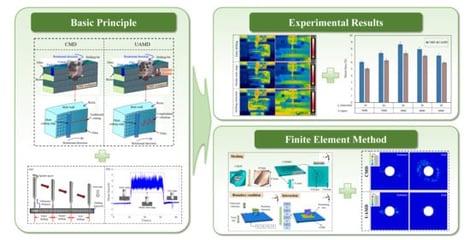
Microscopic cutting mechanism under CMD and UAMD.
  • Article
  • Open Access

Zn-Mn-based alloys represent promising material candidates for biodegradable orthopedic implants. Nevertheless, their real-world clinical deployment is severely hampered by unsatisfactory mechanical properties. In this research, a Zn-0.5Mn-0.2Mg (wt.%) alloy was subjected to equal-channel angular pressing (ECAP) with 4, 8 and 12 passes, to systematically explore the influence of ECAP on microstructural evolution and tensile properties. Grain refinement proceeds gradually with additional ECAP passes. The average grain size declines from 1.94 μm (4 passes) to 1.09 μm (8 passes) and further decreases to 0.78 μm (12 passes). While the tilted basal texture remains strong and stable (approximately 15.1–15.2 multiples of uniform distribution, MUD) after 4 and 8 passes, a dramatic drop in texture intensity to 6.7 MUD is detected for the 12-pass sample. Yield strength (YS) and ultimate tensile strength (UTS) increase monotonically with pass number from 279 MPa and 311 MPa (4 passes) to 287 MPa and 323 MPa (8 passes), and further to 298 MPa and 348 MPa (12 passes). Grain boundary strengthening serves as the dominant strengthening mechanism, and dislocation hardening provides supplementary strength contributions. Elongation (EL) also shows a pronounced improvement, increasing from 12% (4 passes) and 17% (8 passes) to a high value of 41% (12 passes). The excellent ductility achieved after 12 passes stems from the combined effects of significant texture weakening and refined second-phase particles. Benefiting from the excellent strength and superior ductility, the 12-pass alloy satisfies the mechanical benchmark for load-bearing orthopedic implantation.

Coatings

30 September 2026

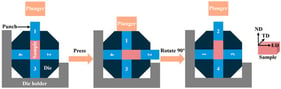
Schematic of the rotary-die ECAP setup, with ED, ND, and TD denoting the extrusion, normal, and transverse directions, respectively.
  • Article
  • Open Access

To elucidate the influence of ring-chamber dust on the current-carrying tribological behavior of the carbon brush/collector ring system in hydro-generators, D172 carbon brushes paired with 45 steel collector rings were employed as the research subjects. Current-carrying sliding friction tests were systematically conducted under varying concentrations of carbon powder, iron powder, and carbon–iron mixed powders. The evolution of friction coefficient, wear loss, wear rate, and contact resistance was analyzed in detail, while the worn carbon brush specimens were characterized using three-dimensional profilometry, scanning electron microscopy (SEM), and energy-dispersive X-ray spectroscopy (EDS). The results demonstrate that different wear debris powders, serving as third-body media, exert significant regulatory effects on both interfacial tribological and electrical conduction behaviors. Under the carbon powder condition, a relatively stable carbonaceous third-body layer readily forms at the interface, maintaining low friction coefficient and wear rate—both reaching their minima at 120 mg/min—thus demonstrating effective friction reduction and wear resistance. In contrast, iron powder conditions promote pronounced abrasive action induced by hard particles, which increases the friction coefficient, accelerates carbon brush wear, and deteriorates the interfacial contact state. For carbon–iron mixed powders, the friction and wear levels lie between those observed for pure carbon and pure iron powders; meanwhile, contact resistance decreases steadily with increasing powder supply rate, indicating relatively superior current-carrying stability. The study reveals that carbon powder primarily contributes positively through lubrication and interfacial protection, whereas iron powder exacerbates damage via particle plowing and contact disruption. The synergistic interaction between the two determines the evolution of the interfacial film layer and the resulting changes in electrical contact performance. These findings provide a theoretical basis for wear control and operational maintenance of carbon brush systems in hydro-generators.

Coatings

30 September 2026
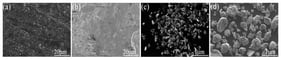
SEM images of the initial samples: (a) carbon brush, (b) collector ring, (c) carbon powder, and (d) iron powder.
  • Article
  • Open Access

Mn-based disordered rock-salt (DRX) cathode materials offer high theoretical capacities and operating voltages, rendering them promising candidates for high-energy-density lithium-ion batteries. However, severe interfacial reactions between Mn-based DRX cathodes and the electrolyte can induce surface degradation and a pronounced increase in interfacial impedance. In this study, a LAGP glass ceramic coating layer was introduced onto the surface of Li1.2Cr0.3Ti0.3Mn0.3O1.9F0.1 (LCTMOF) particles to minimize direct contact between the active material and the electrolyte, thereby enhancing the capacity retention over 50 cycles. It delivered an initial discharge capacity of 278.7 mAh g−1 and retained 227.3 mAh g−1 after 50 cycles. Relative to the pristine uncoated cathode, the LAGP glass ceramic coating material achieved a capacity retention of 81.5% together with improved rate performance, retaining a high specific capacity of 184.5 mAh g−1 at a current density of 500 mA g−1. Surface XPS analysis, together with the electrochemical results, suggests that the LAGP glass ceramic coating mitigates cathode interfacial degradation under the investigated cycling conditions.

Coatings

29 September 2026

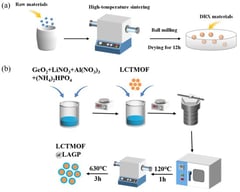
Scheme of synthesis procedure of (a) LCTMOF and (b) LCTMOF@LAGP.

Highly Accessed Articles

News & Conferences

Latest Issues

Open for Submission

Journal Sections

XFacebookLinkedIn
Coatings - ISSN 2079-6412