
- Article

19 Pages
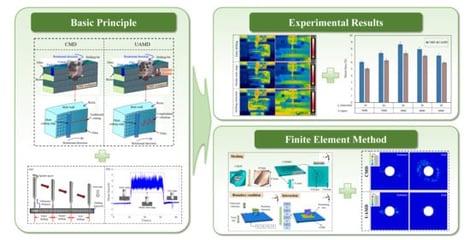
Carbon fiber reinforced polymer (CFRP) is extensively employed in aerospace and advanced equipment industries for its outstanding mechanical performance and corrosion resistance. As conventional micro-drilling (CMD) easily induces excessive cutting force, accumulated heat, burrs and matrix thermal damage that degrade hole quality, this paper presents an experimental and theoretical investigation on the cutting force and thermal characteristics of CFRP in ultrasonic-assisted micro-drilling (UAMD). Combined with finite-element method (FEM) simulation and machining experiments, the machinability evolution law of CFRP under different machining methods and parameters is systematically explored. A self-developed high-frequency vibration spindle is adopted to improve the micro-hole machinability of CFRP materials. The paper systematically analyzes the cutting force, cutting heat, tool wear and other experimental results under CMD and UAMD with various machining parameters. To ensure the reliability of the research data, a corresponding finite-element model for CFRP micro-drilling was established and validated through experimental tests. The results demonstrate that UAMD can effectively improve the machining condition and suppress cutting force and cutting heat. Compared with the conventional CMD process, UAMD reduces the cutting force and cutting heat of CFRP micro-drilling by up to 16.3% and 19.6%, respectively. The high-frequency intermittent vibration effect of ultrasonic assistance facilitates heat dissipation, alleviates tool abrasion, and significantly extends tool service life. The proposed UAMD method effectively optimizes the cutting force and thermal characteristics in CFRP micro-drilling, providing a credible theoretical basis and technical reference for high-quality and high-precision micro-hole machining of CFRP materials.
Coatings
30 September 2026