



J. Manuf. Mater. Process., Volume 9, Issue 11 (November 2025) – 37 articles
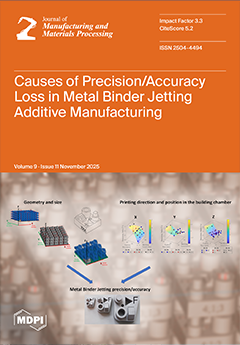
Cover Story (view full-size image):
Metal binder jetting (MBJ) is an additive manufacturing technology of increasing interest due to its potential competitiveness in medium- and large-scale production in a sustainability perspective. However, challenges in controlling the product accuracy and precision significantly limit the widespread adoption of this technology. This work investigates the achievable accuracy, precision, and spatial repeatability of parts produced using the MBJ process, identifying the causes of inaccuracy and proposing countermeasures to improve the product quality. Based on a huge experimental campaign, this study reveals the challenges in compensating for accuracy losses originating from both the printing and sintering stages, also providing novel insights into improving MBJ process precision, and supporting wider adoption of this technology within the manufacturing industry. View this paper
- Issues are regarded as officially published after their release is announced to the table of contents alert mailing list.
- You may sign up for e-mail alerts to receive table of contents of newly released issues.
- PDF is the official format for papers published in both, html and pdf forms. To view the papers in pdf format, click on the "PDF Full-text" link, and use the free Adobe Reader to open them.
Previous Issue
Next Issue