You are currently viewing a new version of our website. To view the old version click .

Biomedicines, Volume 8, Issue 9

September 2020 - 80 articles

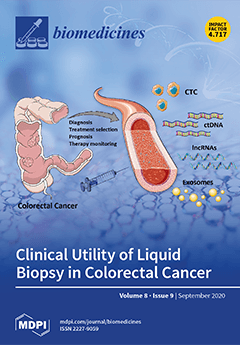
Cover Story: Evaluation of peripheral blood elements, such as circulating tumor cells (CTCs), circulating tumor DNA (ctDNA), microRNAs (miRNAs), and long non-coding RNAs (lncRNAs) could be useful for colorectal cancer screening and diagnosis and for predicting relapse and metastasis. Blood-based liquid biopsy could be helpful in monitoring minimal residual disease and drug resistance in colorectal cancer patients treated with chemotherapy. View this paper
  • Issues are regarded as officially published after their release is announced to the table of contents alert mailing list .
  • You may sign up for email alerts to receive table of contents of newly released issues.
  • PDF is the official format for papers published in both, html and pdf forms. To view the papers in pdf format, click on the "PDF Full-text" link, and use the free Adobe Reader to open them.

Articles (80)

  • Article
  • Open Access
6 Citations
3,303 Views
14 Pages

Chronic Electrical Stimulation of the Superior Laryngeal Nerve in the Rat: A Potential Therapeutic Approach for Postmenopausal Osteoporosis

  • Kaori Iimura,
  • Nobuhiro Watanabe,
  • Philip Milliken,
  • Yee-Hsee Hsieh,
  • Stephen J. Lewis,
  • Arun Sridhar and
  • Harumi Hotta

Electrical stimulation of myelinated afferent fibers of the superior laryngeal nerve (SLN) facilitates calcitonin secretion from the thyroid gland in anesthetized rats. In this study, we aimed to quantify the electrical SLN stimulation-induced system...

  • Article
  • Open Access
17 Citations
5,066 Views
18 Pages

In the Compendium of Materia Medica, seahorse (Hippocampus) is considered effective for the reinforcement of kidney and men’s health. However, the role of seahorse on human health lacks scientific evidence. Therefore, we evaluated the effect of...

  • Review
  • Open Access
13 Citations
5,216 Views
24 Pages

Therapeutic response is evaluated using the diameter of tumors and quantitative parameters of 2-[18F] fluoro-2-deoxy-d-glucose positron emission tomography (FDG-PET). Tumor response to molecular-targeted drugs and immune checkpoint inhibitors is diff...

  • Article
  • Open Access
17 Citations
4,280 Views
16 Pages

Plasma APE1/Ref-1 Correlates with Atherosclerotic Inflammation in ApoE−/− Mice

  • Yu Ran Lee,
  • Hee Kyoung Joo,
  • Eun-Ok Lee,
  • Myoung Soo Park,
  • Hyun Sil Cho,
  • Sungmin Kim,
  • Hao Jin,
  • Jin-Ok Jeong,
  • Cuk-Seong Kim and
  • Byeong Hwa Jeon

Apurinic/apyrimidinic endonuclease 1/redox factor-1 (APE1/Ref-1) is involved in DNA base repair and reducing activity. However, the role of APE1/Ref-1 in atherosclerosis is unclear. Herein, we investigated the role of APE1/Ref-1 in atherosclerotic ap...

  • Article
  • Open Access
34 Citations
3,906 Views
13 Pages

Tauroursodeoxycholic Acid Protects Retinal Pigment Epithelial Cells from Oxidative Injury and Endoplasmic Reticulum Stress In Vitro

  • Reem Hasaballah Alhasani,
  • Mohammad Almarhoun,
  • Xinzhi Zhou,
  • James Reilly,
  • Steven Patterson,
  • Zhihong Zeng and
  • Xinhua Shu

Retinal degeneration is characterized by the dysfunction of retinal cells. Oxidative and endoplasmic reticulum (ER) stress play an important role in the pathogenesis and progression of retinal degeneration. Tauroursodeoxycholic acid (TUDCA) has been...

  • Article
  • Open Access
33 Citations
4,685 Views
23 Pages

Novel 1,3,4-oxadiazole Targets STAT3 Signaling to Induce Antitumor Effect in Lung Cancer

  • Vikas H. Malojirao,
  • Swamy S. Girimanchanaika,
  • Muthu K. Shanmugam,
  • Ankith Sherapura,
  • Dukanya,
  • Prashant K. Metri,
  • Vellingiri Vigneshwaran,
  • Arunachalam Chinnathambi,
  • Sulaiman Ali Alharbi and
  • Shobith Rangappa
  • + 4 authors

Lung cancer is the leading type of malignancy in terms of occurrence and mortality in the global context. STAT3 is an oncogenic transcription factor that is persistently activated in many types of human malignancies, including lung cancer. In the pre...

  • Article
  • Open Access
24 Citations
5,997 Views
21 Pages

Capsaicin-Loaded Chitosan Nanocapsules for wtCFTR-mRNA Delivery to a Cystic Fibrosis Cell Line

  • A. Katharina Kolonko,
  • Janes Efing,
  • Yadira González-Espinosa,
  • Nadine Bangel-Ruland,
  • Willy van Driessche,
  • Francisco M. Goycoolea and
  • Wolf-Michael Weber

Cystic fibrosis (CF), a lethal hereditary disease caused by mutations in the cystic fibrosis transmembrane conductance regulator (CFTR) gene coding for an epithelial chloride channel, is characterized by an imbalanced homeostasis of ion and water tra...

  • Article
  • Open Access
14 Citations
3,867 Views
16 Pages

Effect of Hypoxia Preconditioned Secretomes on Lymphangiogenic and Angiogenic Sprouting: An in Vitro Analysis

  • Philipp Moog,
  • Rahmin Schams,
  • Alexander Schneidinger,
  • Arndt F. Schilling,
  • Hans-Günther Machens,
  • Ektoras Hadjipanayi and
  • Ulf Dornseifer

Hypoxia Preconditioned Plasma (HPP) and Serum (HPS) are two blood-derived autologous growth factor compositions that are being clinically employed as tools for promoting tissue regeneration, and have been extensively examined for their angiogenic act...

  • Review
  • Open Access
20 Citations
10,420 Views
30 Pages

Protein Dynamics in F-like Bacterial Conjugation

  • Nicholas Bragagnolo,
  • Christina Rodriguez,
  • Naveed Samari-Kermani,
  • Alice Fours,
  • Mahboubeh Korouzhdehi,
  • Rachel Lysenko and
  • Gerald F. Audette

Efficient in silico development of novel antibiotics requires high-resolution, dynamic models of drug targets. As conjugation is considered the prominent contributor to the spread of antibiotic resistance genes, targeted drug design to disrupt vital...

  • Article
  • Open Access
2 Citations
2,363 Views
13 Pages

Impact of Subclinical Congestion on Outcome of Patients Undergoing Mitral Valve Surgery

  • Anne-Kristin Schaefer,
  • Thomas Poschner,
  • Martin Andreas,
  • Alfred Kocher,
  • Günther Laufer,
  • Dominik Wiedemann and
  • Markus Mach

Since risk assessment prior to cardiac surgery is based on proven but partly unsatisfactory scores, the need for novel tools in preoperative risk assessment taking into account cardiac decompensation is obvious. Even subclinical chronic heart failure...

of 8

Get Alerted

Add your email address to receive forthcoming issues of this journal.

XFacebookLinkedIn
Biomedicines - ISSN 2227-9059