



Economies, Volume 13, Issue 11 (November 2025) – 33 articles
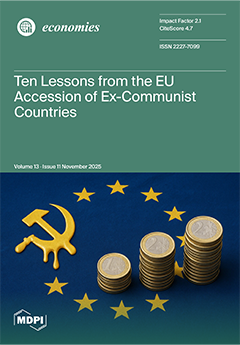
Cover Story (view full-size image):
Ten countries joined the EU in 2004, two in 2007, and another one in 2013. Almost all were former communist countries, lagging behind in economic development and political governance. This enlargement represents an opportunity to ascertain whether European integration is indeed beneficial to lesser developed countries. This paper documents post-accession growth in income per capita and/or total factor productivity, especially when compared to non-EU states, but it is not able to find evidence in favor of improved governance. Moreover, the subsequent increase in the level of indebtedness is sometimes associated with poorer governance and economic performance suggesting borrowing is perhaps a compensatory measure rather than sound economic strategy. View this paper
- Issues are regarded as officially published after their release is announced to the table of contents alert mailing list.
- You may sign up for e-mail alerts to receive table of contents of newly released issues.
- PDF is the official format for papers published in both, html and pdf forms. To view the papers in pdf format, click on the "PDF Full-text" link, and use the free Adobe Reader to open them.
Previous Issue
Next Issue
