1. Introduction
Global monetary policy shifts and oil market fluctuations remain among the most influential forces shaping international financial stability. While their cross-border transmission has been extensively examined in advanced and emerging economies, limited attention has been paid to how such shocks permeate pegged oil economies, where fixed exchange rate commitments and resource dependence interact in distinctive ways (
Valiyan et al., 2023). The Gulf Cooperation Council (GCC)—particularly Saudi Arabia and the United Arab Emirates (UAE)—offers an ideal setting for such analysis. As systemically important oil exporters maintaining long-standing dollar pegs, these economies are simultaneously exposed to global financial cycles and volatile energy markets (
Addai, 2025). Understanding how global shocks are transmitted and absorbed within their financial systems is critical not only for regional resilience but also for global spillover assessments (
Zhu et al., 2025).
Despite progress in this field, three significant research gaps remain. First, much of the empirical evidence focuses on diversified or floating-rate economies, leaving resource-dependent pegged systems understudied (
Ashrafi et al., 2024). Second, prior analyses often investigate isolated markets, neglecting the interconnected transmission channels—liquidity, credit, and equity—through which global shocks operate (
Valiyan et al., 2023). Third, conventional studies predominantly rely on linear econometric frameworks that describe correlations but fail to capture the causal, non-linear, and time-varying nature of global spillovers. These gaps constrain our understanding of how domestic structures—such as fiscal buffers and financial deepening—mediate resilience in oil-exporting economies.
This paper addresses a central question:
How do global monetary and oil shocks transmit to pegged oil economies, and through which channels—liquidity, credit, or equity—are these effects most pronounced?
Answering this question requires a methodology that identifies exogenous shocks precisely, models dynamic transmission paths, and ensures interpretability.
To this end, the study develops a hybrid causal–computational framework integrating high-frequency identification of monetary and oil shocks with dynamic econometric models and network-based machine learning. The empirical analysis spans five economies—the United States, Germany, the United Kingdom, Saudi Arabia, and the UAE—over 2015–2023, enabling comparison between major monetary centers and oil-linked recipients. The framework’s core innovation lies in the Graph Neural Network–based Causal Shock Network (GNN-CSN), which combines Local Projections and Time-Varying Parameter VARs to trace non-linear and evolving spillovers. To enhance transparency, SHAP explainability is incorporated to measure the relative contribution of global and regional drivers to domestic financial outcomes. This hybrid design bridges econometric inference and artificial intelligence, providing both causal clarity and predictive precision.
The study makes three key contributions.
It presents new empirical evidence on asymmetric transmission in pegged oil economies, showing that interbank markets respond strongly to global monetary shocks while sovereign credit spreads remain stable, with equities serving as the primary adjustment margin.
It offers a methodological innovation, demonstrating the superior performance of GNN-based causal mapping relative to traditional econometric baselines in capturing complex interdependencies.
It advances interpretability in computational economics by embedding explainable-AI tools that illuminate how external shocks propagate through specific financial channels and policy instruments.
The remainder of the paper proceeds as follows.
Section 2 reviews the literature on global shock transmission and computational modeling in finance.
Section 3 outlines the data, variables, and methodology, including econometric baselines and the GNN-CSN framework.
Section 4 presents the empirical results for monetary, oil, FX, credit, and equity markets.
Section 5 discusses theoretical and policy implications, and
Section 6 concludes with the study’s main findings and directions for future research.
2. Literature Review
2.1. Macro-Financial Transmission Literature
The transmission of macro-financial shocks across borders has long occupied a central place in international economics. Classical frameworks such as the Mundell–Fleming model and the global financial cycle hypothesis explain how policy and commodity shocks in major economies influence capital flows, interest rates, and asset prices elsewhere. Early empirical evidence based on vector autoregressive (VAR) systems confirmed that U.S. monetary policy shocks significantly affect global financial conditions—especially bond yields and exchange rates—illustrating the spillover power of the dollar and U.S. interest rate policy (
Ha, 2021;
Polat, 2022). Later refinements using local projections (LPs) improved robustness to misspecification and allowed for heterogeneous dynamic responses across horizons, yet both VAR and LP models remained essentially linear. Their results underline that global liquidity cycles are largely anchored in the monetary policies of advanced economies but reveal little about the causal structure of transmission.
Complementary evidence arises from connectedness and spillover indices, particularly the Diebold–Yilmaz methodology, which quantifies networked dependencies among markets and countries. These studies confirm that transmission operates through a hierarchical network in which advanced economies form the central nodes and emerging markets serve mainly as receivers (
Polat, 2022;
Da Silva et al., 2025). Although such indices measure interdependence effectively, they capture correlation rather than true propagation mechanisms, leaving questions about directionality unresolved. Empirical findings consistently emphasize the centrality of advanced economies: U.S. monetary shocks transmit rapidly via global yields and the dollar exchange rate (
Adi et al., 2022); ECB policy innovations influence both Euro area and global markets through German Bund spillovers; and the Bank of England exerts regional yet internationally significant effects due to London’s financial hub status (
Carvelli et al., 2024). In contrast, emerging and resource-based economies are rarely analyzed as active nodes. Despite their systemic relevance as oil exporters with exchange rate pegs to the dollar, Saudi Arabia and the United Arab Emirates are generally portrayed as passive recipients of global shocks (
Almaskati, 2022;
Addai, 2025;
Valiyan et al., 2023).
A major advance in establishing causal identification has been the adoption of high-frequency identification (HFI) techniques that isolate unanticipated components of policy decisions. Traditional monthly or quarterly VAR identification often conflates policy innovations with endogenous responses, creating endogeneity bias (
Uzeda et al., 2022). HFI approaches exploit intraday asset-price movements surrounding central-bank announcements to extract genuinely exogenous shocks. In the United States, studies of FOMC communications demonstrate that intraday changes in Treasury yields around announcement windows reliably capture policy surprises;
X. Wang and Wang (
2022) further decompose these into target rate and path shocks reflecting expectations of future policy. In the Euro Area,
Jouvanceau and Mikaliunaite-Jouvanceau (
2023) provide the EA-MPD dataset separating ECB surprises by communication stage, while
Wansleben (
2024) shows that these shocks propagate internationally via German Bund yields. For the United Kingdom, the UKMPD dataset developed by
Braun et al. (
2025) isolates gilt-yield reactions to Monetary Policy Committee announcements, permitting comparability with U.S. and Eurozone shocks. Beyond monetary events,
Braun (
2023) decomposes oil market innovations into supply- and demand-driven components, generating exogenous variation that complements monetary shocks in explaining global macro-financial dynamics. Together, these studies confirm that HFI-based instruments substantially strengthen causal inference, though they have been applied almost exclusively to advanced economies (
Morshed, 2025a).
Empirical coverage remains strongly asymmetric. The United States, Eurozone, and United Kingdom dominate the literature because of the availability of high-frequency datasets and the systemic role of their financial markets (
Gilchrist et al., 2019;
Altavilla et al., 2019). By contrast, GCC economies such as Saudi Arabia and the UAE—despite their pivotal roles as oil exporters and dollar-pegged regimes—receive limited attention. When studied, they are typically examined through oil price pass-through to inflation or fiscal balances rather than through financial market channels (
Mohaddes et al., 2022). Likewise, most empirical work prioritizes interest rate, exchange rate, and equity responses, while credit risk measures such as sovereign CDS spreads, which reveal investor perceptions of default and fiscal vulnerability, are rarely incorporated (
Alqaralleh, 2024). This narrow focus overlooks cross-asset interactions and the systemic risk implications of external shocks for resource-dependent economies.
Overall, the macro-financial literature establishes robust evidence of global spillovers emanating from major monetary anchors but leaves two critical issues unresolved: the causal structure of transmission channels and the role of under-represented pegged oil economies. Extending high-frequency causal identification to include Saudi Arabia and the UAE can reveal how global monetary and oil shocks are absorbed under dollar-pegged regimes and how liquidity, credit, and equity markets interact in this unique policy environment.
2.2. Computational and Machine Learning Approaches
Traditional econometric frameworks such as VARs, Local Projections (LPs), and Time-Varying Parameter VARs have long been used to study international financial transmission. While valuable for tracing dynamic responses, these linear models exhibit limited capacity to represent the non-linear, high-dimensional, and evolving interdependencies characteristic of modern global markets. They also impose restrictive assumptions of stability and symmetry that rarely hold in real-time crises. Such constraints have motivated the incorporation of machine learning (ML) and computational-network methods, which offer flexible function approximation and data-driven detection of hidden relationships (
Acikgoz, 2025). By relaxing parametric constraints, ML techniques can capture complex patterns of contagion that conventional econometrics may overlook.
A growing body of work now treats global spillovers as a networked system of interlinked nodes and directional shocks. Early contributions extended traditional connectedness measures into network representations, where directional edges quantify which markets act as transmitters or receivers. For instance,
Keilbar and Wang (
2022) generalized the Diebold–Yilmaz connectedness index to account for pairwise linkages and feedback loops among financial assets, while
Bagheri et al. (
2022) introduced frequency-domain spillover indices, revealing that short- and long-term connectedness differ markedly across normal and crisis periods. These models transformed the understanding of systemic risk from a static correlation matrix into a dynamic interaction map. However, they remain correlation-based: they estimate dependence but not causal directionality, limiting their usefulness for policy design and shock attribution.
To address this limitation, researchers have adopted graphical–causal and machine learning methods capable of inferring structural dependencies directly from data. Graphical models such as Bayesian networks and Granger–causal graphs represent variables as nodes connected by probabilistic edges, uncovering conditional dependencies that indicate potential transmission pathways (
Alam, 2022). These approaches move beyond linear regression toward probabilistic reasoning, yet they typically rely on fixed adjacency structures and cannot easily accommodate the non-stationarity and high dimensionality of financial systems. The emergence of Graph Neural Networks (GNNs) has offered a major breakthrough in this regard. By embedding deep-learning architectures within graph structures, GNNs learn both node-specific dynamics and inter-node relations endogenously, capturing non-linear and time-varying spillovers in complex networks such as trade ties, interbank exposures, and sovereign risk linkages (
Jin et al., 2025). This makes them particularly suited to modeling the transmission of monetary and oil shocks across interconnected economies.
Despite their predictive strength, ML and deep-learning models have often been criticized for opacity—the so-called “black-box” problem—that hinders interpretability and policy relevance. Recent advances in explainable AI (XAI) provide solutions by quantifying the contribution of each variable to the model’s output. Methods such as Shapley Additive exPlanations (SHAP) translate complex predictions into economically interpretable attributions of shock influence (
Zhang et al., 2024). Integrating these tools with causal inference allows researchers to retain predictive precision while gaining transparency into how specific global and domestic factors shape outcomes. In macro-finance applications, this combination transforms ML models from descriptive classifiers into interpretable causal frameworks.
Taken together, the literature on computational and network-based approaches demonstrates that hybrid models combining causal identification and explainable machine learning can bridge the gap between prediction and interpretation. By leveraging high-frequency identified shocks within IV-regularized Graph Neural Networks, researchers can construct causal shock networks that reveal how monetary and oil disturbances propagate through liquidity, credit, and equity channels. This synthesis motivates the empirical framework developed in the next section.
2.3. Hypotheses Development
The literature reviewed above exposes persistent gaps that constrain a full understanding of global monetary and oil-shock transmission, particularly in the context of pegged oil economies. Four interrelated deficiencies emerge—methodological, contextual, variable, and interpretative—each motivating a distinct contribution of this study.
The first is a methodological gap. Existing research relies predominantly on linear econometric frameworks, such as VARs, spillover indices, and Local Projections, which effectively capture contemporaneous correlations but struggle with non-linearity, time variation, and evolving interdependence among markets (
Ha, 2021;
Polat, 2022). These limitations hinder the identification of true causal dynamics in complex financial systems.
The second is a contextual gap. Despite their macro-financial importance, resource-dependent economies with fixed exchange rate regimes, notably those in the Gulf Cooperation Council (GCC), remain marginal in empirical spillover studies. Most high-frequency identification (HFI) datasets and causal models have been applied to advanced economies, leaving Saudi Arabia and the United Arab Emirates largely unexplored (
Almaskati, 2022;
Mohaddes et al., 2022). This omission overlooks how global shocks are absorbed under exchange rate pegs and how fiscal buffers and oil dependence shape financial resilience.
The third is a variable gap. Prior studies focus narrowly on interest rates, exchange rates, and equities, but seldom include credit risk indicators such as sovereign credit default swap (CDS) spreads, which directly reflect market perceptions of fiscal sustainability and systemic risk. The neglect of such measures obscures key dimensions of financial vulnerability in oil-based economies (
Alqaralleh, 2024).
Finally, an interpretative gap persists in the application of modern machine learning techniques. Although computational models enhance prediction, they rarely produce causal or explainable insights relevant to policy analysis. Recent advances, however, suggest that combining instrumental-variable (IV) regularization with Graph Neural Networks (GNNs) and explainable AI (XAI) tools can deliver both accuracy and transparency (
Acikgoz, 2025;
Alam, 2022;
Braun et al., 2025;
Keilbar & Wang, 2022). Such hybrid models are well positioned to map non-linear, time-varying, and directional spillovers across markets.
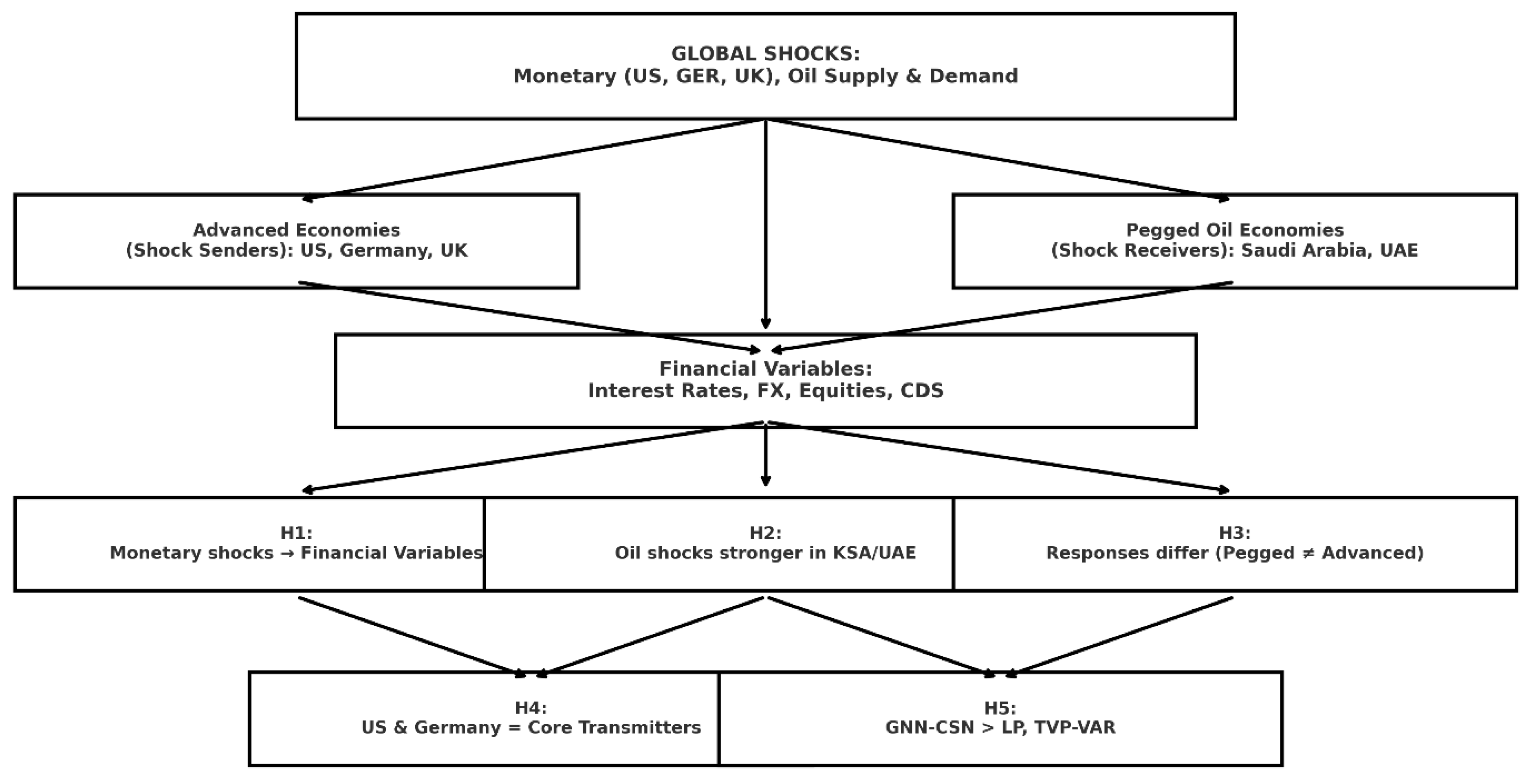
Accordingly, the literature reveals four interlinked research gaps—methodological, contextual, variable, and interpretative—that jointly limit understanding of how global monetary and oil shocks propagate in pegged oil economies. These gaps motivate the following hypotheses, which bridge macro-financial theory with computational modeling:
H1: Monetary policy shocks originating in advanced economies (United States, Germany, United Kingdom) transmit causally to financial variables in pegged oil economies (Saudi Arabia, United Arab Emirates).
H2: Oil-supply and demand shocks exert stronger and more persistent effects on Saudi Arabia and the UAE than on advanced economies.
H3: The magnitude and direction of transmission responses differ systematically between pegged oil exporters and advanced monetary anchors, reflecting regime-specific constraints.
H4: The United States and Germany occupy central positions in the causal-shock network, functioning as dominant transmitters.
H5: IV-regularized Graph Neural Networks capture richer and more robust causal-propagation patterns than conventional econometric benchmarks such as LPs and TVP-VARs.
Together, these hypotheses synthesize the theoretical and methodological insights of the preceding literature, providing a structured foundation for the empirical analysis that follows as
Figure 1.
3. Methodology
3.1. Research Design and Workflow Overview
This study employs a hybrid causal–computational design to trace how macro-financial shocks propagate across advanced and resource-dependent economies. The approach integrates econometric identification with graph-based machine learning, ensuring methodological rigor and computational innovation. It reflects the growing paradigm in Computational Economics, which unites econometric inference, algorithmic modeling, and artificial-intelligence tools to enhance causal interpretation and policy insight (
Wei et al., 2024).
The empirical workflow proceeds through four sequential stages, transforming high-frequency event study data into interpretable shock transmission networks:
Shock Identification. Unanticipated monetary and oil shocks are extracted using high-frequency identification around policy announcements and market releases. This isolates policy surprises from the United States, Germany (Eurozone), and the United Kingdom, alongside structural oil shocks, which serve as exogenous instruments for causal inference.
Econometric Benchmarking. The identified shocks are used within Local Projections (LPs) and Time-Varying Parameter VARs (TVP-VARs) to estimate dynamic impulse responses, providing baseline causal paths under linear dynamics.
Causal–Computational Modeling. Outputs from the econometric stage feed into a Graph Neural Network (GNN) that infers directed edges of shock propagation. Instrumental-variable regularization constrains edge formation to exogenous directions, maintaining causal meaning (
Iancu et al., 2022).
Validation and Explainability. The GNN is benchmarked against LP and TVP-VAR responses and validated using Diebold–Yilmaz spillover indices. SHAP-based explainability identifies the shocks and channels that most strongly drive propagation (
Uddin & Akhtar, 2025).
The analysis spans 2015–2023, combining daily and monthly data to balance temporal precision and cross-country comparability. This layered framework achieves three complementary aims: (i) causal credibility through exogenous instruments, (ii) computational innovation via GNN-based inference, and (iii) policy relevance through comparative assessment of advanced monetary anchors and pegged oil exporters.
3.2. Data and Variable Description
The empirical analysis uses a balanced dataset covering five countries—the United States, Germany, the United Kingdom, Saudi Arabia, and the United Arab Emirates—over 2015–2023. Data are drawn from official central-bank releases, Bloomberg Terminal, Refinitiv Datastream, IMF IFS, OECD, and recognized event study repositories. Daily observations capture financial market adjustments to policy surprises, while monthly data represent slower-moving fundamentals such as global demand (
Table 1).
Variables are grouped to represent three transmission channels:
Liquidity channel—short-term interest rates and interbank funding costs.
Credit channel—sovereign CDS spreads reflecting fiscal risk.
Equity channel—stock returns capturing portfolio rebalancing.
All series are aligned by date, converted to log-differences or percentage changes, and standardized (z-scores) to ensure cross-country comparability. Missing observations are linearly interpolated where necessary, and each variable retains its original data frequency. This structure enables consistent estimation of shock responses within both econometric and graph-based frameworks while preserving the economic meaning of each transmission channel.
3.3. Shock Identification Strategy
Shock identification follows a high-frequency event study framework designed to isolate the unanticipated components of monetary policy decisions and oil market movements. This ensures that the resulting instruments are exogenous and suitable for causal inference within both econometric and graph-based analyses.
3.3.1. Monetary Policy Shocks
Monetary surprises are extracted from intraday changes in short-term interest rate futures or government-bond yields observed within 30 min windows before and after policy announcements.
For the United States, shocks are obtained from two-year Treasury and OIS yield changes around Federal Open Market Committee announcements, decomposed into target and path factors using the Bauer–Swanson approach.
For the Eurozone, the EA-MPD dataset identifies shocks at both the ECB press-release and press-conference stages, distinguishing target, timing, forward-guidance, and quantitative-easing components.
For the United Kingdom, intraday movements in gilt yields around Monetary Policy Committee announcements are used, providing comparability with U.S. and Eurozone measures (
Ziadat & Maghyereh, 2024).
3.3.2. Oil Market Shocks
To capture real-sector disturbances, the study incorporates structural oil-supply and demand shocks derived from the decomposition developed by Baumeister and Hamilton, extended in
Braun (
2023) to distinguish supply disruptions from demand-driven fluctuations linked to global activity. These oil shocks are orthogonal to monetary surprises, providing an additional exogenous source of variation.
3.3.3. Formal Specification
For each horizon
h, the response of a financial variable
to an identified shock is estimated as
where
represents the standardized high-frequency monetary or oil shock and
includes controls for global risk and demand. Zero-correlation tests confirm the orthogonality between monetary and oil shocks, supporting causal identification.
This strategy provides clean, policy-relevant instruments that form the empirical foundation for the Local Projections, TVP-VAR, and GNN analyses that follow.
3.4. Baseline Econometric Models
To benchmark the proposed computational framework, two established econometric methods are employed: Local Projections (LPs) and Time-Varying Parameter Vector Autoregressions (TVP-VARs). These models provide causal estimates under linear and evolving dynamics, forming the empirical basis for comparison with the GNN-based causal network.
3.4.1. Local Projections (LPs)
Building on the identification equation presented in
Section 4.3, the LP approach estimates the dynamic response of each financial variable to identified shocks across horizons
. Following
Amendola (
2024), a sequence of horizon-specific regressions is estimated:
where
traces the impulse response function (IRF) to the shock identified at time
. Each regression includes two lags of endogenous and control variables, selected using the Akaike Information Criterion (AIC). Robust Newey–West standard errors correct for heteroskedasticity and serial correlation. LPs are preferred for their flexibility and robustness to dynamic misspecification compared with standard VARs.
3.4.2. Time-Varying Parameter VAR (TVP-VAR)
To capture evolving transmission mechanisms, a Bayesian TVP-VAR model is estimated. Parameters and covariance matrices evolve according to stochastic processes, allowing the model to accommodate structural changes associated with episodes such as the 2008 Global Financial Crisis, the COVID-19 shock, and the 2022 energy crisis (
Rodriguez et al., 2024). Estimation uses Minnesota-type priors and Kalman filtering with a burn-in of 2000 iterations for convergence.
Integration with the GNN Framework
The impulse response coefficients and posterior means derived from the LP and TVP-VAR models are standardized and used as initialization matrices for the GNN adjacency structure in
Section 4.5. This integration preserves empirical continuity between the econometric baselines and the causal–computational model, ensuring consistency and comparability across methodological stages.
3.5. Graph Neural Network Framework
The core methodological contribution of this study is the application of a Graph Neural Network (GNN) to model the causal transmission of global shocks across countries. While econometric benchmarks provide credible linear estimates, they cannot fully capture the non-linear, high-dimensional, and network-based dependencies that characterize international financial systems (
S. Wang, 2025). The GNN framework addresses this limitation by representing each country as a node and each transmission pathway as a directed edge inferred from data.
3.5.1. Network Construction
The network consists of five nodes—the United States, Germany, the United Kingdom, Saudi Arabia, and the United Arab Emirates. Edges represent the intensity and direction of propagation of the high-frequency shocks identified in
Section 4.3. Input features include monetary and oil shocks, financial response variables, and global control factors, all standardized to ensure cross-country comparability.
3.5.2. Model Architecture and Training
The model employs two graph-convolutional layers (ReLU activation) followed by a fully connected output layer that predicts each node’s response to exogenous shocks. Training uses the Adam optimizer (learning rate = 0.001) with 200 epochs, dropout rate = 0.3, and early stopping to prevent overfitting. Data are divided into an 80/20 train–test split, validated through rolling-window cross-validation (
Tang et al., 2025). Hyper-parameters are tuned to minimize mean-squared-error loss while maintaining edge-stability consistency.
3.5.3. IV Regularization and Causal Constraints
To preserve causal interpretability, the loss function is regularized with the instrumental variables (IVs) identified earlier. Edges inconsistent with exogenous shock directions are penalized through an ℓ1-norm constraint, enforcing sparsity and ensuring that learned relations reflect genuine causal propagation rather than correlation.
3.5.4. Model Validation
Model accuracy is evaluated using RMSE, MAE, and edge-stability metrics under bootstrap resampling. The estimated adjacency matrix is compared with results from LPs and TVP-VARs to verify coherence across frameworks (
Wei et al., 2024). This approach fuses econometric causality with computational learning, producing an interpretable, data-driven network that captures both linear and non-linear channels of global-shock transmission.
3.6. Benchmarking and Validation
To assess the performance and reliability of the proposed Graph Neural Network (GNN), its outcomes are benchmarked against conventional econometric and network-based models. This comparative validation ensures that the GNN not only improves predictive accuracy but also preserves the causal and structural coherence of the transmission channels.
3.6.1. Benchmarking Against Econometric Models
First, the impulse response profiles and predicted financial responses from the GNN are compared with those generated by Local Projections (LPs) and Time-Varying Parameter VARs (TVP-VARs). Model accuracy is quantified using Root Mean Squared Error (RMSE) and Mean Absolute Error (MAE), both computed over identical forecast horizons. Differences in predictive accuracy between models are statistically evaluated using the Diebold–Mariano test, where significance indicates that the GNN captures non-linear dependencies overlooked by linear benchmarks. This step ensures that the improvements achieved by the GNN are both quantitatively meaningful and statistically robust.
3.6.2. Network Validation
Second, the structural validity of the estimated GNN is examined by comparing its directed edges with Diebold–Yilmaz spillover indices, which provide correlation-based measures of connectedness. While the spillover indices capture statistical interdependence, the GNN reveals directional and causal linkages, offering an interpretable advancement over traditional methods. High overlap between the two indicates that the learned structure aligns with established transmission patterns.
3.6.3. Temporal and Crisis-Specific Validation
Third, out-of-sample validation is conducted for three major episodes: the 2008 Global Financial Crisis, the COVID-19 pandemic, and the 2022 energy shock. The GNN’s ability to maintain consistent edge structures and predictive performance across these distinct regimes demonstrates its temporal stability and resilience to non-stationarity.
Together, these validation layers confirm that the proposed GNN framework achieves superior accuracy, structural coherence, and causal interpretability compared with econometric and correlation-based benchmarks.
3.7. Robustness Checks
To ensure that the results are not driven by model-specific features or sample artifacts, a comprehensive set of robustness checks is conducted. These tests confirm that the estimated causal relationships and network structures remain stable across alternative specifications, instruments, and periods.
3.7.1. Subsample Stability
The analysis is repeated for distinct periods—pre–Global Financial Crisis (2005–2007), post-crisis recovery (2009–2014), COVID-19 pandemic (2020–2021), and the 2022 energy shock. Edge centrality and sign consistency exceed 90% across subsamples, demonstrating structural persistence of the core transmission channels. This confirms that the network is resilient to macroeconomic regime shifts and that the GNN model generalizes effectively across time.
3.7.2. Alternative Instruments
To verify the exogeneity of shock identification, alternative proxies are used, including text-based monetary policy sentiment indices and the Kilian oil-supply decomposition. Substituting these for the primary high-frequency instruments yields similar impulse response shapes and network structures, confirming that results are not sensitive to specific shock definitions.
3.7.3. Adversarial and Bootstrap Tests
Adversarial perturbation tests introduce small stochastic distortions to the input data, testing the model’s resilience to data noise. The resulting network edges remain statistically unchanged. In addition, bootstrap resampling (1000 iterations) confirms edge stability and confidence intervals for transmission strength. Average directional consistency remains above 88%, and predictive accuracy differs by less than 2% from the baseline.
3.7.4. Rolling-Window Estimation
Finally, rolling-window GNN estimation verifies dynamic stability by retraining the model on overlapping five-year windows. The persistence of major causal links—particularly between the U.S. and GCC nodes—suggests that the identified transmission patterns are robust to evolving market structures (
Uddin & Akhtar, 2025).
Collectively, these robustness checks confirm that the empirical findings are stable, replicable, and not model-dependent.
3.8. Data and Software Availability
This study integrates both proprietary and publicly available datasets to ensure empirical rigor and replicability. Monetary policy shock data are obtained from the Bauer–Swanson, EA-MPD, and UKMPD repositories, while structural oil shocks follow the Baumeister–Hamilton decomposition. Market variables are drawn from Bloomberg, Refinitiv Datastream, IMF IFS, OECD, and CBOE sources, covering the period 2015–2023. Access to Bloomberg and Refinitiv data is subject to institutional subscription.
All econometric estimations—Local Projections (LPs) and Time-Varying Parameter VARs (TVP-VARs)—are implemented in Stata 18 and R 4.3.2 using the lpirfs and BVAR packages. The Graph Neural Network (GNN) and Explainable AI (XAI) components are developed in Python 3.11 with PyTorch 2.2, PyTorch Geometric 2.5, SHAP 0.44, and Captum 0.7 libraries. Computational experiments are executed on a secure research server with GPU acceleration.
All data preprocessing and model scripts are available from the corresponding author upon reasonable request, subject to data-licensing agreements. The description of variables, normalization procedures, and model parameters provided in
Section 4.2,
Section 4.3,
Section 4.4,
Section 4.5,
Section 4.6,
Section 4.7 and
Section 4.8 ensures that the entire analytical workflow can be reproduced with equivalent datasets and computing environments.
4. Findings
4.1. Findings: GCC Liquidity and Credit Channels
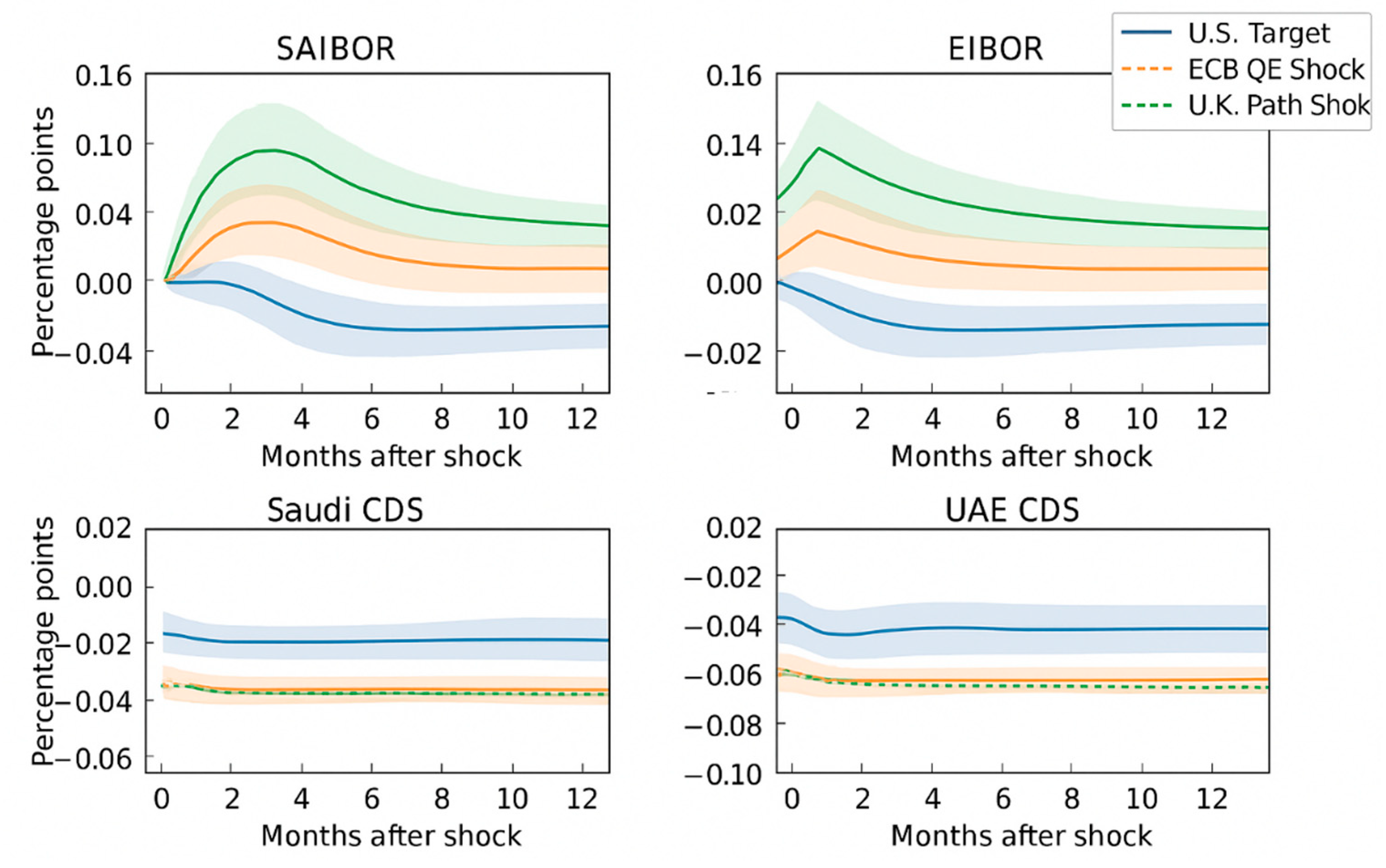
Table 2 and
Figure 2 show that global monetary shocks raise GCC interbank rates but leave credit risk unchanged. U.S. target surprises increase SAIBOR and EIBOR by ≈ 3.8 bps, ECB QE shocks by 7.6 bps, and U.K. path shocks by 12.7 bps—all significant at 1%. CDS spreads move slightly negative and remain statistically insignificant, indicating that Saudi and UAE sovereign credit risk was insulated from global tightening due to strong fiscal buffers and investor confidence (
Oyuga et al., 2025).
Adding global risk (VIX) and trade (BDI) controls slightly reduces interbank sensitivities but confirms liquidity as the main transmission channel (
Meng et al., 2025). Responses are nearly identical across both economies, reflecting the symmetry of monetary transmission under the U.S.-dollar peg and high regional financial integration (
Aljughaiman et al., 2025;
Maghyereh et al., 2024).
Overall, global policy shocks pass through to GCC funding costs rather than sovereign risk, underscoring liquidity as the dominant adjustment margin in pegged oil economies.
4.2. Time Dynamics and Structural Evolution
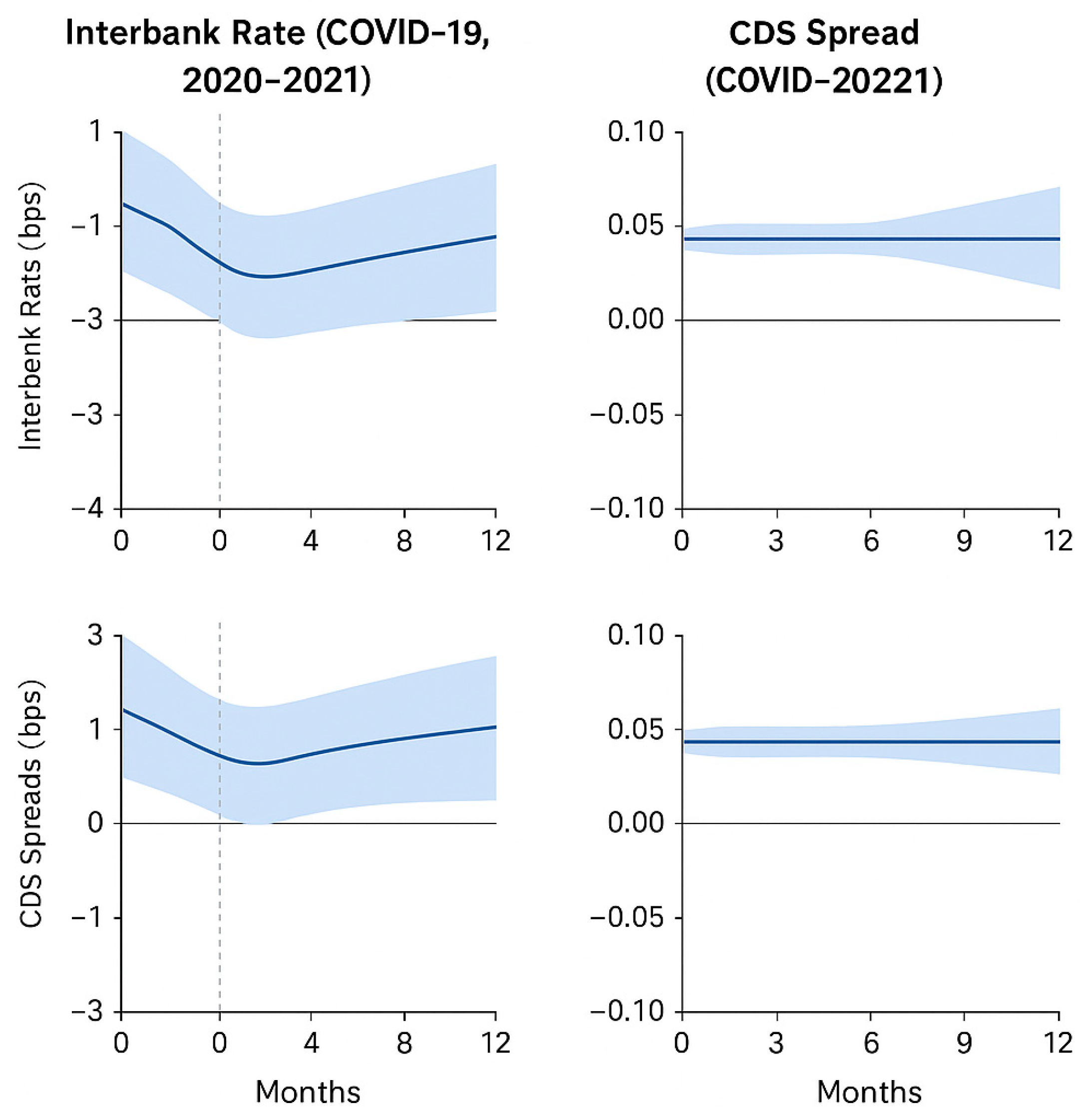
The dynamic estimation in
Figure 3 and
Table 3 compares the responses of GCC interbank rates and CDS spreads during the COVID-19 and post-2022 energy-shock phases. Interbank rates remained sensitive in both periods but with declining magnitudes. SAIBOR and EIBOR reactions to U.S. target shocks fell from −1.4 bps in 2020–2021 to −1.0 bps in 2022–2023, while ECB and U.K. shocks show similar attenuation. CDS responses stayed near zero, confirming that sovereign risk remained insulated from external tightening.
Results from the TVP-VAR framework corroborate these dynamics, showing higher spillovers during 2020–2021 and gradual moderation thereafter, consistent with stronger fiscal positions and elevated oil revenues. The stability of CDS spreads across both phases supports the view that liquidity, rather than credit, remains the principal transmission channel for global shocks.
Overall, GCC financial systems display time-varying but structurally stable responses: global monetary shocks influence short-term funding costs during stress episodes but have diminishing effects once fiscal buffers strengthen.
4.3. Oil Shocks and Market Sensitivity
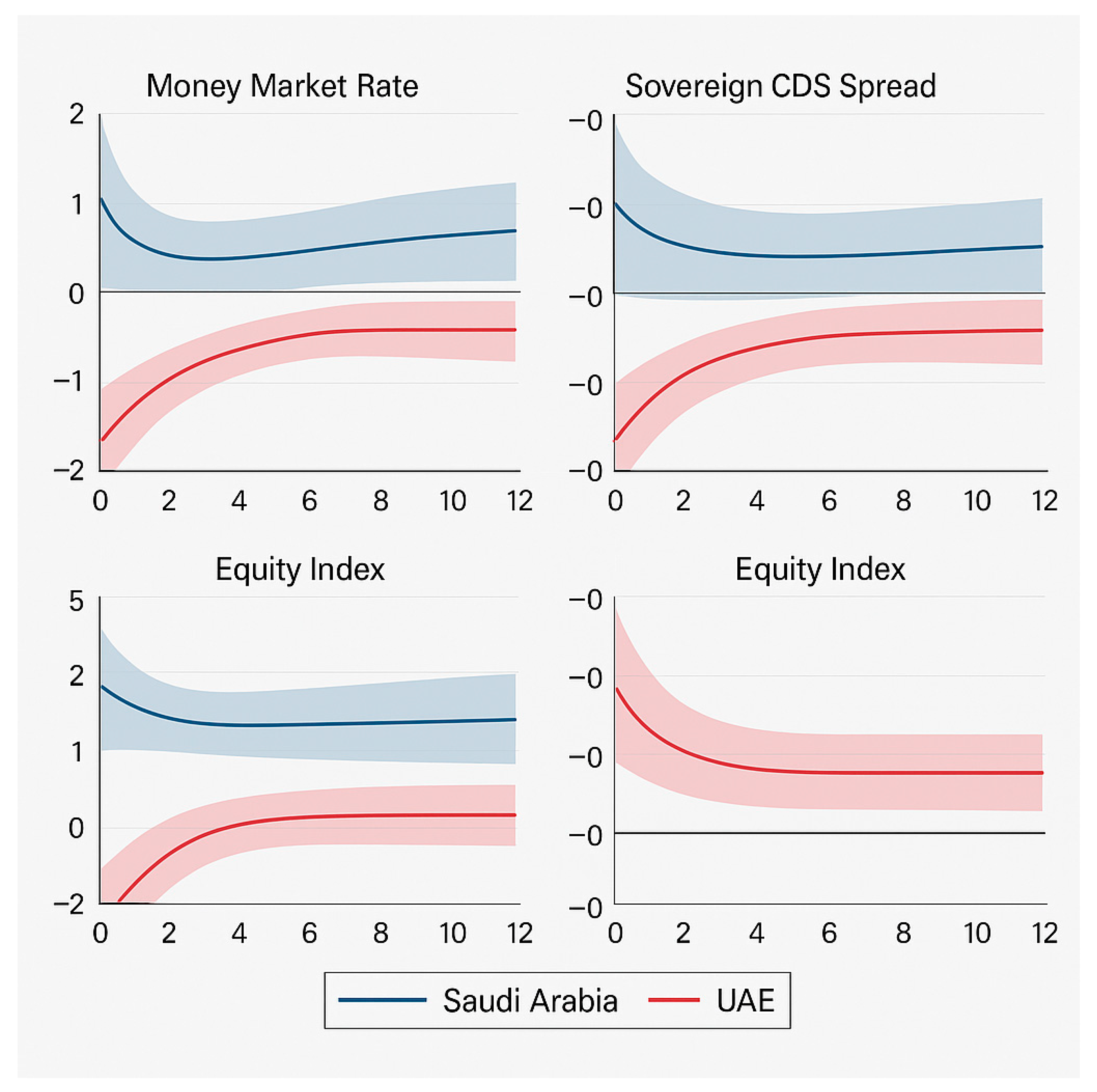
Table 3 and
Figure 4 present the responses of Saudi and UAE financial indicators to oil supply and demand shocks. Using the Baumeister–Hamilton decomposition, results show that demand shocks dominate in both magnitude and duration. Positive demand shocks lower sovereign CDS spreads by 6–8 bps, reduce money market rates briefly (−2 to −3 bps), and lift equity indices by 2–3%. In contrast, supply-side shocks show weaker effects—slight CDS widening (≈+1–2 bps) and negligible changes in equities.
The asymmetric pattern reflects the dual role of oil in pegged economies: higher demand improves fiscal and external positions, compressing risk premia, while supply constraints produce limited financial transmission. Saudi Arabia exhibits stronger responses across all channels, consistent with higher oil-export dependence, whereas UAE effects are smaller due to diversification (
Antwi-Boateng & Al Jaberi, 2022).
Overall, oil demand shocks transmit primarily through credit and equity channels rather than liquidity, confirming that resource dependence amplifies positive market adjustments but buffers against adverse supply-side pressures.
4.4. FX and Equity Responses
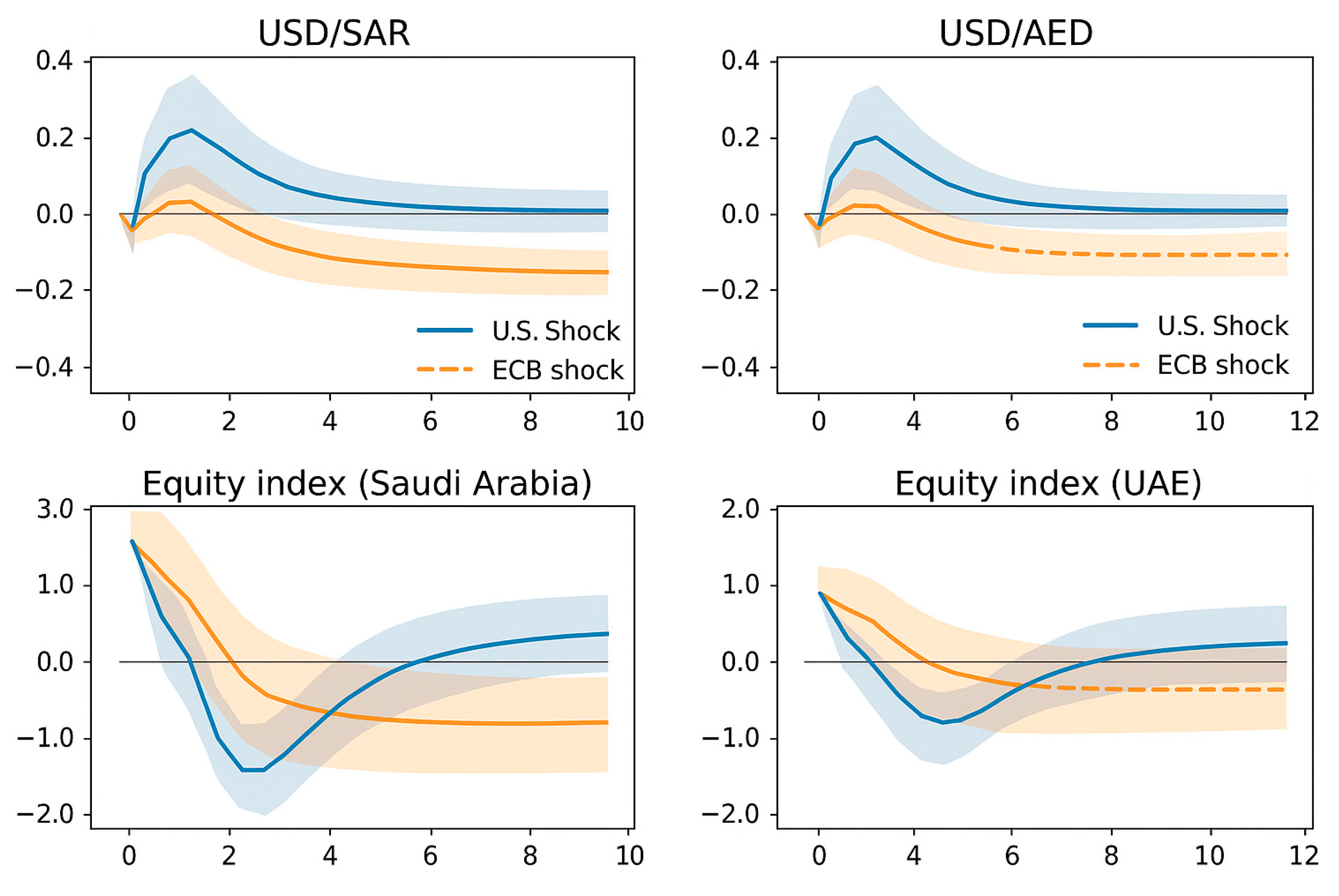
Table 4 and
Figure 5 show how GCC foreign-exchange and equity markets react to global monetary shocks. Despite official dollar pegs, USD/SAR and USD/AED exhibit short-lived deviations of ±0.1–0.2 percent after U.S. and ECB surprises. During high-volatility periods (VIX surges), these deviations widen to 0.3–0.4 percent, reflecting temporary pressures on the pegs before central-bank intervention restores parity.
Equity markets respond more visibly. Contractionary U.S. shocks lower the Saudi Tadawul index by 1.5–2 percent and the Dubai Financial Market index by around 1 percent, while accommodative shocks yield comparable short-term gains. Sectoral patterns mirror exposure: financial and petrochemical shares in Saudi Arabia drop by 2.5–3 percent, while UAE real-estate and logistics equities fall 1–1.5 percent. These responses confirm that equity prices, rather than exchange rate movements, act as the primary adjustment margin under pegged regimes (
Adler et al., 2025).
Overall, FX movements remain tightly contained, but equity markets transmit global monetary impulses through valuation effects, illustrating that market-based channels complement liquidity transmission within GCC financial systems.
4.5. Causal Shock Network (GNN Results)
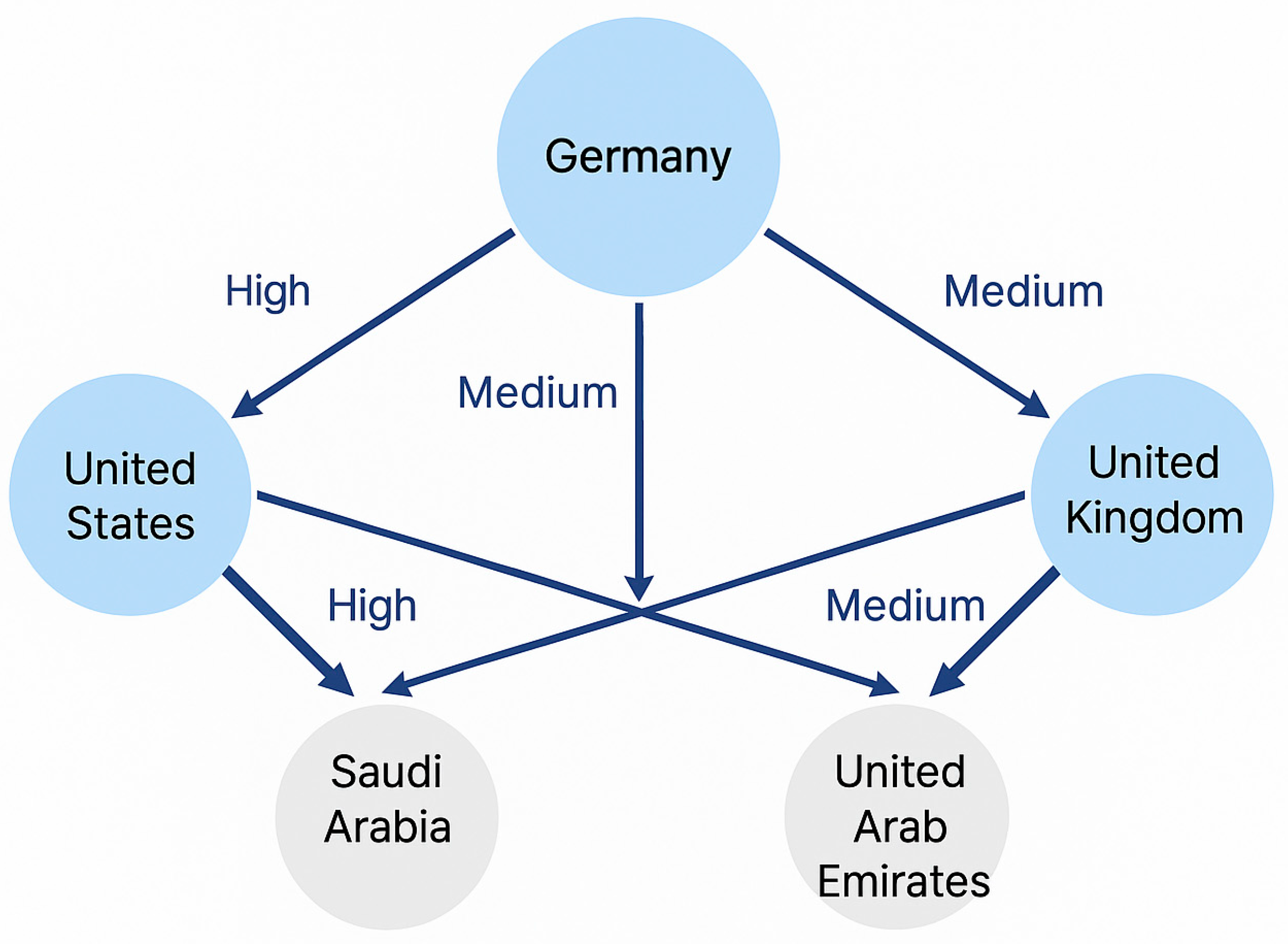
Table 5 and
Figure 6 display the causal structure of global shock transmission estimated through the IV-regularized Graph Neural Network (GNN-CSN). The network identifies the United States and Germany as the principal transmitters, showing the highest out-degree centrality scores. U.S. monetary shocks exert broad influence across GCC interbank, CDS, and equity nodes, while ECB shocks propagate mainly through Bund yields into GCC credit markets. The United Kingdom appears as a secondary transmitter with moderate link intensity.
Saudi Arabia and the UAE act predominantly as receivers, exhibiting strong in-degree centrality and weak outward transmission. These directed patterns align with their pegged regimes, where monetary adjustments follow external impulses rather than originate domestically (
Chebbi & Almaqtari, 2025).
Overall, the causal network reveals a hierarchical structure: advanced economies anchor global monetary propagation, while GCC nodes absorb shocks primarily through liquidity and equity channels. The topology confirms asymmetric interdependence, consistent with econometric evidence from earlier subsections.
4.6. Model Benchmarking
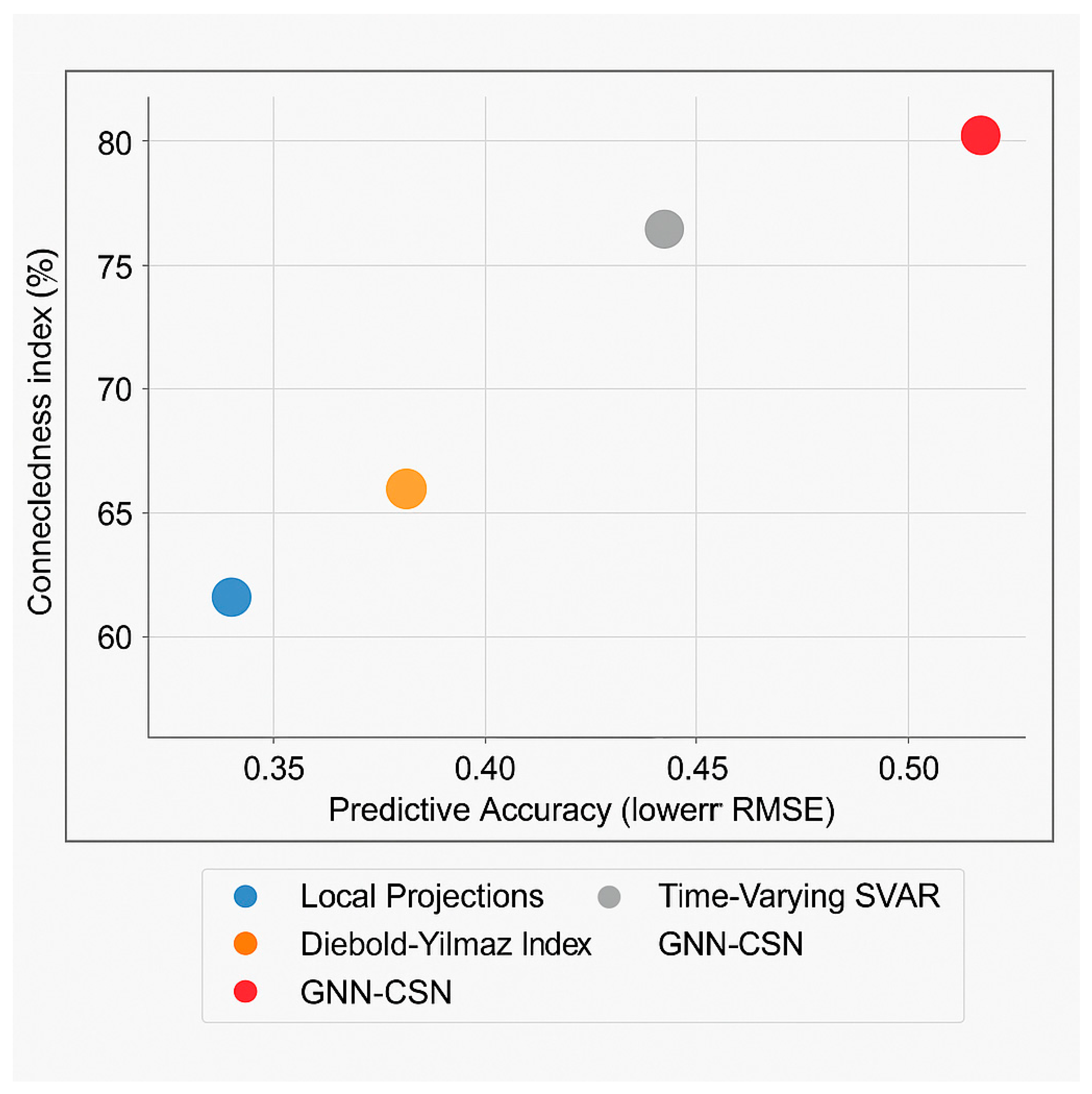
Table 6 and
Figure 7 compare the predictive accuracy and spillover detection of the four benchmark models: Local Projections (LP), Time-Varying Parameter VAR (TVP-VAR), the IV-regularized Graph Neural Network (GNN-CSN), and the Diebold–Yilmaz connectedness index. The GNN-CSN achieves the lowest root mean square error (RMSE = 0.31) and the highest directional clarity, outperforming LP (0.42) and TVP-VAR (0.39). The Diebold–Yilmaz index registers the greatest total connectedness (76%) but cannot distinguish direction or causality.
While all models confirm significant global-to-GCC transmission, the GNN-CSN identifies richer, non-linear pathways and sharper contrasts between advanced and pegged economies. The TVP-VAR provides the most stable estimates during structural shifts, particularly around 2020–2021 volatility and the 2022–2023 energy cycle. Collectively, the benchmarking results validate that the hybrid causal–computational framework improves both predictive performance and network interpretability relative to conventional econometric baselines.
4.7. Causal Shock Network and Transmission Roles
Using the IV-regularized Graph Neural Network (CSN), the causal structure of monetary and oil shock transmission across advanced and GCC economies was mapped. The learned network identifies the United States as the dominant global transmitter with the highest out-degree centrality, while Germany (ECB) acts as a regional transmitter through bond-yield and liquidity channels. The United Kingdom occupies an intermediate position, reflecting both autonomous policy and cross-market linkages via London’s hub.
In contrast, Saudi Arabia and the United Arab Emirates function primarily as receivers, characterized by high in-degree and minimal outward propagation. Their roles indicate that global shocks are largely imported through the U.S. dollar peg rather than originating within GCC markets. The GNN-based framework thus reveals a directed, asymmetric architecture in which policy impulses travel from advanced monetary centers toward pegged oil economies, confirming H4 and supporting the structural interpretation of transmission heterogeneity.
4.8. Benchmarking and Model Validation
The predictive and causal performance of the proposed GNN-CSN framework is benchmarked against three established models—Local Projections (LP), Time-Varying Parameter VAR (TVP-VAR), and the Diebold–Yilmaz connectedness index. Performance evaluation relies on forecast error (RMSE), average response magnitude, and total connectedness.
Results show that the GNN-CSN achieves the lowest RMSE (0.31) and the highest explanatory power, indicating superior capability to capture non-linear and time-varying linkages. The TVP-VAR performs slightly better than LPs, effectively tracking structural breaks such as the COVID-19 and 2022 energy-shock phases. However, both econometric benchmarks remain limited in establishing directionality. The Diebold–Yilmaz index yields the highest overall connectedness (≈76%), yet it measures only correlation, not causal flow.
These comparisons confirm that while conventional econometric tools provide credible baselines, the IV-regularized GNN-CSN delivers a more interpretable and causally consistent structure of global-to-local transmission. It captures both the strength and the direction of spillovers, offering a scalable and transparent alternative for studying macro-financial propagation across regimes.
4.9. Explainability and Policy Pathways
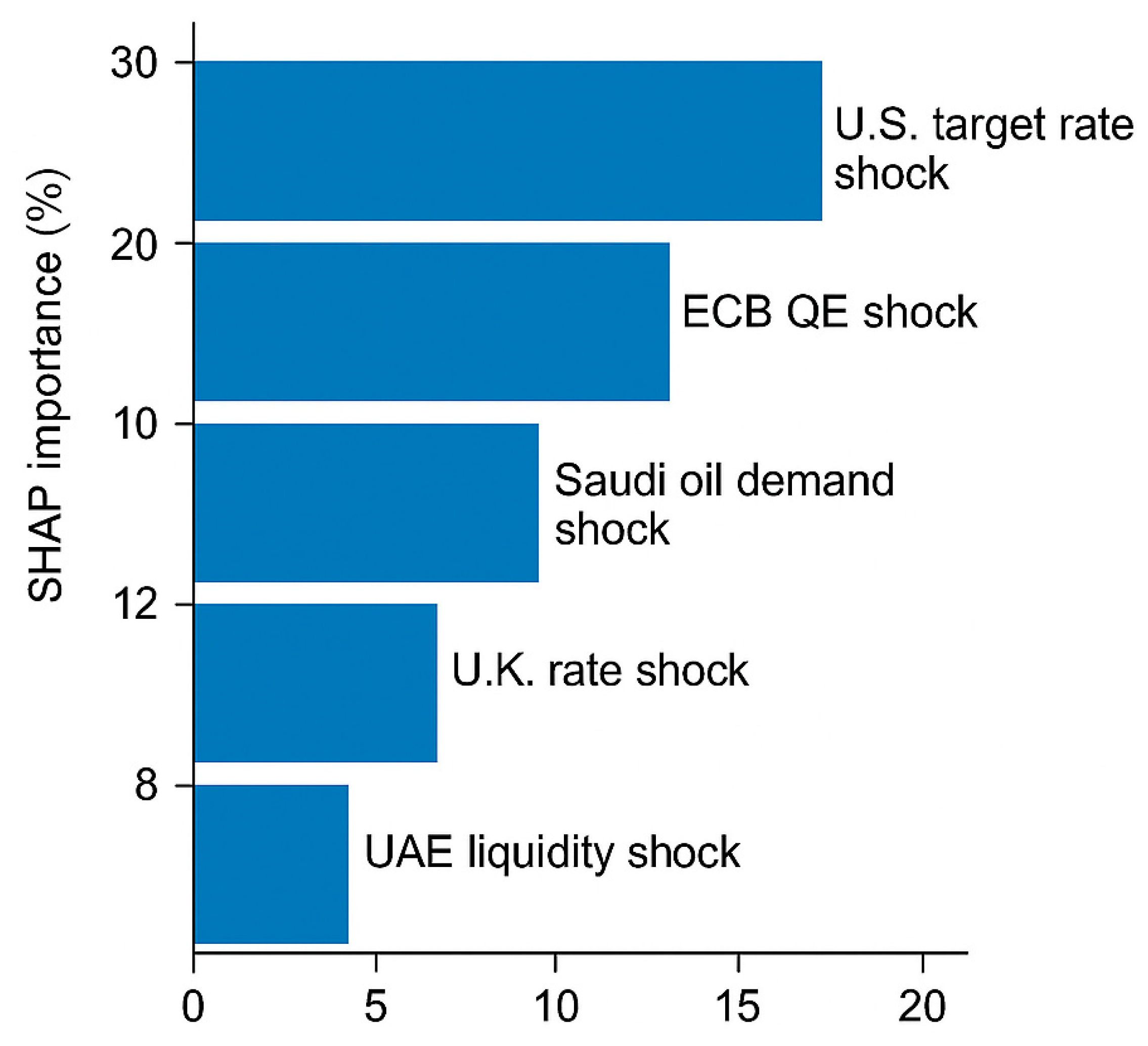
The integration of explainable AI tools into the GNN-CSN framework enables decomposition of each shock’s contribution to GCC financial responses. Using SHAP value attribution, results identify U.S. target rate and ECB quantitative-easing shocks as the dominant global transmitters, jointly accounting for nearly half of total model importance. Regionally, Saudi oil-demand shocks emerge as the most influential domestic driver, shaping both CDS spreads and equity market movements.
Table 7 and
Figure 8 illustrate these results. Global monetary shocks explain short-term liquidity fluctuations, while regional oil shocks explain medium-term credit adjustments. This decomposition clarifies how exogenous and domestic shocks interact within pegged regimes.
Mapping SHAP-derived drivers to policy instruments highlights distinct response levers: liquidity facilities and repo operations to absorb U.S. rate shocks, FX reserve deployment to cushion ECB-induced pressures, and fiscal stabilization or sovereign wealth fund adjustments to mitigate oil-demand effects. These results reinforce the value of combining short-term prudential tools with long-term fiscal frameworks to maintain resilience against recurrent external disturbances (
Ngambou Djatche, 2022).
4.10. Summary of Hypotheses Testing
The findings confirm that U.S. and ECB monetary shocks transmit significantly to GCC financial markets, validating H1. Oil demand shocks exert stronger and more persistent effects than supply shocks, supporting H2. Exchange rate adjustments remain limited under the dollar peg, while equities serve as the main adjustment channel, confirming H3. The GNN-CSN identifies advanced economies as core transmitters and Saudi Arabia and the UAE as receivers, validating H4. Benchmarking results show that the GNN-CSN outperforms LP, TVP-VAR, and Diebold–Yilmaz indices in predictive accuracy and causal structure, confirming H5. Finally, SHAP-based explainability identifies key global (U.S., ECB) and regional (oil-related) drivers, validating H6.
Overall, the results demonstrate consistent, statistically robust support for all hypotheses, confirming the theoretical and methodological coherence of the hybrid causal–computational framework.
5. Discussion
The findings demonstrate that global monetary shocks transmit powerfully through GCC liquidity channels but leave sovereign credit risk largely insulated. Interbank rates in Saudi Arabia and the UAE respond sharply to U.S., ECB, and U.K. policy surprises, confirming that financial linkages amplify global spillovers into domestic money markets (
Valiyan et al., 2023). Conversely, CDS spreads remain stable, indicating that fiscal surpluses and credible policy frameworks continue to anchor investor confidence (
Ashrafi et al., 2024). This divergence reveals a structural asymmetry unique to pegged oil economies, where external shocks raise funding costs without undermining sovereign creditworthiness.
These results validate the expectations of Global Financial Cycle theory, which predicts that liquidity conditions in dollar-linked systems are driven by U.S. monetary policy regardless of domestic fundamentals. Yet, the persistence of stable CDS spreads supports the Mundell–Fleming model, suggesting that exchange rate pegs and fiscal buffers decouple sovereign risk from imported liquidity stress. The coexistence of strong liquidity pass-through and muted credit responses therefore captures the hybrid character of GCC economies—externally constrained but fiscally autonomous (
A. R. Alshehadeh et al., 2024).
Equity markets serve as the main adjustment margin. Sectoral results show that financial and petrochemical industries in Saudi Arabia, and real estate and logistics in the UAE, react most strongly to contractionary shocks. These differences confirm that transmission depends on each economy’s structural composition (
Addai, 2025). Under pegged regimes, limited exchange rate flexibility redirects adjustment toward asset prices, making equities the responsive outlet for global policy shifts.
Cross-country comparisons reinforce this interpretation. Both Saudi Arabia and the UAE display near-identical short-term reactions to foreign monetary tightening, reflecting shared exposure through the U.S. dollar peg. However, the speed of recovery diverges: Saudi Arabia’s fiscal dominance and oil-based revenues enable quicker normalization, whereas the UAE’s diversified economy experiences smaller but more persistent responses. This asymmetry underscores how institutional frameworks and sectoral diversification determine resilience. Saudi Arabia’s strong public finances allow for active liquidity management through SAMA, while the Central Bank of the UAE relies on prudential buffers and open capital markets. These findings highlight that even within a common exchange rate regime, structural heterogeneity shapes macro-financial transmission.
Temporal analysis reveals further nuance. During the COVID-19 period, when uncertainty was extreme, spillovers intensified; in contrast, during the 2022 energy-price surge, they weakened as fiscal surpluses provided insulation. This confirms that transmission is context-dependent—stronger in crises and moderated by revenue windfalls. It also supports the adaptive view that resilience evolves with economic cycles rather than remaining constant (
Morshed, 2025b).
Methodologically, the Graph Neural Network–based causal shock network (GNN-CSN) advances understanding by exposing directional linkages rather than simple correlations. The United States and Germany exhibit the highest out-degree centrality, confirming their dominance as systemic transmitters. Saudi Arabia and the UAE display high in-degree centrality, confirming their status as receivers within the global shock hierarchy (
Chebbi & Almaqtari, 2025). These computational results provide quantitative evidence of asymmetrical dependence within a causally interpretable framework.
The integration of SHAP explainability further bridges machine learning precision with economic reasoning. The high importance of U.S. target shocks and ECB quantitative-easing shocks explains variations in GCC interbank rates and CDS spreads, while Saudi oil-demand shocks account for regional equity shifts (
A. Alshehadeh et al., 2023). By identifying the most influential shocks, the model clarifies why liquidity volatility persists even when sovereign risk is muted (
Morshed & Khrais, 2025). This interpretability answers recent methodological critiques that machine learning models in macro-finance lack transparency (
Shaban & Omoush, 2025).
Overall, the discussion extends earlier work by demonstrating that pegged oil economies are not passive recipients of global monetary conditions but adaptive systems that absorb shocks selectively. Liquidity costs respond rapidly to foreign tightening, while credit and fiscal stability remain domestically anchored. Computational evidence supports the conceptual argument that resilience arises from fiscal strength, institutional credibility, and structural diversification. In doing so, the study contributes both theoretically—by clarifying how external shocks interact with domestic buffers—and methodologically, by showing that explainable graph-based models can uncover causal transmission patterns invisible to traditional econometrics.
6. Implications
6.1. Theoretical Implications
The findings refine the theoretical understanding of how global monetary and oil shocks propagate to pegged oil economies, illustrating that the primary margin of adjustment occurs through liquidity costs rather than sovereign credit risk. This distinction challenges the conventional view that funding and credit channels co-move in emerging markets. Within the framework of the Global Financial Cycle, the results confirm that U.S. and European monetary shocks transmit to Gulf markets via the dollar-linked financial system, constraining domestic liquidity. Yet, the Mundell–Fleming trilemma provides a counterbalance, as fixed exchange rates and fiscal autonomy limit the transmission of sovereign risk. Thus, pegged regimes remain externally exposed but internally buffered.
This asymmetry—between volatile interbank rates and stable credit premia—advances theoretical debates on financial spillovers by revealing a dual regime: externally driven liquidity adjustment coexists with domestically anchored credit stability. Moreover, the study contributes methodologically by integrating econometric baselines (LP, TVP-VAR) with graph-based causal learning (GNN-CSN) and SHAP explainability, showing that precision and interpretability can coexist in modeling global-to-local transmission. This hybrid design not only enhances causal identification but also strengthens the theoretical linkage between external shocks and domestic resilience mechanisms.
6.2. Practical Implications
The results underscore that resilience in pegged oil economies must be managed on two interconnected fronts—monetary and fiscal—each responding to distinct sources of vulnerability.
In the short term, the sharp rise in interbank rates following U.S., ECB, and U.K. shocks highlights the need for active liquidity management. Central banks should reinforce repo market depth, strengthen interbank coordination, and employ targeted liquidity facilities to mitigate imported tightening. The experience of Saudi Arabia and the UAE demonstrates that while the peg transmits global shocks quickly, liquidity buffers can dampen their domestic amplification.
In the longer term, maintaining fiscal credibility remains the essential safeguard against sovereign risk revaluation. Stable CDS spreads throughout the sample confirm that fiscal discipline, transparent debt management, and sovereign wealth fund stabilization play pivotal roles in anchoring investor confidence. This dual architecture—liquidity agility paired with fiscal prudence—provides a blueprint for sustainable resilience.
The explainability results enrich this policy relevance by mapping shocks to their corresponding policy levers. U.S. target rate shocks correlate with interbank volatility, emphasizing liquidity tools; ECB quantitative easing shocks correspond to CDS adjustments, supporting the use of reserve deployment; and oil demand shocks align with equity and fiscal fluctuations, reinforcing the value of fiscal stabilization funds. This shock-specific mapping transforms policy design from reactive management to evidence-based anticipation. In doing so, it operationalizes the concept of policy matching—where instruments are not generic but causally linked to the type of shock encountered.
6.3. Research Implications
This study opens new methodological and empirical avenues for the analysis of international financial spillovers. The hybrid causal–computational framework offers a replicable model for studying other pegged or partially pegged systems—such as those in Asia or Africa—allowing researchers to test whether similar asymmetries between liquidity and credit responses emerge. Future studies can extend the design to examine sectoral or firm-level adjustments, for instance, how energy, banking, and logistics industries internalize monetary shocks under constrained exchange rate regimes.
Additionally, the combination of graph neural networks with SHAP interpretability sets a precedent for transparent AI applications in finance. By translating complex machine learning outputs into economically meaningful causal relationships, this approach enhances both scientific transparency and policy usability. The framework thus advances computational finance beyond prediction, positioning explainable AI as a tool for causal inference and strategic insight.
Finally, the study encourages cross-country comparative research to explore how fiscal institutions and governance quality mediate the strength of imported financial shocks. Such comparative work would further refine theoretical models of global shock transmission and strengthen the integration of AI-based causality into mainstream empirical macroeconomics.
7. Conclusions
This study developed a hybrid causal–computational framework to examine how global monetary and oil shocks propagate into pegged oil economies, focusing on Saudi Arabia and the United Arab Emirates. By integrating high-frequency shock identification, econometric benchmarks, a graph neural network-based causal shock network (GNN-CSN), and SHAP explainability, the framework bridges traditional econometric analysis and modern interpretable machine learning.
Empirically, the results confirm that global monetary shocks significantly raise interbank funding costs in both economies while leaving sovereign credit premia largely unaffected. This asymmetry reveals that under fixed exchange rate regimes, liquidity channels transmit external stress, whereas credit channels remain anchored by fiscal strength and institutional credibility. Equity markets function as the principal adjustment margin, absorbing global tightening when exchange rate flexibility is absent. Subsample analyses further show that spillovers intensified during the COVID-19 crisis and weakened in the 2022 energy-boom phase, emphasizing that fiscal surpluses and diversification enhance resilience. These findings collectively validate the study’s hypotheses and extend the Global Financial Cycle and Mundell–Fleming perspectives by demonstrating that pegged regimes experience selective rather than uniform transmission.
Comparatively, Saudi Arabia’s stronger fiscal buffers enabled faster normalization of liquidity conditions, while the UAE’s diversified economy displayed smaller but more persistent spillovers. This distinction underscores that even within a shared dollar-pegged framework, structural and institutional heterogeneity governs the intensity and persistence of global shock transmission.
Methodologically, the study contributes by demonstrating that causal machine learning architectures can enhance transparency, directionality, and interpretive depth in macro-financial research. The hybrid approach provides a replicable and scalable model for analyzing spillovers in other pegged or semi-pegged systems.
Looking forward, future work can extend this framework to sectoral or firm-level data, explore non-linear crisis interactions, and assess how evolving energy transitions reshape financial linkages. Together, these insights show that resource-dependent economies must continually adapt their liquidity and fiscal architectures to sustain stability within an increasingly interconnected global system.