



Nanomaterials, Volume 15, Issue 21 (November-1 2025) – 82 articles
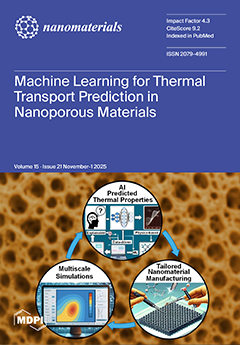
Cover Story (view full-size image):
Predicting the thermal properties of nanoporous materials remains a significant challenge, influencing their use in thermal insulation and energy storage. This review examines the application of machine learning to nanoporous materials such as covalent organic frameworks, metal–organic frameworks, aerogels, and zeolites. It highlights advances in predictive and efficient models, including convolutional, graph, and physics-informed neural networks, while discussing data scarcity, physical consistency, and generalization challenges. The study also explores multimodal and transfer learning for cost reduction and emphasizes interpretable machine learning for uncovering underlying physical mechanisms. Overall, it offers practical guidelines for applying machine learning to design nanoporous materials. View this paper
- Issues are regarded as officially published after their release is announced to the table of contents alert mailing list.
- You may sign up for e-mail alerts to receive table of contents of newly released issues.
- PDF is the official format for papers published in both, html and pdf forms. To view the papers in pdf format, click on the "PDF Full-text" link, and use the free Adobe Reader to open them.
Previous Issue
Next Issue
