


Conferences
Upcoming Journal Conferences (1)

Virtual
Recent advances in nanomaterial-based spectroscopy, particularly Raman and surface-enhanced Raman spectroscopy (SERS), have significantly expanded our ability to probe chemical and biological systems with high sensitivity. However, extracting reliable and reproducible information from spectral data remains a major challenge due to noise, background interference, and variability across experimental conditions.
At the same time, the rapid emergence of artificial intelligence (AI) and machine learning (ML) is transforming how spectral data are analyzed, interpreted, and utilized. Modern spectroscopy is increasingly data-rich, and traditional analysis approaches alone are often insufficient to fully capture complex spectral features, nonlinear relationships, and subtle variations across datasets. AI and ML methods now offer powerful tools for automated feature extraction, classification, quantitative prediction, and even physics-informed modeling of spectral responses, and these developments are a major driving force behind this webinar.
This webinar brings together experts in spectral preprocessing, chemometrics, and machine learning to address these challenges from both methodological and practical perspectives. Topics will include baseline correction and normalization strategies, multivariate data analysis, and emerging AI-driven approaches for spectral interpretation and prediction. In addition, we will introduce the SpectraGuru platform as an example of a reproducible and FAIR-aligned infrastructure designed to support data-driven and AI-enabled spectroscopy research.
We hope this webinar will provide both fundamental insights and practical guidance for researchers working at the intersection of nanomaterials, spectroscopy, and data science, and help advance the integration of AI/ML into next-generation spectroscopic analysis.
Date: 15 September 2026 at 3:00 p.m. CEST | 9:00 a.m. EDT | 9:00 p.m. CST Asia
Webinar ID: 813 1368 4214
Register now for free!

Program:
|
Speaker/Presentation |
Time in CEST |
Time in EDT |
|
Prof. Dr. Yiping Zhao |
3:00–3:10 p.m. |
9:00–9:10 a.m. |
|
Prof. Dr. Kimberly Hamad-Schifferli |
3:10–3:30 p.m. |
9:10–9:30 a.m. |
|
Dr. Xianyan Chen |
3:30–3:50 p.m. |
9:30–9:50 a.m. |
|
Dr. Bo Hu |
3:50–4:10 p.m. |
9:50–10:10 a.m. |
|
Fengbo Ma and Prof. Dr. Yiping Zhao |
4:10–4:30 p.m. |
10:10–10:30 a.m. |
|
Q&A Session |
4:30–4:45 p.m. |
10:30–10:45 a.m. |
|
Prof. Dr. Yiping Zhao |
4:45–4:50 p.m. |
10:45–10:50 a.m. |
After registering, you will receive a confirmation email containing information on how to join the webinar. Registrations with academic institutional email addresses will be prioritized.
Unable to attend? Register anyway and we’ll let you know when the recording is available to watch.
Webinar Chair and Keynote Speakers:
- Prof. Dr. Yiping Zhao, Department of Physics and Astronomy, University of Georgia, USA;
- Prof. Dr. Kimberly Hamad-Schifferli, University of Massachusetts Boston, USA;
- Dr. Xianyan Chen, Department of Epidemiology and Biostatistics, University of Georgia, USA;
- Dr. Bo Hu, Xidian University, China;
- Fengbo Ma, School of Electrical and Computer Engineering, College of Engineering, University of Georgia, USA.
https://sciforum.net/event/Nanomaterials-30?section=#welcome_chair
Upcoming MDPI Conferences (4)
Online
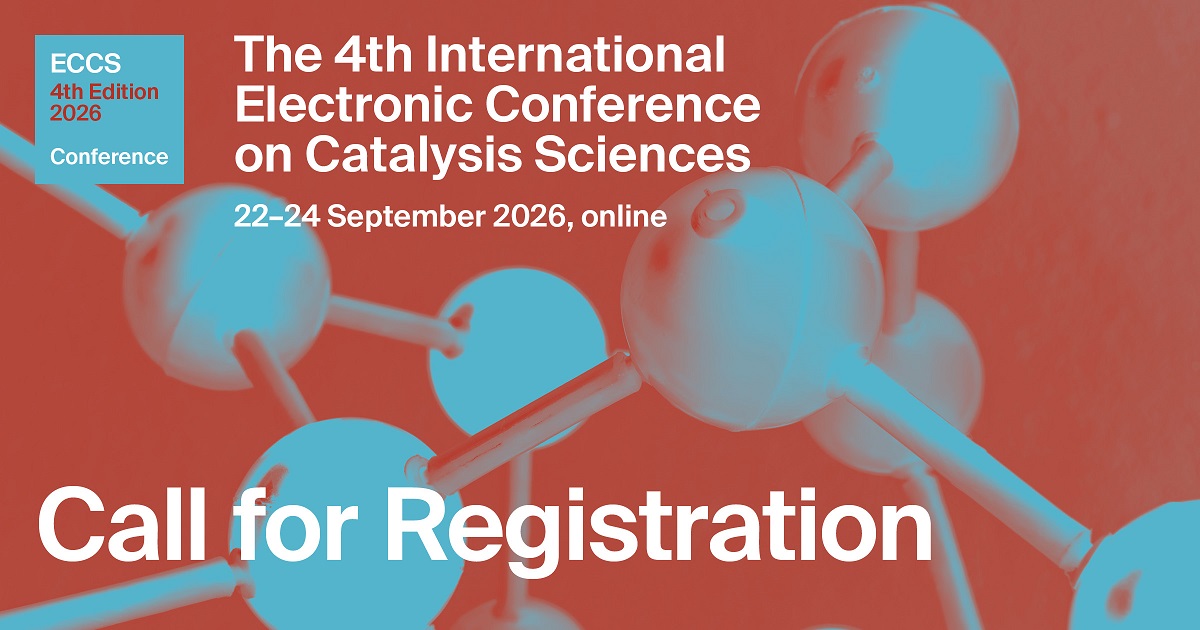
We are excited to announce the 4th International Electronic Conference on Catalysis Sciences (ECCS 2026) organized by MDPI’s Catalysts (ISSN: 2073-4344, Impact Factor: 4.0, Citescore: 8.3), which will be held from 22 to 24 September 2026, CEST.
ECCS 2026 has been designed to closely align with the innovative new section structure of the journal. We sincerely invite the participation of all interested researchers and academics in exchanging ideas, engaging in fruitful collaboration, and making the new edition of this conference a success.
Conference Chairs
Dr. Vincenzo Baglio, National Research Council, Messina, Italy
Prof. Dr. Raffaella Mancuso, University of Calabria, Cosenza, Italy
Prof. Dr. Maria A. Goula, University of Western Macedonia, Western Macedonia, Greece
Prof. Dr. Gonzalo de Gonzalo, University of Seville, Seville, Spain
Topics of Interest
S1. Catalytic Materials
S2. Environmental Catalysis
S3. Photocatalysis and Electrocatalysis
S4. Biocatalysis
S5. Biomass Catalysis
S6. Industrial Catalysis
S7. Catalysis in Organic and Polymer Chemistry
S8. Catalysts Synthesis and Characterization
Important Date
Deadline for Registration: 16 September 2026
Guide for Authors:
Please use the following link to register for the event for FREE by 16 September 2026:
https://sciforum.net/registration/ECCS2026/tickets.
For details regarding abstract submissions and poster and slide submissions, you may refer to the “Instructions for Authors” section of the following website:
https://sciforum.net/event/ECCS2026/instructions-for-authors.
For any inquiries regarding the event, please contact: eccs2026@mdpi.com.
We look forward to seeing you at ECCS 2026!

Barcelona, Spain
Dear Colleagues,
It is our pleasure to invite you to Intelectro 2027, an international conference organized by MDPI and supported by the MDPI journals Electronics and Micromachines. The event will be held in Barcelona, Spain, from 12–14 April 2027.
Intelectro 2027 aims to bring together researchers, engineers, and innovators working at the forefront of modern electronics, from micro- and nanoscale systems to intelligent, AI-driven devices that are shaping the next generation of technology. As electronics continue to evolve at a remarkable speed, cross-disciplinary collaboration has never been more essential. This conference provides a unique platform to explore advances in MEMS/NEMS, sensors and actuators, microfluidics, flexible electronics, energy harvesting, optoelectronics, embedded and intelligent systems, IoT, quantum and neuromorphic devices, and many other rapidly advancing areas.
We welcome submissions for short talks and poster presentations related to the conference themes. Intelectro 2027 will offer an engaging and dynamic environment where participants can share their latest findings, discuss emerging challenges, and build meaningful connections across academia, industry, and applied research.
We look forward to welcoming you to Barcelona for three inspiring days of scientific exchange, innovation, and collaboration.
Sessions:
S1. MEMS/NEMS
S2. Microfluidics, LoC & Bioelectronics
S3. Advanced Materials, Fabrication Processes & Flexible Electronics
S4. Photonics, Optoelectronics & Quantum Devices
S5. IoT, Wearables, Cyber-Physical & AI-Driven Systems
S6. Sensors, Actuators & Robotics
Important Dates:
Abstract submission deadline: Nov 13, 2026
Abstract acceptance notification: Dec 14, 2026
Early bird registration deadline: Jan 18, 2027
Regular registration deadline: Apr 05, 2027
Late registration deadline: Apr 09, 2027
Click here for submission instructions:
https://sciforum.net/event/intelectro2027/instructions-for-authors
Click here to submit your abstract:
https://sciforum.net/event/intelectro2027/instructions-for-authors
Click here to register for the conference:
https://sciforum.net/event/intelectro2027/registration
Conference Chairs
Prof. Dr. José Luis Sánchez-Rojas
Universidad de Castilla-La Mancha, Toledo, Spain
Department of Electrical and Electronic Engineering, University of Cagliari, Cagliari, Italy
Online
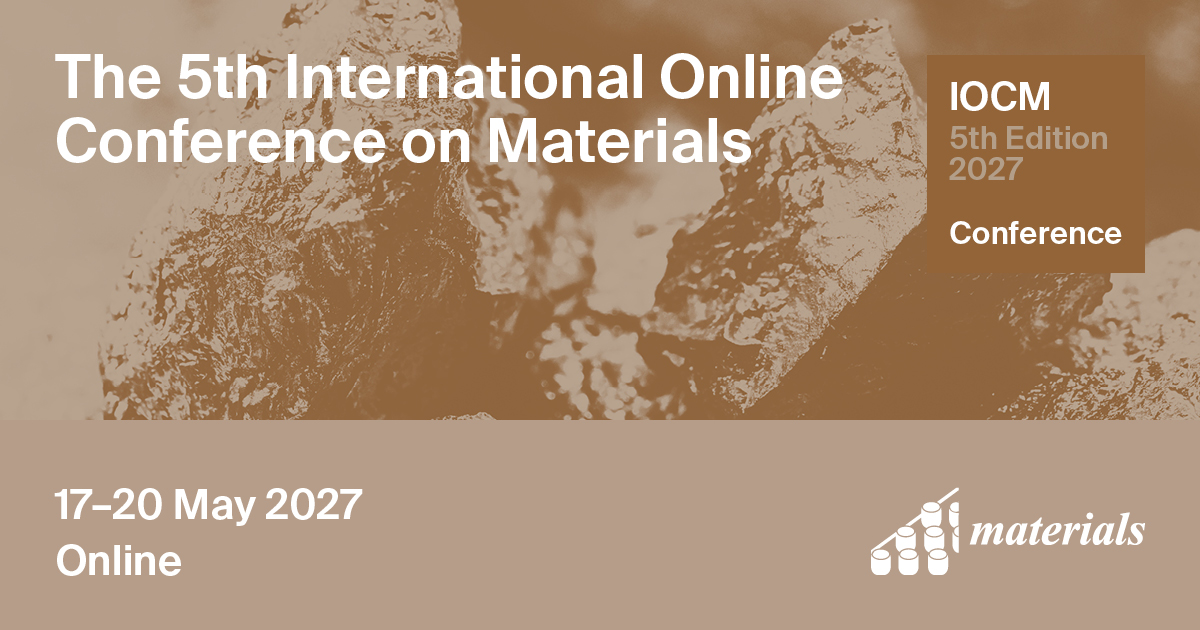
We cordially invite you to attend this event organized by MDPI’s journal Materials (ISSN: 1996-1944, IF: 3.7). It will take place virtually on 17–20 May 2027, CEST.
Conference Chair
Prof. Dr. Maryam Tabrizian, McGill University, Canada.
The Topics of Interest
S1. Advanced Functional Materials: Optical, Electronic and Magnetic Materials;
S2. Low-Dimensional and Quantum Materials: Nanomaterials, 2D Materials and Quantum Frontiers;
S3. Biomaterials, Soft Matter and Composites;
S4. Materials Design and Application: From Simulation and Artificial Intelligence to Experimental Realization;
S5. Energy and Sustainable Materials: From Harvesting to Storage;
S6. Structural Materials: Metals, Alloys, Ceramics and Construction Materials;
S7. Materials Processing, Manufacturing and Process Engineering;
S8. Materials Characterization, Physical Chemistry and Synthesis Fundamentals.
Important Dates
Abstract Submission Deadline: 18 January 2027
Abstract Acceptance Notification: 17 February 2027
Registration Deadline: 11 May 2027
Guide for Authors
To submit your abstract, please click on the following link: https://sciforum.net/user/submission/create/1778
To register for the event, please click on the following link: https://sciforum.net/event/IOCM2027?section=#registration
For details regarding Abstract Submission, Poster and Slide Submission, and Publication Opportunities, you may refer to the “Instructions for Authors” section: https://sciforum.net/event/IOCM2027?section=#instructions.
For any enquiries regarding the event, please contact iocm2027@mdpi.com.
We look forward to seeing you at the 5th International Online Conference on Materials.

Barcelona, Spain
We are pleased to announce that The 2nd International Conference on Bioengineering (BIOENG 2026) is back and it will take place from 10 to 13 November 2026 in Barcelona, Spain.
This conference is organized by MDPI’s open access journal Bioengineering (ISSN: 2306-5354, Impact Factor 4.4). Following the success of IOCBE 2024, an earlier edition in this series, BIOENG 2026 aims to gather leading minds from around the world once more to discuss transformative advances in bioengineering at the intersection with AI.
Conference Chairman
Prof. Dr. Anthony Guiseppi-Elie, Texas A&M University, USA
Session Topics of Interest
S1. Regenerative Engineering
S2. Biochemical Engineering
S3. Biosignal Processing
S4. Biomedical Engineering and Biomaterials
S5. Biomechanics and Sports Medicine
S6. Cellular and Molecular Bioengineering
Important Dates
Deadline for abstract submission: 31 July 2026
Abstract notification of acceptance: 3 September 2026
Deadline for Early Bird Registration: 10 September 2026
Deadline for Covering Author Registration: 10 September 2026
Deadline for Registration: 4 November 2026
Guide for Authors
To submit your abstract, please click on the following link: https://sciforum.net/user/submission/create/1424
To register for the event, please visit the following website: https://sciforum.net/event/BIOENG2026?section=#registration
For details regarding abstract submission, poster and slide submission, and publication opportunities, please refer to the “Instructions for Authors” section: https://sciforum.net/event/BIOENG2026?section=#instructions
We welcome you to partake in this opportunity to contribute to and shape the AI-enabled evolution of bioengineering.
For any enquiries regarding this event, please contact bioeng2026@mdpi.com.
Upcoming Partner Conferences (5)

Padova, Italy
Electrospin2026 is the 9th edition of the biennial international conference on electrospinning technology. This year, in the prestigious location of Padova, leading scientists, engineers, and industry experts from around the world will gather to discuss the latest developments in electrospinning science and technology. This event serves as a global platform for presenting cutting-edge research, sharing technical knowledge, and fostering collaboration among academia, research institutions, and industry.
The conference will cover the full spectrum of electrospinning topics, including advances in nanofiber fabrication, process optimization, novel polymer, and composite materials. Special attention will be given to emerging applications in biomedicine, energy storage, catalysis, filtration, and smart textiles, highlighting the role of electrospun materials in addressing current technological and environmental challenges.
Virtual
Recent advances in nanomaterial-based spectroscopy, particularly Raman and surface-enhanced Raman spectroscopy (SERS), have significantly expanded our ability to probe chemical and biological systems with high sensitivity. However, extracting reliable and reproducible information from spectral data remains a major challenge due to noise, background interference, and variability across experimental conditions.
At the same time, the rapid emergence of artificial intelligence (AI) and machine learning (ML) is transforming how spectral data are analyzed, interpreted, and utilized. Modern spectroscopy is increasingly data-rich, and traditional analysis approaches alone are often insufficient to fully capture complex spectral features, nonlinear relationships, and subtle variations across datasets. AI and ML methods now offer powerful tools for automated feature extraction, classification, quantitative prediction, and even physics-informed modeling of spectral responses, and these developments are a major driving force behind this webinar.
This webinar brings together experts in spectral preprocessing, chemometrics, and machine learning to address these challenges from both methodological and practical perspectives. Topics will include baseline correction and normalization strategies, multivariate data analysis, and emerging AI-driven approaches for spectral interpretation and prediction. In addition, we will introduce the SpectraGuru platform as an example of a reproducible and FAIR-aligned infrastructure designed to support data-driven and AI-enabled spectroscopy research.
We hope this webinar will provide both fundamental insights and practical guidance for researchers working at the intersection of nanomaterials, spectroscopy, and data science, and help advance the integration of AI/ML into next-generation spectroscopic analysis.
Date: 15 September 2026 at 3:00 p.m. CEST | 9:00 a.m. EDT | 9:00 p.m. CST Asia
Webinar ID: 813 1368 4214
Register now for free!
Program:
|
Speaker/Presentation |
Time in CEST |
Time in EDT |
|
Prof. Dr. Yiping Zhao |
3:00–3:10 p.m. |
9:00–9:10 a.m. |
|
Prof. Dr. Kimberly Hamad-Schifferli |
3:10–3:30 p.m. |
9:10–9:30 a.m. |
|
Dr. Xianyan Chen |
3:30–3:50 p.m. |
9:30–9:50 a.m. |
|
Dr. Bo Hu |
3:50–4:10 p.m. |
9:50–10:10 a.m. |
|
Fengbo Ma and Prof. Dr. Yiping Zhao |
4:10–4:30 p.m. |
10:10–10:30 a.m. |
|
Q&A Session |
4:30–4:45 p.m. |
10:30–10:45 a.m. |
|
Prof. Dr. Yiping Zhao |
4:45–4:50 p.m. |
10:45–10:50 a.m. |
After registering, you will receive a confirmation email containing information on how to join the webinar. Registrations with academic institutional email addresses will be prioritized.
Unable to attend? Register anyway and we’ll let you know when the recording is available to watch.
Webinar Chair and Keynote Speakers:
- Prof. Dr. Yiping Zhao, Department of Physics and Astronomy, University of Georgia, USA;
- Prof. Dr. Kimberly Hamad-Schifferli, University of Massachusetts Boston, USA;
- Dr. Xianyan Chen, Department of Epidemiology and Biostatistics, University of Georgia, USA;
- Dr. Bo Hu, Xidian University, China;
- Fengbo Ma, School of Electrical and Computer Engineering, College of Engineering, University of Georgia, USA.
https://sciforum.net/event/Nanomaterials-30?section=#welcome_chair

Virtual
Recent advances in nanomaterial-based spectroscopy, particularly Raman and surface-enhanced Raman spectroscopy (SERS), have significantly expanded our ability to probe chemical and biological systems with high sensitivity. However, extracting reliable and reproducible information from spectral data remains a major challenge due to noise, background interference, and variability across experimental conditions.
At the same time, the rapid emergence of artificial intelligence (AI) and machine learning (ML) is transforming how spectral data are analyzed, interpreted, and utilized. Modern spectroscopy is increasingly data-rich, and traditional analysis approaches alone are often insufficient to fully capture complex spectral features, nonlinear relationships, and subtle variations across datasets. AI and ML methods now offer powerful tools for automated feature extraction, classification, quantitative prediction, and even physics-informed modeling of spectral responses, and these developments are a major driving force behind this webinar.
This webinar brings together experts in spectral preprocessing, chemometrics, and machine learning to address these challenges from both methodological and practical perspectives. Topics will include baseline correction and normalization strategies, multivariate data analysis, and emerging AI-driven approaches for spectral interpretation and prediction. In addition, we will introduce the SpectraGuru platform as an example of a reproducible and FAIR-aligned infrastructure designed to support data-driven and AI-enabled spectroscopy research.
We hope this webinar will provide both fundamental insights and practical guidance for researchers working at the intersection of nanomaterials, spectroscopy, and data science, and help advance the integration of AI/ML into next-generation spectroscopic analysis.
Date: 15 September 2026 at 3:00 p.m. CEST | 9:00 a.m. EDT | 9:00 p.m. CST Asia
Webinar ID: 813 1368 4214
Register now for free!
Program:
|
Speaker/Presentation |
Time in CEST |
Time in EDT |
|
Prof. Dr. Yiping Zhao |
3:00–3:10 p.m. |
9:00–9:10 a.m. |
|
Prof. Dr. Kimberly Hamad-Schifferli |
3:10–3:30 p.m. |
9:10–9:30 a.m. |
|
Dr. Xianyan Chen |
3:30–3:50 p.m. |
9:30–9:50 a.m. |
|
Dr. Bo Hu |
3:50–4:10 p.m. |
9:50–10:10 a.m. |
|
Fengbo Ma and Prof. Dr. Yiping Zhao |
4:10–4:30 p.m. |
10:10–10:30 a.m. |
|
Q&A Session |
4:30–4:45 p.m. |
10:30–10:45 a.m. |
|
Prof. Dr. Yiping Zhao |
4:45–4:50 p.m. |
10:45–10:50 a.m. |
After registering, you will receive a confirmation email containing information on how to join the webinar. Registrations with academic institutional email addresses will be prioritized.
Unable to attend? Register anyway and we’ll let you know when the recording is available to watch.
Webinar Chair and Keynote Speakers:
- Prof. Dr. Yiping Zhao, Department of Physics and Astronomy, University of Georgia, USA;
- Prof. Dr. Kimberly Hamad-Schifferli, University of Massachusetts Boston, USA;
- Dr. Xianyan Chen, Department of Epidemiology and Biostatistics, University of Georgia, USA;
- Dr. Bo Hu, Xidian University, China;
- Fengbo Ma, School of Electrical and Computer Engineering, College of Engineering, University of Georgia, USA.
https://sciforum.net/event/Nanomaterials-30?section=#welcome_chair

Virtual
Recent advances in nanomaterial-based spectroscopy, particularly Raman and surface-enhanced Raman spectroscopy (SERS), have significantly expanded our ability to probe chemical and biological systems with high sensitivity. However, extracting reliable and reproducible information from spectral data remains a major challenge due to noise, background interference, and variability across experimental conditions.
At the same time, the rapid emergence of artificial intelligence (AI) and machine learning (ML) is transforming how spectral data are analyzed, interpreted, and utilized. Modern spectroscopy is increasingly data-rich, and traditional analysis approaches alone are often insufficient to fully capture complex spectral features, nonlinear relationships, and subtle variations across datasets. AI and ML methods now offer powerful tools for automated feature extraction, classification, quantitative prediction, and even physics-informed modeling of spectral responses, and these developments are a major driving force behind this webinar.
This webinar brings together experts in spectral preprocessing, chemometrics, and machine learning to address these challenges from both methodological and practical perspectives. Topics will include baseline correction and normalization strategies, multivariate data analysis, and emerging AI-driven approaches for spectral interpretation and prediction. In addition, we will introduce the SpectraGuru platform as an example of a reproducible and FAIR-aligned infrastructure designed to support data-driven and AI-enabled spectroscopy research.
We hope this webinar will provide both fundamental insights and practical guidance for researchers working at the intersection of nanomaterials, spectroscopy, and data science, and help advance the integration of AI/ML into next-generation spectroscopic analysis.
Date: 15 September 2026 at 3:00 p.m. CEST | 9:00 a.m. EDT | 9:00 p.m. CST Asia
Webinar ID: 813 1368 4214
Register now for free!
Program:
|
Speaker/Presentation |
Time in CEST |
Time in EDT |
|
Prof. Dr. Yiping Zhao |
3:00–3:10 p.m. |
9:00–9:10 a.m. |
|
Prof. Dr. Kimberly Hamad-Schifferli |
3:10–3:30 p.m. |
9:10–9:30 a.m. |
|
Dr. Xianyan Chen |
3:30–3:50 p.m. |
9:30–9:50 a.m. |
|
Dr. Bo Hu |
3:50–4:10 p.m. |
9:50–10:10 a.m. |
|
Fengbo Ma and Prof. Dr. Yiping Zhao |
4:10–4:30 p.m. |
10:10–10:30 a.m. |
|
Q&A Session |
4:30–4:45 p.m. |
10:30–10:45 a.m. |
|
Prof. Dr. Yiping Zhao |
4:45–4:50 p.m. |
10:45–10:50 a.m. |
After registering, you will receive a confirmation email containing information on how to join the webinar. Registrations with academic institutional email addresses will be prioritized.
Unable to attend? Register anyway and we’ll let you know when the recording is available to watch.
Webinar Chair and Keynote Speakers:
- Prof. Dr. Yiping Zhao, Department of Physics and Astronomy, University of Georgia, USA;
- Prof. Dr. Kimberly Hamad-Schifferli, University of Massachusetts Boston, USA;
- Dr. Xianyan Chen, Department of Epidemiology and Biostatistics, University of Georgia, USA;
- Dr. Bo Hu, Xidian University, China;
- Fengbo Ma, School of Electrical and Computer Engineering, College of Engineering, University of Georgia, USA.
https://sciforum.net/event/Nanomaterials-30?section=#welcome_chair

Bangkok, Thailand
Welcome to the 7th International Conference on Materials Science, Engineering and Technology 2027 (Materials 2027). This premier academic event is dedicated to fostering groundbreaking discussions and collaborations in the field of materials science, engineering and technology. Materials 2027 will bring together leading academic researchers, industry professionals, and promising students from around the globe to explore the latest advancements, emerging trends, and future directions in materials science. We aim to provide a comprehensive platform for disseminating cutting-edge research, exchanging innovative ideas, and cultivating new partnerships that will drive the next generation of materials innovation.
Abstract Submission: https://materialstechconference.com/abstract-submission/
Conference Registration: https://materialstechconference.com/register-now/
