



Information, Volume 16, Issue 11 (November 2025) – 93 articles
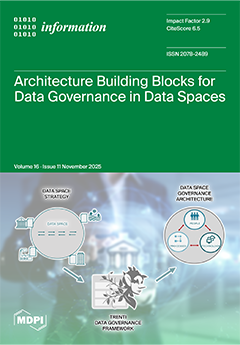
Cover Story (view full-size image):
Data is becoming the backbone of the digital economy, and data spaces are emerging as critical ecosystems for the secure, controlled, and ethical exchange of information. This article introduces a comprehensive reference architecture for data governance in data spaces, addressing essential dimensions such as data quality, security, metadata management, roles, responsibilities, and the entire data lifecycle. By translating high-level governance strategies into concrete architectural components, the framework provides practical guidance for organizations and governing bodies, enabling trust, interoperability, accountability, and effective management of data, guiding government bodies to formalize data strategies and principles in concrete architectural components that establish the capacities to be implemented within the data ecosystem. View this paper
- Issues are regarded as officially published after their release is announced to the table of contents alert mailing list.
- You may sign up for e-mail alerts to receive table of contents of newly released issues.
- PDF is the official format for papers published in both, html and pdf forms. To view the papers in pdf format, click on the "PDF Full-text" link, and use the free Adobe Reader to open them.
Previous Issue
Next Issue
