

You are currently viewing a new version of our website. To view the old version click .

Antioxidants, Volume 8, Issue 2

February 2019 - 23 articles

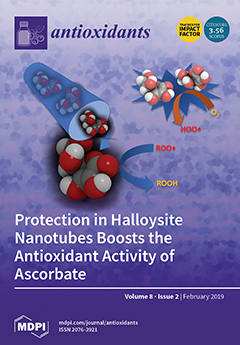
Cover Story: The antioxidant activity of ascorbic acid (vitamin C) is counteracted by its reactivity with oxygen, which turns into superoxide, becoming prooxidant. Vitamin C is also unproductively depleted, particularly in water at physiologic pH, where it is dissociated to the less-stable ascorbate. Loading ascorbic acid into the alkaline inner lumen of natural halloysite nanotubes protects it from oxygen and allows slower release in time to quench peroxyl radicals. Through this method, antioxidant activity is boosted 4-fold! View Paper here.
  • Issues are regarded as officially published after their release is announced to the table of contents alert mailing list .
  • You may sign up for email alerts to receive table of contents of newly released issues.
  • PDF is the official format for papers published in both, html and pdf forms. To view the papers in pdf format, click on the "PDF Full-text" link, and use the free Adobe Reader to open them.

Articles (23)

  • Article
  • Open Access
132 Citations
13,384 Views
12 Pages

Antioxidant and Anti-Inflammatory Properties of Nigella sativa Oil in Human Pre-Adipocytes

  • Laura Bordoni,
  • Donatella Fedeli,
  • Cinzia Nasuti,
  • Filippo Maggi,
  • Fabrizio Papa,
  • Martin Wabitsch,
  • Raffaele De Caterina and
  • Rosita Gabbianelli

25 February 2019

The oil obtained from the seeds of Nigella sativa L. (N. sativa), also known as black cumin, is frequently used in the Mediterranean area for its anti-inflammatory, anti-oxidant, and anti-cancer activities. The aim of the present study was to evaluat...

  • Article
  • Open Access
15 Citations
6,153 Views
17 Pages

24 February 2019

When healthy adults consume carbohydrates at night, postprandial blood glucose responses are elevated and prolonged compared to daytime.Extended postprandial hyperglycaemia is a risk factor for type 2 diabetes. Polyphenols are bioactive secondary met...

  • Review
  • Open Access
89 Citations
11,635 Views
23 Pages

Hydrogen Sulfide and Persulfides Oxidation by Biologically Relevant Oxidizing Species

  • Dayana Benchoam,
  • Ernesto Cuevasanta,
  • Matías N. Möller and
  • Beatriz Alvarez

22 February 2019

Hydrogen sulfide (H2S/HS–) can be formed in mammalian tissues and exert physiological effects. It can react with metal centers and oxidized thiol products such as disulfides (RSSR) and sulfenic acids (RSOH). Reactions with oxidized thiol produc...

  • Article
  • Open Access
23 Citations
6,745 Views
12 Pages

Comparison of the Phenolic Profiles of Soaked and Germinated Peanut Cultivars via UPLC-QTOF-MS

  • Qiong-Qiong Yang,
  • Lin Cheng,
  • Zhi-Yuan Long,
  • Hua-Bin Li,
  • Anil Gunaratne,
  • Ren-You Gan and
  • Harold Corke

20 February 2019

Diverse peanut varieties are widely cultivated in China. However, few studies have investigated the effects of germination on the phenolic profiles and antioxidant activities of specific Chinese peanut cultivars. Therefore, this study was conducted t...

  • Review
  • Open Access
58 Citations
11,111 Views
10 Pages

Antioxidant Defense Mechanisms in Erythrocytes and in the Central Nervous System

  • Rafael Franco,
  • Gemma Navarro and
  • Eva Martínez-Pinilla

18 February 2019

Differential antioxidant action is found upon comparison of organ/tissue systems in the human body. In erythrocytes (red blood cells), which transport oxygen and carbon dioxide through the circulatory system, the most important issue is to keep hemog...

  • Review
  • Open Access
56 Citations
50,885 Views
10 Pages

16 February 2019

Longevity is determined by a number of factors, including genetic, environmental and lifestyle factors. A major factor affecting longevity is the development of degenerative disorders such as cardiovascular disease, diabetes, kidney disease and liver...

  • Review
  • Open Access
70 Citations
9,891 Views
10 Pages

16 February 2019

The winemaking industry produces large amount of byproducts, including grape pomace, stalks, and lees. Wine lees are a natural source of phenolic compounds, which have important antioxidant and biological properties. Due to the high quantities produc...

  • Article
  • Open Access
63 Citations
8,286 Views
19 Pages

Bioactive Phenolic Compounds from the Agroindustrial Waste of Colombian Mango Cultivars ‘Sugar Mango’ and ‘Tommy Atkins’—An Alternative for Their Use and Valorization

  • Henry I. Castro-Vargas,
  • Diego Ballesteros Vivas,
  • Jenny Ortega Barbosa,
  • Sandra Johanna Morantes Medina,
  • Fabio Aristizabal Gutiérrez and
  • Fabián Parada-Alfonso

15 February 2019

The aim of this study was to explore the potential of the agroindustrial waste from two Colombian mango cultivars as sources of bioactive phenolic compounds. Phenolic extracts from mango waste (peels, seed coats, and seed kernels) of ‘sugar man...

of 3

Get Alerted

Add your email address to receive forthcoming issues of this journal.

XFacebookLinkedIn
Antioxidants - ISSN 2076-3921