You are currently viewing a new version of our website. To view the old version click .

Insects, Volume 10, Issue 5

May 2019 - 33 articles

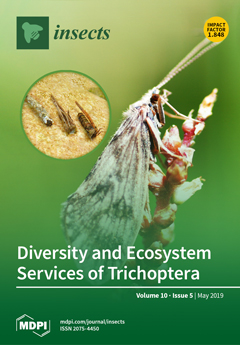
Cover Story: There are more species of caddisflies (Trichoptera) than of all other primarily aquatic orders of insects combined. Ecosystem services provided by Trichoptera are also unusually diverse. They capture and assimilate many forms of nutrients and transform them for use by other freshwater and riparian organisms; they also stabilize stream gravel habitat. Humans employ them to monitor water quality; their labial silk, produced under water, may serve as a model for various new textiles. An increasingly credible phylogeny of families provides a foundation for interpreting and hypothesizing the many functional traits of caddisflies and their corresponding ecological services. The use of angiosperm plant tissues as food and case construction material by the earliest ancestors of infraorder Plenitentoria—by at least 175 Ma—may provide insight into the timing of the origin of angiosperms. View this paper
  • Issues are regarded as officially published after their release is announced to the table of contents alert mailing list .
  • You may sign up for email alerts to receive table of contents of newly released issues.
  • PDF is the official format for papers published in both, html and pdf forms. To view the papers in pdf format, click on the "PDF Full-text" link, and use the free Adobe Reader to open them.

Articles (33)

  • Article
  • Open Access
13 Citations
4,107 Views
13 Pages

Case Study: A Practical Application of an Aerosol Treatment in a Commercial Mill

  • Deanna S. Scheff,
  • Daniel Brabec,
  • James F. Campbell and
  • Frank H. Arthur

25 May 2019

In recent years, there has been an increasing interest and need for alternatives to structural fumigations, and one alternative that has been used across the industry is aerosol insecticides. Previous tests inside a pilot-scale mill demonstrated that...

  • Article
  • Open Access
59 Citations
7,658 Views
14 Pages

Insecticidal Properties of Ocimum basilicum and Cymbopogon winterianus against Acanthoscelides obtectus, Insect Pest of the Common Bean (Phaseolus vulgaris, L.)

  • Álvaro Rodríguez-González,
  • Samuel Álvarez-García,
  • Óscar González-López,
  • Franceli Da Silva and
  • Pedro A. Casquero

25 May 2019

The bean weevil, Acanthoscelides obtectus Say (Coleoptera: Chrysomelidae: Bruchinae), causes severe post-harvest losses in the common bean, Phaseolus vulgaris L. The control of this insect is still poor and involves the use of conventional insecticid...

  • Article
  • Open Access
8 Citations
11,863 Views
15 Pages

New Litter Trap Devices Outperform Pitfall Traps for Studying Arthropod Activity

  • Dolores Ruiz-Lupión,
  • Jordi Pascual,
  • Nereida Melguizo-Ruiz,
  • Oriol Verdeny-Vilalta and
  • Jordi Moya-Laraño

23 May 2019

Soil fauna play a key role in nutrient cycling and decomposition, and in recent years, researchers have become more and more interested in this compartment of terrestrial ecosystems. In addition, soil fauna can act as ecosystem engineers by creating,...

  • Article
  • Open Access
23 Citations
4,266 Views
14 Pages

The Contribution of Surrounding Margins in the Promotion of Natural Enemies in Mediterranean Apple Orchards

  • Neus Rodríguez-Gasol,
  • Jesús Avilla,
  • Yahana Aparicio,
  • Judit Arnó,
  • Rosa Gabarra,
  • Jordi Riudavets,
  • Simó Alegre,
  • Jaume Lordan and
  • Georgina Alins

23 May 2019

(1) Habitat management can enhance beneficial arthropod populations and provide ecosystem services such as biological control. However, the implementation of ecological infrastructures inside orchards has a number of practical limitations. Therefore,...

  • Review
  • Open Access
57 Citations
10,394 Views
26 Pages

23 May 2019

Low temperatures play an important role in arthropods because they affect both the individual and population development of all physiological and behavioural activities. Manipulation with low temperatures is a primary nonchemical pest control method....

  • Article
  • Open Access
21 Citations
8,654 Views
13 Pages

22 May 2019

New insecticide treatment options would be beneficial for control programs for Trogoderma granarium Everts, the khapra beetle, in the United States. Two insecticides were evaluated, the Polyzone® formulation of deltamethrin and a formulation of t...

  • Article
  • Open Access
13 Citations
5,323 Views
22 Pages

22 May 2019

The gypsy moth, Lymantria dispar, is among the most destructive quarantine pests of forests. Here, we reconstructed the genetic structure and determined the population differentiation of gypsy moths across its distribution range at different times. T...

  • Article
  • Open Access
7 Citations
3,771 Views
9 Pages

20 May 2019

Imidacloprid application, as a seed coating agent on oilseed rape, is recommended to control mustard aphid, Lipaphis erysimi (Kaltenbach) (Hemiptera: Aphididae). In this study, responses of L. erysimi were investigated, including survival, feeding be...

  • Article
  • Open Access
16 Citations
6,408 Views
17 Pages

19 May 2019

To obtain a better understanding of feeding adaptations, the fine structure of the mouthparts in adults of Cheilocapsus nigrescens Liu and Wang, including the sculpture and interlocking mechanisms of the stylets and distribution and abundance of sens...

  • Article
  • Open Access
7 Citations
3,455 Views
9 Pages

17 May 2019

Residual effects of pyrethrin + methoprene aerosol dispensed at 4 and 16-µm particle sizes and an untreated control, was assessed against late-stage larvae of Trogoderma inclusum (LeConte), the larger cabinet beetle, and T. variabile (Ballion),...

of 4

Get Alerted

Add your email address to receive forthcoming issues of this journal.

XFacebookLinkedIn
Insects - ISSN 2075-4450