


You are currently viewing a new version of our website. To view the old version click .

Cells, Volume 13, Issue 5

March-1 2024 - 101 articles

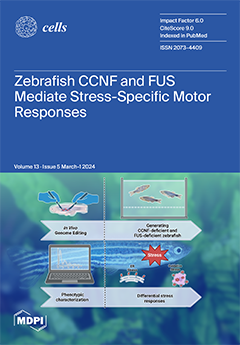
Cover Story: In this study, Aksoy et al. used CRISPR/Cas9 and TALEN genome editing to explore the roles of the ALS-associated CCNF and FUS genes in new zebrafish disease models. They systematically examine the phenotypic effects of CCNF and FUS gene disruptions, focusing on motor neuron development, axonal outgrowth, and the responses to cellular stress. They identify distinct sensitivities to oxidative and endoplasmic reticulum stress, shedding light on specific and shared functions in ALS pathogenesis. The study underscores the critical role of CCNF and FUS in modulating stress-specific motor responses, thereby enhancing our understanding of ALS's molecular mechanisms and opening new avenues for targeted therapeutic interventions. These models offer deeper insights into the genetic complexity of ALS, creating a pathway to potential treatments. View this paper
  • Issues are regarded as officially published after their release is announced to the table of contents alert mailing list .
  • You may sign up for email alerts to receive table of contents of newly released issues.
  • PDF is the official format for papers published in both, html and pdf forms. To view the papers in pdf format, click on the "PDF Full-text" link, and use the free Adobe Reader to open them.

Articles (101)

  • Article
  • Open Access
5 Citations
3,668 Views
27 Pages

High-Resolution Microscopic Characterization of Tunneling Nanotubes in Living U87 MG and LN229 Glioblastoma Cells

  • Nicole Matejka,
  • Asieh Amarlou,
  • Jessica Neubauer,
  • Sarah Rudigkeit and
  • Judith Reindl

6 March 2024

Tunneling nanotubes (TNTs) are fine, nanometer-sized membrane connections between distant cells that provide an efficient communication tool for cellular organization. TNTs are thought to play a critical role in cellular behavior, particularly in can...

  • Article
  • Open Access
3 Citations
3,734 Views
23 Pages

Neutral Sphingomyelinase 2 Inhibition Limits Hepatic Steatosis and Inflammation

  • Fatema Al-Rashed,
  • Hossein Arefanian,
  • Ashraf Al Madhoun,
  • Fatemah Bahman,
  • Sardar Sindhu,
  • Halemah AlSaeed,
  • Texy Jacob,
  • Reeby Thomas,
  • Areej Al-Roub and
  • Fawaz Alzaid
  • + 6 authors

6 March 2024

Non-alcoholic fatty liver disease (NAFLD) is manifested by hepatic steatosis, insulin resistance, hepatocyte death, and systemic inflammation. Obesity induces steatosis and chronic inflammation in the liver. However, the precise mechanism underlying...

  • Review
  • Open Access
2 Citations
3,219 Views
15 Pages

Communication between Mast Cells and Group 2 Innate Lymphoid Cells in the Skin

  • Yeganeh Mehrani,
  • Solmaz Morovati,
  • Tahmineh Tajik,
  • Soroush Sarmadi,
  • Ali Bitaraf,
  • Zahra Sourani,
  • Mohammad Shahverdi,
  • Helia Javadi,
  • Julia E. Kakish and
  • Byram W. Bridle
  • + 1 author

6 March 2024

The skin is a dynamic organ with a complex immune network critical for maintaining balance and defending against various pathogens. Different types of cells in the skin, such as mast cells (MCs) and group 2 innate lymphoid cells (ILC2s), contribute t...

  • Commentary
  • Open Access
1 Citations
2,775 Views
12 Pages

6 March 2024

Cannabis use stimulates calorie intake, but epidemiological studies show that people who regularly use it are leaner than those who don’t. Two explanations have been proposed for this paradoxical finding. One posits that Δ9-tetrahydrocann...

  • Article
  • Open Access
11 Citations
11,186 Views
22 Pages

Secretome from Magnetically Stimulated Muscle Exhibits Anticancer Potency: Novel Preconditioning Methodology Highlighting HTRA1 Action

  • Yee Kit Tai,
  • Jan Nikolas Iversen,
  • Karen Ka Wing Chan,
  • Charlene Hui Hua Fong,
  • Rafhanah Banu Abdul Razar,
  • Sharanya Ramanan,
  • Lye Yee Jasmine Yap,
  • Jocelyn Naixin Yin,
  • Shi Jie Toh and
  • Craig Jun Kit Wong
  • + 3 authors

5 March 2024

Briefly (10 min) exposing C2C12 myotubes to low amplitude (1.5 mT) pulsed electromagnetic fields (PEMFs) generated a conditioned media (pCM) that was capable of mitigating breast cancer cell growth, migration, and invasiveness in vitro, whereas the c...

  • Review
  • Open Access
17 Citations
8,730 Views
35 Pages

5 March 2024

Although it has been known for decades that lysosomes are central for degradation and recycling in the cell, their pivotal role as nutrient sensing signaling hubs has recently become of central interest. Since lysosomes are highly dynamic and in cons...

  • Article
  • Open Access
3 Citations
2,795 Views
19 Pages

Chlorine-Induced Toxicity on Murine Cornea: Exploring the Potential Therapeutic Role of Antioxidants

  • Seungwon An,
  • Khandaker Anwar,
  • Mohammadjavad Ashraf,
  • Kyu-Yeon Han and
  • Ali R. Djalilian

5 March 2024

Chlorine (Cl2) exposure poses a significant risk to ocular health, with the cornea being particularly susceptible to its corrosive effects. Antioxidants, known for their ability to neutralize reactive oxygen species (ROS) and alleviate oxidative stre...

  • Review
  • Open Access
6 Citations
4,597 Views
26 Pages

Emerging Roles and Mechanisms of RNA Modifications in Neurodegenerative Diseases and Glioma

  • Ami Kobayashi,
  • Yosuke Kitagawa,
  • Ali Nasser,
  • Hiroaki Wakimoto,
  • Keisuke Yamada and
  • Shota Tanaka

5 March 2024

Despite a long history of research, neurodegenerative diseases and malignant brain tumor gliomas are both considered incurable, facing challenges in the development of treatments. Recent evidence suggests that RNA modifications, previously considered...

  • Article
  • Open Access
1 Citations
4,138 Views
14 Pages

Nicotinamide Riboside Augments Human Macrophage Migration via SIRT3-Mediated Prostaglandin E2 Signaling

  • Jing Wu,
  • Maximilian Bley,
  • Russell S. Steans,
  • Allison M. Meadows,
  • Rebecca D. Huffstutler,
  • Rong Tian,
  • Julian L. Griffin and
  • Michael N. Sack

5 March 2024

NAD+ boosting via nicotinamide riboside (NR) confers anti-inflammatory effects. However, its underlying mechanisms and therapeutic potential remain incompletely defined. Here, we showed that NR increased the expression of CC-chemokine receptor 7 (CCR...

  • Article
  • Open Access
3 Citations
2,339 Views
15 Pages

LncRNA NEAT1/miR-146a-5p Axis Restores Normal Angiogenesis in Diabetic Foot Ulcers by Targeting mafG

  • TCA Architha,
  • George Raj Juanitaa,
  • Ramanarayanan Vijayalalitha,
  • Ravichandran Jayasuriya,
  • Gopinathan Athira,
  • Ramachandran Balamurugan,
  • Kumar Ganesan and
  • Kunka Mohanram Ramkumar

5 March 2024

Non-healing lesions in diabetic foot ulcers are a significant effect of poor angiogenesis. Epigenetic regulators, mainly lncRNA and miRNA, are recognized for their important roles in disease progression. We deciphered the regulation of lncRNA NEAT1 t...

of 11

Get Alerted

Add your email address to receive forthcoming issues of this journal.

XFacebookLinkedIn
Cells - ISSN 2073-4409