


Crystals, Volume 15, Issue 11 (November 2025) – 93 articles
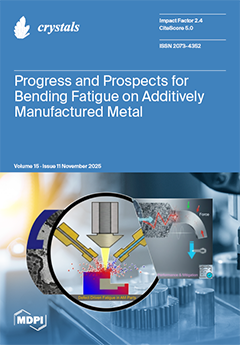
Cover Story (view full-size image):
Metal additive manufacturing is advancing the production of metallic components; however, understanding the quality of these parts in terms of bending fatigue is crucial for their safe use in demanding industries. This review explores the impact of AM process parameters, build orientation, post processing, and surface treatment on bending fatigue performance. By identifying current unresolved challenges, this study emphasizes the promise of miniaturized special geometries and predictive modeling techniques, establishing standardized procedures, and correlations across different fatigue tests to accelerate the testing and qualification of AM parts. By bridging current knowledge gaps and exploring future pathways, this work ensures the safer deployment of AM components in real-life bending fatigue loading applications. View this paper
- Issues are regarded as officially published after their release is announced to the table of contents alert mailing list.
- You may sign up for e-mail alerts to receive table of contents of newly released issues.
- PDF is the official format for papers published in both, html and pdf forms. To view the papers in pdf format, click on the "PDF Full-text" link, and use the free Adobe Reader to open them.
Previous Issue
Next Issue
