Article

Plasmon Dispersion in Two-Dimensional Systems with Non-Coulomb Interaction

1
National Institute for Research and Development of Isotopic and Molecular Technologies, 67-103 Donat, 400293 Cluj-Napoca, Romania
2
Faculty of Physics, Babeș-Bolyai University, 1 Kogălniceanu, 400084 Cluj-Napoca, Romania
*
Author to whom correspondence should be addressed.
Crystals 2025, 15(11), 985; https://doi.org/10.3390/cryst15110985
Submission received: 20 October 2025 / Revised: 10 November 2025 / Accepted: 11 November 2025 / Published: 15 November 2025
(This article belongs to the Special Issue Research on Electrolytes and Energy Storage Materials (2nd Edition))

Abstract

We theoretically study plasmon dispersion within the random-phase approximation in two-dimensional systems, including undoped and doped monolayer graphene at zero and finite temperatures, and hole- and electron-doped monolayer X Se ( X = In , Ga ) and disordered two-dimensional electron gas at zero temperature, in the presence of a non-Coulomb interaction of the form r η . Our findings show that the parameter η , which characterizes the non-Coulombic nature of the interaction, strongly affects the dependence of the plasmon frequency on the wave vector in the long-wavelength limit. Furthermore, the carrier density dependence of the plasmon frequency is unaffected by the parameter η in this regime. For η = 1 , corresponding to the Coulomb case, the well-known results are fully recovered for all systems studied here.

1. Introduction

In condensed matter physics, a plasmon is the quantum of a collective charge density oscillation of the electron liquid [1,2,3]. In three-dimensional materials, electrons can oscillate collectively under an external electric field, and form a dynamic, propagating collective excitation of electrons (plasmon mode) that oscillates with the plasmon frequency ω p . In a three-dimensional electron gas, plasmons exhibit an almost wave-vector-independent (constant) frequency at small wave vectors, whereas in two-dimensional systems, the reduced dimensionality fundamentally alters their behavior, with plasmons confined to a plane. This spatial restriction changes the behavior of plasmons compared to their bulk counterparts. The difference lies in their dispersion relation, which describes how frequency of the plasmon is connected to its wave vector. For a two-dimensional electron gas, the plasmon frequency tends to zero as the wave vector approaches zero [4,5,6]. This means that two-dimensional plasmons can be excited at arbitrarily low frequencies, which makes these systems interesting for various applications, such as plasmonic devices, biosensors, optoelectronics, and metamaterials [7,8,9,10,11].
In contrast to three-dimensional systems, in some two-dimensional materials (e.g., high-quality graphene), the plasmon modes experience relatively low damping, making them ideal platforms for carrying signals over long distances [12,13,14,15,16]. Graphene, a two-dimensional crystal composed of carbon atoms arranged in a honeycomb lattice structure, was first isolated approximately twenty years ago [17,18]. It exhibits remarkable physical properties arising from its Dirac-like band structure [19,20]. In graphene, the conduction and valence bands touch each other at six corners of the first Brillouin zone, known as Dirac points. Near these points, the energy dispersion is linear in momentum, leading to several unique physical effects [21,22]. We can distinguish between undoped and doped graphene. Undoped graphene is chemically pure and charge-neutral, for which the Fermi level lies at the Dirac point. In the case of doped graphene, the Fermi level shifts away from the Dirac point, which can be achieved by adding impurities or applying gate voltages, thus modifying its carrier concentration and electronic and optical properties [20,23,24]. Theoretical studies have explored the effects of doping and temperature on graphene plasmon dispersion within the random-phase approximation [6,12,14,25]. Specifically, the plasmon dispersion in doped graphene remains ω p ( q ) q , where q is the wave vector, with a carrier density dependence of ω p ( q ) n 1 / 4 [5,6,12]. For undoped graphene, the absence of charge carriers at the Dirac points prevents the existence of plasmon modes at zero temperature [14]. At finite temperatures, however, gapless undoped graphene becomes thermally excited, leading to the appearance of charge carriers. In this regime, the undoped plasmon dispersion follows ω p ( q ) q T , where T is the temperature, implying that the undoped graphene plasmon frequency can be tuned by varying the sample temperature [14]. The influence of an energy gap in the graphene dispersion on the dependence of plasmon frequency on the wave vector and carrier density has also been studied theoretically [26,27,28,29]. This anomalous dependence of graphene plasmon dispersion on wave vector and carrier density has been experimentally investigated using high-resolution electron energy-loss spectroscopy, scattering-type scanning near-field optical microscopy, Fourier-transform infrared spectroscopy, and inelastic scanning tunneling spectroscopy [8,30,31,32,33,34,35,36,37,38].
The field of two-dimensional materials has expanded far beyond graphene and transition metal dichalcogenides [39,40,41] to include metal monochalcogenide monolayers such as X Se ( X = In ,   Ga ), which have attracted considerable attention due to their distinctive physical properties [42,43,44,45,46,47,48,49,50,51,52]. In particular, these two-dimensional semiconductors X Se ( X = In ,   Ga ) have valence bands with a “Mexican-hat” dispersion and exhibit plasmon dispersions that depend on the Fermi energy as ω p ( q ) | E F | 1 / 4 and on the carrier density as ω p ( q ) n in monolayers [51]. This behavior contrasts with that of doped monolayer graphene and two-dimensional electron gases, which show ω p ( q ) | E F | , ω p ( q ) n 1 / 4 and ω p ( q ) n , respectively [5,6,12].
It has also been shown that disorder can have a significant impact on the collective dynamics of two-dimensional systems [2,53,54,55,56,57,58,59,60,61]. Disorder is often detrimental but can also be engineered to impact special properties for various applications, such as to enable light localization for random lasing in photonics, to reduce thermal conductivity in thermoelectrics, or to achieve tunable mechanical responses in metamaterials [62,63,64]. There are different types and sources of disorder such as vacancies, adatoms, various impurities, defects, and dislocations. In addition, disorder reduces carrier mobility (a pronounced effect in graphene), and can lead to the localization of electrons (Anderson localization), causing a metal–insulator transition. It may also open a band gap in semimetals, making them suitable for semiconductor applications. Furthermore, strong disorder can also cause phonon localization, reducing the thermal transport [65,66,67,68].
Theoretical and experimental investigations of many-body systems dominated by non-Coulomb interactions have attracted significant attention in recent years. Such effects occur in ultracold atomic and molecular gases, including Rydberg atoms, dipolar quantum gases, and trapped ions, where the interactions are mostly long-ranged. Non-Coulombic behavior is also observed in solid-state heterostructures and at interfaces between materials and neighboring electrolyte solutions [69,70,71,72,73,74,75,76,77,78,79,80,81]. Furthermore, plasmon modes can also provide a promising platform for studying novel quantum phenomena and for detecting exotic quasiparticles, such as Majorana bound states in hybrid quantum dot–topological superconductor nanowire junctions and quantum dot–nanoparticle systems [82,83,84,85].
In realistic two-dimensional electron systems, the effective electron–electron interaction may deviate significantly from the unscreened Coulomb potential due to the surrounding dielectric environment [60,61,72,77,86]. These deviations are particularly important for two-dimensional materials, such as semiconductor heterostructures, graphene, and transition metal chalcogenides, as dielectric screening from substrates, encapsulation layers, metallic gates, finite thickness, and disorder can significantly impact electronic correlations [60,61,87,88,89,90,91,92,93]. The interaction potential in these systems can be accurately approximated by a non-Coulomb potential, the form of which can strongly influence many-body properties and collective excitations, including plasmon dispersion. In this study, we investigate plasmon dispersion induced by a non-Coulomb interaction of the form r η in two-dimensional systems, including undoped and doped monolayer graphene at zero and finite temperatures, and monolayer X Se ( X = In ,   Ga ) and a disordered two-dimensional electron gas at zero temperature. The main goal of this work is to study the influence of the parameter η , which describes the non-Coulomb character of the interaction, on the plasmon modes in these systems.

2. Theory

We calculate the plasmon mode dispersion in two-dimensional systems, specifically for undoped and doped monolayer graphene at zero and finite temperatures, and monolayer X Se ( X = In ,   Ga ) and a disordered two-dimensional electron gas at zero temperature, assuming a non-Coulomb potential of the form [58,77,80,94,95]
V ( r ) = A r η ,
where η characterizes the non-Coulomb character of the interaction in two dimensions. The dimensionality of A in Equation (1) is chosen such that the potential has the dimension of energy. The parameter η used in our interaction potential (1) is phenomenological and provides a simple way to tune the interaction range in two-dimensional materials. For 0 < η < 1 , the interaction is longer-ranged than the Coulomb potential (super-Coulomb type), whereas for η > 1 , it is shorter-ranged (sub-Coulomb type). As mentioned above, in realistic systems, deviations from the standard Coulomb law may arise from various physical mechanisms, such as screening effects in materials (e.g., presence of metallic gate electrodes, substrate, boundaries, or mobile charges) [60,61,72,77,86]. In such cases, the resulting effective interactions can often be more conveniently approximated by an adjustable power law rather than by more complex functional forms. We note that, in a purely two-dimensional system, the solution of the Poisson equation leads to a logarithmic potential [96]. In practice, most two-dimensional systems are embedded in three-dimensional space, where it is more appropriate to employ the Coulomb potential rather than the logarithmic form [2,12,95,97].
The plasmon dispersion is determined by the zeros of the dynamical dielectric function ϵ ( q , ω ) , which, within the random-phase approximation, is given by [2,12,54,98,99]
ϵ ( q , ω ) = 1 V ( q ) χ 0 ( q , ω ) ,
where V ( q ) and χ 0 ( q , ω ) denote the Fourier transform of the interaction potential V ( r ) and the density–density response function (polarizability) of the non-interacting system, respectively. When the imaginary part of the density–density response function is nonzero, i.e., I m χ 0 ( q , ω ) 0 , the condition for plasmon modes becomes
ϵ ( q , ω p ( q ) i Γ p ( q ) ) = 0 ,
where ω p ( q ) and Γ p ( q ) represent the plasmon dispersion relation and the decay (damping) rate of plasma oscillations, respectively [5,26,98]. If Γ p ( q ) ω p ( q ) , the damping is weak and the plasmon modes are accurately defined. If Γ p ( q ) ω p ( q ) , the plasmon modes become overdamped and decay into electron–hole pairs (Landau damping) [14,26]. In the weak-damping limit [ Γ p ( q ) ω p ( q ) ], instead of solving Equation (3) directly, the plasmon dispersion can be obtained from the relation [5,26,100,101]
R e [ ϵ ( q , ω p ( q ) ) ] = 1 V ( q ) R e [ χ 0 ( q , ω p ( q ) ) ] = 0 ,
which requires R e [ χ 0 ( q , ω ) ] > 0 in Equation (2). The decay rate can be approximated as
Γ p ( q ) = I m [ χ 0 ( q , ω p ( q ) ) ] ω R e [ χ 0 ( q , ω ) ] | ω = ω p ( q ) ,
which, when I m [ χ 0 ( q , ω ) ] = 0 , yields stable plasmon solutions with Γ p ( q ) = 0 [5,12,101]. Relations (4) and (5) are no longer valid in the strongly damped regime, where Equation (3) must be solved directly.
The Fourier transform of the non-Coulomb potential V ( r ) , given in Equation (1), is expressed as [58,94,95]
V ( q ) = ʃ d 2 r e i q · r V ( r ) = C ( η ) q 2 η ,
with C ( η ) = A 2 2 η [ Γ ( 1 η 2 ) ] 2 sin ( π η 2 ) , where Γ ( z ) denotes the Gamma function. Note that V ( q ) is valid for values of the parameter η in the range 1 2 < η < 2 .

3. Results and Discussions

In what follows, we first calculate the plasmon dispersion relation ω p ( q ) for undoped and doped monolayer graphene at zero ( T = 0 ) and finite ( T 0 ) temperatures in the presence of interactions described by the non-Coulomb potential (1). It may also be relevant to consider plasmons in graphene beyond the simple Coulomb model, since environmental dielectric screening has been shown to strongly modify electronic interactions and could potentially affect plasmon behavior [72,87]. Note that the electron–electron interactions in graphene lead to a momentum-dependent renormalization of the quasiparticle dispersion. This results in a logarithmic increase in the Fermi velocity as the Dirac point is approached, the effect of which becomes more pronounced in undoped and ultraclean graphene [102,103,104,105]. For simplicity, in the following calculations, we will not include the renormalization of the Fermi velocity.
We first study the plasmon dispersion at zero temperature. Using the zero-temperature form of the non-interacting density–density response function for undoped monolayer graphene [14] and the non-Coulomb interaction (6), the non-interacting density–density response function χ 0 ( q , ω ) obeys R e [ χ 0 ( q , ω ) ] 0 , while V ( q ) > 0 . Consequently, V ( q ) R e [ χ 0 ( q , ω ) ] 0 , and the random-phase approximation condition (2) has no solution at T = 0 . Therefore, undoped monolayer graphene exhibits no plasmon modes within the random-phase approximation for non-Coulomb interactions, as in the Coulomb case ( η = 1 ) discussed in Ref. [14].
For doped monolayer graphene at zero temperature, in the long-wavelength limit ( q 0 ), the non-interacting density–density response function, in the high- and low-frequency regimes, is given by [12]
χ 0 ( q , ω ) D ( E F ) v F 2 q 2 2 ω 2 1 2 ω 2 4 E F 2 , q v F < ω < 2 E F , D ( E F ) 1 + i ω q v F , ω < q v F ,
where D ( E F ) = g s g v | E F | / ( 2 π 2 v F 2 ) = g s g v n / π / ( v F ) is the density of states in graphene at the Fermi level E F , related to the graphene Fermi velocity v F = E F / ( k F ) and to the Fermi wave vector k F = 4 π n / ( g s g v ) . Here, n is the charge carrier (electron/hole) density, while g s = 2 and g v = 2 are the spin and valley degeneracies, respectively. In the q 0 limit and for q v F < ω < 2 E F , the imaginary part of χ 0 ( q , ω ) vanishes, i.e., I m χ 0 ( q , ω ) = 0 , yielding undamped plasmons ( Γ p ( q ) = 0 ) in this region [5,6,12,26]. Using ϵ ( q , ω p ( q ) ) = 0 in Equation (2), together with Equation (6) and the first line of Equation (7), we obtain, for the high-frequency regime, the following relation:
ω p 2 ( q ) = g s g v C ( η ) | E F | 4 π 2 q η 1 + g s g v C ( η ) 16 π | E F | q η .
Expanding the denominator of Equation (8) in the q 0 limit yields
1 1 + g s g v C ( η ) 16 π | E F | q η 1 g s g v C ( η ) 16 π | E F | q η + O ( q 2 η ) .
Substituting Equation (9) into Equation (8), and assuming again that q 0 , the plasmon dispersion relation reads
ω p ( q ) g s g v C ( η ) | E F | 4 π 2 1 g s g v C ( η ) 32 π | E F | q η q η 2 .
Keeping only the leading-order term in wave vector q, relation (10) reduces to
ω p ( q ) g s g v C ( η ) | E F | 4 π 2 q η 2 .
In this limit, the carrier density dependence of the plasmon frequency is independent of the parameter η , yielding ω p ( q ) | E F | and thus ω p ( q ) n 1 / 4 , consistent with the results of Refs. [6,12,14] for η = 1 . Thus, tuning the carrier density via the gate voltage in doped graphene shows that the characteristic n 1 / 4 scaling of the plasmon frequency remains unaffected by variations in the power-law exponent η of the non-Coulomb potential. In particular, for the Coulomb case ( η = 1 ) with A = e 2 / K where K is the background lattice dielectric constant, Equation (11) reproduces the well-known result
ω p ( q ) e 2 g s g v | E F | 2 K 2 q ,
for doped monolayer graphene at zero temperature [6,12,14]. In addition, we calculate the plasmon dispersion for a non-interacting two-dimensional electron gas with a parabolic energy dispersion. In this case, the non-interacting density–density response function in the long-wavelength limit is [2,6,106]
χ 0 ( q , ω ) n m q 2 ω 2 ,
which, together with Equations (2) and (6), yields the plasmon dispersion
ω p ( q ) n m C ( η ) q η 2 .
We find that ω p ( q ) is independent of the parameter η in its electron density dependence because the plasmon dispersion scales as ω p ( q ) n , which also implies ω p E F . At the same time, it exhibits the same wave vector dependence, ω p ( q ) q η / 2 , as in the case of doped monolayer graphene. For the Coulomb interaction ( η = 1 ), Equation (14) reduces to the well-known result, ω p ( q ) 2 π e 2 n / ( κ m ) q [6].
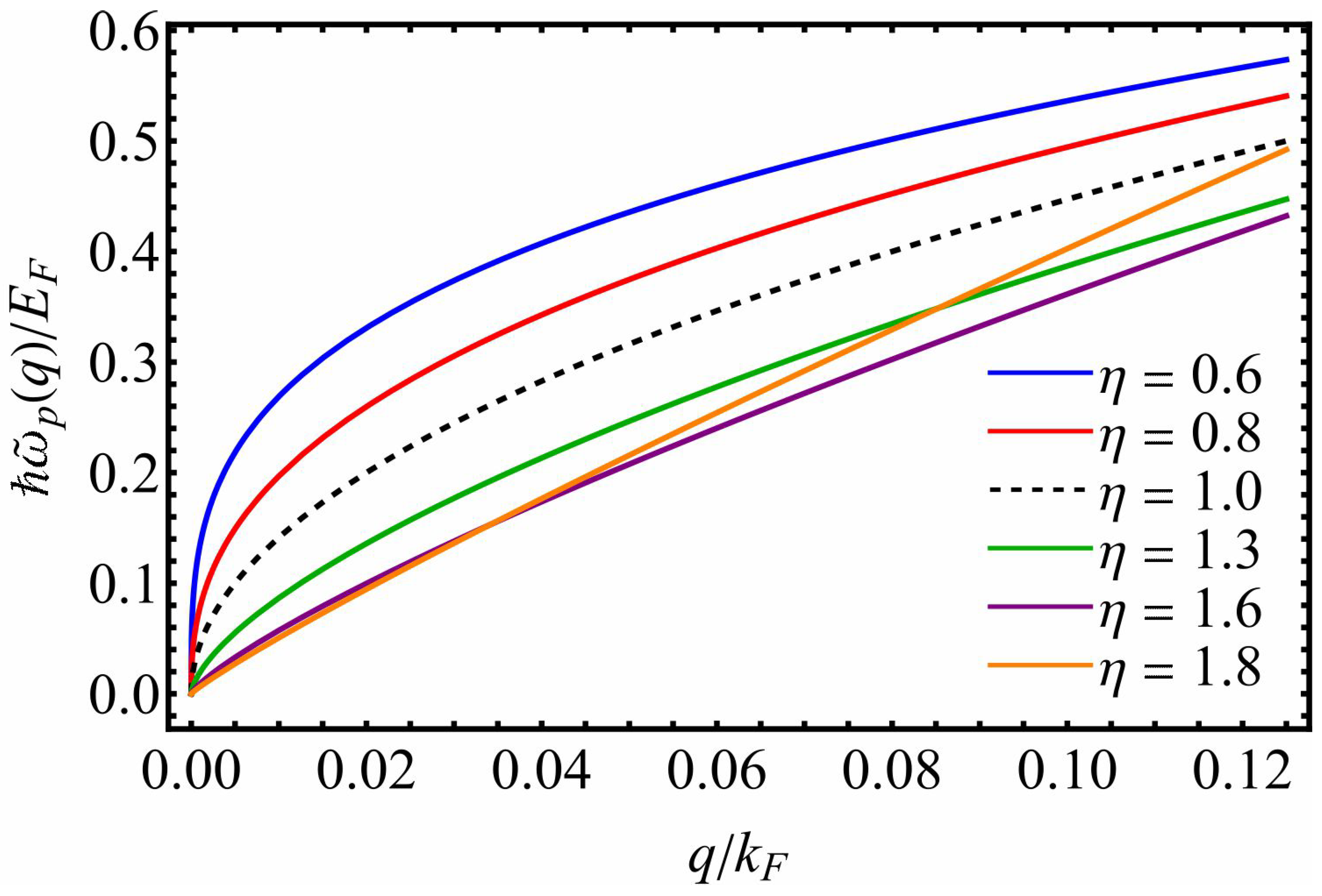
Figure 1 shows the normalized plasmon mode dispersion ω ˜ p ( q ) / E F as a function of the dimensionless variable q / k F , where ω ˜ p ( q ) = ω p ( q ) / A k F η 1 / ( v F ) , for doped monolayer graphene at zero temperature for different values of the parameter η , which describes the non-Coulombic nature of the interaction. We can observe that the plasmon mode dispersion, which depends on the wave vector as ω p ( q ) q η / 2 , evolves from a strongly sublinear power-law behavior ω p ( q ) q 1 / 4 as η 0.5 , toward an almost linear dependence ω p ( q ) q as η 2 . Note that the η = 1 case, corresponding to the standard Coulomb interaction, is recovered (see dashed line).
We now turn our attention to the finite-temperature case. In the long-wavelength limit v F q / ( k B T ) 0 , the non-interacting density–density response function for undoped graphene at T 0 and ω q v F is given by [14]
χ 0 ( q , ω ) 2 ln 2 π q 2 ( ω ) 2 k B T + i 16 q 2 k B T .
Using relations (4), (6), and (15), we obtain the plasmon dispersion for undoped monolayer graphene at T 0 :
ω p ( q ) = 2 ln 2 π 2 C ( η ) k B T q η 2 .
Now applying the small-damping Formula (5), we obtain
Γ p ( q ) = 1 32 2 ln 2 π k B T C ( η ) 3 2 q 3 η 2 .
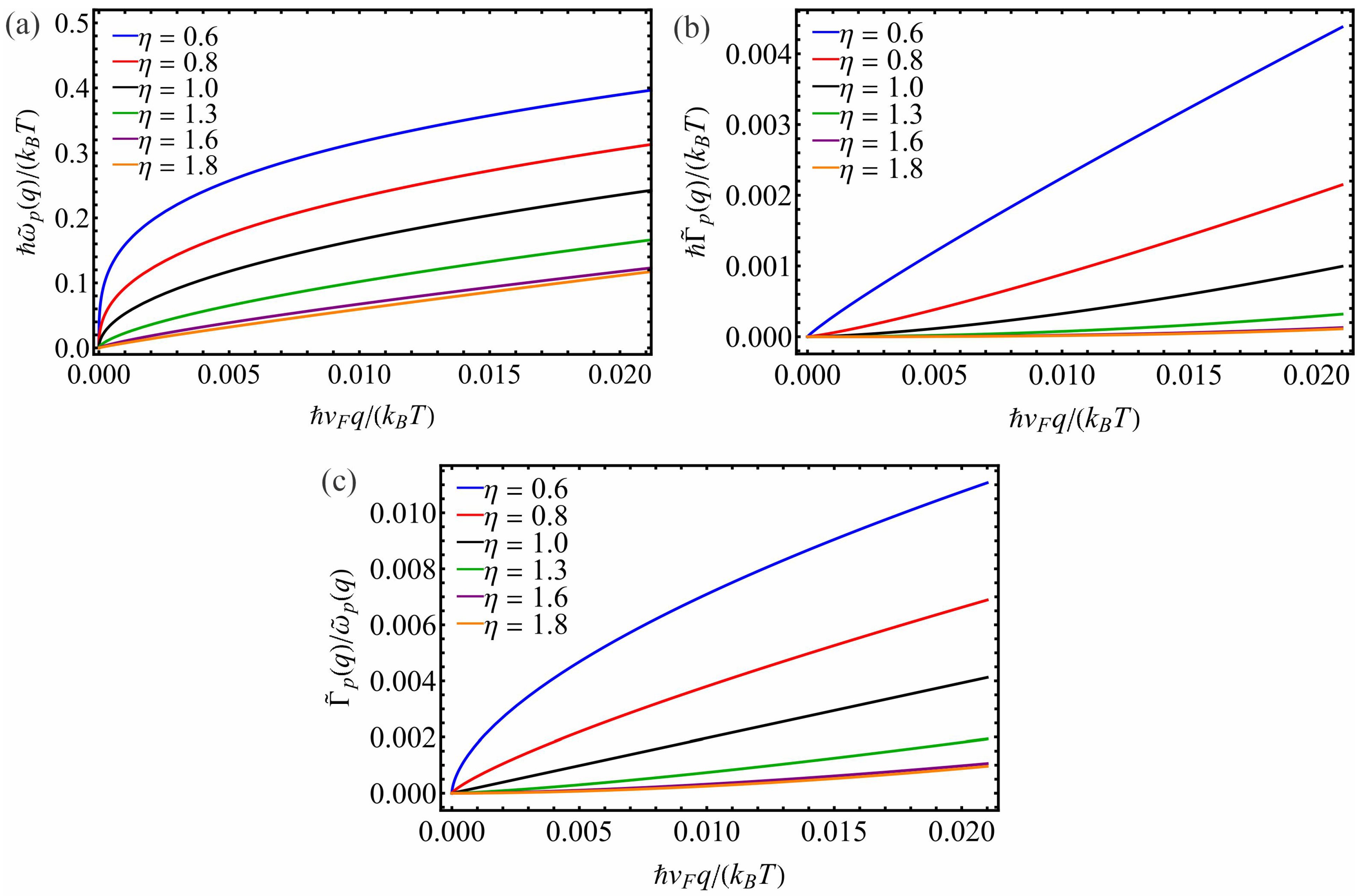
We find that for undoped monolayer graphene, the plasmon dispersion and damping rate are proportional to ω p ( q ) q η / 2 T and Γ p ( q ) q 3 η / 2 / T , respectively, indicating that the parameter η of non-Coulombic interaction has no influence on their temperature dependence. Consequently, modifying the power-law exponent η in the non-Coulomb potential does not enhance the thermal tunability of the undoped plasmon frequency. Note that the ratio ω p ( q ) / Γ p ( q ) is
ω p ( q ) Γ p ( q ) = 2 η 8 k B T A [ Γ ( 1 η 2 ) ] 2 sin ( π η 2 ) 1 q η ,
showing that the long-wavelength undoped graphene plasmon mode at finite temperatures is well-defined as long as the relation
q q c 2 8 k B T A [ Γ ( 1 η 2 ) ] 2 sin ( π η 2 ) 1 η ,
is fulfilled, where q c denotes the critical wave vector. For q q c , we obtain Γ p ( q ) ω p ( q ) , which means that the plasmon mode is overdamped, and relations (4) and (5) are no longer applicable. In the special η = 1 case with A = e 2 / K , our results reproduce those of Ref. [14].
Figure 2 presents (a) the normalized plasmon dispersion ω ˜ p ( q ) / ( k B T ) as a function of the dimensionless variable v F q / ( k B T ) , (b) the normalized damping rate Γ ˜ p ( q ) / ( k B T ) as a function of v F q / ( k B T ) , and (c) the ratio Γ ˜ p ( q ) / ω ˜ p ( q ) as a function of v F q / ( k B T ) where ω ˜ p ( q ) = ω p ( q ) / A ( k B T ) η 1 / ( v F ) η and Γ ˜ p ( q ) = Γ p ( q ) / A 3 ( k B T ) 3 ( η 1 ) / ( v F ) 3 η for undoped monolayer graphene at finite temperature for different values of the parameter η , which characterizes the non-Coulombic nature of the interaction. As we can see, the plasmon mode frequency ω p ( q ) increases with decreasing values of the parameter η . Specifically, for smaller values of the parameter η , the plasmon frequency increases significantly while damping rate remains relatively low, indicating more robust and well-defined plasmon modes. Thus, adjusting the parameter η provides a potential way of controlling the plasmonic response of the system.
Now, we determine the plasmon mode dispersion for doped monolayer graphene at finite temperature. In the low-temperature limit, i.e., T T F where T F = E F / k B is the Fermi temperature, we can perform the substitution E F μ ( T ) E F [ 1 π 2 6 ( T T F ) 2 ] [14] in Equation (11) and obtain
ω p ( q ) g s g v C ( η ) | E F | 4 π 2 1 π 2 6 T T F 2 q η 2 ,
which, for η = 1 with A = e 2 / K , reduces to the findings from Ref. [14].
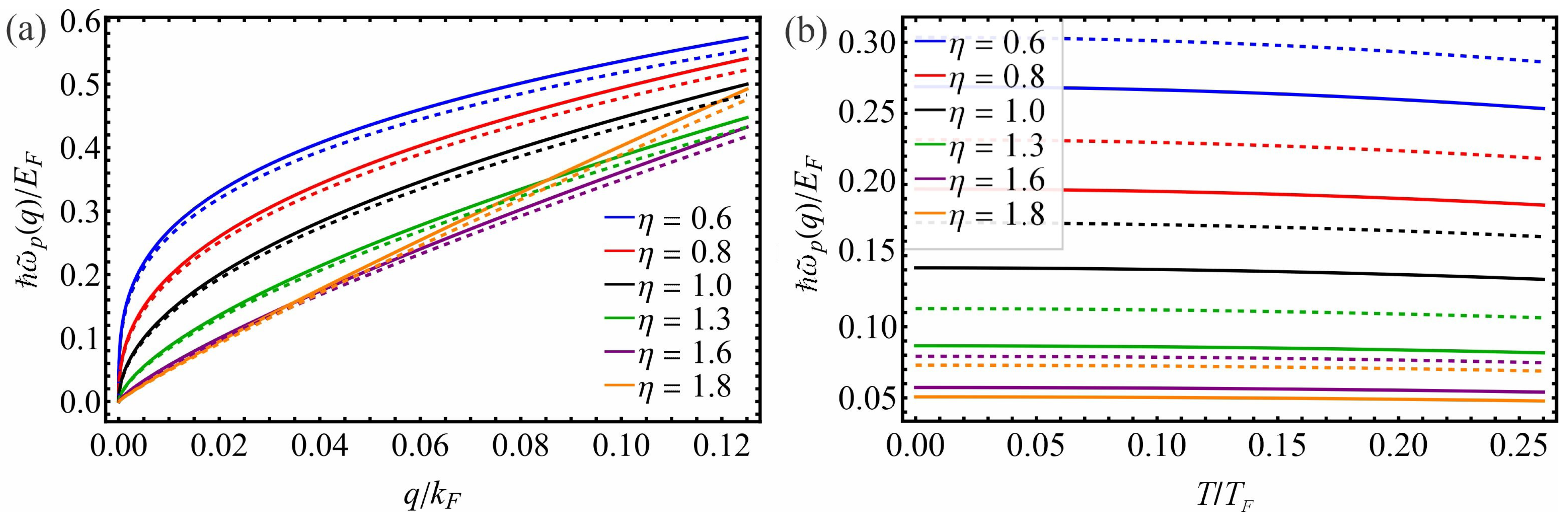
We plot in Figure 3a the normalized plasmon mode dispersion ω ˜ p ( q ) / E F as a function of the dimensionless variable q / k F at different temperatures T / T F and (b) ω ˜ p ( q ) / E F as a function of the dimensionless variable T / T F at different values of the wave vector q / k F where ω ˜ p ( q ) = ω p ( q ) / A k F η 1 / ( v F ) for doped monolayer graphene with different values of the parameter η . One observes that the plasmon frequency ω p ( q ) slowly decreases with increasing temperature for small values of the wave vector and at low temperature, where the analytical approximations remain valid. In this regime, the reduction in plasmon frequency ω p ( q ) is relatively weak, indicating that the plasmon modes remain well defined.
We now briefly examine the high-temperature limit ( T T F ) with q v F ω , when the non-interacting density–density response function for doped monolayer graphene is given by the relation [14]
χ 0 ( q , ω ) 2 ln 2 π q 2 ( ω ) 2 k B T 1 + T F 4 128 ( ln 2 ) 3 T 4 + i 16 q 2 k B T 1 ( ω ) 2 48 ( k B T ) 2 .
Using relations (4), (6), and (21), we find the plasmon dispersion for doped monolayer graphene at high temperatures:
ω p ( q ) = 2 ln 2 π 2 C ( η ) k B T 1 + T F 4 128 ( ln 2 ) 3 T 4 q η 2 .
Employing the weak-damping approximation (5), we obtain
Γ p ( q ) 1 32 2 ln 2 π C ( η ) 3 2 k B T 1 ln 2 24 k B T C ( η ) π q η q 3 η 2 .
Note that relations (22) and (23) reduce to the results of Ref. [14] for Coulomb interaction ( η = 1 ) with the substitution A = e 2 / K . Notably, in the T T F limit, the doped graphene plasmon dispersion and damping rate, given by the relations (22) and (23), reduce to the undoped graphene cases, given by Equations (16)–(17). For undoped graphene, the Fermi energy is E F = k B T F = 0 ; thus, it is in the high-temperature regime at any finite temperature, due to the fact that T > T F , as discussed in Ref. [14]. In both doped (at T T F ) and undoped ( E F = 0 ) graphene cases, the plasmon mode dispersion and damping rate exhibit the same scaling behaviors, ω p ( q ) T q η / 2 and Γ p ( q ) q 3 η / 2 / T , respectively, with differences appearing only in higher-order corrections in temperature. Therefore, the parameter η of non-Coulomb interaction does not affect the temperature dependence of plasmon mode dispersion and damping rate. The thermal energy enhances the plasmon frequency while simultaneously suppressing damping [14].
In the following, we briefly study the plasmon mode dispersion at zero temperature in monolayer X Se ( X = In ,   Ga ), which exhibits a nonparabolic "Mexican-hat" topmost valence band dispersion [51]. The environment-dependent screening observed in related transition metal dichalcogenides [88,89,90,91,92] suggests that it may be worthwhile to consider whether generalized power-law interactions could influence plasmons in metal monochalcogenide monolayers, even for small deviations from the standard Coulomb potential. In the following, we will distinguish between hole- and electron-doped monolayer X Se . In the long-wavelength limit ( q 0 ), the non-interacting density–density response function for hole-doped monolayer X Se is given by
χ 0 ( q , ω ) q 2 4 π ω 2 h 1 n ,
where n = 2 h 2 E F / h 2 is the hole concentration at the Fermi energy E F < 0 with band parameters h 1 > 0 and h 2 < 0 [51]. Using Equations (2), (6), and (24), the plasmon dispersion in monolayer X Se for hole doping reads
ω p ( q ) = C ( η ) h 1 n 4 π q η 2 .
Thus, in the hole-doped X Se case, the long-wavelength plasmon dispersion depends on the wave vector as ω p ( q ) q η / 2 . The dependencies of plasmon dispersion on hole concentration and Fermi energy are given by ω p ( q ) n and ω p ( q ) | E F | 1 / 4 , respectively, and are independent of the parameter η . For η = 1 , we recover the findings from Ref. [51]. For the case of electron doping, the non-interacting density–density response function is expressed as
χ 0 ( q , ω ) = 1 4 π λ q q ω + λ q 2 2 λ q 2 k F 2 + i k F 2 ω λ q 2 2 λ q 2 ,
where λ and k F are a characteristic band parameter and the Fermi wave vector, respectively [51]. In the weak-damping limit, applying Equations (4)–(6) and (26), we find that, for electron doping, the plasmon frequency becomes
ω p ( q ) = λ q 2 4 π λ C ( η ) q 3 η + q 2 + k F 2 q ,
with damping rate
Γ p ( q ) = 2 λ q 4 π λ C ( η ) q 3 η + q 4 π λ C ( η ) q 3 η + q 2 + k F 2 k F 2 4 π λ C ( η ) q 3 η + q 2 + k F 2 q 2 .
In the case of Coulomb interaction ( η = 1 ), Equations (27) and (28) reduce to the well-known results reported in Ref. [51].
Finally, we determine the plasmon dispersion for a disordered two-dimensional electron gas. Disorder in two-dimensional materials refers to deviations from the perfect periodic crystal structure. The properties of two-dimensional materials, due to their atomic-scale thickness, are very sensitive to such imperfections [65,66,67,68]. The effect of disorder on dynamics of two-dimensional electron systems with non-Coulomb interactions has been studied in the literature [60,61,93]. This indicates that going beyond the standard Coulomb picture may also be relevant for plasmon calculations in these materials. The non-interacting density–density response function that we use to model disorder in two-dimensional systems, in the long-wavelength limit ( q 0 ), is given by [53,58]
χ 0 ( q , ω ) = D ( E F ) D q 2 D q 2 i ω ω 2 τ 0 ,
where D ( E F ) is the electron density of states at the Fermi level E F , D = v F 2 τ / 2 is the diffusion constant, and τ and τ 0 denote the relaxation time and the response lag time of the system, respectively. We note that disorder is not related to the non-Coulomb interaction potential. However, it is included through the modified response function in Equation (29), which accounts for scattering due to impurities and defects in two-dimensional electron systems. Scattering on impurities or defects induces diffusive rather than ballistic transport of electrons [98]. Now using Equations (2), (3), and (6) with (29), we obtain for the plasmon frequency
ω p ( q ) = 1 2 τ 0 2 v F 2 τ τ 0 q η C ( η ) D ( E F ) + q 2 η 1 ,
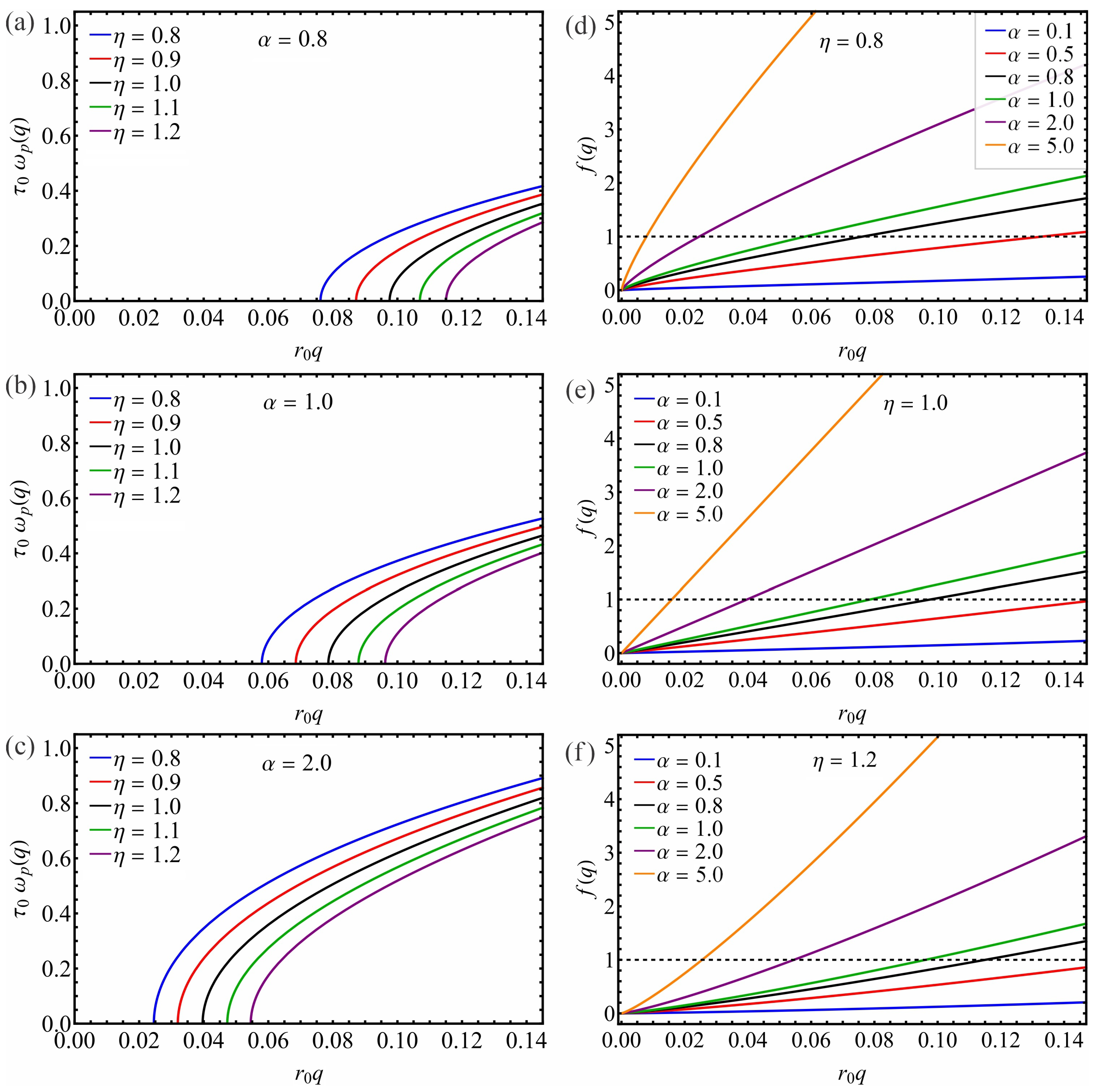
with damping rate Γ p ( q ) = 1 / ( 2 τ 0 ) , as was found in Ref. [58]. Note that, in order to obtain real solutions for the plasmon frequency, the condition
q η C ( η ) D ( E F ) + q 2 η 1 2 v F 2 τ τ 0 ,
in Equation (30) must be satified. Now introducing r 0 = v F τ τ 0 , relation (30) becomes
ω p ( q ) = 1 2 τ 0 2 ( r 0 q ) η A D ( E F ) r 0 2 η 2 2 η Γ 1 η 2 2 sin ( π η 2 ) + ( r 0 q ) 2 η 1 ,
with condition f ( q ) 1 , where
f ( q ) = 2 ( r 0 q ) η A D ( E F ) r 0 2 η 2 2 η Γ 1 η 2 2 sin ( π η 2 ) + ( r 0 q ) 2 η .
We plot in Figure 4a–c the plasmon dispersion τ 0 ω p ( q ) as a function of the dimensionless variable r 0 q and in Figure 4d–f the function f ( q ) as a function of the dimensionless variable r 0 q for a disordered two-dimensional electron gas at different values of the parameters η near the Coulomb-like case ( η 1 ) and α = A D ( E F ) r 0 2 η with r 0 = 1 . We find that the plasmon modes become more well defined with the decrease in parameter η , describing the non-Coulomb nature of the interaction, and with the increase in parameter α = A D ( E F ) r 0 2 η .

4. Conclusions

In this paper, we have studied the plasmon dispersion in several two-dimensional systems under a generalized non-Coulomb interaction of the form r η . Plasmons, which are collective oscillations of the electron density in materials, play an important role in determining their optical and electronic properties. The plasmon mode dispersion generally depends on the dimensionality of the system and is very sensitive to the density of charge carriers, temperature, and disorder in the material. Plasmons can significantly affect light–matter interactions, signal propagation, and energy confinement. Thus, understanding plasmon dispersion in low-dimensional systems is important for optimizing nanodevices and plasmonic applications [107,108,109]. The analytical results presented in this work extend the known plasmonic behavior from the Coulomb case to a more general non-Coulomb interaction of the form r η , allowing a unified description of collective excitations in clean and disordered two-dimensional systems. The presence of disorder can lead to strong influence on the electronic, thermal, magnetic, optical, and mechanical properties of materials and usually is a factor limiting the performance of two-dimensional electronic devices [65,66,67,68]. Our analysis shows that the parameter η , which describes the non-Coulomb behavior of the interaction, controls only the power of the wave vector (q) dependence of plasmon frequency ( ω p ) in the long-wavelength limit. Furthermore, the dependence of the plasmon frequency on temperature (T), carrier density (n), and Fermi energy ( E F ) is unaffected by the parameter η in the long-wavelength limit for the systems studied here. Namely, for doped graphene, at zero temperature and in the low-temperature limit, the plasmon frequency scales with wave vector as ω p q η / 2 , meaning that a decrease in η can produce a stronger, more sublinear dispersion. In addition, we found that the carrier and Fermi energy dependence of plasmon frequency is not influenced by the parameter η , leading to ω p n 1 / 4 or equivalently to ω p | E F | , as in the case of Coulomb interaction. In conventional two-dimensional electron gases, the plasmon frequency behaves as ω p q η / 2 , ω p n , and ω p E F . For undoped graphene at finite temperature, the temperature dependence of the thermally excited plasmon modes is also universal and independent of η in the long-wavelength limit. Namely, the frequency behaves as ω p q η / 2 T and the damping rate as Γ p q 3 η / 2 / T . The high-temperature limit of doped graphene plasmons was discussed by recovering the Coulomb interaction case. We have also analyzed the plasmon dispersion for monolayer X Se ( X = In ,   Ga ) at zero temperature. We have found that the hole-doped monolayer X Se exhibits a plasmon frequency dependence on the wave vector as ω p q η / 2 , while the dependence on charge carrier density and Fermi energy remains unaffected, following ω p n and ω p | E F | 1 / 4 , respectively. In the case of disordered two-dimensional electron gas, we have found that the parameter η strongly affects the shape of the plasmon dispersion and the domain where well-defined plasmons exist. Our findings may serve as a basis for tuning plasmonic properties in graphene, monochalcogenides, and disordered two-dimensional systems, and for guiding future experimental and theoretical studies on non-Coulomb interactions. A more complete understanding of plasmon behavior under non-Coulomb interactions could be achieved by exploring larger wave vector regimes, beyond the validity of the long-wavelength approximation. Future work may include numerical studies at finite temperatures for different two-dimensional systems.

Author Contributions

Conceptualization, L.M.; methodology, L.M. and I.G.; validation, I.L. and A.C.; formal analysis, L.M. and I.G.; investigation, I.L. and A.C.; writing—original draft preparation, L.M. and I.G.; writing—review and editing, L.M., A.C. and I.G.; supervision, I.G.; project administration, A.C.; funding acquisition, A.C. All authors have read and agreed to the published version of the manuscript.

Funding

This work was supported through the “Nucleu” Program within the National Research Development and Innovation Plan 2022–2027, Romania, carried out with the support of MEC, project no. 27N/03.01.2023, component project code PN 23 24 01 04, and also received financial support from CNCS/CCCDI-UEFISCDI, under project number PN-IV-P1-PCE-2023-0987.

Institutional Review Board Statement

Not applicable.

Informed Consent Statement

Not applicable.

Data Availability Statement

Data supporting results are available from the corresponding author upon reasonable request.

Acknowledgments

The authors would like to thank Ionel Ţifrea, Frederic Piechon, and Doru Sticleț for valuable discussions.

Conflicts of Interest

The authors declare no conflicts of interest.

References

  1. Pines, D. Elementary Excitations In Solids; CRC Press: Boca Raton, FL, USA, 1999; p. 312. [Google Scholar] [CrossRef]
  2. Giuliani, G.; Vignale, G. Quantum Theory of the Electron Liquid; Cambridge University Press: Cambridge, UK, 2005. [Google Scholar] [CrossRef]
  3. Kumar, S.; Bozhevolnyi, S.I. Coupling of Quantum Emitters to Plasmonic Nanoguides. In Quantum Plasmonics; Bozhevolnyi, S., Martin-Moreno, L., Garcia-Vidal, F., Eds.; Springer Series in Solid State Sciences; Springer: Berlin/Heidelberg, Germany, 2017. [Google Scholar] [CrossRef]
  4. Stern, F. Polarizability of a Two-Dimensional Electron Gas. Phys. Rev. Lett. 1967, 18, 546–548. [Google Scholar] [CrossRef]
  5. Wunsch, B.; Stauber, T.; Sols, F.; Guinea, F. Dynamical polarization of graphene at finite doping. New J. Phys. 2006, 8, 318. [Google Scholar] [CrossRef]
  6. Das Sarma, S.; Hwang, E.H. Collective Modes of the Massless Dirac Plasma. Phys. Rev. Lett. 2009, 102, 206412. [Google Scholar] [CrossRef]
  7. Maier, S. Plasmonics: Fundamentals and Applications; Springer: Cham, Switzerland, 2007. [Google Scholar] [CrossRef]
  8. Ju, L.; Geng, B.; Horng, J.; Girit, C.; Martin, M.; Hao, Z.; Bechtel, H.A.; Liang, X.; Zettl, A.; Shen, Y.R.; et al. Graphene plasmonics for tunable terahertz metamaterials. Nat. Nanotechnol. 2011, 6, 630–634. [Google Scholar] [CrossRef]
  9. Luo, X.; Qiu, T.; Lu, W.; Ni, Z. Plasmons in graphene: Recent progress and applications. Mater. Sci. Eng. R Rep. 2013, 74, 351–376. [Google Scholar] [CrossRef]
  10. Tame, M.S.; McEnery, K.R.; Özdemir, Ş.K.; Lee, J.; Maier, S.A.; Kim, M.S. Quantum plasmonics. Nat. Phys. 2013, 9, 329–340. [Google Scholar] [CrossRef]
  11. Han, X.; Liu, K.; Sun, C. Plasmonics for Biosensing. Materials 2019, 12, 1411. [Google Scholar] [CrossRef]
  12. Hwang, E.H.; Das Sarma, S. Dielectric function, screening, and plasmons in two-dimensional graphene. Phys. Rev. B 2007, 75, 205418. [Google Scholar] [CrossRef]
  13. Grigorenko, A.N.; Polini, M.; Novoselov, K.S. Graphene plasmonics. Nat. Photonics 2012, 6, 749–758. [Google Scholar] [CrossRef]
  14. Das Sarma, S.; Li, Q. Intrinsic plasmons in two-dimensional Dirac materials. Phys. Rev. B 2013, 87, 235418. [Google Scholar] [CrossRef]
  15. Bandurin, D.A.; Svintsov, D.; Gayduchenko, I.; Xu, S.G.; Principi, A.; Moskotin, M.; Tretyakov, I.; Yagodkin, D.; Zhukov, S.; Taniguchi, T.; et al. Resonant terahertz detection using graphene plasmons. Nat. Commun. 2018, 9, 5392. [Google Scholar] [CrossRef]
  16. Hu, H.; Yu, R.; Teng, H.; Hu, D.; Chen, N.; Qu, Y.; Yang, X.; Chen, X.; McLeod, A.S.; Alonso-González, P.; et al. Active control of micrometer plasmon propagation in suspended graphene. Nat. Commun. 2022, 13, 1465. [Google Scholar] [CrossRef]
  17. Novoselov, K.S.; Geim, A.K.; Morozov, S.V.; Jiang, D.; Zhang, Y.; Dubonos, S.V.; Grigorieva, I.V.; Firsov, A.A. Electric Field Effect in Atomically Thin Carbon Films. Science 2004, 306, 666–669. [Google Scholar] [CrossRef]
  18. Novoselov, K.S.; Geim, A.K.; Morozov, S.V.; Jiang, D.; Katsnelson, M.I.; Grigorieva, I.V.; Dubonos, S.V.; Firsov, A.A. Two-dimensional gas of massless Dirac fermions in graphene. Nature 2005, 438, 197–200. [Google Scholar] [CrossRef]
  19. Castro Neto, A.H.; Guinea, F.; Peres, N.M.R.; Novoselov, K.S.; Geim, A.K. The electronic properties of graphene. Rev. Mod. Phys. 2009, 81, 109–162. [Google Scholar] [CrossRef]
  20. Das Sarma, S.; Adam, S.; Hwang, E.H.; Rossi, E. Electronic transport in two-dimensional graphene. Rev. Mod. Phys. 2011, 83, 407–470. [Google Scholar] [CrossRef]
  21. Zhang, Y.; Tan, Y.W.; Stormer, H.L.; Kim, P. Experimental observation of the quantum Hall effect and Berry’s phase in graphene. Nature 2005, 438, 201. [Google Scholar] [CrossRef] [PubMed]
  22. Stander, N.; Huard, B.; Goldhaber-Gordon, D. Evidence for Klein Tunneling in Graphene p-n Junctions. Phys. Rev. Lett. 2009, 102, 026807. [Google Scholar] [CrossRef] [PubMed]
  23. Wakabayashi, K.; Dutta, S. Nanoscale and edge effect on electronic properties of graphene. Solid State Commun. 2012, 152, 1420–1430. [Google Scholar] [CrossRef]
  24. Maffucci, A.; Miano, G. Electrical Properties of Graphene for Interconnect Applications. Appl. Sci. 2014, 4, 305–317. [Google Scholar] [CrossRef]
  25. Zhao-Zhe, L. Coulomb Screening and Plasmon Excitation in Graphene at Finite Temperature. Commun. Theor. Phys. 2009, 52, 361. [Google Scholar] [CrossRef]
  26. Pyatkovskiy, P.K. Dynamical polarization, screening, and plasmons in gapped graphene. J. Phys. Condens. Matter 2008, 21, 025506. [Google Scholar] [CrossRef]
  27. Scholz, A.; Schliemann, J. Dynamical current-current susceptibility of gapped graphene. Phys. Rev. B 2011, 83, 235409. [Google Scholar] [CrossRef]
  28. Patel, D.K.; Ashraf, S.S.Z.; Sharma, A.C. Finite temperature dynamical polarization and plasmons in gapped graphene. Phys. Status Solidi 2015, 252, 1817–1826. [Google Scholar] [CrossRef]
  29. Thakur, A.; Sachdeva, R.; Agarwal, A. Dynamical polarizability, screening and plasmons in one, two and three dimensional massive Dirac systems. J. Phys. Condens. Matter 2017, 29, 105701. [Google Scholar] [CrossRef] [PubMed]
  30. Brar, V.W.; Wickenburg, S.; Panlasigui, M.; Park, C.H.; Wehling, T.O.; Zhang, Y.; Decker, R.; Girit, i.m.c.b.u.; Balatsky, A.V.; Louie, S.G.; et al. Observation of Carrier-Density-Dependent Many-Body Effects in Graphene via Tunneling Spectroscopy. Phys. Rev. Lett. 2010, 104, 036805. [Google Scholar] [CrossRef]
  31. Fei, Z.; Andreev, G.O.; Bao, W.; Zhang, L.M.; McLeod, A.S.; Wang, C.; Stewart, M.K.; Zhao, Z.; Dominguez, G.; Thiemens, M.; et al. Infrared Nanoscopy of Dirac Plasmons at the Graphene–SiO2 Interface. Nano Lett. 2011, 11, 4701–4705. [Google Scholar] [CrossRef] [PubMed]
  32. Tegenkamp, C.; Pfnür, H.; Langer, T.; Baringhaus, J.; Schumacher, H.W. Plasmon electron–hole resonance in epitaxial graphene. J. Phys. Condens. Matter 2010, 23, 012001. [Google Scholar] [CrossRef]
  33. Chen, J.; Badioli, M.; Alonso-González, P.; Thongrattanasiri, S.; Huth, F.; Osmond, J.; Spasenović, M.; Centeno, A.; Pesquera, A.; Godignon, P.; et al. Optical nano-imaging of gate-tunable graphene plasmons. Nature 2012, 487, 77–81. [Google Scholar] [CrossRef]
  34. Fei, Z.; Rodin, A.S.; Andreev, G.O.; Bao, W.; McLeod, A.S.; Wagner, M.; Zhang, L.M.; Zhao, Z.; Thiemens, M.; Dominguez, G.; et al. Gate-tuning of graphene plasmons revealed by infrared nano-imaging. Nature 2012, 487, 82–85. [Google Scholar] [CrossRef]
  35. Yan, H.; Low, T.; Zhu, W.; Wu, Y.; Freitag, M.; Li, X.; Guinea, F.; Avouris, P.; Xia, F. Damping pathways of mid-infrared plasmons in graphene nanostructures. Nat. Photonics 2013, 7, 394–399. [Google Scholar] [CrossRef]
  36. Gerber, J.A.; Berweger, S.; O’Callahan, B.T.; Raschke, M.B. Phase-Resolved Surface Plasmon Interferometry of Graphene. Phys. Rev. Lett. 2014, 113, 055502. [Google Scholar] [CrossRef]
  37. Liou, S.C.; Shie, C.S.; Chen, C.H.; Breitwieser, R.; Pai, W.W.; Guo, G.Y.; Chu, M.W. π-plasmon dispersion in free-standing graphene by momentum-resolved electron energy-loss spectroscopy. Phys. Rev. B 2015, 91, 045418. [Google Scholar] [CrossRef]
  38. In, C.; Kim, U.J.; Choi, H. Two-dimensional Dirac plasmon-polaritons in graphene, 3D topological insulator and hybrid systems. Light. Sci. Appl. 2022, 11, 313. [Google Scholar] [CrossRef]
  39. Li, S.; Lin, Y.C.; Zhao, W.; Wu, J.; Wang, Z.; Hu, Z.; Shen, Y.; Tang, D.M.; Wang, J.; Zhang, Q.; et al. Vapour–liquid–solid growth of monolayer MoS2 nanoribbons. Nat. Mater. 2018, 17, 535–542. [Google Scholar] [CrossRef]
  40. Kotekar-Patil, D.; Deng, J.; Wong, S.L.; Goh, K.E.J. Coulomb Blockade in Etched Single- and Few-Layer MoS2 Nanoribbons. ACS Appl. Electron. Mater. 2019, 1, 2202–2207. [Google Scholar] [CrossRef]
  41. Yang, C.; Wang, B.; Xie, Y.; Zheng, Y.; Jin, C. Deriving MoS2 nanoribbons from their flakes by chemical vapor deposition. Nanotechnology 2019, 30, 255602. [Google Scholar] [CrossRef] [PubMed]
  42. Nüsse, S.; Haring Bolivar, P.; Kurz, H.; Klimov, V.; Levy, F. Carrier cooling and exciton formation in GaSe. Phys. Rev. B 1997, 56, 4578–4583. [Google Scholar] [CrossRef]
  43. Late, D.J.; Liu, B.; Luo, J.; Yan, A.; Matte, H.S.S.R.; Grayson, M.; Rao, C.N.R.; Dravid, V.P. GaS and GaSe Ultrathin Layer Transistors. Adv. Mater. 2012, 24, 3549–3554. [Google Scholar] [CrossRef] [PubMed]
  44. Rybkovskiy, D.V.; Osadchy, A.V.; Obraztsova, E.D. Transition from parabolic to ring-shaped valence band maximum in few-layer GaS, GaSe, and InSe. Phys. Rev. B 2014, 90, 235302. [Google Scholar] [CrossRef]
  45. Bandurin, D.A.; Tyurnina, A.V.; Yu, G.L.; Mishchenko, A.; Zólyomi, V.; Morozov, S.V.; Kumar, R.K.; Gorbachev, R.V.; Kudrynskyi, Z.R.; Pezzini, S.; et al. High electron mobility, quantum Hall effect and anomalous optical response in atomically thin InSe. Nat. Nanotechnol. 2017, 12, 223–227. [Google Scholar] [CrossRef]
  46. Zhou, M.; Yu, S.; Yang, W.; Lou, W.k.; Cheng, F.; Zhang, D.; Chang, K. Current-induced spin polarization in monolayer InSe. Phys. Rev. B 2019, 100, 245409. [Google Scholar] [CrossRef]
  47. Zhou, M.; Zhang, D.; Yu, S.; Huang, Z.; Chen, Y.; Yang, W.; Chang, K. Spin-charge conversion in InSe bilayers. Phys. Rev. B 2019, 99, 155402. [Google Scholar] [CrossRef]
  48. Song, C.; Huang, S.; Wang, C.; Luo, J.; Yan, H. The optical properties of few-layer InSe. J. Appl. Phys. 2020, 128, 060901. [Google Scholar] [CrossRef]
  49. Sarkar, A.S.; Stratakis, E. Recent Advances in 2D Metal Monochalcogenides. Adv. Sci. 2020, 7, 2001655. [Google Scholar] [CrossRef] [PubMed]
  50. Rahaman, M.; Aslam, M.A.; He, L.; Madeira, T.I.; Zahn, D.R.T. Plasmonic hot electron induced layer dependent anomalous Fröhlich interaction in InSe. Commun. Phys. 2021, 4, 172. [Google Scholar] [CrossRef]
  51. Zhou, M. Dynamical polarization function and plasmons in monolayer XSe (X = In, Ga). Phys. Rev. B 2021, 103, 155429. [Google Scholar] [CrossRef]
  52. Zhou, J.; Zhou, C. Spin polarized quantum oscillations in monolayer InSe induced by magnetic field. Solid State Commun. 2022, 341, 114557. [Google Scholar] [CrossRef]
  53. Kadanoff, L.P.; Martin, P.C. Hydrodynamic equations and correlation functions. Ann. Phys. 1963, 24, 419–469. [Google Scholar] [CrossRef]
  54. Giuliani, G.F.; Quinn, J.J. Effects of diffusion on the plasma oscillations of a two-dimensional electron gas. Phys. Rev. B 1984, 29, 2321–2323. [Google Scholar] [CrossRef]
  55. Geldart, D.; Das, A.; Gumbs, G. Plasmon dispersion relation for a disordered interacting quasi-two-dimensional electron gas. Solid State Commun. 1986, 60, 987–990. [Google Scholar] [CrossRef]
  56. Shegelski, M.R.A.; Geldart, D.J.W. Plasmons in disordered, two-component, quasi-two-dimensional electron systems. Phys. Rev. B 1989, 40, 3647–3651. [Google Scholar] [CrossRef][Green Version]
  57. Tanatar, B.; Das, A.K. Effects of disorder on collective modes in single- and double-layer Bose systems. J. Phys. Condens. Matter 1996, 8, 1937. [Google Scholar] [CrossRef]
  58. Grosu, I. Collective modes and disorder in two-dimensional systems. J. Optoelectron. Adv. M. 2007, 9, 2709–2712. [Google Scholar]
  59. Principi, A.; Vignale, G.; Carrega, M.; Polini, M. Impact of disorder on Dirac plasmon losses. Phys. Rev. B 2013, 88, 121405. [Google Scholar] [CrossRef]
  60. Lin, P.V.; Popović, D. Critical Behavior of a Strongly Disordered 2D Electron System: The Cases of Long-Range and Screened Coulomb Interactions. Phys. Rev. Lett. 2015, 114, 166401. [Google Scholar] [CrossRef]
  61. Stanley, L.J.; Lin, P.V.; Jaroszyński, J.; Popović, D. Screening the Coulomb interaction leads to a prethermal regime in two-dimensional bad conductors. Nat. Commun. 2023, 14, 7004. [Google Scholar] [CrossRef] [PubMed]
  62. Schwartz, T.; Fishman, S.; Segev, M. Localisation of light in disordered lattices. Electron. Lett. 2008, 44, 165–168. [Google Scholar] [CrossRef]
  63. Zheng, Y.; Slade, T.J.; Hu, L.; Tan, X.Y.; Luo, Y.; Luo, Z.Z.; Xu, J.; Yan, Q.; Kanatzidis, M.G. Defect engineering in thermoelectric materials: What have we learned? Chem. Soc. Rev. 2021, 50, 9022–9054. [Google Scholar] [CrossRef]
  64. Zaiser, M.; Zapperi, S. Disordered mechanical metamaterials. Nat. Rev. Phys. 2023, 5, 679–688. [Google Scholar] [CrossRef]
  65. Ferrari, A.C. Raman spectroscopy of graphene and graphite: Disorder, electron–phonon coupling, doping and nonadiabatic effects. Solid State Commun. 2007, 143, 47–57. [Google Scholar] [CrossRef]
  66. Banhart, F.; Kotakoski, J.; Krasheninnikov, A.V. Structural Defects in Graphene. ACS Nano 2010, 5, 26–41. [Google Scholar] [CrossRef]
  67. Raja, A.; Waldecker, L.; Zipfel, J.; Cho, Y.; Brem, S.; Ziegler, J.D.; Kulig, M.; Taniguchi, T.; Watanabe, K.; Malic, E.; et al. Dielectric disorder in two-dimensional materials. Nat. Nanotechnol. 2019, 14, 832–837. [Google Scholar] [CrossRef]
  68. Rhodes, D.; Chae, S.H.; Ribeiro-Palau, R.; Hone, J. Disorder in van der Waals heterostructures of 2D materials. Nat. Mater. 2019, 18, 541–549. [Google Scholar] [CrossRef]
  69. Bares, P.A.; Wen, X.G. Breakdown of the Fermi liquid due to long-range interactions. Phys. Rev. B 1993, 48, 8636–8650. [Google Scholar] [CrossRef] [PubMed]
  70. Stafiej, J.; di Caprio, D.; Badiali, J.P. A simple model to investigate the effects of non-Coulombic interactions on the structure of charged interfaces. J. Chem. Phys. 1998, 109, 3607–3618. [Google Scholar] [CrossRef]
  71. Grosu, I. Frequency Dependence of the Transport Scattering Time in Non-Fermi Liquids. J. Supercond. 2001, 14, 371–374. [Google Scholar] [CrossRef]
  72. Katsnelson, M.I. Nonlinear screening of charge impurities in graphene. Phys. Rev. B 2006, 74, 201401. [Google Scholar] [CrossRef]
  73. Britton, J.W.; Sawyer, B.C.; Keith, A.C.; Wang, C.C.J.; Freericks, J.K.; Uys, H.; Biercuk, M.J.; Bollinger, J.J. Engineered two-dimensional Ising interactions in a trapped-ion quantum simulator with hundreds of spins. Nature 2012, 484, 489–492. [Google Scholar] [CrossRef]
  74. Vangara, R.; Stoltzfus, K.; York, M.R.; Swol, F.v.; Petsev, D.N. Coulombic and non-Coulombic effects in charge-regulating electric double layers. Mater. Res. Express 2019, 6, 086331. [Google Scholar] [CrossRef]
  75. Gabovich, A.M.; Li, M.S.; Szymczak, H.; Voitenko, A.I. Non-Coulombic behavior of electrostatic charge-charge interaction in three-layer heterostructures. J. Electrostat. 2019, 102, 103377. [Google Scholar] [CrossRef]
  76. Zhang, L.; Wang, H.; Muniz, M.C.; Panagiotopoulos, A.Z.; Car, R.; E, W. A deep potential model with long-range electrostatic interactions. J. Chem. Phys. 2022, 156, 124107. [Google Scholar] [CrossRef]
  77. Defenu, N.; Donner, T.; Macrì, T.; Pagano, G.; Ruffo, S.; Trombettoni, A. Long-range interacting quantum systems. Rev. Mod. Phys. 2023, 95, 035002. [Google Scholar] [CrossRef]
  78. Chen, C.; Bornet, G.; Bintz, M.; Emperauger, G.; Leclerc, L.; Liu, V.S.; Scholl, P.; Barredo, D.; Hauschild, J.; Chatterjee, S.; et al. Continuous symmetry breaking in a two-dimensional Rydberg array. Nature 2023, 616, 691–695. [Google Scholar] [CrossRef] [PubMed]
  79. Christakis, L.; Rosenberg, J.S.; Raj, R.; Chi, S.; Morningstar, A.; Huse, D.A.; Yan, Z.Z.; Bakr, W.S. Probing site-resolved correlations in a spin system of ultracold molecules. Nature 2023, 614, 64–69. [Google Scholar] [CrossRef]
  80. Radzihovsky, L.; Toner, J. Coulomb universality. Phys. Rev. E 2024, 110, 014136. [Google Scholar] [CrossRef]
  81. Defenu, N.; Lerose, A.; Pappalardi, S. Out-of-equilibrium dynamics of quantum many-body systems with long-range interactions. Phys. Rep. 2024, 1074, 1–92. [Google Scholar] [CrossRef]
  82. Poddubny, A.; Miroshnichenko, A.; Slobozhanyuk, A.; Kivshar, Y. Topological Majorana States in Zigzag Chains of Plasmonic Nanoparticles. ACS Photonics 2014, 1, 101–105. [Google Scholar] [CrossRef]
  83. Chen, H.J.; Zhu, K.D. Surface Plasmon Enhanced Sensitive Detection for Possible Signature of Majorana Fermions via a Hybrid Semiconductor Quantum Dot-Metal Nanoparticle System. Sci. Rep. 2015, 5, 13518. [Google Scholar] [CrossRef]
  84. Chen, H.J.; Wu, H.W. Rabi splitting and optical Kerr nonlinearity of quantum dot mediated by Majorana fermions. Sci. Rep. 2018, 8, 17677. [Google Scholar] [CrossRef] [PubMed]
  85. Máthé, L.; Kovács-Krausz, Z.; Botiz, I.; Grosu, I.; El Anouz, K.; El Allati, A.; Zârbo, L.P. Phonon-Assisted Tunneling through Quantum Dot Systems Connected to Majorana Bound States. Nanomaterials 2023, 13, 1616. [Google Scholar] [CrossRef] [PubMed]
  86. Kotov, V.N.; Uchoa, B.; Pereira, V.M.; Guinea, F.; Castro Neto, A.H. Electron-Electron Interactions in Graphene: Current Status and Perspectives. Rev. Mod. Phys. 2012, 84, 1067–1125. [Google Scholar] [CrossRef]
  87. Cudazzo, P.; Tokatly, I.V.; Rubio, A. Dielectric screening in two-dimensional insulators: Implications for excitonic and impurity states in graphane. Phys. Rev. B 2011, 84, 085406. [Google Scholar] [CrossRef]
  88. Berkelbach, T.C.; Hybertsen, M.S.; Reichman, D.R. Theory of neutral and charged excitons in monolayer transition metal dichalcogenides. Phys. Rev. B 2013, 88, 045318. [Google Scholar] [CrossRef]
  89. Chernikov, A.; Berkelbach, T.C.; Hill, H.M.; Rigosi, A.; Li, Y.; Aslan, B.; Reichman, D.R.; Hybertsen, M.S.; Heinz, T.F. Exciton Binding Energy and Nonhydrogenic Rydberg Series in Monolayer WS2. Phys. Rev. Lett. 2014, 113, 076802. [Google Scholar] [CrossRef]
  90. Courtade, E.; Semina, M.; Manca, M.; Glazov, M.M.; Robert, C.; Cadiz, F.; Wang, G.; Taniguchi, T.; Watanabe, K.; Pierre, M.; et al. Charged excitons in monolayer WSe2: Experiment and theory. Phys. Rev. B 2017, 96, 085302. [Google Scholar] [CrossRef]
  91. Van Tuan, D.; Yang, M.; Dery, H. Coulomb interaction in monolayer transition-metal dichalcogenides. Phys. Rev. B 2018, 98, 125308. [Google Scholar] [CrossRef]
  92. Liu, E.; van Baren, J.; Taniguchi, T.; Watanabe, K.; Chang, Y.C.; Lui, C.H. Magnetophotoluminescence of exciton Rydberg states in monolayer WSe2. Phys. Rev. B 2019, 99, 205420. [Google Scholar] [CrossRef]
  93. Bhandari, P.; Malik, V.; Schechter, M. Effect of screening on the relaxation dynamics in a Coulomb glass. Phys. Rev. B 2023, 108, 094208. [Google Scholar] [CrossRef]
  94. Ene, V.M.; Lianu, I.; Grosu, I. Hartree-Fock approximation for non-Coulomb interactions in three and two-dimensional systems. Phys. Lett. A 2025, 529, 130064. [Google Scholar] [CrossRef]
  95. Máthé, L.; Grosu, I. Friedel oscillations in a two-dimensional electron gas and monolayer graphene with a non-Coulomb impurity potential. Phys. E Low-Dimens. Syst. Nanostruct. 2025, 173, 116328. [Google Scholar] [CrossRef]
  96. Kraut, E.A. Fundamentals of Mathematical Physics; Dover Publications: Garden City, NY, USA, 2007. [Google Scholar]
  97. Katsnelson, M.I. The Physics of Graphene; Cambridge University Press: Cambridge, UK, 2020. [Google Scholar] [CrossRef]
  98. Das Sarma, S.; Hwang, E.H. Dynamical response of a one-dimensional quantum-wire electron system. Phys. Rev. B 1996, 54, 1936–1946. [Google Scholar] [CrossRef]
  99. Grosu, I.; Tugulan, L. Plasmon dispersion in quasi-one- and one-dimensional systems with non-magnetic impurities. Phys. E Low-Dimens. Syst. Nanostruct. 2008, 40, 474–477. [Google Scholar] [CrossRef][Green Version]
  100. Principi, A.; Vignale, G.; Carrega, M.; Polini, M. Intrinsic lifetime of Dirac plasmons in graphene. Phys. Rev. B 2013, 88, 195405. [Google Scholar] [CrossRef]
  101. Stauber, T. Plasmonics in Dirac systems: From graphene to topological insulators. J. Phys. Condens. Matter 2014, 26, 123201. [Google Scholar] [CrossRef]
  102. Vafek, O. Anomalous Thermodynamics of Coulomb-Interacting Massless Dirac Fermions in Two Spatial Dimensions. Phys. Rev. Lett. 2007, 98, 216401. [Google Scholar] [CrossRef] [PubMed]
  103. Das Sarma, S.; Hwang, E.H.; Tse, W.K. Many-body interaction effects in doped and undoped graphene: Fermi liquid versus non-Fermi liquid. Phys. Rev. B 2007, 75, 121406. [Google Scholar] [CrossRef]
  104. Elias, D.C.; Gorbachev, R.V.; Mayorov, A.S.; Morozov, S.V.; Zhukov, A.A.; Blake, P.; Ponomarenko, L.A.; Grigorieva, I.V.; Novoselov, K.S.; Guinea, F.; et al. Dirac cones reshaped by interaction effects in suspended graphene. Nat. Phys. 2011, 7, 701–704. [Google Scholar] [CrossRef]
  105. Barnes, E.; Hwang, E.H.; Throckmorton, R.E.; Das Sarma, S. Effective field theory, three-loop perturbative expansion, and their experimental implications in graphene many-body effects. Phys. Rev. B 2014, 89, 235431. [Google Scholar] [CrossRef]
  106. Linghua, K.; Baorong, Y.; Xiwei, H. Dispersion Relations of Longitudinal Plasmons in One, Two and Three Dimensional Electron Gas of Metals. Plasma Sci. Technol. 2007, 9, 519. [Google Scholar] [CrossRef]
  107. Yu, H.; Peng, Y.; Yang, Y.; Li, Z.Y. Plasmon-enhanced light–matter interactions and applications. npj Comput. Mater. 2019, 5, 45. [Google Scholar] [CrossRef]
  108. Babicheva, V.E. Optical Processes behind Plasmonic Applications. Nanomaterials 2023, 13, 1270. [Google Scholar] [CrossRef] [PubMed]
  109. Mallika, C.S.; Shwetha, M. Plasmonic Ring Resonator-Based Sensors: Design, Performance, and Applications. Plasmonics 2025, 20, 8423–8440. [Google Scholar] [CrossRef]
Figure 1. The normalized plasmon mode dispersion ω ˜ p ( q ) / E F as a function of the dimensionless variable q / k F , where ω ˜ p ( q ) = ω p ( q ) / A k F η 1 / ( v F ) , for doped monolayer graphene at zero temperature with different values of the parameter η .
Crystals 15 00985 g001
Figure 2. (a) Normalized plasmon mode dispersion ω ˜ p ( q ) / ( k B T ) as a function of v F q / ( k B T ) , (b) normalized damping rate Γ ˜ p ( q ) / ( k B T ) as a function of v F q / ( k B T ) , and (c) the ratio Γ ˜ p ( q ) / ω ˜ p ( q ) as a function of v F q / ( k B T ) where ω ˜ p ( q ) = ω p ( q ) / A ( k B T ) η 1 / ( v F ) η and Γ ˜ p ( q ) = Γ p ( q ) / A 3 ( k B T ) 3 ( η 1 ) / ( v F ) 3 η for undoped monolayer graphene with different values of the parameter η .
Crystals 15 00985 g002
Figure 3. (a) The normalized plasmon mode dispersion ω ˜ p ( q ) / E F as a function of the dimensionless variable q / k F at temperatures T / T F = 0 (solid lines) and T / T F = 0.2 (dashed lines), and (b) ω ˜ p ( q ) / E F as a function of the dimensionless variable T / T F with q / k F = 0.010 (solid lines) or q / k F = 0.015 (dashed lines) where ω ˜ p ( q ) = ω p ( q ) / A k F η 1 / ( v F ) for doped monolayer graphene with different values of the parameter η .
Crystals 15 00985 g003
Figure 4. (ac) The plasmon mode dispersion τ 0 ω p ( q ) and (df) function f ( q ) as a function of the dimensionless variable r 0 q for disordered two-dimensional electron gas with different values of the parameters η and α = A D ( E F ) r 0 2 η with r 0 = 1 , respectively.
Crystals 15 00985 g004
Disclaimer/Publisher’s Note: The statements, opinions and data contained in all publications are solely those of the individual author(s) and contributor(s) and not of MDPI and/or the editor(s). MDPI and/or the editor(s) disclaim responsibility for any injury to people or property resulting from any ideas, methods, instructions or products referred to in the content.