

You are currently viewing a new version of our website. To view the old version click .

Toxins, Volume 15, Issue 1

January 2023 - 80 articles

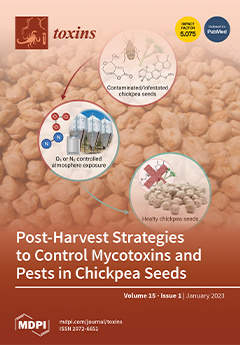
Cover Story: Mycotoxin contamination and pest infestation of foods and feeds represent a crucial threat for food safety and security worldwide, with remarkable implications for human and animal health. Ozone (O3) treatment and high nitrogen (N2) concentrations were tested in the post-harvest management of Cicer arietinum seeds to control the presence of mycotoxigenic fungi and their mycotoxins, as well as Callosobruchus maculatus infestation. At the end of the exposure, O3 significantly decreased the incidence of Penicillium spp. (−50% on average) and the mycotoxins content (−90% on average). High N2 concentrations remarkably reduced mycotoxins contamination (−94% on average) and induced pest mortality (100% after 5 days of exposure). These results confirm the promising potential of O3 and N2 as eco-friendly post-harvest conservation strategies. View this paper
  • Issues are regarded as officially published after their release is announced to the table of contents alert mailing list .
  • You may sign up for email alerts to receive table of contents of newly released issues.
  • PDF is the official format for papers published in both, html and pdf forms. To view the papers in pdf format, click on the "PDF Full-text" link, and use the free Adobe Reader to open them.

Articles (80)

  • Article
  • Open Access
1 Citations
4,057 Views
19 Pages

The Important Role of Membrane Fluidity on the Lytic Mechanism of the α-Pore-Forming Toxin Sticholysin I

  • Lohans Pedrera,
  • Uris Ros,
  • Maria Laura Fanani,
  • María E. Lanio,
  • Richard M. Epand,
  • Ana J. García-Sáez and
  • Carlos Álvarez

16 January 2023

Actinoporins have emerged as archetypal α-pore-forming toxins (PFTs) that promote the formation of pores in membranes upon oligomerization and insertion of an α-helix pore-forming domain in the bilayer. These proteins have been used as ac...

  • Article
  • Open Access
15 Citations
3,451 Views
11 Pages

Ultrasensitive Lateral Flow Immunoassay for Fumonisin B1 Detection Using Highly Luminescent Aggregation-Induced Emission Microbeads

  • Ge Xu,
  • Xiaojing Fan,
  • Xirui Chen,
  • Zilong Liu,
  • Guoxin Chen,
  • Xiaxia Wei,
  • Xiangmin Li,
  • Yuankui Leng,
  • Yonghua Xiong and
  • Xiaolin Huang

16 January 2023

Lateral flow immunoassay (LFIA) based on fluorescent microbeads has attracted much attention for its use in rapid and accurate food safety monitoring. However, conventional fluorescent microbeads are limited by the aggregation-caused quenching effect...

  • Article
  • Open Access
3 Citations
3,099 Views
14 Pages

15 January 2023

Patients bitten by Protobothrops mucrosquamatus, Viridovipera stejnegeri, and Naja atra develop different degrees of wound infection. This study validated BITE and Cobra BITE scoring systems that we established previously. Bacteriological studies of...

  • Article
  • Open Access
9 Citations
3,242 Views
16 Pages

Volatiles from Pseudomonas palleroniana Strain B-BH16-1 Suppress Aflatoxin Production and Growth of Aspergillus flavus on Coix lacryma-jobi during Storage

  • Shihua Zhou,
  • Qing-Song Yuan,
  • Xiaoai Wang,
  • Weike Jiang,
  • Xiaohong Ou,
  • Changgui Yang,
  • Yanping Gao,
  • Yanhong Wang,
  • Lanping Guo and
  • Luqi Huang
  • + 1 author

14 January 2023

Semen coicis is not only a traditional Chinese medicine (TCM), but also a typical food in China, with significant medical and healthcare value. Because semen coicis is rich in starch and oil, it can be easily contaminated with Aspergillus flavus and...

  • Feature Paper
  • Article
  • Open Access
11 Citations
5,112 Views
16 Pages

Effects of Botulinum Toxin Type A on the Nociceptive and Lemniscal Somatosensory Systems in Chronic Migraine: An Electrophysiological Study

  • Gabriele Sebastianelli,
  • Francesco Casillo,
  • Antonio Di Renzo,
  • Chiara Abagnale,
  • Ettore Cioffi,
  • Vincenzo Parisi,
  • Cherubino Di Lorenzo,
  • Mariano Serrao,
  • Francesco Pierelli and
  • Jean Schoenen
  • + 1 author

14 January 2023

(1) Background: OnabotulinumtoxinA (BoNT-A) is a commonly used prophylactic treatment for chronic migraine (CM). Although randomized placebo studies have shown its clinical efficacy, the mechanisms by which it exerts its therapeutic effect are still...

  • Article
  • Open Access
8 Citations
3,524 Views
19 Pages

Changes in Spirulina’s Physical and Chemical Properties during Submerged and Solid-State Lacto-Fermentation

  • Ernesta Tolpeznikaite,
  • Vadims Bartkevics,
  • Anna Skrastina,
  • Romans Pavlenko,
  • Ernestas Mockus,
  • Egle Zokaityte,
  • Vytaute Starkute,
  • Dovile Klupsaite,
  • Romas Ruibys and
  • João Miguel Rocha
  • + 2 authors

13 January 2023

The aim of this study was to select a lactic acid bacteria (LAB) strain for bio-conversion of Spirulina, a cyanobacteria (“blue-green algae”), into an ingredient with a high concentration of gamma-aminobutyric acid (GABA) for human and an...

  • Article
  • Open Access
11 Citations
5,285 Views
22 Pages

The Mechanism of Houttuynia cordata Embryotoxicity Was Explored in Combination with an Experimental Model and Network Pharmacology

  • Yufu Liu,
  • Guodong Yang,
  • Chunqi Yang,
  • Zhuo Shi,
  • Yi Ru,
  • Ningning Shen,
  • Chengrong Xiao,
  • Yuguang Wang and
  • Yue Gao

13 January 2023

Houttuynia cordata (H. cordata) is the most common herb as a food and traditional Chinese medicine. Currently, studies on its toxicity have mainly focused on hepatotoxicity. However, its potential embryotoxicity by long-term exposure is often overloo...

  • Article
  • Open Access
20 Citations
4,827 Views
18 Pages

Highly Evolvable: Investigating Interspecific and Intraspecific Venom Variation in Taipans (Oxyuranus spp.) and Brown Snakes (Pseudonaja spp.)

  • Jory van Thiel,
  • Luis L. Alonso,
  • Julien Slagboom,
  • Nathan Dunstan,
  • Roel M. Wouters,
  • Cassandra M. Modahl,
  • Freek J. Vonk,
  • Timothy N. W. Jackson and
  • Jeroen Kool

13 January 2023

Snake venoms are complex mixtures of toxins that differ on interspecific (between species) and intraspecific (within species) levels. Whether venom variation within a group of closely related species is explained by the presence, absence and/or relat...

  • Feature Paper
  • Article
  • Open Access
5 Citations
3,981 Views
17 Pages

Montane Rattlesnakes in México: Venoms of Crotalus tancitarensis and Related Species within the Crotalus intermedius Group

  • Emily R. Grabowsky,
  • Anthony J. Saviola,
  • Javier Alvarado-Díaz,
  • Adrian Quijada Mascareñas,
  • Kirk C. Hansen,
  • John R. Yates and
  • Stephen P. Mackessy

13 January 2023

The Crotalus intermedius group is a clade of rattlesnakes consisting of several species adapted to a high elevation habitat, primarily in México. Crotalus tancitarensis was previously classified as C. intermedius, until individuals occurring o...

  • Article
  • Open Access
19 Citations
3,895 Views
17 Pages

Brazilian Table Olives: A Source of Lactic Acid Bacteria with Antimycotoxigenic and Antifungal Activity

  • Luara Simões,
  • Natália Fernandes,
  • José Teixeira,
  • Luís Abrunhosa and
  • Disney Ribeiro Dias

13 January 2023

Food and feed contamination by fungi, especially by toxigenic ones, is a global concern because it can pose serious health problems when the production of mycotoxins is involved. Lactic acid bacteria (LAB), well-known for fermenting foods, have been...

of 8

Get Alerted

Add your email address to receive forthcoming issues of this journal.

XFacebookLinkedIn
Toxins - ISSN 2072-6651