Skip to Content

Toxins, Volume 15, Issue 2

2023 February - 87 articles

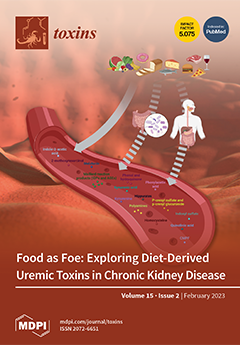
Cover Story: Chronic kidney disease (CKD) is characterized by the plasma accumulation of protein-bound solutes called uremic toxins. These uremic toxins are associated with detrimental effects, such as cardiovascular events and systemic inflammation, among others. Most of these protein-bound uremic toxins are diet-derived. In this paper, food-derived uremic toxins and their sources, metabolism, and mechanisms of action are discussed, and the importance of healthy dietary habits in preventing and managing CKD is highlighted. The evidence concerning the contribution of specific dietary components to increased plasma retention is summarized, and research gaps in this field are pointed out. Insights into potential dietary therapeutic approaches for reducing the accumulation of these toxins in CKD patients are provided. The completed graphic was created using BioRender.com. View this paper
  • Issues are regarded as officially published after their release is announced to the table of contents alert mailing list .
  • You may sign up for email alerts to receive table of contents of newly released issues.
  • PDF is the official format for papers published in both, html and pdf forms. To view the papers in pdf format, click on the "PDF Full-text" link, and use the free Adobe Reader to open them.

Articles (87)

  • Article
  • Open Access
2,237 Views
12 Pages

Mutation of a Threonine Residue in αD-β4 Loop of Cyt2Aa2 Protein Influences Binding on Fluid Lipid Membranes

  • Chontida Tangsongcharoen,
  • Jose L. Toca-Herrera,
  • Boonhiang Promdonkoy and
  • Sudarat Tharad

19 February 2023

Cyt proteins are insecticidal proteins originally from Bacillus thuringiensis. The lipid binding of the Cyt2Aa2 protein depends on the phase of the lipid bilayer. In this work, the importance of the conserved T144 residue in the αD-β4 loop...

  • Review
  • Open Access
21 Citations
7,908 Views
14 Pages

17 February 2023

Botulinum toxin A (BoNT-A) paralyzes muscle by blocking acetylcholine release at the synaptic junction. BoNT-A has shown its therapeutic effects in neurological disorders such as Parkinson’s disease (PD) and post-stroke spasticity. A high propo...

  • Review
  • Open Access
10 Citations
6,481 Views
11 Pages

Type II Toxin–Antitoxin Systems in Pseudomonas aeruginosa

  • Meng Li,
  • Nannan Guo,
  • Gaoyu Song,
  • Yi Huang,
  • Lecheng Wang,
  • Yani Zhang and
  • Tietao Wang

17 February 2023

Toxin–antitoxin (TA) systems are typically composed of a stable toxin and a labile antitoxin; the latter counteracts the toxicity of the former under suitable conditions. TA systems are classified into eight types based on the nature and molecu...

  • Review
  • Open Access
11 Citations
4,383 Views
14 Pages

17 February 2023

Envenomation by animal venoms remains a serious medical and social problem, especially in tropical countries. On the other hand, animal venoms are widely used as a source of biologically active compounds for the development of novel drugs. Numerous d...

  • Article
  • Open Access
6 Citations
2,787 Views
18 Pages

First Identification of Amphidinols from Mexican Strains and New Analogs

  • Lorena M. Durán-Riveroll,
  • Jannik Weber and
  • Bernd Krock

16 February 2023

The genus Amphidinium has been the subject of recent attention due to the production of polyketide metabolites. Some of these compounds have shown significant bioactivities and could be related to species interactions in the natural benthic microenvi...

  • Article
  • Open Access
5 Citations
3,284 Views
19 Pages

Metabolome-Based Classification of Snake Venoms by Bioinformatic Tools

  • Luis L. Alonso,
  • Julien Slagboom,
  • Nicholas R. Casewell,
  • Saer Samanipour and
  • Jeroen Kool

15 February 2023

Snakebite is considered a neglected tropical disease, and it is one of the most intricate ones. The variability found in snake venom is what makes it immensely complex to study. These variations are present both in the big and the small molecules fou...

  • Article
  • Open Access
14 Citations
4,970 Views
13 Pages

15 February 2023

Dispersive magnetic solid-phase extraction (DMSPE) technique is proposed as a new sensitive and effective sample treatment method for the determination of aflatoxins in paprika samples. DMSPE was followed by ultrahigh-performance liquid chromatograph...

  • Review
  • Open Access
1 Citations
6,313 Views
12 Pages

Harnessing the Power of Venomous Animal-Derived Toxins against COVID-19

  • Isadora Oliveira,
  • Isabela Ferreira,
  • Beatriz Jacob,
  • Kiara Cardenas,
  • Felipe Cerni,
  • Djane Baia-da-Silva,
  • Eliane Arantes,
  • Wuelton Monteiro and
  • Manuela Pucca

14 February 2023

Animal-derived venoms are complex mixtures of toxins triggering important biological effects during envenomings. Although venom-derived toxins are known for their potential of causing harm to victims, toxins can also act as pharmacological agents. Du...

  • Article
  • Open Access
15 Citations
7,054 Views
16 Pages

Children and Snakebite: Snake Venom Effects on Adult and Paediatric Plasma

  • Christina N. Zdenek,
  • Caroline F. B. Rodrigues,
  • Lachlan A. Bourke,
  • Anita Mitico Tanaka-Azevedo,
  • Paul Monagle and
  • Bryan G. Fry

14 February 2023

Snakebite is a globally neglected tropical disease, with coagulation disturbances being the primary pathology of many deadly snake venoms. Age-related differences in human plasma have been abundantly reported, yet the effect that these differences po...

  • Article
  • Open Access
5 Citations
3,561 Views
14 Pages

Gymnodinium catenatum Paralytic Shellfish Toxin Production and Photobiological Responses under Marine Heat Waves

  • Vanessa M. Lopes,
  • Mélanie Court,
  • Martim Costa Seco,
  • Francisco O. Borges,
  • Bernardo Vicente,
  • Sandra Lage,
  • Ana Catarina Braga,
  • Bernardo Duarte,
  • Catarina Frazão Santos and
  • Rui Rosa
  • + 2 authors

14 February 2023

Marine heatwaves (MHWs) have doubled in frequency since the 1980s and are projected to be exacerbated during this century. MHWs have been shown to trigger harmful algal blooms (HABs), with severe consequences to marine life and human populations. Wit...

  • Article
  • Open Access
15 Citations
3,183 Views
16 Pages

Improved Production of Recombinant Carboxylesterase FumDM by Co-Expressing Molecular Chaperones in Pichia pastoris

  • Lixiang Jiang,
  • Xiao Guan,
  • Hujun Liu,
  • Xiaojiao Chang,
  • Jing Sun,
  • Changpo Sun and
  • Chengcheng Zhao

14 February 2023

Fumonisins (FBs) are mycotoxins that threaten public health and food safety worldwide. Enzymatic degradation of Fumonisin B1 (FB1) through decarboxylation has attracted much attention, whereas application of FB1 carboxylesterase in detoxification req...

  • Article
  • Open Access
24 Citations
5,339 Views
12 Pages

Determination of Regulated and Emerging Mycotoxins in Organic and Conventional Gluten-Free Flours by LC-MS/MS

  • Zoe Giannioti,
  • Beatriz Albero,
  • María Dolores Hernando,
  • Luana Bontempo and
  • Rosa Ana Pérez

14 February 2023

Gluten-free cereal products have grown in popularity in recent years as they are perceived as “healthier” alternatives and can be safely consumed by celiac patients, and people with gluten intolerance or wheat allergies. Molds that produc...

  • Article
  • Open Access
14 Citations
2,821 Views
19 Pages

13 February 2023

Angelica sinensis, a Chinese herbal medicine, is susceptible to molds during storage, reducing its quality, and even generating mycotoxins with toxic effects on human health. Fresh A. sinensis was harvested from Min County of Gansu Province in China...

  • Article
  • Open Access
15 Citations
4,434 Views
26 Pages

Mixtures of Mycotoxins, Phytoestrogens, and Other Secondary Metabolites in Whole-Plant Corn Silages and Total Mixed Rations of Dairy Farms in Central and Northern Mexico

  • Felipe Penagos-Tabares,
  • Michael Sulyok,
  • Juan-Ignacio Artavia,
  • Samanta-Irais Flores-Quiroz,
  • César Garzón-Pérez,
  • Ezequías Castillo-Lopez,
  • Luis Zavala,
  • Juan-David Orozco,
  • Johannes Faas and
  • Qendrim Zebeli
  • + 1 author

13 February 2023

Mycotoxins and endocrine disruptors such as phytoestrogens can affect cattle health, reproduction, and productivity. Most studies of mycotoxins in dairy feeds in Mexico and worldwide have been focused on a few (regulated) mycotoxins. In contrast, les...

  • Communication
  • Open Access
11 Citations
2,686 Views
8 Pages

Correlation between Saliva Levels and Serum Levels of Free Uremic Toxins in Healthy Volunteers

  • Nicolas Fabresse,
  • Islam Amine Larabi,
  • Emuri Abe,
  • Elodie Lamy,
  • Claire Rigothier,
  • Ziad A. Massy and
  • Jean-Claude Alvarez

13 February 2023

The objective of the present study was to investigate the putative correlation between the saliva concentration and free serum concentration for 10 uremic toxins (UTs; eight protein-bound solutes: 3-carboxy-4-methyl-5-propyl-2-furanpropanoic acid (CM...

  • Article
  • Open Access
6 Citations
3,630 Views
16 Pages

13 February 2023

Pain and quality of life are closely interrelated in children with cerebral palsy (CCP). Even though 67% of CCP experience pain, it is overlooked and untreated. In this study, our purpose was two-fold: first, to examine the relationship between pain...

  • Article
  • Open Access
7 Citations
2,674 Views
15 Pages

13 February 2023

The objectives of this study were to explore the possibility of using near infrared (NIR) and Fourier transform mid-infrared spectroscopy—attenuated total reflectance (ATR-FT/MIR) molecular spectroscopic techniques as non-invasive and rapid met...

  • Article
  • Open Access
6 Citations
4,294 Views
16 Pages

13 February 2023

Hydractinia symbiolongicarpus is a colonial hydrozoan that displays a division of labor through morphologically distinct and functionally specialized polyp types. As with all cnidarians, their venoms are housed in nematocysts, which are scattered acr...

  • Article
  • Open Access
11 Citations
3,217 Views
12 Pages

12 February 2023

Breakfast cereals have been reported as one of the most susceptible cereal-based products to mycotoxin contamination. These products pose an even more concerning risk to human health since they are marketed as a ready-to-eat product and one of its ma...

  • Review
  • Open Access
10 Citations
8,214 Views
14 Pages

Efficacy and Safety of Botulinum Toxin B in Focal Hyperhidrosis: A Narrative Review

  • Anna Campanati,
  • Federico Diotallevi,
  • Giulia Radi,
  • Emanuela Martina,
  • Barbara Marconi,
  • Ivan Bobyr and
  • Annamaria Offidani

11 February 2023

Botulinum toxin type B (BoNT-B), known as Myobloc® in the United States and as Neurobloc® in Europe, is a new therapeutically available serotype among the botulinum toxin family. During the last years several data have been reported in litera...

  • Review
  • Open Access
24 Citations
4,969 Views
17 Pages

E-Nose Technology for Mycotoxin Detection in Feed: Ready for a Real Context in Field Application or Still an Emerging Technology?

  • Federica Cheli,
  • Matteo Ottoboni,
  • Francesca Fumagalli,
  • Sharon Mazzoleni,
  • Luca Ferrari and
  • Luciano Pinotti

11 February 2023

Mycotoxin risk in the feed supply chain poses a concern to animal and human health, economy, and international trade of agri-food commodities. Mycotoxin contamination in feed and food is unavoidable and unpredictable. Therefore, monitoring and contro...

  • Review
  • Open Access
7 Citations
4,019 Views
16 Pages

Antimicrobial Compounds from Skin Secretions of Species That Belong to the Bufonidae Family

  • Rodrigo Ibarra-Vega,
  • Alan Roberto Galván-Hernández,
  • Hermenegildo Salazar-Monge,
  • Rocio Zataraín-Palacios,
  • Patricia Elizabeth García-Villalvazo,
  • Diana Itzel Zavalza-Galvez,
  • Laura Leticia Valdez-Velazquez and
  • Juana María Jiménez-Vargas

10 February 2023

Skin secretions of toads are a complex mixture of molecules. The substances secreted comprise more than 80 different compounds that show diverse pharmacological activities. The compounds secreted through skin pores and parotid glands are of particula...

  • Article
  • Open Access
6 Citations
2,872 Views
11 Pages

Combination Effect of Microcystins and Arsenic Exposures on CKD: A Case-Control Study in China

  • Hong Gao,
  • Na Zhu,
  • Shuxiang Deng,
  • Can Du,
  • Yan Tang,
  • Peng Tang,
  • Shuaishuai Xu,
  • Wenya Liu,
  • Minxue Shen and
  • Fei Yang
  • + 1 author

10 February 2023

Evidence has shown that exposure to environmental pollutants such as microcystins (MCs), arsenic (As), and cadmium (Cd) can lead to the occurrence and development of chronic kidney disease (CKD). There is a synergistic effect between MCs and Cd. Howe...

  • Article
  • Open Access
6 Citations
4,064 Views
16 Pages

The Molecular Composition of Peptide Toxins in the Venom of Spider Lycosa coelestis as Revealed by cDNA Library and Transcriptomic Sequencing

  • Xiangyue Wu,
  • Yan Chen,
  • Hao Liu,
  • Xiangjin Kong,
  • Xinyao Liang,
  • Yu Zhang,
  • Cheng Tang and
  • Zhonghua Liu

10 February 2023

In the so-called “struggle for existence” competition, the venomous animals developed a smart and effective strategy, envenomation, for predation and defense. Biochemical analysis revealed that animal venoms are chemical pools of proteina...

  • Article
  • Open Access
2 Citations
3,302 Views
11 Pages

β-N-Methylamino-L-Alanine (BMAA) Modulates the Sympathetic Regulation and Homeostasis of Polyamines

  • Milena Shkodrova,
  • Milena Mishonova,
  • Mariela Chichova,
  • Iliyana Sazdova,
  • Bilyana Ilieva,
  • Dilyana Doncheva-Stoimenova,
  • Neli Raikova,
  • Milena Keremidarska-Markova and
  • Hristo Gagov

9 February 2023

The neurotoxin β-N-methylamino-L-alanine (BMAA) is a non-proteinogenic amino acid produced by cyanobacteria. Non-neuronal toxicity of BMAA is poorly studied with a reported increase in reactive oxygen species and a decrease in the antioxidant ca...

  • Article
  • Open Access
4 Citations
3,073 Views
22 Pages

Comparative Analysis of Transcriptomic Changes including mRNA and microRNA Expression Induced by the Xenoestrogens Zearalenone and Bisphenol A in Human Ovarian Cells

  • Éva Márton,
  • Alexandra Varga,
  • András Penyige,
  • Zsuzsanna Birkó,
  • István Balogh,
  • Bálint Nagy and
  • Melinda Szilágyi

9 February 2023

Xenoestrogens are natural or synthetic compounds that mimic the effect of endogenous estrogens and might cause cancer. We aimed to compare the global transcriptomic response to zearalenone (ZEA; mycotoxin) and bisphenol A (BPA; plastic additive) with...

  • Article
  • Open Access
2,999 Views
20 Pages

Whole-Transcriptome Analysis Highlights Adenylyl Cyclase Toxins-Derived Modulation of NF-κB and ERK1/2 Pathways in Macrophages

  • Taoran Zhao,
  • Ruihua Li,
  • Mengyin Qian,
  • Meirong Wang,
  • Xiaozheng Zhang,
  • Yuhan Wang,
  • Xinghui Zhao and
  • Jun Xie

9 February 2023

Edema toxin (ET), one of the main toxic factors of Bacillus anthracis (B. anthracis), is a kind of potent adenylate cyclase (AC). B. anthracis has adapted to resist macrophage microbicidal mechanisms in part by secreting ET. To date, there is limited...

  • Article
  • Open Access
22 Citations
4,544 Views
14 Pages

Paenibacillus polymyxa Antagonism towards Fusarium: Identification and Optimisation of Antibiotic Production

  • Junjian Ran,
  • Youzhi Wu,
  • Bo Zhang,
  • Yiwei Su,
  • Ninghai Lu,
  • Yongchao Li,
  • Xinhong Liang,
  • Haixu Zhou and
  • Jianrong Shi

9 February 2023

An antibiotic produced by Paenibacillus polymyxa 7F1 was studied. The 7F1 strain was isolated from the rhizosphere of a wheat field. Response surface methodology was used to optimize the physicochemical parameters. The strain showed broad-spectrum ac...

  • Article
  • Open Access
15 Citations
2,825 Views
11 Pages

Seven Years of Monitoring Susceptibility to Cry1Ab and Cry1F in Asian Corn Borer

  • Yueqin Wang,
  • Wenlu Zhao,
  • Shuang Han,
  • Lianxia Wang,
  • Xue Chang,
  • Kaiqiang Liu,
  • Yudong Quan,
  • Zhenying Wang and
  • Kanglai He

7 February 2023

Resistance monitoring in the Asian corn borer, Ostrinia furnacalis, is necessary to accommodate the commercial introduction and stewardship of Bt maize in China. The susceptibility of 56 O. furnacalis field populations, collected between 2015 and 202...

  • Article
  • Open Access
13 Citations
3,497 Views
15 Pages

Assessment of Agricultural Practices for Controlling Fusarium and Mycotoxins Contamination on Maize Grains: Exploratory Study in Maize Farms

  • Daniela Simões,
  • Bruna Carbas,
  • Andreia Soares,
  • Andreia Freitas,
  • Ana Sanches Silva,
  • Carla Brites and
  • Eugénia de Andrade

7 February 2023

Maize is a significant crop to the global economy and a key component of food and feed, although grains and whole plants can often be contaminated with mycotoxins resulting in a general exposure of the population and animals. To investigate strategie...

  • Review
  • Open Access
58 Citations
8,792 Views
35 Pages

Computational Studies of Aflatoxin B1 (AFB1): A Review

  • Joel Martínez,
  • Maricarmen Hernández-Rodríguez,
  • Abraham Méndez-Albores,
  • Guillermo Téllez-Isaías,
  • Elvia Mera Jiménez,
  • María Inés Nicolás-Vázquez and
  • René Miranda Ruvalcaba

7 February 2023

Aflatoxin B1 (AFB1) exhibits the most potent mutagenic and carcinogenic activity among aflatoxins. For this reason, AFB1 is recognized as a human group 1 carcinogen by the International Agency of Research on Cancer. Consequently, it is essential to d...

  • Article
  • Open Access
8 Citations
3,494 Views
15 Pages

Advantages of Multiplexing Ability of the Orbitrap Mass Analyzer in the Multi-Mycotoxin Analysis

  • Dávid Rakk,
  • József Kukolya,
  • Biljana D. Škrbić,
  • Csaba Vágvölgyi,
  • Mónika Varga and
  • András Szekeres

7 February 2023

In routine measurements, the length of the analysis time and nfumber of samples analysed during a time unit are crucial parameters, which are especially important for the food analysis, particularly in the case of mycotoxin determinations. High-resol...

  • Article
  • Open Access
18 Citations
2,869 Views
18 Pages

Electrospun Membranes Anchored with g-C3N4/MoS2 for Highly Efficient Photocatalytic Degradation of Aflatoxin B1 under Visible Light

  • Ruixin Song,
  • Liangtao Yao,
  • Changpo Sun,
  • Dechao Yu,
  • Hui Lin,
  • Guisheng Li,
  • Zichao Lian,
  • Songlin Zhuang and
  • Dawei Zhang

6 February 2023

The degradation of aflatoxin (AF) is a topic that always exists along with the food and feed industry. Photocatalytic degradation as an advanced oxidation technology has many benefits, including complete inorganic degradation, no secondary contaminat...

  • Article
  • Open Access
12 Citations
4,096 Views
17 Pages

6 February 2023

N-glycolylneuraminic acid (Neu5Gc) is a specific factor in red meat that induces intestinal disease. Our aim was to investigate the effect of Neu5Gc on the intestinal barrier as well as its mechanism of endocytosis and exocytosis. Ten specific inhibi...

  • Article
  • Open Access
7 Citations
2,446 Views
8 Pages

4 February 2023

Abdominal aortic aneurysm (AAA) is a degenerative disease of the aortic wall with potentially fatal complications. The widespread adoption of endovascular aneurysm repair (EVAR), which is less invasive and equally (if not more) effective for abdomina...

  • Review
  • Open Access
7 Citations
5,752 Views
16 Pages

Bee Venom Acupuncture for Neck Pain: A Review of the Korean Literature

  • Soo-Hyun Sung,
  • Hee-Jung Lee,
  • Ji-Eun Han,
  • Angela Dong-Min Sung,
  • Minjung Park,
  • Seungwon Shin,
  • Hye In Jeong,
  • Soobin Jang and
  • Gihyun Lee

4 February 2023

Bee venom is a natural toxin that is effective in treating various types of pain. The purpose of this paper was to review all the features of clinical studies conducted on bee venom acupuncture (BVA) for the treatment of neck pain in Korean publicati...

  • Article
  • Open Access
13 Citations
3,668 Views
17 Pages

4 February 2023

In recent years, the consumption of blue-green algae (BGA) dietary supplements is increasing because of their health benefits. However, cyanobacteria can produce cyanotoxins, which present serious health risks. In this work we propose hydrophilic int...

  • Article
  • Open Access
21 Citations
3,656 Views
16 Pages

Seasonal and Geographical Impact on the Mycotoxigenicity of Aspergillus and Fusarium Species Isolated from Smallholder Dairy Cattle Feeds and Feedstuffs in Free State and Limpopo Provinces of South Africa

  • Oluwasola Abayomi Adelusi,
  • Sefater Gbashi,
  • Janet Adeyinka Adebo,
  • Adeola Oluwakemi Aasa,
  • Oluwaseun Mary Oladeji,
  • Glory Kah,
  • Oluwafemi Ayodeji Adebo,
  • Rumbidzai Changwa and
  • Patrick Berka Njobeh

4 February 2023

This study evaluated the impact of seasonal and geographical variations on the toxigenicity of Aspergillus and Fusarium strains previously isolated from smallholder dairy cattle feeds and feedstuffs sampled during summer and winter in the Free State...

  • Conference Report
  • Open Access
3,199 Views
25 Pages

4 February 2023

The French Society of Toxinology (SFET) organized its 28th annual meeting on 28–29 November 2022 (RT28). The central theme of this meeting was “Toxins: What’s up, Doc?”, emphasizing the latest findings on animal, bacterial, al...

  • Article
  • Open Access
2 Citations
3,840 Views
18 Pages

Phytochemical Analysis and Toxicity Assessment of Bouea Macrophylla Yoghurt

  • Rusydatul Nabila Mahmad Rusli,
  • Ruth Naomi,
  • Muhammad Dain Yazid,
  • Hashim Embong,
  • Kokilavani Perumal,
  • Fezah Othman,
  • Azmiza Syawani Jasni,
  • Siti Hadizah Jumidil,
  • Santhra Segaran Balan and
  • Zainul Amiruddin Zakaria
  • + 3 authors

3 February 2023

The Bouea macrophylla fruit is native to Malaysia and is known for its many beneficial effects on one’s health. Probiotics are well-known for their roles as anti-inflammatory, antioxidant, and anti-tumour properties due to their widespread use....

  • Article
  • Open Access
14 Citations
5,109 Views
20 Pages

Effect of Plasma-Activated Water Bubbles on Fusarium graminearum, Deoxynivalenol, and Germination of Naturally Infected Barley during Steeping

  • Ehsan Feizollahi,
  • Urmila Basu,
  • Rudolph Fredua-Agyeman,
  • Brasathe Jeganathan,
  • Lusine Tonoyan,
  • Stephen E. Strelkov,
  • Thava Vasanthan,
  • Arno G. Siraki and
  • M. S. Roopesh

3 February 2023

Contamination of barley by deoxynivalenol (DON), a mycotoxin produced by Fusarium graminearum, causes considerable financial loss to the grain and malting industries. In this study, two atmospheric cold plasma (ACP) reactors were used to produce plas...

  • Article
  • Open Access
6 Citations
3,591 Views
14 Pages

Characterization of Serotype CD Mosaic Botulinum Neurotoxin in Comparison with Serotype C and A

  • Shin-Ichiro Miyashita,
  • Shura Karatsu,
  • Mako Fujiishi,
  • I Hsun Huang,
  • Yuki Nagashima,
  • Tamaki Morobishi,
  • Keita Hosoya,
  • Tsuyoshi Hata,
  • Min Dong and
  • Yoshimasa Sagane

3 February 2023

Botulinum neurotoxin (BoNT), produced by Clostridium botulinum, cleaves proteins involved in neurotransmitter release, thereby triggering flaccid paralyses, which are responsible for botulism. BoNT is classified into seven serotypes (BoNT/A-G); BoNT/...

  • Article
  • Open Access
8 Citations
2,130 Views
16 Pages

Immunohistochemical Expression (IE) of Oestrogen Receptors in the Intestines of Prepubertal Gilts Exposed to Zearalenone

  • Magdalena Gajęcka,
  • Iwona Otrocka-Domagała,
  • Paweł Brzuzan,
  • Michał Dąbrowski,
  • Sylwia Lisieska-Żołnierczyk,
  • Łukasz Zielonka and
  • Maciej Tadeusz Gajęcki

2 February 2023

This study was conducted to determine if a low monotonic dose of zearalenone (ZEN) affects the immunohistochemical expression (IE) of oestrogen receptor alpha (ERα) and oestrogen receptor beta (ERβ) in the intestines of sexually immature g...

  • Article
  • Open Access
15 Citations
4,436 Views
11 Pages

2 February 2023

Background: Intravesical injection of Botulinum toxin A (BoNT-A) and platelet-rich plasma (PRP) have been reported to alleviate bladder pain and decrease nocturia in patients with refractory interstitial cystitis/bladder pain syndrome (IC/BPS). Both...

  • Communication
  • Open Access
13 Citations
3,467 Views
6 Pages

Urinary and Serum Concentration of Deoxynivalenol (DON) and DON Metabolites as an Indicator of DON Contamination in Swine Diets

  • Josiane C. Panisson,
  • Michael O. Wellington,
  • Michael A. Bosompem,
  • Veronika Nagl,
  • Heidi E. Schwartz-Zimmermann and
  • Daniel A. Columbus

2 February 2023

Pig health is impaired and growth performance is reduced when exposed to deoxynivalenol (DON). The measurement of DON in individual feedstuffs and complete swine diets is variable because of the inconsistent distribution of mycotoxins in feed and the...

  • Article
  • Open Access
12 Citations
2,976 Views
19 Pages

1 February 2023

Frequent outbreaks of harmful cyanobacterial blooms and the cyanotoxins they produce not only seriously jeopardize the health of freshwater ecosystems but also directly affect the survival of aquatic organisms. In this study, the dynamic characterist...

  • Communication
  • Open Access
6 Citations
2,245 Views
9 Pages

1 February 2023

Aristolochic acid (AA) is notorious for inducing nephrotoxicity, but the influence of sex on AA-induced kidney injury was not clear. This study sought to investigate sex differences in kidney dysfunction and tubular injury induced by AA. Male and fem...

of 2

XFacebookLinkedIn
Toxins - ISSN 2072-6651