


You are currently viewing a new version of our website. To view the old version click .

Toxins, Volume 13, Issue 6

June 2021 - 67 articles

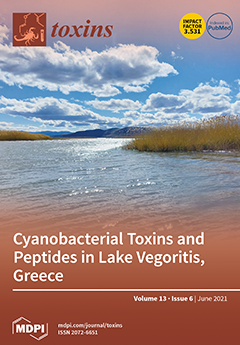
Cover Story: Lake Vegoritis is a beautiful natural lake covering an area of 60 km2 in the region of Western Macedonia, Greece. It belongs to the NATURA 2000 network of protected areas, and it is used for irrigation, fishing, bathing, and recreational activities. The historical background of cyanobacterial blooms in the lake creates a growing concern about the possible effects of cyanotoxins and other cyanobacterial metabolites to its ecosystem and to human health. A collaboration between researchers and water authorities of Greece resulted in a 3-year monitoring program and in the first report of the co-occurrence of cyanotoxins and cyanobacterial peptides in the lake. The findings support the need for future monitoring programs and investigations of the occurrence of cyanotoxins and other cyanobacterial metabolites, to support risk management with relevance to human exposure and ecosystem effects. View this paper
  • Issues are regarded as officially published after their release is announced to the table of contents alert mailing list .
  • You may sign up for email alerts to receive table of contents of newly released issues.
  • PDF is the official format for papers published in both, html and pdf forms. To view the papers in pdf format, click on the "PDF Full-text" link, and use the free Adobe Reader to open them.

Articles (67)

  • Article
  • Open Access
18 Citations
4,336 Views
14 Pages

Reduction of the Adverse Impacts of Fungal Mycotoxin on Proximate Composition of Feed and Growth Performance in Broilers by Combined Adsorbents

  • Anthony Christian Mgbeahuruike,
  • Toochukwu Eleazar Ejiofor,
  • Michael Ushie Ashang,
  • Chiamaka Ojiako,
  • Christian C. Obasi,
  • Chuka Ezema,
  • Obianuju Okoroafor,
  • Mulunda Mwanza,
  • Magnus Karlsson and
  • Kennedy F. Chah

21 June 2021

Synergistic interaction of adsorbents in reducing the adverse impacts of mycotoxin on performance and proximate composition of broiler feeds was investigated. Fungal growth was induced by sprinkling water on the feed. S. cerevisiae + bentonite, kaoli...

  • Article
  • Open Access
10 Citations
3,381 Views
16 Pages

The Regulatory Mechanism of Water Activities on Aflatoxins Biosynthesis and Conidia Development, and Transcription Factor AtfB Is Involved in This Regulation

  • Longxue Ma,
  • Xu Li,
  • Xiaoyun Ma,
  • Qiang Yu,
  • Xiaohua Yu,
  • Yang Liu,
  • Chengrong Nie,
  • Yinglong Zhang and
  • Fuguo Xing

21 June 2021

Peanuts are frequently infected by Aspergillus strains and then contaminated by aflatoxins (AF), which brings out economic losses and health risks. AF production is affected by diverse environmental factors, especially water activity (aw). In this st...

  • Article
  • Open Access
6 Citations
3,325 Views
10 Pages

Daily Headache in Chronic Migraine Is a Predictive Factor of Response in Patients Who Had Completed Three Sessions of OnabotulinumtoxinA

  • Enrique Martínez-Pías,
  • Ángel L. Guerrero,
  • Álvaro Sierra,
  • Javier Trigo and
  • David García-Azorín

21 June 2021

OnabotulinumtoxinA is one of the main preventive treatments for chronic migraine. Despite that up to one third of patients with chronic migraine suffer from daily headache, these individuals have hardly been studied. We conducted a prospective cohort...

  • Article
  • Open Access
90 Citations
5,835 Views
9 Pages

Enzymatic Degradation of Multiple Major Mycotoxins by Dye-Decolorizing Peroxidase from Bacillus subtilis

  • Xing Qin,
  • Xiaoyun Su,
  • Tao Tu,
  • Jie Zhang,
  • Xiaolu Wang,
  • Yaru Wang,
  • Yuan Wang,
  • Yingguo Bai,
  • Bin Yao and
  • Huiying Luo
  • + 1 author

19 June 2021

The co-occurrence of multiple mycotoxins, including aflatoxin B1 (AFB1), zearalenone (ZEN) and deoxynivalenol (DON), widely exists in cereal-based animal feed and food. At present, most reported mycotoxins degrading enzymes target only a certain type...

  • Article
  • Open Access
20 Citations
8,482 Views
16 Pages

18 June 2021

Post-stroke spasticity impedes patients’ rehabilitation progress. Contradictory evidence has been reported in using Botulinum Neurotoxin type A (BoNT-A) to manage post-stroke lower extremity spasticity (PLES); furthermore, an optimum dose of BoNT-A f...

  • Article
  • Open Access
15 Citations
3,881 Views
14 Pages

17 June 2021

This study assessed the impact of increasing seawater surface temperature (SST) and toxic algal abundance (TAA) on the accumulation, tissue distribution and elimination dynamics of paralytic shellfish toxins (PSTs) in mussels. Mytilus coruscus were f...

  • Review
  • Open Access
10 Citations
5,732 Views
24 Pages

17 June 2021

The idea that bacterial toxins are not only killers but also execute more sophisticated roles during bacteria–host interactions by acting as negotiators has been highlighted in the past decades. Depending on the toxin, its cellular target and mode of...

  • Review
  • Open Access
65 Citations
14,242 Views
26 Pages

Old World Vipers—A Review about Snake Venom Proteomics of Viperinae and Their Variations

  • Maik Damm,
  • Benjamin-Florian Hempel and
  • Roderich D. Süssmuth

17 June 2021

Fine-tuned by millions of years of evolution, snake venoms have frightened but also fascinated humanity and nowadays they constitute potential resources for drug development, therapeutics and antivenoms. The continuous progress of mass spectrometry t...

  • Case Report
  • Open Access
1 Citations
3,180 Views
8 Pages

15 June 2021

Background: The aim of this study was to demonstrate an increase in muscle action potentials and an enhancement of the efficacy of botulinum toxin (BoNT) after mechanical leg vibration. Methods: A 53-year-old healthy male volunteer underwent vibratio...

  • Article
  • Open Access
6 Citations
3,664 Views
20 Pages

Tamoxifen Derivatives Alter Retromer-Dependent Endosomal Tubulation and Sorting to Block Retrograde Trafficking of Shiga Toxins

  • Andrey S. Selyunin,
  • Karinel Nieves-Merced,
  • Danyang Li,
  • Stanton F. McHardy and
  • Somshuvra Mukhopadhyay

15 June 2021

Shiga toxin 1 and 2 (STx1 and STx2) undergo retrograde trafficking to reach the cytosol of cells where they target ribosomes. As retrograde trafficking is essential for disease, inhibiting STx1/STx2 trafficking is therapeutically promising. Recently,...

of 7

Get Alerted

Add your email address to receive forthcoming issues of this journal.

XFacebookLinkedIn
Toxins - ISSN 2072-6651