




Next Issue
Volume 24, January
Previous Issue
Volume 23, November


Mar. Drugs, Volume 23, Issue 12 (December 2025) – 40 articles
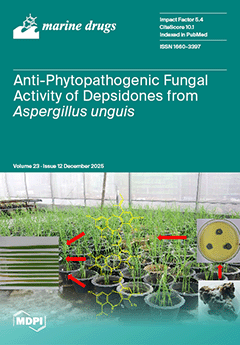
Cover Story (view full-size image): The EtOAc crude extract of a marine sponge-associated fungus Aspergillus unguis KUFA0098 exhibited significant growth inhibitory activity against ten phytopathogenic fungal strains. In particular, it showed preventive and curative effects against leaf spot disease, caused by Pyricularia oryzae, and leaf blast disease, caused by Pyricularia oryzae, on rice plant var. KMDL105, under greenhouse conditions. Among the major depsidones isolated, unguinol and folipastatin displayed the in vitro growth inhibition of 80% of the phytopathogenic fungi tested, suggesting that these two depsidones are responsible for the inhibitory activity of the crude extract. Thus, depsidone can be an important scaffold for the development of eco-friendly fungicides against leaf spot and leaf blast diseases of rice for a sustainable agriculture. View this paper
  • Issues are regarded as officially published after their release is announced to the table of contents alert mailing list.
  • You may sign up for e-mail alerts to receive table of contents of newly released issues.
  • PDF is the official format for papers published in both, html and pdf forms. To view the papers in pdf format, click on the "PDF Full-text" link, and use the free Adobe Reader to open them.
Order results
Result details
Section
Select all
Export citation of selected articles as:
21 pages, 13312 KB  
Article
Precision-Engineered Dermatan Sulfate-Mimetic Glycopolymers for Multi-Targeted SARS-CoV-2 Inhibition
by Lihao Wang, Lei Gao, Chendong Yang, Mengfei Yin, Jiqin Sun, Luyao Yang, Chanjuan Liu, Simon F. R. Hinkley, Guangli Yu and Chao Cai
Mar. Drugs 2025, 23(12), 486; https://doi.org/10.3390/md23120486 - 18 Dec 2025
Viewed by 482
Abstract
The ongoing COVID-19 pandemic, caused by SARS-CoV-2, continues to pose major global health challenges despite extensive vaccination efforts. Variant escape, waning immunity, and reduced vaccine efficacy in immunocompromised populations underscore the urgent need for complementary antiviral therapeutics. Here, we report the design, synthesis, [...] Read more.
The ongoing COVID-19 pandemic, caused by SARS-CoV-2, continues to pose major global health challenges despite extensive vaccination efforts. Variant escape, waning immunity, and reduced vaccine efficacy in immunocompromised populations underscore the urgent need for complementary antiviral therapeutics. Here, we report the design, synthesis, and biological evaluation of precision-engineered dermatan sulfate (DS)-mimetic glycopolymers as multi-targeted inhibitors of SARS-CoV-2. Guided by molecular docking and virtual screening, sulfation at the C2 and C4 positions of iduronic acid was identified as critical for binding to the viral spike protein and inhibiting host and viral enzymes, including heparanase (HPSE) and main protease (Mpro). Chemically synthesized DS disaccharides were covalently grafted onto polymer scaffolds via a post-modification strategy, yielding glycopolymers with well-defined assembly that form uniform nanoparticles under physiological conditions. Surface plasmon resonance and pseudovirus assays revealed strong binding to the viral spike protein (KD ≈ 177 nM), potent viral neutralization, and minimal cytotoxicity. Cellular uptake studies further demonstrated efficient internalization of nanoparticles and intracellular inhibition of HPSE and Mpro. These results establish a modular, non-anticoagulant, and glycosaminoglycan-mimetic platform for the development of broad-spectrum antiviral agents to complement vaccination and enhance preparedness against emerging coronavirus variants. Full article
Show Figures

Figure 1

28 pages, 849 KB  
Review
Astaxanthin from Haematococcus pluvialis and Chromochloris zofingiensis: Biosynthetic Pathways, Engineering Strategies, and Industrial Prospects
by Shufang Yang, Xue Lu, Jia Wang, Ye Liu, Man Nie, Jin Liu and Han Sun
Mar. Drugs 2025, 23(12), 485; https://doi.org/10.3390/md23120485 - 18 Dec 2025
Viewed by 771
Abstract
Astaxanthin, a high-value keto-carotenoid with potent antioxidant and health-promoting properties, has gained global attention as a sustainable nutraceutical and biotechnological product. The green microalgae Haematococcus pluvialis and Chromochloris zofingiensis represent two promising natural producers, yet they differ markedly in physiology, productivity, and industrial [...] Read more.
Astaxanthin, a high-value keto-carotenoid with potent antioxidant and health-promoting properties, has gained global attention as a sustainable nutraceutical and biotechnological product. The green microalgae Haematococcus pluvialis and Chromochloris zofingiensis represent two promising natural producers, yet they differ markedly in physiology, productivity, and industrial scalability. This review provides a focused comparative analysis of these two species, emphasizing their quantitative performance differences. H. pluvialis can accumulate astaxanthin up to ~3–5% of dry biomass but typically reaches biomass densities of only 5–10 g L−1, whereas C. zofingiensis achieves ultrahigh biomass concentrations of 100–220 g L−1 under heterotrophic fed-batch fermentation, although its astaxanthin content is much lower (~0.1–0.5% DW). While H. pluvialis remains the benchmark for natural astaxanthin due to its exceptionally high cellular content, its thick cell wall, slow growth, and strict phototrophic requirements impose major cost and operational barriers. In contrast, C. zofingiensis exhibits rapid and flexible growth under heterotrophic, mixotrophic, or phototrophic conditions and can achieve ultrahigh biomass in fermentation, though its ketocarotenoid flux and astaxanthin accumulation remain comparatively limited. Meanwhile, a rapidly growing patent landscape demonstrates global technological competition, with major portfolios emerging in China, the United States, and Europe, spanning chemical synthesis, microbial fermentation, algal metabolic engineering, and high-density cultivation methods. These patents reveal clear innovation trends—ranging from solvent-free green synthesis routes to engineered microalgae and yeast chassis for enhanced astaxanthin production—which increasingly shape industrial development strategies. By synthesizing recent advances in metabolic engineering, two-stage cultivation, and green extraction technologies, this review identifies key knowledge gaps and outlines a practical roadmap for developing next-generation astaxanthin biorefineries, with an emphasis on scalable production and future integration into broader biorefinery frameworks. The findings aim to guide future research and provide actionable insights for scaling sustainable, cost-effective production of natural astaxanthin. Full article
(This article belongs to the Special Issue Fermentation Processes for Obtaining Marine Bioactive Products)
Show Figures

Figure 1

19 pages, 3502 KB  
Article
Oyster Peptides Prepared by Lactobacillus casei Fermentation Enhance Immune Activity in RAW264.7 Cells via Activation of the MAPK Pathway
by Lingyue Zhong, Yirui Wu, Xuefang Guan, Mei Xu, Juqing Huang, Yafeng Zheng and Qi Wang
Mar. Drugs 2025, 23(12), 484; https://doi.org/10.3390/md23120484 - 18 Dec 2025
Viewed by 489
Abstract
Oyster peptides (OPs) have gained increasing attention for their excellent biological activities, especially immunomodulatory effects. In this study, oyster proteins were fermented using Lactobacillus casei to prepare bioactive peptides, and the effects of fermentation parameters (time, temperature, and inoculum amount) on the degree [...] Read more.
Oyster peptides (OPs) have gained increasing attention for their excellent biological activities, especially immunomodulatory effects. In this study, oyster proteins were fermented using Lactobacillus casei to prepare bioactive peptides, and the effects of fermentation parameters (time, temperature, and inoculum amount) on the degree of hydrolysis (DH) were optimized. The optimal fermentation conditions were determined as 30 h, 35 °C, and 5% inoculum amount, resulting in a DH of 28.24%. Structural characterization showed that OPs were mainly composed of low-molecular-weight peptides (<1000 Da) with high hydrophobic amino acid content, and they exhibited good stability during in vitro gastrointestinal digestion. In vitro immunological evaluation using RAW264.7 macrophages demonstrated that OPs significantly enhanced phagocytic activity and nitric oxide (NO) production, and upregulated the mRNA expression levels of pro-inflammatory cytokines including interleukin (IL)-6, IL-1β, and tumor necrosis factor (TNF)-α. Mechanistically, OPs exerted immunostimulatory effects by specifically activating the extracellular signal-regulated kinase (ERK) pathway within the mitogen-activated protein kinase (MAPK) signaling cascade, without significant alterations in the phosphorylation levels of p38 and c-Jun N-terminal kinase (JNK). These findings highlight the potential of Lactobacillus casei-fermented oyster peptides as natural immunomodulatory ingredients for functional food development. Full article
Show Figures

Figure 1

3 pages, 133 KB  
Editorial
Marine-Derived Terpenes: Chemistry, Synthesis and Their Therapeutic Potential
by Jinmei Xia
Mar. Drugs 2025, 23(12), 483; https://doi.org/10.3390/md23120483 - 17 Dec 2025
Viewed by 286
Abstract
The past five years have marked a significant evolution in terpenoid natural product research, with direct implications for marine drug discovery [...] Full article
17 pages, 1622 KB  
Article
Biomass Growth and Fatty Acid Production by the Marine Thraustochytrium sp. RT2316-16 in Chemically Defined Media
by Liset Flores, María Paz Lefiguala and Carolina Shene
Mar. Drugs 2025, 23(12), 482; https://doi.org/10.3390/md23120482 - 17 Dec 2025
Viewed by 319
Abstract
The biomass and lipid production responses of the psychrophilic marine thraustochytrid Thraustochytrium sp. RT2316-16 were assessed in chemically defined media comprising glucose, up to 17 amino acids and up to 9 B-vitamins and mineral salts. Compared to the control medium with all amino [...] Read more.
The biomass and lipid production responses of the psychrophilic marine thraustochytrid Thraustochytrium sp. RT2316-16 were assessed in chemically defined media comprising glucose, up to 17 amino acids and up to 9 B-vitamins and mineral salts. Compared to the control medium with all amino acids and B-vitamins (biomass concentration: 7.1 ± 0.1 g L−1; total lipid content: 30.4 ± 0.5% of the DW), the growth of RT2316-16 was reduced by more than 50% in the medium that lacked cyanocobalamin or pyridoxamine. The total lipid content of the biomass grown in the absence of vitamins was 63% lower than in the biomass produced in the control medium. The composition of the B-vitamin mixture modulated the fatty acid composition, an effect that may have been related to the availability of dissolved oxygen. In bioreactor culture with the dissolved oxygen level controlled to ≥10% of air saturation, the microorganism consumed all 17 amino acids; 8 of the amino acids were fully consumed within a 0–33 h period, in which the specific growth rate was 0.065 h−1. Under these culture conditions, the sum of eicosapentaenoic acid and docosahexaenoic acid in the total fatty acid content rose from 15% (at time 0) to 54% (after 95 h). A medium that contained the 9 amino acids that were not preferentially consumed favored the accumulation of total lipids, but reduced biomass growth. Full article
(This article belongs to the Section Marine Biotechnology Related to Drug Discovery or Production)
Show Figures

Graphical abstract

12 pages, 4028 KB  
Article
Induction of Apoptotic Cell Death in Non-Small-Cell Lung Cancer Cells by MP28 Peptide Derived from Bryopsis plumosa
by Heabin Kim, Seung-Hyun Jung, Seonmi Jo, Jong Won Han and Jei Ha Lee
Mar. Drugs 2025, 23(12), 481; https://doi.org/10.3390/md23120481 - 17 Dec 2025
Viewed by 469
Abstract
Marine algae are a prolific bioactive peptide source with a broad pharmacological potential. We characterized MP28, a cationic peptide isolated from the green alga Bryopsis plumosa. Structural modeling indicated a predominantly amphipathic α-helix (residues 3–16) flanked by flexible termini and stabilized by [...] Read more.
Marine algae are a prolific bioactive peptide source with a broad pharmacological potential. We characterized MP28, a cationic peptide isolated from the green alga Bryopsis plumosa. Structural modeling indicated a predominantly amphipathic α-helix (residues 3–16) flanked by flexible termini and stabilized by intramolecular disulfide bonds, a motif typical of membrane-active anticancer peptides. Functionally, MP28 demonstrated potent activity against non-small-cell lung cancer cell lines (A549, H460, H1299) without affecting non-tumorigenic lung fibroblasts (MRC-5). In vitro, MP28 decreased cell viability and clonogenic growth and suppressed migration and invasion in a dose-dependent manner. Flow cytometry revealed increased early/late apoptotic fractions, accompanied by caspase-9 activation, consistent with engagement of the intrinsic apoptotic pathway. In a mouse xenograft model, MP28 treatment significantly reduced tumor size compared with that of controls. Collectively, MP28 may be a potent anticancer peptide that exhibits selective cytotoxicity and low toxicity toward normal cells. Full article
Show Figures

Figure 1

25 pages, 4843 KB  
Article
A CALB-like Cold-Active Lipolytic Enzyme from Pseudonocardia antarctica: Expression, Biochemical Characterization, and AlphaFold-Guided Dynamics
by Lixiao Liu, Hackwon Do, Jong-Oh Kim, Jun Hyuck Lee and Hak Jun Kim
Mar. Drugs 2025, 23(12), 480; https://doi.org/10.3390/md23120480 - 15 Dec 2025
Viewed by 452
Abstract
Cold-active lipolytic enzymes enable low-temperature biocatalysis, but remain underexplored in Antarctic actinomycetes. Here, we report the discovery and first-step characterization of a CALB-like cold-active lipolytic enzyme (PanLip) from Pseudonocardia antarctica. Sequence and structure analyses revealed a canonical α/β-hydrolase fold with a conserved [...] Read more.
Cold-active lipolytic enzymes enable low-temperature biocatalysis, but remain underexplored in Antarctic actinomycetes. Here, we report the discovery and first-step characterization of a CALB-like cold-active lipolytic enzyme (PanLip) from Pseudonocardia antarctica. Sequence and structure analyses revealed a canonical α/β-hydrolase fold with a conserved Ser–Asp–His triad and short helical elements around the pocket reminiscent of CALB’s α5/α10 lid. Mature PanLip was expressed primarily as inclusion bodies in E. coli; an N-terminally truncation (PanLipΔN) improved solubility and PanLipΔN was purified by Ni–NTA. Far-UV CD confirmed a folded α/β architecture. PanLipΔN favored short-chain substrates (p-NPA, kcat/KM = 2.4 × 10⁵ M−1·s−1) but also showed measurable hydrolytic activity toward natural triglycerides, consistently with a lipase-family esterase. The enzyme showed an activity optimum near 25 °C and pH 8.0. The enzyme tolerated low salt (maximal at 0.1 M NaCl), mild glycerol, and selected organic solvents (notably n-hexane), but was inhibited by high salt, Triton X-100, and SDS. AlphaFold predicted high local confidence for the catalytic core; DALI placed PanLip closest to fungal lipases (AFLB/CALB). Temperature-series MD and CABS-flex indicated enhanced surface breathing and flexible segments adjacent to the active site—including a region topologically matching CALB α10—supporting a flexibility-assisted access mechanism at low temperature. Structure-based MSAs did not support a cold adaptation role for the reported VDLPGRS motif. Taken together, these findings position PanLip as a promising cold-active catalyst with CALB-like access control and potential for low-temperature biocatalysis. Full article
(This article belongs to the Section Marine Biotechnology Related to Drug Discovery or Production)
Show Figures

Graphical abstract

18 pages, 3917 KB  
Article
Exploiting the Invasive Alga Rugulopteryx okamurae for the Synthesis of Metal Nanoparticles and an Investigation of Their Antioxidant Properties
by Estefania Pereira Pinto, Noelia González-Ballesteros and María Carmen Rodríguez-Argüelles
Mar. Drugs 2025, 23(12), 479; https://doi.org/10.3390/md23120479 - 15 Dec 2025
Viewed by 296
Abstract
The rapid spread of the invasive brown macroalga Rugulopteryx okamurae has caused severe ecological and economic damage along the European coasts. Efforts to mitigate its impact have been largely ineffective, highlighting the need for alternative strategies to valorise this invasive species. This study [...] Read more.
The rapid spread of the invasive brown macroalga Rugulopteryx okamurae has caused severe ecological and economic damage along the European coasts. Efforts to mitigate its impact have been largely ineffective, highlighting the need for alternative strategies to valorise this invasive species. This study explores the use of R. okamurae aqueous extract (RO extract) as a natural reducing and stabilizing agent for the green synthesis of gold (Au@RO), silver (Ag@RO), and platinum (Pt@RO) nanoparticles. The synthesized nanoparticles were extensively characterized using ultraviolet–visible spectroscopy (UV-Vis), transmission electron microscopy (TEM), X-ray diffraction (XRD), zeta potential analysis, and Fourier-transform infrared spectroscopy (FTIR). The results confirmed the successful formation of spherical and stable nanoparticles. Furthermore, the antioxidant activity of the RO extract was determined before and after the synthesis of the nanoparticles by the determination of the reducing power, total phenolic content and 1,1-diphenyl-2-picryl-hydrazyl (DPPH) radical scavenging activity. Notably, Pt@RO showed the highest enhancement in antioxidant activity among the nanoparticles synthesized. The findings demonstrate that R. okamurae can be repurposed as a valuable bioresource for the environmentally friendly production of metal nanoparticles with promising applications. Full article
(This article belongs to the Section Biomaterials of Marine Origin)
Show Figures

Graphical abstract

42 pages, 4695 KB  
Article
ScillyHAB: A Multi-Disciplinary Survey of Harmful Marine Phytoplankton and Shellfish Toxins in the Isles of Scilly: Combining Citizen Science with State-of-the-Art Monitoring in an Isolated UK Island Territory
by Andrew D. Turner, Karl J. Dean, Adam M. Lewis, David M. Hartnell, Zoe Jenkins, Beth Bear, Amy Mace, Nevena Almeida, Rob van Ree, Kerra Etchells, Issy Tibbs, Patrick Jesenko, Loveday Lewin, Natalie Robey, Nikki Banfield, Shamina Page, George Belsham, Benjamin H. Maskrey and Robert G. Hatfield
Mar. Drugs 2025, 23(12), 478; https://doi.org/10.3390/md23120478 - 15 Dec 2025
Cited by 1 | Viewed by 557
Abstract
The Isles of Scilly are an archipelago of islands in the far southwest of the UK which contain numerous beds of wild bivalve molluscs which are recreationally harvested for local consumption. However, the islands have never previously been assessed for the presence of [...] Read more.
The Isles of Scilly are an archipelago of islands in the far southwest of the UK which contain numerous beds of wild bivalve molluscs which are recreationally harvested for local consumption. However, the islands have never previously been assessed for the presence of harmful algae and their shellfish toxin metabolites which can cause serious human health impacts. This study sought to address these knowledge gaps through the analysis of seawater and shellfish tissues for microalgae and toxins utilizing portable and lab-based microscopy, nanopore sequencing, chemical analysis and immunoassay kits. The study design was affected by the national COVID-19 lockdown which enforced implementation of citizen-led sampling and in-field microscopy. Microscopy and sequencing approaches led to the confirmation of multiple HAB species of concern, including those potentially responsible for production of neurotoxic and diarrhetic shellfish toxins. A portable microscope was successfully utilized in the field for recognition of microalgae and for early warning of potential shellfish toxicity events. Chemical analysis of cockle, clam and mussel samples confirmed the detection of paralytic, diarrhetic and amnesic shellfish toxins, with an unusual okadaic acid group toxin profile reaching a maximum toxicity of approximately half the regulatory limit as defined by EU law. The Sensoreal Alert Lateral Flow Assay was used to screen and highlight samples containing higher concentrations of DSP toxins. Furthermore, Tetrodotoxin was detected for the first time in the UK in cockle and grooved carpet shells. Multiple saxitoxin analogues were also detected in two echinoderm species, with this providing the first ever report of paralytic shellfish toxins in the spiny starfish, Marthasterias glacialis. The toxin profiles in the two species varied significantly with a dominance of GTX4 in Luidia ciliaris as opposed to a dominance of STX in Marthasterias glacialis. Overall, the study showed that a multi-method assessment of a previously unexplored region within the UK territory contained microalgae and toxins of concern to human health, and that a citizen-led programme could be instigated using portable microscopy and rapid toxin testing to assess the early warning for potentially harmful microalgae and toxins in the region, with confirmatory analysis being conducted to establish actual levels of risk for local consumers of seafood. Full article
(This article belongs to the Special Issue A ‘One-Health Focus’ on Natural Marine Toxins)
Show Figures

Graphical abstract

10 pages, 686 KB  
Article
Four New Pairs of MetO-Containing Diketopiperazine Enantiomers: Isolation, Synthesis and Potential Anti-Parkinson’s Disease Activity
by Yu Lei, Zhenyu Yang, Daichun Li, Xiaojian Liao, Chamari Hettiarachchi, Bingxin Zhao and Shihai Xu
Mar. Drugs 2025, 23(12), 477; https://doi.org/10.3390/md23120477 - 13 Dec 2025
Viewed by 294
Abstract
Four new methionine sulfoxide-containing diketopiperazines, (+)-dysidmetsulfoxide A [(+)-1], (+)-dysidmetsulfoxide B [(+)-2], (+)-dysidmetsulfoxide C [(+)-3] and (−)-dysidmetsulfoxide C [(−)-3], were isolated from the South China Sea sponge Dysidea sp. These compounds represented the first example of [...] Read more.
Four new methionine sulfoxide-containing diketopiperazines, (+)-dysidmetsulfoxide A [(+)-1], (+)-dysidmetsulfoxide B [(+)-2], (+)-dysidmetsulfoxide C [(+)-3] and (−)-dysidmetsulfoxide C [(−)-3], were isolated from the South China Sea sponge Dysidea sp. These compounds represented the first example of diketopiperazines possessing the unit of methionine sulfoxide (MetO) isolated from marine sponges. As it was difficult to determine the configuration of chiral sulfur atom in the thionyl group, the structures with absolute configurations of these compounds were elucidated by spectroscopic analyses and total synthesis. It was noteworthy that the purchased synthetic precursors, Fmoc-L- and Fmoc-D-MetO, were mixtures of epimers, respectively, due to the stereogenic sulfur atom in MetO, which were separated to prepare the optically pure isomers via the method of supercritical fluid chromatography (SFC). In addition, the other four optical isomers [(−)-1, (−)-2, (+)-4 and (−)-4] were also synthesized. Furthermore, (+)-1, (−)-1, (+)-3, (+)-4 and (−)-4 showed potential anti-Parkinson’s disease activities in an in vivo zebrafish model. Full article
(This article belongs to the Section Structural Studies on Marine Natural Products)
Show Figures

Graphical abstract

19 pages, 1543 KB  
Review
Engineering Microalgae for Enhanced Astaxanthin Production: Integrating Metabolic Pathways and Nano-Biotechnologies
by Zhongliang Sun, Shuonan Cao, Shoukai Guo, Weixian Cheng, Adamu Yunusa Ugya and Liqin Sun
Mar. Drugs 2025, 23(12), 476; https://doi.org/10.3390/md23120476 - 12 Dec 2025
Viewed by 438
Abstract
Astaxanthin is a high-value metabolite with substantial market demand, owing to its potent antioxidant activity and diverse health benefits. Microalgae are considered the primary producers of esterified astaxanthin, yet their industrial-scale cultivation is constrained by low productivity, stress-dependent induction, and challenges in metabolic [...] Read more.
Astaxanthin is a high-value metabolite with substantial market demand, owing to its potent antioxidant activity and diverse health benefits. Microalgae are considered the primary producers of esterified astaxanthin, yet their industrial-scale cultivation is constrained by low productivity, stress-dependent induction, and challenges in metabolic engineering. This review examines strategies to enhance microalgae-derived esterified astaxanthin production through nanoformulation and modulation of metabolic pathways. We highlight that precise, efficient, and multiplexed genetic modifications of the carotenoid biosynthetic pathway can significantly increase astaxanthin accumulation. Downregulation of competing metabolic routes further improves astaxanthin yields. Additionally, targeted engineering of acyltransferases and lipid metabolism regulators enhances astaxanthin esterification, thereby improving its intracellular stability against oxidative degradation. Modifying lipid metabolism also redirects metabolic fluxes toward altered fatty acid saturation in stored lipids, which increases the bioavailability of esterified astaxanthin. The integration of nanoparticles into cultivation systems represents another promising approach, facilitating improved nutrient delivery and light management, and consequently boosting astaxanthin production. However, the application of genetic engineering and nanotechnology faces challenges such as biosafety legislation, regulatory approval processes, and potential ecological impacts. A synergistic combination of both approaches may help overcome these limitations and maximize astaxanthin production from microalgae. Full article
(This article belongs to the Special Issue Applications of Marine Microalgal Biotechnology)
Show Figures

Figure 1

16 pages, 3377 KB  
Article
Integrative Metabolomics, Pharmacoinformatics and Experimental Studies Reveal the Neuroprotective Potential of Caulerpa racemosa Metabolites Against Alzheimer’s Disease
by Nita Handayani, Dhecella Winy Cintya Ningrum, Adha Fauzi Hendrawan, Anis Yuniati, Raffaele Romano, Lucia De Luca, Antonello Santini and Fahrul Nurkolis
Mar. Drugs 2025, 23(12), 475; https://doi.org/10.3390/md23120475 - 11 Dec 2025
Viewed by 464
Abstract
Alzheimer’s disease (AD) is a multifactorial neurodegenerative disorder characterized by cholinergic dysfunction, oxidative/nitrosative stress, and neuroinflammation. Marine green algae Caulerpa racemosa are rich in neuroactive lipids and fatty acid derivatives with reported antioxidant and anti-inflammatory properties. However, their integrated mechanistic potential against AD [...] Read more.
Alzheimer’s disease (AD) is a multifactorial neurodegenerative disorder characterized by cholinergic dysfunction, oxidative/nitrosative stress, and neuroinflammation. Marine green algae Caulerpa racemosa are rich in neuroactive lipids and fatty acid derivatives with reported antioxidant and anti-inflammatory properties. However, their integrated mechanistic potential against AD remains largely underexplored. This study aimed to elucidate the neuroprotective mechanisms of C. racemosa metabolites against AD using integrative metabolomics, network pharmacology, molecular docking, and in vitro validation assays. Untargeted LC–HRMS profiling was performed to identify major metabolites in the ethanolic extract of C. racemosa. Neuroprotective targets were predicted via TargetNet, STRING, and Cytoscape (MCODE, CytoNCA). Functional enrichment was conducted using KEGG, GO (BP, MF, CC), and ClueGO. Molecular docking (CB-Dock2) validated compound–target interactions with ACHE, CHRM1, NOS1, and NOS2. Antioxidant (DPPH) and cholinesterase (AChE/BChE) inhibitory activities were evaluated in vitro. Metabolomic profiling identified lipid-dominant metabolites—oleamide, hexadecanamide, palmitoyl ethanolamide, α-linolenic acid, α-eleostearic acid, and 9-oxo-octadecadienoic acid. Network analysis revealed key AD-related hubs (ACHE, CHRM1, NOS1, NOS2) enriched in cholinergic regulation, arachidonic-acid metabolism, oxidative stress response, and nitric oxide signaling. Docking showed moderate multi-target affinities (−6.0 to −8.4 kcal/mol), with α-linolenic acid, α-eleostearic acid, and oxidized C18 lipids exhibiting the strongest interactions—particularly with ACHE and NOS isoforms. In vitro assays showed moderate antioxidant activity (IC50 = 120.97 ± 10.93 µg/mL) and cholinesterase inhibition (AChE IC50 = 136.48 ± 1.70 µg/mL; BChE IC50 = 145.98 ± 3.28 µg/mL), aligning with predicted multi-target interactions. C. racemosa extract exhibits neuroprotective potential through a synergistic combination of cholinergic modulation, antioxidant activity, NOS-mediated nitrosative stress reduction, and suppression of arachidonic-acid inflammatory pathways. These findings support C. racemosa as a promising marine-derived multi-target candidate for AD intervention, warranting further mechanistic and in vivo evaluation. Full article
(This article belongs to the Special Issue The Extraction and Application of Functional Components in Algae)
Show Figures

Graphical abstract

34 pages, 2897 KB  
Review
Structural Diversity and Bioactivities of Mangrove-Derived Fungal Polyketids (2020–2025)
by Miao Yu, Caijuan Zheng, Guangjin Zheng, Haofu Dai and Qiang Wang
Mar. Drugs 2025, 23(12), 474; https://doi.org/10.3390/md23120474 - 11 Dec 2025
Viewed by 1198
Abstract
Mangrove forests represent a complex ecosystem inhabiting tropical and subtropical intertidal zones, harboring diverse microbial communities including fungi, actinomycetes, bacteria, cyanobacteria, algae, and protozoa. Among these communities, mangrove-derived fungi, as the second-largest ecological group of marine fungi, not only play essential roles in [...] Read more.
Mangrove forests represent a complex ecosystem inhabiting tropical and subtropical intertidal zones, harboring diverse microbial communities including fungi, actinomycetes, bacteria, cyanobacteria, algae, and protozoa. Among these communities, mangrove-derived fungi, as the second-largest ecological group of marine fungi, not only play essential roles in establishing and sustaining this biosphere but also serve as an important source of structurally unique and biologically active secondary metabolites. This review systematically summarizes research progress on metabolites isolated from mangrove-derived fungi and their associated bioactivities over the recent five years (2020–2025). Emphasis is placed on 457 metabolites documented in 97 selected publications, with a focus on the biological activities and distinctive chemical diversity of these secondary metabolites. This review provides an important reference for the research status of secondary metabolites isolated from mangrove-derived fungi and the lead compounds worthy of further development, and reveals that mangrove-derived fungi have important medicinal values and are worthy of further development. Full article
(This article belongs to the Section Structural Studies on Marine Natural Products)
Show Figures

Graphical abstract

21 pages, 7991 KB  
Article
Synergistic Protective Effects of Haematococcus pluvialis-Derived Astaxanthin and Walnut Shell Polyphenols Against Particulate Matter (PM)2.5-Induced Pulmonary Inflammation
by Hyun Kang, Jae-Ho Choi and Sung-Gyu Lee
Mar. Drugs 2025, 23(12), 473; https://doi.org/10.3390/md23120473 - 10 Dec 2025
Viewed by 425
Abstract
Airborne particulate matter (PM) triggers oxidative stress and inflammation in pulmonary tissues, contributing to chronic respiratory diseases. This study evaluated the antioxidant and anti-inflammatory effects of a combined extract of Haematococcus pluvialis (H. pluvialis) and walnut shell (HW extract) and its protective [...] Read more.
Airborne particulate matter (PM) triggers oxidative stress and inflammation in pulmonary tissues, contributing to chronic respiratory diseases. This study evaluated the antioxidant and anti-inflammatory effects of a combined extract of Haematococcus pluvialis (H. pluvialis) and walnut shell (HW extract) and its protective efficacy against PM2.5-induced pulmonary inflammation. Extracts mixed at different ratios (10:0–0:10, w/w) were tested using 2,2′-azino-bis(3-ethylbenzothiazoline-6-sulfonic acid) (ABTS) radical scavenging, cell-based assays, HPLC quantification, molecular docking, and a PM2.5-induced pulmonary inflammation mouse model. The optimized 6:4 mixture showed the strongest antioxidant activity (RC50 = 0.61 ± 0.14 μg/mL) and significantly reduced nitric oxide (NO) and cyclooxygenase-2 (COX-2) expression without cytotoxicity. HPLC confirmed the presence of astaxanthin (1.714 μg/mg) and quercetin (0.722 μg/mg). Docking simulations indicated strong COX-2 binding affinities (−9.501 and −8.753 kcal/mol) through hydrogen bonding and hydrophobic interactions. In vivo, HW extract reduced leukocyte infiltration, serum IL-6 levels, and pulmonary expression of COX-2, interleukin-6 (IL-6), and tumor necrosis factor-alpha (TNF-α) while improving alveolar structure. These results suggest that HW extract exerts synergistic antioxidant and anti-inflammatory actions via dual-site COX-2 modulation, providing a promising natural therapeutic approach for mitigating PM2.5-induced respiratory inflammation. Full article
(This article belongs to the Special Issue Research on Marine Compounds and Inflammation)
Show Figures

Figure 1

13 pages, 7740 KB  
Article
Trimethyl Chitosan-Engineered Cod Skin Peptide Nanosystems Alleviate Behavioral and Cognitive Deficits in D-Galactose-Induced Alzheimer’s Disease Model Mice
by Songzhi Kong, Lijiao Lv, Jiaqi Guo, Guiping Lu, Dongdong Li and Xin Zhou
Mar. Drugs 2025, 23(12), 472; https://doi.org/10.3390/md23120472 - 10 Dec 2025
Viewed by 474
Abstract
Alzheimer’s disease (AD) is a common neurodegenerative disorder with limited effective treatments. Cod skin collagen peptides (CSCPs) have neuroprotective potential for AD but face poor bioavailability—due to gastrointestinal enzyme cleavage and hepatic first-pass metabolism—prompting this study to develop a nanodelivery system to enhance [...] Read more.
Alzheimer’s disease (AD) is a common neurodegenerative disorder with limited effective treatments. Cod skin collagen peptides (CSCPs) have neuroprotective potential for AD but face poor bioavailability—due to gastrointestinal enzyme cleavage and hepatic first-pass metabolism—prompting this study to develop a nanodelivery system to enhance CSCPs’ efficacy. Trimethyl chitosan (TMC)-based CSCP-loaded nanoparticles (CSCPs-NPs) were synthesized via ionic gelation, characterized for physicochemical properties, and tested in a D-galactose-induced AD mouse model (six groups: normal control, model, CSCPs low/high dose, blank NPs, CSCPs-NPs) using behavioral tests, histopathology, immunohistochemistry, and ELISA. CSCPs-NPs had a hydrodynamic diameter of 93.25 ± 21.52 nm, polydispersity index of 0.18 ± 0.13, 61.17% encapsulation efficiency, and sustained 24 h release. In AD mice, CSCPs-NPs significantly improved cognitive function and motor coordination, reduced hippocampal atrophy, preserved neurons, and mitigated oxidative stress, neuroinflammation, and apoptosis (upregulated Bcl-2, downregulated Bax)—effects matching high-dose free CSCPs. This TMC-based nanoformulation enhances CSCPs’ bioavailability and provides a promising strategy for AD intervention. Full article
(This article belongs to the Section Marine Pharmacology)
Show Figures

Graphical abstract

23 pages, 7038 KB  
Article
Molecular Docking and Dynamics Simulations Reveal the Antidiabetic Potential of a Novel Fucoxanthin Derivative from Chnoospora minima
by Sachini Sigera, Kavindu D. Theekshana, Sathmi G. Dinanja, Pasindu Eranga, Nayanatharie Karunathilake, Shamali Abeywardhana, Laksiri Weerasinghe, Tharindu Senapathi and Dinithi C. Peiris
Mar. Drugs 2025, 23(12), 471; https://doi.org/10.3390/md23120471 - 9 Dec 2025
Viewed by 1436
Abstract
Type 2 diabetes mellitus (T2DM) is a chronic metabolic disorder requiring safer and more effective therapeutic alternatives. This study investigates a novel fucoxanthin derivative isolated from the marine brown alga Chnoospora minima using a comprehensive in silico approach. Molecular docking revealed that the [...] Read more.
Type 2 diabetes mellitus (T2DM) is a chronic metabolic disorder requiring safer and more effective therapeutic alternatives. This study investigates a novel fucoxanthin derivative isolated from the marine brown alga Chnoospora minima using a comprehensive in silico approach. Molecular docking revealed that the derivative exhibited higher binding affinities toward α-amylase (–9.4 kcal/mol) and α-glucosidase (–8.0 kcal/mol) compared to the reference drug acarbose (–8.5 and –7.4 kcal/mol, respectively). Pharmacokinetic analysis predicted good intestinal absorption and P-gp inhibition (0.894) and moderate plasma clearance (7.864 mL/min/kg), while toxicity predictions classified it in toxicity class 3, with no respiratory or ocular toxicity. Drug-likeness evaluation showed only one Lipinski and one Veber rule violation, common for natural products. Molecular dynamics simulations conducted for 100 ns using NAMD 3.0 confirmed stable protein–ligand complexes with average RMSD values of ~1.3 Å and ~1.8 Å for α-amylase and α-glucosidase, respectively, and consistent hydrogen bonding profiles. Structural analysis identified a substitution of the allene bond with an unsaturated ketone at the C8′ position as a key contributor to enhanced enzyme interaction. The findings suggest that this fucoxanthin derivative is a promising natural candidate for T2DM therapy and warrants further investigation through lab experiments (in vitro and in vivo). Full article
(This article belongs to the Special Issue Advanced Analytical Methods for Marine Natural Product Discovery)
Show Figures

Graphical abstract

16 pages, 1759 KB  
Article
Installing a Ketocarotenoid Branch in Phaeodactylum tricornutum via Functional Activation of Chlamydomonas reinhardtii β-Carotene Ketolase
by Hengshen Chao, Rasool Kamal, Yan Wu, Danqiong Huang and Chaogang Wang
Mar. Drugs 2025, 23(12), 470; https://doi.org/10.3390/md23120470 - 8 Dec 2025
Viewed by 489
Abstract
Astaxanthin is a high-value ketocarotenoid antioxidant, but its industrial production from Haematococcus pluvialis is constrained by multi-stage cultivation and a rigid cell wall that hinders downstream extraction. The marine diatom Phaeodactylum tricornutum, which lacks these limitations, represents a promising alternative chassis because [...] Read more.
Astaxanthin is a high-value ketocarotenoid antioxidant, but its industrial production from Haematococcus pluvialis is constrained by multi-stage cultivation and a rigid cell wall that hinders downstream extraction. The marine diatom Phaeodactylum tricornutum, which lacks these limitations, represents a promising alternative chassis because it grows fast, lacks a recalcitrant wall, and supports efficient pigment accumulation. This study establishes a functional ketocarotenoid biosynthetic branch in P. tricornutum through rational metabolic engineering. To address challenges in protein targeting posed by the host’s complex plastid architecture, we performed heterologous expression of the Chlamydomonas reinhardtii β-carotene ketolase (CrBKT), fused at its N-terminus to bipartite transit peptides derived from two endogenous proteins. Western blotting and UPLC-MS/MS analysis confirmed that only the transit peptide fused constructs produced stable protein and functional activity, whereas the native CrBKT failed. The rationally engineered strain successfully accumulated ~45 µg/g DCW of canthaxanthin and ~15 µg/g DCW of astaxanthin. Metabolomic profiling revealed a 50% reduction in fucoxanthin, indicating a substantial redirection of metabolic flux from the native pathway toward the engineered ketocarotenoid branch. This work establishes P. tricornutum as a viable platform for ketocarotenoid production and highlights the critical role of evolution-aware plastid targeting in heterologous pathway reconstruction within complex algal systems. Full article
(This article belongs to the Special Issue Applications of Marine Microalgal Biotechnology)
Show Figures

Figure 1

16 pages, 948 KB  
Article
Functionality-Driven Optimization of Green Ultrasound-Assisted Extraction of Antioxidant Compounds from Edible Brown Algae
by Carolina Padrón-Sanz, Samanta García-Oms, Javier Pacheco-Juárez, Lorena Pasquali and Dolores Cejalvo-Lapeña
Mar. Drugs 2025, 23(12), 469; https://doi.org/10.3390/md23120469 - 7 Dec 2025
Viewed by 430
Abstract
The extraction of antioxidant compounds from brown macroalgae is of growing industrial interest; however, the weak correlation often observed between polyphenol content and antioxidant activity challenges the conventional strategy of optimizing only extraction yield. This study introduces, for the first time in brown [...] Read more.
The extraction of antioxidant compounds from brown macroalgae is of growing industrial interest; however, the weak correlation often observed between polyphenol content and antioxidant activity challenges the conventional strategy of optimizing only extraction yield. This study introduces, for the first time in brown macroalgae, a functionality-driven optimization approach in which ultrasound-assisted extraction (UAE) conditions are optimized based on antioxidant activity as the primary response variable, rather than compound concentration. A green UAE process was developed and optimized for four edible brown algae (Himanthalia elongata, Eisenia bicyclis, Sargassum fusiforme, and Laminaria ochroleuca), considering algae amount, solvent type and concentration, extraction time, ultrasound power, and temperature. The optimized extracts achieved 69.17–94.68% DPPH inhibition, together with high antioxidant capacity supported by ORAC (18.63–491.30 μmol TE g−1 DW) and FRAP (1.24–87.65 µmol Fe+2 g1 DW) values, identifying E. bicyclis and H. elongata as the most promising species. Chromatographic analyses confirmed the presence of phlorotannins and carotenoid pigments such as fucoxanthin as the main contributors to antioxidant activity. Overall, this work validates a functionality-driven UAE optimization strategy for efficiently maximizing antioxidant activity in brown algal extracts. Full article
(This article belongs to the Special Issue Green Extraction of High-Value Compounds in Marine Algae)
Show Figures

Figure 1

17 pages, 4179 KB  
Article
The Discovery of Antibacterial Cembranoids from the Soft Coral Lobophytum crassum by DeepSAT Analysis
by Bing Wu, Li-Gong Yao, Ming-Zhi Su, Gui-Ge Hou, Song-Wei Li and Yue-Wei Guo
Mar. Drugs 2025, 23(12), 468; https://doi.org/10.3390/md23120468 - 6 Dec 2025
Viewed by 399
Abstract
Eight previously unreported cembranoids (18), along with four known ones (912), have been isolated and identified from the soft coral Lobophytum crissum collected from the South China Sea under the guidance of HSQC-based DeepSAT analysis [...] Read more.
Eight previously unreported cembranoids (18), along with four known ones (912), have been isolated and identified from the soft coral Lobophytum crissum collected from the South China Sea under the guidance of HSQC-based DeepSAT analysis for targeted isolation. The structures of the new compounds were determined by comprehensive spectroscopic analysis, QM-NMR, TDDFT-ECD calculations, and comparison with reported literature data from analogs. In in vitro bioassays, all the isolated compounds have been screened for their antibacterial and antiproliferative activities. Full article
(This article belongs to the Section Structural Studies on Marine Natural Products)
Show Figures

Figure 1

30 pages, 2012 KB  
Review
Chitosan-Based Drug Delivery Systems for Targeted Chemotherapy in Colorectal Cancer: A Scoping Review
by Urszula Piotrowska, Joanna Szatko, Aleksandra Nowakowska, Emilia Klimaszewska, Marta Ogorzałek and Marcin Sobczak
Mar. Drugs 2025, 23(12), 467; https://doi.org/10.3390/md23120467 - 6 Dec 2025
Viewed by 768
Abstract
Chitosan (CS) has emerged as a versatile biopolymer for designing drug delivery systems (DDS) in colorectal cancer (CRC) therapy due to its biocompatibility, mucoadhesive properties, and ability to be surface-functionalized. This scoping review systematically analyzed current experimental studies on CS-based DDS for CRC, [...] Read more.
Chitosan (CS) has emerged as a versatile biopolymer for designing drug delivery systems (DDS) in colorectal cancer (CRC) therapy due to its biocompatibility, mucoadhesive properties, and ability to be surface-functionalized. This scoping review systematically analyzed current experimental studies on CS-based DDS for CRC, comparing non-targeted formulations with ligand-modified systems to identify advances in targeting efficiency, drug release behavior, and biological outcomes. Among the twenty-five initially identified studies, divided into two categories, non-targeted CS-based DDSs and ligand-modified CS-DDSs, five fulfilled the inclusion criteria for ligand-functionalized systems. These incorporated targeting moieties, such as folic acid (FA), hyaluronic acid (HA), and galactose (Gal), to achieve receptor-mediated uptake via FRα, CD44, and ASGP receptors, respectively. Ligand modification consistently enhanced cellular uptake, reduced IC50 values, and improved tumor-selective cytotoxicity compared to non-targeted systems. However, in vivo validation remains scarce, with only one study confirming tumor accumulation in xenograft models. Moreover, no clinical trials currently assess CS-based nanocarriers for the treatment of CRC. Overall, CS represents a promising modular platform for targeted nanomedicine, but translational progress requires bridging preclinical success with comprehensive in vivo and clinical evaluation. Full article
(This article belongs to the Section Biomaterials of Marine Origin)
Show Figures

Graphical abstract

29 pages, 4513 KB  
Article
Isomalabaricane Chemical Composition of Vietnamese Marine Sponges Inspected by Metabolomic and Chemical Approaches
by Sophia A. Kolesnikova, Anastasia B. Kozhushnaya, Vladimir A. Shilov, Andrey D. Kukhlevsky, Anatoly I. Kalinovsky, Roman S. Popov, Pavel S. Dmitrenok and Natalia V. Ivanchina
Mar. Drugs 2025, 23(12), 466; https://doi.org/10.3390/md23120466 - 5 Dec 2025
Viewed by 516
Abstract
Reliable taxonomy of biological producers is essential for finding new natural substances. A recent study morphologically re-examined 21 accessed vouchers to confirm multiple reported misidentifications and suggested marine sponges from the genus Rhabdastrella as the only known source of the isomalabaricane triterpenoids. The [...] Read more.
Reliable taxonomy of biological producers is essential for finding new natural substances. A recent study morphologically re-examined 21 accessed vouchers to confirm multiple reported misidentifications and suggested marine sponges from the genus Rhabdastrella as the only known source of the isomalabaricane triterpenoids. The present study aimed to find isomalabaricane-containing sponges among the samples collected during seven marine expeditions to the Vietnam waters of the South China Sea, accompanied with their identification confirmed using morphological and molecular (18S rRNA and 28S rRNA) analyses. As a result, nine sponges identified as Rhabdastrella globostellata were found to contain isomalabaricanes in their extracts. A chemical investigation of the R. globostellata (PIBOC O63-136) specimen led to the isolation of nine isomalabaricane triterpenoids including the new compound 1, of which the chemical structure was elucidated based on HRESIMS and NMR data. Subsequently, a combination of LC–MS/MS, multivariate statistical analysis, and feature-based molecular networking was applied to detect, annotate, and characterize the isomalabaricane chemical diversity across the nine R. globostellata specimens. As a result, two primary chemotypes containing individual sets of annotated compounds were discovered within the Vietnamese population of this sponge. Moreover, obtained data showed a series of new extremely rare isomalabaricanes in R. globostellata extracts including nitrogen-containing metabolites and glycosides of this structural class. Full article
(This article belongs to the Special Issue Bioactive Compounds from Marine Invertebrates)
Show Figures

Graphical abstract

18 pages, 2748 KB  
Article
SMART-Guided Isolation and Identification of Seven-Membered Cembranolides with Anti-Inflammation Activity from the Soft Coral Sinularia mollis
by Huiyue Hou and Pinglin Li
Mar. Drugs 2025, 23(12), 465; https://doi.org/10.3390/md23120465 - 5 Dec 2025
Viewed by 431
Abstract
The first systematic chemical investigation on Sinularia mollis resulted in the isolation and identification of 36 seven-membered cembranolides, including 14 new compounds named sinumollolides A–N (114) and 22 known analogs (1536) by HSQC-based small molecule [...] Read more.
The first systematic chemical investigation on Sinularia mollis resulted in the isolation and identification of 36 seven-membered cembranolides, including 14 new compounds named sinumollolides A–N (114) and 22 known analogs (1536) by HSQC-based small molecule accurate recognition technology (SMART). Their structures were characterized by spectroscopic methods (1D/2D NMR and UV), HRESIMS, quantum chemical calculations (DP4+ analysis and ECD calculations), and X-ray diffraction analysis. In zebrafish assays, compounds 1, 2, 4, and 5 exhibited anti-inflammatory activity at 20 μM by inhibiting the number of macrophages around the neuromasts, with inhibition rates ranging from 30.4% to 45.6%. Moreover, the two most bioactive and less toxic compounds, 1 and 5, featuring a 14-membered macrocyclic lactone scaffold with several hydroxyl groups and a seven-membered α, β-unsaturated lactone moiety, can inhibit inflammation by suppressing the secretion of inflammatory cytokines at 10 μM in LPS-stimulated BV-2 cells. Full article
(This article belongs to the Section Structural Studies on Marine Natural Products)
Show Figures

Graphical abstract

13 pages, 2554 KB  
Article
Mechanistic Investigation of Adociaquinone and Xestoquinone Derivatives in Breast Cancer Cells
by Yu-Dong Zhou, Fakhri Mahdi, Nicholas M. Nagle, Mika B. Jekabsons and Dale G. Nagle
Mar. Drugs 2025, 23(12), 464; https://doi.org/10.3390/md23120464 - 2 Dec 2025
Viewed by 429
Abstract
Xestoquinone derivatives isolated from marine sponges exhibit a range of bioactivities, including the inhibition of HIF signaling, mitochondrial function, and tumor cell proliferation. Mechanistic investigation suggested that 14-hydroxymethylxestoquinone (1) acts as a protonophore. Although adociaquinones A (5) and B [...] Read more.
Xestoquinone derivatives isolated from marine sponges exhibit a range of bioactivities, including the inhibition of HIF signaling, mitochondrial function, and tumor cell proliferation. Mechanistic investigation suggested that 14-hydroxymethylxestoquinone (1) acts as a protonophore. Although adociaquinones A (5) and B (6) each stimulated cellular oxygen consumption, neither affected mitochondrial membrane potential. Cell-based respiration studies revealed that adociaquinones restored sodium azide-stalled oxygen consumption and ascorbate enhanced this response, suggesting ascorbate-supported redox cycling as a possible mechanism by which adociaquinones suppress HIF and tumor cell proliferation. These xestoquinone derivatives activated cellular stress response pathways that inhibit protein translation by phosphorylating key regulatory proteins (i.e., eIF2α, eIF4E, and eEF2). Further, thiol-reducing agents NAC and DTT attenuated the monosubstituted xestoquinone derivatives’ efficacy to inhibit HIF signaling, suggesting a potential mechanism of action that involves sulfhydryl modification. Full article
(This article belongs to the Special Issue Bioactive Compounds from Marine Invertebrates)
Show Figures

Graphical abstract

36 pages, 1848 KB  
Review
Marine Antimicrobial Peptides: Advances in Discovery, Multifunctional Mechanisms, and Therapeutic Translation Challenges
by Bin Gao, Na Yang, Da Teng, Ya Hao, Jianhua Wang and Ruoyu Mao
Mar. Drugs 2025, 23(12), 463; https://doi.org/10.3390/md23120463 - 1 Dec 2025
Viewed by 1234
Abstract
The pervasive misuse of antibiotics has precipitated a global crisis of antimicrobial resistance (AMR), epitomized by the proliferation of methicillin-resistant Staphylococcus aureus (MRSA). Marine-derived antimicrobial peptides (AMPs) have emerged as promising alternatives, exhibiting broad therapeutic potential, including antimicrobial and anticancer activities. This review [...] Read more.
The pervasive misuse of antibiotics has precipitated a global crisis of antimicrobial resistance (AMR), epitomized by the proliferation of methicillin-resistant Staphylococcus aureus (MRSA). Marine-derived antimicrobial peptides (AMPs) have emerged as promising alternatives, exhibiting broad therapeutic potential, including antimicrobial and anticancer activities. This review summarizes recent advances in marine AMPs, encompassing resource exploration, preparation methods, and biomedical applications, while addressing challenges such as instability and limited scalability. Future perspectives emphasize rational AMPs design to enhance efficacy and safety, alongside synergistic combination strategies, underscoring the potential of marine AMPs as viable interventions against drug-resistant pathogens. Full article
(This article belongs to the Special Issue Research on Marine Antimicrobial Peptides)
Show Figures

Figure 1

5 pages, 148 KB  
Editorial
Special Issue: Marine-Derived Compounds Applied in Cardiovascular Disease
by Alexandros Tsoupras
Mar. Drugs 2025, 23(12), 462; https://doi.org/10.3390/md23120462 - 29 Nov 2025
Viewed by 390
Abstract
Cardiovascular diseases (CVDs) are the leading cause of death worldwide [...] Full article
(This article belongs to the Special Issue Marine-Derived Compounds Applied in Cardiovascular Disease)
16 pages, 1569 KB  
Article
In Vitro and In Vivo Anti-Phytopathogenic Fungal Activity of a Culture Extract of the Marine-Derived Fungus, Aspergillus unguis KUFA 0098, and Its Major Depsidone Constituents
by Decha Kumla, Diana I. C. Pinho, Emília Sousa, Tida Dethoup, Luis Gales, Sharad Mistry, Artur M. S. Silva and Anake Kijjoa
Mar. Drugs 2025, 23(12), 461; https://doi.org/10.3390/md23120461 - 29 Nov 2025
Viewed by 918
Abstract
The crude ethyl acetate extract of the culture of a marine sponge-associated fungus, Aspergillus unguis KUFA 0098, was tested for its capacity to inhibit the growth of ten phytopathogenic fungi, viz. Alternaria brassicicola, Bipolaris oryzae, Colletotrichum capsici, Curvularia oryzae [...] Read more.
The crude ethyl acetate extract of the culture of a marine sponge-associated fungus, Aspergillus unguis KUFA 0098, was tested for its capacity to inhibit the growth of ten phytopathogenic fungi, viz. Alternaria brassicicola, Bipolaris oryzae, Colletotrichum capsici, Curvularia oryzae, Fusarium semitectum, Lasiodiplodia theobromae, Phytophthora palmivora, Pyricularia oryzae, Rhizoctonia oryzae, and Sclerotium roflsii. At a concentration of 1 g/L, the crude extract was most active against P. palmivora, causing the highest growth inhibition (55.32%) of this fungus but inactive against R. oryzae and S. roflsii. At a concentration of 10 g/L, the crude extract completely inhibited the growth of most of the fungi, except for L. theobromae, R. oryzae, and S. roflsii, with 94.50%, 74.12%, and 67.80% of inhibition, respectively. The crude extract of A. unguis KUFA 0098 exhibited growth-inhibitory effects against B. oryzae and P. oryzae, causative agents of brown leaf spot disease and leaf blast disease, respectively, on rice plant var. KDML105, under greenhouse conditions. Chromatographic fractionation and purification of the extract led to the isolation of four previously described depsidones, viz. unguinol (1), 2-chlorounguinol (2), 2,4-dichlorounguinol (3), and folipastatin (4), as well as one polyphenol, aspergillusphenol A (5). The major compounds, i.e., 1, 2, and 4, were tested against the ten phytopathogenic fungi. Compounds 1 and 4 were able to inhibit growth of most of the fungi, except L. theobromae, R. oryzae, and S. roflsii. Compound 1 showed the same minimum inhibitory concentration (MIC) values as that of carbendazim against A. brassicicola, C. capsici, C. oryzae, and P. oryzae, while compound 4 showed the same MIC values as that of carbendazim against only C. capsici and P. oryzae. Compound 2 was not active against all of the ten phytopathogenic fungi tested. Full article
Show Figures

Graphical abstract

12 pages, 2222 KB  
Article
Biodiversity of Rhizosphere Fungi from Suaeda glauca in the Yellow River Delta and Their Agricultural Antifungal and Herbicidal Potentials
by Tian-Li Qu, Hong Li, Dong-Fang Cao, Meng-Ya Li, Chen Zhao, Li-Yuan Zhang, Bao-Hua Zhang, Lin Xiao and Feng-Yu Du
Mar. Drugs 2025, 23(12), 460; https://doi.org/10.3390/md23120460 - 29 Nov 2025
Viewed by 393
Abstract
Suaeda glauca is a typical halophyte distributed in coastal and inland zones of the Yellow River Delta. Its rhizosphere soil is a potential source for exploring various fungi and their metabolites. In this study, the rhizosphere fungal community of S. glauca was evaluated [...] Read more.
Suaeda glauca is a typical halophyte distributed in coastal and inland zones of the Yellow River Delta. Its rhizosphere soil is a potential source for exploring various fungi and their metabolites. In this study, the rhizosphere fungal community of S. glauca was evaluated with high-throughput sequencing, suggesting that it was tightly associated with seasonal variation and soil physicochemical factors. The fungal diversity at the genus level when sampling in May was better than that in July and October. The physicochemical factors TK and TP exerted relatively positive effects on the fungal diversity, while SOM, pH and TDS exhibited negative ones. Using the dilution plating method, 55 cultivable fungal strains were further isolated from the rhizosphere soil of S. glauca, in which Aspergillus and Penicillium were the dominant ones. A total of 47 and 20 strains showed antifungal and herbicidal activity, respectively. Finally, bioassay-guided isolation from the representative strain A. tabacinus GD-25 obtained three polyketides (13) and one diphenyl ether (4). 1 (sydonic acid) and 4 (diorcinol) greatly inhibited mycelial vitality of Bortrytis cinerea, with IC50 values of 75.4 and 67.4 mg/L, respectively. In addition, 50 μg/mL of 4 could almost inhibit seedling growth of Echinochloa crusgalli. Full article
(This article belongs to the Special Issue Marine Microorganisms Bioprospecting, 2nd Edition)
Show Figures

Figure 1

16 pages, 3832 KB  
Article
Enhanced Toxicity of Diol-Estered Diarrhetic Shellfish Toxins Across Trophic Levels: Evidence from Caenorhabditis elegans and Mytilus galloprovincialis
by Caihong Chen, Haiyan Wu, Guanchao Zheng, Limin Lu and Zhijun Tan
Mar. Drugs 2025, 23(12), 459; https://doi.org/10.3390/md23120459 - 28 Nov 2025
Viewed by 447
Abstract
Prorocentrum lima is a widely distributed and major source of diarrhetic shellfish toxins (DSTs); the ecological impact of diol-estered DSTs (eDSTs) compounds on benthic systems is still inadequate. In this study, the acute toxicity of eDSTs was evaluated in Caenorhabditis elegans, and [...] Read more.
Prorocentrum lima is a widely distributed and major source of diarrhetic shellfish toxins (DSTs); the ecological impact of diol-estered DSTs (eDSTs) compounds on benthic systems is still inadequate. In this study, the acute toxicity of eDSTs was evaluated in Caenorhabditis elegans, and their accumulation capacity and toxic effects were examined in Mytilus galloprovincialis for an ecological risk assessment. The results indicated that larvae 1 (L1) was more sensitive than larvae 4 (L4) of C. elegans, and the eDSTs in P. lima extract lysate were more toxic than the okadaic acid (OA) standard solution. The lowest LC50 values were 0.293 and 0.469 μg/mL for L1 and L4, respectively. The growth, productivity, and intestinal permeability of C. elegans were impaired, and the effect of P. lima extract lysate on C. elegans was greater than that of the OA standard solution. The total toxin concentration in the digestive gland of mussels reached 3230 μg/kg, with esterified DSTs accounting for 76.7–97.1% of total toxins and inducing marked oxidative stress. Diol-estered DSTs exert direct toxic effects, including oxidative damage and growth inhibition, while exhibiting a high accumulation potential. This study revealed the toxicity of eDSTs, necessitating a focused investigation to comprehensively assess their toxicological impact and ecological risks. Full article
(This article belongs to the Special Issue A ‘One-Health Focus’ on Natural Marine Toxins)
Show Figures

Graphical abstract

26 pages, 2027 KB  
Review
A Journey into the Blue: Current Knowledge and Emerging Insights into Marine-Derived Peptaibols
by Claudia Finamore, Carmen Festa, Mattia Cammarota, Simona De Marino and Maria Valeria D’Auria
Mar. Drugs 2025, 23(12), 458; https://doi.org/10.3390/md23120458 - 28 Nov 2025
Viewed by 861
Abstract
Peptaibols represent a large family of membrane-active, linear fungal peptides, with variable lengths from 5 to 21 α–amino acid residues. As products of nonribosomal peptide synthetase (NRPS) biosynthetic machinery, they encompass several non-proteinogenic amino acids, particularly the Cα–tetrasubstituted residues, such as α–aminoisobutyric acid [...] Read more.
Peptaibols represent a large family of membrane-active, linear fungal peptides, with variable lengths from 5 to 21 α–amino acid residues. As products of nonribosomal peptide synthetase (NRPS) biosynthetic machinery, they encompass several non-proteinogenic amino acids, particularly the Cα–tetrasubstituted residues, such as α–aminoisobutyric acid (Aib) and its homologue isovaline (Iva). Further distinctive features include an N-acyl terminus, such as an acetyl group, and a C-terminus containing an amino alcohol residue (such as phenylalaninol, leucinol, and valinol, among others), which neutralize charges at both termini and confer them a hydrophobic nature. Peptaibols not only represent the most abundant class among nonribosomal peptides, but they have also attracted continuous scientific interest due to their diverse pharmacological properties, including antimicrobial, cytotoxic, antifungal, and antiviral activities. In this review, we present for the first time the recently explored chemodiversity of fungal peptaibiotics derived from marine sources, with a particular focus on peptaibols. We discuss their distinctive structural features, chemical characterization, biosynthetic pathways, and biological activity profiles, with the aim of supporting ongoing research toward their development as potential pharmaceutical agents. Full article
Show Figures

Figure 1

22 pages, 3565 KB  
Article
Anti-Cancer Activity of Sphaerococcus coronopifolius Algal Extract: Hopes and Fears of a Possible Alternative Treatment for Canine Mast Cell Tumor
by Greta Mucignat, Fatima Lakhdar, Hanane Maghrebi, Ewa Dejnaka, Lorena Lucatello, Bouchra Benhniya, Francesca Capolongo, Samira Etahiri, Marianna Pauletto, Aleksandra Pawlak, Mery Giantin and Mauro Dacasto
Mar. Drugs 2025, 23(12), 457; https://doi.org/10.3390/md23120457 - 28 Nov 2025
Viewed by 652
Abstract
Within the “One Health, One Medicine” and comparative oncology paradigms, algal extracts have attracted attention, containing natural compounds (NCs) with biological activities, including anti-cancer properties. To characterize the biological effects of a Sphaerococcus coronopifolius extract (SCE), two canine mastocytoma and two normal cell [...] Read more.
Within the “One Health, One Medicine” and comparative oncology paradigms, algal extracts have attracted attention, containing natural compounds (NCs) with biological activities, including anti-cancer properties. To characterize the biological effects of a Sphaerococcus coronopifolius extract (SCE), two canine mastocytoma and two normal cell lines were used. After a preliminary screening of three algal extracts, SCE cytotoxicity was measured using Alamar Blue, Sulforhodamine B, and Neutral Red Uptake assays. After assessing the selectivity versus tumor cells and its chemical characterization, SCE mechanisms of action were investigated using RNA-seq, quantitative PCR, flow cytometry and immunoblotting approaches. SCE showed an IC50 comprised between 25 and 35 μg/mL in tumor cell lines, but it also affected normal ones (selectivity index < 2.0). RNA-seq and flow cytometry revealed that SCE negatively affected cell cycle and mevalonate pathway in tumor cells. Additional flow cytometry and immunoblotting investigations suggested a concentration- and time-dependent pro-apoptotic effect of SCE and DNA damage events. In conclusion, SCE demonstrated promising anti-cancer activity in mastocytoma cell lines by targeting the mevalonate pathway, arresting the cell cycle, and inducing apoptosis and DNA damage. Furthermore, the results presented here reinforce the idea that NCs may be promising candidates in comparative anti-cancer chemotherapy. Full article
(This article belongs to the Special Issue Marine-Derived Bioactive Substances and Their Mechanisms of Action)
Show Figures

Graphical abstract

Previous Issue
Next Issue
Back to TopTop
