
Article

A CALB-like Cold-Active Lipolytic Enzyme from Pseudonocardia antarctica: Expression, Biochemical Characterization, and AlphaFold-Guided Dynamics
1
Department of Chemistry, Pukyong National University, Busan 48513, Republic of Korea
2
Division of Life Sciences, Korea Polar Research Institute, Incheon 21990, Republic of Korea
3
Department of Microbiology, Pukyong National University, Busan 48513, Republic of Korea
*
Author to whom correspondence should be addressed.
Mar. Drugs 2025, 23(12), 480; https://doi.org/10.3390/md23120480
Submission received: 27 October 2025 / Revised: 8 December 2025 / Accepted: 12 December 2025 / Published: 15 December 2025
(This article belongs to the Section Marine Biotechnology Related to Drug Discovery or Production)

Abstract

Cold-active lipolytic enzymes enable low-temperature biocatalysis, but remain underexplored in Antarctic actinomycetes. Here, we report the discovery and first-step characterization of a CALB-like cold-active lipolytic enzyme (PanLip) from Pseudonocardia antarctica. Sequence and structure analyses revealed a canonical α/β-hydrolase fold with a conserved Ser–Asp–His triad and short helical elements around the pocket reminiscent of CALB’s α5/α10 lid. Mature PanLip was expressed primarily as inclusion bodies in E. coli; an N-terminally truncation (PanLipΔN) improved solubility and PanLipΔN was purified by Ni–NTA. Far-UV CD confirmed a folded α/β architecture. PanLipΔN favored short-chain substrates (p-NPA, kcat/KM = 2.4 × 10⁵ M−1·s−1) but also showed measurable hydrolytic activity toward natural triglycerides, consistently with a lipase-family esterase. The enzyme showed an activity optimum near 25 °C and pH 8.0. The enzyme tolerated low salt (maximal at 0.1 M NaCl), mild glycerol, and selected organic solvents (notably n-hexane), but was inhibited by high salt, Triton X-100, and SDS. AlphaFold predicted high local confidence for the catalytic core; DALI placed PanLip closest to fungal lipases (AFLB/CALB). Temperature-series MD and CABS-flex indicated enhanced surface breathing and flexible segments adjacent to the active site—including a region topologically matching CALB α10—supporting a flexibility-assisted access mechanism at low temperature. Structure-based MSAs did not support a cold adaptation role for the reported VDLPGRS motif. Taken together, these findings position PanLip as a promising cold-active catalyst with CALB-like access control and potential for low-temperature biocatalysis.

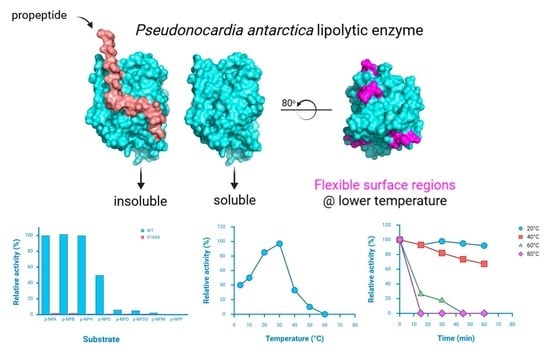
Graphical Abstract

1. Introduction

Lipolytic enzymes (EC 3.1.1.x), including lipases and esterases, constitute a major group of the α/β-hydrolase superfamily and catalyze the hydrolysis of ester bonds in a broad range of substrates [1,2]. Due to their broad substrate specificity, regioselectivity, and ability to function under mild reaction conditions, lipolytic enzymes have been extensively utilized in various biotechnological and industrial fields, including organic synthesis, food and dairy industries, pharmaceutical manufacturing, biofuel production, and detergent formulations [3,4,5]. Among these, cold-active lipolytic enzymes, in particular, derived from psychrophilic microorganisms, have attracted significant attention because of their high catalytic efficiency at lower temperatures [6,7,8,9]. This feature provides substantial advantages in reducing energy consumption, preserving the activity of heat-sensitive substrates, and minimizing undesirable side reactions.
Psychrophilic microorganisms produce enzymes adapted to cold environments, characterized by higher catalytic activity at lower temperatures and typically reduced stability at elevated temperatures [10,11,12,13,14]. This thermal adaptability is largely attributed to increased structural flexibility in their active sites, allowing effective catalysis even under conditions of low kinetic energy [15,16,17]. Cold-active lipolytic enzymes have been characterized from diverse microorganisms inhabiting cold environments, such as polar regions, glaciers, and deep-sea ecosystems [7,18,19,20,21,22,23,24,25,26]. However, despite these advancements, the current repertoire of cold-active lipolytic enzymes remains limited, particularly those from Antarctic actinomycetes, which represent a relatively unexplored group. Actinomycetes from extreme Antarctic ecosystems exhibit unique biochemical and molecular adaptations, making them promising sources for novel enzyme discovery [27,28,29].
Pseudonocardia antarctica, isolated from the McMurdo Dry Valleys, Antarctica, represents one such actinomycete adapted to cold environments [30]. Pseudonocardia, a genus of actinobacteria, has received little attention regarding lipase characterization, especially those isolated from extreme Antarctic environments. Investigating enzymes from such environments can uncover novel enzymatic properties and catalytic mechanisms that could be invaluable for industrial processes. Hence, the detailed characterization of lipases from Antarctic Pseudonocardia species presents a significant research opportunity to discover enzymes with unique structural and catalytic traits suitable for industrial applications.
Although cold-active lipolytic enzymes are widely studied, enzymes from Antarctic genus Pseudonocardia remain largely unexplored, representing a significant gap in current enzyme biotechnology research. In this context, the present study aims to characterize a novel cold-active lipolytic enzyme derived from P. antarctica. Preliminary sequence analyses have indicated significant similarity between this enzyme and lipase B enzymes from Aspergillus fumigatus [31] and Candida antarctica [32], both extensively studied due to their robust industrial applications. Given these promising initial findings, this study focuses on cloning, expression, purification and comprehensive bioinformatic characterization of cold-active lipolytic enzyme from P. antarctica. Further, functional characterization assays were conducted to assess its biochemical properties, along with simple molecular dynamics analyses to gain preliminary insights into the structural basis underlying its activity at low temperatures. By exploring this novel enzyme’s enzymatic profile, this study provides critical insights into its potential suitability for biotechnological applications, particularly in processes operating at low temperatures. These findings not only address a critical research gap but also offer valuable theoretical and practical guidance for future enzyme engineering and industrial applications of psychrophilic lipases.

2. Results and Discussion

2.1. Primary Structure Analysis and Classification of PanLip

P. antarctica is an aerobic, Gram-positive actinobacterium first isolated from the extreme cold desert environment of the McMurdo Dry Valleys in Antarctica [30]. The origin of this microorganism strongly suggests that its lipolytic enzyme, designated as PanLip, would be adapted for function at low temperatures. The primary structure analysis revealed that the putative lipase PanLip (UniProt ID: A0A852WCG0) consists of 324 amino acids and contains an N-terminal signal peptide spanning the first 30 residues (Figure S1a). Signal peptide prediction further indicated that this region corresponds to a Sec-type signal peptide, suggesting that PanLip is secreted via the Sec pathway in its native host. Excluding this signal sequence, the mature protein has a calculated molecular weight of approximately 36.8 kDa. Interestingly, immediately downstream of the signal peptide, PanLip contains a ca. 40 residue-long proline-rich N-terminal extension that is likely to be a putative propeptide (Figure S1b). Similar N-terminal propeptides have been identified in fungal and bacterial lipases [33,34,35,36,37] and are known to act as intramolecular chaperones [38] or regulators of the catalytic efficiency and substrate selectivity [39]. Presumably, the putative propeptide of PanLip plays a similar role, although its function remains to be experimentally validated.
Since cold adaptation is frequently assessed from the primary sequences of cold-active proteins [15,16,40,41], PanLip’s primary amino acid composition analyzed with a focus on properties commonly associated with cold adaptation features. These include increased structural flexibility via lower proportions of rigidifying residues (e.g., arginine, proline), altered charge distribution, and reduced hydrophobicity. However, the PanLip sequence contains a relatively high percentage of proline (10.4%) and arginine (4.3%), and an exceptionally low lysine content (0.3%), resulting in a Lys/Arg ratio of 0.067. This is markedly lower than values typically observed in psychrophilic enzymes [15,42,43]. Additionally, PanLip exhibits a moderate aliphatic index (79.91) and a slightly negative GRAVY score (–0.120), indicating an overall moderate thermostability and slight hydrophilicity. Collectively, while the protein does exhibit some cold-adaptive trends (e.g., modest hydrophilicity), its unusual residue distribution—particularly the arginine dominance and lysine scarcity—suggests that it may not conform to canonical models of cold adaptation. Instead, PanLip like other cold active proteins, may rely on alternative mechanisms such as local flexibility hotspots, structural dynamics, or surface charge modulation for maintaining activity at low temperatures [17,41,44,45].
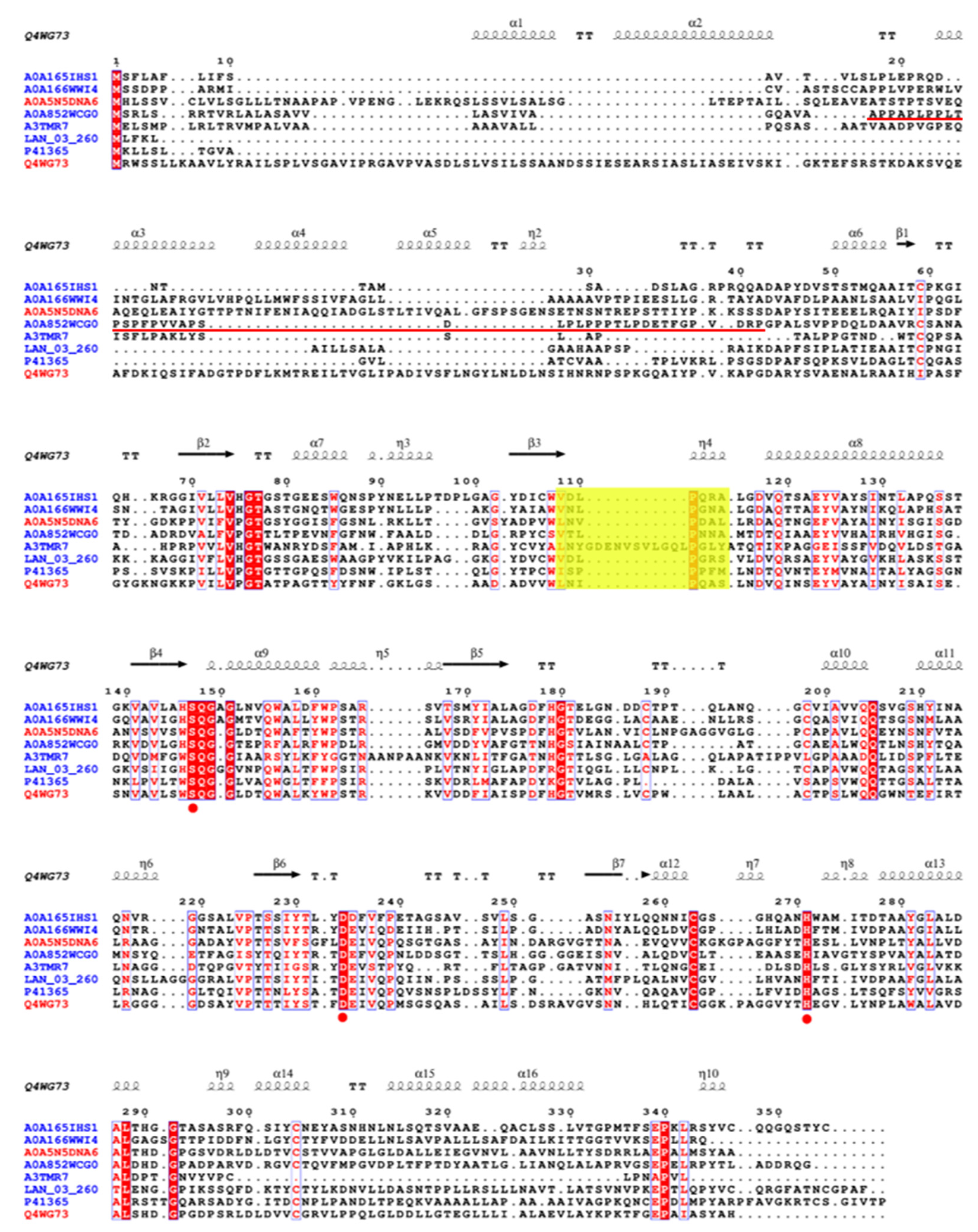
Multiple sequence alignment (MSA) of PanLip with psychrophilic and mesophilic lipases of highest identities was performed to identify conserved residues, infer evolutionary relationships, and reveal functionally or structurally important regions among homologous proteins. The PanLip (A0A852WCG0) exhibited moderate sequence identities with both mesophilic and psychrophilic fungal and bacterial lipases (Figure 1). It showed ~30% identity with the Candida antarctica lipase B (P41365, PDB ID: 4K6G), Calocera cornea (A0A165IHS1), and Glaciozyma antarctica PI12 lipase (LAN_03_260), ~29% with Athelia psychrophila (A0A166WWI4), and 25% with Janibacter sp. HTCC2649 lipase (A3TMR7, PDB ID: 7V3K). In comparison, it shared 29% identity with the mesophilic Aspergillus fumigatus lipase (Q4WG73, PDB ID: 6IDY) and 27% with the Lasiodiplodia theobromae lipase (A0A5N5DNA6, PDB ID: 7V6D). A motif, VDLPGRS, from G. antarctica lipase (LAN_03_260), was recently proposed as potentially essential for cold adaptation, contributing to structural stability and function at low temperatures [42]. However, the MSA analysis presented here, based on lipase sequences from various organisms, challenges the uniqueness and specificity of the VDLPGRS motif (Figure 1 and Figure S2). The alignment reveals substantial conservation of the VDLPGRS region across lipases from both psychrophilic and mesophilic actinomyctes, suggesting that this motif may not exclusively define psychrophilic adaptation. Specifically, mesophilic lipases from L. theobromae and A. fumigatus exhibit high sequence similarity within this motif, arguing that the VDLPGRS sequence is solely critical for psychrophilic stability and catalytic activity.
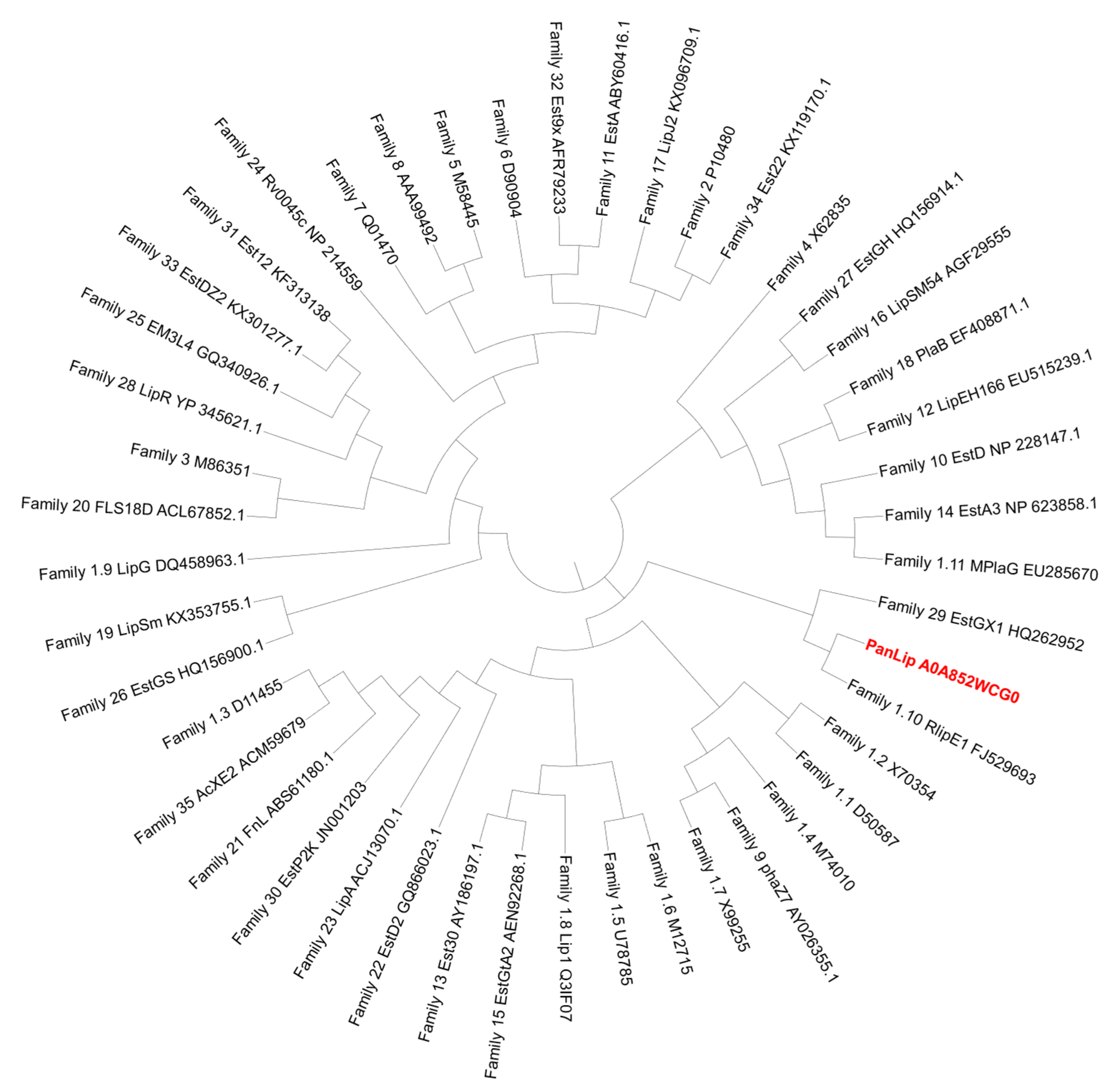
To classify lipolytic enzyme family of PanLip among known bacterial lipolytic enzyme families, a phylogenetic tree (Figure 2) was constructed following the classification criteria established by Hitch and Clavel (2019) [46]. In this classification, enzymes exhibiting ≥60% sequence identity are considered to belong to the same lipase family, a threshold that represents three standard deviations above the mean inter-family similarity (30.9 ± 9.6%). In the pairwise analysis, PanLip did not display sequence identity exceeding 60% with any representative member from the 35 previously defined lipolytic enzyme families (as shown in Table S1). Although PanLip has catalytic seine within the pentapeptide GHSQG motif as in family XIX, it shows 37% similarity to this family [47]. This finding suggests that PanLip likely represents a distinct or divergent member within the bacterial lipase superfamily, potentially forming a novel subfamily related to family I.10, as indicated by its clustering pattern in the phylogenetic tree (Figure 2). The relatively low sequence identity, together with its unique amino acid composition and conserved catalytic triad, implies that PanLip may have evolved specialized structural adaptations distinct from canonical lipase families.

2.2. Cloning, Expression, and Purification of PanLip Proteins

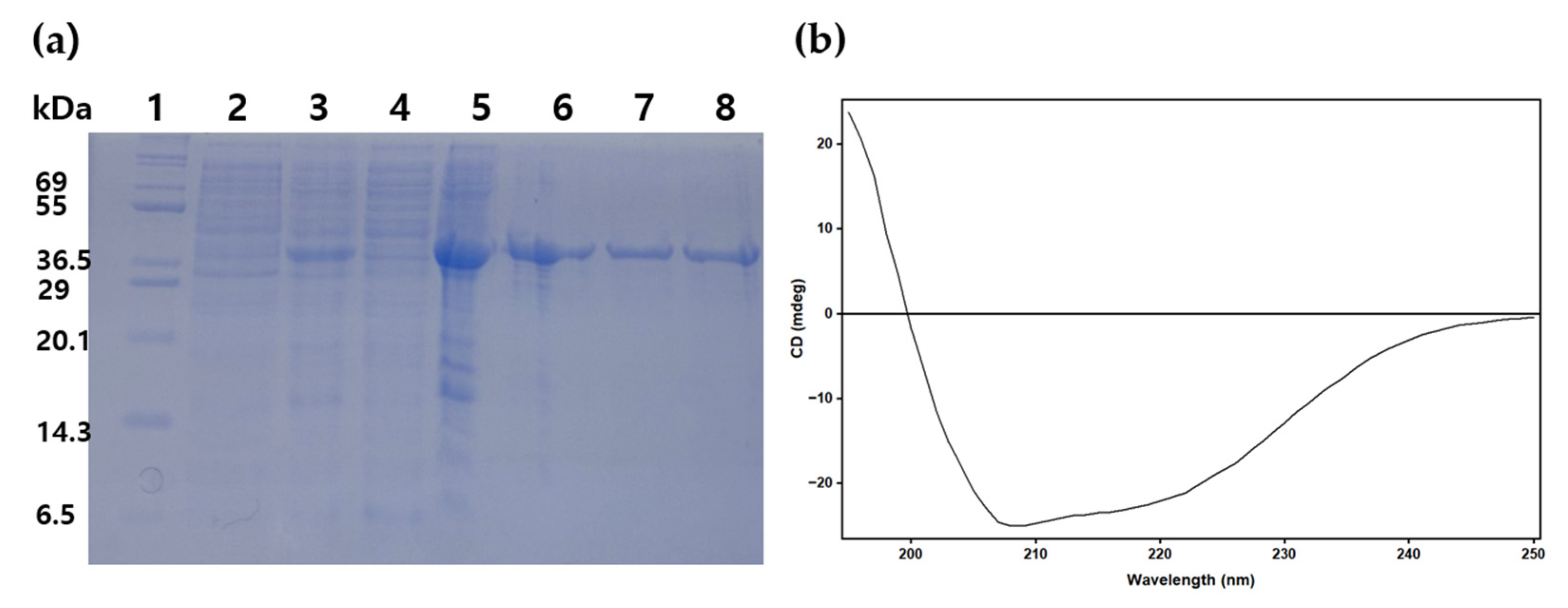
The signal peptide-deleted mature PanLip was expressed from pET-22b(+), pET-28a(+), and pET-32a(+) in both E. coli BL21(DE3) and SHuffle strains and observed predominantly as inclusion bodies. The expression in pET-22b(+) was very low, while in pET-28a(+) and pET-32a(+) were mild. However, all expressions were remained insoluble. In our expression trials, the full-length PanLip containing its native signal peptide was not evaluated. Notably, actinomycete-derived signal peptides, such as acetyl xylan esterase A of Streptomyces lividans [48] and xylanase from Kocuria sp. 3-3 [48,49], have successfully facilitated extracellular secretion in E. coli. Therefore, it is plausible that the native PanLip signal peptide could similarly support soluble or secretory expression, representing a promising avenue for further investigation. To reduce inclusion body formation, we generated PanLipΔN construct by removing the proline-rich 27 residues from the N-terminus that are predicted with low confidence in PanLip’s 3D structural model. These residues constitute the putative propeptide region of PanLip. In addition, PanLip contains six cysteine residues, and the AlphaFold model predicts the formation of three disulfide bonds (Cys87–Cys129, Cys210–Cys216, and Cys284–Cys326) within the folded protein, as discussed in the structural analysis below. To facilitate proper oxidative folding during heterologous expression, PanLipΔN was produced in the SHuffle T7 Express strain, which enables cytoplasmic disulfide bond formation. Expression of PanLipΔN using pET-28a(+) at low temperature (0.1 mM IPTG, 20 °C, 16 h) resulted in markedly improved solubility relative to the mature construct, although a substantial portion (>70%, visual estimate) remained in the insoluble fraction (Figure 3) [50,51]. Soluble PanLipΔN was purified by Ni2+–NTA with stepwise imidazole elution (200–250 mM) to homogeneity, yielding 0.3 mg·L−1 culture [8,21,24,26,51,52,53,54,55]. Refolding of inclusion bodies yielded soluble PanLipΔN (~0.35 mg·L−1); however, the full-length PanLip containing the putative propeptide region precipitated upon removal of denaturant and could not be recovered in a soluble form (Figure S3). These findings are consistent with the improved solubility of the truncated variant during heterologous expression. Similar obstacles in soluble expression of lipases containing propeptide in E. coli have been reported [56,57]. For example, attempts to express the pre-pro form of Rhizopus delemar lipase in E. coli resulted in inactive insoluble inclusion bodies, requiring denaturation in 8 M urea followed by redox-assisted refolding to recover active mature lipase [56]. Similarly, for R. oryzae lipase (ROL), successful soluble expression or refolding has often required expression in Origami (DE3) strain or secretion systems optimized for fungal lipases [57]. In the case of PanLip, the inability to recover soluble full-length protein suggests that the native propeptide may hinder folding or require host-specific maturation machinery (e.g., secretion chaperones, proteolytic processing) for correct folding, assembly, or solubility. Therefore, the role of the propeptide in PanLip’s folding, stability, or secretion supports further experimental investigation.
Far-UV CD spectra of purified PanLipΔN indicated a predominantly α/β architecture (Figure 3b). Deconvolution of the spectrum yielded 34% α-helix, 14.4% β-strand, and 52.2% other (loops/turns/disordered) [58], in close agreement with the Alphafold model-based composition (37% α-helix, 12.4% β-strand, 49.4% others). The result supports that the recombinant protein is properly folded after purification.

2.3. Biochemical Characterization of PanLipΔN

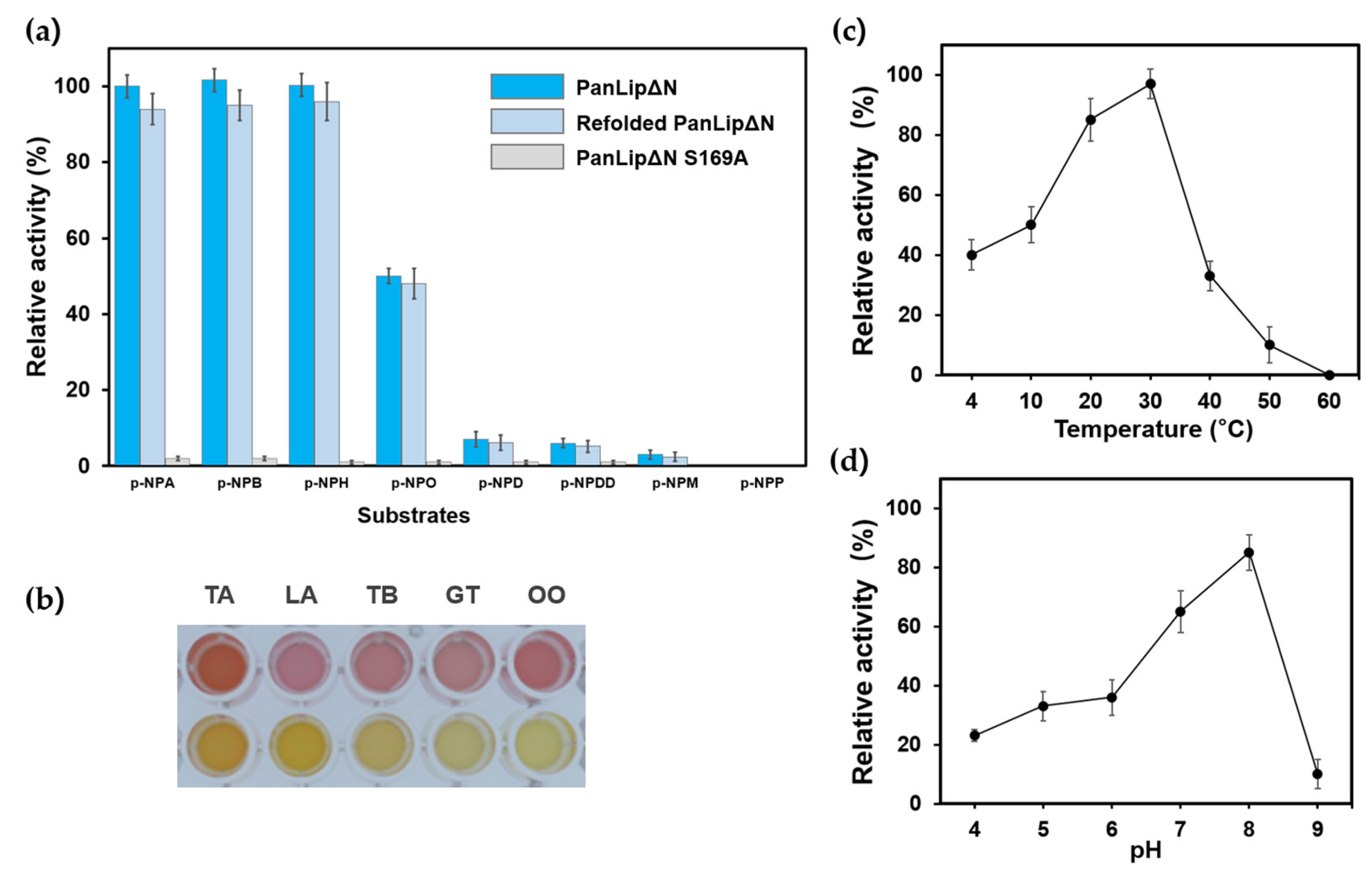
The substrate specificity of recombinant PanLipΔN toward p-nitrophenyl esters with varying acyl chain lengths (C2–C16) was determined (Figure 4a). Among the tested substrates, PanLipΔN exhibited the highest catalytic activity toward p-nitrophenyl acetate (C2, p-NPA), which was set as 100% relative activity. Activity gradually decreased as the acyl chain length increased, indicating a preference for short-chain esters. Specifically, the enzyme retained activity toward p-nitrophenyl butyrate (C4), and p-nitrophenyl hexanoate (C6) but showed markedly lower activity toward medium- and long-chain substrates such as p-nitrophenyl octanoate (C8), p-nitrophenyl dodecanoate (C12), and p-nitrophenyl palmitate (C16) and so on. This pattern suggests that PanLipΔN functions more efficiently on short, soluble ester substrates rather than bulky hydrophobic esters. Such substrate-length preference is typical of esterase-type lipolytic enzymes, whose active sites are generally exposed to the aqueous phase and not optimized for interfacial activation [5,8,18,21,59,60,61,62]. The insoluble PanLipΔN was successfully refolded by stepwise dialysis, and the refolded enzyme exhibited activity towards p-NP esters that were highly comparable to those of soluble PanLipΔN (Figure 4a). This indicates that the refolding restored the catalytic function of the enzyme. To further verify the catalytic triad, we generated the PanLipΔN S169A mutant by substituting the predicted nucleophilic Ser169 with alanine (Figure 3a). This mutant exhibited no detectable activity toward any p-nitrophenyl ester substrate (Figure 4a), providing direct experimental evidence that Ser169 is essential for catalysis and functions as the nucleophilic component of the predicted Ser–Asp–His triad. As shown in Figure 4b, PanLipΔN also demonstrated hydrolytic activity toward bulky tertiary alcohol esters, including linalyl acetate and α-terpinyl acetate, indicating that the enzyme can accommodate sterically demanding substrates. In addition, glyceryl tributyrate (TB), glyceryl trioleate (GT), and olive oil (OO) produced a visible yellow color in the colorimetric assay, confirming that PanLipΔN is capable of hydrolyzing natural triglycerides and displays measurable lipase-like activity. This ability to act on structurally diverse and bulkier substrates may reflect an increased conformational flexibility near the active site, a feature commonly associated with cold-adapted lipolytic enzymes [63] and consistent with psychrophilic catalytic strategies that compensate for reduced thermal energy [15]. These results further support the classification of PanLipΔN as a lipase-family esterase with both esterase-type substrate preference and lipase-like catalytic capability.
The optimal temperature for hydrolytic activity of PanLipΔN was found to be at ~25 °C (Figure 4c). The effect of pH on the catalytic activity of PanLipΔN was investigated in the pH range of 4.0–9.0 (Figure 4d). The enzyme exhibited relatively low activity under acidic conditions (pH 4.0–6.0), but the activity increased sharply at near-neutral to alkaline pH. The maximum activity was observed at pH 8.0, indicating that PanLipΔN is an alkaline-preferring lipase. A rapid decline in activity was detected beyond pH 8.0, with less than 15% residual activity at pH 9.0.
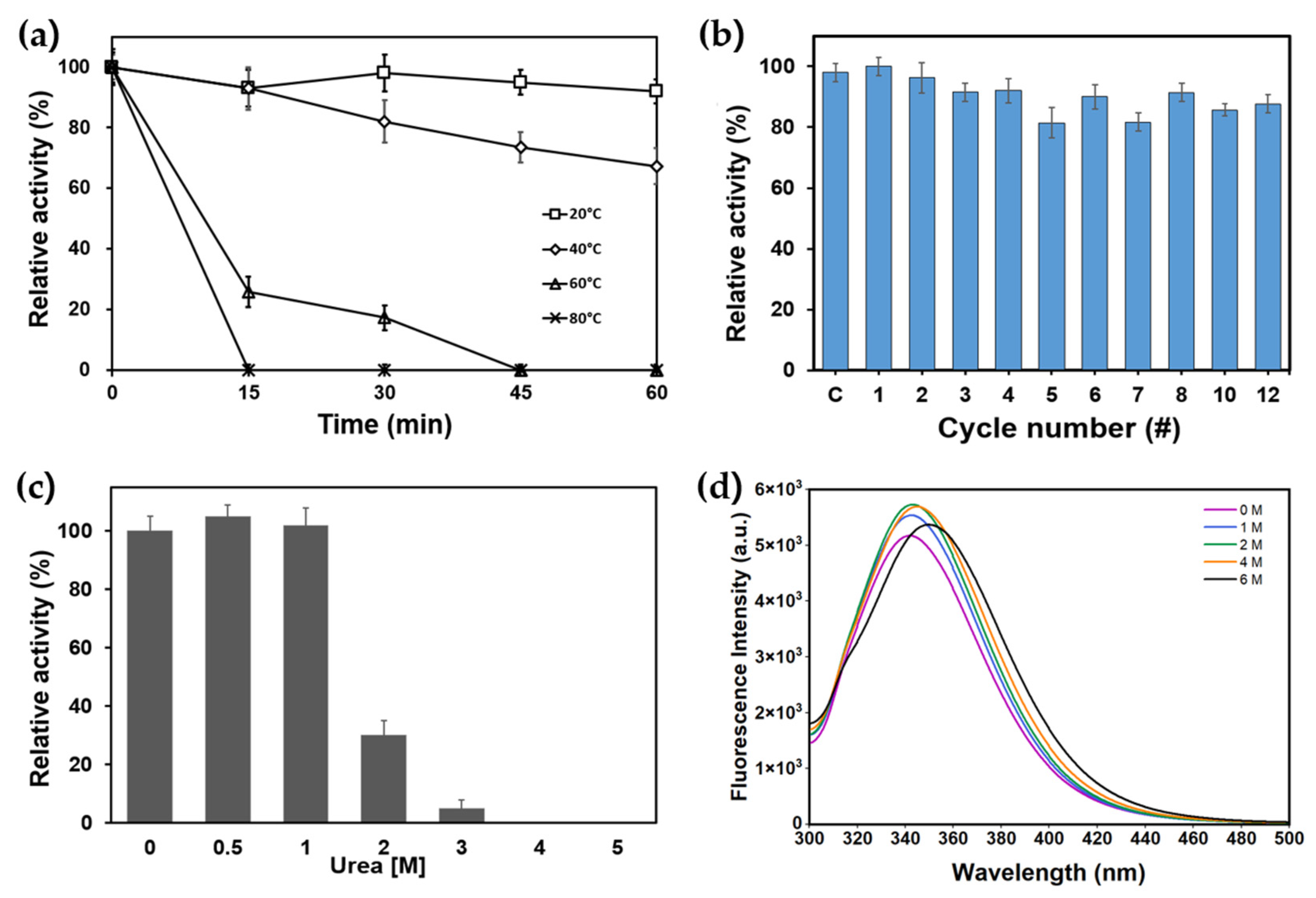
The thermal stability of PanLipΔN was examined at the different temperatures (20 °C, 40 °C, 60 °C, and 80 °C) for up to 60 min (Figure 5a). The enzyme was stable below 40 °C, maintaining over 80% of its initial activity. However, activity decreased markedly at 60 °C and was completely lost at 80 °C within 15 min. These results indicate that PanLipΔN has moderate thermal tolerance, consistent with other cold-active bacterial lipases [18,21,55,59,60,62]. The freeze–thaw stability of recombinant PanLipΔN was evaluated over twelve consecutive cycles (Figure 5b). The enzyme retained over 85% of its initial activity even after 12 cycles, showing only minor fluctuations in activity throughout the process. This result indicates that PanLipΔN not only possesses excellent structural robustness and refolding capability during repeated freezing and thawing, but also is comparable to other cold-active lipolytic enzymes. For example, the cold-active SGNH-type lipase HaSGNH1 from Halocynthiibacter arcticus retained most of its initial activity after nine freeze–thaw cycles [64]. Similarly, the related cold-active hormone-sensitive lipase HaHSL from the same organism was shown to withstand multiple freeze–thaw cycles with limited inactivation [21]. Such stability suggests that the enzyme’s tertiary structure is not easily disrupted by temperature-induced stresses, possibly due to the presence of stabilizing intramolecular interactions such as hydrogen bonds or hydrophobic packing [17,65]. The tolerance of PanLipΔN to repeated freeze–thaw cycles enhance its potential for industrial applications in low-temperature biocatalytic processes [4,8].
The stability of recombinant PanLipΔN was evaluated in the presence of Urea (Figure 5c,d). The enzyme displayed a pronounced sensitivity to urea, with activity gradually declining as the concentration increased. More than 80% of the activity was lost at 2 M urea, and complete inactivation occurred at concentrations above 3 M (Figure 5c). This observation suggests that urea disrupts the hydrogen bonding network and tertiary structure of PanLipΔN, resulting in a loss of catalytic function. Fluorescence emission spectra (Figure 5d) were recorded at an excitation wavelength of 280 nm to monitor tertiary structural changes in PanLipΔN in the presence of increasing urea concentrations (0–6 M). With increasing urea concentration, the fluorescence intensity gradually increased, accompanied by a slight red shift in the emission maximum from approximately 338 to 345 nm. This indicates progressive exposure of tryptophan residues as the protein structure unfolded. The shift toward longer wavelengths suggests disruption of the native tertiary structure and increased solvent accessibility [21,62,66]. Even at 6 M urea, the emission spectrum retained a discernible peak, implying that PanLipΔN still preserves partial structural integrity or folding intermediates under strongly denaturing conditions.
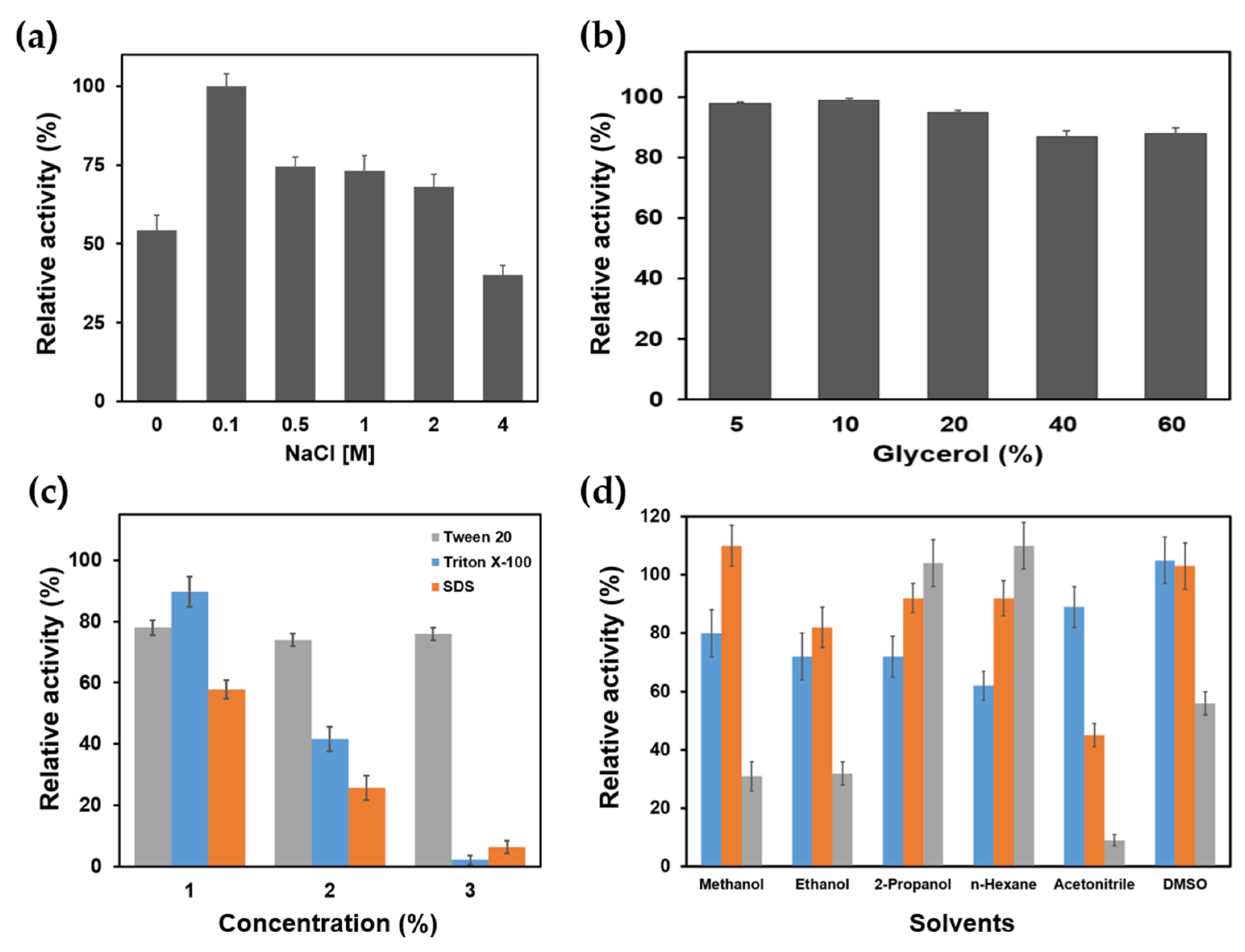
The stability of recombinant PanLipΔN was evaluated in the presence of common additives such as NaCl and glycerol. PanLipΔN shows maximum activity at 0.1M NaCl, then its activity declines progressively as salt concentration increases (Figure 6a). Low concentrations slightly enhanced the activity, possibly by stabilizing the electrostatic environment or promoting proper folding, while higher NaCl concentration may disrupt the essential ion pairs or perturbs interfacial binding [18,21,25,55,60,67]. The cold-active SGNH-type lipase HaSGNH1 from H. showed comparable activity to PanLipΔN, retaining ~50% activity at 2.0 M NaCl [64]. In contrast, the cold-active lipase/esterase HaHSL from H. arcticus retains approximately 100% of its activity between 0.1 and 2.0 M NaCl, reflecting markedly higher halotolerance than PanLipΔN [21]. These comparisons indicate that PanLipΔN is less salt-tolerant than some halophilic lipases such as LipS2 from Chromohalobacter canadensis [68] or lipase from Marinobacter litoralis [69], but still functional under low to moderate salinity, which may be adequate for many aqueous or mildly saline bioprocesses. Glycerol had a mild protective effect on PanLipΔN activity (Figure 6b). The enzyme retained over 90% of its activity in 5–60% glycerol and showed a gradual decline at concentrations above 40%. This stabilizing behavior is commonly attributed to glycerol’s ability to enhance hydrophobic interactions and reduce protein flexibility, thereby maintaining the folded state under mild stress [20,21,55,67,70]. The glycerol tolerance of PanLipΔN is comparable with that of HaHSL [21], which also shows almost no loss of activity even at 60% glycerol, and higher than that of HaSGNH1, which exhibits maximal activity around 20% glycerol [64]. The slight tolerance to salt and glycerol suggests potential applicability in moderate salinity or cryoprotectant-containing biocatalytic systems [71,72].
The stability of PanLipΔN in the presence of surfactants was investigated using non-ionic (Tween 20, Triton X-100) and anionic (SDS) detergents (Figure 6c). PanLipΔN retained full activity at 0.5% Tween 20, suggesting a mild stabilizing or emulsifying effect at low concentration. However, its activity gradually decreased with increasing concentrations, maintaining approximately 80% activity at 1–3% Tween 20. This indicates that higher surfactant concentrations slightly perturb the enzyme’s hydrophobic core or substrate-binding region [73,74,75]. Triton X-100 exhibited a strong inhibitory effect in a concentration-dependent manner, with only ~85% activity remaining at 1%, ~40% at 2%, and complete inactivation at 3%. On the contrary, the cold-active HaHSL from H. arcticus retained >30% activity even at 5% Triton X-100, whereas it almost completely lost its activity [21]. However, HaSGNH1 lipase only ~30% of retained its activity at 0.1% Triton x-100, and less than 10% at 0.1% Tween 20 [64]. The anionic detergent SDS caused severe denaturation, reducing enzyme activity to ~55% at 1%, ~25% at 2%, and nearly zero at 3%, consistent with the disruptive nature of ionic surfactants on protein folding [76,77]. Compared to other cold-active lipases that are easily inactivated by 0.1% SDS [21,53], PanLipΔN is somewhat resistant to SDS. Notably, certain mesophilic or thermotolerant lipases such as those from Acinetobacter sp. [78], Leuconostoc mesenteroides [79], and Bacillus sp. RN2 [80] demonstrate substantially higher compatibility with non-ionic surfactants (Tween 20, Tween 80, Triton X-100) and SDS than is typically observed for psychrophilic lipolytic enzymes.
DMSO (1–3%) The enzyme maintained over 100% activity at 1–2% DMSO, with a moderate decline to approximately 55% at 3%. These results indicate that PanLipΔN exhibits good tolerance toward mild non-ionic surfactants and low levels of organic solvents, but is highly sensitive to strong amphiphilic or ionic detergents such as Triton X-100 and SDS.
The effect of various organic solvents on the activity of PanLipΔN was evaluated to assess its stability in solvent rich environments (Figure 6d). The effects of organic solvents, including methanol, ethanol, 2-propanol, n-hexane, and acetonitrile at 10, 25, and 50% (v/v) concentrations, and DMSO at 1, 2, and 3% were investigated. PanLipΔN retained substantial activity in low concentrations of short chain alcohols (Figure 6d). In 10% methanol, approximately 85% of the activity remained, indicating a transient stabilizing or substrate-diffusion effect at lower exposure levels [74,81]. However, activity sharply decreased at higher concentrations, with only residual activity observed at 50%. A similar pattern was observed for ethanol. In contrast, 2-propanol and n-hexane, a nonpolar solvent, showed remarkable compatibility with PanLipΔN. The enzyme retained over 70–100% activity even at 50% solvent concentration, indicating excellent tolerance to nonpolar environments and potential utility in biphasic or organic phase catalysis. Acetonitrile, however, strongly inhibited the enzyme, with less than 20% activity remaining under all conditions, likely due to its high polarity and ability to penetrate the enzyme’s interior, disrupting essential hydrogen bonding networks. In DMSO (1–3%), the enzyme maintained over 100% activity at 1–2%, with a moderate decline to approximately 55% at 3%. PanLipΔN demonstrated moderate tolerance toward low concentrations of polar alcohols and excellent stability in nonpolar solvents such as n-hexane, but was highly sensitive to strongly polar aprotic solvents like acetonitrile. These results suggest that PanLipΔN possesses structural rigidity favorable for catalysis in hydrophobic or low-water environments, supporting its potential application in organic phase biotransformations [4,8].
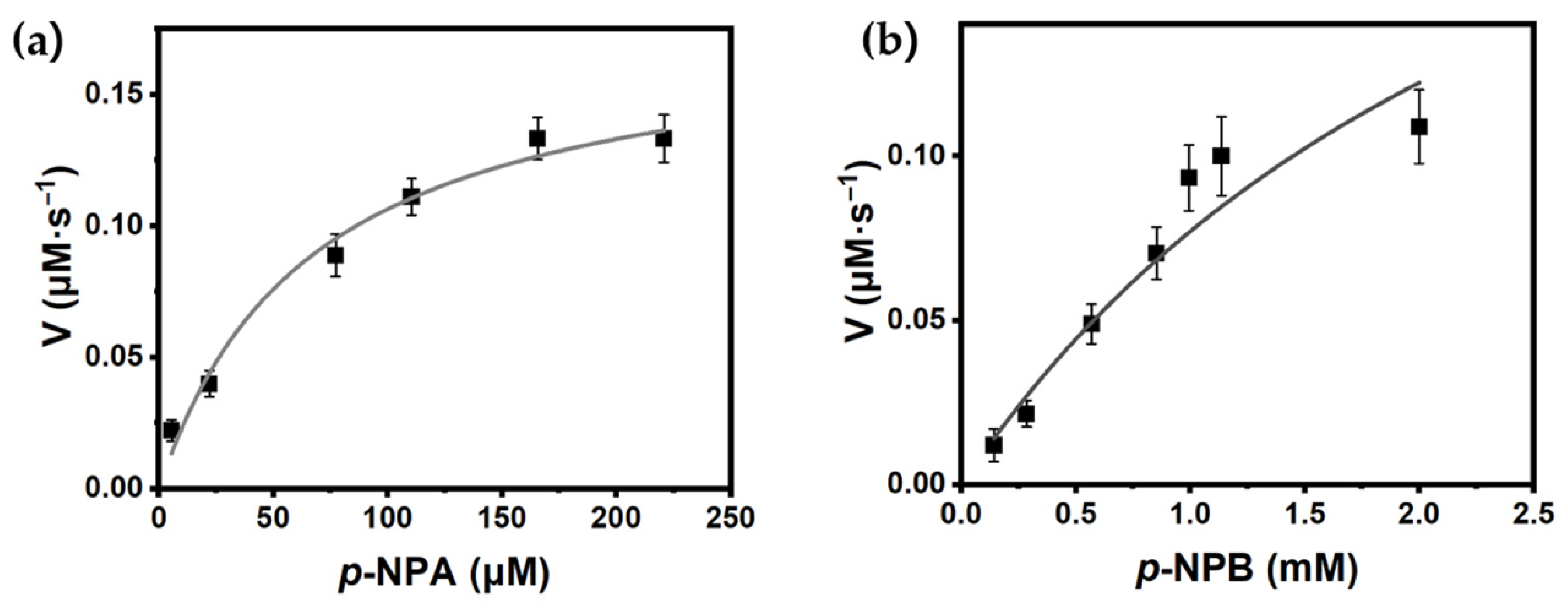
The kinetic parameters of PanLipΔN for p-NPA and p-NPB were determined (Figure 7). For p-NPA (Figure 7a), the kinetic parameters, Vmax, KM, kcat, kcat/KM were 0.18 ± 0.02 µM·s−1, 66.8 ± 18.5 µM, 16.2 ± 1.8 s−1, and 2.4 × 10⁵ M−1·s−1, respectively. The KM value suggests that p-NPA binds to PanLipΔN relatively tighter than many cold-active counterparts that report mM range KM for short p-NP esters. In contrast, p-NPB (Figure 7b) showed a lower kcat (9.7 ± 1.8 s−1) and much weaker binding (KM = 2.83 ± 1.56 mM), yielding kcat/KM 5.94 × 10⁴ M−1·s−1. These values in this study are within the range reported for cold-active microbial lipases measured on p-NP esters [18,21,60,62,82]. This study primarily reports kinetic parameters for short-chain model substrates, and detailed kinetic analysis using natural triglycerides remains to be completed.

2.4. Structural Analysis of Alphafold Generated PanLip Model

The advent of highly accurate protein structure prediction tools, particularly AlphaFold, has revolutionized structural biology by enabling detailed analyses of proteins lacking experimentally determined structures. The three-dimensional structure of PanLip was obtained from the AlphaFold Protein Structure Database (entry AF--A0A852WCG0--F1) for structural evaluation [83]. The model was generated by AlphaFold, a deep learning–based platform that produces high-accuracy protein structure predictions, and its reliability was assessed using AlphaFold’s internal confidence metric, the predicted Local Distance Difference Test (pLDDT) score. The pLDDT is a per-residue confidence value ranging from 0 to 100, which estimates the accuracy of the local structural environment of each amino acid residue.
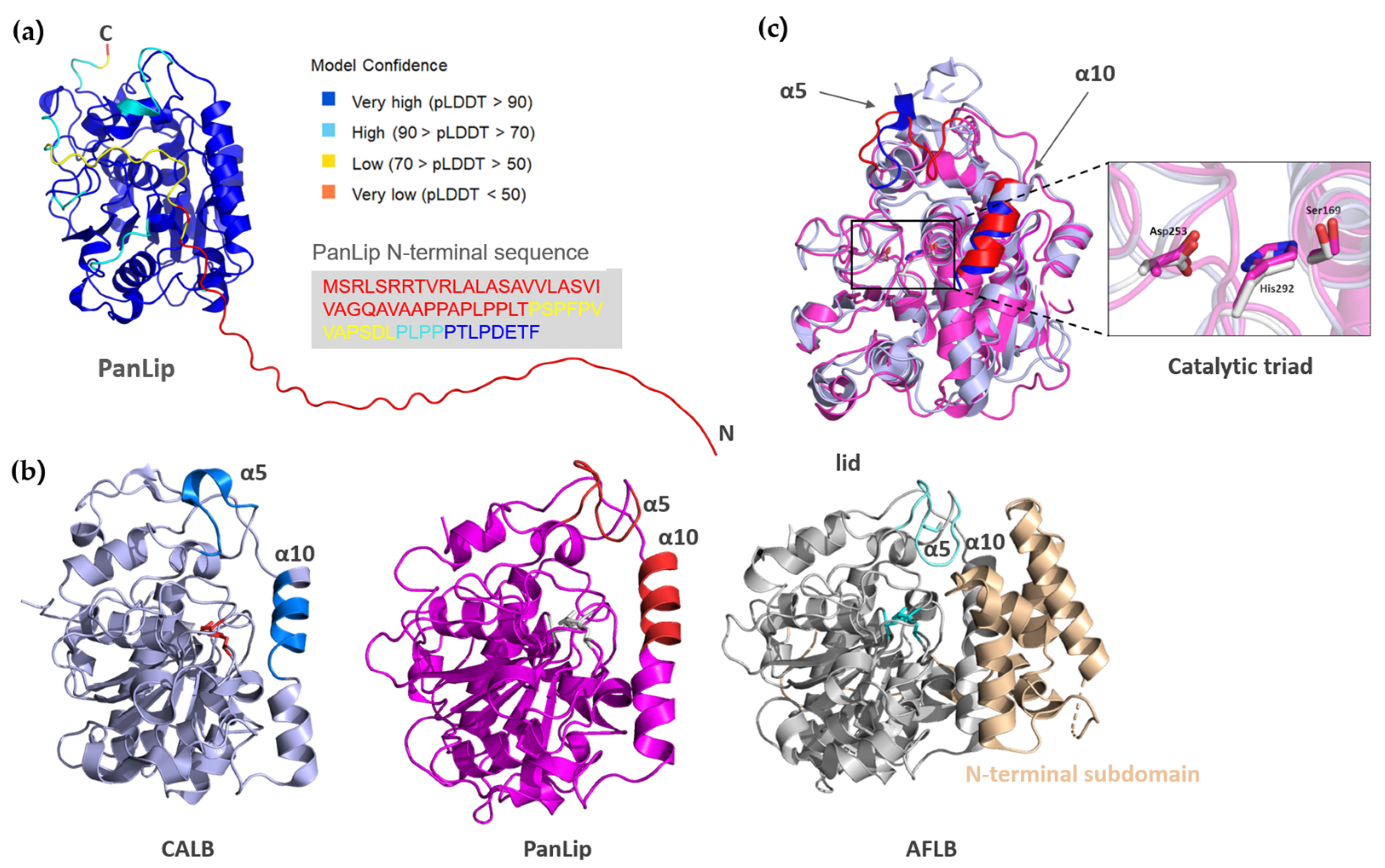
The full-length PanLip model (377 residues) demonstrated overall high confidence, with 78.5% of residues showing pLDDT scores above 90, indicative of a reliable structural prediction (Figure 8a). In contrast, the N-terminal signal peptide and the adjacent unique proline-rich region exhibited low to very low pLDDT values, suggesting structural disorder or intrinsic flexibility. When the N-terminal region of PanLip is eliminated, 92.5% of residues exhibited very high confidence (pLDDT > 90), particularly within the catalytic core. Further validation of the AlphaFold model was performed using Molprobity [84]. The structure achieved a clashscore of 0.91 and a MolProbity score of 1.25, ranking within the 99th percentile for models of comparable resolution. The Ramachandran plot showed 94.4% of residues in favored regions, with only 0.27% classified as outliers, confirming excellent stereochemical quality. For further structural analysis, the first 57 residues including a signal peptide and proline-rich regions were eliminated in the structural model.
Structural homolog search of the PanLip using the DALI server [85] revealed that the lipase shares the highest structural homology with several fungal lipases (Table 1), corroborating the initial sequence-based analysis. The highest-scoring homolog was lipase B from A. fumigatus (AFLB; PDB ID: 6IDY), with a Z-score of 56.0 and 31% sequence identity. Other significant structural homologs included lipases from L. theobromae (PDB ID: 7V6D; Z-score = 47.7), and C. antarctica (CALB; PDB ID: 4K6G; Z-score = 40.3). Notably, the highest-ranking bacterial lipase, from Streptomyces sp. W007 (PDB ID: 5H6B), appeared fourth in the results with a substantially lower Z-score of 24.8. These results strongly suggest that the actinomycetes PanLip adopts a fold more closely related to this family of fungal lipases than to known bacterial lipases, despite its prokaryotic origin.
The overall structure of PanLip adopts the canonical α/β-hydrolase fold characteristic of most lipases, comprising a central β-sheet core surrounded by α-helices (Figure 8b). This fold houses the catalytic triad, which in PanLip is predicted to consist of Ser169, Asp253, and His292. A key point of comparison among its structural homologs, AFLB and CALB, is the nature of a “lid” domain, a mobile element that often covers the active site and modulates substrate access [31,32]. The top structural homolog, AFLB, possesses a large, unique N-terminal subdomain and a tightly closed large lid that regulates its activity. In contrast, CALB has a short lid (Leu140-Ala146) forming α5 helix (Figure 8c). The AlphaFold model of PanLip reveals a structure that appears to be intermediate between these two lipases. It does not possess the large, complex lid of AFLB, but it does feature a flexible loop, corresponding to α5 of CALB surrounding the entrance to the active site, reminiscent of the more open architecture of CALB (Figure 8c). This structural arrangement suggests that PanLip may not rely on large-scale conformational changes for interfacial activation. However, the proline-rich N-terminal segment located adjacent to the catalytic pocket may be presumed to participate in regulating substrate accessibility. However, since the mature form of PanLip could not be expressed in a soluble state, the functional role of this proline-rich region remains to be elucidated.

2.5. Analysis of MD Simulation of PanLip Model

The conformational flexibility of enzymes is intrinsically linked to their catalytic activity and stability, particularly in response to temperature fluctuations. In this study, molecular dynamics (MD) simulations for 25 ns at 283, 303, 323K and CABS-flex 3.0 at different temperature parameters were performed and provided valuable insights into these dynamic properties of PanLip.
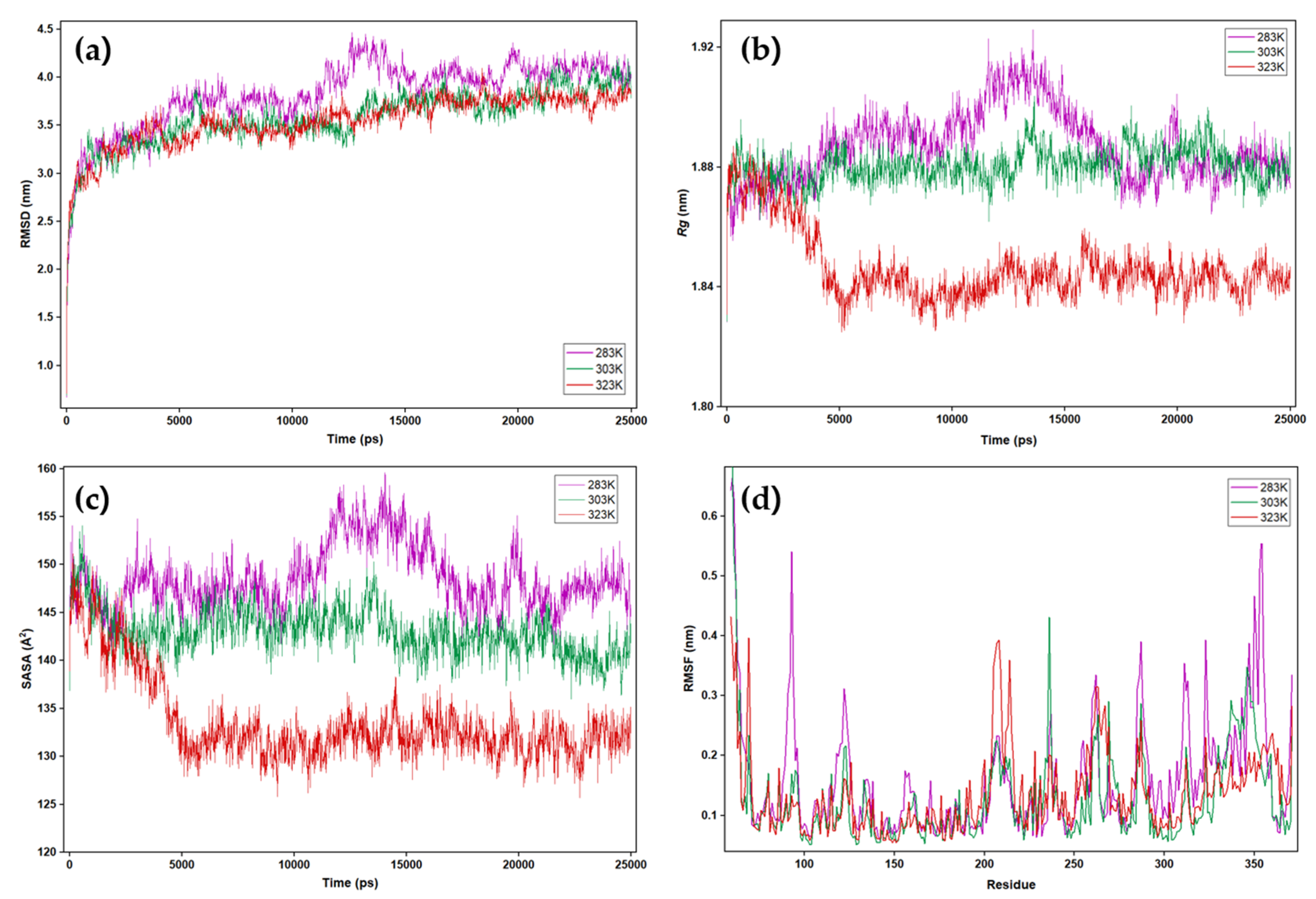
Contrary to the common expectation that higher temperature broadens the conformational ensemble [42,59,62,94], PanLip showed its largest RMSD at 283 K (3.827 ± 0.361) and progressively smaller RMSD at 303 K (3.582 ± 0.298) and 323 K (3548 ± 0.266), indicating that the protein explores broader conformational space at low temperature (Figure 9a). The radius of gyration (Rg) is a standard compactness metric in MD; lower Rg denotes a more compact, often more rigid conformation, whereas higher Rg reflects expansion and flexibility [95,96]. The radius of gyration (Rg) also followed the same trend (Figure 9b): modestly larger Rg at lower temperatures—1.887 ± 0.012 nm (283 K) and 1.881 ± 0.006 nm (303 K)—compared with a smaller Rg at 323 K (1.846 ± 0.011 nm). Similarly, SASA traces (Figure 9c) were exhibited higher at low temperatures. The larger SASA at cold temperature reflects a slightly more solvent-exposed/relaxed surface, in line with the “surface softness” often reported for cold-adapted enzymes [17,44,97]. Together, these results support the “surface softness” model of psychrophilic proteins, in which small increases in surface breathing and solvent exposure help sustain catalytic competency at low temperature without large disruption of the catalytic core. Comparable trend has been observed for other psychrophilic enzymes and cold-active lipases, such as G. antarctica lipase [42], AMS8 lipase [62,98], cold-active lipase 4K6H [32].
Per-residue RMSF profiles highlighted several surface exposed loops with enhanced mobility at lower temperature, notably Thr92–Ala94, Asp122–Leu124, Rhr286–Ala288, Asp311–Asp313, and Thr346-Ala354 (Figure 9d), while the hydrophobic core remained comparatively rigid. Among them, Thr286–Ala288 lies adjacent to His292 of catalytic triad, suggesting a plausible allosteric coupling whereby increased local breathing could modulate accessibility, orientation, or proton relay efficiency at the active site, analogous to observations in other cold-active enzymes where surface softness—rather than exaggerated active-site disorder—supports catalysis at low temperature. This interpretation aligns with structural analyses of psychrophilic enzymes showing that cold adaptation frequently arises from softer surfaces with weakened inter-residue hydrogen-bond networks and restricted large-scale motions, while active-site geometries remain comparatively conserved relative to mesophilic homologs [59,99]. Residues Thr346–Ala354 of PanLip, assigned to α10, display pronounced temperature-dependent flexibility. This segment topologically matches with the residues Leu278–Ala287 of CALB α10 helix (Figure 9b), one of two short, mobile helices (α5/α10) that flank the CALB active site entrance and act as a dynamic gate for substrate access [100].
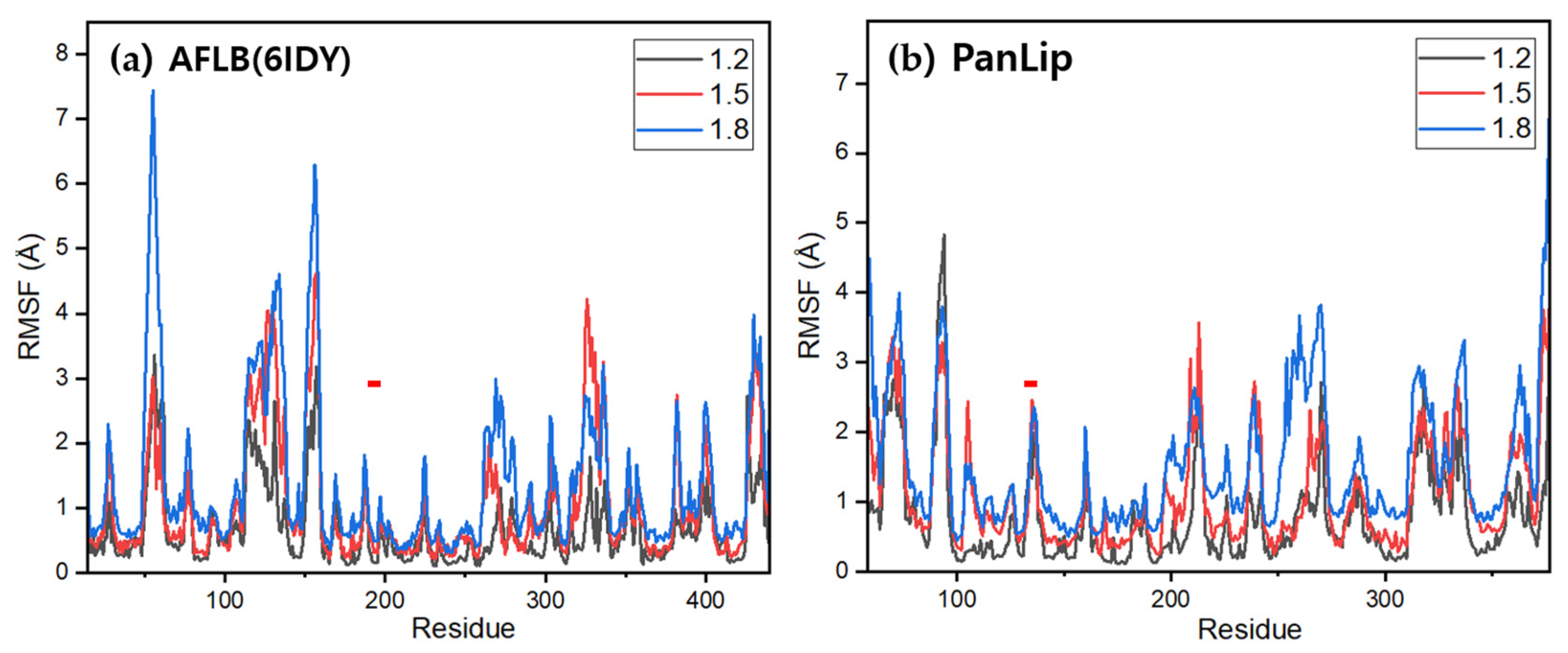
CABS-flex analyses [101] recapitulated the greater intrinsic flexibility of PanLip at lower temperature parameters and localized peaks in surface regions, while preserving the α/β-hydrolase core (Figure 10). The mesophilic AFLB exhibited a progressive increase in overall flexibility with rising temperature parameters (Figure 10a), reflected in the escalating average RMSF values: 0.68 Å at 1.2, 1.04 Å at 1.5, and 1.37 Å at 1.8. PanLip also demonstrated an increase in overall flexibility with rising temperature parameters (Figure 10b), with average RMSF values of 0.87 Å at 1.2, 1.21 Å at 1.5, and 1.73 Å at 1.8. However, its dynamic response exhibited notable differences compared to AFLB. At the lowest temperature parameter (1.2), this psychrophilic lipase displayed a high intrinsic flexibility, particularly in its N-terminus (residues 92–94, RMSF ~4.8 Å), which is significantly higher than any residues in AFLB at the same parameter. However, the region corresponding to the VDLPGRS motif (displayed as red bar on top of residues Val132-Ala137) in PanLip did not show temperature dependent fluctuations, arguing against a universal role for that this motif as a cold-adaptation determinant [42].

3. Materials and Methods

3.1. Chemicals and Reagents

The polymerase chain reaction (PCR) premix kit, plasmid purification kit, restriction enzymes, and T4 DNA ligase was purchased from Bioneer (Daejeon, Republic of Korea). PCR cleanup and gel extraction kit were obtained from Takara Biomedicals (Seoul, Republic of Korea). Synthesis of primers and DNA sequencing were performed by Macrogen (Seoul, Republic of Korea). p-Nitrophenyl acetate, linalyl acetate, α-terpinyl acetate, tert-butyl acetate, glyceryl trioleate, olive oil, p-nitrophenyl butyrate, p-nitrophenyl hexanoate, p-nitrophenyl octanoate, p-nitrophenyl decanoate, p-nitrophenyl dodecanoate, p-nitrophenyl myristate, and p-nitrophenyl palmitate were obtained from Sigma-Aldrich (St. Louis, MO, USA). The Ni2+ affinity resin was purchased from Qiagen (Hilden, Germany). The 96-well PCR plate (Code 781368) was obtained from Axygen (Corning, NY, USA). All other chemicals and reagents used in this study were of analytical grade unless otherwise stated.

3.2. Cloning, Expression, and Purification of Pseudonocardia Antarctica Lipase

The signal peptide-deleted lipase gene for Pseudonocardia antarctica, designated PanLip, was codon-optimized and synthesized by GenScript (Piscataway, NJ, USA). The gene was cloned into three different expression vectors, pET-22b(+), pET-28a(+), and pET-32a(+) vectors, to compare the expression levels of recombinant proteins. To improve the solubility of PanLip, which was largely expressed as inclusion bodies in both E. coli BL21(DE3) and Shuffle strains, an N-terminally truncated mutant, designated PanLipΔN, was designed by removing the first 27 amino acid residues of the full-length enzyme. Lipase expression constructs, designated PanLipΔN, were generated. PanLipΔN was obtained by amplifying the truncated fragment from the wild-type PanLip gene. To construct PanLipΔN1, the gene was amplified using the following primers in Table 2. PCR amplification was performed in a 20 μL reaction mixture containing 1× PCR premix (Bioneer, Daejeon, Republic of Korea), 0.2 μM of each primer, and the template DNA. The cycling conditions were as follows: initial denaturation at 95 °C for 3 min; 30 cycles of 95 °C for 30 s, 58 °C for 30 s, and 72 °C for 60 s; and a final extension at 72 °C for 7 min. The amplified product was verified by 1% agarose gel electrophoresis and purified using the DNA fragment purification kit (Takara). The purified Δ27N PCR product and pET-28a(+) vector were digested with NdeI and XhoI, gel-purified, and ligated using T4 DNA ligase (Bioneer, Daejeon, Republic of Korea) at a 3:1 insert-to-vector molar ratio. The ligation product was transformed into E. coli DH5α competent cells for plasmid propagation. Positive clones were confirmed by colony PCR and restriction digestion analysis. The insert sequence was verified by Sanger sequencing (Macrogen, Seoul, Republic of Korea). Site-directed mutagenesis of Ser 169 to Ala was conducted using the QuikChange site-directed mutagenesis kit (Stratagene, LaJolla, CA, USA) according to the manufacturer’s instructions.
To evaluate the solubility improvement of truncated variants, the confirmed recombinant plasmids PanLipΔN were transformed into E. coli Shuffle T7 Express cells for expression. The transformants were selected on LB agar plates containing 50 μg·mL−1 kanamycin. A single colony was inoculated into 5 mL of LB medium and cultured overnight at 37 °C with shaking at 190 rpm. The seed culture was transferred to 2L of fresh LB medium and incubated until OD600 reached 0.6–0.8. Protein expression was induced by adding 0.1 mM IPTG and incubating at 20 °C for 16 h.
Cells were harvested by centrifugation (12,000 rpm, 15 min, 4 °C), resuspended in lysis buffer (50 mM sodium phosphate, pH 8.0, 400 mM NaCl, 10 mM imidazole), and disrupted by sonication on ice for 5 min with 5 s pulses followed by 5 s intervals. After centrifugation (12,000 rpm, 30 min, 4 °C), the soluble and insoluble fractions were analyzed by SDS–PAGE. The ΔN variants showed markedly improved solubility compared with the full-length PanLip, particularly in the Shuffle strain.
For purification, the soluble fraction was loaded onto a Ni2+–NTA affinity column (Qiagen, Germany) pre-equilibrated with binding buffer (50 mM sodium phosphate, pH 8.0, 300 mM NaCl, 10 mM imidazole). After washing the column with 40 mM imidazole buffer to remove nonspecifically bound proteins, the target protein was eluted stepwise with imidazole concentrations of 100 mM, 150 mM, 200 mM, and 250 mM in the same buffer. Eluted fractions were analyzed by SDS–PAGE, desalted, and concentrated and buffer-exchanged using Amicon Ultra filters (10 kDa cutoff). The purified concentration is determined by the Bradford assay [102]. The insoluble fractions of PanLip and PanLipΔN were subjected to refolding to recover soluble, active enzyme using a stepwise dialysis refolding method as described previously with slight modifications [103]. After cell lysis, the inclusion bodies were collected by centrifugation and washed twice with washing buffer (20 mM Tris–HCl, pH 8.0, 0.5% Triton X-100, 1 mM EDTA), followed by a final wash with 20 mM Tris–HCl (pH 8.0). The washed pellets were solubilized in 8 M urea (50 mM Tris–HCl, pH 8.0, 300 mM NaCl) and purified under denaturing conditions using a Ni2+–NTA affinity column. The eluted fraction was reduced by adding 50-fold molar access of β-mercaptoethanol (β-ME). β-ME was removed by dialysis against 8 M urea (50 mM Tris–HCl, pH 8.0, 300 mM NaCl) without β-ME. The unfolded PanLip proteins (~2 mg/mL in 8 M urea) were transferred into dialysis tubing, and refolding was carried out at room temperature (22–25 °C) by stepwise dialysis against refolding buffer (50 mM Tris–HCl, pH 8.0, 1 mM EDTA, 1% Triton X-100, and 0.3 M L-arginine-HCl) while gradually decreasing the urea concentration (4 M, 2 M, 1 M, 0.5 M, and 0 M). At the 2 M urea step, a redox couple (2 mM reduced glutathione and 0.2 mM oxidized glutathione) was added to facilitate disulfide bond formation. The sample was maintained overnight at 1 M urea and subsequently dialyzed sequentially to 0.5 M and 0 M urea. Following complete removal of urea, the solution was clarified by centrifugation (20,000× g, 15 min) and filtered through a 0.22 µm membrane. The refolded protein was concentrated using an Amicon Ultra centrifugal filter unit (10 kDa cutoff).

3.3. Enzyme Activity Assay of Recombinant PanLipΔN

3.3.1. Substrate Specificity

The substrate specificity of recombinant PanLipΔN was determined using p-nitrophenyl esters (p-NP esters) with acyl chain lengths from C2 to C18. The standard reaction mixture (1.5 mL) contained 200 mM Tris–HCl pH 7.4, 100 mM NaCl, and 1 mM p-NP ester (dissolved in isopropanol). The reaction was started by adding the enzyme and incubated at 25 °C for 20 min. The release of p-nitrophenol was monitored at 405 nm and relative activity was calculated using p-nitrophenyl acetate (p-NPA) as the reference (100%). Error bars represent the standard deviation from triplicate measurements.

3.3.2. Effect of pH and Temperature

The effect of pH on enzyme activity was evaluated in 200 mM Tris–HCl buffer containing 100 mM NaCl, with pH adjusted from 3.0 to 10.0 using small amounts of HCl or NaOH. Reactions were performed at 25 °C for 20 min using p-NPA as the substrate, and absorbance was measured at 405 nm. The effect of temperature was assessed by performing reactions from 10 °C to 70 °C in the same buffer at pH 7.4, with the activity at 25 °C taken as 100%. Thermal stability was evaluated by preincubating the enzyme at various temperatures for 30 min and determining the residual activity.

3.3.3. Freeze–Thaw Stability

The enzyme was subjected to 1, 2, 4, 6, 8, 10, and 12 freeze–thaw cycles between −20 °C and 25 °C. After each cycle, residual activity was measured using p-NPA as the substrate under standard assay conditions. The activity before freezing was defined as 100%. Error bars represent standard deviations from three independent experiments.

3.3.4. Effects of Additives

To evaluate the effect of chemical additives on PanLipΔN, enzyme samples were incubated for 30 min at room temperature in 200 mM Tris–HCl pH 7.4, 100 mM NaCl supplemented with varying concentrations of additives. Urea (0.1–5 M), NaCl (0.1–4 M), glycerol (0–60%), and Tween-20 (0.5–3%). Following incubation, residual activity was assayed using p-NPA at 25 °C. The activity without any additive was defined as the control (100%).

3.3.5. Effects of Surfactants and Organic Solvents

The tolerance of PanLipΔN to surfactants and organic solvents was examined by preincubating the enzyme at 25 °C for 20, 40, or 60 min. The following surfactants and organic solvents are examined: Tween 20, Triton X-100, and SDS at 1–3% (v/v); methanol, ethanol, n-butanol, isopropanol, acetonitrile, n-hexane at 10–50% (v/v) and DMSO at 1–3% (v/v). After treatment, enzyme activities were determined under the standard condition, and relative activity was expressed as a percentage of the untreated control.

3.3.6. Spectroscopy of PanLipΔN

A 100 μg·mL−1 PanLipΔN was prepared in 10 mM sodium phosphate pH 7.4, 100 mM NaCl containing the indicated urea concentrations (0, 1, 2, 4, and 6 M). Samples were equilibrated at 25 °C for 20 min prior to measurement. Intrinsic fluorescence spectra were recorded with λex of 280 nm and scanned from 300 to 450 nm in a 1 cm quartz cuvette. Buffer baselines were subtracted. The emission maximum (λmax) and peak intensity were used to evaluate tertiary structural changes as a function of urea.
Far-UV CD spectra were recorded on a Jasco J1500 circular dichroism spectrometer (Tokyo, Japan) to assess secondary structure content of PanLipΔN. A 200 μg·mL−1 sample in 10 mM sodium phosphate buffer pH 7.4 was placed in a 0.1 cm path-length quartz cuvette and scanned over 190–250 nm at 25 °C. Spectra were collected as an average of five scans. The secondary structure was estimated using Bestsel webserver (https://bestsel.elte.hu/ssfrompdb.php, accessed on 15 July 2025).

3.3.7. Kinetic Parameter Determination

Kinetic parameters were determined using p-nitrophenyl acetate (p-NPA) and p-nitrophenyl butyrate (p-NPB) as substrate. Reactions (1 mL total volume) were carried out at 25 °C in 100 mM Tris–HCl pH 7.4, 100 mM NaCl. Initial rates were obtained from the linear region, and kinetic parameters were calculated by nonlinear regression using Origin 2024. All kinetic experiments were performed in triplicate.

3.4. Bioinformatic and Structural Model Analysis and MD Simulation

Physicochemical parameters of PanLip were computed by ProtParam [104]. Signal peptide was predicted using SignalP 6.0 (https://services.healthtech.dtu.dk/services/SignalP-6.0/, accessed on 3 October 2024) [105]. The amino acid sequence of P. antarctica lipase (PanLip; UniProt ID: A0A852WCG0) was analyzed to determine its phylogenetic position within bacterial lipolytic enzyme families. The classification framework followed that of Hitch and Clavel (2019) [46], who organized bacterial lipolytic enzymes into 35 families based on sequence similarity and function. Representative sequences from each family were retrieved from the UniProt database, and PanLip was included as the query sequence. Multiple sequence alignment was performed using the ClustalW program and phylogenetic reconstruction was conducted in MEGA 12.0.11 [106] using the Maximum Likelihood (ML) method and the Jones–Taylor–Thornton (1992) model of amino acid substitution.
The three-dimensional structure of PanLip was retrieved from the AlphaFold Protein Structure Database (entry AF--A0A852WCG0--F1). The predicted model was downloaded in PDB format. Model confidence at the local residue--level was assessed via the per--residue predicted local distance difference test (pLDDT) scores, and global structural consistency was evaluated using the predicted aligned error (PAE) matrix provided. Regions of high, moderate and low prediction confidence were annotated and color--coded according to standard ranges (e.g., pLDDT > 90, 70–90, <70). The model quality was assess using MolProbity (v4.5.2) [84]. To identify structural homologs of the PanLip, a structural similarity search was conducted against the Protein Data Bank (PDB) using the DALI server. All structural figures were prepared using PyMOL version 2.5.8.
To investigate temperature-dependent conformational flexibility of lipases, we performed CABS-flex 3.0 https://lcbio.pl/cabsflex3/; accessed on 5 June 2025) simulations [101] on mesophilic A, fumigatus lipase (PDB: 6IDY) and AlphaFold structure model of PanLip. Simulations were conducted with default options at relative temperatures of 1.2, 1.5, and 1.8 to approximate 10 °C, 30 °C, and 50 °C, respectively. We also performed MD simulation to study molecular dynamics of PanLip at different temperatures with GROMACS using the Neurosnap platform (https://neurosnap.ai/; accessed on 5 June 2025). AlphaFold generated PanLip structure was energy minimized and subjected to MD simulation for 25 ns at three temperatures (10 °C, 30 °C, and 50 °C). OPLS-AA/L force filed was used for all MD simulations [107].

4. Conclusions

This study reports identification and characterization of PanLip, a cold-active lipolytic enzyme from Pseudonocardia antarctica. Limited soluble expression was achieved by N-terminal truncation (PanLipΔN), enabling purification and functional analyses. Insoluble PanLipΔN was also successfully refolded. PanLipΔN displays a clear preference for short-chain p-nitrophenyl esters, an alkaline pH optimum, and maximal activity near 25 °C, while retaining measurable hydrolytic activity toward natural triglycerides, consistent with its classification as a lipolytic enzyme with esterase-type substrate preference. Its activity profile shows a distinct ionic-strength optimum (0.1 M NaCl) and notable compatibility with certain organic solvents, features that are advantageous for low-temperature and biphasic processes. AlphaFold and DALI analysis placed PanLip closest to fungal lipases (CALB/AFLB), and temperature series MD and CABS-flex revealed temperature-sensitive flexibility concentrated in surface loops and a region homologous to the CALB α10 helix—elements known to regulate substrate ingress/egress without large lid motions. Structure-based multiple sequence alignments did not support the VDLPGRS motif as a unique motif of cold adaptation, emphasizing that distributed flexibility and dynamic context, rather than short linear motifs, underpin low-temperature performance. Together these findings expand the emerging repertoire of the cold-active lipolytic enzymes from Antarctic actinomycetes and establish PanLip as a tractable, CALB-like scaffold for future engineering. Ongoing studies will include interfacial kinetics on emulsified substrates, and evaluation of application-relevant reactions in low-temperature and low-water media.

Supplementary Materials

The following supporting information can be downloaded at: https://www.mdpi.com/article/10.3390/md23120480/s1. Figure S1: Comparative Sequence Analysis and Codon Optimization of Pseudonocardia antarctica Lipase and Its Propeptide Variants; Figure S2: Multiple sequence alignment (MSA) of lipases from thermophilic, mesophilic, and psychrophilic actinomycetes performed using T-Coffee Expresso based on 3D structural information; Figure S3: SDS-PAGE analysis of refolded PanLipΔN; Table S1: Similarity of Pseudonocardia antarctica lipase against the accepted type proteins for each lipolytic family.

Author Contributions

Conceptualization, L.L., J.H.L. and H.J.K.; methodology, L.L., J.-O.K., H.D. and H.J.K.; software, L.L. and H.J.K.; validation, L.L., J.-O.K., H.D. and H.J.K.; formal analysis, L.L., J.-O.K. and H.J.K.; investigation, L.L. and H.J.K.; resources, J.-O.K. and H.D.; data curation, L.L. and J.-O.K.; writing—original draft preparation, L.L., J.-O.K. and H.J.K.; writing—review and editing, L.L., H.D., J.H.L. and H.J.K.; visualization, L.L., J.-O.K. and H.J.K.; supervision, J.H.L. and H.J.K.; project administration, J.H.L. and H.J.K.; funding acquisition, J.H.L. All authors have read and agreed to the published version of the manuscript.

Funding

This work was supported by a Korea Polar Research Institute grant funded by the Ministry of Oceans and Fisheries (KOPRI Grant number PE25150).

Institutional Review Board Statement

Not applicable.

Data Availability Statement

The majority of the data generated and analyzed during this study are included in this article and its supplementary materials. Additional data are available from the corresponding author upon request.

Acknowledgments

During the preparation of this manuscript, the authors used ChatGPT 5.1 (OpenAI; accessed October 2025) solely to improve English grammar, clarity, and style. The authors have reviewed and edited the output and take full responsibility for the content of this publication.

Conflicts of Interest

The authors declare no conflicts of interest.

References

  1. Javed, S.; Azeem, F.; Hussain, S.; Rasul, I.; Siddique, M.H.; Riaz, M.; Afzal, M.; Kouser, A.; Nadeem, H. Bacterial lipases: A review on purification and characterization. Prog. Biophys. Mol. Biol. 2018, 132, 23–34. [Google Scholar] [CrossRef]
  2. Casas-Godoy, L.; Duquesne, S.; Bordes, F.; Sandoval, G.; Marty, A. Lipases: An overview. Lipases Phospholipases Methods Protoc. 2012, 861, 3–30. [Google Scholar]
  3. Wang, G.; Abdella, A.; Fakhari, M.; Dong, J.; Yang, K.K.; Yang, S.T. Recent advances in engineering microbial lipases for industrial applications. Biotechnol. Adv. 2025, 83, 108658. [Google Scholar] [CrossRef]
  4. Xu, L.L.; Li, J.X.; Zhang, H.J.; Zhang, M.Y.; Qi, C.C.; Wang, C.T. Biological modification and industrial applications of microbial lipases: A general review. Int. J. Biol. Macromol. 2025, 302, 140486. [Google Scholar] [CrossRef]
  5. Sharma, N.; Ahlawat, Y.K.; Stalin, N.; Mehmood, S.; Morya, S.; Malik, A.; Malathi, H.; Nellore, J.; Bhanot, D. Microbial Enzymes in Industrial Biotechnology: Sources, Production, and Significant Applications of Lipases. J. Ind. Microbiol. Biotechnol. 2025, 52, kuaf010. [Google Scholar] [CrossRef] [PubMed]
  6. Alquati, C.; De Gioia, L.; Santarossa, G.; Alberghina, L.; Fantucci, P.; Lotti, M. The cold-active lipase of Pseudomonas fragi. Heterologous expression, biochemical characterization and molecular modeling. Eur. J. Biochem. 2002, 269, 3321–3328. [Google Scholar] [CrossRef] [PubMed]
  7. Joseph, B.; Ramteke, P.W.; Thomas, G. Cold active microbial lipases: Some hot issues and recent developments. Biotechnol. Adv. 2008, 26, 457–470. [Google Scholar] [CrossRef]
  8. Matinja, A.I.; Kamarudin, N.H.A.; Leow, A.T.C.; Oslan, S.N.; Ali, M.S.M. Cold-active lipases and esterases: A review on recombinant overexpression and other essential issues. Int. J. Mol. Sci. 2022, 23, 15394. [Google Scholar] [CrossRef]
  9. Mhetras, N.; Mapare, V.; Gokhale, D. Cold active lipases: Biocatalytic tools for greener technology. Appl. Biochem. Biotechnol. 2021, 193, 2245–2266. [Google Scholar] [CrossRef]
  10. Bialkowska, A.; Turkiewicz, M. Miscellaneous Cold-Active Yeast Enzymes of Industrial Importance. In Cold-Adapted Yeasts; Springer: Berlin/Heidelberg, Germany, 2014; pp. 377–395. [Google Scholar]
  11. Birgisson, H.; Delgado, O.; Garcia Arroyo, L.; Hatti-Kaul, R.; Mattiasson, B. Cold-adapted yeasts as producers of cold-active polygalacturonases. Extremophiles 2003, 7, 185–193. [Google Scholar] [CrossRef]
  12. Buzzini, P.; Branda, E.; Goretti, M.; Turchetti, B. Psychrophilic yeasts from worldwide glacial habitats: Diversity, adaptation strategies and biotechnological potential. FEMS Microbiol. Ecol. 2012, 82, 217–241. [Google Scholar] [CrossRef]
  13. Kim, D.; Park, H.J.; Kim, I.C.; Yim, J.H. A new approach for discovering cold-active enzymes in a cell mixture of pure-cultured bacteria. Biotechnol. Lett. 2014, 36, 567–573. [Google Scholar] [CrossRef]
  14. Margesin, R. Cold-active enzymes as new tools in biotechnology. In Extremophiles, Encyclopedia of Life Support Systems (EOLSS); EOLSS Publications: Oxford, UK, 2002. [Google Scholar]
  15. Siddiqui, K.S.; Cavicchioli, R. Cold-adapted enzymes. Annu. Rev. Biochem. 2006, 75, 403–433. [Google Scholar] [CrossRef]
  16. Olufsen, M.; Smalas, A.O.; Moe, E.; Brandsdal, B.O. Increased flexibility as a strategy for cold adaptation: A comparative molecular dynamics study of cold- and warm-active uracil DNA glycosylase. J. Biol. Chem. 2005, 280, 18042–18048. [Google Scholar] [CrossRef]
  17. van der Ent, F.; Lund, B.A.; Svalberg, L.; Purg, M.; Chukwu, G.; Widersten, M.; Isaksen, G.V.; Brandsdal, B.O.; Åqvist, J. Structure and mechanism of a cold-adapted bacterial lipase. Biochemistry 2022, 61, 933–942. [Google Scholar] [CrossRef] [PubMed]
  18. Guo, C.; Zheng, R.; Cai, R.; Sun, C.; Wu, S. Characterization of two unique cold-active lipases derived from a novel deep-sea cold seep bacterium. Microorganisms 2021, 9, 802. [Google Scholar] [CrossRef] [PubMed]
  19. Hu, X.P.; Heath, C.; Taylor, M.P.; Tuffin, M.; Cowan, D. A novel, extremely alkaliphilic and cold-active esterase from Antarctic desert soil. Extremophiles 2012, 16, 79–86. [Google Scholar] [CrossRef]
  20. Jeon, J.H.; Kim, J.T.; Kim, Y.J.; Kim, H.K.; Lee, H.S.; Kang, S.G.; Kim, S.J.; Lee, J.H. Cloning and characterization of a new cold-active lipase from a deep-sea sediment metagenome. Appl. Microbiol. Biotechnol. 2009, 81, 865–874. [Google Scholar] [CrossRef]
  21. Le, L.; Yoo, W.; Lee, C.; Wang, Y.; Jeon, S.; Kim, K.K.; Lee, J.H.; Kim, T.D. Molecular Characterization of a Novel Cold-Active Hormone-Sensitive Lipase (HaHSL) from Halocynthiibacter arcticus. Biomolecules 2019, 9, 704. [Google Scholar] [CrossRef] [PubMed]
  22. Lo Giudice, A.; Michaud, L.; de Pascale, D.; De Domenico, M.; di Prisco, G.; Fani, R.; Bruni, V. Lipolytic activity of Antarctic cold-adapted marine bacteria (Terra Nova Bay, Ross Sea). J. Appl. Microbiol. 2006, 101, 1039–1048. [Google Scholar] [CrossRef]
  23. Mohammed, S.; Te’o, J.; Nevalainen, H. A gene encoding a new cold-active lipase from an Antarctic isolate of Penicillium expansum. Curr. Genet. 2013, 59, 129–137. [Google Scholar] [CrossRef] [PubMed]
  24. Parra, L.P.; Reyes, F.; Acevedo, J.P.; Salazar, O.; Andrews, B.A.; Asenjo, J.A. Cloning and fusion expression of a cold-active lipase from marine Antarctic origin. Enzyme. Microb. Technol. 2008, 42, 371–377. [Google Scholar] [CrossRef]
  25. Wang, Q.; Hou, Y.; Ding, Y.; Yan, P. Purification and biochemical characterization of a cold-active lipase from Antarctic sea ice bacteria Pseudoalteromonas sp. NJ 70. Mol. Biol. Rep. 2012, 39, 9233–9238. [Google Scholar] [CrossRef] [PubMed]
  26. Wang, Q.; Zhang, C.; Hou, Y.; Lin, X.; Shen, J.; Guan, X. Optimization of cold-active lipase production from psychrophilic bacterium Moritella sp. 2-5-10-1 by statistical experimental methods. Biosci. Biotechnol. Biochem. 2013, 77, 17–21. [Google Scholar] [CrossRef]
  27. Brault, G.; Shareck, F.; Hurtubise, Y.; Lepine, F.; Doucet, N. Isolation and characterization of EstC, a new cold-active esterase from Streptomyces coelicolor A3(2). PLoS ONE 2012, 7, e32041. [Google Scholar] [CrossRef]
  28. Kuddus, M.; Ramteke, P.W. Purification and properties of cold-active metalloprotease from Curtobacterium luteum and effect of culture conditions on production. Sheng Wu Gong Cheng Xue Bao 2008, 24, 2074–2080. [Google Scholar]
  29. Zhang, J.W.; Zeng, R.Y. Purification and characterization of a cold-adapted alpha-amylase produced by Nocardiopsis sp. 7326 isolated from Prydz Bay, Antarctic. Mar. Biotechnol. 2008, 10, 75–82. [Google Scholar] [CrossRef]
  30. Prabahar, V.; Dube, S.; Reddy, G.; Shivaji, S. Pseudonocardia antarctica sp. nov. an actinomycetes from McMurdo Dry Valleys, Antarctica. Syst. Appl. Microbiol. 2004, 27, 66–71. [Google Scholar] [CrossRef]
  31. Huang, W.; Lan, D.; Popowicz, G.M.; Zak, K.M.; Zhao, Z.; Yuan, H.; Yang, B.; Wang, Y. Structure and characterization of Aspergillus fumigatus lipase B with a unique, oversized regulatory subdomain. FEBS J. 2019, 286, 2366–2380. [Google Scholar] [CrossRef]
  32. Xie, Y.; An, J.; Yang, G.; Wu, G.; Zhang, Y.; Cui, L.; Feng, Y. Enhanced enzyme kinetic stability by increasing rigidity within the active site. J. Biol. Chem. 2014, 289, 7994–8006. [Google Scholar] [CrossRef] [PubMed]
  33. Boel, E.; Huge-Jensen, B.; Christensen, M.; Thim, L.; Fiil, N.P. Rhizomucor miehei triglyceride lipase is synthesized as a precursor. Lipids 1988, 23, 701–706. [Google Scholar] [CrossRef]
  34. Beer, H.-D.; Wohlfahrt, G.; Schmid, R.D.; Mccarthy, J.E. The folding and activity of the extracellular lipase of Rhizopus oryzae are modulated by a prosequence. Biochem. J. 1996, 319, 351–359. [Google Scholar] [CrossRef] [PubMed]
  35. Wang, S.; Xu, Y.; Yu, X.-W. Propeptide in Rhizopus chinensis lipase: New insights into its mechanism of activity and substrate selectivity by computational design. J. Agric. Food Chem. 2021, 69, 4263–4275. [Google Scholar] [CrossRef]
  36. Demleitner, G.; Götz, F. Evidence for importance of the Staphylococcus hyicus lipase pro-peptide in lipase secretion, stability and activity. FEMS Microbiol. Lett. 1994, 121, 189–197. [Google Scholar] [CrossRef]
  37. Oh, B.-C.; Kim, H.-K.; Lee, J.-K.; Kang, S.-C.; Oh, T.-K. Staphylococcus haemolyticus lipase: Biochemical properties, substrate specificity and gene cloning. FEMS Microbiol. Lett. 1999, 179, 385–392. [Google Scholar] [CrossRef]
  38. Tian, M.; Huang, S.; Wang, Z.; Fu, J.; Lv, P.; Miao, C.; Liu, T.; Yang, L.; Luo, W. Enhanced activity of Rhizomucor miehei lipase by directed saturation mutation of the propeptide. Enzyme. Microb. Technol. 2021, 150, 109870. [Google Scholar] [CrossRef]
  39. Moroz, O.V.; Blagova, E.; Reiser, V.; Saikia, R.; Dalal, S.; Jørgensen, C.I.; Bhatia, V.K.; Baunsgaard, L.; Andersen, B.; Svendsen, A. Novel inhibitory function of the Rhizomucor miehei lipase propeptide and three-dimensional structures of its complexes with the enzyme. Acs Omega 2019, 4, 9964–9975. [Google Scholar] [CrossRef]
  40. D’Amico, S.; Marx, J.-C.; Gerday, C.; Feller, G. Activity-stability relationships in extremophilic enzymes. J. Biol. Chem. 2003, 278, 7891–7896. [Google Scholar] [CrossRef] [PubMed]
  41. Bjelic, S.; Brandsdal, B.O.; Aqvist, J. Cold adaptation of enzyme reaction rates. Biochemistry 2008, 47, 10049–10057. [Google Scholar] [CrossRef] [PubMed]
  42. Matinja, A.I.; Kamarudin, N.H.A.; Leow, A.T.C.; Oslan, S.N.; Ali, M.S.M. Structural Insights into Cold-Active Lipase from Glaciozyma antarctica PI12: Alphafold2 Prediction and Molecular Dynamics Simulation. J. Mol. Evol. 2024, 92, 944–963. [Google Scholar] [CrossRef]
  43. Lee, J.H.; Choi, J.M.; Kim, H.J. Crystal structure of 5-enolpyruvylshikimate-3-phosphate synthase from a psychrophilic bacterium, Colwellia psychrerythraea 34H. Biochem Biophys. Res. Commun. 2017, 492, 500–506. [Google Scholar] [CrossRef] [PubMed]
  44. Isaksen, G.V.; Åqvist, J.; Brandsdal, B.O. Enzyme surface rigidity tunes the temperature dependence of catalytic rates. Proc. Natl. Acad. Sci. USA 2016, 113, 7822–7827. [Google Scholar] [CrossRef] [PubMed]
  45. van der Ent, F.; Yu, S.; Lund, B.A.; Brandsdal, B.O.; Sheng, X.; Åqvist, J. Computational Design of Highly Efficient Cold-Adapted Enzymes with Elevated Temperature Optima. ACS Catal. 2025, 15, 11257–11265. [Google Scholar] [CrossRef]
  46. Hitch, T.C.; Clavel, T. A proposed update for the classification and description of bacterial lipolytic enzymes. PeerJ 2019, 7, e7249. [Google Scholar] [CrossRef]
  47. Kovacic, F.; Babic, N.; Krauss, U.; Jaeger, K.-E. Classification of Lipolytic Enzymes from Bacteria. In Aerobic Utilization of Hydrocarbons, Oils and Lipids; Spring Nature: Berlin/Heidelberg, Germany, 2019; pp. 1–35. [Google Scholar]
  48. Nisole, A.; Lussier, F.-X.; Morley, K.L.; Shareck, F.; Kazlauskas, R.J.; Dupont, C.; Pelletier, J.N. Extracellular production of Streptomyces lividans acetyl xylan esterase A in Escherichia coli for rapid detection of activity. Protein Expr. Purif. 2006, 46, 274–284. [Google Scholar] [CrossRef]
  49. Wang, W.; Wang, Z.; Cheng, B.; Zhang, J.; Li, C.; Liu, X.; Yang, C. High secretory production of an alkaliphilic actinomycete xylanase and functional roles of some important residues. World J. Microbiol. Biotechnol. 2014, 30, 2053–2062. [Google Scholar] [CrossRef]
  50. Zhang, W.; Lu, J.; Zhang, S.; Liu, L.; Pang, X.; Lv, J. Development an effective system to expression recombinant protein in E. coli via comparison and optimization of signal peptides: Expression of Pseudomonas fluorescens BJ-10 thermostable lipase as case study. Microb. Cell Fact. 2018, 17, 50. [Google Scholar] [CrossRef]
  51. Pulido, I.Y.; Prieto, E.; Pieffet, G.P.; Méndez, L.; Jiménez-Junca, C.A. Functional heterologous expression of mature lipase LipA from Pseudomonas aeruginosa PSA01 in Escherichia coli SHuffle and BL21 (DE3): Effect of the expression host on thermal stability and solvent tolerance of the enzyme produced. Int. J. Mol. Sci. 2020, 21, 3925. [Google Scholar] [CrossRef]
  52. Bello, M.N.; Sabri, S.; mohd Yahaya, N.; Sharif, F.M.; Ali, M.S.M. Catalytically Active Inclusion Bodies of Cold-Adapted Lipase: Production and Its Industrial Potential. AMB Expr. 2025, 15, 158. [Google Scholar] [CrossRef]
  53. Novototskaya-Vlasova, K.; Petrovskaya, L.; Kryukova, E.; Rivkina, E.; Dolgikh, D.; Kirpichnikov, M. Expression and chaperone-assisted refolding of a new cold-active lipase from Psychrobacter cryohalolentis K5(T). Protein Expr. Purif. 2013, 91, 96–103. [Google Scholar] [CrossRef]
  54. Kim, S.; Wi, A.R.; Park, H.J.; Kim, D.; Kim, H.W.; Yim, J.H.; Han, S.J. Enhancing Extracellular Lipolytic Enzyme Production in an Arctic Bacterium, Psychrobacter sp. ArcL13, by Using Statistical Optimization and Fed-Batch Fermentaion. Prep. Biochem. Biotechnol. 2014, 45, 348–364. [Google Scholar] [CrossRef] [PubMed]
  55. Duan, X.; Zheng, M.; Liu, Y.; Jiang, Z.; Yang, S. High-level expression and biochemical characterization of a novel cold-active lipase from Rhizomucor endophyticus. Biotechnol. Lett. 2016, 38, 2127–2135. [Google Scholar] [CrossRef]
  56. Joerger, R.D.; Haas, M.J. Overexpression of aRhizopus delemar lipase gene in Escherichia coli. Lipids 1993, 28, 81–88. [Google Scholar] [CrossRef]
  57. Di Lorenzo, M.; Hidalgo, A.; Haas, M.; Bornscheuer, U.T. Heterologous production of functional forms of Rhizopus oryzae lipase in Escherichia coli. Appl. Environ. Microbiol. 2005, 71, 8974–8977. [Google Scholar] [CrossRef]
  58. Micsonai, A.; Bulyáki, É.; Kardos, J. BeStSel: From Secondary Structure Analysis to Protein Fold Prediction by Circular Dichroism Spectroscopy. In Structural Genomics: General Applications; Chen, Y.W., Yiu, C.-P.B., Eds.; Springer US: New York, NY, USA, 2021; pp. 175–189. [Google Scholar]
  59. Esakkiraj, P.; Bharathi, C.; Ayyanna, R.; Jha, N.; Panigrahi, A.; Karthe, P.; Arul, V. Functional and molecular characterization of a cold-active lipase from Psychrobacter celer PU3 with potential antibiofilm property. Int. J. Biol. Macromol. 2022, 211, 741–753. [Google Scholar] [CrossRef]
  60. Xiang, M.; Wang, L.; Yan, Q.; Jiang, Z.; Yang, S. Heterologous expression and biochemical characterization of a cold-active lipase from Rhizopus microsporus suitable for oleate synthesis and bread making. Biotechnol. Lett. 2021, 43, 1921–1932. [Google Scholar] [CrossRef]
  61. Yu, D.; Margesin, R. Partial characterization of a crude cold-active lipase from Rhodococcus cercidiphylli BZ22. Folia Microbiol. 2014, 59, 439–445. [Google Scholar] [CrossRef]
  62. Mohamad Ali, M.S.; Mohd Fuzi, S.F.; Ganasen, M.; Abdul Rahman, R.N.; Basri, M.; Salleh, A.B. Structural adaptation of cold-active RTX lipase from Pseudomonas sp. strain AMS8 revealed via homology and molecular dynamics simulation approaches. BioMed Res. Int. 2013, 2013, 925373. [Google Scholar] [CrossRef] [PubMed]
  63. Park, S.-H.; Yoo, W.; Lee, C.W.; Jeong, C.S.; Shin, S.C.; Kim, H.-W.; Park, H.; Kim, K.K.; Kim, T.D.; Lee, J.H. Crystal structure and functional characterization of a cold-active acetyl xylan esterase (Pb AcE) from psychrophilic soil microbe Paenibacillus sp. PLoS ONE 2018, 13, e0206260. [Google Scholar] [CrossRef] [PubMed]
  64. Le, L.T.H.L.; Yoo, W.; Jeon, S.; Lee, C.; Kim, K.K.; Lee, J.H.; Kim, T.D. Biodiesel and flavor compound production using a novel promiscuous cold-adapted SGNH-type lipase (Ha SGNH1) from the Psychrophilic bacterium Halocynthiibacter arcticus. Biotechnol. Biofuels 2020, 13, 55. [Google Scholar] [CrossRef]
  65. Salwoom, L.; Raja Abd Rahman, R.N.Z.; Salleh, A.B.; Mohd Shariff, F.; Convey, P.; Mohamad Ali, M.S. New recombinant cold-adapted and organic solvent tolerant lipase from Psychrophilic Pseudomonas sp. LSK25, isolated from Signy Island Antarctica. Int. J. Mol. Sci. 2019, 20, 1264. [Google Scholar] [CrossRef]
  66. Gatti-Lafranconi, P.; Natalello, A.; Rehm, S.; Doglia, S.M.; Pleiss, J.; Lotti, M. Evolution of stability in a cold-active enzyme elicits specificity relaxation and highlights substrate-related effects on temperature adaptation. J. Mol. Biol. 2010, 395, 155–166. [Google Scholar] [CrossRef]
  67. Lan, D.M.; Yang, N.; Wang, W.K.; Shen, Y.F.; Yang, B.; Wang, Y.H. A novel cold-active lipase from Candida albicans: Cloning, expression and characterization of the recombinant enzyme. Int. J. Mol. Sci. 2011, 12, 3950–3965. [Google Scholar] [CrossRef]
  68. Ai, L.; Huang, Y.; Wang, C. Purification and characterization of halophilic lipase of Chromohalobacter sp. from ancient salt well. J. Basic Microbiol. 2018, 58, 647–657. [Google Scholar] [CrossRef]
  69. Musa, H.; Hafiz Kasim, F.; Nagoor Gunny, A.A.; Gopinath, S.C.; Azmier Ahmad, M. Enhanced halophilic lipase secretion by Marinobacter litoralis SW-45 and its potential fatty acid esters release. J. Basic Microbiol. 2019, 59, 87–100. [Google Scholar] [CrossRef]
  70. Yuan, D.; Lan, D.; Xin, R.; Yang, B.; Wang, Y. Biochemical properties of a new cold-active mono- and diacylglycerol lipase from marine member Janibacter sp. strain HTCC2649. Int. J. Mol. Sci. 2014, 15, 10554–10566. [Google Scholar] [CrossRef] [PubMed]
  71. Chen, X.; Zhang, H.; Hemar, Y.; Li, N.; Zhou, P. Glycerol induced stability enhancement and conformational changes of β-lactoglobulin. Food Chem. 2020, 308, 125596. [Google Scholar] [CrossRef] [PubMed]
  72. Dubey, V.; Daschakraborty, S. Influence of glycerol on the cooling effect of pair hydrophobicity in water: Relevance to proteins’ stabilization at low temperature. Phys. Chem. Chem. Phys. 2019, 21, 800–812. [Google Scholar] [CrossRef] [PubMed]
  73. Alam, P.; Rabbani, G.; Badr, G.; Badr, B.M.; Khan, R.H. The surfactant-induced conformational and activity alterations in Rhizopus niveus lipase. Cell Biochem. Biophys. 2015, 71, 1199–1206. [Google Scholar] [CrossRef]
  74. Goswami, D. Lipase catalysis in presence of nonionic surfactants. Appl. Biochem. Biotechnol. 2020, 191, 744–762. [Google Scholar] [CrossRef]
  75. Yao, X.; Nie, K.; Chen, Y.; Jiang, F.; Kuang, Y.; Yan, H.; Fang, Y.; Yang, H.; Nishinari, K.; Phillips, G.O. The influence of non-ionic surfactant on lipid digestion of gum Arabic stabilized oil-in-water emulsion. Food Hydrocoll. 2018, 74, 78–86. [Google Scholar] [CrossRef]
  76. Stachurska, K.; Marcisz, U.; Długosz, M.; Antosiewicz, J.M. Kinetics of Structural Transitions Induced by Sodium Dodecyl Sulfate in α-Chymotrypsin. ACS Omega 2023, 8, 49137–49149. [Google Scholar] [CrossRef]
  77. Kumar, S.; Saha, D.; Ray, D.; Aswal, V.K. Surfactant-driven modifications in protein structure. Soft Matter 2025, 21, 4979–4998. [Google Scholar] [CrossRef]
  78. Khoramnia, A.; Ebrahimpour, A.; Beh, B.K.; Lai, O.M. Production of a Solvent, Detergent, and Thermotolerant Lipase by a Newly Isolated Acinetobacter sp. in Submerged and Solid-State Fermentations. BioMed Res. Int. 2011, 2011, 702179. [Google Scholar] [CrossRef]
  79. Eko Sukohidayat, N.H.; Zarei, M.; Baharin, B.S.; Manap, M.Y. Purification and characterization of lipase produced by Leuconostoc mesenteroides subsp. mesenteroides ATCC 8293 using an aqueous two-phase system (ATPS) composed of triton X-100 and maltitol. Molecules 2018, 23, 1800. [Google Scholar] [CrossRef]
  80. Kanjanavas, P.; Khuchareontaworn, S.; Khawsak, P.; Pakpitcharoen, A.; Pothivejkul, K.; Santiwatanakul, S.; Matsui, K.; Kajiwara, T.; Chansiri, K. Purification and characterization of organic solvent and detergent tolerant lipase from thermotolerant Bacillus sp. RN2. Int. J. Mol. Sci. 2010, 11, 3783–3792. [Google Scholar] [CrossRef]
  81. Ingenbosch, K.N.; Vieyto-Nuñez, J.C.; Ruiz-Blanco, Y.B.; Mayer, C.; Hoffmann-Jacobsen, K.; Sanchez-Garcia, E. Effect of organic solvents on the structure and activity of a minimal lipase. J. Org. Chem. 2021, 87, 1669–1678. [Google Scholar] [CrossRef]
  82. Bustos-Jaimes, I.; Mora-Lugo, R.; Calcagno, M.L.; Farrés, A. Kinetic studies of Gly28: Ser mutant form of Bacillus pumilus lipase: Changes in kcat and thermal dependence. Biochim. Biophys. Acta (BBA)-Proteins Proteom. 2010, 1804, 2222–2227. [Google Scholar] [CrossRef]
  83. Fleming, J.; Magana, P.; Nair, S.; Tsenkov, M.; Bertoni, D.; Pidruchna, I.; Afonso, M.Q.L.; Midlik, A.; Paramval, U.; Zidek, A.; et al. AlphaFold Protein Structure Database and 3D-Beacons: New Data and Capabilities. J. Mol. Biol. 2025, 437. [Google Scholar] [CrossRef] [PubMed]
  84. Williams, C.J.; Headd, J.J.; Moriarty, N.W.; Prisant, M.G.; Videau, L.L.; Deis, L.N.; Verma, V.; Keedy, D.A.; Hintze, B.J.; Chen, V.B.; et al. MolProbity: More and better reference data for improved all-atom structure validation. Protein Sci. 2018, 27, 293–315. [Google Scholar] [CrossRef] [PubMed]
  85. Holm, L. Dali server: Structural unification of protein families. Nucleic Acids Res. 2022, 50, W210–W215. [Google Scholar] [CrossRef]
  86. Ng, A.M.J.; Yang, R.; Zhang, H.; Xue, B.; Yew, W.S.; Nguyen, G.K.T. A Novel Lipase from Lasiodiplodia theobromae Efficiently Hydrolyses C8–C10 Methyl Esters for the Preparation of Medium-Chain Triglycerides’ Precursors. Int. J. Mol. Sci. 2021, 22, 10339. [Google Scholar] [CrossRef]
  87. Zhao, Z.; Hou, S.; Lan, D.; Wang, X.; Liu, J.; Khan, F.I.; Wang, Y. Crystal structure of a lipase from Streptomyces sp. strain W007–implications for thermostability and regiospecificity. FEBS J. 2017, 284, 3506–3519. [Google Scholar] [CrossRef]
  88. Cui, R.G.; Che, X.Y.; Li, L.L.; Sun-Waterhouse, D.; Wang, J.; Wang, Y.H. Engineered lipase from Janibacter sp. with high thermal stability to efficiently produce long-medium-long triacylglycerols. Lwt-Food Sci. Technol. 2022, 165, 113675. [Google Scholar] [CrossRef]
  89. Nakamura, A.M.; Godoy, A.S.; Kadowaki, M.A.S.; Trentin, L.N.; Gonzalez, S.E.; Skaf, M.S.; Polikarpov, I. Structures of Bl Est2 from Bacillus licheniformis in its propeptide and mature forms reveal autoinhibitory effects of the C-terminal domain. FEBS J. 2024, 291, 4930–4950. [Google Scholar] [CrossRef]
  90. Calero, G.; Gupta, P.; Nonato, M.C.; Tandel, S.; Biehl, E.R.; Hofmann, S.L.; Clardy, J. The crystal structure of palmitoyl protein thioesterase-2 (PPT2) reveals the basis for divergent substrate specificities of the two lysosomal thioesterases, PPT1 and PPT2. J. Biol. Chem. 2003, 278, 37957–37964. [Google Scholar] [CrossRef]
  91. Kawasaki, K.; Kondo, H.; Suzuki, M.; Ohgiyai, S.; Tsuda, S. Alternate conformations observed in catalytic serine of Bacillus subtilis lipase determined at 1.3 Å resolution. Biol. Crystallogr. 2002, 58, 1168–1174. [Google Scholar] [CrossRef] [PubMed]
  92. Jendrossek, D.; Hermawan, S.; Subedi, B.; Papageorgiou, A.C. Biochemical analysis and structure determination of P. aucimonas lemoignei poly (3-hydroxybutyrate)(PHB) depolymerase PhaZ 7 muteins reveal the PHB binding site and details of substrate–enzyme interactions. Mol. Microbiol. 2013, 90, 649–664. [Google Scholar] [CrossRef] [PubMed]
  93. Hutchins, G.H.; Kiehstaller, S.; Poc, P.; Lewis, A.H.; Oh, J.; Sadighi, R.; Pearce, N.M.; Ibrahim, M.; Drienovská, I.; Rijs, A.M. Covalent bicyclization of protein complexes yields durable quaternary structures. Chem 2024, 10, 615–627. [Google Scholar] [CrossRef] [PubMed]
  94. Tan, Z.; Li, J.; Wu, M.; Wang, J. Enhancing the Thermostability of a Cold-Active Lipase from Penicillium cyclopium by In Silico Design of a Disulfide Bridge. Appl. Biochem. Biotechnol. 2014, 173, 1752–1764. [Google Scholar] [CrossRef]
  95. Rahimi, M.; Taghdir, M.; Joozdani, F.A. Dynamozones are the most obvious sign of the evolution of conformational dynamics in HIV-1 protease. Sci. Rep. 2023, 13. [Google Scholar] [CrossRef]
  96. Lobanov, M.; Bogatyreva, N.S.; Galzitskaia, O.V. Radius of gyration is indicator of compactness of protein structure. Mol. Biol. 2008, 42, 701–706. [Google Scholar] [CrossRef]
  97. Isaksen, G.V.; Åqvist, J.; Brandsdal, B.O. Protein surface softness is the origin of enzyme cold-adaptation of trypsin. PLoS Comput. Biol. 2014, 10, e1003813. [Google Scholar] [CrossRef]
  98. Yaacob, N.; Kamonsutthipaijit, N.; Soontaranon, S.; Leow, T.C.; Abd Rahman, R.N.Z.R.; Ali, M.S.M. Structural interpretations of a flexible cold-active AMS8 lipase by combining small-angle X-ray scattering and molecular dynamics simulation (SAXS-MD). Int. J. Biol. Macromol. 2022, 220, 1095–1103. [Google Scholar] [CrossRef] [PubMed]
  99. Omar, M.N.; Rahman, R.N.Z.R.A.; Noor, N.D.M.; Latip, W.; Knight, V.F.; Ali, M.S.M. Exploring the Antarctic aminopeptidase P from Pseudomonas sp. strain AMS3 through structural analysis and molecular dynamics simulation. J. Biomol. Struct. Dyn. 2025, 43, 6239–6251. [Google Scholar] [CrossRef]
  100. Zisis, T.; Freddolino, L.; Turunen, P.; van Teeseling, M.C.F.; Rowan, A.E.; Blank, K.G. Interfacial Activation of Candida antarctica Lipase B: Combined Evidence from Experiment and Simulation. Biochemistry 2015, 54, 5969–5979. [Google Scholar] [CrossRef]
  101. Jamroz, M.; Kolinski, A.; Kmiecik, S. CABS-flex: Server for fast simulation of protein structure fluctuations. Nucleic Acids Res. 2013, 41, W427–W431. [Google Scholar] [CrossRef] [PubMed]
  102. Kielkopf, C.L.; Bauer, W.; Urbatsch, I.L. Bradford assay for determining protein concentration. Cold Spring Harb. Protoc. 2020, 2020, pdb.prot102269. [Google Scholar] [CrossRef] [PubMed]
  103. Umetsu, M.; Tsumoto, K.; Hara, M.; Ashish, K.; Goda, S.; Adschiri, T.; Kumagai, I. How additives influence the refolding of immunoglobulin-folded proteins in a stepwise dialysis system: Spectroscopic evidence for highly efficient refolding of a single-chain Fv fragment. J. Biol. Chem. 2003, 278, 8979–8987. [Google Scholar] [CrossRef]
  104. Gasteiger, E.; Hoogland, C.; Gattiker, A.; Duvaud, S.e.; Wilkins, M.R.; Appel, R.D.; Bairoch, A. Protein identification and analysis tools on the ExPASy server. In The Proteomics Protocols Handbook; Springer: Berlin/Heidelberg, Germany, 2005; pp. 571–607. [Google Scholar]
  105. Nielsen, H. Practical Applications of Language Models in Protein Sorting Prediction: SignalP 6.0, DeepLoc 2.1, and DeepLocPro 1.0. In Large Language Models (LLMs) in Protein Bioinformatics; Kc, D.B., Ed.; Springer US: New York, NY, USA, 2025; pp. 153–175. [Google Scholar]
  106. Kumar, S.; Stecher, G.; Suleski, M.; Sanderford, M.; Sharma, S.; Tamura, K. MEGA12: Molecular Evolutionary Genetic Analysis version 12 for adaptive and green computing. Mol. Biol. Evol. 2024, 41, msae263. [Google Scholar] [CrossRef]
  107. Kaminski, G.A.; Friesner, R.A.; Tirado-Rives, J.; Jorgensen, W.L. Evaluation and reparametrization of the OPLS-AA force field for proteins via comparison with accurate quantum chemical calculations on peptides. J. Phys. Chem. B 2001, 105, 6474–6487. [Google Scholar] [CrossRef]
Figure 1. Multiple sequence alignment (MSA) of lipases from various organisms aligned using T-Coffee Expresso based on 3D structural information. The alignment includes two mesophilic lipases, Lasiodiplodia theobromae (A0A5N5DNA6, PDB ID: 7V6D) and Aspergillus fumigatus (Q4WG73, PDB ID: 6IDY), and six psychrophilic or psychrotolerant lipases from Glaciozyma antarctica PI12 (LAN_03_260), Pseudonocardia antarctica (A0A852WCG0), Janibacter sp. HTCC2649 (A3TMR7, PDB ID: 7V3K), Calocera cornea (A0A165IHS1), Athelia psychrophila (A0A166WWI4), and Candida antarctica lipase B (P41365, PDB ID: 4K6G). The accession numbers for mesophilic and psychrophilic lipases were written in red and blue, respectively. Secondary structure annotations are based on the A. fumigatus lipase (6IDY). The conserved catalytic triad residues (Ser169, Asp253, His292) are indicated with red circles below the aligned sequences. The cold-adaptation motif VDLPGRS proposed based on the structural analysis of lipase from G. antarctica PI12 (LAN_03_260) is indicated. The putative propeptide region of PanLip is underlined in red. The figure was generated using ESPript 3.0 (https://espript.ibcp.fr/ESPript/ESPript/, accessed on 10 March 2025).
Marinedrugs 23 00480 g001
Figure 2. Phylogenetic tree of 35 representative lipolytic enzyme families constructed using MEGA 12.0.11. Each branch represents one UniProt--annotated sequence per family. Pseudonocardia antarctica lipase (PanLip) is highlighted in bold red and clusters most closely with Family I.10. The tree was inferred by the Maximum-Likelihood method with the Jones–Taylor–Thornton (1992) substitution model.
Marinedrugs 23 00480 g002
Figure 3. SDS-PAGE (a) and far-UV circular dichroism (CD) spectrum (b) of PanLipΔN. (a) The N-terminal 27 residue-deleted PanLip (PanLipΔN) and PanLipΔN S169A were cloned in pET28 vector, expressed in SHuffle strain with 0.1 mM IPTG, and purified using Ni-NTA affinity chromatography. Lane 1, protein molecular marker (K08000, KOMA biotechnology, Seoul, Republic of Korea); lane 2, uninduced total cell; lane 3, induced total cell; lane4, supernatant of cell lysate; lane 5, insoluble fraction of cell lysate; lane 6, elution of PanLipΔN with 150 mM imidazole; lane 7, elution of PanLipΔN with 200–250 mM imidazole; lane 8, purified PanLipΔN S169A. (b) A 200 μg·mL−1 of PanLipΔN was prepared in 10 mM sodium phosphate buffer pH 7.4 and placed in a 0.1 cm path-length quartz cuvette. The far-UV CD was measured over 190–250 nm at 25 °C.
Marinedrugs 23 00480 g003
Figure 4. Substrate specificity and catalytic optima of PanLipΔN proteins. (a) Substrate specificity. Relative activity toward p-nitrophenyl (p-NP) esters of varying acyl chain length (C2-C18). Activities were normalized to the activity of p-NPA. (b) The pH indicator-based colorimetric assay to monitor the hydrolytic activity of PanLipΔN toward tertiary alcohol esters and natural substrates. TA, α-terpinyl acetate; LA, linalyl acetate; TB, glyceryl tributyrate; GT, glyceryl trioleate; OO, olive oil. Temperature (c) and pH (d) profiles. Enzyme activity measured using p-NPA as a substrate from 4 to 60 °C under standard assay conditions to determine the optimal temperature and from pH4-9 to identify the optimal pH.
Marinedrugs 23 00480 g004
Figure 5. Thermal and conformational stability of PanLipΔN. (a) Thermal stability. Residual activity after incubation at 20, 40, 60, and 80 °C for up to 60 min, expressed as relative activity (%) normalized to time 0. (b) Freeze–thaw stability experiments. Enzyme activity after repeated freeze–thaw cycles (up to 20 cycles); data plotted as relative activity (%) per cycle. C indicates the storage control, in which the enzyme is stored at −20 °C for an equivalent duration without repeated freeze–thaw cycles. (c) Chemical denaturation. Residual activity following 30 min incubation in urea (0–5 M). (d) Intrinsic fluorescence during urea-induced unfolding. Tryptophan fluorescence emission spectra (excitation 280 nm) recorded for PanLipΔN in 0–6 M urea, showing progressive spectral changes associated with unfolding.
Marinedrugs 23 00480 g005
Figure 6. Effects of NaCl, glycerol, surfactants, and solvents on PanLipΔN activity. Enzyme activity was measured under standard assay conditions and expressed as relative activity (%) normalized to the no additive control. (a) NaCl dependence (0–4 M). (b) Glycerol dependence (5–60%, v/v). (c) Effect of surfactants, Tween 20, Triton X-100, and SDS, each tested at 1%, 2%, and 3% (w/v or v/v as indicated for the reagent). (d) Stability of PanLipΔN against various concentrations of organic solvents: 10 (blue), 25 (orange), 50% (gray) for methanol, ethanol, 2-propanol, n-hexane, and acetonitrile; 1 (blue), 2 (orange), 3 (gray) for DMSO.
Marinedrugs 23 00480 g006
Figure 7. Michaelis–Menten kinetics of PanLipΔN toward p-nitrophenyl acetate (a) and butyrate (b). Initial velocities were plotted as function of p-NP esters. The kinetic parameters of PanLipΔN were determined by nonlinear least-square fits to Michaelis–Menten equation.
Marinedrugs 23 00480 g007
Figure 8. (a) Predicted three-dimensional structure of PanLip and residue-specific confidence estimation. The tertiary structure of PanLip was predicted using AlphaFold. The AlphaFold-generated model was displayed and colored according to its predicted local distance difference test (pLDDT) scores: blue (>90, very high confidence), cyan (70–90, confident), yellow (50–70, low confidence), and orange-red (<50, very low confidence). In this model, the N-terminal signal peptide and proline-rich propeptide regions exhibited lower prediction confidence, while the core domain, including the conserved α/β-hydrolase fold and the catalytic triad (Ser169–Asp253–His292), is predicted with very high confidence. The N-terminal residues of PanLip are also colored according to their pLDDT scores. (b) Ribbon presentation of structural homologs, CALB (PDB ID: 4K6H) and AFLB (PBD ID: 6IDY), and PanLip. The N-terminal residues are eliminated in this presentation of PanLip. The catalytic triad was colored in red for CALB, in gray for PanLip, and in cyan for AFLB. The regions involved in modulating substrate access in CALB (α5 and α10), PanLip (α5 and α10), and AFLB (lid) were colored in blue, red, and cyan, respectively. The N-terminal subdomain mediating AFLB activity was colored in wheat. (c) Superposition of PanLipΔN and CALB. PanLipΔN is in magenta; CALB in light blue. The catalytic triad is enlarged.
Marinedrugs 23 00480 g008
Figure 9. MD simulation analysis of PanLip at different temperatures: 283 K (red), 303 K (green), and 323 K (purple). (a) the root mean square deviation (RMSD). (b) the radius of gyration (Rg). (c) solvent-accessible surface area (SASA). (d) The root mean square fluctuation (RMSF) per residue.
Marinedrugs 23 00480 g009
Figure 10. Per-residue root mean square fluctuation (RMSF) profiles of a mesophilic lipase (AFLB, PDB: 6IDY) and a psychrophilic lipase (PanLip) at three relative temperatures. Panels show RMSF (Å) per residue computed from CABS-flex ensembles for (a) AFLB and (b) PanLip. Gray, red, and blue traces correspond to relative temperatures 1.2, 1.5, and 1.8, respectively (approximating 10 °C, 30 °C, and 50 °C). The x-axis denotes residue index; the y-axis denotes RMSF (Å). In both enzymes, RMSF increases with temperature, with the largest peaks localized to solvent-exposed loops and putative lid/channel-adjacent segments, whereas secondary-structure cores remain comparatively rigid. Short horizontal red ticks highlight regions corresponding to VDLPGRS motif.
Marinedrugs 23 00480 g010
Table 1. DALI search results.
PDB IDZ-ScorermsdIdentity (%)aln/nres 1SpeciesReference
6IDY56.00.631311/421Aspergillus fumigatus[31]
7V6D47.71.428307/366Lasiodiplodia theobromae[86]
4K6G40.31.830289/319Candida antarctica[32]
5H6B24.82.227220/252Streptomyces sp. W007[87]
7V3K24.02.425224/294Janibacter sp. HTCC2649[88]
6WPY19.32.717201/245Bacillus licheniformis[89]
1PJA17.92.515193/268Homo sapiens[90]
1ISP17.61.823163/179Bacillus subtilis[91]
4BRS17.53.213220/332Paucimonas lemoignei[92]
8PI117.32.813199/271Pseudomonas fluorescens[93]
1 aln/nres: number of residues aligned/total number of residues.
Table 2. Plasmids and primers used in this study.
Plasmids/PrimersDescription
Plasmids
pET-22a-PanLipAmp r; codon-optimized P. antarctica lipase gene inserted into NcoI/HindIII
pET-28a-PanLipKan r; codon-optimized P. antarctica lipase gene inserted into NdeI/BamHI
pET-32a-PanLipAmp r; codon-optimized P. antarctica lipase gene inserted into NcoI/HindIII
pET-28a-PanLipΔNKan r; N-terminal deleted codon-optimized P. antarctica lipase gene inserted into NdeI/XhoI
Primers
ΔN-F5′–GCGGCATATGACTCTGCCGGATGAGAC–3′ (underlined was NdeI)
ΔN-R5′–GCGGCTCGAGTTATTCCAGTAGGTTCTGTTTC–3′ (underlined was XhoI)
Disclaimer/Publisher’s Note: The statements, opinions and data contained in all publications are solely those of the individual author(s) and contributor(s) and not of MDPI and/or the editor(s). MDPI and/or the editor(s) disclaim responsibility for any injury to people or property resulting from any ideas, methods, instructions or products referred to in the content.