
Marine Antimicrobial Peptides: Advances in Discovery, Multifunctional Mechanisms, and Therapeutic Translation Challenges

 , ,
, ,  and
and 
Abstract
1. Introduction
2. Marine AMPs Resource Exploration
2.1. Exploration Technologies for Marine AMPs
2.2. Exploring Omics Technologies
2.2.1. Genomics
2.2.2. Transcriptomics
2.2.3. Proteomics
2.3. Novel Techniques and Methods
3. Antimicrobial Mechanisms of AMPs
3.1. Cell Wall Target
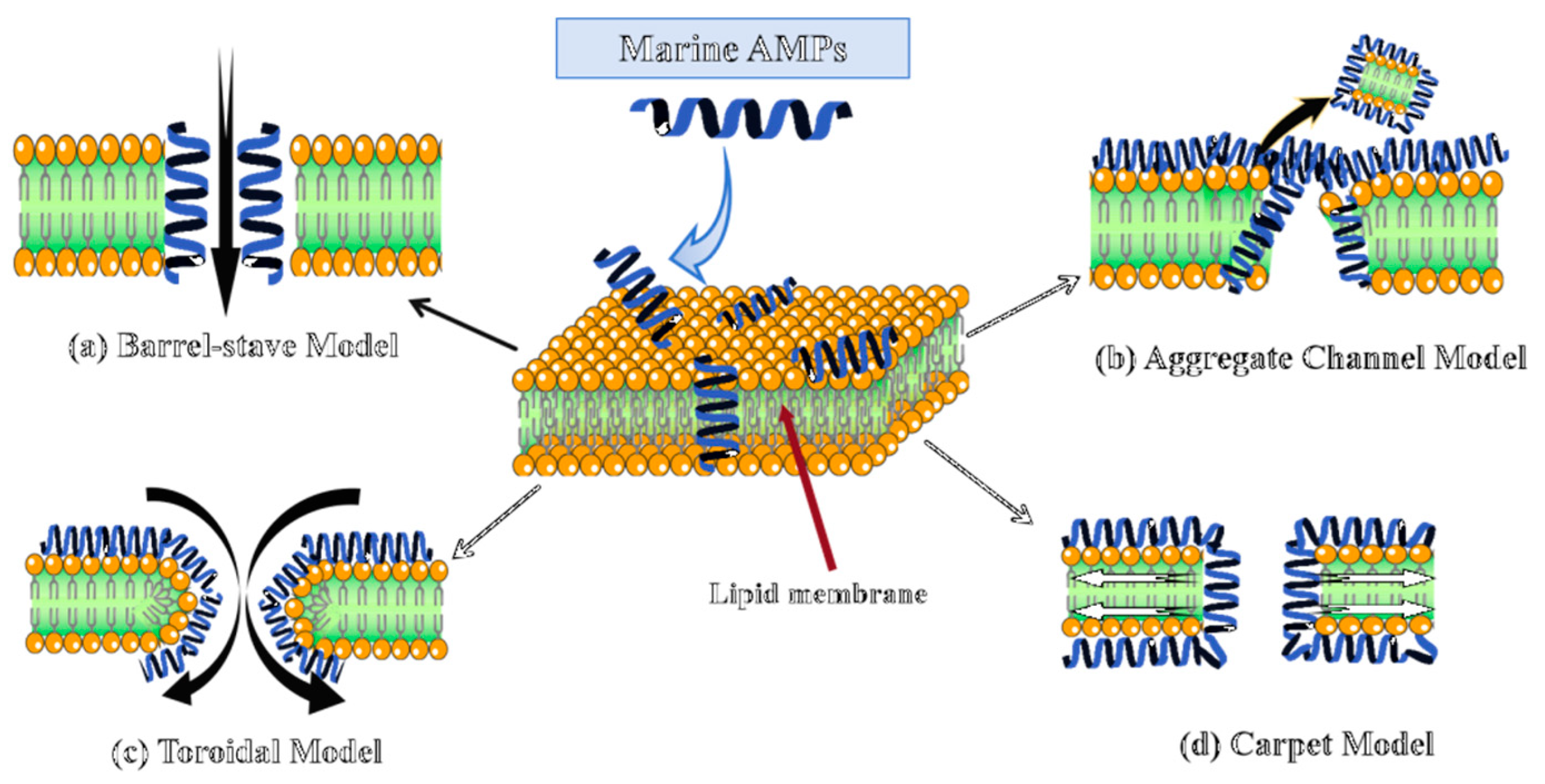
3.2. Membrane Target
3.3. Intracellular Target
3.4. For Biofilms
4. Biological Functions of Marine AMPs
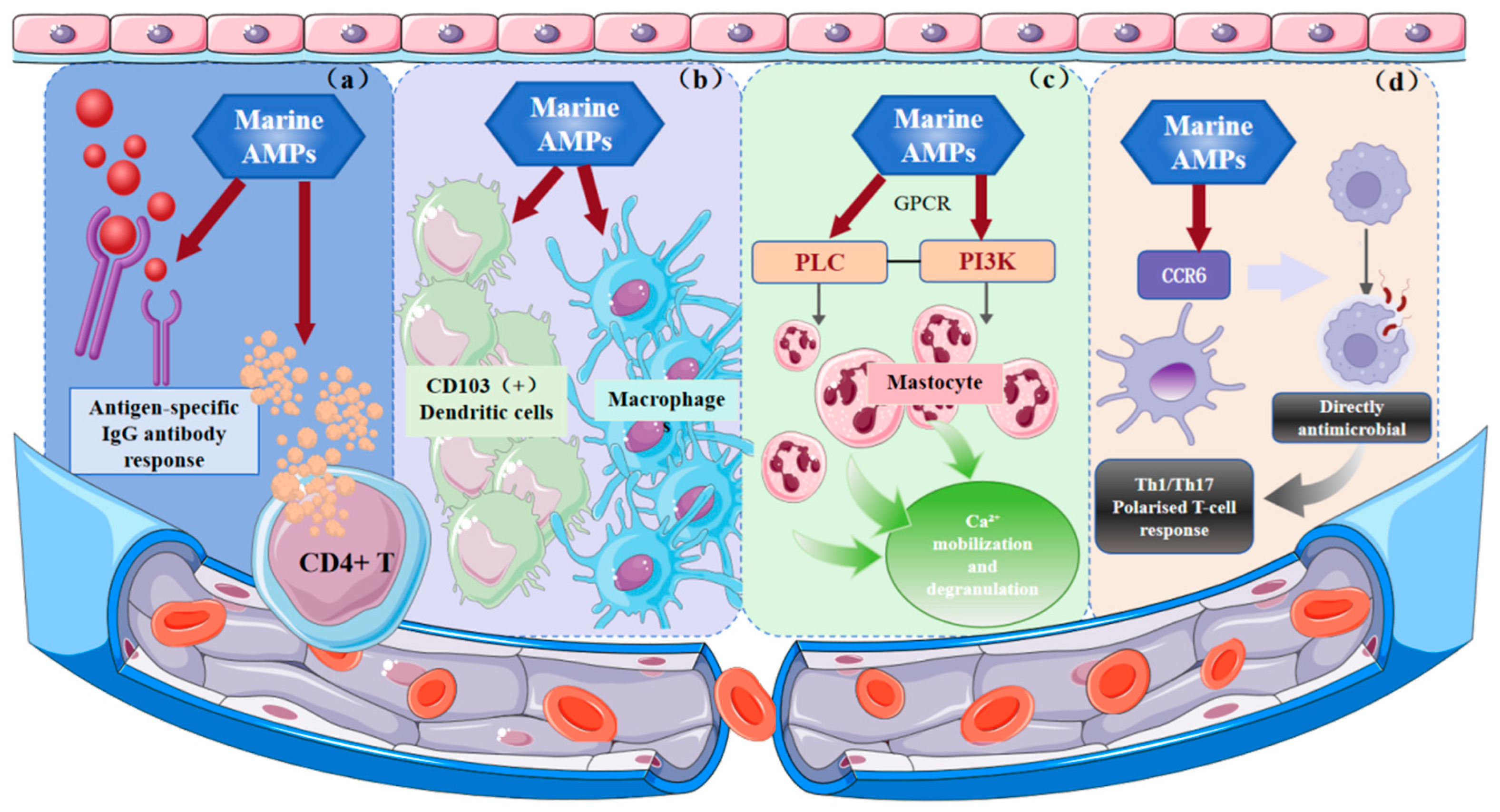
4.1. AMPs in Immunomodulation
4.2. Antiviral Properties
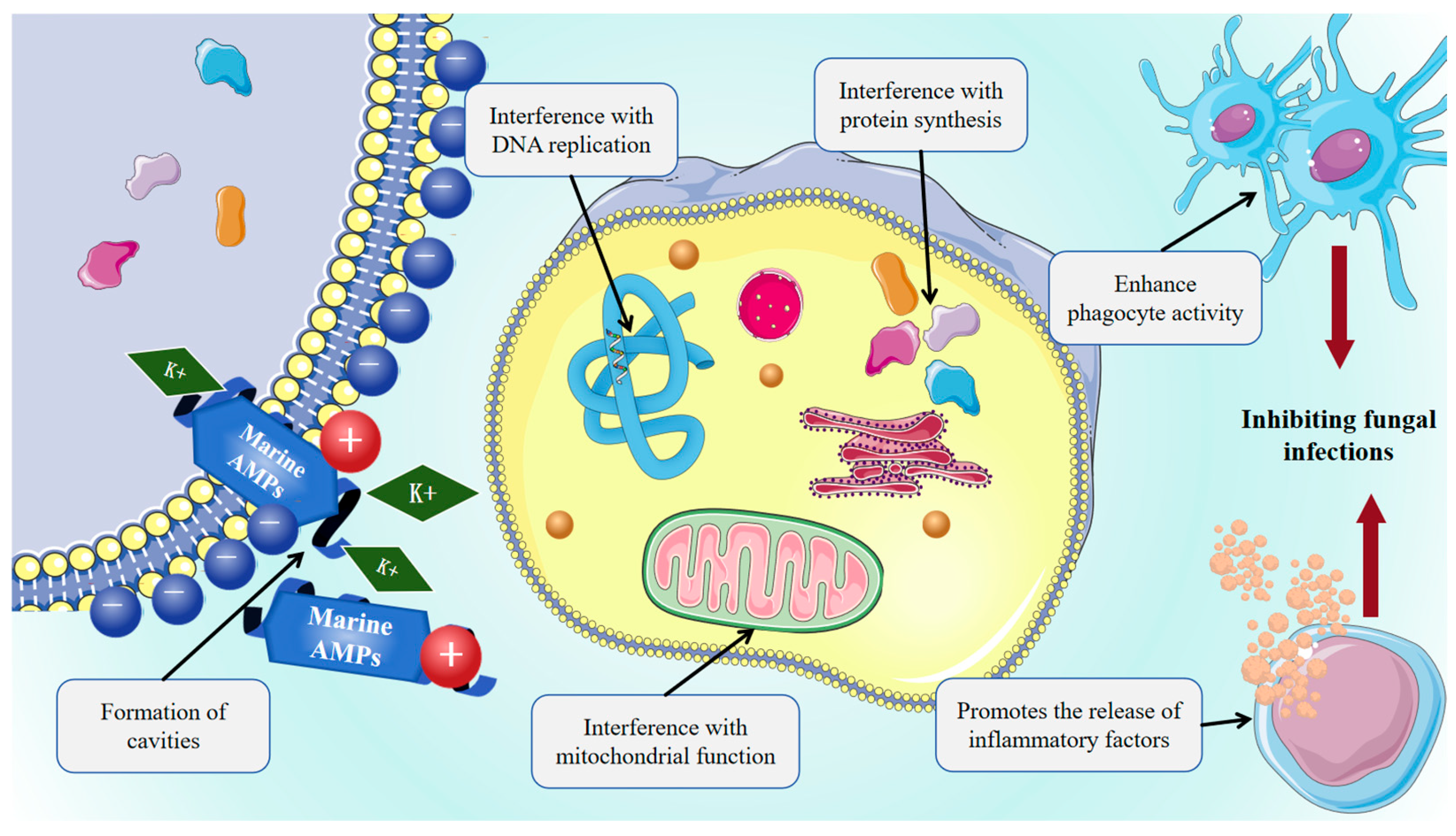
4.3. Antifungal Properties
4.4. Anticancer Properties
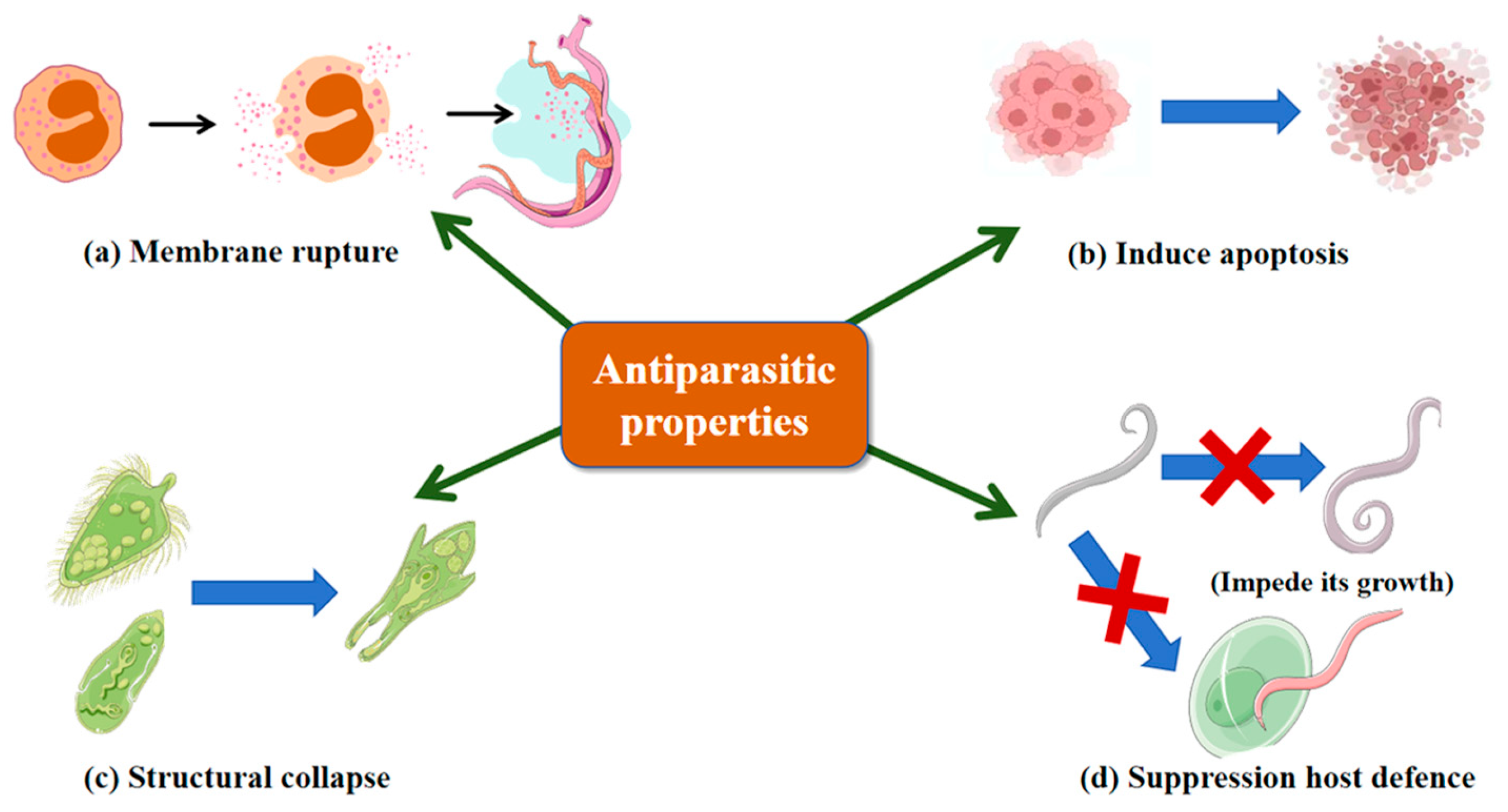
4.5. Antiparasitic Properties
4.6. Antioxidant Properties
4.7. Other Features
5. Preparation Technology of Marine AMPs
5.1. Natural Extraction
5.2. Protease Hydrolysis Method and Optimization
5.3. Chemical Synthesis
5.4. Cell-Free Preparation
5.5. Heterologous Expression
5.6. Plant Molecular Farming
6. Marine AMPs Application Areas
6.1. AMPs in the Food Industry
6.2. AMPs for Agricultural Applications
6.3. AMPs for Environmental Applications
7. Challenges in the Application of Marine AMPs
7.1. Stability and Activity Retention
7.2. Toxicity and Hemolytic
7.3. Production Costs and Scale-Up
7.4. Pharmacokinetic Activity
7.5. Resources and Regulations
8. Prospects for Marine AMPs
8.1. Drug Development Potential
8.2. Nanotechnology Application Strategy
9. Outlook and Concluding Remarks
Author Contributions
Funding
Institutional Review Board Statement
Data Availability Statement
Acknowledgments
Conflicts of Interest
References
- Ahmad, M.; Aduru, S.V.; Smith, R.P.; Zhao, Z.; Lopatkin, A.J. The role of bacterial metabolism in antimicrobial resistance. Nat. Rev. Microbiol. 2025, 23, 439–454. [Google Scholar] [CrossRef] [Scilit]
- Singh, P.K.; Sharma, S.; Kumari, A.; Korpole, S. A non-pediocin low molecular weight antimicrobial peptide produced by Pediococcus pentosaceus strain IE-3 shows increased activity under reducing environment. BMC Microbiol. 2014, 14, 226. [Google Scholar] [CrossRef] [Scilit]
- Waghu, F.H.; Barai, R.S.; Gurung, P.; Idicula-Thomas, S. CAMPR3: A database on sequences, structures and signatures of antimicrobial peptides. Nucleic. Acids. Res. 2016, 44, D1094–D1097. [Google Scholar] [CrossRef] [Scilit] [PubMed]
- Gallardo-Becerra, L.; Cervantes-Echeverria, M.; Cornejo-Granados, F.; Vazquez-Morado, L.E.; Ochoa-Leyva, A. Perspectives in searching antimicrobial peptides (AMPs) produced by the microbiota. Microb. Ecol. 2023, 87, 8. [Google Scholar] [CrossRef] [Scilit] [PubMed]
- Yu, H.H.; Wu, L.Y.; Hsu, P.L.; Lee, C.W.; Su, B.C. Marine antimicrobial peptide epinecidin-1 inhibits proliferation induced by lipoteichoic acid and causes cell death in non-small cell lung cancer cells via mitochondria damage. Probiotics Antimicrob. Proteins 2024, 16, 1724–1733. [Google Scholar] [CrossRef] [Scilit] [PubMed]
- Suttmann, H.; Retz, M.; Paulsen, F.; Harder, J.; Zwergel, U.; Kamradt, J.; Wullich, B.; Unteregger, G.; Stockle, M.; Lehmann, J. Antimicrobial peptides of the cecropin-family show potent antitumor activity against bladder cancer cells. BMC Urol. 2008, 8, 5. [Google Scholar] [CrossRef] [Scilit]
- Panayi, T.; Diavoli, S.; Nicolaidou, V.; Papaneophytou, C.; Petrou, C.; Sarigiannis, Y. Short-chained linear scorpion peptides: A pool for novel antimicrobials. Antibiotics 2024, 13, 422. [Google Scholar] [CrossRef] [Scilit]
- Moretta, A.; Scieuzo, C.; Petrone, A.M.; Salvia, R.; Manniello, M.D.; Franco, A.; Lucchetti, D.; Vassallo, A.; Vogel, H.; Sgambato, A.; et al. Antimicrobial peptides: A new hope in biomedical and pharmaceutical fields. Front. Cell. Infect. Microbiol. 2021, 11, 668632. [Google Scholar] [CrossRef] [Scilit]
- Erdem, B.M.; Kesmen, Z. Antimicrobial peptides (AMPs): A promising class of antimicrobial compounds. J. Appl. Microbiol. 2022, 132, 1573–1596. [Google Scholar] [CrossRef] [Scilit]
- Wang, S.; Fan, L.; Pan, H.; Li, Y.; Qiu, Y.; Lu, Y. Antimicrobial peptides from marine animals: Sources, structures, mechanisms and the potential for drug development. Front. Mar. Sci. 2023, 9, 11. [Google Scholar] [CrossRef] [Scilit]
- Rakers, S.; Niklasson, L.; Steinhagen, D.; Kruse, C.; Schauber, J.; Sundell, K.; Paus, R. Antimicrobial peptides (AMPs) from fish epidermis: Perspectives for investigative dermatology. J. Invest. Dermatol. 2013, 133, 1140–1149. [Google Scholar] [CrossRef] [Scilit] [PubMed]
- Kang, H.K.; Lee, H.H.; Seo, C.H.; Park, Y. Antimicrobial and immunomodulatory properties and applications of marine-derived proteins and peptides. Mar. Drugs 2019, 17, 350. [Google Scholar] [CrossRef] [Scilit] [PubMed]
- Chang, C.; Chang, P.; Lee, Y.; Pan, C.; Chang, H.; Wu, W.; Lin, M.; Chen, C.; Wen, Z.; Lee, C. The antimicrobial peptide tilapia piscidin 4 induced the apoptosis of bladder cancer through ERK/SIRT1/PGC-1alpha signaling pathway. Probiotics Antimicrob. Proteins 2024, 17, 3319–3337. [Google Scholar] [CrossRef] [Scilit] [PubMed]
- Laederach, A.; Andreotti, A.H.; Fulton, D.B. Solution and micelle-bound structures of tachyplesin I and its active aromatic linear derivatives. Biochemistry 2002, 41, 12359–12368. [Google Scholar] [CrossRef] [Scilit]
- Muta, T.; Fujimoto, T.; Nakajima, H.; Iwanaga, S. Tachyplesins isolated from hemocytes of Southeast Asian horseshoe crabs (Carcinoscorpius rotundicauda and Tachypleus gigas): Identification of a new tachyplesin, tachyplesin III, and a processing intermediate of its precursor. J. Biochem. 1990, 108, 261–266. [Google Scholar] [CrossRef] [Scilit]
- Zhang, L.; Scott, M.G.; Yan, H.; Mayer, L.D.; Hancock, R.E. Interaction of polyphemusin I and structural analogs with bacterial membranes, lipopolysaccharide, and lipid monolayers. Biochemistry 2000, 39, 14504–14514. [Google Scholar] [CrossRef] [Scilit]
- Meng, M.; Ning, J.; Yu, J.; Chen, D.; Meng, X.; Xu, J.; Zhang, J. Antitumor activity of recombinant antimicrobial peptide penaeidin-2 against kidney cancer cells. J. Huazhong Univ. Sci. Technolog. Med. Sci. 2014, 34, 529–534. [Google Scholar] [CrossRef] [Scilit]
- Destoumieux, D.; Munoz, M.; Bulet, P.; Bachere, E. Penaeidins, a family of antimicrobial peptides from penaeid shrimp (Crustacea, Decapoda). Cell. Mol. Life Sci. 2000, 57, 1260–1271. [Google Scholar] [CrossRef] [Scilit]
- Zhou, Y.; Meng, X.; Chen, F.; Xiong, M.; Zhang, W.; Wang, K. Newly discovered antimicrobial peptide scyampcin(44-63) from scylla paramamosain exhibits a multitargeted candidacidal mechanism in vitro and is effective in a murine model of vaginal candidiasis. Antimicrob. Agents. Chemother. 2023, 67, e2223. [Google Scholar] [CrossRef] [Scilit]
- Ma, X.; Hou, L.; Chen, B.; Fan, D.; Chen, Y.; Yang, Y.; Wang, K. A truncated sph12–38 with potent antimicrobial activity showing resistance against bacterial challenge in Oryzias melastigma. Fish Shellfish Immunol. 2017, 67, 561–570. [Google Scholar] [CrossRef] [Scilit]
- Guterstam, P.; Madani, F.; Hirose, H.; Takeuchi, T.; Futaki, S.; El Andaloussi, S.; Graslund, A.; Langel, U. Elucidating cell-penetrating peptide mechanisms of action for membrane interaction, cellular uptake, and translocation utilizing the hydrophobic counter-anion pyrenebutyrate. Biochim. Biophys. Acta 2009, 1788, 2509–2517. [Google Scholar] [CrossRef] [Scilit]
- Panteleev, P.V.; Tsarev, A.V.; Safronova, V.N.; Reznikova, O.V.; Bolosov, I.A.; Sychev, S.V.; Shenkarev, Z.O.; Ovchinnikova, T.V. Structure elucidation and functional studies of a novel beta-hairpin antimicrobial peptide from the marine Polychaeta Capitella teleta. Mar. Drugs 2020, 18, 620. [Google Scholar] [CrossRef] [Scilit] [PubMed]
- Pan, W.; Liu, X.; Ge, F.; Han, J.; Zheng, T. Perinerin, a novel antimicrobial peptide purified from the clamworm Perinereis aibuhitensis grube and its partial characterization. J. Biochem. 2004, 135, 297–304. [Google Scholar] [CrossRef] [Scilit] [PubMed]
- Tasiemski, A.; Schikorski, D.; Le Marrec-Croq, F.; Pontoire-Van Camp, C.; Boidin-Wichlacz, C.; Sautiere, P. Hedistin: A novel antimicrobial peptide containing bromotryptophan constitutively expressed in the NK cells-like of the marine annelid, Nereis diversicolor. Dev. Comp. Immunol. 2007, 31, 749–762. [Google Scholar] [CrossRef] [Scilit]
- Lofgren, S.E.; Miletti, L.C.; Steindel, M.; Bachere, E.; Barracco, M.A. Trypanocidal and leishmanicidal activities of different antimicrobial peptides (AMPs) isolated from aquatic animals. Exp. Parasitol. 2008, 118, 197–202. [Google Scholar] [CrossRef] [Scilit] [PubMed]
- Roch, P.; Yang, Y.; Toubiana, M.; Aumelas, A. NMR structure of mussel mytilin, and antiviral-antibacterial activities of derived synthetic peptides. Dev. Comp. Immunol. 2008, 32, 227–238. [Google Scholar] [CrossRef] [Scilit]
- Dong, B.; Wang, Y.; Cui, G.; Wang, Y.; Lin, Y.; Su, Z.; Zhao, G. In vitro antimicrobial activity of the novel antimicrobial peptide mytimacin—4 and its influence on the microbial community and quality of pork during refrigerated storage. Food Control 2024, 163, 12. [Google Scholar] [CrossRef] [Scilit]
- Domeneghetti, S.; Franzoi, M.; Damiano, N.; Norante, R.; Haifawy, N.M.E.; Mammi, S.; Marin, O.; Bellanda, M.; Venier, P. Structural and antimicrobial features of peptides related to myticin c, a special defense molecule from the mediterranean mussel Mytilus galloprovincialis. J. Agric. Food. Chem. 2015, 63, 9251–9259. [Google Scholar] [CrossRef] [Scilit]
- Mao, F.; Bao, Y.; Wong, N.K.; Huang, M.; Liu, K.; Zhang, X.; Yang, Z.; Yi, W.; Shu, X.; Xiang, Z.; et al. Large-Scale plasma peptidomic profiling reveals a novel, nontoxic, Crassostrea hongkongensis-derived antimicrobial peptide against foodborne pathogens. Mar. Drugs 2021, 19, 420. [Google Scholar] [CrossRef] [Scilit]
- Song, J.; Liu, K.; Jin, X.; Huang, K.; Fu, S.; Yi, W.; Cai, Y.; Yu, Z.; Mao, F.; Zhang, Y. Machine learning-driven discovery and evaluation of antimicrobial peptides from Crassostrea gigas mucus proteome. Mar. Drugs 2024, 22, 385. [Google Scholar] [CrossRef] [Scilit]
- Maselli, V.; Galdiero, E.; Salzano, A.M.; Scaloni, A.; Maione, A.; Falanga, A.; Naviglio, D.; Di Cosmo, A.; Galdiero, S. OctoPartenopin: Identification and preliminary characterization of a novel antimicrobial peptide from the suckers of Octopus vulgaris. Mar. Drugs 2020, 18, 380. [Google Scholar] [CrossRef] [Scilit] [PubMed]
- Nikapitiya, C.; Dananjaya, S.H.S.; Chandrarathna, H.P.S.U.; De Zoysa, M.; Whang, I. Octominin: A novel synthetic anticandidal peptide derived from defense protein of Octopus minor. Mar. Drugs 2020, 18, 56. [Google Scholar] [CrossRef] [Scilit] [PubMed]
- Liu, H.; Fan, M.; Liu, H.; Qi, P.; Zhi, L. Production and function of different regions from mytichitin-1 of Mytilus coruscus. Fish Shellfish Immunol. 2018, 84, 1018–1029. [Google Scholar] [CrossRef] [Scilit] [PubMed]
- Ovchinnikova, T.V.; Balandin, S.V.; Aleshina, G.M.; Tagaev, A.A.; Leonova, Y.F.; Krasnodembsky, E.D.; Men’Shenin, A.V.; Kokryakov, V.N. Aurelin, a novel antimicrobial peptide from jellyfish Aurelia aurita with structural features of defensins and channel-blocking toxins. Biochem. Biophys. Res. Commun. 2006, 348, 514–523. [Google Scholar] [CrossRef] [Scilit]
- Vidal-Dupiol, J.; Ladriere, O.; Destoumieux-Garzon, D.; Sautiere, P.; Meistertzheim, A.; Tambutte, E.; Tambutte, S.; Duval, D.; Foure, L.; Adjeroud, M.; et al. Innate immune responses of a scleractinian coral to vibriosis. J. Biol. Chem. 2011, 286, 22688–22698. [Google Scholar] [CrossRef] [Scilit]
- Silva, O.N.; de la Fuente-Nunez, C.; Haney, E.F.; Fensterseifer, I.C.M.; Ribeiro, S.M.; Porto, W.F.; Brown, P.; Faria-Junior, C.; Rezende, T.M.B.; Moreno, S.E.; et al. An anti-infective synthetic peptide with dual antimicrobial and immunomodulatory activities. Sci. Rep. 2016, 6, 35465. [Google Scholar] [CrossRef] [Scilit]
- Miller, A.; Matera-Witkiewicz, A.; Mikolajczyk, A.; Wieczorek, R.; Rowinska-Zyrek, M. Chemical “butterfly effect” explaining the coordination chemistry and antimicrobial properties of clavanin complexes. Inorg. Chem. 2021, 60, 12730–12734. [Google Scholar] [CrossRef] [Scilit]
- Lee, I.H.; Cho, Y.; Lehrer, R.I. Effects of pH and salinity on the antimicrobial properties of clavanins. Infect. Immun. 1997, 65, 2898–2903. [Google Scholar] [CrossRef] [Scilit]
- Lee, I.H.; Cho, Y.; Lehrer, R.I. Styelins, broad-spectrum antimicrobial peptides from the solitary tunicate, Styela clava. Comp. Biochem. Physiol. B-Biochem. Mol. Biol. 1997, 118, 515–521. [Google Scholar] [CrossRef] [Scilit]
- Li, C.; Haug, T.; Styrvold, O.B.; Jorgensen, T.O.; Stensvag, K. Strongylocins, novel antimicrobial peptides from the green sea urchin, Strongylocentrotus droebachiensis. Dev. Comp. Immunol. 2008, 32, 1430–1440. [Google Scholar] [CrossRef] [Scilit]
- Chee, P.Y.; Mang, M.; Lau, E.S.; Tan, L.T.; He, Y.W.; Lee, W.L.; Pusparajah, P.; Chan, K.G.; Lee, L.H.; Goh, B.H. Epinecidin-1, an antimicrobial peptide derived from grouper (Epinephelus coioides): Pharmacological activities and applications. Front. Microbiol. 2019, 10, 2631. [Google Scholar] [CrossRef] [Scilit]
- Wang, K.; Cai, J.; Cai, L.; Qu, H.; Yang, M.; Zhang, M. Cloning and expression of a hepcidin gene from a marine fish (Pseudosciaena crocea) and the antimicrobial activity of its synthetic peptide. Peptides 2009, 30, 638–646. [Google Scholar] [CrossRef] [Scilit] [PubMed]
- Zhang, J.; Yan, Q.; Ji, R.; Zou, W.; Guo, G. Isolation and characterization of a hepcidin peptide from the head kidney of large yellow croaker, Pseudosciaena crocea. Fish Shellfish Immunol. 2009, 26, 864–870. [Google Scholar] [CrossRef] [Scilit] [PubMed]
- Yang, S.; Li, J.; Aweya, J.J.; Yuan, Z.; Weng, W.; Zhang, Y.; Liu, G. Antimicrobial mechanism of Larimichthys crocea whey acidic protein-derived peptide (LCWAP) against Staphylococcus aureus and its application in milk. Int. J. Food Microbiol. 2020, 335, 108891. [Google Scholar] [CrossRef] [Scilit] [PubMed]
- Choi, M.; Jang, H.S.; Oh, Y.D.; Jeon, Y.; Kim, J.; Lim, H.K. Characterization and antimicrobial activity of a novel pleurocidin in starry flounder (Platichthys stellatus). Fish Shellfish Immunol. 2025, 163, 110420. [Google Scholar] [CrossRef] [Scilit]
- Gonzalez Garcia, M.; Rodriguez, A.; Alba, A.; Vazquez, A.A.; Morales Vicente, F.E.; Perez-Erviti, J.; Spellerberg, B.; Stenger, S.; Grieshober, M.; Conzelmann, C.; et al. New antibacterial peptides from the freshwater Mollusk Pomacea poeyana (Pilsbry, 1927). Biomolecules 2020, 10, 1473. [Google Scholar] [CrossRef] [Scilit]
- Pu, C.; Tang, W. Affinity and selectivity of anchovy antibacterial peptide for Staphylococcus aureus cell membrane lipid and its application in whole milk. Food Control 2017, 72, 153–163. [Google Scholar] [CrossRef] [Scilit]
- Noga, E.J.; Silphaduang, U.; Park, N.G.; Seo, J.K.; Stephenson, J.; Kozlowicz, S. Piscidin 4, a novel member of the piscidin family of antimicrobial peptides. Comp. Biochem. Physiol. B-Biochem. Mol. Biol. 2009, 152, 299–305. [Google Scholar] [CrossRef] [Scilit]
- Sun, B.J.; Xie, H.X.; Song, Y.; Nie, P. Gene structure of an antimicrobial peptide from mandarin fish, Siniperca chuatsi (Basilewsky), suggests that moronecidins and pleurocidins belong in one family: The piscidins. J. Fish Dis. 2007, 30, 335–343. [Google Scholar] [CrossRef] [Scilit]
- Thennarasu, S.; Nagaraj, R. Specific antimicrobial and hemolytic activities of 18-residue peptides derived from the amino terminal region of the toxin pardaxin. Protein Eng. 1996, 9, 1219–1224. [Google Scholar] [CrossRef] [Scilit]
- Cho, S.H.; Lee, B.D.; An, H.; Eun, J.B. Kenojeinin I, antimicrobial peptide isolated from the skin of the fermented skate, Raja kenojei. Peptides 2005, 26, 581–587. [Google Scholar] [CrossRef] [Scilit]
- Qiao, X.; Yang, H.; Gao, J.; Zhang, F.; Chu, P.; Yang, Y.; Zhang, M.; Wang, Y.; Yu, H. Diversity, immunoregulatory action and structure-activity relationship of green sea turtle cathelicidins. Dev. Comp. Immunol. 2019, 98, 189–204. [Google Scholar] [CrossRef] [Scilit]
- Chattopadhyay, S.; Sinha, N.K.; Banerjee, S.; Roy, D.; Chattopadhyay, D.; Roy, S. Small cationic protein from a marine turtle has beta-defensin-like fold and antibacterial and antiviral activity. Proteins 2006, 64, 524–531. [Google Scholar] [CrossRef] [Scilit] [PubMed]
- Wei, L.; Gao, J.; Zhang, S.; Wu, S.; Xie, Z.; Ling, G.; Kuang, Y.; Yang, Y.; Yu, H.; Wang, Y. Identification and characterization of the first cathelicidin from sea snakes with potent antimicrobial and anti-inflammatory activity and special mechanism. J. Biol. Chem. 2015, 290, 16633–16652. [Google Scholar] [CrossRef] [Scilit] [PubMed]
- Wang, S.; Fan, L.; Pan, H.; Li, Y.; Zhao, X.; Qiu, Y.; Lu, Y. Identification and Characterization of a novel cathelicidin from Hydrophis cyanocinctus with antimicrobial and anti-Inflammatory activity. Molecules 2023, 28, 2082. [Google Scholar] [CrossRef] [Scilit]
- Sola, R.; Mardirossian, M.; Beckert, B.; Sanghez De Luna, L.; Prickett, D.; Tossi, A.; Wilson, D.N.; Scocchi, M. Characterization of cetacean proline-rich antimicrobial peptides displaying activity against ESKAPE pathogens. Int. J. Mol. Sci. 2020, 21, 7367. [Google Scholar] [CrossRef] [Scilit] [PubMed]
- Mardirossian, M.; Perebaskine, N.; Benincasa, M.; Gambato, S.; Hofmann, S.; Huter, P.; Muller, C.; Hilpert, K.; Innis, C.A.; Tossi, A.; et al. The dolphin proline-rich antimicrobial peptide Tur1A inhibits protein synthesis by targeting the bacterial ribosome. Cell Chem. Biol. 2018, 25, 530–539. [Google Scholar] [CrossRef] [Scilit]
- Cherniavskyi, Y.K.; Oliva, R.; Stellato, M.; Vecchio, P.D.; Galdiero, S.; Falanga, A.; Dames, S.A.; Tieleman, D.P. Structural characterization of the antimicrobial peptides myxinidin and WMR in bacterial membrane mimetic micelles and bicelles. Biochim. Et Biophys. Acta (BBA)—Biomembr. 2024, 1866, 184272. [Google Scholar] [CrossRef] [Scilit]
- Luque-Ortega, J.R.; Cruz, L.J.; Albericio, F.; Rivas, L. The antitumoral depsipeptide IB-01212 kills leishmania through an apoptosis-like process involving intracellular targets. Mol. Pharm. 2010, 7, 1608–1617. [Google Scholar] [CrossRef] [Scilit]
- Beau, J.; Mahid, N.; Burda, W.N.; Harrington, L.; Shaw, L.N.; Mutka, T.; Kyle, D.E.; Barisic, B.; Van Olphen, A.; Baker, B.J. Epigenetic tailoring for the production of anti-infective cytosporones from the marine fungus Leucostoma persoonii. Mar. Drugs 2012, 10, 762–774. [Google Scholar] [CrossRef] [Scilit]
- Watts, K.R.; Ratnam, J.; Ang, K.; Tenney, K.; Compton, J.E.; Mckerrow, J.; Crews, P. Assessing the trypanocidal potential of natural and semi-synthetic diketopiperazines from two deep water marine-derived fungi. Bioorg. Med. Chem. 2010, 18, 2566–2574. [Google Scholar] [CrossRef] [Scilit]
- Pettit, G.R.; Knight, J.C.; Herald, D.L.; Pettit, R.K.; Hogan, F.; Mukku, V.J.R.V.; Hamblin, J.S.; Dodson, M.J.; Chapuis, J. Antineoplastic agents. 570. Isolation and structure elucidation of bacillistatins 1 and 2 from a marine Bacillus silvestris. J. Nat. Prod. 2009, 72, 366–371. [Google Scholar] [CrossRef] [Scilit]
- Oku, N.; Kawabata, K.; Adachi, K.; Katsuta, A.; Shizuri, Y. Unnarmicins a and c, new antibacterial depsipeptides produced by marine bacterium Photobacterium sp. MBIC06485. J. Antibiot. 2008, 61, 11–17. [Google Scholar] [CrossRef] [Scilit] [PubMed]
- Oku, N.; Adachi, K.; Matsuda, S.; Kasai, H.; Takatsuki, A.; Shizuri, Y. Ariakemicins a and b, novel polyketide-peptide antibiotics from a marine gliding bacterium of the genus Rapidithrix. Org. Lett. 2008, 10, 2481–2484. [Google Scholar] [CrossRef] [Scilit] [PubMed]
- Guzman, F.; Wong, G.; Roman, T.; Cardenas, C.; Alvarez, C.; Schmitt, P.; Albericio, F.; Rojas, V. Identification of antimicrobial peptides from the Microalgae Tetraselmis suecica (Kylin) butcher and bactericidal activity improvement. Mar. Drugs 2019, 17, 453. [Google Scholar] [CrossRef] [Scilit] [PubMed]
- Shin, E.; Hwang, H.; Kim, I.; Nam, T. A glycoprotein from Porphyra yezoensis produces anti-inflammatory effects in liposaccharide-stimulated macrophages via the TLR4 signaling pathway. Int. J. Mol. Med. 2011, 28, 809–815. [Google Scholar] [CrossRef] [Scilit]
- Righini, H.; Francioso, O.; Di Foggia, M.; Quintana, A.M.; Roberti, R. Preliminary Study on the activity of phycobiliproteins against Botrytis cinerea. Mar. Drugs 2020, 18, 600. [Google Scholar] [CrossRef] [Scilit]
- Bo, J.; Yang, Y.; Zheng, R.; Fang, C.; Jiang, Y.; Liu, J.; Chen, M.; Hong, F.; Bailey, C.; Segner, H.; et al. Antimicrobial activity and mechanisms of multiple antimicrobial peptides isolated from rockfish Sebastiscus marmoratus. Fish Shellfish Immunol. 2019, 93, 1007–1017. [Google Scholar] [CrossRef] [Scilit]
- Rajanbabu, V.; Chen, J.Y. Applications of antimicrobial peptides from fish and perspectives for the future. Peptides 2011, 32, 415–420. [Google Scholar] [CrossRef] [Scilit]
- Chaturvedi, P.; Bhat, R.A.H.; Pande, A. Antimicrobial peptides of fish: Innocuous alternatives to antibiotics. Rev. Aquac. 2020, 12, 85–106. [Google Scholar] [CrossRef] [Scilit]
- Nguyen, L.T.; Haney, E.F.; Vogel, H.J. The expanding scope of antimicrobial peptide structures and their modes of action. Trends. Biotechnol. 2011, 29, 464–472. [Google Scholar] [CrossRef] [Scilit]
- Qi-Yu, Z.; Zhi-Bin, Y.; Yue-Ming, M.; Xiang-Yu, H.; Gang, S.; Xu-Rui, C.; Jun, L.; Melbourne, U.O.; Cai-Yun, F. Antimicrobial peptides: Mechanism of action, activity and clinical potential. Mil. Med. Res. 2021, 8, 48. [Google Scholar] [CrossRef] [Scilit]
- Kumari, S.; Booth, V. Antimicrobial peptide mechanisms studied by Whole-Cell deuterium NMR. Int. J. Mol. Sci. 2022, 23, 2740. [Google Scholar] [CrossRef] [Scilit]
- Guryanova, S.V.; Ovchinnikova, T.V. Multifaceted marine peptides and their therapeutic potential. Mar. Drugs 2025, 23, 288. [Google Scholar] [CrossRef] [Scilit] [PubMed]
- Zheng, S.; Tu, Y.; Li, B.; Qu, G.; Li, A.; Peng, X.; Li, S.; Shao, C. Antimicrobial peptide biological activity, delivery systems and clinical translation status and challenges. J. Transl. Med. 2025, 23, 292. [Google Scholar] [CrossRef] [Scilit] [PubMed]
- Su, Z.; Yu, H.; Lv, T.; Chen, Q.; Luo, H.; Zhang, H. Progress in the classification, optimization, activity, and application of antimicrobial peptides. Front. Microbiol. 2025, 16, 1582863. [Google Scholar] [CrossRef] [Scilit] [PubMed]
- Bouchet, P.; Kantor, Y.I.; Sysoev, A.; Puillandre, N. A new operational classification of the conoidea (Gastropoda). J. Molluscan Stud. 2011, 77, 273–308. [Google Scholar] [CrossRef] [Scilit]
- Boeuf, G. Marine biodiversity characteristics. Comptes Rendus Biol. 2011, 334, 435–440. [Google Scholar] [CrossRef] [Scilit]
- Jeong, G.; Khan, F.; Tabassum, N.; Cho, K.; Kim, Y. Marine-derived bioactive materials as antibiofilm and antivirulence agents. Trends. Biotechnol. 2024, 42, 1288–1304. [Google Scholar] [CrossRef] [Scilit]
- Nguyen, T.; Sperou, N.; Su, P.; Zhang, W. Marine biorefinery: An environmentally sustainable solution to turn marine biomass and processing wastes into value-added products and profits. Biochem. 2022, 44, 22–27. [Google Scholar] [CrossRef] [Scilit]
- Andersson, D.I.; Hughes, D.; Kubicek-Sutherland, J.Z. Mechanisms and consequences of bacterial resistance to antimicrobial peptides. Drug Resist. Update 2016, 26, 43–57. [Google Scholar] [CrossRef] [Scilit] [PubMed]
- Jangir, P.K.; Ogunlana, L.; Maclean, R.C. Evolutionary constraints on the acquisition of antimicrobial peptide resistance in bacterial pathogens. Trends Microbiol. 2021, 29, 1058–1061. [Google Scholar] [CrossRef] [Scilit] [PubMed]
- Ramesh, C.; Tulasi, B.R.; Raju, M.; Thakur, N.; Dufosse, L. Marine Natural Products from tunicates and their associated microbes. Mar. Drugs 2021, 19, 308. [Google Scholar] [CrossRef] [Scilit] [PubMed]
- Stanovova, M.; Gazizova, G.R.; Gorbushin, A.M. Transcriptomic profiling of immune-associated molecules in the coelomocytes of lugworm Arenicola marina (Linnaeus, 1758). J. Exp. Zool. Part B 2023, 340, 34–55. [Google Scholar] [CrossRef] [Scilit]
- Sperstad, S.V.; Haug, T.; Blencke, H.; Styrvold, O.B.; Li, C.; Stensvag, K. Antimicrobial peptides from marine invertebrates: Challenges and perspectives in marine antimicrobial peptide discovery. Biotechnol. Adv. 2011, 29, 519–530. [Google Scholar] [CrossRef] [Scilit]
- Chen, Y.; Yi, M.; Wang, Y.; Yao, L.; Ji, G.; Gao, Z. Identification of a novel antimicrobial peptide from amphioxus ribosomal protein L27. Fish Shellfish Immunol. 2025, 157, 110063. [Google Scholar] [CrossRef] [Scilit]
- Ahn, M.; Rajasekaran, G.; Gunasekaran, P.; Ryu, E.K.; Lee, G.; Hyun, J.; Cheong, C.; Kim, N.; Shin, S.Y.; Bang, J. Enhancement of antibacterial activity of short tryptophan-rich antimicrobial peptide Pac-525 by replacing Trp with His (chx). Bull. Korean Chem. Soc. 2014, 35, 2818–2824. [Google Scholar] [CrossRef] [Scilit]
- Ahn, M.; Murugan, R.N.; Jacob, B.; Hyun, J.; Cheong, C.; Hwang, E.; Park, H.; Seo, J.; Srinivasrao, G.; Lee, K.S.; et al. Discovery of novel histidine-derived lipo-amino acids: Applied in the synthesis of ultra-short antimicrobial peptidomimetics having potent antimicrobial activity, salt resistance and protease stability. Eur. J. Med. Chem. 2013, 68, 10–18. [Google Scholar] [CrossRef] [Scilit]
- Yang, B.; Yang, H.; Liang, J.; Chen, J.; Wang, C.; Wang, Y.; Wang, J.; Luo, W.; Deng, T.; Guo, J. A review on the screening methods for the discovery of natural antimicrobial peptides. J. Pharm. Anal. 2025, 15, 16. [Google Scholar] [CrossRef] [Scilit]
- Kavousi, K.; Bagheri, M.; Behrouzi, S.; Vafadar, S.; Atanaki, F.F.; Lotfabadi, B.T.; Ariaeenejad, S.; Shockravi, A.; Moosavi-Movahedi, A.A. IAMPE: NMR-assisted computational prediction of antimicrobial peptides. J. Chem Inf. Model. 2020, 60, 4691–4701. [Google Scholar] [CrossRef] [Scilit]
- Chen, J.; Jia, Y.; Sun, Y.; Liu, K.; Zhou, C.; Liu, C.; Li, D.; Liu, G.; Zhang, C.; Yang, T.; et al. Global marine microbial diversity and its potential in bioprospecting. Nature 2024, 633, 371–379. [Google Scholar] [CrossRef] [Scilit]
- Shen, H.; Li, Y.; Pi, Q.; Tian, J.; Xu, X.; Huang, Z.; Huang, J.; Pian, C.; Mao, S. Unveiling novel antimicrobial peptides from the ruminant gastrointestinal microbiomes: A deep learning-driven approach yields an anti-MRSA candidate. J. Adv. Res. 2025, 77, 821–835. [Google Scholar] [CrossRef] [Scilit]
- Chen, B.; Zhang, Z.; Zhang, Q.; Xu, N.; Lu, T.; Wang, T.; Hong, W.; Fu, Z.; Penuelas, J.; Gillings, M.; et al. Antimicrobial peptides in the global microbiome: Biosynthetic genes and resistance determinants. Environ. Sci. Technol. 2023, 57, 7698–7708. [Google Scholar] [CrossRef] [Scilit]
- Wei, B.; Hu, G.; Zhou, Z.; Yu, W.; Du, A.; Yang, C.; Yu, Y.; Chen, J.; Zhang, H.; Wu, Q.; et al. Global analysis of the biosynthetic chemical space of marine prokaryotes. Microbiome 2023, 11, 144. [Google Scholar] [CrossRef] [Scilit]
- Prichula, J.; Primon-Barros, M.; Luz, R.C.Z.; Castro, I.M.S.; Paim, T.G.S.; Tavares, M.; Ligabue-Braun, R.; D’Azevedo, P.A.; Frazzon, J.; Frazzon, A.P.G.; et al. Genome mining for antimicrobial compounds in wild marine animals-associated enterococci. Mar. Drugs 2021, 19, 328. [Google Scholar] [CrossRef] [Scilit] [PubMed]
- Fan, S.; Qin, P.; Lu, J.; Wang, S.; Zhang, J.; Wang, Y.; Cheng, A.; Cao, Y.; Ding, W.; Zhang, W. Bioprospecting of culturable marine biofilm bacteria for novel antimicrobial peptides. Imeta 2024, 3, e244. [Google Scholar] [CrossRef] [Scilit] [PubMed]
- Sruthy, K.S.; Nair, A.; Puthumana, J.; Antony, S.P.; Singh, I.S.B.; Philip, R. Molecular cloning, recombinant expression and functional characterization of an antimicrobial peptide, Crustin from the Indian white shrimp, Fenneropenaeus indicus. Fish Shellfish Immunol. 2017, 71, 83–94. [Google Scholar] [CrossRef] [Scilit] [PubMed]
- Lin, J.; Wan, H.; Xue, H.; He, Y.; Peng, B.; Zhang, Z.; Wang, Y. Transcriptomics reveals different response mechanisms of Litopenaeus vannamei hemocytes to injection of Vibrio parahaemolyticus and WSSV. Comp. Biochem. Physiol. D-Genomics Proteomics 2024, 50, 101201. [Google Scholar] [CrossRef] [Scilit]
- Fei, Y.; Wang, Q.; Lu, J.; Ouyang, L.; Hu, Q.; Chen, L. New insights into the antimicrobial mechanism of LEAP2 mutant zebrafish under Aeromonas hydrophila infection using transcriptome analysis. Fish Shellfish Immunol. 2023, 143, 109225. [Google Scholar] [CrossRef] [Scilit]
- Gao, Q.; Ge, L.; Wang, Y.; Zhu, Y.; Liu, Y.; Zhang, H.; Huang, J.; Qin, Z. An explainable few-shot learning model for the directed evolution of antimicrobial peptides. Int. J. Biol. Macromol. 2025, 285, 138272. [Google Scholar] [CrossRef] [Scilit]
- Lin, B.; Hung, A.; Li, R.; Barlow, A.; Singleton, W.; Matthyssen, T.; Sani, M.; Hossain, M.A.; Wade, J.D.; O’Brien-Simpson, N.M.; et al. Systematic comparison of activity and mechanism of antimicrobial peptides against nosocomial pathogens. Eur. J. Med. Chem. 2022, 231, 114135. [Google Scholar] [CrossRef] [Scilit]
- Houyvet, B.; Bouchon-Navaro, Y.; Bouchon, C.; Corre, E.; Zatylny-Gaudin, C. Marine transcriptomics analysis for the identification of new antimicrobial peptides. Mar. Drugs 2021, 19, 490. [Google Scholar] [CrossRef] [Scilit] [PubMed]
- Li, R.; Huang, Y.; Peng, C.; Gao, Z.; Liu, J.; Yin, X.; Gao, B.; Ovchinnikova, T.V.; Qiu, L.; Bian, C.; et al. High-throughput prediction and characterization of antimicrobial peptides from multi-omics datasets of Chinese tubular cone snail (Conus betulinus). Front. Mar. Sci. 2022, 9, 13. [Google Scholar] [CrossRef] [Scilit]
- Huang, J.; Xu, Y.; Xue, Y.; Huang, Y.; Li, X.; Chen, X.; Xu, Y.; Zhang, D.; Zhang, P.; Zhao, J.; et al. Identification of potent antimicrobial peptides via a machine-learning pipeline that mines the entire space of peptide sequences. Nat. Biomed. Eng. 2023, 7, 797–810. [Google Scholar] [CrossRef] [Scilit] [PubMed]
- Pandi, A.; Adam, D.; Zare, A.; Trinh, V.T.; Schaefer, S.L.; Burt, M.; Klabunde, B.; Bobkova, E.; Kushwaha, M.; Foroughijabbari, Y.; et al. Cell-free biosynthesis combined with deep learning accelerates de novo-development of antimicrobial peptides. Nat. Commun. 2023, 14, 7197. [Google Scholar] [CrossRef] [Scilit]
- Wu, K.; Xu, G.; Tian, Y.; Li, G.; Yi, Z.; Tang, X. Synthesis and evaluation of aquatic antimicrobial peptides derived from marine metagenomes using a high-throughput screening approach. Mar. Drugs 2025, 23, 178. [Google Scholar] [CrossRef] [Scilit]
- Caprani, M.; Slattery, O.; O’Keeffe, J.; Healy, J. Identification of antimicrobial peptides from macroalgae with machine learning. In Proceedings of the International Conference on Practical Applications of Computational Biology & Bioinformatics, L’Aquila, Italy, 17–19 June 2020; Springer International Publishing: Cham, Switzerland, 2020; pp. 1–11. [Google Scholar] [CrossRef] [Scilit]
- Aguero-Chapin, G.; Marrero-Ponce, Y.; Castillo-Mendieta, K.; Antunes, A. Unveiling encrypted antimicrobial peptides from cephalopods’ salivary glands: A proteolysis-driven virtual approach. ACS Omega 2024, 9, 43353–43367. [Google Scholar] [CrossRef] [Scilit]
- Mohanram, H.; Bhattacharjya, S. Resurrecting inactive antimicrobial peptides from the lipopolysaccharide trap. Antimicrob. Agents. Chemother. 2014, 58, 1987–1996. [Google Scholar] [CrossRef] [Scilit]
- Li, X.; Zuo, S.; Wang, B.; Zhang, K.; Wang, Y. Antimicrobial mechanisms and clinical application prospects of antimicrobial peptides. Molecules 2022, 27, 2675. [Google Scholar] [CrossRef] [Scilit]
- Hu, J.; Li, S.; Lv, Q.; Miao, M.; Li, X.; Li, F. Characterization of the Dual Functions of LvCrustinVII from Litopenaeus vannamei as antimicrobial peptide and opsonin. Mar. Drugs 2022, 20, 157. [Google Scholar] [CrossRef] [Scilit]
- Li, J.; Li, Y.; Fan, Z.; Chen, S.; Yan, X.; Yue, Z.; Huang, G.; Liu, S.; Zhang, H.; Chen, S.; et al. Two amphioxus ApeC-Containing proteins bind to microbes and inhibit the TRAF6 pathway. Front. Immunol. 2021, 12, 715245. [Google Scholar] [CrossRef] [Scilit] [PubMed]
- Schmitt, P.; Wilmes, M.; Pugniere, M.; Aumelas, A.; Bachere, E.; Sahl, H.; Schneider, T.; Destoumieux-Garzon, D. Insight into invertebrate defensin mechanism of action: Oyster defensins inhibit peptidoglycan biosynthesis by binding to lipid II. J. Biol. Chem. 2010, 285, 29208–29216. [Google Scholar] [CrossRef] [Scilit] [PubMed]
- Pushpanathan, M.; Gunasekaran, P.; Rajendhran, J. Mechanisms of the antifungal action of marine metagenome-derived peptide, MMGP1, against Candida albicans. PLoS ONE 2013, 8, e69316. [Google Scholar] [CrossRef] [Scilit] [PubMed]
- Cardoso, M.H.; de la Fuente-Nunez, C.; Santos, N.C.; Zasloff, M.A.; Franco, O.L. Influence of antimicrobial peptides on the bacterial membrane curvature and vice versa. Trends Microbiol. 2024, 32, 624–627. [Google Scholar] [CrossRef] [Scilit]
- Ramos-Martin, F.; D’Amelio, N. Biomembrane lipids: When physics and chemistry join to shape biological activity. Biochimie 2022, 203, 118–138. [Google Scholar] [CrossRef] [Scilit]
- Arouri, A.; Dathe, M.; Blume, A. The helical propensity of KLA amphipathic peptides enhances their binding to gel-state lipid membranes. Biophys. Chem. 2013, 180–181, 10–21. [Google Scholar] [CrossRef] [Scilit]
- Marquette, A.; Bechinger, B. Biophysical investigations elucidating the mechanisms of action of antimicrobial peptides and their synergism. Biomolecules 2018, 8, 18. [Google Scholar] [CrossRef] [Scilit]
- Lin, B.; Hung, A.; Singleton, W.; Darmawan, K.K.; Moses, R.; Yao, B.; Wu, H.; Barlow, A.; Marc-Antoine, S.; Sloan, A.J.; et al. The effect of tailing lipidation on the bioactivity of antimicrobial peptides and their aggregation tendency. Aggregate 2023, 4, 15. [Google Scholar] [CrossRef] [Scilit]
- Porcelli, F.; Buck, B.; Lee, D.; Hallock, K.J.; Ramamoorthy, A.; Veglia, G. Structure and orientation of pardaxin determined by NMR experiments in model membranes. J. Biol. Chem. 2004, 279, 45815–45823. [Google Scholar] [CrossRef] [Scilit]
- Luo, Y.; Song, Y. Mechanism of antimicrobial peptides: Antimicrobial, Anti-Inflammatory and antibiofilm activities. Int. J. Mol. Sci. 2021, 22, 11401. [Google Scholar] [CrossRef] [Scilit]
- Huan, Y.; Kong, Q.; Mou, H.; Yi, H. Antimicrobial peptides: Classification, design, application and research progress in multiple fields. Front. Microbiol. 2020, 11, 582779. [Google Scholar] [CrossRef] [Scilit] [PubMed]
- Garcia-Fernandez, R.; Peigneur, S.; Pons, T.; Alvarez, C.; Gonzalez, L.; Chavez, M.A.; Tytgat, J. The Kunitz-type protein ShPI-1 inhibits serine proteases and Voltage-Gated potassium channels. Toxins 2016, 8, 110. [Google Scholar] [CrossRef] [Scilit]
- Zhang, K.; Li, X.; Yu, C.; Wang, Y. Promising therapeutic strategies against microbial biofilm challenges. Front. Cell. Infect. Microbiol. 2020, 10, 16. [Google Scholar] [CrossRef] [Scilit] [PubMed]
- Flemming, H.; van Hullebusch, E.D.; Neu, T.R.; Nielsen, P.H.; Seviour, T.; Stoodley, P.; Wingender, J.; Wuertz, S. The biofilm matrix: Multitasking in a shared space. Nat. Rev. Microbiol. 2023, 21, 70–86. [Google Scholar] [CrossRef] [Scilit] [PubMed]
- Brancatisano, F.L.; Maisetta, G.; Di Luca, M.; Esin, S.; Bottai, D.; Bizzarri, R.; Campa, M.; Batoni, G. Inhibitory effect of the human liver-derived antimicrobial peptide hepcidin 20 on biofilms of polysaccharide intercellular adhesin (PIA)-positive and PIA-negative strains of Staphylococcus epidermidis. Biofouling 2014, 30, 435–446. [Google Scholar] [CrossRef] [Scilit]
- Neshani, A.; Zare, H.; Akbari Eidgahi, M.R.; Khaledi, A.; Ghazvini, K. Epinecidin-1, a highly potent marine antimicrobial peptide with anticancer and immunomodulatory activities. BMC Pharmacol. Toxicol. 2019, 20, 33. [Google Scholar] [CrossRef] [Scilit]
- Chatterjee, D.; Sivashanmugam, K. Immunomodulatory peptides: New therapeutic horizons for emerging and re-emerging infectious diseases. Front. Microbiol. 2024, 15, 1505571. [Google Scholar] [CrossRef] [Scilit]
- Oh, D.; Strangman, W.K.; Kauffman, C.A.; Jensen, P.R.; Fenical, W. Thalassospiramides a and b, immunosuppressive peptides from the marine bacterium Thalassospira sp. Org. Lett. 2007, 9, 1525–1528. [Google Scholar] [CrossRef] [Scilit]
- Wang, Y.; Sun, L. A type ib crustin from deep-sea shrimp possesses antimicrobial and immunomodulatory activity. Int. J. Mol. Sci. 2022, 23, 6444. [Google Scholar] [CrossRef] [Scilit]
- Yao, L.; Yang, P.; Luo, W.; Li, S.; Wu, Y.; Cai, N.; Bi, D.; Li, H.; Han, Q.; Xu, X. Macrophage-stimulating activity of European eel (Anguilla anguilla) peptides in RAW264.7 cells mediated via NF-kappaB and MAPK signaling pathways. Food Funct. 2020, 11, 10968–10978. [Google Scholar] [CrossRef] [Scilit]
- Mallet, J.; Duarte, J.; Vinderola, G.; Anguenot, R.; Beaulieu, M.; Matar, C. The immunopotentiating effects of shark-derived protein hydrolysate. Nutrition 2014, 30, 706–712. [Google Scholar] [CrossRef] [Scilit]
- Huang, X.; Mao, W.; Yi, Y.; Lu, Y.; Liu, F.; Deng, L. The effects of four paralogous piscidin antimicrobial peptides on the chemotaxis, macrophage respiratory burst, phagocytosis and expression of immune-related genes in orange-spotted grouper (Epinephelus coicodes). Dev. Comp. Immunol. 2024, 154, 105144. [Google Scholar] [CrossRef] [Scilit]
- Gao, X.; Liu, Y.; Huang, X.; Yang, Z.; Sun, M.; Li, F. A type Ia Crustin from the pacific white Shrimp Litopenaeus vannamei exhibits antimicrobial and chemotactic activities. Biomolecules 2025, 15, 1015. [Google Scholar] [CrossRef] [Scilit]
- Zhang, W.; An, Z.; Bai, Y.; Zhou, Y.; Chen, F.; Wang, K. A novel antimicrobial peptide Scyreptin(1–30) from Scylla paramamosain exhibiting potential therapy of Pseudomonas aeruginosa early infection in a mouse burn wound model. Biochem. Pharmacol. 2023, 218, 115917. [Google Scholar] [CrossRef] [Scilit] [PubMed]
- Garcia-Valtanen, P.; Martinez-Lopez, A.; Ortega-Villaizan, M.; Perez, L.; Coll, J.M.; Estepa, A. In addition to its antiviral and immunomodulatory properties, the zebrafish beta-defensin 2 (zfBD2) is a potent viral DNA vaccine molecular adjuvant. Antiviral. Res. 2014, 101, 136–147. [Google Scholar] [CrossRef] [Scilit] [PubMed]
- Amiss, A.S.; von Pein, J.B.; Webb, J.R.; Condon, N.D.; Harvey, P.J.; Phan, M.; Schembri, M.A.; Currie, B.J.; Sweet, M.J.; Craik, D.J.; et al. Modified horseshoe crab peptides target and kill bacteria inside host cells. Cell. Mol. Life Sci. 2021, 79, 38. [Google Scholar] [CrossRef] [Scilit] [PubMed]
- Pundir, P.; Catalli, A.; Leggiadro, C.; Douglas, S.E.; Kulka, M. Pleurocidin, a novel antimicrobial peptide, induces human mast cell activation through the FPRL1 receptor. Mucosal Immunol. 2014, 7, 177–187. [Google Scholar] [CrossRef] [Scilit]
- Li, H.; Niu, J.; Wang, X.; Niu, M.; Liao, C. The contribution of antimicrobial peptides to immune cell function: A review of recent advances. Pharmaceutics 2023, 15, 2278. [Google Scholar] [CrossRef] [Scilit]
- Diamond, G.; Beckloff, N.; Weinberg, A.; Kisich, K.O. The roles of antimicrobial peptides in innate host defense. Curr. Pharm. Des. 2009, 15, 2377–2392. [Google Scholar] [CrossRef] [Scilit]
- Bepler, T.; Barrera, M.D.; Rooney, M.T.; Xiong, Y.; Kuang, H.; Goodell, E.; Goodwin, M.J.; Harbron, E.; Fu, R.; Mihailescu, M.; et al. Antiviral activity of the host defense peptide piscidin 1: Investigating a membrane-mediated mode of action. Front. Chem. 2024, 12, 1379192. [Google Scholar] [CrossRef] [Scilit]
- Morimoto, M.; Mori, H.; Otake, T.; Ueba, N.; Kunita, N.; Niwa, M.; Murakami, T.; Iwanaga, S. Inhibitory effect of tachyplesin I on the proliferation of human immunodeficiency virus in vitro. Chemotherapy 1991, 37, 206–211. [Google Scholar] [CrossRef] [Scilit]
- Narula, P.; Kiruthika, S.; Chowdhari, S.; Vivekanandan, P.; Chugh, A. Inhibition of hepatitis b virus (HBV) by tachyplesin, a marine antimicrobial cell-penetrating peptide. Pharmaceutics 2023, 15, 672. [Google Scholar] [CrossRef] [Scilit]
- Xie, H.; Wei, J.; Qin, Q. Antiviral function of tachyplesin I against iridovirus and nodavirus. Fish Shellfish Immunol. 2016, 58, 96–102. [Google Scholar] [CrossRef] [Scilit]
- Plaza, A.; Gustchina, E.; Baker, H.L.; Kelly, M.; Bewley, C.A. Mirabamides A-D, depsipeptides from the sponge Siliquariaspongia mirabilis that inhibit HIV-1 fusion. J. Nat. Prod. 2007, 70, 1753–1760. [Google Scholar] [CrossRef] [Scilit]
- Martinez-Culebras, P.V.; Gandia, M.; Garrigues, S.; Marcos, J.F.; Manzanares, P. Antifungal peptides and proteins to control toxigenic fungi and mycotoxin biosynthesis. Int. J. Mol. Sci. 2021, 22, 13261. [Google Scholar] [CrossRef] [Scilit] [PubMed]
- Pettit, R.K.; Pettit, G.R.; Hazen, K.C. Specific activities of dolastatin 10 and peptide derivatives against Cryptococcus neoformans. Antimicrob. Agents. Chemother. 1998, 42, 2961–2965. [Google Scholar] [CrossRef] [Scilit] [PubMed]
- Boyd, M.R.; Gustafson, K.R.; Mcmahon, J.B.; Shoemaker, R.H.; O’Keefe, B.R.; Mori, T.; Gulakowski, R.J.; Wu, L.; Rivera, M.I.; Laurencot, C.M.; et al. Discovery of cyanovirin-N, a novel human immunodeficiency virus-inactivating protein that binds viral surface envelope glycoprotein gp120: Potential applications to microbicide development. Antimicrob. Agents. Chemother. 1997, 41, 1521–1530. [Google Scholar] [CrossRef] [Scilit] [PubMed]
- Chiu, F.; Kuo, H.; Yu, C.; Selvam, P.; Su, I.; Tseng, C.; Yuan, C.; Wen, Z. Marine-derived antimicrobial peptide piscidin-1 triggers extrinsic and intrinsic apoptosis in oral squamous cell carcinoma through reactive oxygen species production and inhibits angiogenesis. Free. Radic. Biol. Med. 2024, 220, 28–42. [Google Scholar] [CrossRef] [Scilit]
- Zheng, L.; Li, Y.; Wang, J.; Pan, Y.; Chen, J.; Zheng, W.; Lin, L. Antibacterial and antiparasitic activities analysis of a hepcidin—Like antimicrobial peptide from Larimichthys crocea. Acta Oceanol. Sin. 2020, 39, 129–139. [Google Scholar] [CrossRef] [Scilit]
- Khalili, S.; Ebrahimzade, E.; Mohebali, M.; Shayan, P.; Mohammadi-Yeganeh, S.; Moghaddam, M.M.; Elikaee, S.; Akhoundi, B.; Sharifi-Yazdi, M.K. Investigation of the antimicrobial activity of a short cationic peptide against promastigote and amastigote forms of Leishmania major (MHRO/IR/75/ER): An in vitro study. Exp. Parasitol. 2019, 196, 48–54. [Google Scholar] [CrossRef] [Scilit]
- Mizuno, Y.; Makioka, A.; Kawazu, S.; Kano, S.; Kawai, S.; Akaki, M.; Aikawa, M.; Ohtomo, H. Effect of jasplakinolide on the growth, invasion, and actin cytoskeleton of Plasmodium falciparum. Parasitol. Res. 2002, 88, 844–848. [Google Scholar] [CrossRef] [Scilit]
- Makioka, A.; Kumagai, M.; Ohtomo, H.; Kobayashi, S.; Takeuchi, T. Growth inhibition and actin aggregate formation of Entamoeba histolytica by jasplakinolide. Arch. Med. Res. 2000, 31, S145–S146. [Google Scholar] [CrossRef] [Scilit]
- Cruz, G.S.; Santos, A.T.D.; de Brito, E.H.S.; Radis-Baptista, G. Cell-penetrating antimicrobial peptides with anti-infective activity against intracellular pathogens. Antibiotics 2022, 11, 1772. [Google Scholar] [CrossRef] [Scilit]
- Zhang, X.; Cao, D.; Sun, X.; Sun, S.; Xu, N. Preparation and identification of antioxidant peptides from protein hydrolysate of marine alga Gracilariopsis lemaneiformis. J. Appl. Phycol. 2019, 31, 2585–2596. [Google Scholar] [CrossRef] [Scilit]
- Marinou, D.; Jacobsen, C.; Odelli, D.; Sarigiannidou, K.; Sorensen, A.M. Production of protein hydrolysates from cod backbone using selected enzymes: Evaluation of antioxidative and antimicrobial activities of hydrolysates. Mar. Drugs 2025, 23, 125. [Google Scholar] [CrossRef] [Scilit]
- Liu, Z.; Li, H.; Li, L.; Ma, Q.; Fang, Z.; Wang, H.; Lee, Y.; Zhao, J.; Zhang, H.; Chen, W.; et al. Gene-trait matching analysis reveals putative genes involved in Bifidobacterium spp. biofilm formation. Gene 2022, 826, 146449. [Google Scholar] [CrossRef] [Scilit] [PubMed]
- Nowak, A.; Paliwoda, A.; Blasiak, J. Anti-proliferative, pro-apoptotic and anti-oxidative activity of Lactobacillus and Bifidobacterium strains: A review of mechanisms and therapeutic perspectives. Crit. Rev. Food. Sci. Nutr. 2019, 59, 3456–3467. [Google Scholar] [CrossRef] [Scilit] [PubMed]
- Ortizo, R.G.G.; Sharma, V.; Tsai, M.; Wang, J.; Sun, P.; Nargotra, P.; Kuo, C.; Chen, C.; Dong, C. Extraction of novel bioactive peptides from fish protein hydrolysates by enzymatic reactions. Appl. Sci. 2023, 13, 5768. [Google Scholar] [CrossRef] [Scilit]
- Kim, N.Y.; Jung, H.Y.; Kim, J.K. Identification and characterisation of a novel heptapeptide mackerel by-product hydrolysate, and its potential as a functional fertiliser component. J. Chromatogr. B 2021, 1180, 10. [Google Scholar] [CrossRef] [Scilit]
- Han, J.; Huang, Z.; Tang, S.; Lu, C.; Wan, H.; Zhou, J.; Li, Y.; Ming, T.; Jim Wang, Z.; Su, X. The novel peptides ICRD and LCGEC screened from tuna roe show antioxidative activity via Keap1/Nrf2-ARE pathway regulation and gut microbiota modulation. Food Chem. 2020, 327, 127094. [Google Scholar] [CrossRef] [Scilit]
- Chen, J.; Liang, P.; Xiao, Z.; Chen, M.; Gong, F.; Li, C.; Zhou, C.; Hong, P.; Jung, W.; Qian, Z. Antiphotoaging effect of boiled abalone residual peptide ATPGDEG on UVB-induced keratinocyte HaCaT cells. Food Nutr. Res. 2019, 63. [Google Scholar] [CrossRef] [Scilit]
- Elsheikh, M.A.; Gaafar, P.M.E.; Khattab, M.A.; A Helwah, M.K.; Noureldin, M.H.; Abbas, H. Dual-effects of caffeinated hyalurosomes as a nano-cosmeceutical gel counteracting UV-induced skin ageing. Int. J. Pharm. X 2023, 5, 100170. [Google Scholar] [CrossRef] [Scilit]
- Chen, T.; Hou, H. Protective effect of gelatin polypeptides from pacific cod (Gadus macrocephalus) against UV irradiation-induced damages by inhibiting inflammation and improving transforming growth factor-beta/smad signaling pathway. J. Photochem. Photobiol. B Biol. 2016, 162, 633–640. [Google Scholar] [CrossRef] [Scilit]
- Sun, L.; Zhang, Y.; Zhuang, Y. Antiphotoaging effect and purification of an antioxidant peptide from tilapia (Oreochromis niloticus) gelatin peptides. J. Funct. Foods 2013, 5, 154–162. [Google Scholar] [CrossRef] [Scilit]
- Robinson, D.M.; Vega, J.; Palm, M.D.; Bell, M.; Widgerow, A.D.; Giannini, A. Multicenter evaluation of a topical hyaluronic acid serum. J. Cosmet. Dermatol. 2022, 21, 3848–3858. [Google Scholar] [CrossRef] [Scilit]
- Juncan, A.M.; Moisa, D.G.; Santini, A.; Morgovan, C.; Rus, L.; Vonica-Tincu, A.L.; Loghin, F. Advantages of hyaluronic acid and its combination with other bioactive ingredients in cosmeceuticals. Molecules 2021, 26, 4429. [Google Scholar] [CrossRef] [Scilit]
- Kim, H.; Jeon, B.; Lee, H.; Chung, D. Evaluation of the skin moisturizing efficacy of a collagen peptide isolated from fish scales, using HaCaT keratinocytes. J. Korean Soc. Food Sci. Nutr. 2020, 49, 454–461. [Google Scholar] [CrossRef] [Scilit]
- Jo, D.; Khan, F.; Park, S.; Ko, S.; Kim, K.W.; Yang, D.; Kim, J.; Oh, G.; Choi, G.; Lee, D.; et al. From sea to lab: Angiotensin I-converting enzyme inhibition by marine peptides—Mechanisms and applications. Mar. Drugs 2024, 22, 449. [Google Scholar] [CrossRef] [Scilit]
- Purcell, D.; Packer, M.A.; Hayes, M. Angiotensin-I-converting enzyme inhibitory activity of protein hydrolysates generated from the macroalga Laminaria digitata (Hudson) JV Lamouroux 1813. Foods 2022, 11, 1792. [Google Scholar] [CrossRef] [Scilit]
- Cao, J.; Xiang, B.; Dou, B.; Hu, J.; Zhang, L.; Kang, X.; Lyu, M.; Wang, S. Novel angiotensin-converting enzyme-inhibitory peptides obtained from Trichiurus lepturus: Preparation, identification and potential antihypertensive mechanism. Biomolecules 2024, 14, 581. [Google Scholar] [CrossRef] [Scilit]
- Nasab, S.B.; Homaei, A.; Pletschke, B.; Salinas-Salazar, C.; Castillo-Zacarias, C.; Parra-Saldivar, R. Marine resources effective in controlling and treating diabetes and its associated complications. Process Biochem. 2020, 92, 313–342. [Google Scholar] [CrossRef] [Scilit]
- Harnedy, P.A.; Parthsarathy, V.; Mclaughlin, C.M.; O’Keeffe, M.B.; Allsopp, P.J.; Mcsorley, E.M.; O’Harte, F.P.M.; Fitzgerald, R.J. Atlantic salmon (salmo salar) co-product-derived protein hydrolysates: A source of antidiabetic peptides. Food Res. Int. 2018, 106, 598–606. [Google Scholar] [CrossRef] [Scilit]
- Wright, J.R.J. Frederick Banting’s actual great idea: The role of fetal bovine islets in the discovery of insulin. Islets 2021, 13, 121–133. [Google Scholar] [CrossRef] [Scilit]
- Mitta, G.; Hubert, F.; Noel, T.; Roch, P. Myticin, a novel cysteine-rich antimicrobial peptide isolated from haemocytes and plasma of the mussel Mytilus galloprovincialis. Eur. J. Biochem. 1999, 265, 71–78. [Google Scholar] [CrossRef] [Scilit]
- Ojeda, P.G.; Cardoso, M.H.; Franco, O.L. Pharmaceutical applications of cyclotides. Drug Discov. Today 2019, 24, 2152–2161. [Google Scholar] [CrossRef] [Scilit]
- Zhang, H.; Chen, S. Cyclic peptide drugs approved in the last two decades (2001–2021). RSC Chem. Biol. 2022, 3, 18–31. [Google Scholar] [CrossRef] [Scilit]
- Dong, S.; Song, H.; Zhao, Y.; Liu, Z.; Wei, B.; Zeng, M. The preparation and antimicrobial activity of peptide fractions from blue mussel (Mytilus edulis) protein hydrolysate. Adv. Mater. Res. 2012, 485, 340–347. [Google Scholar] [CrossRef] [Scilit]
- Abuine, R.; Rathnayake, A.U.; Byun, H. Biological activity of peptides purified from fish skin hydrolysates. Fish. Aquat. Sci. 2019, 22, 10. [Google Scholar] [CrossRef] [Scilit]
- Yusof, F.; Chowdhury, S.; Faruck, M.O.; Sulaiman, N. Anticancer peptides derived from supermeal worm (Zophobas morio) larvae. Int. Food Res. J. 2017, 24, S446–S451. [Google Scholar]
- Seyedjavadi, S.S.; Razzaghi-Abyaneh, M.; Nasiri, M.J.; Hashemi, A.; Goudarzi, H.; Haghighi, M.; Dadashi, M.; Goudarzi, M.; Zare-Zardini, H.; Pourhossein, B. Isolation and chemical characterization of an alpha-helical peptide, Dendrocin-ZM1, derived from Zataria multiflora boiss with potent antibacterial activity. Probiotics Antimicrob. Proteins 2022, 14, 326–336. [Google Scholar] [CrossRef] [Scilit]
- Tang, K.H.D.; Lock, S.S.M.; Yap, P.; Cheah, K.W.; Chan, Y.H.; Yiin, C.L.; Ku, A.Z.E.; Loy, A.C.M.; Chin, B.L.F.; Chai, Y.H. Immobilized enzyme/microorganism complexes for degradation of microplastics: A review of recent advances, feasibility and future prospects. Sci. Total Environ. 2022, 832, 21. [Google Scholar] [CrossRef] [Scilit]
- Dawson, P.L.; Harmon, L.; Sotthibandhu, A.; Han, I.Y. Antimicrobial activity of nisin-adsorbed silica and corn starch powders. Food Microbiol. 2005, 22, 93–99. [Google Scholar] [CrossRef] [Scilit]
- Patrulea, V.; Borchard, G.; Jordan, O. An update on antimicrobial peptides (AMPs) and their delivery strategies for wound infections. Pharmaceutics 2020, 12, 840. [Google Scholar] [CrossRef] [Scilit]
- Lee, H.; Lim, S.I.; Shin, S.; Lim, Y.; Koh, J.W.; Yang, S. Conjugation of cell-penetrating peptides to antimicrobial peptides enhances antibacterial activity. ACS Omega 2019, 4, 15694–15701. [Google Scholar] [CrossRef] [Scilit]
- Armstrong, M.J.; Gaunt, P.; Aithal, G.P.; Barton, D.; Hull, D.; Parker, R.; Hazlehurst, J.M.; Guo, K.; Abouda, G.; Aldersley, M.A.; et al. Liraglutide safety and efficacy in patients with non-alcoholic steatohepatitis (LEAN): A multicentre, double-blind, randomised, placebo-controlled phase 2 study. Lancet 2016, 387, 679–690. [Google Scholar] [CrossRef] [Scilit]
- Ferrazzano, L.; Catani, M.; Cavazzini, A.; Martelli, G.; Corbisiero, D.; Cantelmi, P.; Fantoni, T.; Mattellone, A.; De Luca, C.; Felletti, S.; et al. Sustainability in peptide chemistry: Current synthesis and purification technologies and future challenges. Green Chem. 2022, 24, 975–1020. [Google Scholar] [CrossRef] [Scilit]
- Berillo, D.; Al-Jwaid, A.; Caplin, J. Polymeric materials used for immobilisation of bacteria for the bioremediation of contaminants in water. Polymers 2021, 13, 1073. [Google Scholar] [CrossRef] [Scilit]
- Kanaujia, K.A.; Wagh, S.; Pandey, G.; Phatale, V.; Khairnar, P.; Kolipaka, T.; Rajinikanth, P.S.; Saraf, S.A.; Srivastava, S.; Kumar, S. Harnessing marine antimicrobial peptides for novel therapeutics: A deep dive into ocean-derived bioactives. Int. J. Biol. Macromol. 2025, 307, 27. [Google Scholar] [CrossRef] [Scilit]
- Varnava, K.G.; Sarojini, V. Making Solid-phase peptide synthesis greener: A review of the literature. Chem.-Asian J. 2019, 14, 1088–1097. [Google Scholar] [CrossRef] [Scilit]
- Hansen, A.M.; Bonke, G.; Hogendorf, W.F.J.; Bjorkling, F.; Nielsen, J.; Kongstad, K.T.; Zabicka, D.; Tomczak, M.; Urbas, M.; Nielsen, P.E.; et al. Microwave-assisted solid-phase synthesis of antisense acpP peptide nucleic acid-peptide conjugates active against colistin-and tigecycline-resistant E. coli and K. pneumoniae. Eur. J. Med. Chem. 2019, 168, 134–145. [Google Scholar] [CrossRef] [Scilit]
- Chen, J.; Sun, S.; Zhao, R.; Xi, C.; Qiu, W.; Wang, N.; Wang, Y.; Bierer, D.; Shi, J.; Li, Y. Chemical synthesis of six-atom thioether bridged diaminodiacid for solid-phase synthesis of peptide disulfide bond mimics. ChemistrySelect 2020, 5, 1359–1363. [Google Scholar] [CrossRef] [Scilit]
- Ozawa, A.; Cai, Y.; Lindberg, I. Production of bioactive peptides in an in vitro system. Anal. Biochem. 2007, 366, 182–189. [Google Scholar] [CrossRef] [Scilit]
- Brookwell, A.; Oza, J.P.; Caschera, F. Biotechnology applications of cell-free expression systems. Life 2021, 11, 1367. [Google Scholar] [CrossRef] [Scilit]
- Pardee, K.; Slomovic, S.; Nguyen, P.Q.; Lee, J.W.; Donghia, N.; Burrill, D.; Ferrante, T.; Mcsorley, F.R.; Furuta, Y.; Vernet, A.; et al. Portable, on-demand biomolecular manufacturing. Cell 2016, 167, 248. [Google Scholar] [CrossRef] [Scilit]
- Jin, X.; Kightlinger, W.; Kwon, Y.; Hong, S.H. Rapid production and characterization of antimicrobial colicins using Escherichia coli-based cell-free protein synthesis. Synth. Biol. 2018, 3, y4. [Google Scholar] [CrossRef] [Scilit]
- Yang, N.; Wang, X.; Teng, D.; Mao, R.; Hao, Y.; Zong, L.; Feng, X.; Wang, J. Modification and characterization of a new recombinant marine antimicrobial peptide N2. Process Biochem. 2016, 51, 734–739. [Google Scholar] [CrossRef] [Scilit]
- Li, X.; Jiang, Y.; Lin, Y. Production of antimicrobial peptide arasin-like Sp in Escherichia coli via an ELP-intein self-cleavage system. J. Biotechnol. 2022, 347, 49–55. [Google Scholar] [CrossRef] [Scilit]
- Neshani, A.; Eidgahi, M.R.A.; Zare, H.; Ghazvini, K. Extended-spectrum antimicrobial activity of the low cost produced tilapia piscidin 4 (TP4) marine antimicrobial peptide. J. Res. Med. Dent. Sci. 2018, 6, 327–334. [Google Scholar]
- Zhao, Q.; Yang, N.; Gu, X.; Li, Y.; Teng, D.; Hao, Y.; Lu, H.; Mao, R.; Wang, J. High-Yield preparation of american oyster defensin (AOD) via a small and acidic fusion tag and its functional characterization. Mar. Drugs 2024, 22, 8. [Google Scholar] [CrossRef] [Scilit]
- Bryksa, B.C.; Macdonald, L.D.; Patrzykat, A.; Douglas, S.E.; Mattatall, N.R. A C-terminal glycine suppresses production of pleurocidin as a fusion peptide in Escherichia coli. Protein. Expr. Purif. 2006, 45, 88–98. [Google Scholar] [CrossRef] [Scilit]
- Gaglione, R.; Pane, K.; Dell’Olmo, E.; Cafaro, V.; Pizzo, E.; Olivieri, G.; Notomista, E.; Arciello, A. Cost-effective production of recombinant peptides in Escherichia coli. New Biotech. 2019, 51, 39–48. [Google Scholar] [CrossRef] [Scilit] [PubMed]
- Wei, Q.D.; Kim, Y.S.; Seo, J.H.; Cha, H.J. Facilitation of expression and purification of an antimicrobial peptide by fusion with baculoviral polyhedrin in Escherichia coli. Appl. Environ. Microbiol. 2005, 71, 5038–5043. [Google Scholar] [CrossRef] [Scilit] [PubMed]
- Zhu, S.; Weber, D.K.; Separovic, F.; Sani, M. Expression and purification of the native c-amidated antimicrobial peptide Maculatin 1.1. J. Pept. Sci. 2021, 27, e3330. [Google Scholar] [CrossRef] [Scilit] [PubMed]
- Lee, B.; Tsai, J.; Lin, C.; Hung, C.; Sheu, J.; Tsai, H. Using Bacillus subtilis as a host cell to express an antimicrobial peptide from the marine chordate Ciona intestinalis. Mar. Drugs 2021, 19, 111. [Google Scholar] [CrossRef] [Scilit]
- Meng, D.; Zhao, J.; Ling, X.; Dai, H.; Guo, Y.; Gao, X.; Dong, B.; Zhang, Z.; Meng, X.; Fan, Z. Recombinant expression, purification and antimicrobial activity of a novel antimicrobial peptide PaDef in Pichia pastoris. Protein. Expr. Purif. 2017, 130, 90–99. [Google Scholar] [CrossRef] [Scilit]
- Garvey, M. Non-Mammalian eukaryotic expression systems yeast and fungi in the production of biologics. J. Fungi 2022, 8, 1179. [Google Scholar] [CrossRef] [Scilit]
- Dong, C.; Li, M.; Zhang, R.; Lu, W.; Xu, L.; Liu, J.; Chu, X. The expression of antibacterial peptide turgencin a in Pichia pastoris and an analysis of its antibacterial activity. Molecules 2023, 28, 5405. [Google Scholar] [CrossRef] [Scilit]
- Chiou, M.; Chen, L.; Peng, K.; Pan, C.; Lin, T.; Chen, J. Stable expression in a Chinese hamster ovary (CHO) cell line of bioactive recombinant chelonianin, which plays an important role in protecting fish against pathogenic infection. Dev. Comp. Immunol. 2009, 33, 117–126. [Google Scholar] [CrossRef] [Scilit]
- Felberbaum, R.S. The baculovirus expression vector system: A commercial manufacturing platform for viral vaccines and gene therapy vectors. Biotechnol. J. 2015, 10, 702–714. [Google Scholar] [CrossRef] [Scilit]
- He, Y.; Peng, H.; Liu, J.; Chen, F.; Zhou, Y.; Ma, X.; Chen, H.; Wang, K. Transgenic with Scy-hepc enhancing the survival of Sparus macrocephalus and hybrid grouper challenged with Aeromonas hydrophila. Fish Shellfish Immunol. 2018, 73, 22–29. [Google Scholar] [CrossRef] [Scilit]
- Shanmugaraj, B.; Bulaon, C.J.I.; Phoolcharoen, W. Plant molecular farming: A viable platform for recombinant biopharmaceutical production. Plants 2020, 9, 842. [Google Scholar] [CrossRef] [Scilit] [PubMed]
- Bock, R. Engineering plastid genomes: Methods, tools, and applications in basic research and biotechnology. Annu. Rev. Plant Biol. 2015, 66, 211–241. [Google Scholar] [CrossRef] [Scilit] [PubMed]
- Chaudhary, S.; Ali, Z.; Mahfouz, M. Molecular farming for sustainable production of clinical-grade antimicrobial peptides. Plant Biotechnol. J. 2024, 22, 2282–2300. [Google Scholar] [CrossRef] [Scilit] [PubMed]
- Chaudhary, S.; Mahfouz, M.M. Molecular farming of antimicrobial peptides. Nat. Rev. Bioeng. 2024, 2, 3–5. [Google Scholar] [CrossRef] [Scilit]
- Jaiswal, M.; Singh, A.; Kumar, S. PTPAMP: Prediction tool for plant-derived antimicrobial peptides. Amino Acids 2023, 55, 1–17. [Google Scholar] [CrossRef] [Scilit]
- Wang, K.; Gao, Z.; Wang, Y.; Meng, C.; Li, J.; Qin, S.; Cui, Y. The chloroplast genetic engineering of a unicellular green alga chlorella vulgaris with two foreign peptides Co-Expression. Algal Res. 2021, 54, 102214. [Google Scholar] [CrossRef] [Scilit]
- Chai, T.; Tan, Y.; Ee, K.; Xiao, J.; Wong, F. Seeds, fermented foods, and agricultural by-products as sources of plant-derived antibacterial peptides. Crit. Rev. Food. Sci. Nutr. 2019, 59, S162–S177. [Google Scholar] [CrossRef] [Scilit]
- Lee, I.H.; Zhao, C.; Cho, Y.; Harwig, S.S.; Cooper, E.L.; Lehrer, R.I. Clavanins, alpha-helical antimicrobial peptides from tunicate hemocytes. FEBS Lett. 1997, 400, 158–162. [Google Scholar] [CrossRef] [Scilit]
- Fan, L.; Wei, Y.; Chen, Y.; Jiang, S.; Xu, F.; Zhang, C.; Wang, H.; Shao, X. Epinecidin-1, a marine antifungal peptide, inhibits Botrytis cinerea and delays gray mold in postharvest peaches. Food Chem. 2023, 403, 9. [Google Scholar] [CrossRef] [Scilit]
- Bi, J.; Tian, C.; Jiang, J.; Zhang, G.; Hao, H.; Hou, H. Antibacterial activity and potential application in food packaging of peptides derived from turbot viscera hydrolysate. J. Agric. Food. Chem. 2020, 68, 9968–9977. [Google Scholar] [CrossRef] [Scilit]
- Liu, Z.; Zeng, M.; Dong, S.; Xu, J.; Song, H.; Zhao, Y. Effect of an antifungal peptide from oyster enzymatic hydrolysates for control of gray mold (Botrytis cinerea) on Harvested Strawberries. Postharvest Biol. Technol. 2007, 46, 95–98. [Google Scholar] [CrossRef] [Scilit]
- Tassanakajon, A.; Amparyup, P.; Somboonwiwat, K.; Supungul, P. Cationic antimicrobial peptides in penaeid shrimp. Mar. Biotechnol. 2010, 12, 487–505. [Google Scholar] [CrossRef] [Scilit] [PubMed]
- Lin, Y.; Yang, S.; Wang, X.; Xie, R.; Cheng, J.; He, T.; Chen, X.; Zhang, X. A synthetic peptide based on large yellow croaker (Larimichthys crocea) IFNG1R protein sequence has potential antimicrobial activity against Pseudomonas plecoglossicida. Front. Mar. Sci. 2022, 9, 12. [Google Scholar] [CrossRef] [Scilit]
- Phuket, T.R.N.; Charoensapsri, W.; Amparyup, P.; Imjongjirak, C. Antibacterial activity and immunomodulatory role of a proline-rich antimicrobial peptide SpPR-AMP1 against Vibrio campbellii infection in shrimp Litopenaeus vannamei. Fish Shellfish Immunol. 2023, 132, 9. [Google Scholar] [CrossRef] [Scilit]
- Huang, H.; Su, B.; Tsai, T.; Rajanbabu, V.; Pan, C.; Chen, J. Dietary supplementation of recombinant tilapia piscidin 4-expressing yeast enhances growth and immune response in Lates calcarifer. Aquacult. Rep. 2020, 16, 8. [Google Scholar] [CrossRef] [Scilit]
- An, Z.; Chen, F.; Hao, H.; Xiong, M.; Peng, H.; Sun, H.; Wang, K. Growth-promoting effect of antimicrobial peptide Scy-hepc on mariculture large yellow croaker Larimichthys crocea and the underlying mechanism. Fish Shellfish Immunol. 2023, 134, 108649. [Google Scholar] [CrossRef] [Scilit]
- Doiron, K.; Beaulieu, L.; St-Louis, R.; Lemarchand, K. Reduction of bacterial biofilm formation using marine natural antimicrobial peptides. Colloid Surf. B-Biointerfaces 2018, 167, 524–530. [Google Scholar] [CrossRef] [Scilit]
- Han, J.; Jyoti, M.A.; Song, H.; Jang, W.S. Antifungal activity and action mechanism of histatin 5-halocidin hybrid peptides against Candida ssp. PLoS ONE 2016, 11, e150196. [Google Scholar] [CrossRef] [Scilit]
- Jang, W.S.; Kim, H.K.; Lee, K.Y.; Kim, S.A.; Han, Y.S.; Lee, I.H. Antifungal activity of synthetic peptide derived from halocidin, antimicrobial peptide from the tunicate, Halocynthia aurantium. FEBS Lett. 2006, 580, 1490–1496. [Google Scholar] [CrossRef] [Scilit]
- Nixon, A.E.; Sexton, D.J.; Ladner, R.C. Drugs derived from phage display: From candidate identification to clinical practice. MAbs 2014, 6, 73–85. [Google Scholar] [CrossRef] [Scilit]
- Hong, J.; Hu, J.; Ke, F. Experimental induction of bacterial resistance to the antimicrobial peptide tachyplesin I and investigation of the resistance mechanisms. Antimicrob. Agents. Chemother. 2016, 60, 6067–6075. [Google Scholar] [CrossRef] [Scilit]
- Guo, Z.; Hou, Y.; Tian, Y.; Tian, J.; Hu, J.; Zhang, Y. Antimicrobial peptide hydrogel with pH-responsive and controllable drug release properties for the efficient treatment of helicobacter pylori infection. ACS Appl. Mater. Interfaces 2024, 16, 51981–51993. [Google Scholar] [CrossRef] [Scilit] [PubMed]
- Starr, C.G.; He, J.; Wimley, W.C. Host cell interactions are a significant barrier to the clinical utility of peptide antibiotics. ACS Chem. Biol. 2016, 11, 3391–3399. [Google Scholar] [CrossRef] [Scilit] [PubMed]
- Gruden, S.; Ulrih, N.P. Diverse mechanisms of antimicrobial activities of lactoferrins, lactoferricins, and other lactoferrin-derived peptides. Int. J. Mol. Sci. 2021, 22, 11264. [Google Scholar] [CrossRef] [Scilit] [PubMed]
- Alfei, S.; Schito, A.M. Positively charged polymers as promising devices against multidrug resistant gram-negative bacteria: A review. Polymers 2020, 12, 1195. [Google Scholar] [CrossRef] [Scilit]
- Dong, L.; Li, Y.; Zhang, Y.; Su, S. Cationic antimicrobial peptide CC34 potential anticancer and apoptotic induction on cancer cells. Amino Acids 2025, 57, 28. [Google Scholar] [CrossRef] [Scilit]
- Ma, S.; Li, S.; Song, L.; Riaz, A.; Huang, R.; Zhou, S.; Qiu, J.; Chu, Z.; He, J. Isolation and synthesis of a new cyclic tetrapeptide from marine-associated Bacillus sp. and its bacterial biofilm formation inhibitory activity. J. Antibiot. 2025, 78, 408–417. [Google Scholar] [CrossRef] [Scilit]
- Yakir, I.; Cohen, E.; Schlesinger, S.; Hayouka, Z. Random antimicrobial peptide mixtures as non-antibiotic antimicrobial agents for cultured meat industry. Food Chem. Mol. Sci. 2025, 10, 100240. [Google Scholar] [CrossRef] [Scilit]
- Tincu, J.A.; Menzel, L.P.; Azimov, R.; Sands, J.; Hong, T.; Waring, A.J.; Taylor, S.W.; Lehrer, R.I. Plicatamide, an antimicrobial octapeptide from Styela Plicata Hemocytes. J. Biol. Chem. 2003, 278, 13546–13553. [Google Scholar] [CrossRef] [Scilit]
- Panteleev, P.V.; Tsarev, A.V.; Bolosov, I.A.; Paramonov, A.S.; Marggraf, M.B.; Sychev, S.V.; Shenkarev, Z.O.; Ovchinnikova, T.V. Novel antimicrobial peptides from the arctic polychaeta Nicomache minor provide new molecular insight into biological role of the BRICHOS Domain. Mar. Drugs 2018, 16, 401. [Google Scholar] [CrossRef] [Scilit]
- Marr, A.K.; Gooderham, W.J.; Hancock, R.E. Antibacterial peptides for therapeutic use: Obstacles and realistic outlook. Curr. Opin. Pharmacol. 2006, 6, 468–472. [Google Scholar] [CrossRef] [Scilit]
- Jin, Q.; Peng, D.; Zheng, Z. Advances in extracting and understanding the bioactivities of marine organism peptides: A review. J. Food Process Preserv. 2022, 46, 14. [Google Scholar] [CrossRef] [Scilit]
- Guyonnet, D.; Fremaux, C.; Cenatiempo, Y.; Berjeaud, J.M. Method for rapid purification of class IIa bacteriocins and comparison of their activities. Appl. Environ. Microbiol. 2000, 66, 1744–1748. [Google Scholar] [CrossRef] [Scilit] [PubMed]
- Chumchalova, J.; Stiles, J.; Josephsen, J.; Plockova, M. Characterization and purification of acidocin CH5, a bacteriocin produced by Lactobacillus acidophilus CH5. J. Appl. Microbiol. 2004, 96, 1082–1089. [Google Scholar] [CrossRef] [Scilit] [PubMed]
- Sarkar, T.; Chetia, M.; Chatterjee, S. Antimicrobial peptides and proteins: From nature’s reservoir to the laboratory and beyond. Front. Chem. 2021, 9, 40. [Google Scholar] [CrossRef] [Scilit] [PubMed]
- Deptula, M.; Wardowska, A.; Dzierzynska, M.; Rodziewicz-Motowidlo, S.; Pikula, M. Antibacterial peptides in dermatology-strategies for evaluation of allergic potential. Molecules 2018, 23, 414. [Google Scholar] [CrossRef] [Scilit]
- Costa, F.; Teixeira, C.; Gomes, P.; Martins, M.C.L. Clinical application of AMPs. Adv. Exp. Med. Biol. 2019, 1117, 281–298. [Google Scholar] [CrossRef] [Scilit]
- Chen, C.H.; Lu, T.K. Development and challenges of antimicrobial peptides for therapeutic applications. Antibiotics 2020, 9, 24. [Google Scholar] [CrossRef] [Scilit]
- Ma, X.; Aminov, R.; Franco, O.L.; de la Fuente-Nunez, C.; Wang, G.; Wang, J. Editorial: Antimicrobial peptides and their druggability, bio-safety, stability, and resistance. Front. Microbiol. 2024, 15, 1425952. [Google Scholar] [CrossRef] [Scilit]
- Patra, A.; Das, J.; Agrawal, N.R.; Kushwaha, G.S.; Ghosh, M.; Son, Y. Marine antimicrobial peptides-based strategies for tackling bacterial biofilm and biofouling challenges. Molecules 2022, 27, 7546. [Google Scholar] [CrossRef] [Scilit]
- Przeslawski, R.; Foster, S.D. Field Manuals for Marine Sampling in Australian Waters; Version 2; NESP Marine Biodiversity Hub: Canberra, Australia, 2020. [Google Scholar] [CrossRef]
- Schroeder, C.I.; Lewis, R.J. Ω-conotoxins GVIA, MVIIA and CVID: SAR and clinical potential. Mar. Drugs 2006, 4, 193–214. [Google Scholar] [CrossRef] [Scilit]
- Santhiravel, S.; Dave, D.; Shahidi, F. Bioactives from marine resources as natural health products: A review. Pharmacol. Rev. 2025, 77, 100006. [Google Scholar] [CrossRef] [Scilit]
- Deng, C.; Wu, J.; Cheng, R.; Meng, F.; Klok, H.; Zhong, Z. Functional polypeptide and hybrid materials: Precision synthesis via α-amino acid N-carboxyanhydride polymerization and emerging biomedical applications. Prog. Polym. Sci. 2014, 39, 330–364. [Google Scholar] [CrossRef] [Scilit]
- Pan, H.; Ye, R.; Han, S.; Li, A.; Zhou, Y.; Li, Y.; Yang, D.; Lin, J.; Dai, H.; Dang, X.; et al. Discovery of a novel sea snake antimicrobial peptide Hydrostatin-AMP3 with dual-mechanism against multidrug-resistant Klebsiella pneumoniae. Eur. J. Med. Chem. 2025, 293, 117696. [Google Scholar] [CrossRef] [Scilit] [PubMed]
- Chen, S.; Liu, D.; Wang, L.; Fan, A.; Wu, M.; Xu, N.; Zhu, K.; Lin, W. Marine-derived new peptaibols with antibacterial activities by targeting bacterial membrane phospholipids. Acta Pharm. Sin. B 2025, 15, 2764–2777. [Google Scholar] [CrossRef] [Scilit] [PubMed]
- Hsu, H.; Chen, M.; Yeh, M.; Chen, W. Antibacterial and anticancer activities of pleurocidin-amide, a potent marine antimicrobial peptide derived from winter flounder, Pleuronectes americanus. Mar. Drugs 2022, 20, 519. [Google Scholar] [CrossRef] [Scilit]
- Ramezanzade, L.; Hosseini, S.F.; Nikkhah, M. Biopolymer-coated nanoliposomes as carriers of rainbow trout skin-derived antioxidant peptides. Food Chem. 2017, 234, 220–229. [Google Scholar] [CrossRef] [Scilit]
- Sun, H.; Hong, Y.; Xi, Y.; Zou, Y.; Gao, J.; Du, J. Synthesis, Self-Assembly, and biomedical applications of antimicrobial peptide-polymer conjugates. Biomacromolecules 2018, 19, 1701–1720. [Google Scholar] [CrossRef] [Scilit]
- Lepeltier, E.; Rijo, P.; Rizzolio, F.; Popovtzer, R.; Petrikaite, V.; Assaraf, Y.G.; Passirani, C. Nanomedicine to target multidrug resistant tumors. Drug Resist. Update 2020, 52, 100704. [Google Scholar] [CrossRef] [Scilit]
- Zhang, C.; Chen, F.; Bai, Y.; Dong, X.; Meng, X.; Wang, K. A novel antimicrobial peptide Spasin141-165 identified from Scylla paramamosain exhibiting protection against Aeromonas hydrophila infection. Aquaculture 2024, 591, 16. [Google Scholar] [CrossRef] [Scilit]
- Kesavan, D.; Philip, R. Unveiling the modes of action of a recombinant antimicrobial peptide, hepcidin (rGf-Hep), from Gerres filamentosus against pathogenic vibrios: Membrane disintegration and reactive oxygen species generation leading to cell death. Probiotics Antimicrob. Proteins 2025. [Google Scholar] [CrossRef] [Scilit]
- Hosseini, S.F.; Ramezanzade, L.; Mcclements, D.J. Recent advances in nanoencapsulation of hydrophobic marine bioactives: Bioavailability, safety, and sensory attributes of nano-fortified functional foods. Trends Food Sci. Technol. 2021, 109, 322–339. [Google Scholar] [CrossRef] [Scilit]



| Taxonomic | Source Classification | Peptide Name | Origin | Pharmacologic Activity | Mechanism | MIC/IC50 | References |
|---|---|---|---|---|---|---|---|
| Arthropod | Tachyplesin I, II | Tachypleus tridentatus | E. coli, S. aureus, C. albicans and P. pastoris | Dual membrane disruption and intracellular argeting | 0.132 μM | [14,15] |
| Polyphemusins I, II | Limulus polyphemus | E. coli, S. typhimurium and P. aeruginosa | Non-lytic translocation and multi-target intracellular interference | 0.098 μM | [16] | ||
| Penaeidins | Penaeus annamei | A. viridans and B. megaterium | Cell-wall (chitin) targeting and membrane-active | 0.3–2.5 μM | [17,18] | ||
| Scyampcin44–63 | Scylla paramamosain | S. aureus, S. epidermidis, L. monocytogenes and A. baumannii | Ergosterol-pathway interference and apoptosis induction. | 3–12 μM | [19] | ||
| Sph12–38 | Scylla paramamosain | S. Aureus | Membrane disruption and intracellular argeting | 3 μM | [20] | ||
| Crustins | Carcinus maenas | P. aeruginosa, V. alginolyticus and M. luteus | Cell-wall targeting and secondary membrane perturbation | 1.5–49.6 μM | [21] | ||
| Annelid | Capitellacin | Capitella teleta | S. aureus, B. subtilis and E. cloacae | Membrane permeabilization and cell lysis | 0.125–16 µM | [22] | |
| Perinerin | Perinereis aibuhitensis | E. coli, P. aeruginosa, A. hydrophila and P. vulgaris | Membrane permeabilization and leakage | 1.98–39.68 μM | [23] | ||
| Hedistin | Hediste diversicolor | V. alginolyticus and M. luteus | Membrane disruption | 0.8–1.6 μM | [24] | ||
| Mollusc | Mytilin | Mytilus edulis | F. oxysporum and S. aureus | Cell-wall precursor binding and secondary membrane damage | 0.6–1.2 μM | [25,26] | |
| Mytimacin-4 | Mytilus galloprovincialis | E. coli, L. monocytogenes, P. aeruginosa and S. typhimurium | Membrane disruption | 4.18 μM | [27] | ||
| Myticin C | Mytilus galloprovincialis | E. coli | Membrane disruption and intracellular argeting | 4–32 μM | [28] | ||
| URP20 | Crassostrea hongkongensis | E. coli, V. parahaemolyticus and C. albicans | Membrane permeabilization (non-specific lytic) | 0.5–5 μM | [29] | ||
| P1–P4 | Crassostrea gigas | E. coli, S. aureus, and V. parahaemolyticus | Membrane permeabilization | 0.012 μM | [30] | ||
| OctoPartenopin | Octopus vulgaris | S. Aureus, P. aeruginosa and C. albicans | Membrane interference and biofilm inhibition | 15.6–62.5 μM | [31] | ||
| Octominin | Octopus minor | C. albicans | Membrane disruption | 1–8 μM | [32] | ||
| Mytichitin-CB | Mytilus coruscus | B. Subtilis and S. aureus | Chitin-binding cell-wall targeting with secondary membrane disruption | <5 μM | [33] | ||
| Cnidarian | Aurelin | Aurelia aurita | E. coli and L. monocytogenes | Membrane disruption | 3.20–9.47 μM | [34] | |
| Damicornin | Pocillopora damicornis | B. megaterium, S. aureus, M. luteus and V. shiloi | Disrupting cytoplasmic membrane and causing lysis | 1.25–20 µM | [35] | ||
| Protochordate | Clavanin A | Styela clava | S. aureus, E. faecium and P. aeruginosa | Carpet-like membrane disruption and ROS-dependent intracellular killing | 0.70 ± 0.3 µM | [36,37,38] | |
| Styelin A, B | Styela clava | P. immobilis and P. citreus | Membrane-lytic, causing rapid permeabilization | <0.5 µM | [39] | ||
| Echinoderm | Strongylocins | Strongylocentrotus droebachiensis | E. coli, L. anguillarum, S. aureus and C. glutamicum | Membrane disruption | 1.3–5 μM | [40] | |
| Osteichthyes fish | Tilapia piscidin 4 | Oreochromis niloticus (Nile tilapia) | V. vulnificus, A. hydrophila, P. aeruginosa and S. agalactiae | Membrane permeabilization, depolarization and lysis | 0.72 µM | [13] |
| Epinecidin-1 | Epinephelus coioides | B. subtilis, V. parahaemolyticus and P. multocida | Membrane disruption | 2.68–4.01 µM | [41] | ||
| Hepcidins | Larimichthys crocea | M. lysodeikticus, S. aureus, A. hydrophila | Membrane rupture and intracellular argeting | 1.5625–3.125 μM | [42,43] | ||
| LCWAP | Larimichthys crocea | S. aureus and V. parahaemolyticus | Membrane disruption | 3.35 µM | [44] | ||
| Pleurocidin SF | Pseudopleuronectes americanus | E. coli and C. albicans | Membrane disruption | 18.75–37.5 μM | [45] | ||
| Sm-A1-3 | Scophthalmus maximus | E. coli, S. typhimurium and H. alvei | Membrane disruption | 3.1–15.4 μM | [46] | ||
| ACWWP1 | Coilia mystus | E. coli, S. aureus | Direct membrane permeabilization and leakage | 4.85 µM | [47] | ||
| Piscidins 4 | Epinephelus coioides | Streptococcus and Lactococcus | Membrane disruption and chemotaxis | 1.18–2.35 µM | [48] | ||
| Moronecidin | Siniperca chuatsi | A. sobria and Y. ruckeri | Membrane disruption | 10–40 µM | [49] | ||
| Pardaxin | Pardachirus pavoninus | E. coli | Membrane disruption | 7.27 µM | [50] | ||
| Cartilaginous fish | Kenojeinin I | Raja kenojei | B. subtilis, E. coli, S. cerevisiae | Membrane permeabilization | 13.33–7.73 µM | [51] | |
| Marine reptiles | Cm-CATH 1-4 | Chelonia mydas | E. coli, S. dysenteriae and K. oxytoca | Membrane permeabilization | 1.30–5.20 µM | [52] | |
| TEWP | Caretta caretta | E. coli, S. typhimurium and S. aureus | Membrane disruption | 2.8–5.1 µM | [53] | ||
| Hc-CATH | Hydrophis cyanocinctus | E. coli, K. pneumoniae and S. marcescens | Rapid membrane permeabilization | 0.71–2.84 µM | [54] | ||
| Hydrostatin-AMP2 | Hydrophis cyanocinctus | E. coli, K. pneumoniae, and Cutibacterium acnes | Membrane disruption and DNA binding | 5.93 µM | [55] | ||
| Marine mammals | Lip1 | Lipotes vexillifer | S. aureus and E. faecium | Membrane disruption | 0.5–16 μM | [56] | |
| Tur1A,B | Tursiops truncatus | E. coli | Intracellular targeting (protein synthesis) | 1.2 ± 0.4 μM | [57] | ||
| Myxini | Myxinidin | Myxine glutinosa | Not mention | Not mention | Not mention | [58] | |
| Fungus | IB-01212 | Clonostachys sp. ESNA-A009 | E. coli and L. donovani | Intracellular targeting | 7.1 ± 0.4 μM | [59] |
| Cytosporones | Leucostoma persoonii | methicillin-resistant S. aureus | Enzyme inhibition (membrane disruption) | 72–78 μM | [60] | ||
| Diketopiperazines | Nectria inventa | Trypanosoma brucei | Intracellular metabolic inhibition | 0.002–40 μM | [61] | ||
| Bacteria | Bacillistatins | Bacillus silvestris | S. pneumoniae and S. pyogenes | Membrane depolarization and disruption | 0.48–1.90 μM | [62] | |
| Unnarmicins A | Photobacterium sp. strain MBIC06485 | Pseudovibrio sp. | Lipopeptide-type membrane disruptor | 4.48–11.2 μM | [63] | ||
| Ariakemicins A | Rapidithrix sp. | Brevibacterium sp., S. aureus and B. subtilis | Cell-wall targeting and membrane disruption | 0.31–53.33 μM | [64] | ||
| AQ-1756 etc. | Tetraselmis suecica | E. coli and M. luteus | Membrane disruption | 50 μM | [65] | |
| Lectin | Kappaphycus striatum | V. alginolyticus and E. cloacae | Cell-wall targeting and membrane binding | 1.81–7.26 μM | [66] | ||
| PBPs | Hydropuntia cornea | H. cornea, A. platensis | Membrane permeabilization and oxidative stress | 0.192 μM | [67] |
Disclaimer/Publisher’s Note: The statements, opinions and data contained in all publications are solely those of the individual author(s) and contributor(s) and not of MDPI and/or the editor(s). MDPI and/or the editor(s) disclaim responsibility for any injury to people or property resulting from any ideas, methods, instructions or products referred to in the content. |
© 2025 by the authors. Licensee MDPI, Basel, Switzerland. This article is an open access article distributed under the terms and conditions of the Creative Commons Attribution (CC BY) license (https://creativecommons.org/licenses/by/4.0/).
Share and Cite
Gao, B.; Yang, N.; Teng, D.; Hao, Y.; Wang, J.; Mao, R. Marine Antimicrobial Peptides: Advances in Discovery, Multifunctional Mechanisms, and Therapeutic Translation Challenges. Mar. Drugs 2025, 23, 463. https://doi.org/10.3390/md23120463
Gao B, Yang N, Teng D, Hao Y, Wang J, Mao R. Marine Antimicrobial Peptides: Advances in Discovery, Multifunctional Mechanisms, and Therapeutic Translation Challenges. Marine Drugs. 2025; 23(12):463. https://doi.org/10.3390/md23120463
Chicago/Turabian StyleGao, Bin, Na Yang, Da Teng, Ya Hao, Jianhua Wang, and Ruoyu Mao. 2025. "Marine Antimicrobial Peptides: Advances in Discovery, Multifunctional Mechanisms, and Therapeutic Translation Challenges" Marine Drugs 23, no. 12: 463. https://doi.org/10.3390/md23120463
APA StyleGao, B., Yang, N., Teng, D., Hao, Y., Wang, J., & Mao, R. (2025). Marine Antimicrobial Peptides: Advances in Discovery, Multifunctional Mechanisms, and Therapeutic Translation Challenges. Marine Drugs, 23(12), 463. https://doi.org/10.3390/md23120463