

You are currently viewing a new version of our website. To view the old version click .

Marine Drugs, Volume 17, Issue 7

July 2019 - 50 articles

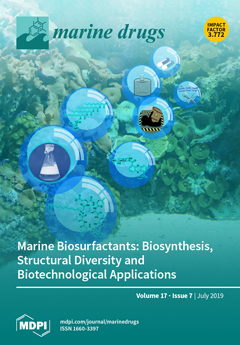
Cover Story: Biosurfactants represent a prominent example of valuable compounds that are synthesized by a multitude of microorganisms thriving in the oceans to allow an adaptation to the very specific environmental conditions. These compounds constitute amphiphilic secondary metabolites which exhibit surface-active properties and can be produced from renewable resources, making them useful for diverse applications. This review summarises the structural diversity of biosurfactants focusing on low molecular weight compounds produced by marine microorganisms. Additionally, biotechnological applications are described with special emphasis on bioremediation of oil-contaminated environments. Furthermore, novel exploitation strategies are suggested in an attempt to extend the portfolio of marine biosurfactants. View this paper.
  • Issues are regarded as officially published after their release is announced to the table of contents alert mailing list .
  • You may sign up for email alerts to receive table of contents of newly released issues.
  • PDF is the official format for papers published in both, html and pdf forms. To view the papers in pdf format, click on the "PDF Full-text" link, and use the free Adobe Reader to open them.

Articles (50)

  • Review
  • Open Access
78 Citations
11,290 Views
25 Pages

Quorum Sensing Inhibition by Marine Bacteria

  • Anabela Borges and
  • Manuel Simões

23 July 2019

Antibiotic resistance has been increasingly reported for a wide variety of bacteria of clinical significance. This widespread problem constitutes one of the greatest challenges of the twenty-first century. Faced with this issue, clinicians and resear...

  • Feature Paper
  • Review
  • Open Access
73 Citations
12,332 Views
23 Pages

Prostaglandins in Marine Organisms: A Review

  • Federica Di Costanzo,
  • Valeria Di Dato,
  • Adrianna Ianora and
  • Giovanna Romano

23 July 2019

Prostaglandins (PGs) are lipid mediators belonging to the eicosanoid family. PGs were first discovered in mammals where they are key players in a great variety of physiological and pathological processes, for instance muscle and blood vessel tone reg...

  • Article
  • Open Access
18 Citations
4,531 Views
10 Pages

23 July 2019

Thirty-four new benzo[d]thiazol derivatives 2a–2i, 3a–3r, and 4a–4g were synthesized and investigated for their potential antidepressant and anticonvulsant effects. In a forced swimming test, 2c and 2d showed the highest antidepress...

  • Article
  • Open Access
13 Citations
4,971 Views
24 Pages

23 July 2019

In vitro and in vivo studies have shown that phycotoxins can impact intestinal epithelial cells and can cross the intestinal barrier to some extent. Therefore, phycotoxins can reach cells underlying the epithelium, such as enteric glial cells (EGCs),...

  • Article
  • Open Access
23 Citations
5,784 Views
16 Pages

23 July 2019

Angiotensin II (Ang II) is closely involved in endothelial injury during the development of hypertension. In this study, the protective effects of the tilapia by-product oligopeptide Leu-Ser-Gly-Tyr-Gly-Pro (LSGYGP) on oxidative stress and endothelia...

  • Review
  • Open Access
15 Citations
4,998 Views
13 Pages

Pinnatoxins’ Deleterious Effects on Cholinergic Networks: From Experimental Models to Human Health

  • Nicolas Delcourt,
  • Emmeline Lagrange,
  • Eric Abadie,
  • Valérie Fessard,
  • Jean-Marc Frémy,
  • Jean-Paul Vernoux,
  • Marie-Bénédicte Peyrat,
  • Thomas Maignien,
  • Nathalie Arnich and
  • Jordi Molgó
  • + 1 author

20 July 2019

Pinnatoxins (PnTXs) are emerging neurotoxins that were discovered about 30 years ago. They are solely produced by the marine dinoflagellate Vulcanodinium rugosum, and may be transferred into the food chain, as they have been found in various marine i...

  • Article
  • Open Access
12 Citations
15,590 Views
17 Pages

Genome Sequencing of the Japanese Eel (Anguilla japonica) for Comparative Genomic Studies on tbx4 and a tbx4 Gene Cluster in Teleost Fishes

  • Weiwei Chen,
  • Chao Bian,
  • Xinxin You,
  • Jia Li,
  • Lizhen Ye,
  • Zhengyong Wen,
  • Yunyun Lv,
  • Xinhui Zhang,
  • Junmin Xu and
  • Shaosen Yang
  • + 3 authors

20 July 2019

Limbs originated from paired fish fins are an important innovation in Gnathostomata. Many studies have focused on limb development-related genes, of which the T-box transcription factor 4 gene (tbx4) has been considered as one of the most essential f...

  • Article
  • Open Access
7 Citations
6,010 Views
12 Pages

Abalone Collagen Extracts Potentiate Stem Cell Properties of Human Epidermal Keratinocytes

  • Sajee Thaweekitphathanaphakdee,
  • Pithi Chanvorachote,
  • Sagaw Prateepchinda,
  • Mattaka Khongkow and
  • Apirada Sucontphunt

20 July 2019

Stem cell activities in human tissues are critical for tissue integrity and function. Maintaining keratinocyte stem cells (KSCs) stemness helps sustain healthy skin by supporting keratinocyte renewal, involving the formation of epidermal barriers. In...

  • Article
  • Open Access
9 Citations
4,590 Views
11 Pages

Costatone C—A New Halogenated Monoterpene from the New Zealand Red Alga Plocamium angustum

  • Joe Bracegirdle,
  • Zaineb Sohail,
  • Michael J. Fairhurst,
  • Monica L. Gerth,
  • Giuseppe C. Zuccarello,
  • Muhammad Ali Hashmi and
  • Robert A. Keyzers

19 July 2019

Red algae of the genus Plocamium have been a rich source of halogenated monoterpenes. Herein, a new cyclic monoterpene, costatone C (7), was isolated from the extract of P. angustum collected in New Zealand, along with the previously reported (1E,5Z)...

  • Feature Paper
  • Article
  • Open Access
21 Citations
7,011 Views
24 Pages

19 July 2019

Zostera marina (eelgrass) is a marine foundation species with key ecological roles in coastal habitats. Its bacterial microbiota has been well studied, but very little is known about its mycobiome. In this study, we have isolated and identified 13 fu...

of 5

Get Alerted

Add your email address to receive forthcoming issues of this journal.

XFacebookLinkedIn
Mar. Drugs - ISSN 1660-3397