You are currently viewing a new version of our website. To view the old version click .

Current Issues in Molecular Biology, Volume 46, Issue 1

January 2024 - 61 articles

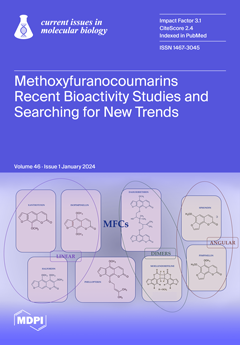
Cover Story: Methoxyfuranocoumarins (MFCs), biologically active plant molecules, have been recently investigated for enzyme inhibitory activity; α-glucosidase, tyrosinase, and cholinesterases, pro-apoptotic potential, antioxidant, anticonvulsant, antidepressant, and antiadipogenic, neuroprotective, anti-amyloid-β, and anti-inflammatory effects (via SIRT 1 expression), as well as activity against hepatitis B virus. Agonistic effects on bitter taste receptors (TAS2R), 3D cell cultures and the zebrafish model, and MFCs as therapeutic adjuvants are promising future research methods. This review highlights the key biological activities of MFCs and promising trends for their further studies. The mechanisms of action of MFCs, which are related to the constantly discovered therapeutic potential of MFCs, are provided. View this paper
  • Issues are regarded as officially published after their release is announced to the table of contents alert mailing list .
  • You may sign up for email alerts to receive table of contents of newly released issues.
  • PDF is the official format for papers published in both, html and pdf forms. To view the papers in pdf format, click on the "PDF Full-text" link, and use the free Adobe Reader to open them.

Articles (61)

  • Review
  • Open Access
12 Citations
5,515 Views
17 Pages

Ghrelin in Focus: Dissecting Its Critical Roles in Gastrointestinal Pathologies and Therapies

  • Wei Wu,
  • Lei Zhu,
  • Zhimin Dou,
  • Qiliang Hou,
  • Sen Wang,
  • Ziqian Yuan and
  • Bin Li

This review elucidates the critical role of ghrelin, a peptide hormone mainly synthesized in the stomach in various gastrointestinal (GI) diseases. Ghrelin participates in diverse biological functions ranging from appetite regulation to impacting aut...

  • Article
  • Open Access
1 Citations
3,078 Views
14 Pages

Genetic Predisposition for White Matter Hyperintensities and Risk of Mild Cognitive Impairment and Alzheimer’s Disease: Results from the HELIAD Study

  • Stefanos N. Sampatakakis,
  • Niki Mourtzi,
  • Sokratis Charisis,
  • Eirini Mamalaki,
  • Eva Ntanasi,
  • Alexandros Hatzimanolis,
  • Alfredo Ramirez,
  • Jean-Charles Lambert,
  • Mary Yannakoulia and
  • Mary H. Kosmidis
  • + 4 authors

The present study investigated the association of genetic predisposition for white matter hyperintensities (WMHs) with incident amnestic mild cognitive impairment (aMCI) or Alzheimer’s disease (AD), as well as whether such an association was in...

  • Article
  • Open Access
6 Citations
2,405 Views
11 Pages

Evaluation of the Reparative Effect of Sinomenine in an Acetaminophen-Induced Liver Injury Model

  • Ahmet Kayalı,
  • Ejder Saylav Bora,
  • Hüseyin Acar and
  • Oytun Erbaş

Due to its rising global prevalence, liver failure treatments are urgently needed. Sinomenine (SIN), an alkaloid from sinomenium acutum, is being studied for its liver-repair properties due to Acetaminophen (APAP) overdose. SIN’s effect on APAP...

  • Article
  • Open Access
2 Citations
2,327 Views
14 Pages

In Vitro Anti-Inflammatory Study of Limonoids Isolated from Chisocheton Plants

  • Erina Hilmayanti,
  • Xuhao Huang,
  • Supriatno Salam,
  • Nurlelasari,
  • Unang Supratman,
  • Kazuya Kabayama and
  • Koichi Fukase

Chisocheton plants from the family Meliaceae have traditionally been used to treat several diseases; however, scientific evidence is limited. The most abundant chemical constituents of this plant are the limonoids, which are known for their various b...

  • Review
  • Open Access
6 Citations
15,471 Views
13 Pages

Coffee and Microbiota: A Narrative Review

  • Federico Rosa,
  • Benedetta Marigliano,
  • Sergio Mannucci,
  • Marcello Candelli,
  • Gabriele Savioli,
  • Giuseppe Merra,
  • Maurizio Gabrielli,
  • Antonio Gasbarrini,
  • Francesco Franceschi and
  • Andrea Piccioni

Coffee is one of the most widely consumed beverages in the world, which has important repercussions on the health of the individual, mainly because of certain compounds it contains. Coffee consumption exerts significant influences on the entire body,...

  • Article
  • Open Access
6 Citations
3,247 Views
12 Pages

Anti-Neuroinflammatory Effects of Arecae pericarpium on LPS-Stimulated BV2 Cells

  • Hyeon-gyu Cho,
  • Dong-Uk Kim,
  • Jin-Young Oh,
  • Sung-Joo Park,
  • Bitna Kweon and
  • Gi-Sang Bae

Arecae pericarpium (AP), the fruit peel of the betel palm, is a traditional Oriental herbal medicine. AP is used to treat various diseases and conditions, such as ascites, edema, and urinary retention, in traditional Korean medicine. Recent studies h...

  • Review
  • Open Access
16 Citations
4,993 Views
28 Pages

Plant secondary metabolites, including furanocoumarins, have attracted attention for decades as active molecules with therapeutic potential, especially those occurring in a limited number of species as evolutionarily specific and chemotaxonomically i...

  • Article
  • Open Access
3 Citations
2,414 Views
14 Pages

Inflammation and Starvation Affect Housekeeping Gene Stability in Adipose Mesenchymal Stromal Cells

  • Enrico Ragni,
  • Simona Piccolo,
  • Michela Taiana,
  • Caterina Visconte,
  • Giulio Grieco and
  • Laura de Girolamo

Due to the scientific success of in vitro and in vivo model studies, the interest in using mesenchymal stromal cells (MSCs) for the treatment of orthopaedic conditions is growing. In the context of osteoarthritis (OA), MSCs, and, in particular, those...

  • Review
  • Open Access
6 Citations
2,204 Views
21 Pages

Epoxyalcohol Synthase Branch of Lipoxygenase Cascade

  • Yana Y. Toporkova,
  • Elena O. Smirnova and
  • Svetlana S. Gorina

Oxylipins are one of the most important classes of bioregulators, biosynthesized through the oxidative metabolism of unsaturated fatty acids in various aerobic organisms. Oxylipins are bioregulators that maintain homeostasis at the cellular and organ...

  • Article
  • Open Access
1,515 Views
13 Pages

The Role of Nicotinic Receptors on Ca2+ Signaling in Bovine Chromaffin Cells

  • Amparo Gil,
  • Virginia González-Vélez,
  • Luis Miguel Gutiérrez and
  • José Villanueva

Chromaffin cells have been used as a physiological model to understand neurosecretion in mammals for many years. Nicotinic receptors located in the cells’ membrane are stimulated by acetylcholine, and they participate in the exocytosis of chrom...

of 7

Get Alerted

Add your email address to receive forthcoming issues of this journal.

XFacebookLinkedIn
Curr. Issues Mol. Biol. - ISSN 1467-3045